Expectations Are Never What You Expect

Do you ever wonder what life expects out of you? Have you ever wondered if you’re on the right track, based on those expectations? Well, I have some illuminating news for you: life expects nothing. You’re not “expected” to be on any track. Your life depends on you.

For centuries, there have been expectations out of people through the natural course of their lives. In medieval times, a boy became a man and was expected to take a wife and raise a family. This could happen anytime after the age of 12. Can you imagine? People today would cringe at the very thought of allowing such a young child to marry.

Throughout Contemporary History, you were expected to serve a tour of duty in your country’s military, return home and marry, have kids and get a house and solid job. Not even a career, mind you. Simply a job that would bring in the income required to support your family. That’s all that mattered.

What do you think the expectations are now? There are certain things that people impose on themselves. There are several people who believe that they need to go to post-secondary studies, obtain a university degree, meet someone and get married prior to their 30’s and have children, secure a career and a stable home.

One good example is how most teenagers start meeting guidance counsellors at 16 to start deciding what career they want and what path they’ll choose in life. I don’t know about you, but I had a hard time deciding what I would be doing on any particular weekend; I certainly wasn’t ready to plan out my life at that point!

Things need to happen in their own time. There is no template to how life should be lived. It’s okay if you chose never to go to college or university. It’s okay if you don’t meet the love of your life until later in life. The choice to have children is also yours and can’t be dictated by others.

Pooja Rajkumar once said: “Everybody have their own pace in achieving things in life… just because it happens to others, doesn’t mean it should happen to you as well… You will have your time and when it is to happen it will, without you being worried about it… just have one thing in your mind to clear off the frustration, “all things happen for a reason” and you will be fine!!!”
Don’t be so hard on yourself. Even if things don’t go “according to plan”, it doesn’t mean you’re off track. Don’t push so hard. Don’t stress so much. The things that bring you happiness will always outweigh the things that bring you money. Or possessions. Or suit the expectations of society. Do what brings you peace. ☯

That Awkward Moment Your Internet Goes Down And You Don’t Know What To Do With Your Life…

So, yesterday’s blog post was pretty late… In fact, I got it published with only about an hour and a half to spare before the stroke of midnight. Here’s what happened:

I went to karate class, since it was Thursday night. Class went well, I got a solid workout in. I had started drafting yesterday’s blog post during the afternoon, but other obligations got in the way and I put it off until I got home from karate.

Since life rarely cares about our plans, I got a text message from my wife right at the end of class. Apparently, our internet was down. My wife had tried resetting our modem a number of times and there had apparently been no planned internet outages in our area.

You know that mild feeling of panic you get in your stomach when the elevator you expected to go up suddenly went down? I had a problem. I’ve consistently posted at least once a day for the past 93 days! If I didn’t manage to post to my blog prior to midnight, I would lose that streak.

I explained to my wife that I would grab my laptop and head to a location with free wifi to complete my post prior to midnight. I got home by 9 pm and this left me only three hours to shower, launder my karate gi (uniform), get to a location and review and publish my post.

By the time I had finished showering and got ready to leave the house, my wife had contacted our service provider and got the internet running again. Not only was I eternally grateful to my faithful partner for getting things up and running again, but we realized the source of the problem: my son!

Turns out that my loving progeny took it upon himself to explore our high-speed modem. When he accidentally unplugged one of the network cables, he plugged it back into the first port that fit. This obviously didn’t work out and resulted in our internet being down. An IT specialist was able to confirm this and guide us to hooking the cable in the proper port.

Once the smoke settled and I was able to sit in front of my keyboard and finish my post, it got me to thinking about how tethered we are to our technology. The sense of panic that set in when I found out I had no internet was borderline ridiculous!

Technology is wonderful. It’s brought us a long way from where we were. And the internet has revolutionized the modern life in many ways. We use the internet to shop, pay bills, make appointments and stay in contact with people across the world (exhibit A: this blog!)

But sometimes I think our dependence on technology has become too intense. There was a time, not so long ago, when I could have said “who cares” to hearing that the internet was down and read a book or took a walk instead.

Albert Einstein once said “It has become appallingly clear that our technology has surpassed our humanity. I hope that someday, our humanity might yet surpass our technology.”

Let’s make sure that while we enjoy the benefits that modern technology has provided that we don’t allow ourselves to become slaves to it, as well. ☯

Be Your Own Hero…

Things can get pretty rough sometimes. Life tends to throw a lot at you, and if you aren’t willing to push through and give yourself the effort you may not overcome it all. They say time heals all wounds, but the scars can sometimes be as bad as the wound itself.

How strong is your will? How much strength of will do you have? If push came to shove, and you or a loved one needed it, how far would you be willing to go in order to overcome the obstacle that you’re facing?

Everyone wants a hero; someone to come along and just fix things and make them all better. How often in your life can you look back and say that this has genuinely happened? I’m not saying it CAN’T happen… Some of us have been blessed to have influential people in our lives that have made a difference. But think back to those situations and take an objective look. Can you honestly say those problems were solved by those outside people? Or were you simply guided and encouraged by these people into accomplishing those goals on your own?

Humanity’s will to survive is amazing. Even when a person is in their last moments of life, the human body will have a number of systems in place biologically designed to try and keep that person alive for as long as naturally possible. YOU try and help yourself without even knowing it. That’s why it’s important to be your OWN hero.

In the late 1980’s, doctors told me I would die from insulin resistance and wouldn’t make my teens. I had to take it upon myself to work on my health and well being in order to restore myself and ensure my continued survival. I had the help of some very important people, but my will to survive is what got me there. I celebrated my fortieth birthday last September.

When I joined the martial arts, my doctors and my family told me that it wasn’t an appropriate “hobby” for someone with Type 1 Diabetes. I was told I would get hurt, my blood sugars would be adversely affected and that I would never make black belt. In March of 2002, I proved all those people wrong by achieving my 1st degree black belt in Okinawa karate.

When I set out to get the career of my dreams, they told me that their health policies at the time didn’t allow for type 1 Diabetics. Even when that policy got rescinded, the candidate application process that would usually take between 6 to 12 months took me 2 years! The increased battery of medical tests and examinations would have caused many to simply drop out of the process. But I stuck with it.

Due to a number of Diabetes-related health complications, it was believed I would never have children. That didn’t matter a great deal when I was younger, but it was life-altering when I became an adult. As many would agree, it can be the sort of thing that can define relationships and futures. But despite all that, my son Nathan will be five years old this year!

I guess my point behind all of this (besides making it look like I’m bragging) is that the strength of will to achieve your goals comes from within you. That isn’t always easy, but it’s what will ultimately get you to where you’re going. You’ll be surprised at what you can accomplish once you stand up and trust that you can do it. ☯

The Doctor Will See You Now… Or Later… Or After That…

In Canada, making a doctor’s appointment and having it be convenient is something of a challenge. Modern trends within medical offices have changed somewhat over the past twenty years, and not all of it has been in favour of the patient.

The days of seeing your family doctor on the day and time of your choosing are long dead, and an unknown receptionist at the end of a phone line will usually respond to your objections by saying “this is the only availability the doctor has at the moment.”

As a diabetic, I have often been faced with the dilemma of scheduling necessary appointments based on my availability. The safe bet is that I usually have to take a day off from work in order to accommodate and accept an appointment to see my doctor.

Once at the appointment, safe money says you won’t be getting beyond the reception desk at the time you were allotted. In fact, you’ll likely wait anywhere from forty to sixty minutes to get in to your “scheduled” appointment. And a common practice to medical offices these days is to restrict the patient to “one problem”. This means that you may have a few issues to bring up to your doctor, but in the interest of getting you in and out as fast as possible your doctor will likely require you to make a subsequent appointment for any added issues you wish to bring up.

Have you experienced this? Let’s say that you have a persistent cough, intestinal distress and your left knee is swollen and painful. Your doctor may only allow you to bring up one of those ailments for diagnosis and require you to return for the others.

Now, let’s be clear on something: doctors are overworked! Don’t believe me? Here’s the reality: In general, becoming a doctor in Canada takes approximately ten years. This includes obtaining an undergraduate’s degree, going to medical school and doing some form of residency. And that doesn’t include the additional time required for specialization.

Once all those steps have been achieved, doctors need to stay current on recent advancements and developments, study and familiarize themselves with all their patient files, write reports and referral letters as well as attend conferences, sit on various boards and committees and spend time in hospital. This is all AFTER spending full days within their medical practice, seeing the patients who complain that they had to wait the added thirty minutes.

Pretty brutal, right? Would you want to do that much work? The average resident works between 70 to 100 hours a week! And it doesn’t get much better once they complete their residency.

Most people see doctors and think “Oh, they make a wonderful salary. I’d love to make as much money as a doctor!” Although most doctors average a little more than $225,000 a year before taxes, the amount of debt and student loans amassed while getting to the finish line of their “MD” can easily match that, and it can take decades to pay back.

The face of medicine has certainly changed since I was a child. I remember walking into a doctor’s office and getting in within minutes of arriving. That still happens on occasion, but it’s become a rare occurrence. And there are good reasons for that. Most times, even while in clinic, doctors can get called away for emergent situations or to deal with an ongoing issue with one of their patients at their local hospital.

I guess my point is that patience is required when dealing with your medical practitioners. Although it would seem that you shouldn’t need to, it’s important to remember that your doctors are people too! And like everyone else, they’re fighting battles you know nothing about! ☯

If Stress Built Muscles, I’d be Mr. Universe…

I’ve written about stress before, but it remains a predominant aspect of daily life for most people. In general, one could easily write about stress indefinitely, given the number of effects it has on the human body and life.

Stress isn’t inherently bad! Although we tend to view it in a negative way, stress is simply your body’s way of dealing with changes within one’s environment. How we adjust to these changes is what defines the response.

Picture this scenario, if you will…

You arrive at the office at 8 am on a Monday morning. You’ve had a reasonably restful weekend and you walk up to your desk in a relaxed manner. Nothing bothers you, no one is disturbing you and although you have some tasks on your desk awaiting completion, you’re not particularly rushed. Then it happens: your supervisor walks in. Within minutes, your supervisor discusses these tasks with you, imposes timelines and completion dates, and advises you of the additional tasks that will be assigned to you once you complete the current ones…

Sound familiar? If we follow the definition of stress in the literal sense, the supervisor is a the change in the environment that requires you to adjust and adapt, creating stress. But what would have happened if you’d been left to your own devices? I’m not trying to call anyone lazy, but one needs to admit that a person’s productivity tends to increase significantly when stressors are introduced.

When produced in small doses, stress can help you cope with daily life, meet goals and achieve deadlines. Believe it or not, if not for stress you likely wouldn’t be here. Since stress is part of your body’s early-warning system, it can often help produce the “fight or flight” reaction required for proper survival. This is something that, from an evolutionary standpoint, is pretty interesting.

But before I start going off on a tangent, let’s refocus on the stress aspect. Some studies have shown that small amounts of stress in the proper environments can actually help boost your immune system and help your body’s defences against infections and the like.

From a Diabetes standpoint, I can safely say that stress plays a major role in the proper control of one’s blood glucose levels. Since every person is different, the after effect will also differ. Stress tends to make my blood sugar spike; for someone else, it may drop.

I’m making a pretty good case in support of stress, but it can obviously be detrimental as well. Sustained stress over long periods of time can lead to many health complications, such as high blood pressure, anxiety and mental health issues.

There are certain signs that will allow you to recognize if your particular level of stress is too much for you. If you can’t seem to sleep properly, if your appetite, mood or weight begins to fluctuate and your immune system seems pooched to the point where you catch every little bug that floats by, it may be time to address the issue.

The mood aspect will have several different colourful sides as well. If you start being angry or irritated (more so than usual) in such a way that interferes with your daily life, there may be a problem.

Although stress is a part of life and there is no eliminating it, it’s important to recognize your limits and deal with stress in a healthy manner. Here’s where I get to suggest my usual dose of exercise, sleep and meditation. Those are a big help, but don’t be afraid to speak to a medical practitioner if you suddenly feel as though it may be getting out of your control. ☯

The ‘Ol Peek and Poke…

I have frequently had people ask me how often I test my blood sugar levels in the course of a day. Truthfully, I’ve gotten this question from a number of Diabetics as well. Blood glucose testing is an important part of managing Diabetes, and requires some attention to detail.

According to an article published by The Mayo Clinic, Type 1 Diabetics should be testing their blood glucose levels somewhere between 4 to 10 times a day. This is conditional on recommendations from their health practitioner, as well.

Personally, I used to test over 12 times a day. At almost four decades of dealing with Type 1, I consider it a matter of import to test this often. Most Diabetics need to test their blood glucose at these moments: before meals, before rigorous exercise, when waking in the morning and before bed. This is hardly an exhaustive list. And you may need to test more frequently if you fall ill, start new medications or have some radical change in your daily routine.

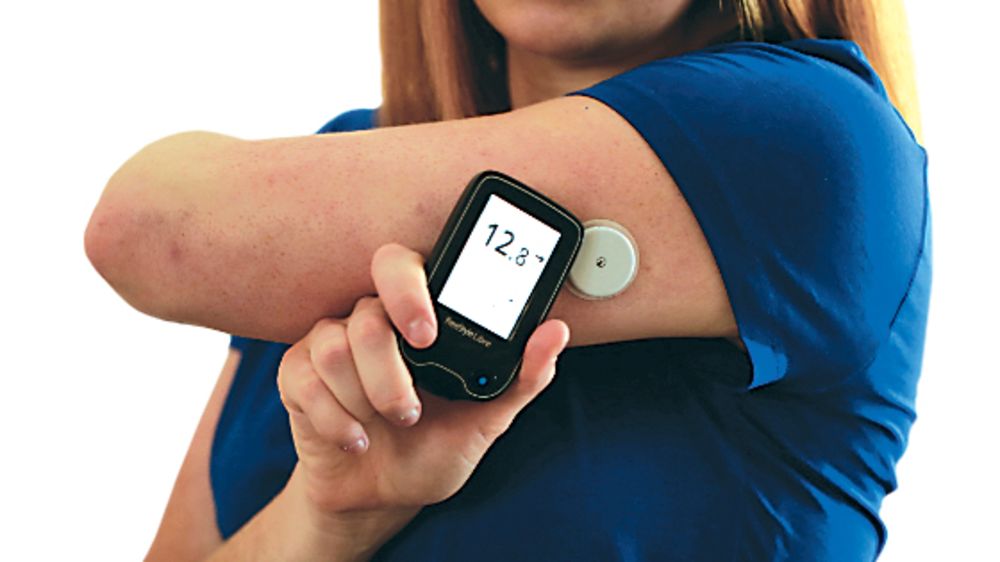
The Abbott FreeStyle Libre is the testing sensor I currently use

You’ll notice I wrote that I “used” to test over 12 times a day… One can only poke one’s finger so often in the course of 24 hours! Last February, my endocrinologist prescribed the Freestyle Libre as a means to trying out continuous glucose monitoring in a simpler way. I now test well over two dozens times within the waking day. This allows me a better control of my blood glucose levels and provides the ability to spend more time “in range” (between 4.0 to 7.0 mmol/L).

For those who don’t know, continuous glucose monitoring (CGM) is a device used in conjunction with an insulin pump. It involves placing a small sensor into the interstitial tissue, which monitors and relays latent blood glucose readings to the insulin pump on a continuous basis. Hence, then name. It’s a handy device to help Diabetics keep their blood sugar levels in range.

A depiction of CGM on the left side with the pump’s infusion set on the right

Despite the use of CGM, it’s still important to test via fingertip blood when first waking up, or anytime your sensor may be in question or need calibration. For example, I recently scanned my sensor and got a reading of 3.5 mmol/L. This would normally require treating with some fast-acting glucose. I decided to err on the side of caution and tested with my glucometer. The result was that I was actually sitting at 4.2 mmol/L. Quite a difference and plays an important role in how I would treat.

The method of testing and its frequency will ultimately be something for discussion between you and your medical practitioner. After all, every case is different, and one’s testing needs differ from person to person. Your doctor may occasionally require you to wake and test during the middle of night, as well. This is so that proper balance throughout the entire day can be achieved.

I often have non-Diabetics comment that they don’t know how I deal with all the testing and the poking I do. Up until about six years ago, I took approximately 4 to 6 insulin injections a day (depending on how much I ate) and poke a finger over 12 times a day. Now, with the advent of these devices, I inject a needle once every three days to load the insulin pump, and poke a finger once or twice a day at most. It’s certainly a welcome change. ☯

Expect The Unexpected

Based on artifacts found around China and India, the earliest evidence of something that could be considered a “martial art” is about 5,000 years ago. That’s a heck of a long time for something to exist. Inevitably, something that old will go through quite a fair number of changes throughout that length of time.

Martial arts was originally not only developed as a means of combat. It was also developed as a means of keeping fit and increasing one’s physical fitness. Over time, it propagated and there are styles of martial arts all over the world.

Through the decades, there has been a bit of an up and down in regards to how martial arts training has been approached. Although some styles used to focus on the freedom of movement and fluidity, a movement began at some point where instructors started teaching a “if they do this, you do that” philosophy. It became more reactive as opposed to proactive.

Here’s the reality: in a real fight, whether on the street or in defence of your own life, you can’t expect what your opponent will do. That being said, you also can’t focus on any one technique that you may do in response to any one attack. It becomes important to expect the unexpected!

When training, it’s important to practice a free-flowing way of fighting in order to allow yourself the flexibility to respond to any attack. This is why routine and constant drills, as well as free sparring is necessary in genuine martial arts. This allows you to groom yourself to the point where you will respond on reflex as opposed to thinking “Okay, here comes a front kick, I need to block THIS way…”

This is the difference between theory and practical application. Theory is extremely important; it’s how we learn the material required to progress. But the practical application is what’s required for survival. It’s what could potentially save your life, should you ever need to use the training you’ve undertaken.

I’m a firm advocate that you should never need to fight. But should someone back you in a corner and your life or the life of your family or loved ones ever be in jeopardy, it would be a good thing to be able to step up and do what’s necessary. Training for the unexpected will bring you closer to that goal. ☯

Mistakes Are Proof That You Are Trying

“The good deeds a man has done before defend him…”

Recognize that quote? It was spoken by J. Robert Oppenheimer, although he took it from the Bhagavad Gita. You may remember Oppenheimer; he was the theoretical physicists nicknamed the “father of the atomic bomb” and is credited with helping to create the atom bombs that were dropped on Hiroshima and Nagasaki.

How well do you think Dr. Oppenheimer sleeps? I guess I should clarify; Dr. Oppenheimer passed away in 1962, but I can’t help but imagine he had a number of sleepless nights.

We all make mistakes. That’s a big part of what makes us human. Is there anything in your life that you can look back upon and wonder if you would have done it differently? You probably shouldn’t.

Life is a vast mosaic of experiences and decisions. No matter what the choice, good or bad, it has become a penultimate part of what has made you who you are. This is second only to your current, conscious choices.

Sometimes outside forces and influences will create a situation in which we question the choices we’ve made. It’s natural and normal to question the decisions we’ve made, as long as it doesn’t make us falter in our confidence.

I’ve written before about how every consequences is based on three sources: your involvement, an outside influence and elements beyond your control. When you come to terms with that, you can start to own your involvement, and work towards dealing with the rest.

We’ve certainly all made our share of mistakes. Humanity wouldn’t be able to grow and progress otherwise. The important part is in knowing that it’ll all be alright. Don’t be so hard on yourself. Don’t struggle so much. Life shouldn’t be a constant butting of heads. And don’t forget that you can never take it more than one day at a time. ☯

Did That Hurt? Well, It Was Supposed To…

I normally try and keep my inner zen and impart information objectively. My goal is generally to impart some wisdom through my stories and experiences, and perhaps teach a little something in the process.

But today, I’m going to hop up on my soap box for a little while and discuss an issue that weighs heavily on my soul. It began in the same way as it often does…

I walk into the dojo. The floor is cold and the hall is empty. The head instructor is setting up the required items for the evening’s class, and I stretch experimentally. I begin slowly; throwing a straight punch at a heavy bag. Then another, and another… Within moments, I start punching faster than I can keep track and am acting upon 30 years of instinct and training. I throw in the occasional kick for good measure, even though I’ve never been a fan of allowing my feet to leave the ground. I step away from the punching bag, allowing my breathing to steady. I fall into several forms followed by a number of knuckle push-ups. I stop and catch my breath, aware that several of the arriving students are watching me. I’m sweating profusely and have already done more on my own in the 15 minutes prior to the start of class than the entire student body…

It’s a sad story. One that has become more prominent in recent years. A lot of fitness and martial arts clubs have become a primarily social gathering, as opposed to a forum for proper training and development.

30 years ago when I started the martial arts, class started promptly at 6 pm and ended only at 8 pm. There were no washroom breaks, no water permitted within the dojo and the energy in the room was electric. Once you were inside, you weren’t permitted to leave the dojo until Sensei dismissed you, barring a medical emergency. Every student present knew their position. Everyone bowed; everyone kept going until the end. No one gave up. No one took it easy.

I feel that some of the genuine strength of the martial arts has become watered down. Let’s be realistic: all those awesome martial arts movies and kung fu flicks you likely watched as a kid (and perhaps still do) are based on real life martial artist who have spent their entire lives training and developing themselves. If not for the hard work of others, those awesome movies wouldn’t exist.

One good example is Bruce Lee. Even though he was an action movie star, he was also a traditional artist artist. Having trained from a young age, he developed himself and built himself to the point where he was able to surpass his teachings and even develop his own martial arts perspective in Jeet Kune Do. He was so skilled that the camera often had to be slowed in order be able to see the actual strike on film…

I use Bruce Lee as an example because he is well known inside and outside of martial arts circles. The likes of him hasn’t been seen since. But his example, as well as some others, set a precedence that effectively set the tone for my martial arts training from a young age well into my current state of being.

I’m a 40-year old man. By no means am I “old”, but I’m certainly not the spry, 21-year old green belt I was in 1999. But yet, I manage to work up more of sweat and burn more calories in 15 minutes than most of the teenage students in my current school will burn throughout the entire class. It may sound like a bit of a conceit, but it’s accurate. The change in the tide almost makes me feel as though traditional martial arts may disappear within the next generation.

It’s important to put in a maximum effort in any training you perform. It will sometimes be painful and it will be exhausting. But this is how you grow and progress. If you give it a minimum effort and basically “half ass” your workout, you may as well stay home. This applies to anything, whether you are training in the martial arts, learning a new sport of learning a new skill such as an instrument.

They say that showing up is the first step. I’ve heard this on occasion. And although I can agree that showing up is the first step, it is also the easiest. The next step becomes more difficult, as it requires the learner to put in a comparable effort for the skill they wish to learn.

So push yourself, damn it! If you don’t sweat, if you don’t feel aches and pains, if you don’t wake up the next morning barely able to walk, you’re not giving yourself the effort. And trust me, you are well worth the effort! ☯

If You “Whey” Out The Options…

Listen, I’m all for a bit of an advantage when trying to get in shape. There are all sorts of supplements and additives that athletes take that give them an “edge”. But how many of them are genuinely effective?

One of the most prominent and important supplements is whey protein. As a matter of import, protein is necessary for the building of muscle tissue, cartilage, bones and skin. It helps to build and support all these things, and also helps to increase strength and mass. Needless to say, most adults require a reasonable amount of protein in their diet.

According to WebMD, most adults get enough protein throughout the day. For a health adult, that means anywhere between 46 to 56 grams of protein, every day. But the question becomes whether or not they are getting the right type of protein.

Besides fibre, most natural sources of protein will help you to feel full for longer and can aid in weight loss. Decent sources of protein, such as fish, chicken and eggs are ideal. Depending on who you speak to, red meat shouldn’t be a constant indulgence, but lean cuts of meat can be a good source of protein.

Although the jury is still out, whey protein will apparently help will developing strength and increasing your athletic performance. Believe it or not, some studies have also shown that whey protein in the correct amount can help in lowering blood sugar levels, although I can’t attest to having experienced that myself.

There are tons of different brands of whey protein on the market, and they can be even be found at most chain retail locations. As always, you should consult your medical practitioner before starting any supplement, and they can recommend a brand and type that best fits what your nutritional and fitness needs may be.

It’s often said that we get enough protein with a healthy food-based diet. And if you eat three well-rounded meals during the course of your day, this may be the case. But for folks trying to build muscle mass or add a bit of an edge to your daily routine, whey protein may be the route for you. ☯