Keeping Your Cool…

Every once in a while, I find something funny or interesting online when I’m researching other posts. I like to throw these up in a post when I find them so that others can enjoy them and get a chuckle out of it. Plus it allows me to provide a short post where I don’t go on for several thousand words. Of course, despite saying I’m trying to keep it short, here I am jabbering on…

Although I get a kick out of this, it also serves to provide an important lesson. It’s important to keep your cool in daily life. After all, things would get pretty bad if one lost their proverbial shit for every little thing. But by the same token, everyone needs to cut loose and find an outlet every now and again. Fresh air, exercise and rigorous fitness routines can help to provide an outlet so that you don’t cause a shit storm of your own. ☯

The New Way Of The World…

I had to go downtown and stand in line last Wednesday for something work-related that I needed. Due to social distancing requirements and the location’s own internal policies for dealing with the public, a facemask was obviously required and I was asked to wait outside the building until one of the people seeking the same service as I was, exited the building. Luckily, I was the first one at the door but I had no idea how many people may have been inside or how long it would take them to come out.

I had dressed reasonably well, wearing a cotton shirt covered by a thick, cotton hooded sweatshirt. Although I won’t be a little whiner and complain that I was freezing to death, I’ll admit that it was only 7 degrees outside with cold winds. This made the wait all the more painful. People accumulated in line behind me, and the general public’s penchant for complaining shone through like a bright beacon in the storm. People were arguing and complaining to the two poor security guards who were monitoring the building’s entrance. One lady, who was there for the same purpose as I was, had brought someone else with her and got visibly angry when she was informed that she wouldn’t be allowed to bring her friend inside with her. They had arrived together in a cab. She was pissed.

Apparently, not everyone took the same precaution as I did by checking the location’s website in order to confirm their requirements prior to coming down. But as the weeks go by, I’m noticing this kind of trend more and more, with people fast becoming frustrated with the restrictive requirements brought on by COVID-19 and the limits imposed by businesses and government locations. The wearing of masks, limits on the number of people within buildings and the need to socially distance is starting to grate on everyone’s patience as the world waits on baited breath for everything to go back to “normal.”

Here’s the problem: This IS the new normal. Leading experts, as well as health authorities and the World Health Organization all agree; there will be a resurgence of COVID-19 in the near future, and likely with a vengeance. I could try and cite some sources, but there’s enough out there that a quick Google search will show you what I’m talking about. At the time of writing this post, the Government of Canada’s website reports an estimated 158,758 active cases of COVID-19, with Ontario and Quebec carrying the brunt of that number (Canada.ca). If you click the provided link, I’m sure that number will have changed, likely increased.

One of the bigger problems is the fact that there seems to be a growing number of the population who simply don’t take the pandemic seriously. I’ve seen this first-hand and even have members of my family who think this is the case. Just a few weeks ago, I saw someone standing by Wascana Lake, here in Regina, holding a sign that stated that Corona Virus was a lie told by the government. Right. Because there isn’t enough on the government’s plate without creating a pandemic that’s currently damaging our Nation’s economy.

But plenty of people are ignoring the easy, common sense precautions that have been put into place. Things like social distancing, wearing a face mask when out in public, and avoiding outings unless for work or mandatory requirements like groceries or medical appointments. A good portion of the population seems to have gone back to the “old” normal, including having large gatherings and carrying on as though there ISN’T a pandemic happening. Idiots.

If there’s one thing history has taught us, it’s that viruses can evolve. We’re not done with COVID-19 and if people continue to ignore the easy steps, the results that follow will be much, MUCH worse. So, why take chances? Wash your hands frequently (which you should have been doing all along, anyway), before and after any outings. use hand sanitizer and wear a face mask. Stay socially distanced and don’t wander needlessly for anything you don’t absolutely need. That seems like a pretty reasonable way to avoid a serious respiratory virus that could kill you. ☯

International Coffee Day ☕️

Okay, this is one of those “silly” holidays that hold no real history or bearing and that most wonder if they should actually be “celebrated.” But I enjoy including some of these from time to time, especially when they relate to something near and dear to me. And I love coffee. It’s no secret that I’m a big fan of caffeine, and since coffee is consumed pretty much everywhere in the world in some form or another, I though I would throw a few facts out for International Coffee Day

The first thing would be the development of this holiday. The International Coffee Organization in Milan came up with this little gem back in 2014. Depending on your source, the holiday is celebrated either on October 1st or September 29th. According to a Wikipedia post, International Coffee Day is celebrated on different dates ranging from early January to early October, depending on what country you hail from. I’ll stick to Canada’s September 29th.

I couldn’t find exactly how one “celebrates,” other than to consume and enjoy a nice, hot cup of coffee. And most people do this on a daily basis, anyway. But now is as good a time as any to remind you of some of the potential health benefits of coffee, so long as with all things, you consume in moderation. Avoiding the fact that many experts believe we’ll run out of coffee beans by 2080 due to climate change, let’s examine my top five benefits of coffee:

  1. Coffee will make you less tired: This one should be pretty obvious, but I always like to start WITH the obvious one. Caffeine is a stimulant, and once it hits your blood stream and reaches your brain, it can help wash away fatigue;
  2. It’s good for you: As long as you don’t douse your coffee with a bunch of sugar and loads of creamer, black coffee has zero calories, zero carbohydrates and contains a batch of B-vitamins as well as Potassium;
  3. Coffee makes us happier: This is another d-uh moment. If you’re a coffee drinker, there’s a noticeable “pick-me-up” effect, due in part to caffeine’s stimulant effect but also because we enjoy the coffee. Any good part of your day is a good part of your day, and will make you happier;
  4. It can help stem Type-2 Diabetes: Despite having Diabetes myself, albeit Type-1, I’m a touch skeptical on this one. But there are a batch of studies that have apparently shown that coffee drinkers have a reduced risk of Type-2 Diabetes;
  5. Coffee is high in antioxidants: Next to the occasional glass of red wine, coffee contains a huge amount of antioxidants and can help clean you out from the bad stuff.

Healthline.com has a fantastic article entitled 13 Health benefits of Coffee, Based on Science, which outlines not only the five I mentioned above but eight more benefits as well. And I mentioned moderation earlier because as with all things in life, moderation is key. Overconsumption of caffeinated beverages can pretty much worsen or CAUSE the opposite of all the benefits I have listed above.

I also forgot to mention my favourite benefit of black coffee: the enjoyment. If you had told me I’d love coffee this much, twenty years ago, I’d have called you crazy. But with all the different blends, types and flavours, there’s a lot to be experienced and enjoyed simply from that small cup of steaming liquid you start your day with. So, hopefully you did. After all, it’s International Coffee Day! ☯

It’s Okay To Skip A Step…

I hate cardio. This probably comes as a surprise, coming from someone who believes that if you aren’t dripping in sweat when you’re done, it wasn’t a workout. And the truth of it is, I do enjoy cycling. But that’s mostly because it allows me to get outside, reconnect with nature (to a degree) and keeps the cardio aspect buried in the background. The best of both worlds. But to say that I’m heading out for a run or doing cardio for the sake of doing cardio would be a stretch.

Cardiovascular endurance training is important for one’s health. According to an article posted by the Mayo Clinic, cardio exercises help to strengthen your heart and muscles, burn calories, help control your appetite, increases sleep, promotes joint movement and helps to manage Diabetes. Cardio can be a long-term or long-distance thing, like long-distance cycling or swimming 30 laps in a pool, or something incorporated into a weight or resistance workout, such as jumping rope.

Jumping rope is an easy, convenient way of including some light cardio into your workout routine. I’ve kept a jump rope in my gym bag for the past ten years, and I make use of it whenever I get the chance. Jumping rope can burn a wicked amount of calories; several hundred calories in a 15-minute period, in fact. It can help improve overall balance and coordination, not to mention that the heart benefits are the same as with traditional cardio. And although it can be taxing on the knees and leg joints, doing it properly is considered a lower-impact than something like running.

I like to incorporate it by using it with circuit or interval training with karate techniques. For example, I’ll do a minute of front kicks, followed by a minute of high-speed jump rope. Then a minute of the next kick and a minute of high-speed jump rope. So on and so forth. Sometimes I’ll simply use it as a warm-up or a cool down. A good quality jump rope is portable, convenient and low-cost. You can stuff it into any gym back or backpack and all you need is about a 25-foot square of space.

As much as I dislike cardio, it is a necessary aspect to proper health and fitness. And there’s no denying that it also helps with the blood sugar control and sleep quality required for someone with Type-1 Diabetes. If the last time you used a jump rope was during a spirited game of double dutch during your school years, you’ll want to start slow and ensure you do it on a stable surface. Avoid grass or carpet as it can snag the rope or catch against your footwear. ☯

Clothes Don’t Make The Karateka

I’m wearing a worn, black pair of gi pants and a Star Wars t-shirt. Far from formal dojo apparel. The sweat has rendered the grey t-shirt black and droplets coming off my forehead splash on the unfinished concrete floor. I just finished a set of shadow boxing and I’ve been using an 8-pound sledgehammer as a workout implement for the past fifteen minutes as my son watches in fascination from the corner. My muscles and joints are all screaming for me to stop, and my knuckles are throbbing from the use of my newly-installed makiwara post outside, but I’m only half way through my workout as the next hour will bring a minimum of three of each of my katas…

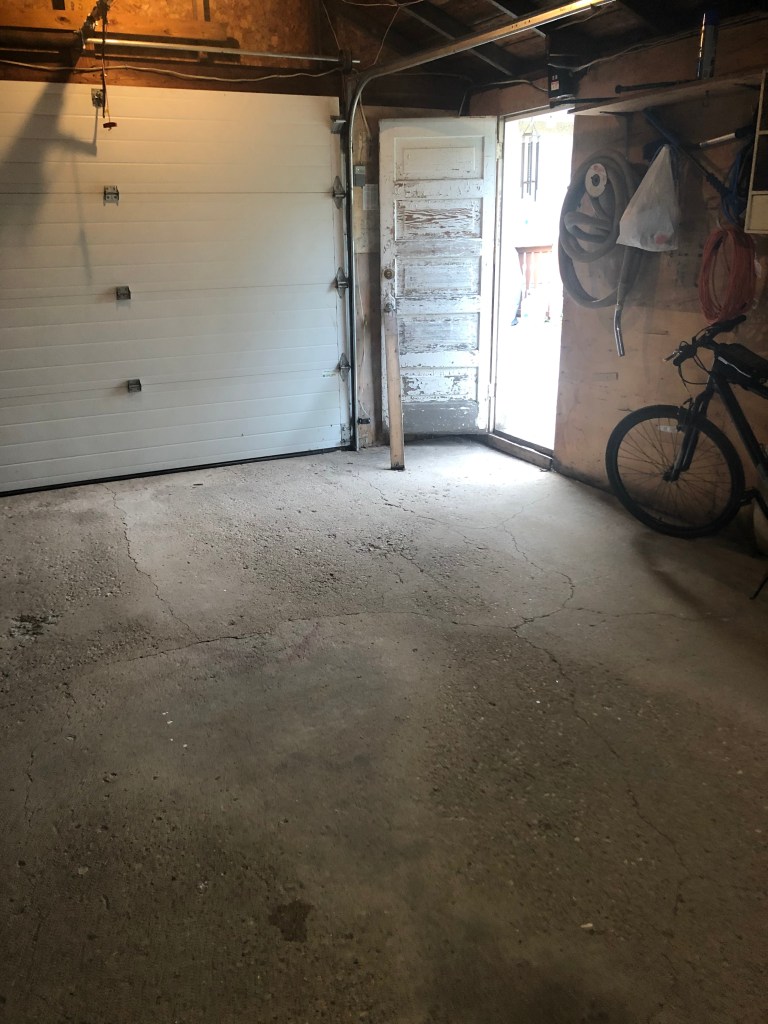
Clean, emptied out garage makes for a decent training area

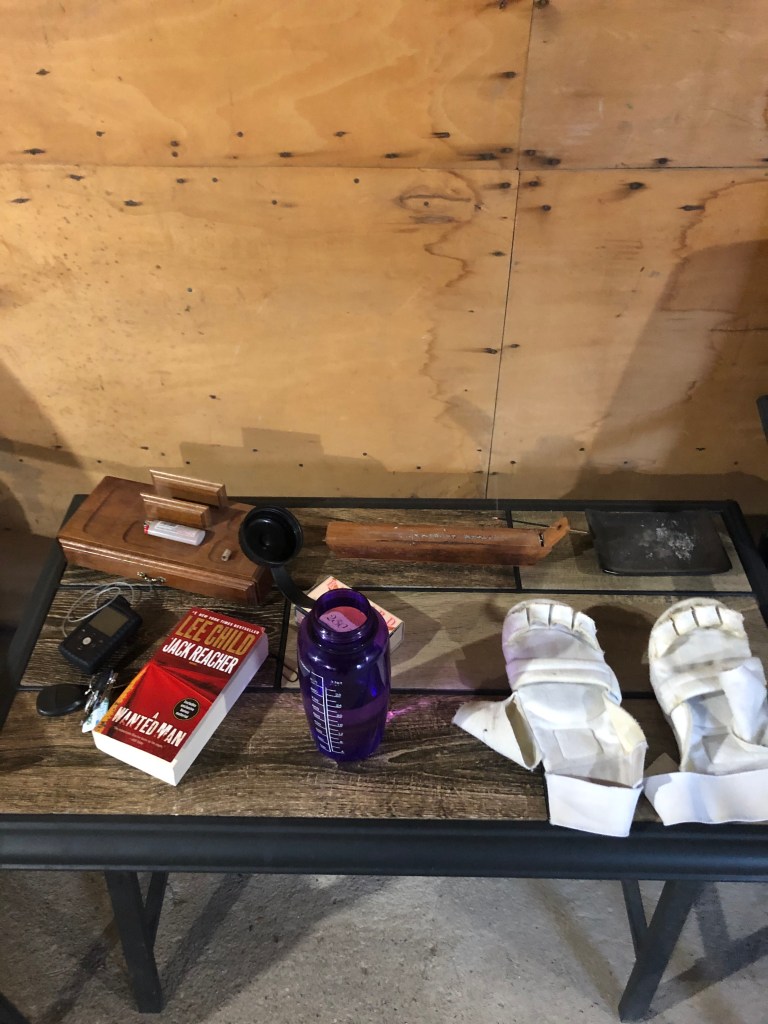
For the past couple of weeks, I’ve been using my garage as a makeshift dojo. The floor is bare, unfinished concrete and is pock-marked everywhere that something heavy or frequent traffic has damaged it. I fastened a padded punching square to the south wall and have a jumprope, an 8-pound sledgehammer and a small table to hold my water, phone and small training implements as may be required for any given session. I have a small incense burner to provide an ambiance to the environment, but with little to no ventilation inside the garage short of opening the large overhead door, I keep incense burning at a minimum.

When people hear about the martial arts, they have some pretty stereotypical images of a dojo in their heads. For the most part, people imagine a polished, hardwood floor, tatami mats in the corner, punching bags and kanji banners across every wall. Or at least, over whatever walls don’t contain photographs of the style’s masters or some the weaponry associated with the style. It’s clean and pretty and usually oozes a “karate movie” feel. But in fact, most traditional dojos (unless they’re the head of the school) never look like that.

The small table in my “dojo” holding everything I need and nothing that I don’t

When I travelled to Japan and Okinawa in 2001, one of the things that surprised me was the venue in which we spent most of our time training. Unlike the expected image of a karate school, or dojo as it is properly referred to as, we trained in a variety of different locations, including but not limited to the beach, on rocks, in school gyms, in garages and in back yards. One school we trained at the most was owned by my Sensei’s instructor and was located above his house. It contained some of the fancy elements, such as a hardwood floor and his training certifications, but little else.

There was nothing fancy. The entire ambiance was created by the efforts and energy put forward by the student body. And what energy there was! We didn’t have a single morning or evening where we weren’t drenched in sweat and felling pain along some or most of our body parts. But we learned a lot. I recently sent photos of my garage to one of my friends back home in New Brunswick and identified it as my “dojo.” His response was to laugh at the appearance. The sad part is, he’s trained in my style of karate, as well.

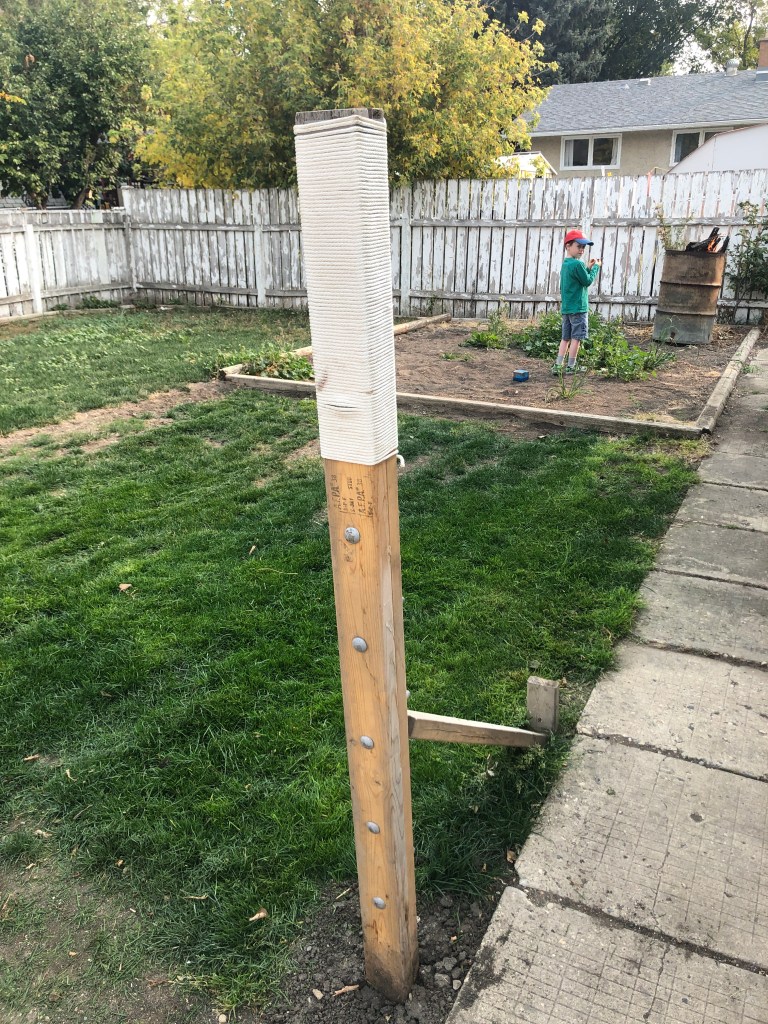
After only two weeks of use, my makiwara (just outside the garage door) has already shifted and has had to be adjusted. Not sure if that’s a good thing or a bad thing…

The point is, you don’t need a fancy or expensive location. You don’t need tons of equipment or have your training area look like something out of a bad 50’s samurai movie. In fact, if you study traditional karate, you can perform the majority of your (solitary) exercises within a 1-square metre space. That’s it! You can perform your katas, bunkai and kumites as well as a huge score of exercises too numerous to list out, including every push-up variation, squats, lunges and shadow boxing.

You reach certain limitations once you incorporate a partner or students, but let’s be honest: at that point, you may be using a local school gymnasium or go outdoors to a soccer field or something of the like. Some of the most traditional karate schools in Okinawa are tucked away behind a single, unmarked door in a back alley. Karate is a free-floating art, which can literally be practiced anywhere. ☯

Growing Sometimes Means Getting Smaller

I have clear memories of all the stuff I had to go through when I was first diagnosed with Type-1 Diabetes. Since my older brother had a wide variety of illnesses, junk food and sugary snacks were never really a staple in my household anyway, but I remember that certain things took a dramatic change nonetheless. I was no longer allowed to drink juice whenever I wanted. I was subjected to frequent daily shots for insulin and finger pokes for blood glucose testing. It was a traumatic time for a 4-year old who hadn’t even had the opportunity to grab life by the horns.

The irony is that all the traumatic stuff is the only reason I’m still alive, even if some of it was misguided, wrong and in some ways caused more harm than good. Back in good ol’ 1982, carbohydrate counting wasn’t a thing at my hospital. Maybe if I had lived in a larger centre, there would have been better Diabetes education available. But in my hometown, there was a singular mantra when it came to the control of Diabetes: Don’t eat sugar! That was it. In tandem with a morning injection of short-term insulin and an evening injection of basal insulin, my blood was tested once a day before bed and I was good to go.

Yes, you read that right! My blood was only tested once a day. Quite a far cry from the dozen times I finger poke myself these days, or the Sensor Glucose readings I get from my pump every five minutes. Not to mention that my first glucometer was roughly the size and shape of a brick. (There’s an illustration of that glucometer in my previous post: When Diabetics Get High… (but not the way you think) But Diabetes therapy has come a long way from it’s beginning, when a person diagnosed with Type-1 Diabetes usually considered it a death sentence.

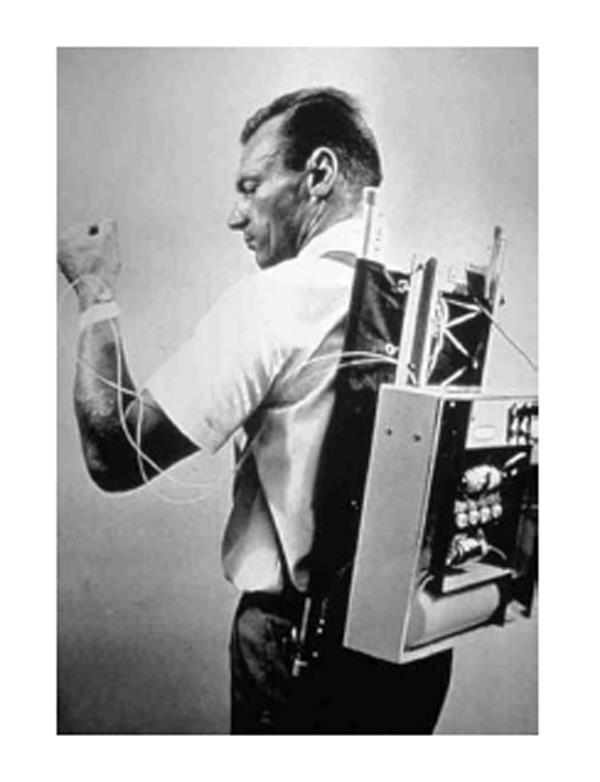
A photo of the first insulin pump

Pump therapy, along with carb-counting and exercise, have made the life of a Type-1 Diabetic easier by scores from what it previously was! As illustrated above, the first insulin pump was basically the size of a large backpack and included metal parts and was cumbersome and impractical. It looks like something Tony Stark developed in a cave. Would I use something like this today? Obviously not, but back in 1963 when Dr. Arnold Kadish designed it, it would prove to be the launching pad for an insulin therapy device that would be widely accepted.

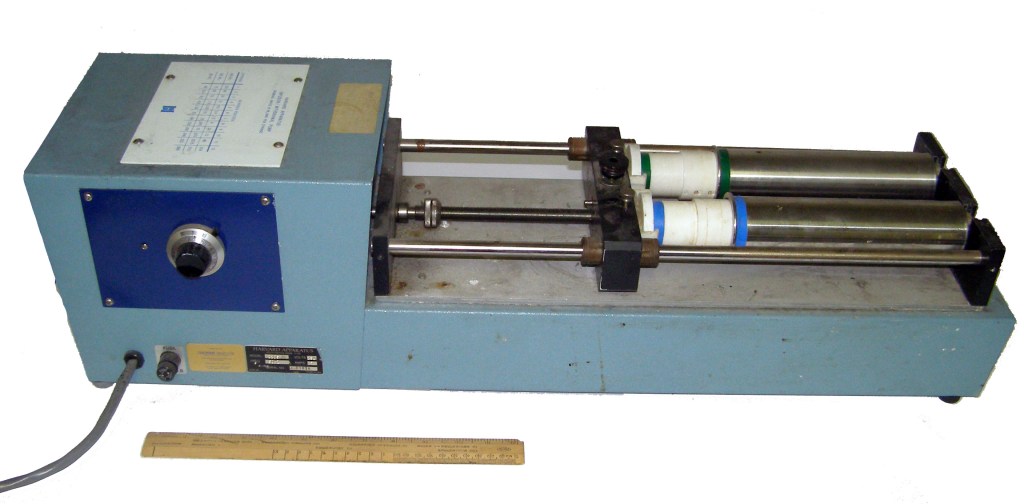
Smaller insulin pump. Source: Wikipedia

Smaller versions were developed by others roughly a decade later and they started being developed with wearability and accessibility in mind. But it wouldn’t be until the early 2000’s that insulin pump therapy would catch on as a common thing. One of the main obstacles is the overall cost. Although I don’t remember the exact retail price of my most recent insulin pump, I do know that it ran to the tune of about $8,500. If I didn’t have benefits through my work, I wouldn’t be on pump therapy.

That’s without taking into consideration that a box of infusion sets runs at about $200/month, reservoirs are about $50/month and the CGM sensors are about $400/month, making for a lovely total of almost $1,000/month when you factor in the insulin and test strips and anything else I may not have mentioned. Is it any wonder why people without solid medical insurance can’t take proper care of themselves? But I digress…

My point is that Diabetes therapy follows the very same trends as modern electronics and technology. When computers started becoming a thing, the average computer took up an entire room that had to be temperature controlled. Imagine trying to play Candy Crush on one of those bastards? The concept of a “personal computer” didn’t take hold until the 1970’s and even then they were boxy, clunky, difficult to move around and were pretty limited in what they could do. Today, the average smart phone has more computing power than what astronauts originally used to land on the moon.

The same can be said for insulin pumps. What started out as a huge, boxy, metallic backpack has now become a small, inconspicuous 3-ounce plastic box. Smaller than most cell phones. And technology is just getting better and better. There are different aspects being developed, including an artificial pancreas going through clinical trials, which could be promising for the future of improved Diabetes control. Who knows, maybe we’ll reach a technology that will allow for the wearing of a simple “insulin patch,” like a nicotine patch, and forego injections and needles altogether! We’ll get there, eventually. But getting there is the obvious problem and as the old saying goes, the waiting is the hardest part. ☯

Just For Laughs…

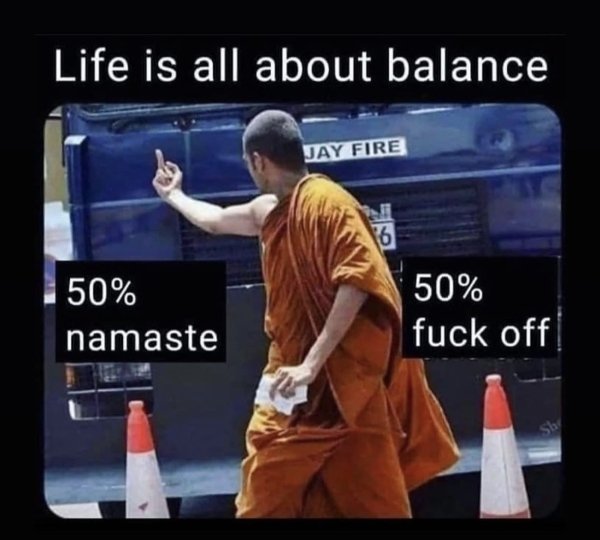
Sometimes, you need to just sit back, take a breath and have a laugh. I found this little gem while cruising the World Wide Web for something else and I couldn’t help but chuckle. I can totally admit that I don’t know the story behind what’s happening in this photograph, but besides making me giggle like a schoolgirl, I think it also illustrates a few important life lessons.

The first is that life is, in fact, a matter of balance. As my friend Daryl once told me, life is like a battery; some positive, some negative, all POWER. But the balance among all things is what’s important. The second lesson is that no matter how disciplined you are or how hard you’ve conditioned yourself, the world can sometimes be overwhelming and cause an overt reaction from even the most serene of people.

That being said, I should once again point out that I don’t know what the story is behind this photo. There was a story a few years ago about a group claiming to be Buddhist monks collecting donation money for a temple in Thailand. I think this was in New York, and the “monks” would approach arriving tourists and try to hit them up for donations. They would apparently become aggressive and even violent if people refused. That probably should have been a sign that they weren’t genuine. But the photo certainly gave me a laugh. ☯

The Answer is Only Important If You Ask The Right Question

Something that occasionally crosses my mind is how there will be a significant employment exodus in the fact that a number of industries have unfortunately discovered that some of the employees they’ve sent home are no longer essential. Months and months of having certain positions sent home without the benefit of a “work at home” plan have rendered some jobs obsolete. The flip side to this, is that all the people who are no longer able to work in their chosen industry will turn to many of the employment positions that were intentionally abandoned by folks who didn’t want to go out into the world during the pandemic.

Regardless what your position or chosen career may be, we’ve all found ourselves in a very specific position at one time or another. The position I’m referring to, is subjecting ourselves to a job interview. No matter how confident in your material you may be, no matter if you’ve worked in the industry you’re interviewing with before, the stress and anxiety that comes with sitting through a job interview can do a number on you.

Throughout my life, I’ve found myself on both sides of the table. I’ve been the interviewer and the interviewee. And especially in the past year, I must have sat through about a dozen interviews while I’ve been busy trying to “find” myself and I’ve learned a thing or two. So despite the fact it has nothing to do with Buddhism, martial arts or Diabetes, I thought I would share some of the gems I’ve discovered about interviewing.

These are a combination of things that have worked for me, as well as things that I’ve noted when interviewing others. So some of it might seem pretty obvious, but not necessarily to everyone. Here we go…

  1. Show up early: You would think this one is obvious, but you’d be surprised at how many people are fine with walking in at the last minute. I’m not saying you need to show up an hour before your scheduled appointment and sit in the waiting area like some sort of psycho. But arriving fifteen minutes ahead of your appointment makes a good impression and can even be important in helping you deal with unexpected obstacles, like construction zones, finding an unknown address and being available in the event the appointment prior to yours ends early;
  2. Dress professionally, not for the job you want: I don’t care if you’re applying to work for waste management or if you’re applying to be CEO of a fortune-500 company… Dress properly. Dress pants, shirt and tie at a minimum. People always say “dress for the job you want,” but that’s total bullshit! Dress to the nines, no matter what the position you’re applying for. It shows your commitment to getting the job and your level of professionalism;
  3. Make eye contact and smile: You want to give your interviewer your utmost attention. There’s nothing worse than an interviewee who drifts off and has you repeat a question. Pay attention and listen. Actively listen;
  4. Don’t be afraid to admit you don’t know: If you’re asked a question and you don’t know the answer, then you should admit that you don’t know. Potential employers don’t like it when you make up some random shit. And you’re almost guaranteed to get called out on it. Employers much prefer someone that can admit they don’t know and are willing to look it up or learn, than someone who will phone it in by trying to lie or make stuff up;
  5. Use the power of “WE”: You want to be a part of that specific company? You want that job? Then include yourself! When asking questions or answering theirs, use “we” to start creating the idea that you consider yourself a part of that organization. What benefits do “we” have included? What schedule do “we” use? It creates the impression that you’re part of the company. You’ll be surprised at the effect it has;
  6. Study up: You can’t know everything, but if you apply for a specific job you should have some rudimentary knowledge about the industry you’re interviewing with. Applying to be an insurance broker? Maybe you want to study up on your Province’s insurance laws and regulations. Applying to be a government employee? Try learning some of the legislation that regulates the specific branch of government you’re interviewing with. This ensures that you can show some minimal knowledge in the job you’re trying to get;
  7. End the interview with a “thank you” and a handshake: No matter how you think the interview went, good or bad, be certain to thank your interviewer(s) for their time and provide a firm farewell handshake. This not only shows your commitment to professionalism, it shows your gratitude for the time that was taken to interview you.

It feels a little strange writing about something that isn’t my usual forte, in terms of this blog. But given the state of the world and how the employment industry is going, knowledge can be an incredible advantage. being qualified for a position is only half the battle. Being able to PROVE you’re a fit for the job and being confident is the other half. ☯

Give It Some Style! 🥋

If you don’t run in martial arts circles, all the terminology and the different forms of martial arts can be somewhat overwhelming. With more than a couple of hundred different styles/types of martial arts from all around the world, divided by style, type, school and sub-styles, it can all get a little convoluted. You have striking styles, grappling styles, weapons styles and uncounted numbers of hybrid styles. Without delving too deeply in how some styles are descendent from another and so forth, let’s focus mainly on the style I’ve been studying all my life: Uechi Ryu Okinawan Karate.

First, let’s cover off some basics so that we’re all on the same page. Karate is an Okinawan martial art, not to be mistaken with a Japanese martial art. Yes, yes, I know… Okinawa is part of Japan; a prefecture of Japan, in fact. For those who don’t know, a prefecture is a sort of jurisdictional division, like a country, Province or state. And although some descendent styles of karate were founded in Japan, karate owes its roots to Okinawa. Hence, the distinction.

Karate, or Karate Do as it’s meant to be pronounced, means “empty hand” with the latter term meaning “way of the empty hand.” The fighting style came about when the original masters returned from China where they had learned a number of different styles of Kung Fu. In the case of my style’s founder, he fled to China in order to escape the military draft. But hey, nobody’s perfect!

Originally, martial arts in Okinawa were referred to as Te, or “martial skill. Once the inclusion of Chinese Kung Fu came about, it was renamed Tode, or “Chinese Hand.” For the most part, Te was used as a fighting art for law enforcement and the rich and generally included the use of a sword or other edged weapon. Te is also way, WAY older than Tode. This is why the true origins of karate as I know it come from Tode.

Once karate made its way to Okinawa, it became divided by three separates schools or “styles” (although they never referred to them as separate styles): Naha-Te, Tomari-Te and Shuri-Te, after the three main cities on Okinawa. To some extent, every traditional style of karate, including the subsequent Japanese styles, can trace their roots to one of these three original schools. In the case of my style, (Uechi-Ryu) it got it’s humble beginnings in Naha, making it a part of Naha-Te.

In the beginning, there were no differing styles. Karate was karate and students from those three cities would train together with no discerning difference in techniques and style with the exception of small, cosmetic aspects. As specific “styles” began to emerge due to the inclusion of specific forms and techniques, most were named in honour or remembrance of their founders, which is the case for Uechi-Ryu, which was so-named by students after Master Kanbun Uechi’s death in 1948.

The only real distinction that could be made amongst the three styles were that Tomari-Te and Shuri-Te were pretty linear styles with Naha-Te being more of a circular style. But in speaking with some of the original masters way back then, most of them were surprised and even indifferent to the prospect that people were referring to their karate as “this style” or “that style.” For them, it was all just karate.

One of the things that makes me sad is that Uechi Ryu is not a mainstream form of karate like many of the more recognizable styles, like Shotokan, Kyokushinkai or Goju-Ryu. Ironically, Goju-Ryu is Uechi-Ryu’s sister style and is almost identical to Uechi-Ryu. Same katas, same circular blocks and movements, same original background. But this means that if you try to see Karate’s family tree, Uechi-Ryu is often not included.

You can check out Uechi-Ryu’s full background by reading the Wikipedia entry, which I have to say is pretty accurate and complete. But today’s face of karate differs quite a bit from it’s humble beginnings two centuries ago. Many popular styles of karate are simply hybrids or combinations of previous or traditional styles. The aforementioned Kyokushinkai, for example, is a hybrid combination of Goju-Ryu and Shotokan karate. And new schools and styles seem to emerge with every passing decade. At the end of the day, karate is karate. A punch is still a punch and a kick is still a kick. Finding the style that works for you and that you can commit yourself to is the key. But knowing the roots that started it all will open the door. ☯

Fumio Demura

I just got through watching both seasons of Cobra Kai, which are now available on Netflix. The series follows the exploits of Johnny Lawrence and Daniel Larusso, respective antagonist and protagonist from the 1985 original “Karate Kid.” This time around, Lawrence is the focus as he struggles through a failed marriage, an estranged son and bringing back his Sensei’s failed karate dojo, which is Cobra Kai. It’s a fantastic martial arts series, focused on karate. I can’t wait to see what Season 3 will bring.

It got me feeling nostalgic for the original Karate Kid movies, which included two sequels and a rebirth with “The Next Karate Kid.” You’ll noticed I haven’t mentioned 2010’s remake of the The Karate Kid, starring Jackie Chan and Jaden Smith. Although it was a decent movie, it’s based on Kung Fu, not karate and was basically a slap in the face to the original. But through that nostalgia, I started researching and falling down the YouTube rabbit hole and discovered some interesting facts about the film series, including the involvement of Fumio Demura.

Fumio Demura is a well-known martial artist who studies Shito-Ryu karate and kobudo. I came to find out that Demura played the stunt double for Pat Morita’s “Mr. Miyagi.” This came as a surprise to me, since I knew of Demura through his books. Demura wrote a series of books in the 1980’s covering a number of weapons used in Kobudo. Since joining Kempo Karate in 2016, I’ve slowly introduced the bo staff and sat into my training regimen.

Since there’s a limited amount of coaching time on weapons in the dojo, I decided to order two of Demura’s books, Bo: Karate Weapon of Self-Defence and Sai: Karate Weapon of Self-Defence. In these books, Demura covers a number of basic concepts for both weapons and includes several photos and diagrams. They’ve been helpful, despite the fact that I don’t focus heavily on weapons.

It was cool to read about his involvement. We’re all aware that movie actors use stunt doubles, but it was neat to find that one of my favourite movies included a stunt double that I’ve read and studied about. If you study karate or kobudo, I highly recommend you search “Fumio Demura” online and see what you can find. Any of his books are definitely worth a read. ☯