Last night I had the pleasure of watching a belt promotion ceremony. My title reflects the fact that the students graduated to their blue belts. it brought back many memories of my own belt promotions from decades ago.
It also caused me to note certain discrepancies in how people train today compared to decades ago. The difference between my home style and the style I train in currently were quite evident last night.
But watching them take their green belts off and tie on their blue… the emotion and the tears that the one student had from the experience… I remember those emotions and feelings well. The sense of accomplishment and the ambition to keep training and pushing forward is quite a feeling.
I think it’s important to fight for what you want in life. I’ve often said that if life had no challenge, then what would be the point? I think it was George S. Patton who said “Accept the challenges so that you can feel the exhilaration of victory.”
I guess I just got feeling a tad nostalgic. One gets that way when one reaches this point in life. Keep working at whatever goals you’ve set for yourself. Your drive and ambition will help you grow. And if by chance, life deems it appropriate to keep you from achieving your goals, I promise the memories you’ll make along the way will be worth the trip! ☯
Alexander Graham Bell once wrote “When one door closes, another opens; but we often look so long and so regretfully upon the closed door that we do not see the one which has opened for us.”
Life has been difficult for me in the past couple of years. And that’s okay. I still believe that all things happen for a reason. We don’t always understand the reason behind things, but good things are often around the corner. We simply don’t have the ability to necessarily see that far ahead.
The basis of Buddhism explains a simple premise referred to as The Four Noble Truths. The first noble truth explains that suffering, pain and misery exist in life. This makes sense, right? I think it would be a fair assessment to say that all of us have suffered from time to time, in some way, shape or form. Most schools of faith teach this in some respect, since life is not meant to be easy. Otherwise, where would the challenge be?
The second noble truth teaches us that this suffering is caused by selfish craving and personal desire. I have difficulty with this, because I tend to believe that some suffering is inflicted upon us by others. Some actions and results are out of our control. Those who wish to do us harm will do so, regardless of our beliefs. This is part of the problem I am currently facing. But selfish cravings and desires are certainly a source of suffering.
However, the third noble truth does teach that this suffering and selfish craving can be overcome. I guess the big question becomes, when do we overcome it? I believe it can take a lifetime or more. Perhaps in the next life, if we’re lucky. But either way, we should never stop fighting and striving to better ourselves. This is the only way to climb the insurmountable mountain of suffering.
The fourth Noble truth path describes that the way to overcome this suffering is by practicing the “Eightfold Path”, which is another part of the doctrine taught by Buddhism. There’s plenty of articles online about what the eightfold path is, so I won’t go into it here as it gets kind of convoluted and moves away from the purpose of this post.
I’ve been reflecting firmly on my beliefs today (hence the deeply Buddhist teachings). This afternoon, I received a phone call that may alter the course of my life. Although nothing is certain about this call, it opened a door and exposed me to the possibilities beyond the suffering I am currently dealing with. And that brings me more joy than I can describe. It tells that I can and WILL overcome the difficulties plaguing my life.
We don’t always know what life has to offer, just around the corner. Keep working hard, training hard and learning hard. The end result can provide possibilities that you may never have imagined. ☯
I’ve often written about some of the complications that people with Diabetes face on a daily basis. certainly, the list is long and the complications are many. Today I will address one of the more common and misunderstood issues surrounding Diabetes. Weight gain and obesity.
This is a very sensitive topic in modern society, so I’m going to start this post by being very clear: This is not a slight against people with genuine weight issues or intended to body shame in any way, shape or form. Although I am a firm believer that we should all love ourselves for who we are, obesity and heavy weight-gain are serious medical issues and carry many consequences.
According to numbers provided by Statistics Canada, approximately 61.3% of Canadian adults were considered under the category of “obese” as of 2015. This is almost a 25% increase from 2004. Without including the rest of world, this is a small example of how serious an issue it is.
An important misconception is that obesity causes Diabetes. Although there is some evidence linking obesity to Type 2 Diabetes, there is no confirmed evidence of the same being the case for Type 1.
Type 1 Diabetes is an auto-immune deficiency and is NOT caused by obesity. That being said, once a Type 1 Diabetic starts insulin therapy weight gain can occur, usually in the stomach area. This is because insulin helps your body to absorb glucose into the blood stream. And as Diabetes can make you extra hungry once you’re on insulin therapy, well… Glucose absorption + extra hunger = weight gain.
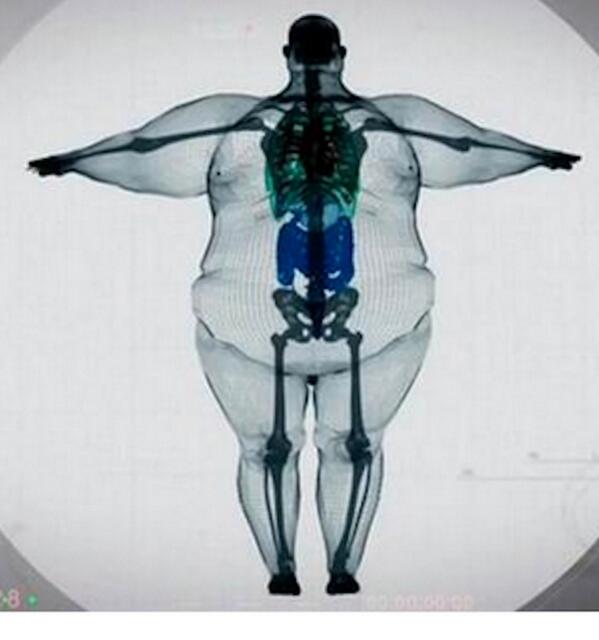
A photograph of an MRI scan that has circulated on the web for years, illustrating the fact that “big boned” is a misnomer!
There is a significant difference between being obese and being overweight. Obesity is generally defined as having a Body Mass Index (BMI) of 30 or higher. That being said, BMI is a fairly inaccurate way of measuring obesity. If you factor in my weight of 220 pounds coupled with a height of 5’7″, my BMI is sitting at 32.9, which is considered under the obese category. Anyone who has seen me in person knows that I’m a far cry from obese! Although it is a standardized form of measuring mass in the human body, it doesn’t take into account whether the weight is carried as fat or muscle. BMI is a subjective tool that has to be used in conjunction with all the other factors and assessed by your doctor.
The purpose behind listing all of this is two-fold: to make people understand that being overweight is NOT what causes Type 1 Diabetes, as many television comedies or online jokes may make you believe, and that there are a number of complications that come with being overweight.
Weight gain and obesity have been linked to heart disease, stroke, gallbladder issues, some forms of cancer, osteoarthritis and gout as well as certain breathing issues and sleep apnea. The added weight one gains taxes and stresses most of the systems in the body and can lead to serious health complications. If you add that on top of having Diabetes, life becomes unnecessarily complicated. I mean, Diabetes makes it unnecessarily complicated anyway, but why make it worse?
All of these complications can be lessened and some may even be eliminated by losing some weight. The obvious steps involve a healthier diet and increased physical activity. Try to stick to foods that contain natural sugars as opposed to artificial additives and preservatives. Keep your workouts consistent, but throw in some variety of workouts to ensure you exercise all the areas of your body.
Remember, even though you should be happy with your body, health complications indicate that your body isn’t the way it should be. Consult your doctor and see what you can do to prevent these complications. ☯
Most people have dreams and goals. In fact, I have rarely ever met any person along my travels who hasn’t indicated that they have something in mind for the future or something they’d like to do. Even the folks who claim that they’re happy with the status quo and aren’t looking to accomplish anything will ultimately have that unspoken dream that haunts them every night.
Dreams and goals are important. They help us to develop focus and builds skills needed to survive in modern society. It can also help to give your life purpose. If one had a life of ease without any effort required, where would humanity find the drive for its advancement.
Although having goals can often make life harder, accomplishment can also help you to become prouder of yourself and help to build on your capabilities.
Like most things in life, the only way to have a silver lining is if there’s a dark cloud holding it. There are some disadvantages to setting goals. According to an article posted on LyveStrong.com, failing at any particular goal can cause some people to become discouraged from setting future goals, which can ultimately lead to losing out on important milestones.
The article goes on to explain that goals should be set using the SMART acronym. I’ve heard this acronym often in different business environments I’ve worked in and I will explain it briefly here:
Specific: No matter what goal you set, you should attempt to ensure that you are specific in what you want to accomplish. Perhaps your goal is to purchase a sports car. Great! What kind? What colour? Providing specifics will help to make the goal more real and leads into the next point.
Measurable: Let’s say your goal is to lose weight. How will you know when you’ve accomplished your goal? Let’s say your goal is to lose 5 pounds; this is how your goal becomes measurable. And it ensures that you’ll know once you’ve accomplished it.
Attainable: I’ll keep this one pretty simple… Make certain that your goal can actually be accomplished. Although I’m a firm believer that anything is possible, if your goal is to own a house on the surface of the moon you may be in for a little surprise!
Relevant: Your goals need to lead towards something. Having goals simply for the sake of having them can lead to a sort of stagnation unless you have them accomplish an end game.
Time-measurable: Set a period of time for when you want everything to happen. It’s one thing to say “I want to accomplish THIS or THAT”, but without a specific time frame to ensure its completion, you may never reach the completion of your goal.
Last but not least, work on one thing at a time. Most people have a “bucket list”, or a list of things they wish to accomplish before the end of their lives. But having too many things on that list that you’re working on at once will cause your bucket to tip over. ☯
Time makes fools of us all. Not because we are fools, but because the ravages of time tend to catch us by surprise. Sometimes those ravages reveal changes we wouldn’t have expected.
It dawned on me a few days ago that we tend to photograph and document our accomplishments, but we rarely document and photograph the beginning. I have no photos of myself as a white belt.
I started karate in April of 1988. Despite my health, I was full of dreams and faith and I knew that my hard work would someday pay off. I could only speculate at how right I would become.
Three years ago, I was visiting a friend in the city whose parents were visiting. My friend’s mother made an off-the-cuff comment about how both of us had “thickened” and she would be curious to dig out a tape measure to see which one of us had gained the most weight over the decades.
Time and age catches up to us all. We don’t really have a choice; certain bodily functions tend to cause us to gain weight and our bodies to change. In fact, we tend to gain weight and lose about 8% of our muscle mass every deacde until we reach our 50’s as our metabolism slows. Fun, eh?
When I started karate in April of 1988, I weighed about 80 pounds, soaking wet. I was slight, I had very little muscle mass and my health wasn’t great.
My current stature, as of June of 2019
As of June of 2019, I weigh 220 pounds and have a significant amount of mass. This is a far cry from what started with in 1988. Sure, some of that is muscle. But some of it is a bit of the aging process.
Like I said before, we all get there. The important thing is to maintain your physical activity. This will help to maintain a healthy weight and proper physical stature as the years march on.
As I’ve gotten older, I’ve gained a lot of wisdom. If I had the physique I held in my 20’s mixed with my current physique, that would be a scary opponent to deal with. But given the current state of life, I’ll gladly accept the wisdom over the physical. ☯
I’ve written a number of times about in my articles about my young son, Nathan. He’s a little Tasmanian devil. He’s developed the ability to destroy everything I care about, but doing it with a smile on his face and an “I love you, daddy” on his lips. Children have an effect on us that we seldom take the time to acknowledge.
One of the most difficult situations to deal with in regards to young children is the noise. And I’ll totally admit that I’ve been guilty this myself, but it feels as though I’m always telling my kid to shut up! Have any of you experienced this?
It often becomes easy to forget that children are simply little people with BIG people emotions. I know for a fact that more often than not, my son feels the need to be the loudest sound in the room. At times when he’s quiet, he’ll suddenly become raucous the moment I pay attention to his mother or anything other than him
So, what does one do? Shushing your child only gets you so far. My wife works from home and for a short period, I was able to get away with telling Nathan “You need to stay quiet! Mommy’s working!” But that unfortunately no longer works and often falls on deaf ears.
Many experts agree that there are some easy ways to help quiet your child when they get too loud. First and foremost, they indicate that you should stop what you’re doing. Children are incredibly sensitive to their environment and will recognize the fact that you’re busy checking Facebook on your phone when you were supposed to be playing with them.
The next thing experts tend to agree on is to bring yourself down to your child’s height. Looming over them can be intimidating and make instruction difficult to deal with. Children will feel more connected and appreciated with parents who are able to bring themselves to their child’s level. Take a knee. It WILL make a difference.
It’s important to model the behaviour you’d like to see in your children. For example, even though you’d love to shut your kid up by placing a hand over their mouths, this is likely the worst thing you could do. Experts believe that this not only shows the child that they are incapable of quieting themselves without the strength of an external source, children live by example. This is chilling, because it teaches the child that they are free to exert their strength against younger and weaker children. This becomes especially important if the child is to become a big brother to a younger sibling and is a bad habit they can carry with them into preschool and kindergarten.
According to an illuminating article on wehavekids.com, there are a number of things that can help.
Whispering. Whispering make children curious. They want to know if something secret is going on. Whispering is likely to get their attention more than yelling.
Prepare ahead of time. When planning any outing, whether at a restaurant or any other public place, be sure to bring snacks and activities for your child to ensure that you can manage their hunger and boredom while you wait for your meal. It’s unrealistic to expect that your child will understand that waiting is necessary.
Give them a loud voice outlet. This one actually makes sense to me. I spend so much time telling Nathan to be quiet… During the morning routine, during the trip to preschool, when I pick him up from preschool and during the evenings leading up to bedtime… When does he get a chance to vent that excess energy? I think we often forget that children have the same amount of energy as we do, just in smaller container. This is why they always seem hyper and full of energy. Make sure you provide them with an outlet. Take then outside where they can be as loud as they want.
Remember that they are still children. I have the most problem with this one. I’m often guilty of losing my shit and tossing Nathan into his room as a punishment for making too much noise. The reality is that even the most disciplined child will only be able to stay quiet for so long. If you expect four straight hours of quiet time in the living room every morning, you’re in for a big surprise.
Children learn by example. If we get angry and lose our minds every time they get noisy, they’ll not only keep getting noisy but they’ll only learn that anger is an appropriate response when dealing with others. Some of these tips may help. But ultimately, you’ll need to learn how your specific child deals with their energy and their noise. As parents, we need to adapt to these trends and teach our kids along the way. ☯
I know a lot of people seem to think that being Buddhist means dressing in robes and constantly sitting on the floor cross-legged, and every free moment of the day finds us meditating and humming to ourselves.
Although these aspect DO happen, they aren’t a constant thing. It’s comparable to any of the world’s other faiths not following a constant regiment as required by their religions. But meditation is an interesting aspect and tends to cause some mystery to most.
There are several ways to meditate, and unlike the belief most people have, it is not a static thing. It doesn’t always involve a comfy pillow, coupled with closed eyes and hands on thighs. In fact, I have trained to the point where meditation is a flow, and tends to happen whenever needed throughout the day.
Have you ever tried to clear your mind and focus on absolutely nothing? It takes a lot of effort and it really isn’t easy. There have been times when I’ve sat and tried to relax, but the ability to clear my mind simply doesn’t happen.
Sound advice…
Like most parents of young children, I had the chance to watch Disney’s “Frozen” with my son, Nathan. And the lead protagonist sings a wonderful song about “letting it go”.
This is what’s often required when meditating. Sometimes the effort of trying to think of nothing is more effort than just letting the mind drift. One needs to let it go in order to empty the mind. If you take a few deep, calming breaths and simply let your mind wander, you can focus on the nothing while your subconscious babbles to itself.
Meditation has become more of a commonality within modern societies. Many employers will provide meditation seminars and allot time throughout the work day for meditation breaks. The advantages are still being studied, but once you get a knack for it, it can provide a plethora of benefits for your health and mental well-being.
I believe I’ve shared this link before, but this is a handy website for folks looking to learn and start meditating: https://www.wikihow.com/Meditate
Learning to relax and clear your mind is paramount based on today’s way of life and work environment. Don’t be shy to learn new skills and habits that will help get you there. And remember, sometimes you just have to “let it go”! ☯
I’ve often written about the multiple complications caused by Type 1 Diabetes and the difficulties it can cause in daily life. But there is an unspoken difficulty that isn’t often discussed when referring to Diabetes. And that difficulty is the cost of Diabetes-related supplies…
Here’s the reality: in Canada, somewhere between 200,000 to 500,000 people have no medical coverage for prescription requirements. In terms of total percentage of the country’s population, that probably doesn’t seem like a lot. But half a million people is still a hell of a lot. And problematically, Diabetes supplies aren’t covered by Provincial health care so private medical insurance is required for the basics like insulin and blood testing supplies.
How my “stash” cupboard usually looks!
Now I’m lucky enough that I have medical coverage through my work. This may change if I lose my job, but that’s neither here nor there. So before I get angry and lose my peaceful composure, I’ll get back on track…
If one were to take a look at the photo I’ve taken of the supplies above, this would be a basic breakdown of how much all this stuff would cost me, if I didn’t have coverage:
The large white box that says “MiniMed Sihouette” are my insulin pump infusion sets. They come in a box of ten and are good for three days at a time. This one box costs $205.00. $205.00/month.
The skinny white box beneath it that says “Medtronic” are the insulin reservoirs. These also come in boxes of 10 and get changed every three days along with the infusion sets. $43.50/month.
Next are the yellow boxes to the left of the Medtronic boxes. These are Freestyle Libre sensors. They measure blood glucose through interstitial tissue and can be read by your cell phone. Each sensor is good for fourteen days before needing to be changed and cost $89.00 each. this means you need two of them every months. $178.00/month.
Next are the vials of Humalog. Personally, I use about 200 units of Humalog every three days. This means I use approximately 2000 units per month and each bottle contains 1000 units. Each bottle costs between $70 to $90 dollars retail, depending on where you buy it. the nice thing is insulin doesn’t require a prescription in Canada. Since I use two bottles, $180.00/month.
At the far back of my stash are Contour Next blood glucose test strips. these are still required, despite the Freestyle Libre sensors. Despite interstitial testing, you still need to test via blood prick every now and again to ensure that you’re actually on par with where you should be. Each box costs about $76.99 and has 100 strips. Since I test between 8 to 10 times a day, I require two boxes a month. $153.98/month.
The remainder are multivitamins and supplements; none of which are necessary. The two prescription vials are Ramipril and Crestor. These are preventative but generally necessary, and come in vials of 30 tablets. Ramipril is about $50.00 and Crestor is about $80.00. Therefore, these two medications come in at $120.00/month.
According to new math, the total for all my medications comes in at a whopping $880.00/month. Are you kidding me??? It costs that much to keep me alive each and every month. And that doesn’t even include the additional cost if I should happen to need more insulin or test too often and burn through my strips.
So just imagine if you happen to be a Type 1 Diabetic without medical insurance. You’d need to spend $880.00/month just to keep yourself alive. Granted, there are things you could do to reduce that total. you could skip out on the preventative medications like Crestor and Ramipril. And you don’t HAVE to be on an insulin pump.
But either way, for a minimum wage earner without medical coverage, you’re looking at rough times ahead. If you’re lucky enough to reside somewhere like Prince Edward Island, where all Diabetic supplies are Provincially covered, it’s not so bad.
This gives you a small idea of what the cost of a Diabetic life involves. It’s not all fun and medical complications. It can cost a hell of a lot to boot. ☯
Our society is quite backwards in terms of our behaviour. We claim we want privacy and fight for that very right, however we live in a world where modern culture allows us to expose every moment of our day through online forums and social media.
Despite these facts, humans are still quite adamant when it comes to their privacy. But at what point does privacy cross that invisible line into secrecy? What’s the difference?
Privacy is generally defined as “the state or condition of being free from being observed or disturbed by other people” or “the state of being free from public attention.” Once again, this is a bit of a misnomer, considering how the average person lives in today’s day and age.
Secrecy is defined as “the action of keeping something secret or the state of being kept secret.” In layman’s terms, secrecy requires one to keep something from others. It’s not always a bad thing, but it does require something being held back.
Privacy generally requires being left alone. Secrecy generally requires intentionally keeping something from others. The question I pose to you, dear readers, is where does the line exist and is one inherently worse than the other?
I’ve seen the above-posted meme a number of times and it always gives me a chuckle. Cell phones have become the carriers of our private lives and we tend to guard them closely. Cell phones are likely the best example that I can think of, because most people would agree that their phone is “private”, but the level of protection people use for their phones tend to suggest it errs closer on the secrecy side.
The line is extremely blurred and some would believe that one is needed in order to achieve the other. This makes sense. In order to maintain privacy, some secrecy will inherently be used and vice versa.
The problem comes when one uses that secrecy in such a way that it brings harm to others. And if privacy is used in such a way that it keeps you from the surrounding world, this can be detrimental as well. Although choice of lifestyle is ultimately each person’s individual choice, it’s important to consider those who are closest to us. ☯
Yesterday was Father’s Day. I’m a little late on the ball, but that often happens with me, so here we are! Father’s Day, like many holidays, was established in the United States during the first decade of the 20th Century by Sonora Smart Dodd as a way to celebrate and honour fathers.
Although it was celebrated in Arkansas for the first time in 1910, it wasn’t until the early 1970’s that it became considered a recognized nationwide holiday.
As some of you know, I have a 4-year old son named Nathan. He’s a handful, and like his father, can’t seem to sit still for very long. Nathan created a few crafts at pre-school for me in celebration of Father’s Day, which I will share with you now.
His first gift was a small five-ounce glass jar that contained ingredients to make two chocolate chip cookies. All that was needed was a tablespoon of butter and an egg, prior to popping it into the oven. It made two cookies, which Nathan and I were then able to share.
Baked goods don’t sit for very long around the men in my family, so we don’t have any photos of our cookies as Nathan and I wolfed them down as soon as they came out of the oven. I’m not certain if the ingredient amounts were incorrect or if I added too much butter, but the batter was a bit soupy. We ended up having one big, square cookie. We still ate it. It was still good.
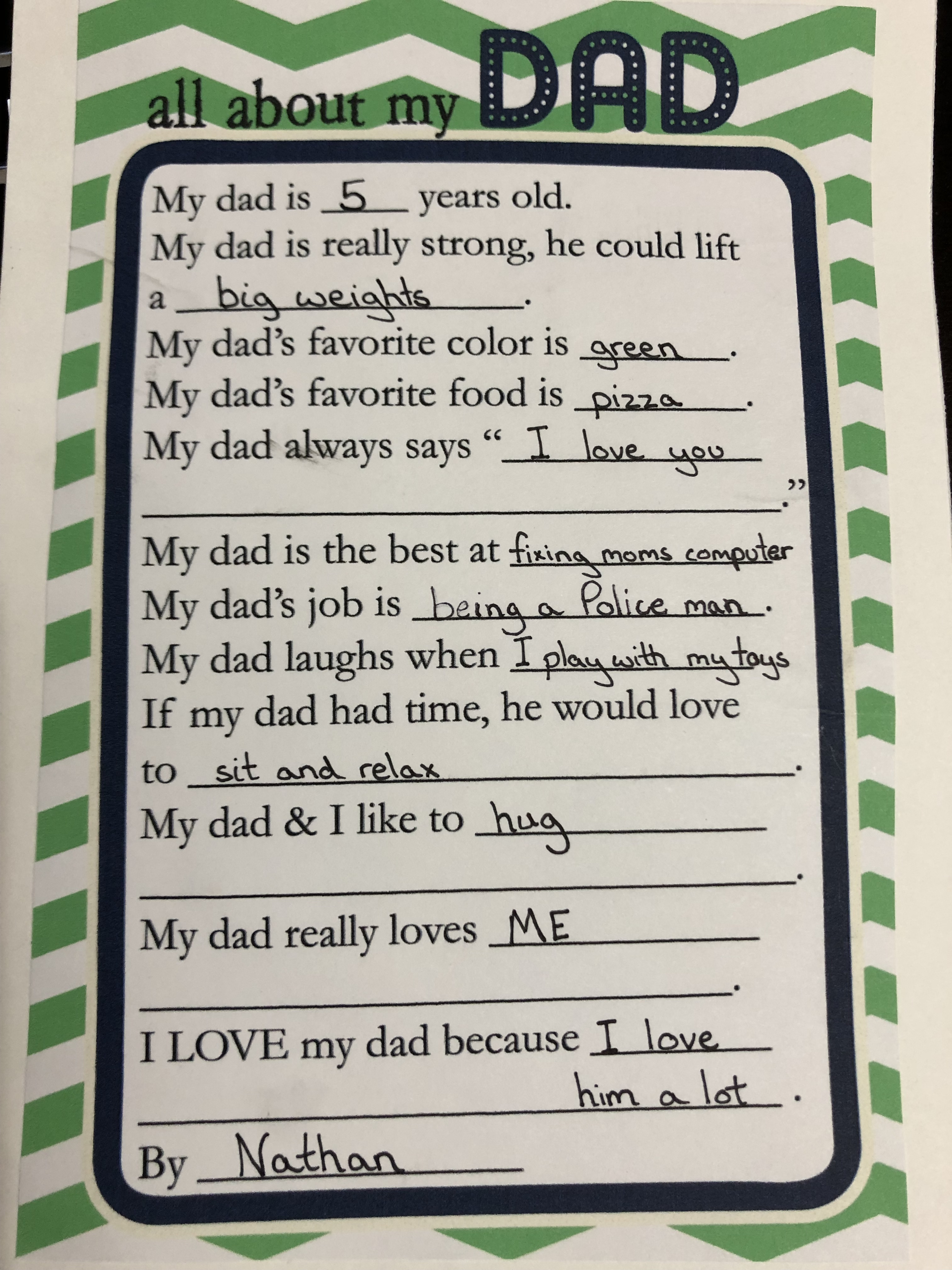
The second gift my sone provided was a card containing questions his teacher asked him about me. I will share it here…
The first thing I’d like to point out is the fact that my son believes I am 5 years’ old. Children can have a wonderful perspective, and it’s often funny to see how their mind works.
The use of “big weights” doesn’t really surprise me as Nathan is often with me during workouts, as I’ve written about before. He apparently knows me well enough to recognize that my favourite meal is pizza and that if I had time I would “sit and relax” haha.
Despite the comedy involved in some of his answers, what melts my heart the most is his recognition of the love in our family, as he indicates that my parting words always include “I love you” and he indicates how much he loves me.
Life is short and is a very fleeting thing. Since we never know what life may bring, I’ve always tried to teach Nathan that telling a loved one that you love them before leaving is important. If this were to be the last words spoken to each other, we would know they meant something.
Happy Father’s Day to all the dads out there, and all the other parents who may be performing the duties of a Father. You’re important and provide the shining example of what your child should endeavour to become. ☯