I Stole My Wife’s Bike! ðŸš²

Yes, you read the title correctly; I stole my wife’s bike! Although a borrowing a marital property can hardly be referred to as theft, and she knew I was boring it. It was 14 degrees Celsius in Regina, Saskatchewan yesterday afternoon (although it may have reached higher but that was what I saw when I checked). As such, I decided that it would be a good idea to spend some time outside for the day’s workout.

Last year I logged a reasonable number of kilometres over the warmer months on a bicycle, and I discovered a love for it. I even cycled to work, on a number of occasions, which happens to be about ten kilometres away. The best aspect of cycling is that it’s a low impact exercise, so the past three and a half decades of wear and tear on my knees from full-contact martial arts doesn’t impede my ability to peddle.

There are a number of measurable benefits to cycling, including but not limited to;

  • increased heart health;
  • increased flexibility and blood flow;
  • muscle gain and joint mobility; and
  • weight loss stress reduction.

As long as you push and bike hard for at least 30 to 60 minutes, several days a week, you’ll get a good burn and see some noticeable results.
I stepped out of the house shortly after 3:30 p.m. and pulled my bicycle out of the garage. It had been sitting there all winter, so I knew I’d have to lubricate the chain and gears, as well as inflate the tires. The first two items went off without a hitch. I hit a hiccup on the third…

Using a small hand pump, I inflated the rear tire. When I moved to the front tire, I worked up a sweat trying to inflate it, to no avail. It was soft to the touch and had no firmness whatsoever (I just heard it, get your mind out of the gutter!) I started my car and plugged in a small emergency compressor that my father-in-law gave us for Christmas. I used it to inflate the front tire. Success!

That success was short-lived, as I could hear an audible hiss that resulted from the front tire deflating. I had a leak. This is not surprising, considering the bike was in the garage through the cold of winter, and rubber tends to crack under such conditions. I was pissed. Given the temperate weather, dry roads and the need for a workout, I was hell-bent on getting behind a handlebar.

I brought out my wife’s bicycle and repeated my prep cycle: lubricate the chain and gears and inflate the tires. No issues, and within minutes I was on the road. I pushed and peddled, all while singing along to Kenny Loggins’ “Nobody’s Fool” (It’s an awesome song, theme to Caddyshack II. Seriously, YouTube it!)

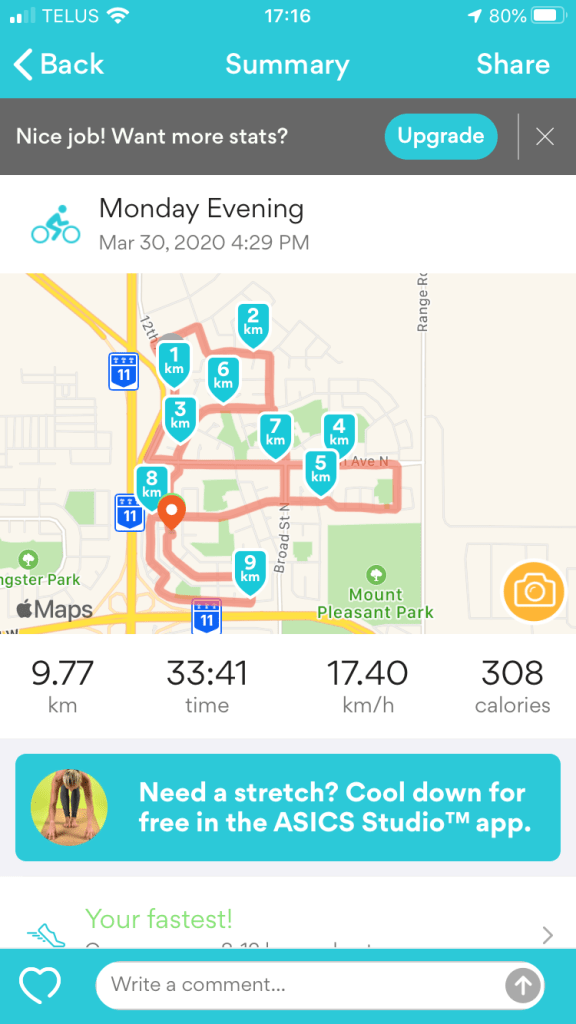
Once I started peddling, I felt it was hard to stop! I ended my run at just under 10 kilometres, feeling great! I think my wife may have lost her bike for the summer (at least until I can repair my front tire). Despite the current state of the world, there’s still plenty of opportunity to get some exercise and fresh air, so long as we stick to social distancing protocol. ☯

Pebble In The Pond

“Just As Ripples Spread Out When A Single Pebble Is Dropped In The Water, The Actions Of Individuals Can Have Far Reaching Effects.”

– Dalai Lama

One of the most important aspects of our existence is karma. Lots of folks refer to karma, usually in an angry context. “Karma will bite you in the ass” or “Karma will get you” are popular ones. People rarely concern themselves with their own karma or how to influence their own lives through their own actions. And I think it says something about modern society when we’re more concerned about someone else’s negative actions rather than our own.

Karma is the totality of everything you do in life, and the resulting energy that ultimately decides the outcome of your life and potentially future lives (if you subscribe to such beliefs). In layman’s terms, what goes around, comes around. So if you do bad, you get bad. If you do good, you may get good. Clear enough?

Another way to look at it is causality. Cause and effect. This is a phenomenon that describes that an action or event will result in the production of a new action or event, usually believed to have been at least partly caused by the original action or event. This means that every action has a result. So if you do something wrong or bad within the scope of your own existence, you’ll likely cause a negative result.

I find that a lot of people tend to do things on a whim, good or bad. And they’ll move on with their lives and forget about the things they’ve done, regardless of the result it may have had on someone else. This is a big part of the issues I’ve been dealing with in recent years. One person’s negative actions have caused immeasurable damage and chaos within my own life. But despite the fact they may have moved on and forgotten about the problems they’ve caused, eventually karma will catch up with them and everyone at some point needs to pay the piper.

As described in a movie I once watched about Bruce Lee’s life, you drop a pebble in a pond, you get ripples… Soon, the ripples cross the whole pond. I believe that the message was that your influence can be far reaching. However, it can also mean that any action on your behalf, good or bad, will affect other people. So make sure you make them positive. You never whose life you may damage. Or improve. ☯

Social Distancing ≠ Social Dissolving

One of my biggest fears when faced with the current state of the world is the after-effects that will continue to linger within our society. For the longest time, we’ve been a society that tends to ignore the world around us. Unless we happen to be online, where most people suddenly become activists, politicians and armchair warriors who always seem to know better. But I digress…

There are many cultures around the world who have ALWAYS practiced social distancing, so the recent pandemic hasn’t create anything new. However, for the folks who haven’t done it before, social distancing may have effects that will take years to recover from. If you’re an outgoing person who enjoys being among the masses, suddenly being locked away in your home can have detrimental physical and emotional effects.

I’m sure you’ve all seen some of the memes and jokes online about social distancing; like the group of dads having beer in the street in a large circle, standing six feet apart. Social distancing has been blatantly difficult for some people to accept and maintain, despite its necessity in helping stem the current spread of COVID-19.

In fact, according to an online article posted by USA Today, large-scale social distancing is required in order to prevent the virus from running rampant and overwhelming the healthcare systems in respective countries, leading to large numbers of fatalities in the coming year. The article goes on to explain that we are nowhere near to ending social distancing and that we NEED to maintain it, in order to stem the propagation and bring an end to the pandemic. (https://www.usatoday.com/story/opinion/2020/03/26/coronavirus-pandemic-growing-too-fast-stop-social-distancing-column/5083173002/)

Despite this requirement, the need for everyone to come together has never been greater. Isolation, whether with family or alone, can involve a number of problems that we may not recognize before they become serious. Depression, hopelessness and the use of drugs and alcohol can become very real aspects to cope with the current state of self-isolation. It’s important to remember that there are a lot of ways, especially in today’s modern world of technology, to stay in touch and communicate with people, thereby maintaining social contact and preventing the dissolving of society.

This is one of the rare occasions where social media can be an asset. Although still a nasty source of false news, misinformation and a destructive means of sharing private information, social media’s ability to help people stay in contact despite long distances can’t be denied. I know that a number of my family members make use of Facebook and other means of online communication in order to stay in touch with friends and loved ones.

A handy tool that many people seem to forget about these days, is the telephone. What with texting and social media, most folks seem to forget that the plastic brick in their hands is actually intended as a means of verbal communication that was invented over 140 years ago!!! Despite the fact tat we live on opposite ends of the country, my mother and I speak by phone every few days, even if only to stay in touch (cue the mama’s boy jokes, here).

My point is that we need to ensure that we don’t begin to accept social distancing as the norm and begin to shy away from in-person contact with each other. It may be necessary in the here and now, but when the smoke clears and the pandemic is over, we will need to rebuild social bridges and allow ourselves the benefit of each other’s company. The worst thing that could come out of all this, is to survive it all just to become xenophobic against society for fear of what else may happen. After all, there will be a lot of work to do once every steps back out into the sunlight; and we’ll need each other more than we probably understand. ☯

One Good Turn…

With all the difficulties in the world and how much suffering everyone seems to enjoy spreading, sometimes it’s nice to share a story of something nice done by others. I always try to push karma in the right direction, and it makes me happy when I see that others are able (and willing) to do the same.

We have a family SUV that we use for daily errands and such, but I have a personal car that I use for going to work and any medical appointments and such that I may have to attend. Given the current state of affairs in Canada, and the fact that saving money is always an important concern for any family, my wife and kids travelled with me to Saskatoon for my last eye injections.

This means that my car has sat idle in our garage since sometime in January. Despite the fact that it’s not really an OLD car, it tends to die out if I forget to unhook the car battery between Saskatoon appointments. This is exactly what happened in this instance. I had the car parked in the driveway at some point in January, and our neighbour (who goes way out of his way to be helpful and we love him) asked me to move the car so he could snowblower our tandem driveway.

I pulled the car into the garage, which is unusual for me. I normally back it in so that I can unhook the car battery. But I didn’t. So the car sat there, with the latent background electronic systems using up battery power, for about two months. So yesterday, I decided to check the car and get it some fuel. I turned the key. Nothing. Brutal. So I used an energy pack to boost the car and headed down to a local gas bar to fuel up.

The beauty is that gas prices are actually REALLY good right now. It cost me less than 40 dollars (Canadian) to fill the tank from less than 1/8th. I had two twenty-dollar bills on me, so I gave it to the pump attendant and told him to use the change to buy himself a coffee. Seems like a trivial thing, but I’ve been where he is, so I figured it would be appreciated.

I was walking on air from the low gas price, until I paid for my fuel and tried to start the car. Not a sound. Fuck. It’s only a five minute drive from my house to the gas bar, so I had to assume that I hadn’t driven long enough to allow the car battery to build up a charge to allow me to stop and start it again.

I ask my pump attendant if he had a power pack to boost my car. He, and one of his coworkers, came out and hooked everything up in order to jumpstart my car. It didn’t seem to be working. A random stranger came over and offered to help push my car so that I could pop the clutch to start the car. Luckily, the car turned over and started. I was unconditionally grateful and thanked all three men for their help and assistance before driving away.

Rest assured, I drove around the neighbourhood for a while and charged up the car before backing it into the garage and unhooking my battery. But it got me to thinking about how some people will still go out of their way to help a total stranger. I mean, those gas bar employees didn’t HAVE to boost my car. And that random customer didn’t have to come offer to push my car to start it.

Sometimes we forget that a random act of kindness can mean the world to someone. It may seem like nothing to us, but it can make all the difference to the person you’re doing it for. Those guys probably carried on with their day and totally forgot about boosting my car, and hour after I pulled away. But the fact they helped me without any gain showed me that there’s still good in the world.

We get so busy with our daily grind that we sometimes forget that there’s an entire world around us. Don’t be afraid to do something nice for someone, even if it’s someone random. Not only is it good karma, but you’ll better for it. ☯

Balancing Yourself And Finding Your Inner Zen

Many people believe that certain lifestyles help to eliminate the negative aspects of life and help to prevent negative emotions, such as anger, frustration and hatred. The big problem is that these aspects are an inherent part of every living person and can’t be eliminated or ignored. Although certain belief sets and practices can help to reduce stress and control negative emotions like anger, it’s important to remember that like everything else, there must be a balance.

I’ve often been accused of being cold or emotionless. On some occasions, I’ve been complimented on my ability to keep my cool and stay calm when faced with difficulty. While this is true to some degree, it’s important to remember that this doesn’t mean there isn’t a lot of emotion raging beneath the surface. I’ve simply developed the skill to redirect or control said emotions.

You don’t always see what’s beneath the surface

Nothing would be better if we could all walk around being little rays of freaking sunshine all the time, but that just ain’t life! And it wouldn’t be normal, anyway. Life is all about balance, and your emotions are no exception. Sometimes, you gotta just let the negative out.

I always try to be as positive as possible, even when faced with the many obstacles that life throws at me. And I try to avoid negative comments against others, although those close to me would agree that I usually fail at that one. There’s nothing to be done for it. The question isn’t whether you feel and or express these thoughts and feelings, but how.

There are practices that help to redirect and control the negative. Meditation is a good one. I may or may not have mentioned that on occasion. When life is pissing you off, deep breathing and clearing your mind can definitely be an asset. When the actions and/or personality of someone else with whom you have to deal with may upset you or make you angry, rigorous physical activity is excellent. A punching bag almost pays for itself, as it provides physical exertion and allows you to vent your negative feelings in a positive way.

As long as you can remember that all these things are normal, the positive and the negative. As a friend of mine told me a couple of days ago, be like a battery; a little bit negative, a little bit positive… but all power!!! (Thanks, Daryl) ☯

Half A Heart, All Of The Will…

Throughout the years, I’ve had many friends and associates ask me how I manage to control my Diabetes and still do martial arts to the extent that I do. I’ve been studying for so long at this point that it basically feels like second nature to me, but I’ve had friends who have come to watch karate classes to see what all the hype is, only to be blown away by the physical exertion, sweat and effort that goes into traditional karate. Given my age, I would be lying if I said that my flexibility and ability to push as hard and as long as say, twenty years ago still existed.

Although I’ve had an interest in the martial arts since a very young age, it wasn’t until my Diabetes complications started to overtake my ability to fight them that I tied on a karate gi and stepped into a dojo for the first time. The rest would be a lifetime story that continues to play out to this day. The martial arts has given me so much, and I think that the average person fails to understand just how many benefits there are to proper, traditional training.

When I say “proper, traditional training,” I don’t mean a commercialized martial arts club where there are hundreds of students, you basically fend for yourself and hardly ever have any one-on-one coaching. I mean the little bare floor dojo down a side street or back alley; the one that has a dozen students at most and push themselves to the point where the floor is literally soaking up blood, sweat and tears… The kind of place where you learn, not only to defend yourself but a definite lifestyle that you keep with you until your end of days. THAT’s the kind of training I was blessed to have throughout my childhood and into adulthood.

Now, I could go into one of my “fun” little bullet lists about all the benefits that martial arts can provide for someone who really dives into it and gives it their all. But instead, I’d like to bring up a very special martial artist that I read about years ago. I found a photo of this little guy while researching something else, and it reminded me of the importance of believing you can achieve your goals, no matter what. I’m talking about an inspirational young lad named Shoham Das.

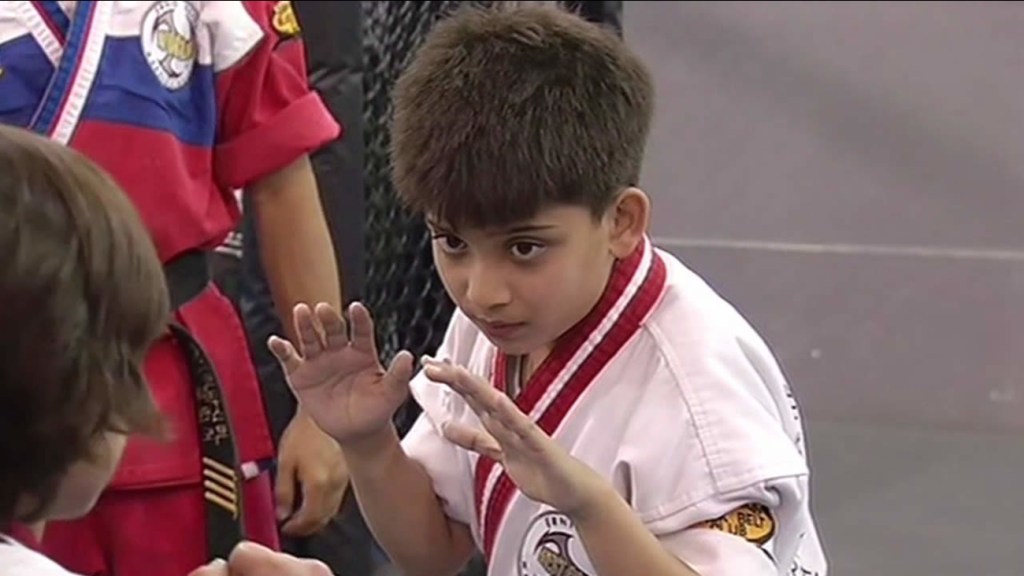
Shoham Das, aged 11

Shoham Das was a young boy from San Jose, who was born with a rare heart condition in which he is missing his right ventricle and in effect only has half a heart. The condition is so rare that it’s thought to afflict only 1 in 10,000 kids. Das has had three open heart surgeries at three days old, six months old and four years old, respectively. This means his endurance tends to be low and he often requires more rest than a counterpart of the same age without this condition.

Despite this condition, Das has been studying Tae Kwon Do and mixed martial arts since the age of 7, and during a weekend in early May of 2014, Das tested and successfully graduated his first-degree black belt at the age of 11. The testing, which required two hours of combined skill in various areas of the art he studies, required Das to have his oxygen levels monitored by his mother throughout, but he was successful and continues to train.

Now if you do the math in your head (and hopefully you don’t actually have to), this means that he graduated his first black belt in only four years, and prior to maturity. Although I’m not a fan of this practice, which seems to be the norm in many modern-day dojos, you can’t argue with the focus and will required to reach this level given the specific ailments Das has been diagnosed with.

In fact, some of Das’ doctors have indicated their belief that all the physical activity and structured study involved in the martial arts has made Das’ muscles and heart tissues stronger, allowing him a better quality of life and to be able to do more without getting tired so easily.

Although Das has a lower endurance than a counterpart without his condition, he’s been blessed to study at a dojo that focuses on the skill rather than the endurance. An aspect in which Das has in abundance. Although many dojos turned him away due to his condition, Das eventually found an instructor who took him in. He kept at it and by last year Das is said to have achieved a third-degree black belt in Tae Kwon Do and continues to train.

Last month, at the age of 16, Das is looking towards the future and is considering a potential career in medicine. You can read about what he’s been up to here: https://healthier.stanfordchildrens.org/en/half-a-heart-and-a-whole-lot-of-spirit/

In the above link, Das has shown to be humble, attributing his health and continued life to his doctors and specialists. It stands to reason that he wouldn’t have gotten this far without them, but there is absolutely no doubt in my mind that the increased strength, discipline and skill he got from training in the martial arts all those years have definitely played a key role.

If you look at this impressive young man’s life and see how much he’s accomplished DESPITE his condition, it may lead you to ask what the hell some people’s problem is. Anything is always more than nothing, and amidst anything else happening in your life, it’ll always be up to you to take yourself in hand and ensure your continued health, whether you have a medical condition or not.

I look back at my life and I have a clear understanding that in order to survive given my personal complications, I couldn’t just sit back and depend on others. I had to stand up and make things happen for myself. Just like Shoham Das. Although he may only physically have half a heart, he’s got more heart than most. ☯

As The World Turns…

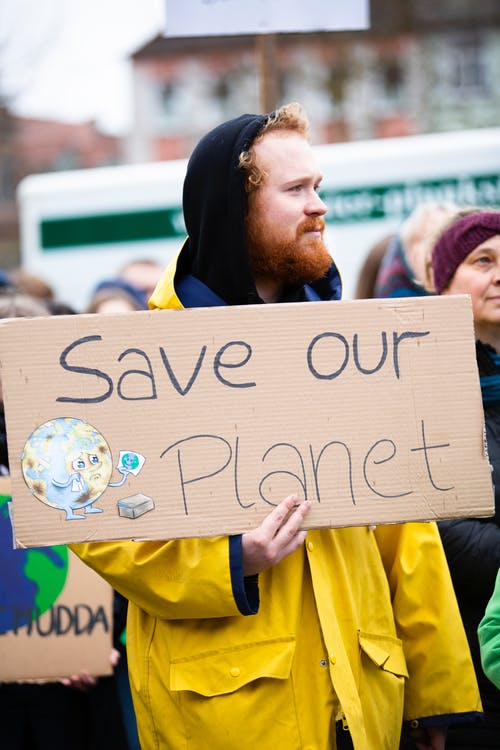
I’m no environmentalist. I’ve done my fair share of wasting, just like the rest of ’em. Having grown up through the 80’s, which most recognize as the decade of decadent waste, I’ve had some bad habits, most of which my parents still have, despite my best efforts to stem them. But despite my past, I’m very keen on looking towards the future. Especially since I’m the father of two young sons who will inherit this planet when my generation steps down.

With that in mind, I’ve been doing some reading on simple ways to reduce my household’s carbon footprint and minimize waste, as much as a single household can. I am very much on board with the concept that big corporations need to be held to task and made to toe the line in terms of the waste they produce, but I also believe that if everyone starts by doing their own little bit, we can certainly improve things. Just to be clear, a carbon footprint refers to the amount of green house gases emitted by any individual, group or corporation.

I’ve recently read about how the current pandemic is having an unexpected positive effect, where air pollution is dropping, water is becoming cleaner and animals are beginning to reclaim some of the lesser frequented areas of the world. It was a good article and posted by a fellow blogger (TheEnlightenedMind622, I’m looking at you) and can be read here: https://theenlightenedmind622.wordpress.com/2020/03/20/coronavirus-shutdowns-have-unintended-climate-benefits-cleaner-air-clearer-water/

Although many believe that we’ve passed the point of no return, I think that some of this proves that it’s never too late and we can all do our part. With that in mind, here are a few easy steps I’ve looked up that you can all do from home:

  1. Have a Recycling Bin: This is a pretty simple and straightforward step, and should be in effect in most Canadian towns and communities. In fact, many locations actually have it legislated in their city bylaws that you WILL make use of a recycling bin, or face monetary penalties if you’re caught tossing recyclables in the refuse. The city we live in has a blue bin program, where they allow for all your recyclables (cardboard, paperboard, cans and such) to be piled into one bin and picked up every two weeks for sorting and sending to the appropriate locations for reuse. My wife is a champ at this, as she’s usually the one to identify the items that can be recycled that I usually overlook. She keeps me on my toes;
  2. Make Use Of Reusable Items: My family and I have a dozen reusable cloth totes and bags in the cargo area of our vehicle. Whenever we do groceries or run errands, we do our best to ensure we’re using our cloth bags as opposed to using the plastic bags provided by most retail outlets. If you must get the plastic bags, be sure to reuse them or recycle them back to the store. Most retail outlets have a bag collection bin, where the used bags are collected, melted down and recycled into new bags. One of the more popular reusable items are travel mugs and water bottles. I have an aluminium coffee mug, and it gets a lot of mileage (ah, me and my caffeine). Just about any coffee chain or restaurant will accommodate a request for your coffee to be served in a travel mug (except for right now, thanks to COVID-19). Aluminium water bottles are also fantastic. If you’re like me and need to consistently sip water throughout the day, a reusable bottle certainly make the job easier;
  3. Use Rechargeable Batteries: If your children are anything like my son, they love their games and tend to consistently burn through batteries. Although rechargeable batteries tend to be a bit harder on the wallet, they essentially pay for themselves in the long run as you don’t need to keep purchasing new ones. Plus, using rechargeable batteries helps to eliminate batteries in the trash, since batteries have their own whole recycling process and most people can’t seem to be bothered;
  4. Preserve Water: You would think this one would be pretty easy, but it’s surprising how much water the average household wastes. Shut the water off while brushing your teeth. It doesn’t need to run while you’re scrubbing. Put in the stopper immediately when filling your sink with dish water. Even if the first ten seconds is cold water, the hot water that follows will still provide the desired effect, and you can prevent wasting litres of water by letting the cold water run down the drain. Men, fill your sink with a couple of inches of hot water and use it to shave. Running the hot water over your razor after every swipe uses WAY more water and doesn’t provide any further benefit; and
  5. Shut Shit Off: Unless you live in a cave or underground, the majority of households can get away with using natural light during most of the waking day. As I write this, I’m sitting in a basement office with a small 1′ x 3′ window, and the Sun’s light is enough to visibly see and work within the office. So the same can certainly be said and done for the average home. Open up your drapes and curtains, lift your blinds and let natural light in, rather than turning lights on. Get into the habit of unplugging electronic devices that make use of a “standby” function, as these tend to use electricity even when not in use.

There’s ton more, and they can be easily found by Googling things like “recycle from home” or “how to reduce my carbon footprint”. Most of these can be done daily as an afterthought and require next to no effort on your part. So why wouldn’t you do it?

This is one of those scenarios where every little bit helps and one of the biggest challenges is teaching these habits to our kids. My son is the worst at leaving lights on, wasting food and walking away with his iPad still running (Damn Paw Patrol!). But it’s a work in progress and if we all do our part, we can mitigate the damage and hopefully even start to reverse some of it. Because I don’t know about y’all, but I rather enjoy drinking clean water and breathing. ☯

All Things Considered…

What’s been happening in the world in recent weeks is certainly stressful and I think I can comfortably speak for everyone when I say that the hope is that this pandemic will pass quickly. With all non-essential services being shut down and the total number of confirmed COVID-19 cases in Canada having doubled since I posted about it two days ago, things are looking bleak.

With families self-isolating and people gathering two-week supplies of everything and staying inside their homes, schools and businesses closing and little to do outside of the routine many of us get so used to, it can be easy to go a little stir crazy. Far be it from me to intentionally break the rules, but certain necessities still need to be accommodated. I’m talking about groceries…

I stepped out of the house to gather some required groceries, and there were a number of things that I noticed along the way. There was a sort of hush over the city. This is saying quite a bit, considering the fact that we live in a suburban area of the city. There are always sounds of car horns, people moving about and the continuous pulse of the city. But not yesterday morning.

There was an eery yet calming silence as I walked to my vehicle. I could even hear birds chirping, which is usually not the norm. As I drove to the local grocery outlet, traffic was light and things felt calm. I didn’t have the typical stress and anxiety I usually experience while running errands, which was kind of nice. Despite the reason behind it, less vehicles in motion, less hustle and bustle and a quieter environment certainly was nice.

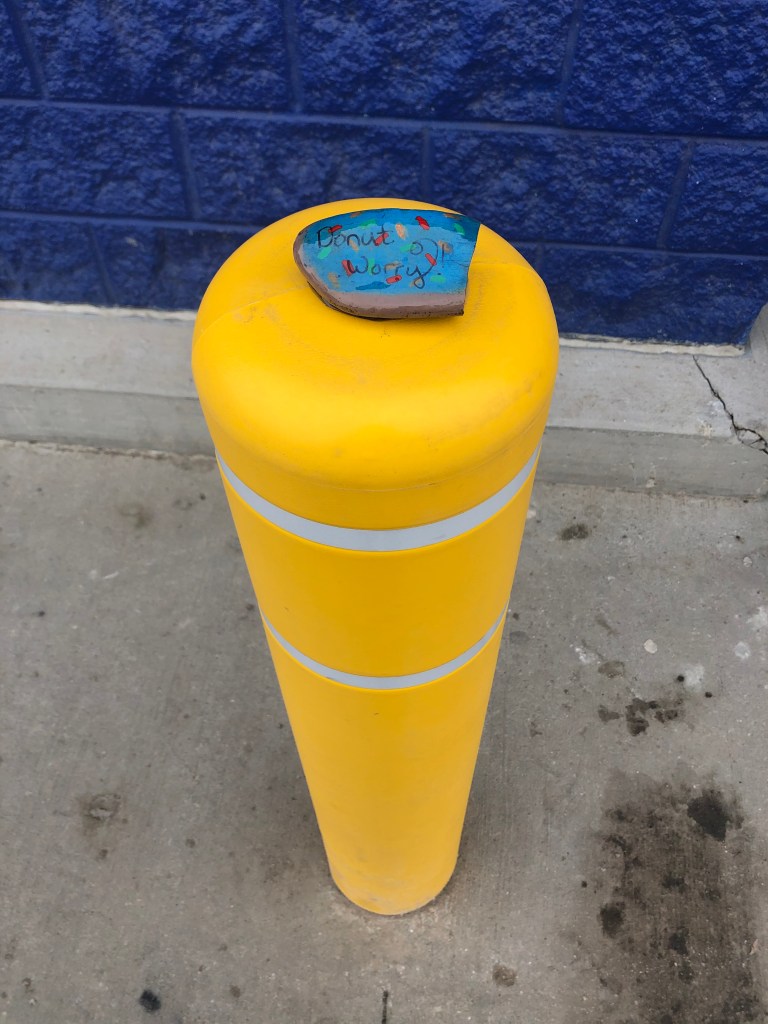
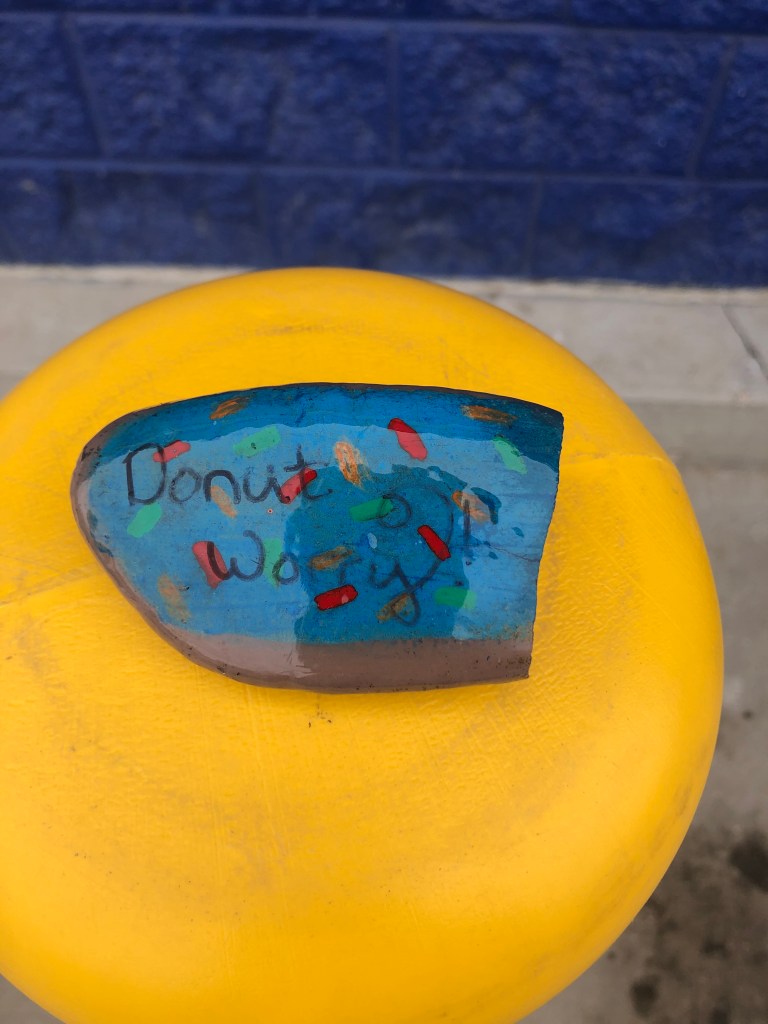
Then I walked out of the retail location I was shopping in, and found something I didn’t expect: a rock! More of a stone, really. But it was painted and polished and left sitting on top of one of the concrete pillars outside the building. It caught my eye, and as I looked closely I noticed that it had the words “donut worry” painted on it.

It was kind of nice to know that amidst all the chaos, some people were still trying to encourage calm and peace. I snapped the photos attached to this post, but left the stone where it sat, so that others could enjoy it as they stepped out of the store.

A close-up of the stone

Despite everything happening in the world right now, there are always little rays of light that shine through. We need only to be receptive to them in order to see them. Stay safe and stay the course. ☯

Love Yourself, And All Your 2000 Parts!

Life is never without difficulty. It seems as though no matter how hard you work at it, there is always a new bump in the road, a new obstacle to overcome and another problem to solve. Sometimes, carrying the weight of the world is more of a burden than the toned shoulders are worth!

We all have aspects of ourselves that we’d rather live without. Some of these aspects are internal; a personality trait or emotional state. Some of those aspects may be something physical, like my love handles. There’s nothing to love about them, really! I joke, but the honest truth is that no matter what aspects of ourselves we don’t like, we really need to learn to love ourselves, flaws and all. If you can do that, then your flaws become strengths. Allow me to provide you with a vague, yet fitting example…

Let’s say you’ve cooked your specialty for dinner. Maybe it’s a meatloaf or a shepherd’s pie; something you’re really good at making (speaking from experience). It’s absolutely delicious and the whole family enjoys it. Unfortunately, there is some left (or fortunately, depending on your perspective). You scoop the leftovers into a tupperware container, intent on enjoying it the following day.

Now, if you forget that the meal is still hot, seal the lid and place your leftovers in the fridge, the heat and cold contrast will create a heavy amount of condensation. When you remove the lid the following day, all that wet condensation will fall onto the leftover food, making it wet and soggy. Do you still eat it? Or do you get grossed out by the prospect and toss it in the trash?

If you chose to toss your leftovers on the trash, you have much to learn. After all, that condensation is actually part of the meal you prepared. The moisture is a byproduct of the heat from the food and the cold from the fridge. The gaseous vapour from the food fall into solid form and collects on the container. Regardless of how you look at it, that moisture is part of the leftovers and shouldn’t be simply tossed aside, even if your perspective of its effect may not be favourable.

The same can be said about yourself. No matter what you feel your flaws or weak points may be, you owe it to yourself to love yourself despite these things. If it happens to be something you can work on and improve, then go to it! If it’s something that you may need to simply accept and learn to live with, this can be a tad more difficult but you can do it. Even if it means you may have to adjust or learn to focus on the positive. After all, you’re worth it. Don’t let the world tell you otherwise. ☯

Stick To Your Guns, And Don’t Be Afraid To Pull The Trigger

Having been diagnosed as Type-1 Diabetic at quite a young age (4 years old, to be precise), I’ve had just about every type of doctor imaginable. I’ve had the detached cynics, who see their patients but are just trying to scrape past the retirement line. I’ve had the eternal optimists, who seem to go out of their way to have you call them by first name and focus on being a friend more than a doctor. I’ve also seen the medical dominatrix types, who basically make you feel like shit and a failure if your last A1C isn’t absolutely spot on. So from a patient standpoint, I’ve pretty much seen it all, Diabetes or not.

There has been a silent tipping of the scales taking place over the past twenty years. It’s been subtle and if you haven’t been paying attention, it’s snuck up on you without notice. I don’t need to tell anybody that waiting to see a medical professional can be excruciatingly frustrating. Increased wait times, doctor availability and sometimes feeling as though you’re being ignored and rushed out the door can all lead to bad experiences and scare you off from going to a doctor, even when you need one.

This tipping of the scale basically involves the internet. I’ve never hidden the fact that the internet and I share a rather love/hate relationship. I admit that I absolutely love the internet for the purposes of education and research, but I loath the effect that social media and the unnecessary propagation of disinformation has damaged our society. But I would be lying if I said that the internet hasn’t been a thorn in the side of most medical professionals. Most doctors absolutely hate “Dr. Google”. And why is that? Wouldn’t it make sense that a doctor would want to get all the help they can to ensure the best diagnosis? Apparently not. And there are reasons behind that.

First of all, unless you ARE a trained diagnostician, you can do more harm than good by going online to seek out the cause of your symptoms. Especially if your symptoms are vague. For example, having frequent headaches does not necessarily mean you’re having migraines. Online symptom checkers can be a real pain in the ass for doctors, especially if you arrive and “challenge” your doctor with a half dozen possible diagnoses that you’ve found online.

According to an article posted on Forbes.com by Robert Glatter, MD, a study was performed four years ago that compared the results of online symptom checking when compared to visiting an actual doctor. He wrote, “When doctors in the study were armed with patients’ medical history and symptoms, and then compared the information entered into a symptom checker, doctors arrived at the correct diagnosis 72% of the time, as opposed to 34% for the apps.”

I don’t know about you, but 72% accuracy doesn’t make me feel all that comfortable when confronted with a possible illness that could be treated by way of medications or other treatments. But it’s a hell of an improvement over the 32% that you would get from using an app. The article goes on to say, “And 84% of the time, doctors provided the correct diagnosis in their top three choices, compared with only 51% for the symptom checkers.”

Here’s the online article, if you wanna give it a read. It’s pretty interesting: (https://www.forbes.com/sites/robertglatter/2016/10/13/doctors-beat-online-symptom-checkers-new-study-finds/#246af81e2d44)

The take-home lesson here is if you want to go on a reputable, peer-reviewed medical site such as WebMD or the Mayo Clinic to look something up, such as Diabetes… What is it? What causes it? Can it be prevented? Etc… That’s fine! The problem is if you go online to find out why your legs might be turning blue and assume you have deep vein thrombosis, when all you did was fail to properly wash your new jeans before wearing them for the first time. This is where doctors and health professionals get pissed and frustrated.

The other side of the coin is no brighter. Because of people’s tendencies to look symptoms up on the internet before consulting their doctor, many medical professionals have started shirking or ignoring what their patients may bring up upon arrival. Don’t even get me started on a doctor’s reaction if you utter the words, “I looked up” or “I read online that…” That’s a surefire way to start a verbal battle of wills. Most medical clinics have extended wait times and many medical professionals have even started limiting the number of things that a patient can bring up during any one visit.

In some respects, it’s rather hard to blame them. The average doctor spends well over a decade of study and training to actually BECOME a doctor. So if you walk in and presume to have diagnosed your problem already by spending two minutes on Google, it only makes sense that they may be offended and dismiss your thoughts.

The best approach would be to ask your doctor questions. Don’t necessarily bring up your online search, but feel free to ask your doctor if what you found is possible and why he or she believes that it’s not. This keeps you involved in the diagnosis process and doesn’t make the doctor feel offended or as though you’re trying to tell them their job. If you feel as though your concerns are being ignored, then say so. And be certain to exercise your right to a second opinion if you aren’t comfortable with what’s being done to help you.

When I was a kid, I literally never waited more than 15 minutes to see my doctor. Once in, I’d be greeted with a handshake and we’d talk about how my Diabetes was doing, how I was managing with my current medications and what life and family issues may be affecting all of it. Nowadays, seeing my personal physician includes well over an hour’s wait, followed by a five minute visit that usually doesn’t even involve reviewing my most recent blood results or Diabetic issues. Times have changed.

As the world continues to turn, we all have a tendency to turn towards the World Wide Web for answers. After all, we have the world’s knowledge at our fingertips. And although all the information required to become a doctor may be available on the internet, it doesn’t mean you have the skills or knowledge to use it. As far as doctors go, they could probably stand to lighten up a touch and be willing to listen more. Because as time passes, the growing trend of doctors using online resources is increasing, as well. Food for thought… ☯