
I found this online a few days ago and I thought I’d share it. Its probably surprising to read a post of mine that doesn’t involve lists or long convoluted explanations about something, but sometimes you just gotta keep things simple. Enjoy! ☯

I found this online a few days ago and I thought I’d share it. Its probably surprising to read a post of mine that doesn’t involve lists or long convoluted explanations about something, but sometimes you just gotta keep things simple. Enjoy! ☯
When faced with a medical condition you know nothing about, people will often make their own assumptions. One can hardly blame them, especially if their education and/or upbringing has provided some “seeded” information that they believe to be true. This is one of the reasons why I find it extremely interesting when someone decides to get past the fear voicing those questions, especially to someone living with the condition.
Enter the big question of the week: “What will happen to you if you don’t have insulin?”
The short answer is that I’ll die. There you go. Thanks for reading. It’s actually a bit more complicated than that, but that’s the short of it. The answer not so much involves the “if” I’ll die so much as it involves what I’ll die from. The bottom line is that before the arrival of insulin, people with Diabetes just didn’t survive. Simple as that. Once diagnosed, they slipped into a coma and died.
Just to be clear, I’m referring strictly to Type-1 Diabetes. For people with Type-2, whether using insulin therapy or not, their life expectancy can extend as long as years, depending on the specifics of their condition, diet, age, exercise and all that fun stuff. But for the average Type-1 Diabetic that can recognize early symptoms and takes precautions, the average life expectancy without insulin is believed to be about 7 to 10 days at most. Nice, eh?
“But why don’t you just diet and restrict yourself from carbohydrates, and exercise more when your blood sugar rises?” Very good question, anonymous person! Here’s the answer…
According to an article posted on Healthline.com, without insulin, your body can’t use glucose as fuel and begins to break down fatty tissue as a replacement, which causes those fats to turn into acids called ketones. These ketones build up in the bloodstream and eventually get expelled through one’s urine. However, when these ketones accumulate in the bloodstream, the blood starts to become acidic. This causes a condition called Diabetic Ketoacidosis.
Ketoacidosis is usually the condition that winds up killing the patient, but some of the symptoms may get to the patient first. These symptoms can include dehydration, shock and slipping into a comatose state. Here’s the HealthLine article, if you want more details: https://www.healthline.com/diabetesmine/ask-dmine-lifespan-sans-insulin#How-did-people-with-type-1-diabetes-survive-historically?
So no, the easy answer is that I can’t simply stop eating carbs and exercise more if my blood sugars rises to dangerous levels. The unfortunate reality is that this would be like sticking a piece of duct tape to stop a crack on the Hoover dam! Eventually, DKA would take over and my blood would turn acidic, effectively killing me despite my best efforts. This is why good blood sugar control and proper insulin therapy is so necessary.
The best way to maintain your health and stay alive, other than proper insulin therapy, is to stay hydrated and recognize the symptoms of DKA before they hit. Your body will cramp and ache everywhere, you’ll fall into the “endless diabetes cycle” of drink, pee, repeat and you’ll likely have confusion and bad breath. This is why it’s important to check for elevated ketone levels if you’ve suffered extreme high blood sugar, as the ketone process may have begun even if you’ve corrected your high with insulin.
Just one more aspect of Type-1 Diabetes that we have to worry about! But this is an easy one to prevent and manage, so long as you adhere to your insulin therapy, stay hydrated and watch your blood sugar levels carefully. Diabetes is already believed to shorten a person’s life expectancy; no need to give it any further opportunities. ☯
We recently suffered a loss in our family… It’s been hard and we’ve been coping as best we can, but there’s little that can be done to get past the deep feelings of grief and loss… from our Keurig machine breaking down! Alright, my apologies for tugging at your heart strings, but coffee is pretty damn important in my daily routine.
I’ve had a coffee pod machine for years, in some iteration or another, and I got the first one in 2013 as a gift to my wife. We’ve had one model or another since then. A few weeks ago, we started to notice that our Keurig machine started brewing a much lower amount than it used to. All “pod”-based coffee machines tend to succumb to various issues over time, including erosion or corrosion of their inner tubings and workings. Most of them have to be descaled and clean on a regular basis, but eventually even that no longer works.
I had the genius idea of taking our current machine apart and seeing if I could clean its inner workings myself. But once the bottom panels were removed and I got a look inside, I was taken aback by the amount of electronic components it contained. I’m not a big fan of trying to fix something electronic that uses water, so we “retired” the machine. It was a pretty nice one, as it only held enough water for a single cup, preventing the usual issues that come with a large canister of water.
It got me to thinking about the little, everyday pleasures that we take for granted. With most things closed for business, doing something as simple as enjoying an espresso on the terrace of a local coffee shop can’t happen. So, it’s important to find some new “little pleasures” in your everyday life that you can indulge, despite the current issues facing the world.
Coffee and caffeinated drinks are a pretty customized and personalized experience in our household, with my wife and I preferring different blends and brews of coffees. This presents a challenge when faced with only one coffee machine. But we’re making it work (especially since I enjoy an energy drink, first thing in the morning) and their are bigger problems in life. Stay caffeinated, people! ☯
Having Type-1 Diabetes is expensive! I’ve spent the majority of my life saying, “I can’t afford to have Diabetes…” And with good reason, considering the cost and expense that goes into everything required to help keep us not only alive, but in good health.
In Canada, the average cost for a bottle of long-acting insulin such as Lantus (this is the type of insulin that would provide basal coverage over a full day) is about $80. A bottle of short-acting insulin, like Humalog, will run you anywhere between $35 to $40 a bottle. And if you’re anything like me, you may require two to three bottles of that sweet stuff in a month.
Now if you’re lucky, a bottle of long-acting stuff will get you through the month. So according to new math, you’d be looking at well over $200 a month for JUST the insulin. Don’t even get me started on the cost of syringes, needles, blood glucose sticks and various other supplies required to maintain oneself in the wonderful odyssey that is Type-1 Diabetes. If you don’t have some sort of medical coverage or benefits, it can be a life-threatening issue.
This is why it’s always so heart-warming to hear about something that helps to alleviate or lessen the burden, financial or otherwise. I just recently read about a bill passed by the Illinois state legislature in November of 2019, which puts a price cap on out-of-pocket cost for insulin at $100. Illinois’ Governor signed the bill into state law in January, with the law taking effect in Illinois in january of 2021.
Illinois will be the second state to pass such a law after Colorado, with several other states beginning to follow suit with bill of their own. An article posted by Newsweek provides further details, including outlining the increasing issue of some people dying from rationing their insulin supplies or skipping doses, to being unable to afford their insulin. Here’s the article: https://www.newsweek.com/illinois-becomes-second-state-cap-monthly-insulin-prices-more-states-are-considering-it-1483987
This is a fantastic step, but obviously it’s only a beginning. To be clear, this price cap applies to a patient’s co-pay, and not to the cost of insulin when purchase over-the-counter. This does not prevent drug manufacturers from charging increased prices for the sale of their products. It is said that in the United States, the price of insulin has tripled over the past decade.
Although this article is based on pricing and laws from the United States, the situation is very much the same in Canada. I remember the difficulties and financial strain I had to deal with, all through my 20’s and into my 30’s, due to the fact that I had no medical benefits to help take the burden of cost off my shoulders. It will be a wonderful time, when governments come to realize that life-saving therapies such as insulin should be made available, free of cost. ☯
If you’re anything like me, the day or two after an extreme workout will have you feeling like hell. For the most part, this sensation is temporary (see my post from four days ago entitled, Grin Through The Pain) but it can often feel as though you need an extra little something to help your tired and sore muscles along; especially if you work out frequently.
Under normal circumstances, one could easily include certain medical professionals in their training routine such as massage therapists, acupuncturists and chiropractors, bearing in mind that the three provide different functions. But with the current state of the world, it’s difficult to find a productive way of getting the same relief for your muscle tissues. Heating pads and over-the-counter pain killers can only take you so far.
This is where foam rollers come into play. Foam rollers are reasonably popular with athletes nowadays, and they first came into play in the late 1980’s when physical therapist Sean Gallagher began using it as a self massage tool. But like everything else, there’s some good, bad and ugly associated to using one.
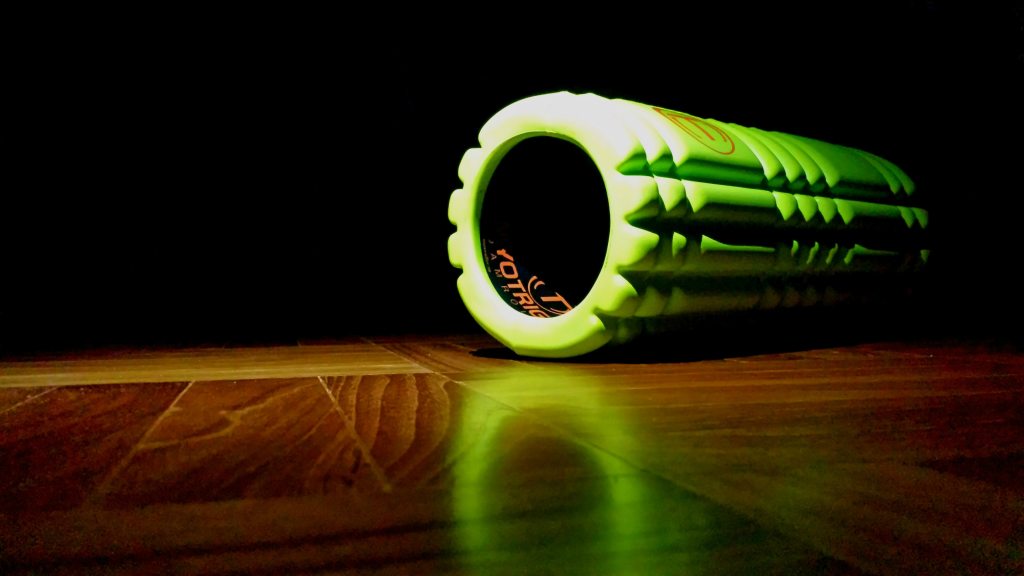
The proper use of a foam roller will help to ease knots and tightness, increase blood flow through the muscle tissue and help loosen scar tissue. All of these things will significantly help with recovery time after an intense or gruelling workout. You can use a roller before and after a workout, to help with stretching and the prevention of injury.
Another good use for a foam roller is if you spend your day working in a sitting position or if you got a kink somewhere from improper sleeping positions. According to an article posted on Healthline.com, foam rolling has a number of benefits including but not limited to easing muscle pain, increasing your range of motion, temporary reduction of the appearance of cellulite, relieves back pain, helps to manage fibromyalgia and is a handy tool for relaxation.
It is advised that one needs to be careful when rolling and that one should avoid rolling over joints and to avoid foam rolling if you have a muscle tear or a break. There different types of foam rollers, including smooth rollers that are suggested if it’s your first time rolling and textured rollers that work deeper into the muscle tissue. Here’s the Healthline article: https://www.healthline.com/health/foam-roller-benefits
Like anything else, consult your doctor or medical professional before starting any new fitness routine. But foam rolling can be a reasonable addition to your at-home workout routine. It won’t completely replace a registered massage therapist, but it can provide some relief during trying times. ☯
Having all this free time as a result of self-isolating, I’ve found myself surfing the web and doing things that I generally wouldn’t do. And no, before any of you perverts get the wrong idea, I don’t mean anything lewd or weird. One of the things I’m referring to, is looking up old friends. Since I don’t have Facebook or any other form of mainstream media, this is a bit of challenge and required the people in question to actually have searchable aspects available through Google and such. I found one such friend a short time ago…
Since I’m not a big fan of being sued, I’ll keep the identity of this person to myself, especially since we haven’t spoken in over ten years. But I found a Twitter feed that I was quite certain was a friend I used to work with in Ottawa about twelve years ago. I was optimistic and looking at possibly reconnecting with him, until I read a recent post on Twitter he sent which read, “Thanks China, for fucking our planet!” I was taken aback and quietly hit the back button and got the hell out of there!
Ignorance and lack of education on specific topics can often lead to such assessments as this Twitter feed. And there seems to be a movement taking place, where people of any Asian descent are starting to be discriminated, judged and blamed for the current pandemic. Like the virus itself, it’s already spread enough that you can Google “China” and “blame” in the same search string and find TONS of links related to this very thing.
According to an online article posted by The Guardian, “[…] Chinese Americans, and other Asians, are increasingly living in fear as the Coronavirus spreads across the country amid racial prejudice that the outbreak is somehow the fault of China.” It doesn’t help that the American President is promoting this racism by referring to COVID-19 as the “Chinese Virus”, a term that he’s repeated and confirmed on more than one occasion since all of this started.
This trend is spreading, with incidents of negative reactions to Asians who happen to be wearing face masks or cough in public, racial harassment and even cases of assault against Chinese and Asian people in general. Here’s the article if you want to check it out: https://www.theguardian.com/world/2020/mar/24/coronavirus-us-asian-americans-racism
The big problem is that people have been focusing their anger against the people instead of the problem. And believe me, there’s plenty of blame to go around. Between the time it took for accurate and complete information to be shared with the World Health Organization, people who are STILL hanging out in groups in public and refuse to self-isolate or the ones who continued to travel, either through ignorance or from a sense of needing to get home, society’s inability to take this pandemic seriously and choosing to blame others instead, there are plenty of contributing factors behind the continued spread of the virus.
Racism has always been a problem. And despite how far we’ve come as a society, racism isn’t dead yet. There’s still a lot of work to do. And we can’t let the current issue cause us to slide backwards. I saw an image of an Asian woman holding a placard that read, “My ethnicity is not a virus.” This is an important message, because people need to stop believing that the Asian people are at fault. One does not lead to the other. As stated in the article I linked above, “We have to acknowledge everyone’s humanity at this time because the virus doesn’t know race or colour.” ☯
Yes, you read the title correctly; I stole my wife’s bike! Although a borrowing a marital property can hardly be referred to as theft, and she knew I was boring it. It was 14 degrees Celsius in Regina, Saskatchewan yesterday afternoon (although it may have reached higher but that was what I saw when I checked). As such, I decided that it would be a good idea to spend some time outside for the day’s workout.
Last year I logged a reasonable number of kilometres over the warmer months on a bicycle, and I discovered a love for it. I even cycled to work, on a number of occasions, which happens to be about ten kilometres away. The best aspect of cycling is that it’s a low impact exercise, so the past three and a half decades of wear and tear on my knees from full-contact martial arts doesn’t impede my ability to peddle.
There are a number of measurable benefits to cycling, including but not limited to;
As long as you push and bike hard for at least 30 to 60 minutes, several days a week, you’ll get a good burn and see some noticeable results.
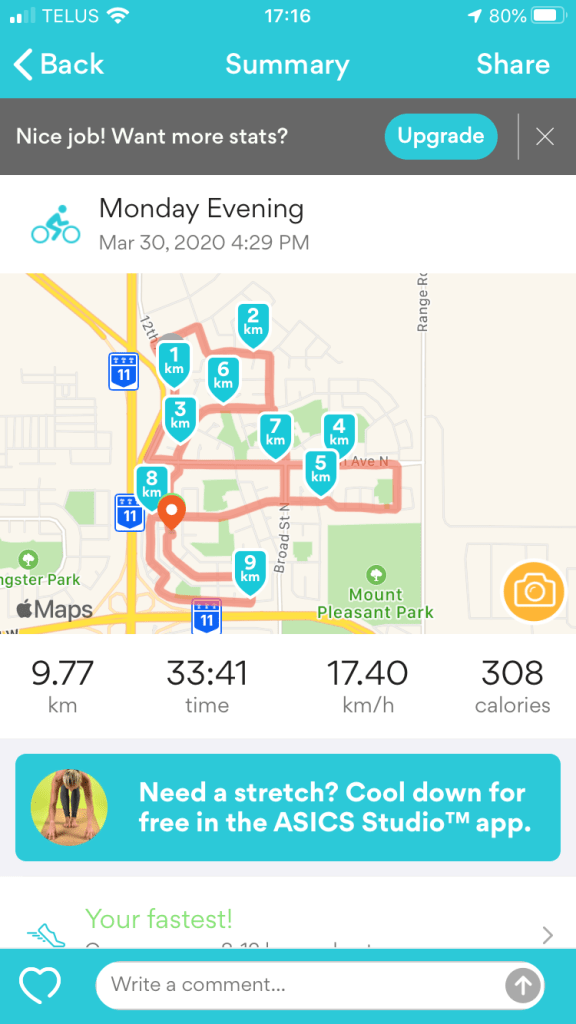
I stepped out of the house shortly after 3:30 p.m. and pulled my bicycle out of the garage. It had been sitting there all winter, so I knew I’d have to lubricate the chain and gears, as well as inflate the tires. The first two items went off without a hitch. I hit a hiccup on the third…
Using a small hand pump, I inflated the rear tire. When I moved to the front tire, I worked up a sweat trying to inflate it, to no avail. It was soft to the touch and had no firmness whatsoever (I just heard it, get your mind out of the gutter!) I started my car and plugged in a small emergency compressor that my father-in-law gave us for Christmas. I used it to inflate the front tire. Success!
That success was short-lived, as I could hear an audible hiss that resulted from the front tire deflating. I had a leak. This is not surprising, considering the bike was in the garage through the cold of winter, and rubber tends to crack under such conditions. I was pissed. Given the temperate weather, dry roads and the need for a workout, I was hell-bent on getting behind a handlebar.
I brought out my wife’s bicycle and repeated my prep cycle: lubricate the chain and gears and inflate the tires. No issues, and within minutes I was on the road. I pushed and peddled, all while singing along to Kenny Loggins’ “Nobody’s Fool” (It’s an awesome song, theme to Caddyshack II. Seriously, YouTube it!)
Once I started peddling, I felt it was hard to stop! I ended my run at just under 10 kilometres, feeling great! I think my wife may have lost her bike for the summer (at least until I can repair my front tire). Despite the current state of the world, there’s still plenty of opportunity to get some exercise and fresh air, so long as we stick to social distancing protocol. ☯
“Just As Ripples Spread Out When A Single Pebble Is Dropped In The Water, The Actions Of Individuals Can Have Far Reaching Effects.”
– Dalai Lama
One of the most important aspects of our existence is karma. Lots of folks refer to karma, usually in an angry context. “Karma will bite you in the ass” or “Karma will get you” are popular ones. People rarely concern themselves with their own karma or how to influence their own lives through their own actions. And I think it says something about modern society when we’re more concerned about someone else’s negative actions rather than our own.
Karma is the totality of everything you do in life, and the resulting energy that ultimately decides the outcome of your life and potentially future lives (if you subscribe to such beliefs). In layman’s terms, what goes around, comes around. So if you do bad, you get bad. If you do good, you may get good. Clear enough?
Another way to look at it is causality. Cause and effect. This is a phenomenon that describes that an action or event will result in the production of a new action or event, usually believed to have been at least partly caused by the original action or event. This means that every action has a result. So if you do something wrong or bad within the scope of your own existence, you’ll likely cause a negative result.
I find that a lot of people tend to do things on a whim, good or bad. And they’ll move on with their lives and forget about the things they’ve done, regardless of the result it may have had on someone else. This is a big part of the issues I’ve been dealing with in recent years. One person’s negative actions have caused immeasurable damage and chaos within my own life. But despite the fact they may have moved on and forgotten about the problems they’ve caused, eventually karma will catch up with them and everyone at some point needs to pay the piper.
As described in a movie I once watched about Bruce Lee’s life, you drop a pebble in a pond, you get ripples… Soon, the ripples cross the whole pond. I believe that the message was that your influence can be far reaching. However, it can also mean that any action on your behalf, good or bad, will affect other people. So make sure you make them positive. You never whose life you may damage. Or improve. ☯
One of my biggest fears when faced with the current state of the world is the after-effects that will continue to linger within our society. For the longest time, we’ve been a society that tends to ignore the world around us. Unless we happen to be online, where most people suddenly become activists, politicians and armchair warriors who always seem to know better. But I digress…
There are many cultures around the world who have ALWAYS practiced social distancing, so the recent pandemic hasn’t create anything new. However, for the folks who haven’t done it before, social distancing may have effects that will take years to recover from. If you’re an outgoing person who enjoys being among the masses, suddenly being locked away in your home can have detrimental physical and emotional effects.
I’m sure you’ve all seen some of the memes and jokes online about social distancing; like the group of dads having beer in the street in a large circle, standing six feet apart. Social distancing has been blatantly difficult for some people to accept and maintain, despite its necessity in helping stem the current spread of COVID-19.
In fact, according to an online article posted by USA Today, large-scale social distancing is required in order to prevent the virus from running rampant and overwhelming the healthcare systems in respective countries, leading to large numbers of fatalities in the coming year. The article goes on to explain that we are nowhere near to ending social distancing and that we NEED to maintain it, in order to stem the propagation and bring an end to the pandemic. (https://www.usatoday.com/story/opinion/2020/03/26/coronavirus-pandemic-growing-too-fast-stop-social-distancing-column/5083173002/)
Despite this requirement, the need for everyone to come together has never been greater. Isolation, whether with family or alone, can involve a number of problems that we may not recognize before they become serious. Depression, hopelessness and the use of drugs and alcohol can become very real aspects to cope with the current state of self-isolation. It’s important to remember that there are a lot of ways, especially in today’s modern world of technology, to stay in touch and communicate with people, thereby maintaining social contact and preventing the dissolving of society.
This is one of the rare occasions where social media can be an asset. Although still a nasty source of false news, misinformation and a destructive means of sharing private information, social media’s ability to help people stay in contact despite long distances can’t be denied. I know that a number of my family members make use of Facebook and other means of online communication in order to stay in touch with friends and loved ones.
A handy tool that many people seem to forget about these days, is the telephone. What with texting and social media, most folks seem to forget that the plastic brick in their hands is actually intended as a means of verbal communication that was invented over 140 years ago!!! Despite the fact tat we live on opposite ends of the country, my mother and I speak by phone every few days, even if only to stay in touch (cue the mama’s boy jokes, here).
My point is that we need to ensure that we don’t begin to accept social distancing as the norm and begin to shy away from in-person contact with each other. It may be necessary in the here and now, but when the smoke clears and the pandemic is over, we will need to rebuild social bridges and allow ourselves the benefit of each other’s company. The worst thing that could come out of all this, is to survive it all just to become xenophobic against society for fear of what else may happen. After all, there will be a lot of work to do once every steps back out into the sunlight; and we’ll need each other more than we probably understand. ☯
With all the difficulties in the world and how much suffering everyone seems to enjoy spreading, sometimes it’s nice to share a story of something nice done by others. I always try to push karma in the right direction, and it makes me happy when I see that others are able (and willing) to do the same.
We have a family SUV that we use for daily errands and such, but I have a personal car that I use for going to work and any medical appointments and such that I may have to attend. Given the current state of affairs in Canada, and the fact that saving money is always an important concern for any family, my wife and kids travelled with me to Saskatoon for my last eye injections.
This means that my car has sat idle in our garage since sometime in January. Despite the fact that it’s not really an OLD car, it tends to die out if I forget to unhook the car battery between Saskatoon appointments. This is exactly what happened in this instance. I had the car parked in the driveway at some point in January, and our neighbour (who goes way out of his way to be helpful and we love him) asked me to move the car so he could snowblower our tandem driveway.
I pulled the car into the garage, which is unusual for me. I normally back it in so that I can unhook the car battery. But I didn’t. So the car sat there, with the latent background electronic systems using up battery power, for about two months. So yesterday, I decided to check the car and get it some fuel. I turned the key. Nothing. Brutal. So I used an energy pack to boost the car and headed down to a local gas bar to fuel up.
The beauty is that gas prices are actually REALLY good right now. It cost me less than 40 dollars (Canadian) to fill the tank from less than 1/8th. I had two twenty-dollar bills on me, so I gave it to the pump attendant and told him to use the change to buy himself a coffee. Seems like a trivial thing, but I’ve been where he is, so I figured it would be appreciated.
I was walking on air from the low gas price, until I paid for my fuel and tried to start the car. Not a sound. Fuck. It’s only a five minute drive from my house to the gas bar, so I had to assume that I hadn’t driven long enough to allow the car battery to build up a charge to allow me to stop and start it again.
I ask my pump attendant if he had a power pack to boost my car. He, and one of his coworkers, came out and hooked everything up in order to jumpstart my car. It didn’t seem to be working. A random stranger came over and offered to help push my car so that I could pop the clutch to start the car. Luckily, the car turned over and started. I was unconditionally grateful and thanked all three men for their help and assistance before driving away.
Rest assured, I drove around the neighbourhood for a while and charged up the car before backing it into the garage and unhooking my battery. But it got me to thinking about how some people will still go out of their way to help a total stranger. I mean, those gas bar employees didn’t HAVE to boost my car. And that random customer didn’t have to come offer to push my car to start it.
Sometimes we forget that a random act of kindness can mean the world to someone. It may seem like nothing to us, but it can make all the difference to the person you’re doing it for. Those guys probably carried on with their day and totally forgot about boosting my car, and hour after I pulled away. But the fact they helped me without any gain showed me that there’s still good in the world.
We get so busy with our daily grind that we sometimes forget that there’s an entire world around us. Don’t be afraid to do something nice for someone, even if it’s someone random. Not only is it good karma, but you’ll better for it. ☯

