I first heard the quote in today’s title all the way back in the early 1990’s when I started reading Robert Jordan’s Wheel of Time series for the first time. At the time, I thought it was just a cool quote, “Duty is heavier than a mountain, death is light as a feather.” It’s a quote that the main protagonist ends up carrying with him throughout the entire series. Since the release of the books, many people have been quick to point out that the quote actually comes from an old Japanese military text (myself included, since I wrote about it last year).
But by the time I had reached the end of the series, the expression had come to mean a great deal more to me than simply a line in a book. And in truth, there are a lot of values that are important to me; loyalty, honor, duty and obligation. These are things that are surprisingly not thought about in any great depth by most people. But the martial arts (at least traditional schools) are steeped in these values. And I’ve grown with these values ingrained as part of who I am.
“Loyalty Above All Else, Except Honor…”
– Lt. Vincent Hardy, Striking Distance
Doing the right thing should be easy. People think it’s hard to do the right thing, but it really isn’t. Unless you’re values are a bit shady, doing the right thing should come smoothly and easily and should be done without thinking. It shouldn’t be a chore, it should feel like what you’re SUPPOSED to do; because it is. It should be. Key word: should. Sometimes, it can be harmful to yourself to do the right thing because it can cost you.
Doing the right thing can sometimes take something from you that you endeavoured to obtain for yourself. So the important question becomes, if you know that being loyal and doing the right thing will take something important away from you, do you still do it? Yes. The answer you’re looking for is yes…
Duty is ever-present. There will always be things in your life that you have a bound duty to, so you should roll with that. Honor is always important. It helps you to do what’s right, even when it seems hard. Loyalty should be earned. But if someone in your life has become important enough to earn that loyalty, then you should be true to that loyalty to the best of your ability. ☯
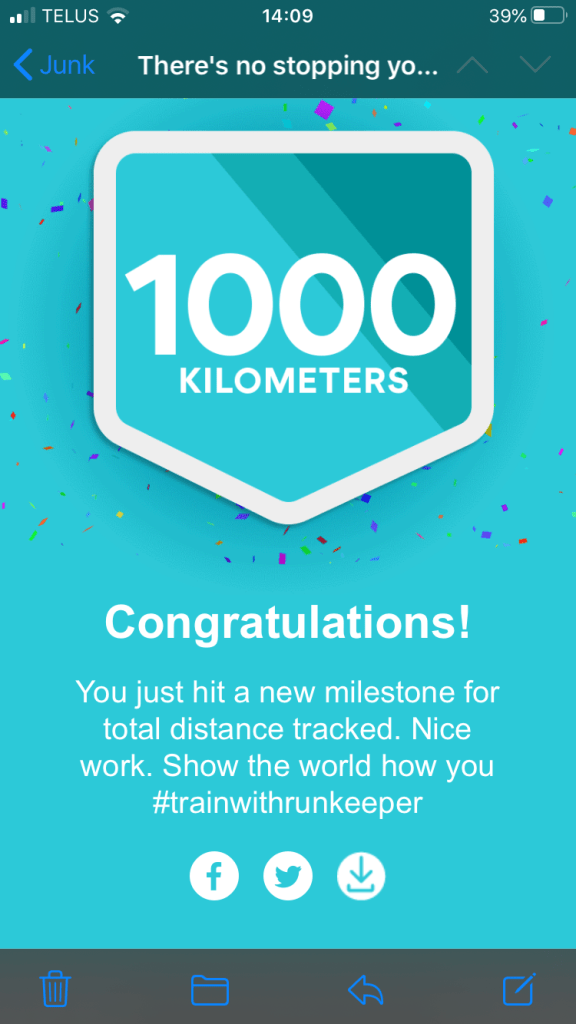
So after using yesterday’s post to bitch, whine and complain about Mother Nature’s unending use of the Prairie Provinces as her personal whipping ground with the non-stop wind, I got an e-mail from my RunKeeper app yesterday indicating that I’ve apparently hit 1000 kilometres this year!
I had some recent issues with my workouts not syncing up to my RunKeeper account, so even if I’ve been counting the number of workouts I’ve been doing per week, none of the statistical stuff has been uploading. I sent in a message to their support link and got a solution the same day. Once I cleared the syncing error and all the workouts synced, I got a batch of emails. One of them was the image you see above.
Considering I reached the 500k mark back in late May, I’m somewhat surprised that I got here this quickly. But either way, it feels nice to be up in the thousands. It will be interesting to see how many more kilometres I can rack up before the colder season kicks in and the snow hits the ground! ☯
Last Monday was a Civic Holiday (Saskatchewan Day for us), and most of the city was quiet and businesses were closed. My wife had the day off and since the temperature seemed pretty mild, I thought it would be an ideal day to try and achieve 70 kilometres on the bicycle. I had discussed this plan with my wife a few days prior, and given the amount of time that it would take me to reach this distance (I cycle at about an hour for every slice of 20 kilometres, give or take) she suggested that I leave during the early morning hours in order for it to be cooler outside and so that I wouldn’t lose the majority of the day to my trek.
I decided to take her advice and set my alarm for 6:30 am. I probably could have gone a bit earlier, but COVID has made me a bit lazy in my old age, and getting out of bed is a definite “not like” for me. My CGM sensor was scheduled to need replacing in the next four hours and I knew I wouldn’t be home in time, so I opted to remove it and simply run without for the duration of my trip. I loaded up the satchels on my bike with cereal bars, protein sticks, electrolytes and jelly beans. I checked the inflation on my tires and I took to the road at about 7:30 in the morning.
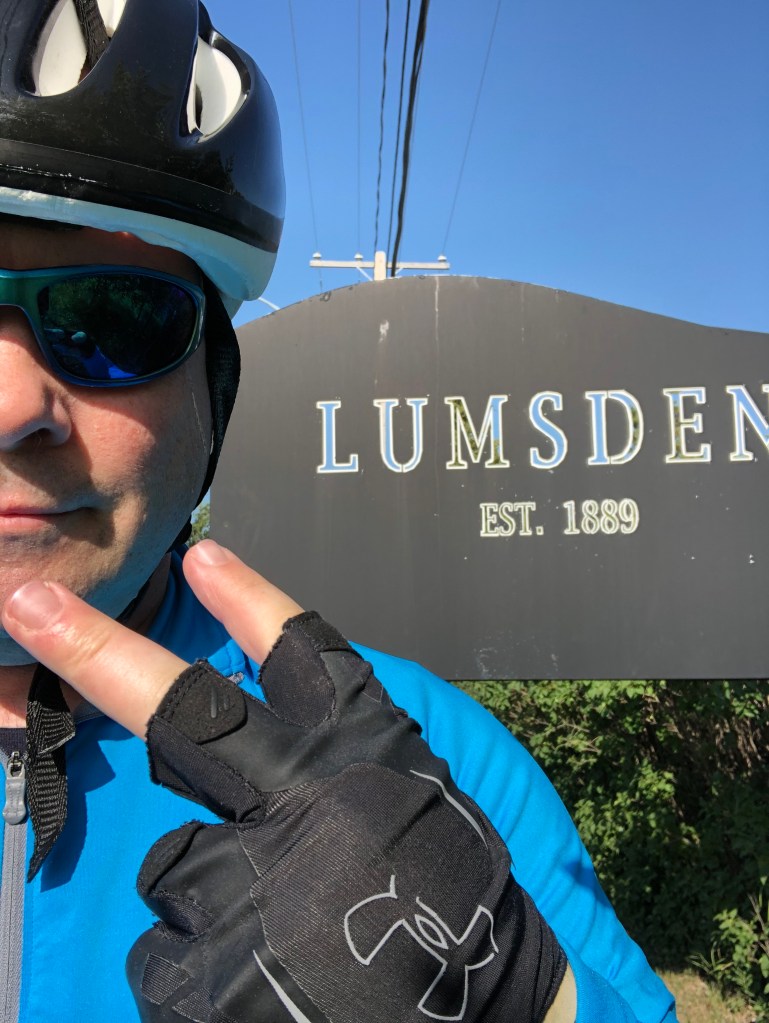
The first leg of my trip went flawlessly. My goal was to take a 35-kilometre route to a local community called Lumsden, stop for a light bite to eat and make my way back. My plan was to use secondary Highway 734, since it had a paved surface but would be quieter than the busy, four-lanes Highway 11. It also takes a roundabout route, allowing for a longer mileage. I had tunes going, my mileage was being tracked by my Runkeeper app and I even achieved 10 kilometres in 20 minutes, which was a speed goal I had been trying to achieve the week prior.
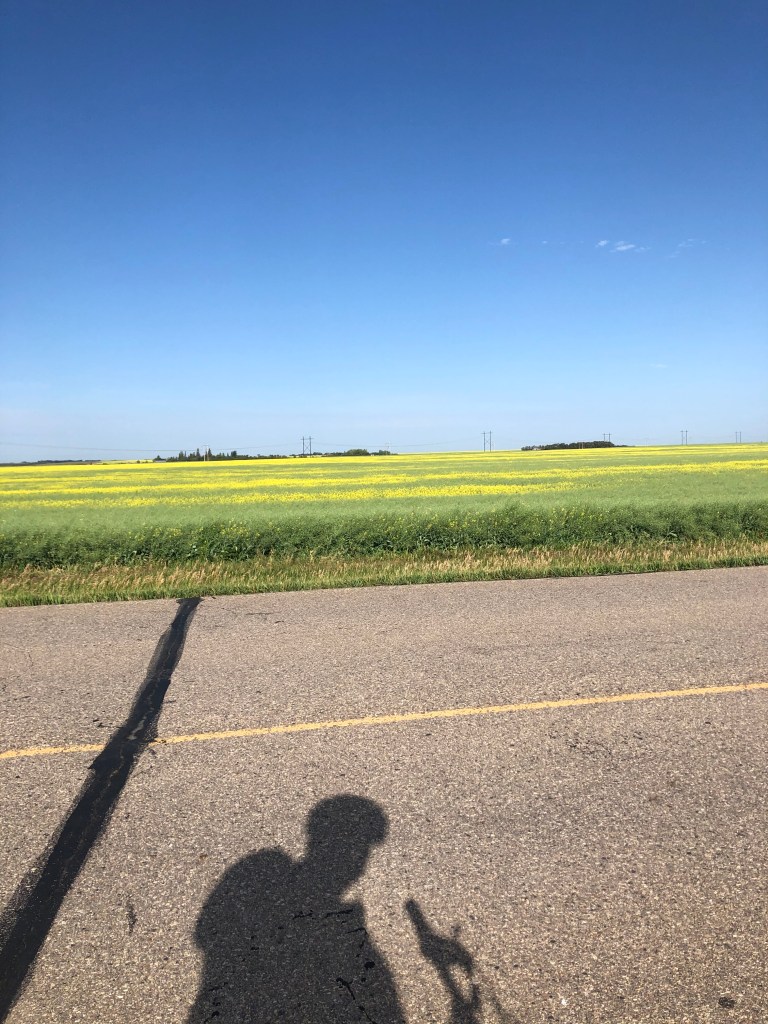
My view of the bright, yellow Canola fields along the highway
I managed to reach Lumsden in just short over an hour, but the route I used only took 29 kilometres! You’d think this would be a good thing, but it meant I’d have to find a different, longer route in order to get home otherwise I’d have to spend time lapping my neighbourhood streets in order to hit my 70. I examined the map and decided on a route that should have allowed me to reach my goal.
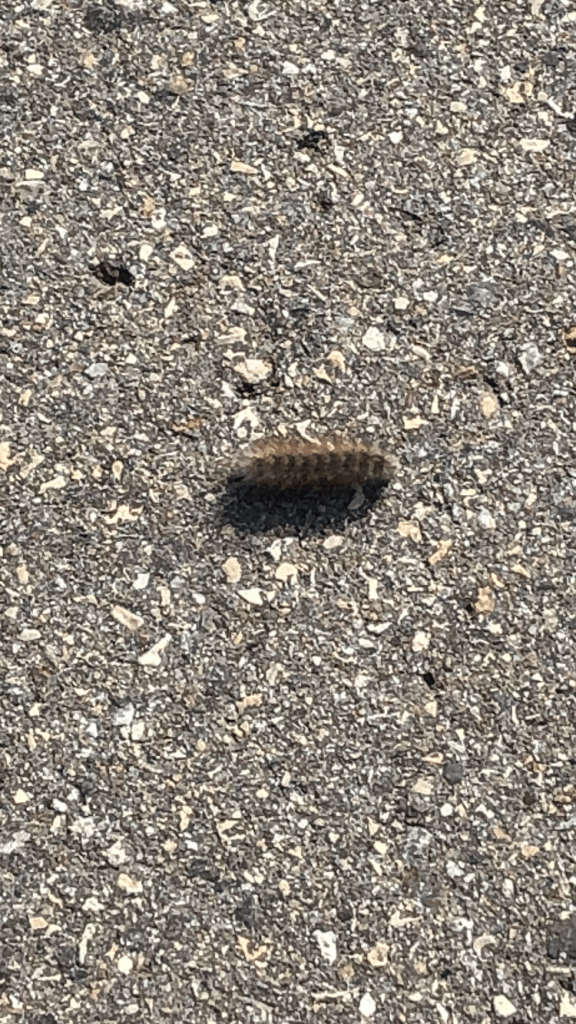
I had plenty of company on the road, despite the light traffic. Between prairie dogs, horses and cattle in the fields and the dozens of caterpillars walking about the road surface… Since it was a fairly chilly morning, the caterpillars are drawn to the asphalt’s heat, which it absorbs from the morning sun. But before I go off on a tangent, let’s get back to the ride…
One of the many fuzzy companions I encountered
Not only was I sitting on cloud nine from the speed I had used to reach Lumsden, I was pretty confident that I would be able to get back home in roughly three hours’ total, which would have signalled a whole bunch of achievements in terms of time and distance. But as I often say, life doesn’t care about one’s plans. And in this instance, nature and technology had a much different idea of how my morning would go.
First, I experienced the AWESOME pleasure of climbing the Lumsden hill on a bicycle. In case my sarcasm isn’t quite oozing through my typed words… It was ridiculous. Then I hit the top of the hill into the open area and got hit by wind. Directly. Into. My face. It was the kind of wind that brought me to a complete stop as soon as I stopped pedalling.
I know that a lot of people joke about how flat Saskatchewan is, but does there seriously have to be this much wind ALL THE TIME??? All the time I gained during the trek towards Lumsden was blown out of the water by trying to ride against the wind over the next three hours. It didn’t take long for me to become exhausted and with the lack of CGM, I was curious as to how my blood sugars were doing.
I stopped on a quiet stretch of highway and tested my blood. I was sitting at 4.1 mmol/L, which isn’t a HUGE issue but since I still had about 20 kilometres to go I thought it would be a good time to stopped for a snack. I texted my wife to let her know I was still alive and stuffed my face, followed by some electrolytes. I got back on the road and kept struggling against the wind.
Then, right in mid-song, my phone went quiet. I stopped and checked on it, only to find the the battery had died. This struck me as odd since I’ve often cycled for four hours or more and still got home with a charge. So now, not only had I lost my ability to track my progress, I also lost any means of communicating with my wife (or emergency services, if need be). There’s a certain psychological effect to recognizing that you’re in the middle of nowhere with no means to call for help, if needed.
I made my way home and realized that as I was angry at the fact it was windy. And then I realized? Is there any point to being angry at the wind? After all, the wind is a natural occurring phenomenon. It serves a number of purposes in nature. It wasn’t INTENTIONALLY making my ride tougher, despite the fact that I kept asking ti to “give me a break.”
And this is an important aspect in everyday life. We’re often faced with naturally-occurring obstacles that we have no control over and aren’t set out to make our lives difficult, despite the fact that they often do. Life doesn’t care about our plan and we have to work through or work around those obstacles accordingly. Ultimately, I managed to reach my 70 kilometres. It sucks that the phone stopped tracking at 58.9 kilometres, but at the end of the day, I still reached the mileage. So it wasn’t a wasted day, despite how blasted I was when I finally got home. ☯
There are no shortages of “holidays” out there, and some of them are pretty far out of left field. I’ve written about a number of these before, and holidays surrounding beer are no exception. Today is International Beer Day, not to be mistaken for National Beer Day, which is celebrated on April 7th. Unlike the latter, the former was founded in 2007 and is celebrated on the first Friday of August. Since its creation, the holiday has come to be observed and celebrated in over 80 countries.
This particular holiday is intended to allow people to “unite” under the banner of beer and celebrate all the different brews offered around the globe. It’s observed by enjoying beer, buying rounds for those celebrating with you and acknowledging the people responsible for the creation of beer. I’m going to go out on a limb and say that it might have been just another excuse for people to get together and slam back a few cold ones. But honestly, does one really need an excuse for that?
Both holidays were founded n the United States, but this one is kinda cool because it’s observed in many countries all over the world. In the interest of today’s most boozy of holidays, I thought I would re-share my post about beer facts from my National Beer Day post from last April. Here we go…
Beer holds a particular interest for me. And unlike the average consumer, I enjoy consuming it for the different flavours and different blends, as opposed to the intoxicating effects (that’s my story and I’m sticking to it). I’m an odd duck in comparison to my counterparts in Canada, as I only start drinking beer when I was 23 years of age in Japan of all places, as opposed to early in my teens like most of my friends. This is mostly because of beer’s significant carb-count and effects on the waistline.
Depending on what history book you read, the first beer is thought to have been brewed by the Chinese almost 9,000 years ago. But beer as it’s brewed today (or close to it) is believed to have been started by the Mesopotamians around 3,500 to 3,100 BCE. Although some scholars think it may have been accidentally discovered when grains used for bread fermented, some postulated that not only was it brewed for its intoxicating effects but also as a dietary staple.
Regardless of who did it first, beer is here and most of us couldn’t be happier. And believe it or not, beer may have some particular health benefits in addition to being the beverage of choice for guitar-playing teens sitting by the fire on a beach. I found an article on a website called EverydayHealth.com, which lists 8 ways that beer is good for you. Here are the ways…
Beer Fights Inflammation. The article suggests that some of the hops used in beer can contain bitter acids that help fight inflammation;
Beer Aids Digestion. Those same bitter acids can also help with the release of stomach acids, essentially helping you to digest;
Beer May prevent Some Cancers. Beer contains Lupulone and Xanthohumol, which have shown promise in fighting tumours. Most of these are just in the study phase;
Beer Builds Bones. Beer contains silicone, which is said to be important for the building of strong bones. The article suggest India Pale Ale (my favourite) as the best source for this;
Beer Is Heart-Healthy. A study in 2012 apparently links the consumption of one or two beer a day as beneficial for the prevention of heart issues, and the prevention of further issues in those who already have them;
Beer “Polishes” Your Teeth. Beer apparently beats out tea and other methods of eliminating the biofilm that accumulates on your teeth if you haven’t brushed for a while, according to another study done in 2012 (were we all just drinking THAT much in 2012?);
Beer Protects Brain Cells. A 2015 study from China describes some benefits in this regard. Finally, a study that WASN’T done in 2012;
Beer Prevents Kidney Stones. Some studies have shown that consuming beer may help prevent the formation of kidney stones.
So there you have it! Beer isn’t all bar fights and hangovers but can actually do some good for you. As with all things, the idea is moderation. Too much consumption can lead to the reversal of some of the benefits listed above, and can also include increased blood pressure and weight gain. So the idea isn’t to down a twelve-pack thinking you’ve found the secret to eternal life! And bear in mind that the average can of beer can be anywhere between 11 to 25 grams of carbohydrates, depending on the blend and size of container. So, know what you’re drinking and how to bolus accordingly.
I’m lucky in the fact that the city I live in has a number of local breweries with their own specific blends of beer. Most of the dispensaries in the province sell a lot of these brews, so there’s a lot of opportunity to try some of them out. So if you have the opportunity to celebrate this holiday, as with all things in life, drink in moderation and be responsible if you happen to be out with friends (which you likely shouldn’t be, since social distancing regulations are still in place). ☯
The world is an ever-changing place. Is this news? Absolutely not. It’s always been like this, whether you’ve been a stay-at-home parent or worker or have been doing the 9 to 5 grind for the past decade. But the past six months have certainly changed the world and how we get things done. I was having a conversation with my wife about this, just a few days ago. I had a couple of things planned for my evening and I pointed out how I was taking my time and was in no inherent hurry to get them completed, which would totally be the opposite if this were “pre-COVID.” It got me to thinking about the other things that will begin or have changed.
It’s been almost six months since we were told (here in Saskatchewan, anyway) to self-isolate and stay home. And things have only started to feel normal, despite all the changes in society. Out of all the things that have changed, here are some of the most prominent that I’ve noticed, which may permanently alter society as we know it:
People who work from home have slowed down. What I mean with this, is that many home workers are running on their own schedule, working around their children and taking breaks when they require them. The benefit of this is that you get to spend more time at home with your family and save a bit of money from less gas and vehicle usage, etc… The downside is that some employers are starting to realize they can cut costs by having employees work remotely (which many are fine with) but in some cases are even realizing that the positions in question have become irrelevant and the company can do without them. This will cause an employment paradox, where some jobs will be eliminated and many of the jobs that are usually filled by students and exchange workers may soon be sought by the working class as a whole.
Online schooling may become the new normal. My son is bored. And with good reason! He’s a five-year old boy, and there’s only so much stimulation that our backyard and my menial game skills can provide. He needs the structure and discipline that school provides, as well as the time out of the house to interact with children his own age. These interactions are integral to a child’s proper social development. So the last six months have been particularly rough on Nathan (especially since he ends up driving me crazy when I’m trying to do things) and the return to school can’t come soon enough. But with September closely approaching, people are waiting on bated breath to see if schools will actually re-open and if so, some are wondering if they really want to send their children back in, given that COVID-19 is still a real and active threat. Schools, colleges and universities are beginning to offer amended curriculums through online options in order to begin accommodating people. Although this has been a growing trend in recent decades (my college education was all done online, in fact) home-schooling and online learning may soon become the new normal.
Fitness and home improvement projects are booming. This one is 100% positive and it’s unfortunate that it took a pandemic for it to become a thing. In recent months, while cycling, jogging or even just being out and about for exercise, I’ve noticed an increase in people doing the same. Although public parks have only just started re-opening in Saskatchewan, I’ve been surprised at the number of people in my immediate neighbourhood who seem to have suddenly taken up jogging and cycling that I’d never seen doing so before. I think this goes to show that maybe Japan has the right idea in including an hour of “exercise time” for their corporate employees. If given the chance, many people will begin to increase their level of fitness. Home improvement is another great benefit. We’ve seen our next-door neighbours completely renovate their basement in the past two months, and improve aspects of their back yards. Even I’ve managed to turn my dirt patch into a lush lawn and grow some flowers.
Hospital waits are incredibly short, but rare. I think we can all admit that the wait at a doctor’s office can be long and painful, a point I covered in a post last August entitled Waiting It Out… But recent world events have forced doctors and hospitals to change how they deal with patients. Most things require an initial phone appointment from home. And only after speaking to the patient will a health professional decide if an in-person appointment is mandated. Although this is a good thing (and prevents long, unnecessary wait times in waiting rooms) it can be a problem for appointments for people such as infants or special needs folks who aren’t able to verbally communicate if there’s a problem. I’m not a doctor, so if there’s something wrong with my infant son and the doctor asks me, “Do you have any concerns?” I may be inclined to say no. But he may be able to see something in an actual examination. One benefit is that when you DO have an in-person appointment, they want you in and out of there as fast as possible. My last eye injection appointment was last Monday. I was fifteen minutes early, and this usually still results in finishing almost an hour beyond my scheduled appointment. To jab a needle into each eye! But they had me in and out of there from start to end within a half hour, including the early time. It makes me questions why this aspect wasn’t the norm to start with!
Masks and social distancing are becoming the new norm in Canada. I can easily say that this isn’t necessarily a bad thing. It’s well-known that the wearing of face masks has been a prominent part of everyday life in many Asian countries for decades. But even as society starts to relax its grip a bit (which is NOT great idea at this point) face masks and maintaining social distancing is showing no signs of backing down. I’ve always felt that the asshole scrapping my heels in line at the grocery store could stand to give me a bit of space, and now it’s basically an expected requirement. Some people are okay with these requirements. Others like to do what people do and bitch, whine and complain every step of the way. “Oh, I can’t breathe with those masks on…,” “My face is getting all sweaty” and “It’s uncomfortable to wear for long periods.” Grow the hell up! It’s obvious that many of these people have never had to work while wearing military or police equipment, carry heavy fire-fighting equipment up flights of stairs and don’t even get me started on how long our first responders and hospital employees need to be bundled in personal protective equipment and the toll it takes on their bodies.
Online shopping, groceries and take out meals have increased and most people have become more reticent to wander throughout public places, making most locations much quieter and easy to navigate than before. Many people fear that the presence of a constant threat such as COVID-19 may be the new permanent state of the world. And so it may… Certainly there are other illnesses that have been around longer than we care to remember but as with those cases, the world will adapt. With a current death toll of almost 670,000 people world-wide (according to the World Health Organization website) this pandemic has certainly left its mark on the world. There will undoubtedly be more changes in the near future and it will be up to us as a combined population, to adapt to the change. ☯
I talk about suffering a lot in some of my posts, and I come by it honestly. As most Buddhists know, the acknowledgement and elimination of suffering are some of the basic concepts behind Buddhism. In fact, Buddhism at its core is based on something referred to as the Four Noble Truths. Those truths are: the existence of suffering, the cause of suffering, the end of suffering and the path required to END suffering. That last one ties into the Noble Eightfold Path, but I don’t want to delve too deeply into the religious or philosophical side of things. I wanna talk about suffering…
Dharma Wheel depicting the Noble Eightfold Path
When someone uses the word “suffering,” most people will associate it with terminal disease, war, poverty or extreme tragedy. But the reality is that suffering is a very common and everyday thing. But realistically, “suffering” is defined as “the state of undergoing pain, distress or hardship.” Tell me that there hasn’t been at least a BIT of that in your everyday life. Suffering comes in various forms and as it happens, we often don’t recognize it for what it is.
The elimination of suffering is the way to peace. Letting go of hate, stopping the propagation of aggression and allowing yourself to let go of the little things is what will ultimately lead to a happier life. This isn’t always an easy thing. In modern society, some people just want to watch the world burn. The unfortunate reality is that sometimes, you end up caught in the flames.
So when you’re reading my posts and I mention the “elimination of suffering,” this is usually what I’m referring to. No, I’m not depressed or in some deep stage of suffering, myself. I simply relate my writing to the everyday things that cause everyday hardships. And there are a lot of them. Hopefully, that answers some of the questions I’ve gotten on the subject. ☯
Do you have friends? Sure, you do. Most people do. The number of friends one has is relative to their stage in life, age, social status and personal beliefs. I’ve known some people who have claimed to have “no friends” but ultimately they still have people they hang out and associate with. And maybe one would be inclined to believe that this isn’t REALLY a friend, but a friend is defined as “a person whom one knows and with whom one has a bond of mutual affection, typically exclusive of sexual or family relations.” So basically, someone who isn’t your partner or a member of the family that you spend time with BECAUSE YOU WANT TO.
Friendship is an important aspect of any one person’s life, because it allows you to have someone you can share in the good times with, discuss and vent about the bad times and allows you some much-needed time outside the home (which everyone needs on occasion, whether they choose to admit it or not). As children, we usually have tons of friends. When I attend an event at my son’s school, EVERY kid he points at is one of his friends. And it’s usually just that easy for kids. Everyone within the same environment and basic age range can be a friend. Childhood is simple. Wish I’d had one. But I digress…
The point is, friendships are beneficial for both parties as they can help you to cope with the difficulties of life, traumas, illnesses, death in the family… They can also be there for the good times and share in your successes, your victories and your good times. And cracking a few cold ones while sharing some idle chatter? Don’t even get me started! Friends also help you develop a sense of belonging.
So how many friends does one have? And no, I’m not referring to social media followers… Well, depending on what source you consult, the average North American adult usually maintains four or five friendships. For the purposes of this post, I refer to a friendship as a relationship where you speak and/or hang out with the person in question at least once a week or more. Anything less than that falls under the category of casual acquaintance. As a young person, that number might have been significantly higher.
I bring this up because in a recent application, I was asked to provide twenty references who are not family or related. TWENTY! I don’t think I had that many friends even when I WAS a youth. I mean, whatever happened to the good ol’ days of two professional references and two personal references? I’m not sure why any employer would be of the opinion that they need twenty people as reference for one single applicant, but what do I know?
It got me to thinking… I keep a pretty tight social circle. I mean, REALLY tight. I don’t maintain many friendships, and even the long-term friendships that I’ve had for decades are on the other side of the country so we don’t exactly catch up over beers every week. I spend the majority of my free time with my wife and children, which if one consider the true meaning of wealth, makes me extremely rich. But I’m lucky enough to have two or three people that I call friend. And since real life isn’t a rom-com where people do cheesy things like telling each how how important they are to one another, I hope those couple of friends know how important they are to me. Friendship is a genuine gift, worth its weight in platinum! ☯
Wednesday night, I did something stupid… If you know me, you may be thinking that this is nothing out of the ordinary and that I do stupid things all the time. If that’s what you’re thinking, shaddup! But you may be right. But the reason behind why this thing I did was so stupid isn’t because it was an inherently stupid act, but because the heat and humidity almost killed me in the process (not literally, but it felt like it!)
On Wednesday, my wife and I were prepping supper and I told her that I wanted to duck out to cycle a quick 10 kilometres before receiving a potential buyer for my car (yes, I’m selling my bachelor-mobile and I’m crying a bit. Something for a future post…) I told her that I needed to blow the cobwebs off as I haven’t done anything but forms and walking for the past two weeks.
This was mostly due to the flooding in our basement eliminating access to my karate area and punching pad and extreme heat making conditions unfavourable for long-distance cycling. I figured that a quick, 10-kilometre ride would only take me a little over thirty minutes anyway, so why not drop the hammer a bit. I think you know that I had to up the ante a bit. After all, this is me…
I told my wife that I intended to cycle my 10 kilometres in twenty minutes as opposed to my usual thirty. In reality, it takes me 3 minutes and 10 seconds for every kilometre when i’m cycling for distance, which means I reach 10 kilometres in about 32 to 33 minutes. I would have to shave 12 to 13 minutes off that time in order to achieve my boast (I mean my goal).
I put in my earbuds and hammered out of my parking lot like a bat out of hell… And promptly realized that the result of not doing any serious cardio in two weeks then pushing it in 32-degree weather was a stupid idea for a Type-1 Diabetic man of my age… And then I realized that this thought pissed me off and I should be ashamed of myself and pushed myself ridiculously.
And lo, I hammered through 10 kilometres of sweaty hell, my lungs on fire and my mind focused on trying to achieve that distance in 20 minutes. Every time the landscape sloped upwards, I felt as though my legs caught fire and spit the flames into my lungs. With every inspirational song on my phone, I pushed and peddled harder, despite the discomfort.
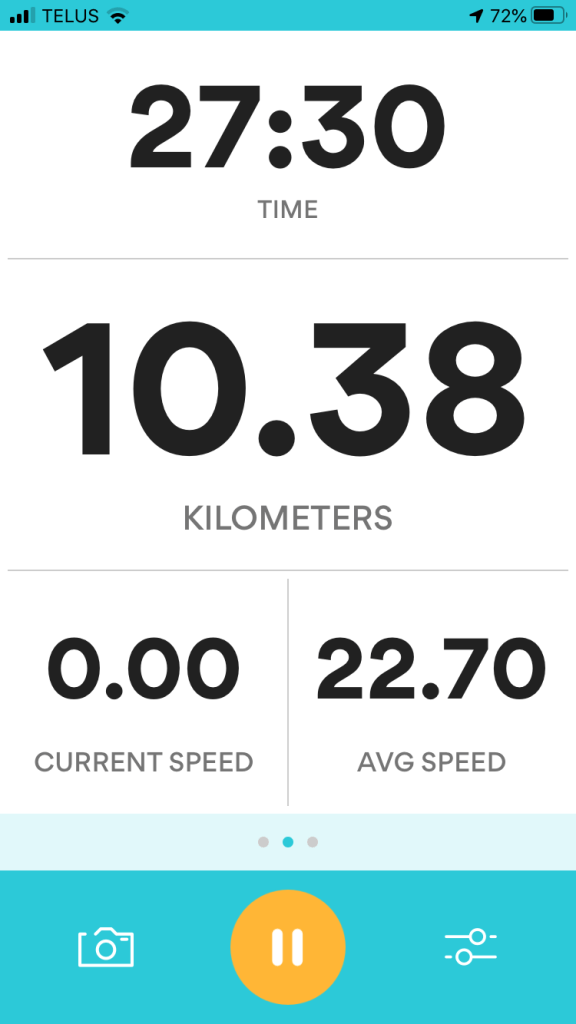
I managed to make my way home after hitting 10.38 kilometres in 27 minutes and 37 seconds. This meant an average of 2 minutes and 39 seconds per kilometre. A measurable reduction from 3 minutes and 10 seconds. However, I paid for it. I woke up the next morning with my legs killing me. I need to hammer out more of these explosive short rides. They have some benefit, despite the fact that I’m training for distance, not speed. But maybe I shouldn’t do it in high heat… ☯
Authoring a blog is a strange combination of easy and difficult. If you’ve chosen your subject matter carefully, it’s easy because you’ll be familiar and comfortable with the material. It can be difficult when you start factoring in finding ENOUGH material to provide interesting content on a daily basis. And if you’re committed to your blog, you SHOULD be posting daily content, even if it’s a short post that contains nothing more than an inspirational quote you found online or something. In fact, there are days where I post nothing more than an inspirational poster with a short, four-line paragraph beneath it. I find this provides my readers with a break from some of the wordy, long-winded posts I’ve written.
Sometimes I find it difficult to get my ideas into words. By this, I mean that even if I have a great idea or concept for a post, finding the right words to put into print for others to read is often my biggest obstacle. I fully admit to researching most things I write about, including the martial arts and Diabetes. “But Shawn, you’ve been doing martial arts for over thirty years and you’ve had Type-1 Diabetes for almost forty… Shouldn’t you know everything there is to know, by now?” First of all, don’t be a smart-ass. Second, a wise person is only wise once they understand that they DON’T know everything.
And the idea behind this, is that sometimes you will use someone else’s information or draw on someone else’s expertise. And there’s absolutely nothing wrong with that, so long as you cite the source of your inspiration. Give credit where credit is due, if you will. Otherwise, it becomes good ol’ plagiarism, which if you’re unfamiliar with the term, is claiming someone else’s work or information as your own. Not only is this a major faux-pas in just about every academic, professional and even personal circle I can think of, it’s also downright inappropriate.
We live in a society where the world’s information is at our fingertips, what with smart phones, tablets and the general use of the internet. Knowing where your information is coming from and ensuring that it’s okay for you to share it are important aspects for any blogger. If you have the means to reach out to someone to discuss the use of their materials, then do so. They’ll definitely appreciate it. Follow this up with citing your sources and giving credit where credit is due, and you’re all set.
Lastly, what you write about should be part of who you are, something you’re intimately familiar with. I could easily start a blog about quilting. I’d probably find myself able to research the subject and even manage a number of posts about it. But ultimately it would lack a certain chemistry since I know NOTHING about quilting and wouldn’t exactly be passionate about it. So you need to make sure those elements are present in order for your writing to mean something. Happy writing! ☯
That title was supposed to say “spilled milk,” but I’m much more partial to coffee than milk, so there you have it. Trust is an important commodity. It’s something you definitely need to have in others, both in your professional and your private life. Without it, you’d never be able to work side-by-side with anyone or let anyone into your life. Just think: when was the last time you met someone new and just immediately trusted them?
Some people can definitely engender a sense of trust in you the first time you meet them but for the most part, trust has to be earned over time and through the words and actions of the other person. It’s almost always a difficult process, especially when it involves trusting the other person to do something in your stead. A good example would be watching my five-year old pull a carton of chocolate milk out of the fridge.
Nathan rarely gets chocolate milk. Yeah, I know… I’m a cruel daddy. But we have chocolate syrup that I use for him on occasion so a carton of actual chocolate milk is a rare treat that he gets when he’s been behaving well (so he rarely gets any). Recently he got a small glass from a 500mL carton, which left the remainder in the fridge for later consumption. During the following morning’s breakfast, he asked if he could have some, to which I replied that he could.
Then my genius son, in all his glory, chose to pull the carton out of the fridge by gripping the very top lip of carton, using nothing but his index and thumb. I could see his tiny wrist trembling from the weight and the visible struggle on his face, and my every instinct was to grab the carton from him and bring it to the counter myself before it inevitably fell and splash all over the kitchen floor. I was surprised when I took a breath (and held it) and allowed him to complete the task, thereby preserving his dignity and allowing me to trust him.
But it was forced and difficult, and I usually find that this is a difficult thing regardless of who or what I’m dealing with. For a lot of people, myself included, it’s a control thing. Most people dislike and/or are uncomfortable with the prospect of letting someone else do a particular thing when they know they can do it faster/better/more efficiently… For others, they’ve simply been doing things themselves for so long that it feels distinctly odd to have someone else do it for them.
Allowing yourself to trust can relieve a great deal of pressure in your own life. Nobody should be expected to carry the burden of life on their own, and we can all agree that any load is much easier to bear when it’s weight is shared. This is something that I feel I need to work on, for my own self-development. Had Nathan dropped that chocolate milk, sure it would have made a mess but it would have been a teachable moment (especially since I’d have made the booger clean it up himself). But it allowed me to let go a bit and trust that he could do it. And he did. What would happen if he’d ever spill my coffee is a conversation for another day… ☯





 The Blogging Buddhist