Something that occasionally crosses my mind is how there will be a significant employment exodus in the fact that a number of industries have unfortunately discovered that some of the employees they’ve sent home are no longer essential. Months and months of having certain positions sent home without the benefit of a “work at home” plan have rendered some jobs obsolete. The flip side to this, is that all the people who are no longer able to work in their chosen industry will turn to many of the employment positions that were intentionally abandoned by folks who didn’t want to go out into the world during the pandemic.
Regardless what your position or chosen career may be, we’ve all found ourselves in a very specific position at one time or another. The position I’m referring to, is subjecting ourselves to a job interview. No matter how confident in your material you may be, no matter if you’ve worked in the industry you’re interviewing with before, the stress and anxiety that comes with sitting through a job interview can do a number on you.
Throughout my life, I’ve found myself on both sides of the table. I’ve been the interviewer and the interviewee. And especially in the past year, I must have sat through about a dozen interviews while I’ve been busy trying to “find” myself and I’ve learned a thing or two. So despite the fact it has nothing to do with Buddhism, martial arts or Diabetes, I thought I would share some of the gems I’ve discovered about interviewing.
These are a combination of things that have worked for me, as well as things that I’ve noted when interviewing others. So some of it might seem pretty obvious, but not necessarily to everyone. Here we go…
Show up early: You would think this one is obvious, but you’d be surprised at how many people are fine with walking in at the last minute. I’m not saying you need to show up an hour before your scheduled appointment and sit in the waiting area like some sort of psycho. But arriving fifteen minutes ahead of your appointment makes a good impression and can even be important in helping you deal with unexpected obstacles, like construction zones, finding an unknown address and being available in the event the appointment prior to yours ends early;
Dress professionally, not for the job you want: I don’t care if you’re applying to work for waste management or if you’re applying to be CEO of a fortune-500 company… Dress properly. Dress pants, shirt and tie at a minimum. People always say “dress for the job you want,” but that’s total bullshit! Dress to the nines, no matter what the position you’re applying for. It shows your commitment to getting the job and your level of professionalism;
Make eye contact and smile: You want to give your interviewer your utmost attention. There’s nothing worse than an interviewee who drifts off and has you repeat a question. Pay attention and listen. Actively listen;
Don’t be afraid to admit you don’t know: If you’re asked a question and you don’t know the answer, then you should admit that you don’t know. Potential employers don’t like it when you make up some random shit. And you’re almost guaranteed to get called out on it. Employers much prefer someone that can admit they don’t know and are willing to look it up or learn, than someone who will phone it in by trying to lie or make stuff up;
Use the power of “WE”: You want to be a part of that specific company? You want that job? Then include yourself! When asking questions or answering theirs, use “we” to start creating the idea that you consider yourself a part of that organization. What benefits do “we” have included? What schedule do “we” use? It creates the impression that you’re part of the company. You’ll be surprised at the effect it has;
Study up: You can’t know everything, but if you apply for a specific job you should have some rudimentary knowledge about the industry you’re interviewing with. Applying to be an insurance broker? Maybe you want to study up on your Province’s insurance laws and regulations. Applying to be a government employee? Try learning some of the legislation that regulates the specific branch of government you’re interviewing with. This ensures that you can show some minimal knowledge in the job you’re trying to get;
End the interview with a “thank you” and a handshake: No matter how you think the interview went, good or bad, be certain to thank your interviewer(s) for their time and provide a firm farewell handshake. This not only shows your commitment to professionalism, it shows your gratitude for the time that was taken to interview you.
It feels a little strange writing about something that isn’t my usual forte, in terms of this blog. But given the state of the world and how the employment industry is going, knowledge can be an incredible advantage. being qualified for a position is only half the battle. Being able to PROVE you’re a fit for the job and being confident is the other half. ☯
If you don’t run in martial arts circles, all the terminology and the different forms of martial arts can be somewhat overwhelming. With more than a couple of hundred different styles/types of martial arts from all around the world, divided by style, type, school and sub-styles, it can all get a little convoluted. You have striking styles, grappling styles, weapons styles and uncounted numbers of hybrid styles. Without delving too deeply in how some styles are descendent from another and so forth, let’s focus mainly on the style I’ve been studying all my life: Uechi Ryu Okinawan Karate.
First, let’s cover off some basics so that we’re all on the same page. Karate is an Okinawan martial art, not to be mistaken with a Japanese martial art. Yes, yes, I know… Okinawa is part of Japan; a prefecture of Japan, in fact. For those who don’t know, a prefecture is a sort of jurisdictional division, like a country, Province or state. And although some descendent styles of karate were founded in Japan, karate owes its roots to Okinawa. Hence, the distinction.
Karate, or Karate Do as it’s meant to be pronounced, means “empty hand” with the latter term meaning “way of the empty hand.” The fighting style came about when the original masters returned from China where they had learned a number of different styles of Kung Fu. In the case of my style’s founder, he fled to China in order to escape the military draft. But hey, nobody’s perfect!
Originally, martial arts in Okinawa were referred to as Te, or “martial skill. Once the inclusion of Chinese Kung Fu came about, it was renamed Tode, or “Chinese Hand.” For the most part, Te was used as a fighting art for law enforcement and the rich and generally included the use of a sword or other edged weapon. Te is also way, WAY older than Tode. This is why the true origins of karate as I know it come from Tode.
Once karate made its way to Okinawa, it became divided by three separates schools or “styles” (although they never referred to them as separate styles): Naha-Te, Tomari-Te and Shuri-Te, after the three main cities on Okinawa. To some extent, every traditional style of karate, including the subsequent Japanese styles, can trace their roots to one of these three original schools. In the case of my style, (Uechi-Ryu) it got it’s humble beginnings in Naha, making it a part of Naha-Te.
In the beginning, there were no differing styles. Karate was karate and students from those three cities would train together with no discerning difference in techniques and style with the exception of small, cosmetic aspects. As specific “styles” began to emerge due to the inclusion of specific forms and techniques, most were named in honour or remembrance of their founders, which is the case for Uechi-Ryu, which was so-named by students after Master Kanbun Uechi’s death in 1948.
The only real distinction that could be made amongst the three styles were that Tomari-Te and Shuri-Te were pretty linear styles with Naha-Te being more of a circular style. But in speaking with some of the original masters way back then, most of them were surprised and even indifferent to the prospect that people were referring to their karate as “this style” or “that style.” For them, it was all just karate.
One of the things that makes me sad is that Uechi Ryu is not a mainstream form of karate like many of the more recognizable styles, like Shotokan, Kyokushinkai or Goju-Ryu. Ironically, Goju-Ryu is Uechi-Ryu’s sister style and is almost identical to Uechi-Ryu. Same katas, same circular blocks and movements, same original background. But this means that if you try to see Karate’s family tree, Uechi-Ryu is often not included.
You can check out Uechi-Ryu’s full background by reading the Wikipedia entry, which I have to say is pretty accurate and complete. But today’s face of karate differs quite a bit from it’s humble beginnings two centuries ago. Many popular styles of karate are simply hybrids or combinations of previous or traditional styles. The aforementioned Kyokushinkai, for example, is a hybrid combination of Goju-Ryu and Shotokan karate. And new schools and styles seem to emerge with every passing decade. At the end of the day, karate is karate. A punch is still a punch and a kick is still a kick. Finding the style that works for you and that you can commit yourself to is the key. But knowing the roots that started it all will open the door. ☯
I just got through watching both seasons of Cobra Kai, which are now available on Netflix. The series follows the exploits of Johnny Lawrence and Daniel Larusso, respective antagonist and protagonist from the 1985 original “Karate Kid.” This time around, Lawrence is the focus as he struggles through a failed marriage, an estranged son and bringing back his Sensei’s failed karate dojo, which is Cobra Kai. It’s a fantastic martial arts series, focused on karate. I can’t wait to see what Season 3 will bring.
It got me feeling nostalgic for the original Karate Kid movies, which included two sequels and a rebirth with “The Next Karate Kid.” You’ll noticed I haven’t mentioned 2010’s remake of the The Karate Kid, starring Jackie Chan and Jaden Smith. Although it was a decent movie, it’s based on Kung Fu, not karate and was basically a slap in the face to the original. But through that nostalgia, I started researching and falling down the YouTube rabbit hole and discovered some interesting facts about the film series, including the involvement of Fumio Demura.
Fumio Demura is a well-known martial artist who studies Shito-Ryu karate and kobudo. I came to find out that Demura played the stunt double for Pat Morita’s “Mr. Miyagi.” This came as a surprise to me, since I knew of Demura through his books. Demura wrote a series of books in the 1980’s covering a number of weapons used in Kobudo. Since joining Kempo Karate in 2016, I’ve slowly introduced the bo staff and sat into my training regimen.
Since there’s a limited amount of coaching time on weapons in the dojo, I decided to order two of Demura’s books, Bo: Karate Weapon of Self-Defence and Sai: Karate Weapon of Self-Defence. In these books, Demura covers a number of basic concepts for both weapons and includes several photos and diagrams. They’ve been helpful, despite the fact that I don’t focus heavily on weapons.
It was cool to read about his involvement. We’re all aware that movie actors use stunt doubles, but it was neat to find that one of my favourite movies included a stunt double that I’ve read and studied about. If you study karate or kobudo, I highly recommend you search “Fumio Demura” online and see what you can find. Any of his books are definitely worth a read. ☯
It’s my opinion that life has more than its fair share of difficulties. It’s no secret that the world has its fair share of suffering and occasionally loves to spread it around. This is why it’s always shocked and surprised me when individual persons seem to make and effort to increase another person’s difficulties and struggles or cause suffering in others. Isn’t life hard enough? It would seem to me that there are enough battles to be fought without people intentionally causing issues for one another.
If I take my own personal situation as an example, one person’s failure coupled with lies that they likely hoped would exonerate them, got me caught up in a whirlwind of unnecessary disciplinary action that’s turned my work and personal life upside down for the past two years. It’s been one of the hardest periods of my life and has made it difficult to live normally, including emotional roller coasters, occasional estrangement and closing myself off and even missing the birth of my second child.
I just recently heard of a similar situation happening to one of my best friends, and it sets a fire under my posterior. I know that the internet as well as the world in general, absolutely loves making jokes, memes and poking fun at the likes of “Karens,” “Kyles” and “Chads.” And it’s no secret that I often comment on “snowflakes” and the over-sensitive nature of recent generations. It seems that with the passing of recent decades, people have become more and more sensitive to menial actions and things.
I remember a job I held, about twenty years ago. Yes, I’m THAT old! Let’s move on, shall we? I worked in a call centre for a Canadian courier company and I absolutely hated it. Part of my assigned duties included taking incoming calls from people who were trying to track their parcels. On top of the fact that people are ridiculously impatient and were usually pissed when they phoned in, I dealt with one of the few times where my bilingualism was a hindrance; because I took shit from people in both official languages.
It got to the point where my gut would kill me with every shift I went on. At one point, I chose to discuss my concerns with my supervisor, who promptly explained that I wasn’t in any physical danger and that of course people would be pissed about being unable to locate their package. I was told I needed to stop being so sensitive and to quit worrying about the words others were using. Then I was told to get the hell back to work. Oh, how the world has changed…
Can you imagine if someone spoke to an employee that way now? The blowback would be significant. In fact, this is also a slippery slope amongst the employees themselves. With everyone having become so sensitive and getting offended about everything, it seems to take very little to get someone in serious trouble, even when the subject of that trouble is ridiculously menial. Now, I know what you’re thinking: if an action or comment sincerely bothers someone, then it isn’t menial.
And although you may be right about that aspect, it doesn’t mean the other person deserves to have their job jeopardized or their lives affected because you can’t handle a comment or action. And that’s the problem. It seems that these days, all it takes is an uttered complaint for a person’s life to be completely turned upside down. People need to realize how their comments and actions can be destructive to others. At the risk of sounding like a broken record, people need to quit being snowflakes and complaining about everything. There’s enough suffering in the world to deal with, without people doing it to each other. ☯
My eye injections came and went yesterday, as they do every 8 weeks. I’ve written about this before… I receive injections of a prescription medication called Lucentis. In case you’re just now joining the show, Lucentis is used to treat a condition known as Diabetic Macular Edema, which involves the accumulation of fluid in the tissues of the eye. Lucentis dries up the fluid, reducing the swelling it causes and overall improving my vision. The condition is basically permanent, and requires scheduled in-hospital injections every two months or so. All caught up? Good! Moving on…
As I recently posted, I sold my car. There were a number of reasons behind this move, but it was for the best. As such, our home is now down to only one vehicle. This shouldn’t be a problem in theory, since I grew up in a household with only one vehicle and I turned out fine (as my jaw twitches imperceptibly). But the timing of this eye injection appointment came at the worst possible time. My son Nathan started his first full week of 1st Grade yesterday.
My wife and I had concerns that if something happened, such as a bathroom-related accident or heaven forbid, he coughs at school, she would have to go get him. Something not so easily accomplished if I have the vehicle up in Saskatoon while she’s stuck down here, juggling a cranky infant and trying to find a way to pick up our five-year old. Boring and routine as my eye injection appointments had become, I decided to branch out and go on a little adventure. I took the bus…
The time, at the city bus stop
It turns out that Regina does have a bus line that runs from here to Saskatoon and back. Since my appointment was at 3 pm, I could catch a bus from Regina to Saskatoon at 7:30 am, arrive around 10:30 am, walk to the hospital, get my injections and catch a return bus at 6 pm. Sounds reasonable in theory, right? Since the bus terminal is a little over 5 kilometres away, it would take a little over an hour to walk there. And waking the entire family just to drop me off and come back home is a definite no! Especially since once you wake an infant, you’re pretty much screwed.
I checked the city bus schedule, and the bus that ran downtown passes in front of my house at 5:40 every morning. When I woke up at 5 am, the temperature was only 4 degrees Celsius and there was a chill in the air. So I dressed with a thermal shirt and my wool fleece shell, wool hat and gloves. I packed a t-shirt and a light Under Armour jacket for the later afternoon. I was quite glad I did, since I made plans to hop on the city bus during this frigid time.
An empty bus in the early hours of the morning
The bus was running a few minutes late, which in retrospect I wish I could say was reasonable and I understood. But my chattering teeth demanded justice, and since there was no one ON the bus, I couldn’t quite understand why the delay. But there’s no telling what the route may have been like, up the road. So I left it alone, paid my fare and sat down.
I was immediately greeted by the conductor’s voice over an intercom asking me to put on a face mask. Of course… Good ol’ COVID-19… I didn’t see the point, since the driver is wrapped in what is effectively a plastic bubble and I was alone on the bus. But fatigue and lack of caffeine rendered me silent and I slipped on a mask. I overestimated the time I would require, since this was my first time getting to Saskatoon this way. I arrived in the downtown area at 6 am, an hour and a half before the departure of the Saskatoon bus.
I’m Batman!
I walked along 11th Avenue in Downtown Regina feeling like that one lonely hospital patient who wakes up during the apocalypse. The streets were empty and quiet, except a couple of city buses, and there was even a token grocery bag floating by on a light morning breeze. Since I was far too early and uncertain what to do with myself, I decided to fix one problem and stopped in at a Tim Hortons, which conveniently opened at 6 am. It was a downtown location without a drive-thru and isn’t open 24 hours like most locations.
I sat down with my coffee and a Wheel of Time book and let the hot cup of caffeine breathe some life into me. About half an hour later, I was asked to vacate my seat as the location had a “no more than 30 minutes” policy in relation to their lobby. I was a little miffed, but it didn’t surprise me. It’s become the way of the world for most businesses. I half-heartedly objected, but I packed up and shuffled on. I made it to my intercity bus stop at 6:40 am. Now, we wait…
Mmm, coffee…
There was one other gentleman (besides the bus driver) waiting at the stop, and upon seeing my coffee cup, asked if I would watch his bags while he walked to Tim’s to grab one of his own. I was a little taken aback by how trusting he was to allow a stranger to watch his bags, until I realized he probably assumed I had nowhere to go since I would be taking the same bus as him.
The bus ride itself was uneventful and I took advantage of the fact that I could still see clearly to do some reading. We arrived on 2nd Avenue in Saskatoon at about 10:30. My appointment was about a 15-minute walk away and was scheduled for 2:55 pm, so I had some time to kill. This is where I discovered something important about Saskatoon: their downtown core has nothing! Oh sure, there are office buildings and businesses, a couple of convenience stores… But I was looking for a place to hunker down for a while and get out of the chill. The nearest place I found was a restaurant that only opened in half an hour.
My chariot awaits
I made my way down to Midtown Plaza, which is a two-story shopping centre I knew would have a food court and hot coffee. I got there fine, despite some douche-canoe’s attempt to grab my backpack (a story for another day) and enjoyed my second cup of coffee of the day and did a bit of reading. I got bored pretty quick and after a couple of laps of the stores in the centre, I walked over to the hospital. I figured I could sit on the bench outside the main entrance and relax until my appointment.
By 12:30, I was starting to get cold and decided to try and get inside. The hospitals are pretty controlled at the moment and for the most part, you can’t even get inside unless you have an appointment. My name was on a list but they obviously didn’t have an appointment time as they told me to go right in. I got to the Eye Care Centre and checked in, since I didn’t assume they’d let some random person lounge in their waiting room.
The first thing the employee at the admitting desk said was that I was booked in for 2:55 pm and that I was too early. I played it off as though it was a mistake and said, “2:55? Not 12:55? That’s my bad, I must have read the appointment slip wrong. Should I just sit and wait then, or do I need to leave and come back?” Since I had arrived on a bus and had nowhere to go, she agreed to let me sit in the waiting room and she would “put a note on my file,” which resulted in my getting in early and being seen by the doctor almost right away.
I should have felt guilty at being passed so far ahead of schedule, but considering the times when I WAS on time and still had to wait an hour beyond my appointment, I took the win and left the hospital just shortly after 1 pm. Now I had a different problem. I needed somewhere to go for the next FIVE HOURS!!! My bus was only scheduled to leave at 6 pm.
I spent the afternoon randomly walking around the city and looking at different shops and things. I walked by the river and I even did a few more laps of the mall. Considering my vision was impaired and I couldn’t read, I was pretty limited so I ended up sitting on a bench at 2nd and 23rd Street and settled in for a long wait for the bus that would take me home. At one point, some city worker (or at least I assumed he was, since he had an orange vest on) tried to tell me to move along since that particular corner had signage stating that loitering was not permitted. I explained why I was there and was basically left alone afterwards.
At 5:30 pm, I walked to the actual bus stop and was checked in for the trip. At 6 pm, which was supposed to be our departure time, we were advised the bus was running at least 15 minutes late. Of course, it is! When the bus finally arrived, loading and check-in for everyone had us leave a half hour later than our scheduled departure. At this point, my head and my eyes were killing me and I was too tired to care. As long as somebody drove the damn bus and got me home.
When I got back to Regina, I stepped off the bus and started walking to wards the only city bus route that ran up to my street. As I walked, I checked the online bus schedule and realized that the next bus would leave the stop I was heading towards at 9:15 pm. It was 9:13… I was over a block away, but I ran. I had to reach that bus, otherwise I would be stuck waiting an hour for the next one. The downtown mall was closed and so was the Tim Hortons I had used that morning. If I missed the bus, the best I could hope for would be a local pub, which wouldn’t be the worst thing but I ultimately just wanted to get home.
My saving grace is that there were four buses lined up to use the stop, and the one I needed was last in line. I had never been so happy about a delay in my life. In actually, a delay had CAUSED the panicked rush. If the intercity bus hadn’t left Saskatoon 30 minutes late, I would have made it to the stop in plenty of time. But the bottom line is I made it, got on the bus and sat quietly, all the way home. I walked into the house and took all of ten minutes to unpack a couple of essentials before unceremoniously crashing on my bed.
Over the course of the day, I walked about 15 kilometres in total. I got cold, then I got too warm. I was found with too much time on my hands and I was at the mercy of someone else’s driving. And as those of you who know me are aware, if it goes faster than I can walk, I just as soon be the one driving. I had a person attempt to steal my backpack, watched some “colourful” people shouting and acting erratically in the street, and experienced the pulse of the neighbouring city.
Do I regret taking the bus instead of the family vehicle? Let’s consider the pros and cons… On the pro side, the cost of my transit was less than half of what I would have paid for my usual hotel room. Once you factor in meals and fuel for the vehicle, I saved a few hundred dollars. Although not an earth-shattering amount, that makes a savings of just shy of $2,000 after a full year. Not too shabby. I also didn’t have to drive and could focus on scenery and reading for a change.
The cons? I had a lot of downtime on my hands with nowhere to go and nothing to do. That’s partially my fault as I overestimated my timings since it was my first time travelling this way. But COVID-19 also take the majority of the blame, since I really had nowhere I could go to simply grab a coffee and chill. In pre-Corona days, I would have sat with a coffee and read for a couple of hours.
I’ll definitely need to fine-tune my timings and work something out, as I don’t plan on spending HOURS outdoors during the winter months. Will this be my new normal? Probably. But the savings involved can’t be ignored, neither can the biggest pro of them all; the fact I was able to sleep in my own bed that night. ☯
I remember training for my black belt in karate, and doing my very best to prepare for it in a Rocky-style format. I used to get up at five in the morning and run five miles, followed by an hour of intensive shadow boxing and forms. Without getting into the specifics of the test, I knew that I would be facing the challenge of my life, and I wanted to do everything I could to ensure I would be successful.
The last class before the weekend of the test, I attended class and tried to blend into the background, which wasn’t easy considering I stood at the front as one of the senior students. I didn’t speak to anyone about the upcoming test I would be subjected to, over the weekend, as was the custom in our dojo. Test dates were kept private until the student walked into the next class with a new belt colour around their waist.
After that last class, Sensei and I took an hour together and discussed the test and what would be involved. We went over some of the material that I knew I had some mild difficulty with, and I made a point of explaining that I planned on having a light meal and getting to bed early, in order to get some extra rest. Sensei smacked me in the back of the head and spoke three very important words: Don’t. Change. Anything.
Essentially, Sensei explained that despite being faced with a very important and very physical test the following day, I should have the supper I’d usually have. I should follow it up by having the evening I would usually have and go to bed no earlier than I usually would. The idea was that altering my usual routine would cause a disruption in my rest as opposed to helping it, and potentially increase my test anxiety.
Change and variety are good. Of this, I have no doubt and there is no question. But when it comes to facing something out of the ordinary, it’s important to remember that we shouldn’t alter our routines. We need to trust our gut and follow our usual routine. trying to do anything out of the ordinary will only stress and tax your body further and increase one’s anxiety. Stick to what you know. It’ll serve you better in the long run. ☯
Where did the time go? It’s a question I ask myself frequently, throughout the year. But even more so on this day. Even though some people will claim it’s impossible, I have clear memories from as far back as when I was two years old. And I’ve seen a lot on my life. I’ve also done a lot in my life. I’ve taken stock of myself and the things I’ve accomplished more often than I can count.
1979. Wow, I’m old…
I’ve always faced obstacles the only way I know how: head on. And I’ve always succeeded. When I was told I wouldn’t survive into my teens due to insulin resistance and Diabetes complications, I started training and taking my own health in hand. I’m several decades beyond what they said my life expectancy would be. They told me I shouldn’t get into the martial arts as the training regiment would be too brutal and intense for something with a compromised immune system and I would suffer frequent low blood sugars. Since then, I’ve obtained multiple black belts and have gone on to teach others.
Yes, the A&W bear. No, there’s no need to mention the pink monkey!
I’ve also achieved the career of my dreams, promoted far earlier than most of my peers and continue to learn and grow with every new day. I’ve learned to live my life without regrets, which is an important lesson I hope to pass on to my two young sons. Another aspect of my life that I believed would never happen is fatherhood. I was told long ago that the prospect of children would never happen. Apparently, 1 out of 3 male Diabetics are incapable of conceiving children. Just one more way I defeated the odds.
I’ve never been a big fan of this day. Both for personal and worldly reasons, but it keeps coming around regardless. It’s almost become more of a day for those who love me than for myself. But regardless, it doesn’t keep me from reflecting on life and the choices that brought me here. No matter what the obstacles, I’ll keep fighting. I owe myself that much. I also owe my family that much. After all, I need my sons to have the same tenacity and stubbornness as I’ve developed. ☯
As people, we have a propensity to think we know everything. Especially in any specific area, where we think we happen to be experts. Sometimes it’s a point of pride, sometimes it’s vanity. But uttering the words “I don’t know” usually evades us. Or we avoid them. Whatever. But there’s nothing wrong with lacking some knowledge. Vulnerability and not knowing is okay.
After graduation, I moved on to college and chose to study computer programming. I spent my entire life around computers as it was my father’s addiction, so it felt like a reasonable step to pursue it further. One thing that didn’t help was that I was convinced to attend a french college. Even if I’m fully bilingual and can speak French, it didn’t change the fact that computer terms that were three inches long in English were found to be ten inches long in French. I’m exaggerating, of course. But it doesn’t change the fact that taking the course in French, despite it being a primary language for me, caused untold difficulties. My college years were some of the most difficult I’ve ever faced, for this reason.
I learned the hard way that computer programming wasn’t for me. I may have enjoyed playing the games and watching my father code, but trying to delve into the complicated world of computer programming proved to be the wrong direction for me. It didn’t help that I had a karate belt test pending during my first year of college, and my priorities were fixed on karate as opposed to college. I did, however, learn to play a network game of Duke Nukem 3D in college. But I digress…
I had a slew of college professors; some good, some bad. Some of my professors walked in, delivered their lesson plan and walked out without making any real connection with the class. Some professors considered every student to be a “buddy” and focused on being a friend more than teaching the curriculum, which was almost worse. Picture a college professor showing up at lounge nights to have drinks with students. Not great, right? But out of the shadows emerged a professor who was the happy medium; part teacher, part friend, all learning.
Because I was having so many difficulties, I asked a lot of questions. I mean, a LOT of questions… If you’ve never experienced being around a French guy who won’t shut up, consider yourself lucky. Picture that boring staff meeting where you’re hoping everyone will keep their trap shut so that the meeting will end sooner, just to have that ONE guy constantly bring up another point. That was pretty much me, in college. But I couldn’t help myself. I hate failing. And I hate quitting.
Most of my professors would either make something up (that I would learn was false later) so as to not look as though they didn’t know their own material. Some would ignore the question and tell me that my answer was in the learning material. But this one professor would make it a point to admit it when he didn’t know something. He had no problem saying, “You know what? I don’t know the answer to that, but let me look it up and I’ll get back to you in tomorrow’s class.”
That’s class. That’s professionalism. Admitting one’s lack of an answer shows a specific vulnerability and humanity beyond what most people are capable of. He was one of my most trusted professors, and my only regret is that I don’t remember his name. Hey, come on! Give me a break! We’re talking almost twenty-five years ago! I’m getting a bit on the older side, I’m expected to forget a few things…
Realistically, I remember this professor BECAUSE of the humanity behind the teacher. Even if you’re teaching something, it doesn’t mean you’re expected to know EVERYTHING. I started studying karate in 1989 and am still learning new things, even now. And if the day ever came where there was nothing new to learn, I’d be greatly surprised. Honestly, I don’t believe it’s possible. But the point is, I learned from that professor, and have found myself often telling my students, “Give me time to try it out” or “Let me look into it.”
And being able to do that is important, because it engenders trust. Your students will trust you and believe what you tell them way more if they understand that you’ll be honest and admit when you don’t know. I’ve applied this concept in almost every area of my life. If I don’t know, I say so. Not only does it engender trust in others, it prevents making me look like a damn fool because I tried to make something up. Important food for thought. ☯
Well, here we go! Diving in head first, my little booger has stepped into the first day of first grade. I was surprised at how motivated he was. He was excited at the prospect of making new friends, getting a new teacher and going back out into the world. I’ll admit that I was a little anxious about the entire thing, given the current state of the world. But as they say, we can’t protect them forever and education can’t be denied.
Conditions this year will be significantly different than what Nathan’s used to. He’s required to wear a mask at all times while on the bus (as shown in the photo above) and his grade has implemented a staggered start, meaning he has class yesterday and tomorrow but will start a full week of classes next week. I don’t know what the actual classroom situation will be, but I can imagine that steps will have been taken.
Unlike last year, where I couldn’t walk away without giving him a hug, Nathan excitedly climbed into the bus and found his assigned seat. Now, he’s in 1st Grade. Where the hell has the time gone? My skinny little booger is once again out in the world. Here’s hoping the world can handle him! ☯
Quarantine and self-isolation have had a positive effect on the Canadian population, as many people have chosen to take some of the downtime to start new hobbies, clean out their homes or begin renovation projects that they may otherwise have never considered. It’s definitely a positive thing, and has kept lumber yards, home improvement places and retail locations in the black during this whole mess.
Although I’ve been dealing with small projects like growing a lawn in my back yard and selling my car, I haven’t really tackled anything that’s taken serious effort. But since the basement of my house is damaged and the whole thing will need renovating, I’ve found myself without a workout space. Oh sure, I’ve been able to continue doing things like cycling and I even did my Marine workout in the garage, last week. But I’m losing the striking pad I had mounted on the current basement wall. I needed a solution.
Some of the materials I started with
Since I didn’t consider it safe or in anyone’s best interest for me to attempt basement renovations on my own (I’m great with a sledgehammer, that’s the limit of my renovation capabilities), I decided to construct my own makiwara board for the back yard. I’ve mentioned this training tool in previous posts, but a makiwara is a padded board typically used to condition the knuckles and strengthen your punches. It’s thought to be Okinawan in origin and is mostly used in traditional styes of karate.
Polyester cord to wrap around the makiwara as a striking surface
Most properly-constructed makiwaras can run anywhere from one to several hundred dollars in cost, especially if you factor in the shipping and handling to have it brought to you from whatever distributor you purchased it from. But if the Okinawans can build theirs from scratch, I figured “so can I.” I had several 7-foot lengths of wooden board that was left over from our house’s previous owner. I started by trimming two of these boards to an appropriate and matching length.
The free lumber was definitely a solid start and is potentially the most expensive aspect of the project. I brought my son Nathan to Home Depot, where we purchased a half dozen 6-inch iron bolts with matching nuts and washers. I also purchased a 100-foot length of polyester cord, which would be wrapped at the top of the makiwara as the striking surface. Polyester is a water-resistant material, so it would be best-suited for an outdoor training tool.
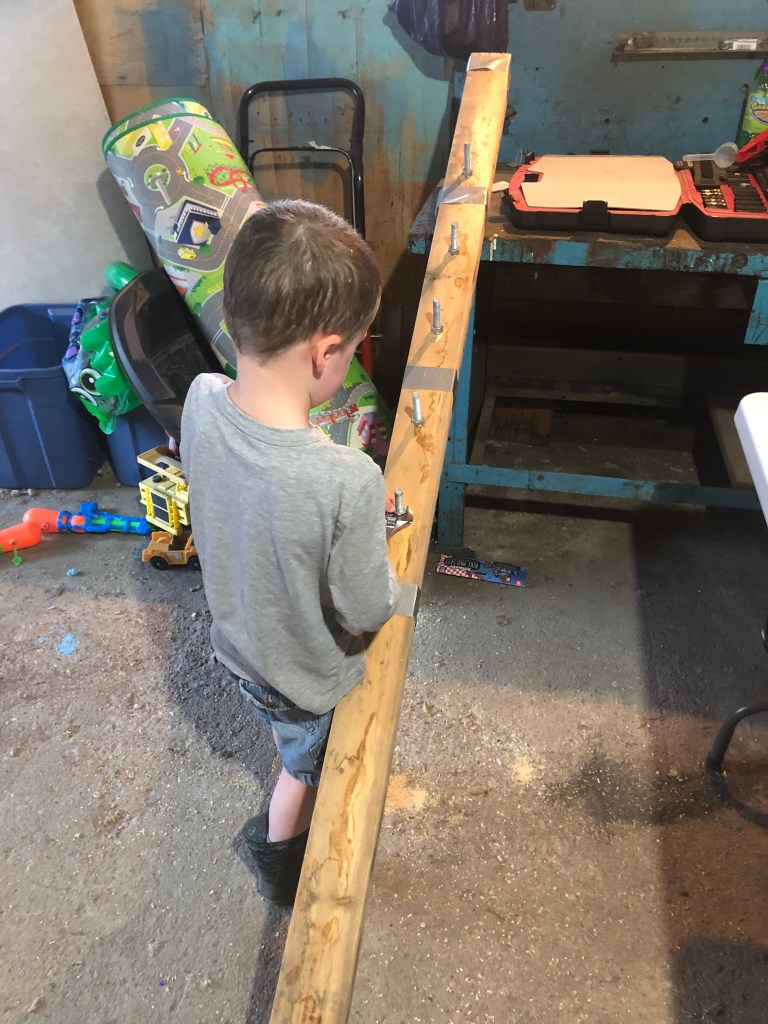
Nathan hard at work, screwing the bolts into place
Nathan and I duct-taped the two boards together so that they were flush, them I drilled 3/4-inch holes at five-inch intervals through both boards. I hammered the iron bolts through the holes and Nathan screwed the washers and nuts into place. Once all six bolts were firmly in place, we were able to remove the duct tape and move on to the striking surface.
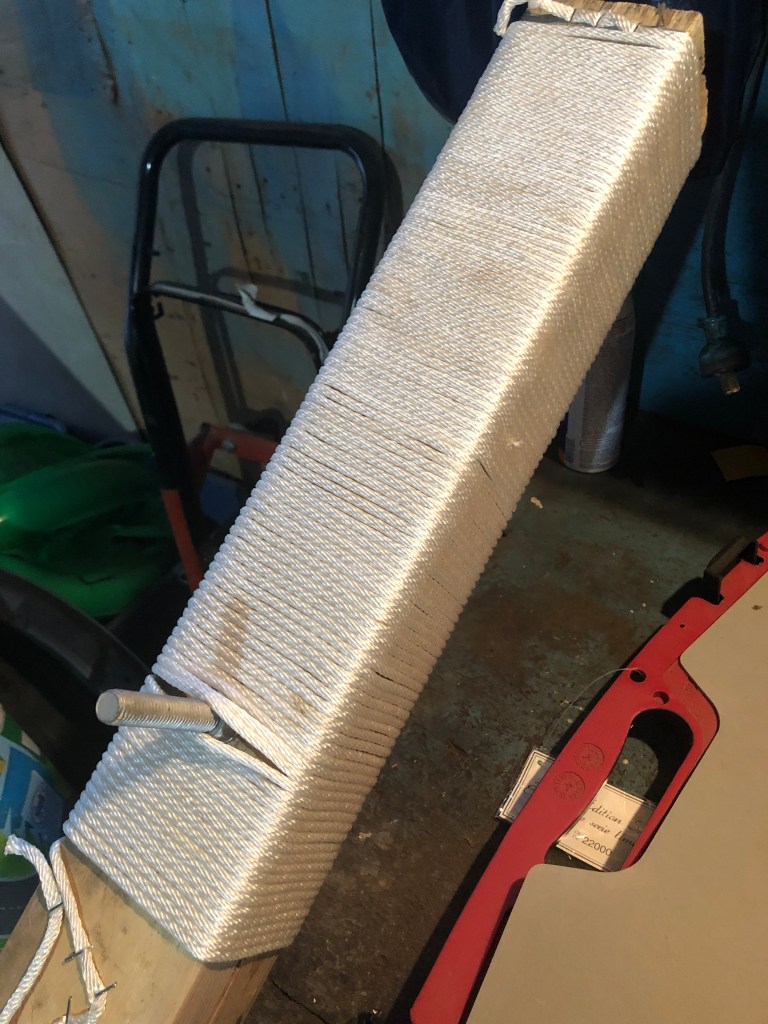
The wrapping of the makiwara
I left the top strip of duct tape and used a staple hammer to fasten the end of cord to the board, followed by twenty minutes of fastidious wrapping and tightening of one hundred feet of cord. With the exception of Nathan complaining he wasn’t allowed to do this part (and climbing over and under the project while I worked), it went reasonably well and I used the same staple hammer to fasten the other end once the cord was all wrapped.
The completed striking surface
The makiwara was now complete. The next step would require digging a two or three foot hole in the ground, placing the post and filling the remainder with some firm, affixing soil. That was over a week ago. The entire project took a little over an hour and Nathan and I were already tired. So we decided we’d put off the installation until we were able to get some rest and start digging when we were fresh.
Our long-weekend was cut short due to unforeseen circumstances. So on Sunday, Nathan and I took two shovels and a metal bucket and started digging. I didn’t take any photos of that part of the project, since Nathan and I were up to our elbows in dirt. The soil in Regina is a clay composite, which is what’s caused the damage to my basement. It sucks (royally) but it DOES have a benefit for this particular project. Nathan and I reached about twenty-eight inches, which was adequate for the makiwara.
We lowered the post into the hole and packed the remaining space around the pole with the dug up soil. We packed it down after every few shovelfuls, and the clay soil held the post firmly in place. I followed it up with a short length of board to firm up the bracing, placed at an angle at the back. The end result came out quite well, and Nathan and I are quite proud of the job we did.
The finished product!
All said and done, a training tool that would have cost several hundreds of dollars wound up costing less than fifty dollars! Now I just have to find the motivation to get outside to use it. My neighbours have all seen the post and seem to understand the concept behind it, since I explained what it was for. But it may be interesting to see their reactions once I start striking it. There you have it! My do-it-yourself project. ☯










 The Blogging Buddhist