Happy Valentine’s Day ❤️

Happy Valentine’s Day! Hopefully amidst the state of the world, y’all have someone special to curl up under a blanket and stay warm with. And if you don’t, remember that loving oneself is just as important and something special can still be done. Despite my typical habit of being sarcastic and making puns, I genuinely mean that and am not trying to be lewd or suggestive. Here are a few quick facts about the origins of this particular day:

Valentine’s Day is based on Valentinus, a martyred saint that is thought to have defied the Roman Emperor by continuing to perform marriages in secret for young lovers after they were outlawed;

Some historical writings suggest as many as three different men who may have been the actual “Valentine,” who were all martyred and executed;

One of the stories depicts Valentine being imprisoned and falling in love with his jailor’s daughter. When Valentine sent her a note prior to his execution, he signed it “From your Valentine,” which is the popular phrase still used today.

I’ll keep this one short and I don’t have any sources to cite. These are just facts that I’ve read about throughout the years that have stuck with me. There are even articles that explain how Valentine’s Day was created by the Christian church to cover up and outlawed pagan holiday called “Lupercalia.” But I ain’t gonna get into any of that.

In modern days, Valentine’s Day has become heavily commercialized, with the sale of cards, chocolate and various “romantic” trinkets becoming a huge cash cow for retail locations. I’ve always been a fond believer that if you’re genuinely in love, you don’t need one specific day of the year to express it. Such a thing can be done on any day of the year and in fact, should be done all days of the year. Now if you’ll excuse me, I have some chocolate to go eat… ☯

“Seiza” The Opportunity For Meditation Facts…

A couple of weeks ago I was chatting with a fellow blogger who asked me an interesting question in relation to how I meditate. We had been discussing the ability and opportunity to meditate in the midst of being at home with family, pretty much around the clock. This discussion led to a question about what posture I use and how I deal with comfort issues and positioning during meditation. Since I effectively never do anything the easy way, the answer is not as simple as one specific pose or position.

The kneeling position, known in martial arts circles as “Seiza”

For the most part, I sit in a kneeling position during meditation. That doesn’t mean that this is always the OPTIMAL position, and I do tend to use a few different ones. But the position you see illustrated above is one that’s also associated with karate and some formal Japanese settings, so I’ve had most of my life to get used to it. Named “Seiza,” this position requires the person to kneel on the floor, placing their calves beneath their thighs and pointing the toes out behind them. The big toe on the right foot overlaps the left one, and the butt rests on the heels of the feet.

There’s a bunch of pomp and ceremony that goes into how to sit down and get up when using this posture, as well as when it’s appropriate and/or required to use it. But this post ain’t about all that. This is a posture that Sensei would often have us close out in, as it allows for a few moments of deep breathing and contemplation at the end of a workout. It also makes it significantly easier to bow respectfully when karate class closes. This posture is also used at the current karate school I train with, both at the beginning and the end of class.

From a meditation standpoint, I like this posture because it effectively forces me to sit up straight. I can breathe fully and unlike the lotus position, which I’ll cover off next, this posture doesn’t allow much room for me to slouch or slump. The downside is that sitting on one’s legs for more than about 20 or 30 minutes can lead to a condition called “paresthesia,” which is where some of the nerves and the blood flow in the legs become compromised resulting in the “pins and needles” sensation when a limb falls asleep. It’s never a good thing to block circulation, and since a Type-1 Diabetic’s circulation isn’t all that great to begin with, this can be a concern if you plan on meditating for a long period of time.

The next important posture is the lotus position. This is the classic and most recognizable posture in meditation. In fact, any time you see a statue of Buddha, he’s likely seated in the lotus position. This involves sitting with your butt on the floor with the left foot resting on top of the right thigh and the right foot resting on top of the left thigh in a cross-legged position. The hands are generally resting on top of the thighs, usually with the index and thumb of each hand joined together. This pose is not only used in meditation but is also used in forms of yoga, and is thought to promote the proper channeling of the body’s energy.

This can be a more comfortable posture to assume if you plan on meditating for a half hour or longer, as it won’t necessarily constrict blood circulation the way Seiza does. The problem I find with this posture is that unless I’m propped against a wall, I tend to let my shoulders slump or I start slouching at the upper back, which can become uncomfortable and damaging to the spine over long periods of time. Lotus has many variations to it and I usually favour the “half lotus,” which involves only setting one of the feet on top of the opposing knee with the other one simply being on the floor. This prevents the usual possible circulatory issues.

If you have Diabetes (or any other circulatory issues) there are a few things you can do to help facilitate meditation, regardless of what pose you use. You can get a meditation pillow. These are great as they keep your butt about four to six inches up off the ground, putting less stress on the knees, hips and various joints associated with meditative postures. The Japanese have special little folding stools that allow for the appearance of the kneeling position while taking the stress off of joints and allowing proper circulation.

Last but not least, you can try traditional postures, such as sitting in a chair. This is fine and I’d be lying if I said that I’ve NEVER done it. It just feels weird to me. Probably because I’ve spent my entire life using formal postures. Sitting in a chair just feels like it takes something away from the experience. You can also try lying flat, either on the floor, a yoga mat or on your bed. The only problem with this is if you lie on your bed and start breathing deeply with your eyes closed, you face the risk of falling asleep. Although I’m a big fan of naps and falling asleep isn’t necessarily a bad thing, it also usually isn’t my goal when I meditate. So I try to avoid this posture unless I’m having difficulty sleeping and I’m intentionally trying to meditate my way to dreamland.

Obviously, there are different types of meditation and postures that go along with them. Depending on what your goal is with meditation, you can’t really go wrong. The important thing is to find a posture that’s comfortable and suits YOU. It should accommodate your body and allow you to relax so that breathing, energy and blood flow are facilitated and you can focus on the mindfulness required for proper meditation. As I’ve often written, every person is different so it should be no surprise that each person’s needs and preference may be different from a meditative standpoint. ☯

Family Ties In The Dojo

We love our families and want nothing but the best for them. Sometimes, the best is not what we think it is and can only be sought out by the family members themselves. But health and fitness doesn’t discriminate, and it’s important that everyone in the family get off the couch and do something physical at least a few times a week. This isn’t always an easy thing to encourage, and some family members will often be less than enthusiastic about being put through the ringer; especially if you happen to be the instructor…

If you happen to be an instructor of a sports club or a martial arts dojo, getting your family involved can be a good or a bad thing. I’ve seen it all… Family members who have basically been forced or coerced to join and family members who feel it necessary to “tag along” even if their efforts are far below what would usually be required of the environment. It can be a difficult and awkward situation, especially since you need to go home and live in relative peace with these people once class is done.

Trying to teach Nathan the basics back in 2019. Kid can’t take a hit…

One of the best examples I can think of are Sensei and his son. As his only male child, Sensei expected his son to train diligently and consistently. And to excel. A bit of an archaic way of thinking by today’s standards but remember that I’m referring to 40 years ago. The son was made to attend every class, train every day and even to start teaching at a young age, despite the fact that by the time he reached his pre-teens, he expressed no interest in karate. As a practitioner myself, I can certainly relate to how heartbreaking that would be. But it’s important to remember that even if karate is your thing, it may not be your child’s.

The result of that forced learning is that decades later, Sensei’s son is no longer an active practitioner. Oh sure, he has skills that will always be with him. And appropriately, he was Sensei’s first student to pass black belt. Those are all important milestones for both of them. But when you compare it to someone like me, who has been eating, breathing and sleeping karate for over 30 years but who joined and trained of his own volition, the difference is I still make it a part of my daily life and have ambitions to teach.

Training with a spouse or loved one has its own set of complications. Imagine having your spouse in your karate class, yelling at her, making her do knuckle push-ups and basically flooring her physically. Then getting home that evening and expecting to share a shower or snuggling up as though you DIDN’T just make her life a living hell. Much to the same tune as working a job with a spouse, training with them can be rough waters to navigate. And if it’s to be attempted, clearly defined parameters and guidelines for what’s expected and what will be done need to be established. By the same token, making sure that nothing is done that could be considered favouritism needs to be kept in mind as well.

It’s important to remember that the familial title should be the priority. If you’re a husband, then that’s your role and it would be very difficult to be a slave-driving instructor to your spouse. They can hate an instructor all they want, so long as they get the results they seek. But it’s a little hard to release and use that hatred against your husband. The same can be said of your children, as forcing them into something they don’t want to do could potentially sour them from being interested in any similar activities in the future. And it’s just as important that ALL family members be active, albeit occasionally for different reasons.

This doesn’t mean that you can’t be active with your family. You can participate in a variety of sports and activities that can get the heart pumping without necessarily taking on an instructional role. Taking walks, snowball fights or sledding are great family activities. Even a good old fashion pillow fight, so long as you have the space and a safe environment to do so. Nathan and I often just roll on the floor mats downstairs, wrestling and grappling. He has a blast playing around while I’m slowly teaching him some grappling techniques. And he’s started showing interest in picking up the 3-pound dumbbells and imitating what I do during at-home workouts.

My wife does not train in karate, but we still work out together whenever we have the chance. Couples who get fit together, stay together. But it would be a different story if I had to act in a capacity where I had to constantly push her and force her to do more. Such student/teacher relationships can lead to resentment and hard feelings. That’s why it’s very difficult, bordering on the impossible for anyone to fill that role while still maintaining the relationship.

There’s no problem with encouraging family members to exercise together and get fit together. In fact, in can even be an inexpensive way of keeping the family involved together during trying times while getting some much needed exercise. But the day your spouse or child decides to walk into your dojo may require some wariness and caution on your part. The difference between “Yes, Sensei!” and “Yes, Dear!” or “Yes, Daddy!” can mean the difference between a happy household or a few slammed doors. ☯

Are You Making Faces At Me?

Unless I’m engaging someone in conversation, I usually tend to stay silent on my shopping excursions. I acknowledge and greet the employees of whatever location I may frequent with a smile and a nod, sometimes even allowing the smile to reach my eyes, which can also speak volumes. So, how does it affect communication when we all wear a facial mask that covers our facial expressions? Do we NEED those facial expressions? Are they necessary for everyday communication? The simple is answer is yes. And no. Of course I won’t make it simple…

There are plenty of animals who use facial expressions as part of communication. In fact, horses, dogs and chimpanzees all have a plethora of facial expressions although they may be using them for different reasons. I’m not a veterinarian. But humans use facial expressions as part of their communication with other humans, which can be found lacking if the recipient can’t see your face. I’ve found this to be an issue during this entire pandemic, when a smile and nod still looks as though you’re deadpan even when you aren’t.

Think about a simple email you sent that was completely misinterpreted… Maybe you were in a perfectly good mood when you sent it and had no malicious intent behind it. THEN you get an aggressive response from the recipient, accusing you of being rude and aggressive with THEM. Ever happen to you? I’ve had supervisors who I’ve asked for help with something, only to have them snap back, accusing me of telling them how to do their jobs. It actually happens a lot.

Despite the words being the same, the recipient can’t see your body language, sense your tone or feel the intonations behind your communication. For example, your spouse saying “you’re such an asshole!” while smiling shyly and shaking her head at you can seem playful and can even be interpreted as a sign of affection. Having that same spouse text message “you’re such an asshole!” without any context will likely have you thinking you’re in trouble for something. This is the same deal. Facial expressions are integral to proper communication.

It’s taken me a while to recognize that when someone out in public says hello or thank you, a simple smile is no longer enough. Because they won’t see it. Oh, there may some small movements of the mask that could potentially tell an observant person that there’s something happening beneath the mask. But for the most part, I look like a creepy mute guy, squinting at the door greeter on my way out. I’ve had to make a concerted effort to remember to actually say “thank you” or “have a nice day.” First world problems, right?

To be honest, I’m not sure where I was going with this post. I admittedly just throw my thoughts out on occasion. But this is another instance where the pandemic has affected our daily lives, much without us thinking about it. Lack of visible facial expressions makes it harder to communicate in public on top of our voices being somewhat muffled by the mask. Added on top of steamy glasses and the unexpected belch that basically makes you hotbox yourself and it adds a bit of speed to your grocery shopping. ☯

My New YouTube Channel

Hey folks! I know I’m not in the habit of drafting two posts in a day and it’s a bit late in the game to be posting a second one, but I’ve decided to put my face on camera and started my own YouTube channel. I only have one video on there, which is scheduled to go live in about ten minutes. But I’m hoping to use the video aspect to discuss and demonstrate things that are a bit difficult to explain with words and photos. If y’all wouldn’t mind visiting the channel and clicking those little “like” and “follow” buttons, I can start pumping out videos in tandem with my blog posts. For any one interested, here’s the link to the YouTube channel.

Check out this first video, which I recoded tonight…

Hopefully, it doesn’t bore everyone any worse than my long-winded posts usually do. I look forward to sharing more in the future. If anyone has any thoughts on something I should be posting in video format as opposed to in written form, please let me know in the comments. ☯

The Unexpected Prejudice

When we think about the word “prejudice,” we mostly think about race, culture, ethnic background or religion. To name a few. But in reality, the term “prejudice” refers to preconceived notions or opinions about someone else, based on something that is KNOWN about the person. This opinion or notions, however, are never based on fact or actual knowledge. Having someone be prejudice against you for any reason can be hurtful, harmful and cause damage to a person’s self-esteem and even prevent certain advancements on life.

I bring this up because believe it or not, I’ve spent a good portion of my life having folks be prejudice against me, because of my Diabetes. Hard to believe? I know. It SHOULD be hard to believe because it isn’t something that should occur. But believe me when I say that it has happened to me far too many times to recount, for a variety of different reasons. I started being “pigeonholed” at a very young age; essentially being dropped into a category that defined me according to my condition as opposed to who I was as a person or what contributions or goals I could achieve.

This started extremely early; as far back as when I was first diagnosed. I was part of a younger group of Scouts, called Beavers (let’s keep the NSFW jokes to a minimum, shall we?). I joined this group when I was 4 years old, and believe me when I say that I was pretty excited about it. Then I was diagnosed with Type-1 Diabetes. A group “camping” event, which entailed staying in the community hall with sleeping bags over a weekend, was denied me on the basis that I had Diabetes. My parents objected to this and tried to do everything possible to allow me to attend. At the end of the argument, my mother even volunteered to attend and stay the weekend as well, in order to deal with the Diabetes aspect of the issue. I was still refused.

I know what you’re going to say; as an adult I understand what the Scouts’ view of the situation might have been. There are risks and liabilities and issues that Scouts Canada simply wouldn’t have wanted to take responsibility for. I get it. But I probably would have been far more understanding at the time, had they made an effort to understand what was going on rather than simply say, “Sorry, we can’t accommodate him.” Effectively, my time as a Scout was over before it began. It shouldn’t have been a big deal. But given my age, it set the tone for all the things that would follow through my life.

My diagnosis came while I was attending kindergarten. This was the big one, because it set the tone for the next decade, in terms of who befriended me and what groups I could have been part of. I still remember the embarrassing “speech” the teacher gave about how I was a “special kind of sick,” and that the children had to treat me gently and tell her immediately if I was found to be acting strangely or seemed too sleepy. ARE YOU FUCKIN’ KIDDING ME???? Setting aside the fact that I’m already weirder than a pillowcase full of angry ferrets, this basically told a bunch of 4 and 5 year olds that there was something strange and different about me. The effect was that most of the kids avoided me unless they were forced to join me for a group lesson during class.

All throughout my formative years in school, I was denied certain group activities, sports and/or teams on the basis of my Diabetes. Some years, I was automatically excused from gym classes and given a basic passing mark for sitting on the side while the rest of my class would play ball, run and exercise, leaving me to rot as opposed to growing my physical capabilities. One would be inclined to think that teachers and adults would be more enlightened and ask certain questions about my condition before simply writing me off. After all, this was well before the snowflake generation of getting offended at everything, so my parents and I would have gladly answered any questions got assuage any concerns.

But instead, it was easier for all of them to live within their (incorrect) preconceived notions and cats me aside, refusing to take responsibility or take a chance on the possibility that something could happen to me while I was in their care. And I get that. Now. Back then, it was a constant feeling of being rejected and segregated. No wonder my health waned and I took a downward turn when I was nearing 10 years old. I was never allowed the opportunity to participate in sports and be a part of the group. If this happened now, there’d be an uproar! People would mount protests, parents’ groups would petition the school board, people would lose their jobs… Anarchy! But I just took it in stride.

I’d like to say that when I finally joined karate that things turned around. And yes, they turned around from a health standpoint, but even karate was a problem. Because my parents refused to let me join, thinking I’d get hurt or that my blood sugars wouldn’t allow me to survive a 2-hour class. As I’ve mentioned in previous posts, I had to join in secret, using my merger allowance to pay what tuition I could. Sensei was really good about never asking questions and trained me no differently than anybody else. That’s when I started to accumulate some mass, gained strength, speed and reflexes and discovered that I could have potentially have had a different path if I could have started to gain these benefits at a younger age as opposed to having everyone simply sit me on the side to watch. After all, life isn’t a spectator sport.

It’s extremely important that you never assume something about someone else’s condition. For my specific example, I may have had a rough start during my childhood. But once I took control of my health and fitness, I took huge strides and have suffered almost none of the usual complications associated with Diabetes. And what’s more is I’ve trained in the martial arts for over three decades, still have all my toes and appendages and have fathered two children. Many said I’d never accomplish any of that. Shame on them. ☯

Seeing It Through…

If you have uncontrolled Diabetes, having the motivation to see something through can be pretty difficult. I have unfortunate memories of my behaviour through my late teens and 20’s where my erratic blood sugars often caused mood swings and a deep apathy for life that went way beyond the point of being lazy. It was hard, because my lack of energy and motivation would usually result in me just wanting to “sit and relax,” or get some “rest.” This was usually code for simply not having any motivation. Honestly, I often wonder how I was able to make my way through the martial arts ranks.

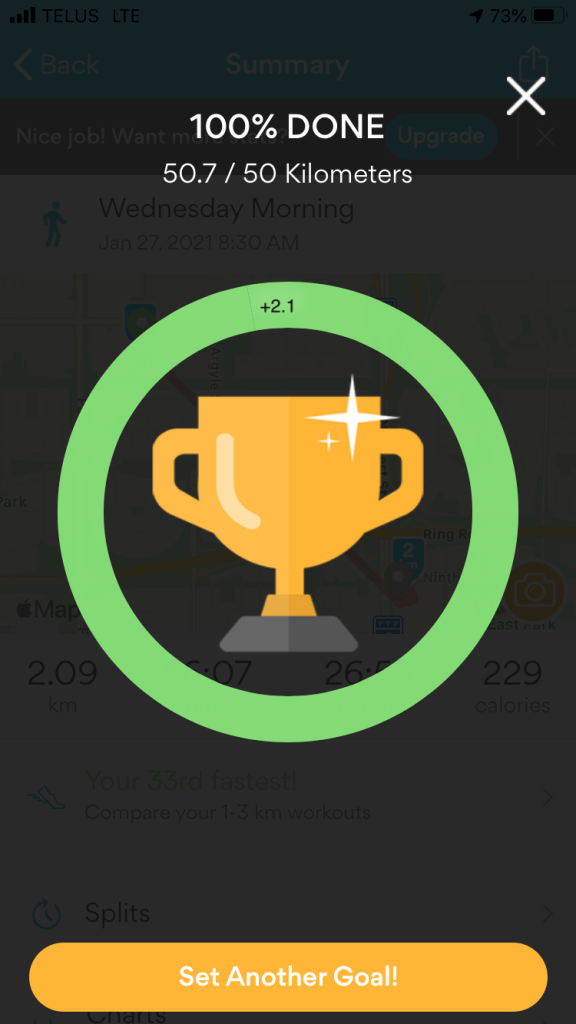
The lack of energy and motivation is what usually hit me hardest. I like to think that things are much better for me these days, and I use my motivation in ways that continue to grow my fitness and increase my control over Diabetes. And sometimes I like to try new things. You may have heard me mention that, once in a while. During the first week of January, I joined a fitness challenge through my RunKeeper app that involved logging 50 kilometres of distance within the calendar month. One would think that this shouldn’t BE an issue, since I usually log more than that in one cycling session. But it’s kind of difficult to cycle on snow, and walking roughly involves three times as much time as cycling.

I started by taking time to walk a few kilometres during the daylight hours. This was made all the more difficult by the fact that Nathan was remote schooling when I started this, and he couldn’t understand why I wouldn’t let him join. When he started going back to school in person, I would see him off on the bus then take my walk immediately after that. It would be a touch on the colder side, since the sun wouldn’t be up at this point. But I would usually manage to get three or four kilometres logged within an hour of walking, which was a good pace and started growing my monthly total to bring me closer to the 50 kilometres I needed.

Sometimes, it was actually nice to get out of the house and have a walk. On clear, sunny days I could listen to music or simply be alone with my thoughts while getting fresh air and some mild modicum of exercise. I started to see some of the advantage behind walking every day. On other days, it felt tedious and very much like an obligation. This is where I started to run into trouble, towards the end. With only 8 kilometres left to log, I lost motivation and started avoiding walks. It’s not like I was even actively trying to avoid it, I simply didn’t;t have the energy. Inclement weather and the recent snow storm with power outages certainly didn’t help.

Ultimately, I reached the minimum I needed. I believe I even went beyond the 50 kilometres I originally set out to log. Completing this 50 kilometres also enters my name in a draw for a potential prize of cross training sneakers that I would never afford on my own (or wouldn’t PAY for, normally) so there was some outside motivation involved, as well. But the experience was good and my wife and I have discussed making walks a family thing, now that the fitness challenge is done. This simply goes to show that you can start working on your fitness with something as easy as taking a walk. The motivation be sometimes need to be found first. But all it takes is getting off the couch and doing it. ☯

Why So Confrontational?

The world is a violent and dangerous place. This isn’t really news; one need only to Google any aspect of world history to recognize that it’s ALWAYS been a dangerous and violent place. But there was a time when a specific violence was contained to its immediate area. If you lived in a small town, you’d likely hear about the assault that took place during the previous evening, but the world would continue to turn. Likely thinking that your small town is a quiet and peaceful place.

These days, even the most remote of places have the world’s information at their fingertips and can access it with but a swipe of their finger across their smart phone, tablets or home computers. People have become much more aware of the way the world operates, albeit most seem to think it’s become an increase since years past. It really hasn’t; we simply hear more about it now. One thing that HAS increased, and I only know this because of personal experience, is confrontation. People seem o have developed a comfort and penchant for confronting one another, either online or in person. And the results can often bring more suffering than it’s worth.

A good example I can provide is a confrontation I had with an unknown gentleman (and I use the term lightly) about a year ago. I believe I wrote a post on this, but it’s been so long, who remembers? Anyway, I pulled out into an inner lane of travel after fuelling up my vehicle. This guy was in the outer lane and decided to switch lanes right in the location where I pulled out. The result was that he honked his horn loudly and proceeded to follow me to the nearest red light where he pulled up next to me and proceeded to call me a plethora of disrespectful names and try to “educate” me on traffic laws. I didn’t bother to tell him, but had he known what I do for a living, he may have understood the redundancy in that tactic.

Long story short, whether in the right or wrong, I apologized and told the guy not to let the incident ruin his day. he seemed unconvinced and unsatisfied. His problem. But it got me to thinking for quite some time afterwards… What would these people do if they confronted someone violent? A wanted criminal or a gang member who’d be just as likely pull out a pistol and shoot the guy in the face as look at him? Because of the nature of the world, you simply never know who it is you may be dealing with when you confront them.

If for no other reason than the fact that you’re prolonging your own suffering and creating some for another person, this is something to be mindful of when confronting unknown persons. And why would you confront them? Let’s look back at my traffic scenario. Did the guy gain anything from confronting me the way he did? Of course not! Has it altered my perceptions or changed the way I drive? I can guarantee you that it did not. I’m still just as careful and mindful of my driving as I was beforehand.

But had I been someone violent or dangerous, that guy might have been caught dealing with quite a different scenario. I’ve seen and experienced it often enough to know it can happen. And this is what needs to be seriously contemplated when one is considering confronting someone. At the end of the day, if something that happened brought you no harm, hasn’t altered your life and you can carry on with the status quo, may consider letting it go rather than confronting another person over it. You may discover that your life will be more peaceful and your stress levels will be less. Food for thought. ☯

You Can’t Roll The Dice Unless You Pick Them Up…

In the short term, I’m not one for taking chances. I like challenge, but I also prefer to know the ground beneath my feet is stable and won’t fall out from under me. But the reality is that sometimes you have to grab life by the sweaty gonads and take a chance. This can relate to many different aspects of life, including one’s health, financials, career and more. In some cases, many cases, if you don’t roll the dice and take a chance in life, you may not accomplish a great deal.

This is perfectly fine if the only ambition one has in life is to make just enough money to keep a roof over one’s head and food on the table, leaving no room for any growth, expansion or experiencing the world around you. Admittedly, there’s nothing wrong with building such a life. I’ve certainly been guilty of wishing to have a simpler life with less belongings and property. One doesn’t need to be Bill Gates in order to have a rich and fulfilling life.

But it stands to reason that if you want something MORE in life, it will sometimes involve taking chances. Rolling the dice. Gambling, if you will. Because the chance you take will often yield negative results, it can be considered as a form of gambling. But traditional gambling is also a good example of this. For example, I buy lottery tickets each week. I’ve been doing so for the past few years and have never won anything beyond a free play or a few dollars, but I continue to play, nonetheless.

Don’t get me wrong; I could give two shits about being rich. I already consider myself rich in a variety of other ways but the money would be effectively used to bring some much needed peace of mind in the form of being debt-free and having an available savings that guarantee that I don’t have to throw myself further into debt just because the foundation of my house decided to start cracking (true story). They say money can’t buy happiness. But to be honest, I’d rather find that out myself than take someone else’s word for it. Money may not buy happiness, but it’s essentially the only way to pay bills.

“Your Odds Of Winning Are Like A Hundred Million To One! Don’t You Know That The Lottery Is Just A Tax On Stupid People?!”

– Brian Griffin, Family Guy (Season 10)

This is a discussion I’ve had with a number of people over the years, since most people are convinced that there’s no point in playing the lottery as the odds of winning are almost non-existent. This may be true, but you know what else GUARANTEES you won’t win? Never playing. Eventually SOMEONE will win. And that someone will reap the benefits of that victory. And the reality is that I may get hundreds, maybe even thousands of losing tickets over the course of time that I play. But it only takes ONE winning ticket to make the difference.

I use the lottery as the subject of my analogy, because it’s familiar to most people and it’s easily understandable. But the lesson applies to all other areas of one’s life. Where would society be if no one ever gambled on themselves and took a chance? I referenced Bill Gates earlier… What if he never took a chance on himself? Microsoft may never have come into existence and the face of modern computing would be significantly different. What if Mark Zuckerberg hadn’t taken a chance and developed FaceBook, subsequently fighting for it and allowing it to develop? The world of social media and how we connect and communicate would be significantly different as well.

Maybe both of those are bad examples as well. Light knows the latter example hasn’t garnered the best reputation in recent years. So let’s consider lightning, instead. Have you ever been struck by lightning? Me neither. Any idea what the odds of being struck by lightning are? 1 in 500,000! And that’s DURING the lightning storm. If it’s a clear, sunny day I’m certain the odds jump sky-high (see what I did there?). But consider this? Do you think that someone who HAS been struck by lightning gives a damn about the odds? Or the statistics? No. They simply know it can happen because it HAS happened.

“Never Tell Me The Odds!”

– Han Solo, Star Wars: The Empire Strikes Back

I’ve basically written this fun little post with all these lottery and lightning analogies to illustrate a simple point: life doesn’t progress and move forward by sitting on the couch waiting for something to come to you. You have to occasionally take a chance. Whether it’s on yourself or on someone else, you can’t roll the dice unless you pick them up. And those dice won’t yield a winning throw unless you decide to take a chance and try. The odds may be against you, but you’re guaranteed to lose if you never play. ☯

Don’t Call Yourself Sensei…

The word Sensei is popularized in the Western world and sometimes used a little too often for comfort’s sake. Putting aside for a moment that the title of Sensei should never be self-given (except to explain to a new student that you ARE the Sensei), the word essentially translates as “the one came before,” indicating that it’s a person’ who’s been there and done that. In martial arts circles it mostly used as a title of respect used by the student body to the lead instructor, which is why I say it shouldn’t be self-given; it’s a word that your students should be using to address YOU, not to identify yourself. But as usual, I digress…

Teaching can be a difficult thing and is in fact, a very strange creature. Most people who DON’T teach, assume that all it involves is passing on knowledge that you know something about. Although that’s a part of it, teaching has a great deal to do with HOW you impart that knowledge, how receptive your students are to what you’re providing and the communication that takes place and control methods used in order to achieve that goal. Teaching is not for everybody; a fact that my wife and I have learned in great detail over the past month from trying to take ownership of Nathan’s “at home” learning.

From a martial arts standpoint, it isn’t enough to have the rank and experience to know what needs to be taught. This is especially true of kids’ classes, but it holds to all students. Having the dynamic methods to impart said knowledge to the students who wish to learn takes a number of different steps on behalf of the instructor, most of which I learned the hard way. I had my own dojo for a few years in Northern New Brunswick before moving out to the Prairies. And I learned a number of different things about how to properly impart the knowledge necessary for a student to learn karate…

Focus On The Foundation: While it may be impressive to start the first open class of your school by demonstrating a triple spin kick, couple with a backflip while holding a sword may be impressive (and redundant in a real fight), it won’t help your students to learn from the beginning. Most people who have been doing something for a number of years won’t relish going back to the beginning. Most of us want to keep moving forward. But that new student who is beginning on Day 1 needs to learn those basics that you mastered so many years ago. Not only is it NECESSARY to impart these foundational skills on new and even intermediate students, it can be a good revisitation for the instructor as it’s important to remember one’s foundation;
Explain The Rules: The dojo can be a confusing place, especially to a Westerner who’s never done martial arts before. They’ll need to be told and come to understand that they have to bow before entering the dojo, refer to the instructor as “Sensei” and how to properly line up. This needs to come BEFORE you start hammering them with all those knuckle push-ups as a punitive measure. This is one of those instances where ignorance CAN be an excuse, unless you permit it to continue;
Use Your Voice: If you’ve ever watch a show or movie centred around karate and the martial arts, you’ll notice that there’s often a lot of yelling going on, the instructor is walking the rows and correcting students’ movements, etc… This is important. Even if you know what you’re doing and you’ve told the class to mirror your movement, you can’t stand at the front like a mime trying to get out of the box. The class needs to feel your presence and receive correction. Maybe that student at the front needs a foot adjusted. Maybe the student at the back has to be reminded to focus instead of staring at the female student in front of him (true story). Be present. Be vocal;
Admit When You’re Wrong/Don’t Ask Anything You Won’t Do Yourself: With over thirty years of karate under my belt, there are still things I don’t know. It’s extremely important as an instructor that you be willing to admit if you don’t know something. Trying to circumvent the question or making something up not only makes you look ridiculous, but it can damage your credibility. Once that happens, good luck trying to teach the class. And if you intend on having the class drill through a couple of hundred kicks, you best be ready to do it as well. Nothing damages an instructor’s credibility like having the students sweating half to death while the instructor calmly and dryly walks around doing nothing. Don’t forget that even if you’re the instructor, you’re ALSO there to work out. You can’t do that from a still position. Never ask your students to do something you aren’t willing to do yourself;
Be Prepared And Have A Focus: As much as it shouldn’t be necessary, your students will need to be kept engaged and interested. If you walk into the dojo and perform the exact same warm-up and the exact same workout during every class, it won’t take long for people to start yawning in class (which is an incredible sign of disrespect, but shame on you if you’re the cause). Keep your warm-ups dynamic and different. Don’t be afraid to change it up, not only to keep it interesting but also because it will keep your muscle groups guessing and work more body parts. Every class should be thought out and planned before the class starts. Focusing on kicks? Next class, focus on punches or blocks. Doing break falls tonight? Maybe focus on pressure points or throws during the next class. It’s perfectly fine to have a class where you work lines of techniques for an hour, but that should be your EVERY class. Planning and preparation will ensure the you’re moving forward with the program and that your students will progress;
Acknowledge Ranks But Don’t Let Them Define Partnerships: It’s important to understand that the white belt that started last month won’t be able to perform some of the techniques and may not have the staying power that the green or brown belt may have. But there’s no reason why a beginner can’t be partnered up with an advanced belt for paired exercises. This is a common misconception in most dojos. Even my current dojo has a nasty habit of saying, “Try to pair up with someone of similar size and rank…” Although this isn’t done maliciously, the pairing of students at different ranks is important to the learning process. Honestly, the head instructor can’t give one-on-one focus to every student during every class. This is why it’s important for junior belts to interact and be involved with the senior and advanced belts. That way, they get the additional coaching they need and the advanced belt can also learn a lot from junior belts;
Push Yourself, No Matter What’s Going On: Life doesn’t care about your plan, and sometimes things may try to get n your way of teaching the class. One good excuse is getting sick. Now, I’m not referring to getting the chicken pox or something dangerous and contagious. But I’ll always remember the times when I’ve had a basic cold and still went to karate. It’s important for the instructor up front to be motivated and driven with the same level of enthusiasm, regardless of anything personal that may be happening or whether or not they are sick. Nothing sucks the energy out of a class like a sluggish instructor who isn’t pushing themselves.

This is not an exhaustive list, but I just took stock of how long this post has gotten, and I’m barely halfway there. Teaching can be a challenge. And since I’m going on about keeping one’s students interested, I’d also like to keep my readers interested so I’ll cut the list short before y’all fall asleep while reading it. Hopefully, it gives any prospective instructors a foundation on which to start teaching. And it should also provide a certain level of clarification for students who may be reading as well. Martial arts is meant to be a give and take. There must always be a balance. ☯