My New YouTube Channel

Hey folks! I know I’m not in the habit of drafting two posts in a day and it’s a bit late in the game to be posting a second one, but I’ve decided to put my face on camera and started my own YouTube channel. I only have one video on there, which is scheduled to go live in about ten minutes. But I’m hoping to use the video aspect to discuss and demonstrate things that are a bit difficult to explain with words and photos. If y’all wouldn’t mind visiting the channel and clicking those little “like” and “follow” buttons, I can start pumping out videos in tandem with my blog posts. For any one interested, here’s the link to the YouTube channel.

Check out this first video, which I recoded tonight…

Hopefully, it doesn’t bore everyone any worse than my long-winded posts usually do. I look forward to sharing more in the future. If anyone has any thoughts on something I should be posting in video format as opposed to in written form, please let me know in the comments. ☯

The Unexpected Prejudice

When we think about the word “prejudice,” we mostly think about race, culture, ethnic background or religion. To name a few. But in reality, the term “prejudice” refers to preconceived notions or opinions about someone else, based on something that is KNOWN about the person. This opinion or notions, however, are never based on fact or actual knowledge. Having someone be prejudice against you for any reason can be hurtful, harmful and cause damage to a person’s self-esteem and even prevent certain advancements on life.

I bring this up because believe it or not, I’ve spent a good portion of my life having folks be prejudice against me, because of my Diabetes. Hard to believe? I know. It SHOULD be hard to believe because it isn’t something that should occur. But believe me when I say that it has happened to me far too many times to recount, for a variety of different reasons. I started being “pigeonholed” at a very young age; essentially being dropped into a category that defined me according to my condition as opposed to who I was as a person or what contributions or goals I could achieve.

This started extremely early; as far back as when I was first diagnosed. I was part of a younger group of Scouts, called Beavers (let’s keep the NSFW jokes to a minimum, shall we?). I joined this group when I was 4 years old, and believe me when I say that I was pretty excited about it. Then I was diagnosed with Type-1 Diabetes. A group “camping” event, which entailed staying in the community hall with sleeping bags over a weekend, was denied me on the basis that I had Diabetes. My parents objected to this and tried to do everything possible to allow me to attend. At the end of the argument, my mother even volunteered to attend and stay the weekend as well, in order to deal with the Diabetes aspect of the issue. I was still refused.

I know what you’re going to say; as an adult I understand what the Scouts’ view of the situation might have been. There are risks and liabilities and issues that Scouts Canada simply wouldn’t have wanted to take responsibility for. I get it. But I probably would have been far more understanding at the time, had they made an effort to understand what was going on rather than simply say, “Sorry, we can’t accommodate him.” Effectively, my time as a Scout was over before it began. It shouldn’t have been a big deal. But given my age, it set the tone for all the things that would follow through my life.

My diagnosis came while I was attending kindergarten. This was the big one, because it set the tone for the next decade, in terms of who befriended me and what groups I could have been part of. I still remember the embarrassing “speech” the teacher gave about how I was a “special kind of sick,” and that the children had to treat me gently and tell her immediately if I was found to be acting strangely or seemed too sleepy. ARE YOU FUCKIN’ KIDDING ME???? Setting aside the fact that I’m already weirder than a pillowcase full of angry ferrets, this basically told a bunch of 4 and 5 year olds that there was something strange and different about me. The effect was that most of the kids avoided me unless they were forced to join me for a group lesson during class.

All throughout my formative years in school, I was denied certain group activities, sports and/or teams on the basis of my Diabetes. Some years, I was automatically excused from gym classes and given a basic passing mark for sitting on the side while the rest of my class would play ball, run and exercise, leaving me to rot as opposed to growing my physical capabilities. One would be inclined to think that teachers and adults would be more enlightened and ask certain questions about my condition before simply writing me off. After all, this was well before the snowflake generation of getting offended at everything, so my parents and I would have gladly answered any questions got assuage any concerns.

But instead, it was easier for all of them to live within their (incorrect) preconceived notions and cats me aside, refusing to take responsibility or take a chance on the possibility that something could happen to me while I was in their care. And I get that. Now. Back then, it was a constant feeling of being rejected and segregated. No wonder my health waned and I took a downward turn when I was nearing 10 years old. I was never allowed the opportunity to participate in sports and be a part of the group. If this happened now, there’d be an uproar! People would mount protests, parents’ groups would petition the school board, people would lose their jobs… Anarchy! But I just took it in stride.

I’d like to say that when I finally joined karate that things turned around. And yes, they turned around from a health standpoint, but even karate was a problem. Because my parents refused to let me join, thinking I’d get hurt or that my blood sugars wouldn’t allow me to survive a 2-hour class. As I’ve mentioned in previous posts, I had to join in secret, using my merger allowance to pay what tuition I could. Sensei was really good about never asking questions and trained me no differently than anybody else. That’s when I started to accumulate some mass, gained strength, speed and reflexes and discovered that I could have potentially have had a different path if I could have started to gain these benefits at a younger age as opposed to having everyone simply sit me on the side to watch. After all, life isn’t a spectator sport.

It’s extremely important that you never assume something about someone else’s condition. For my specific example, I may have had a rough start during my childhood. But once I took control of my health and fitness, I took huge strides and have suffered almost none of the usual complications associated with Diabetes. And what’s more is I’ve trained in the martial arts for over three decades, still have all my toes and appendages and have fathered two children. Many said I’d never accomplish any of that. Shame on them. ☯

Seeing It Through…

If you have uncontrolled Diabetes, having the motivation to see something through can be pretty difficult. I have unfortunate memories of my behaviour through my late teens and 20’s where my erratic blood sugars often caused mood swings and a deep apathy for life that went way beyond the point of being lazy. It was hard, because my lack of energy and motivation would usually result in me just wanting to “sit and relax,” or get some “rest.” This was usually code for simply not having any motivation. Honestly, I often wonder how I was able to make my way through the martial arts ranks.

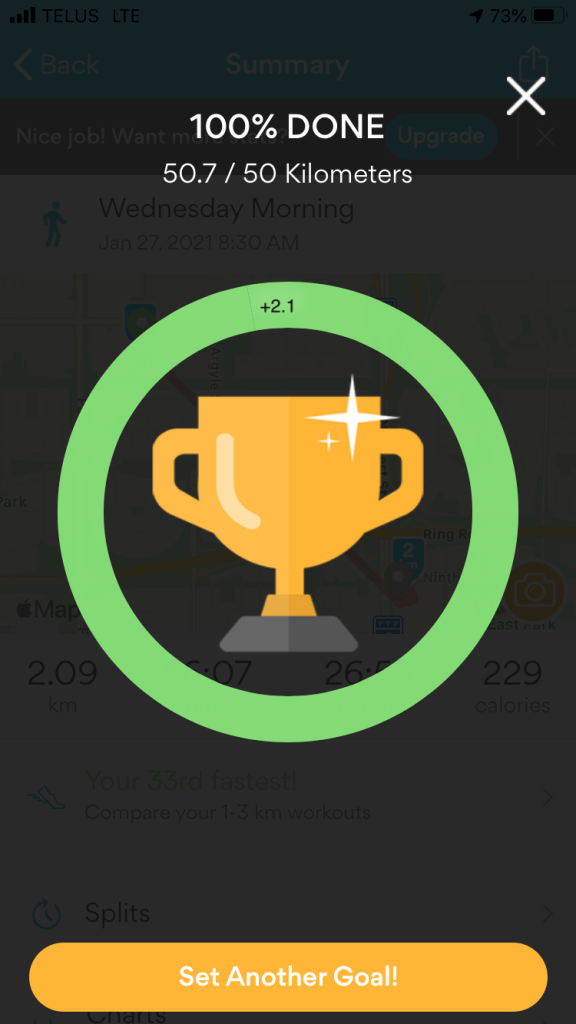
The lack of energy and motivation is what usually hit me hardest. I like to think that things are much better for me these days, and I use my motivation in ways that continue to grow my fitness and increase my control over Diabetes. And sometimes I like to try new things. You may have heard me mention that, once in a while. During the first week of January, I joined a fitness challenge through my RunKeeper app that involved logging 50 kilometres of distance within the calendar month. One would think that this shouldn’t BE an issue, since I usually log more than that in one cycling session. But it’s kind of difficult to cycle on snow, and walking roughly involves three times as much time as cycling.

I started by taking time to walk a few kilometres during the daylight hours. This was made all the more difficult by the fact that Nathan was remote schooling when I started this, and he couldn’t understand why I wouldn’t let him join. When he started going back to school in person, I would see him off on the bus then take my walk immediately after that. It would be a touch on the colder side, since the sun wouldn’t be up at this point. But I would usually manage to get three or four kilometres logged within an hour of walking, which was a good pace and started growing my monthly total to bring me closer to the 50 kilometres I needed.

Sometimes, it was actually nice to get out of the house and have a walk. On clear, sunny days I could listen to music or simply be alone with my thoughts while getting fresh air and some mild modicum of exercise. I started to see some of the advantage behind walking every day. On other days, it felt tedious and very much like an obligation. This is where I started to run into trouble, towards the end. With only 8 kilometres left to log, I lost motivation and started avoiding walks. It’s not like I was even actively trying to avoid it, I simply didn’t;t have the energy. Inclement weather and the recent snow storm with power outages certainly didn’t help.

Ultimately, I reached the minimum I needed. I believe I even went beyond the 50 kilometres I originally set out to log. Completing this 50 kilometres also enters my name in a draw for a potential prize of cross training sneakers that I would never afford on my own (or wouldn’t PAY for, normally) so there was some outside motivation involved, as well. But the experience was good and my wife and I have discussed making walks a family thing, now that the fitness challenge is done. This simply goes to show that you can start working on your fitness with something as easy as taking a walk. The motivation be sometimes need to be found first. But all it takes is getting off the couch and doing it. ☯

Why So Confrontational?

The world is a violent and dangerous place. This isn’t really news; one need only to Google any aspect of world history to recognize that it’s ALWAYS been a dangerous and violent place. But there was a time when a specific violence was contained to its immediate area. If you lived in a small town, you’d likely hear about the assault that took place during the previous evening, but the world would continue to turn. Likely thinking that your small town is a quiet and peaceful place.

These days, even the most remote of places have the world’s information at their fingertips and can access it with but a swipe of their finger across their smart phone, tablets or home computers. People have become much more aware of the way the world operates, albeit most seem to think it’s become an increase since years past. It really hasn’t; we simply hear more about it now. One thing that HAS increased, and I only know this because of personal experience, is confrontation. People seem o have developed a comfort and penchant for confronting one another, either online or in person. And the results can often bring more suffering than it’s worth.

A good example I can provide is a confrontation I had with an unknown gentleman (and I use the term lightly) about a year ago. I believe I wrote a post on this, but it’s been so long, who remembers? Anyway, I pulled out into an inner lane of travel after fuelling up my vehicle. This guy was in the outer lane and decided to switch lanes right in the location where I pulled out. The result was that he honked his horn loudly and proceeded to follow me to the nearest red light where he pulled up next to me and proceeded to call me a plethora of disrespectful names and try to “educate” me on traffic laws. I didn’t bother to tell him, but had he known what I do for a living, he may have understood the redundancy in that tactic.

Long story short, whether in the right or wrong, I apologized and told the guy not to let the incident ruin his day. he seemed unconvinced and unsatisfied. His problem. But it got me to thinking for quite some time afterwards… What would these people do if they confronted someone violent? A wanted criminal or a gang member who’d be just as likely pull out a pistol and shoot the guy in the face as look at him? Because of the nature of the world, you simply never know who it is you may be dealing with when you confront them.

If for no other reason than the fact that you’re prolonging your own suffering and creating some for another person, this is something to be mindful of when confronting unknown persons. And why would you confront them? Let’s look back at my traffic scenario. Did the guy gain anything from confronting me the way he did? Of course not! Has it altered my perceptions or changed the way I drive? I can guarantee you that it did not. I’m still just as careful and mindful of my driving as I was beforehand.

But had I been someone violent or dangerous, that guy might have been caught dealing with quite a different scenario. I’ve seen and experienced it often enough to know it can happen. And this is what needs to be seriously contemplated when one is considering confronting someone. At the end of the day, if something that happened brought you no harm, hasn’t altered your life and you can carry on with the status quo, may consider letting it go rather than confronting another person over it. You may discover that your life will be more peaceful and your stress levels will be less. Food for thought. ☯

You Can’t Roll The Dice Unless You Pick Them Up…

In the short term, I’m not one for taking chances. I like challenge, but I also prefer to know the ground beneath my feet is stable and won’t fall out from under me. But the reality is that sometimes you have to grab life by the sweaty gonads and take a chance. This can relate to many different aspects of life, including one’s health, financials, career and more. In some cases, many cases, if you don’t roll the dice and take a chance in life, you may not accomplish a great deal.

This is perfectly fine if the only ambition one has in life is to make just enough money to keep a roof over one’s head and food on the table, leaving no room for any growth, expansion or experiencing the world around you. Admittedly, there’s nothing wrong with building such a life. I’ve certainly been guilty of wishing to have a simpler life with less belongings and property. One doesn’t need to be Bill Gates in order to have a rich and fulfilling life.

But it stands to reason that if you want something MORE in life, it will sometimes involve taking chances. Rolling the dice. Gambling, if you will. Because the chance you take will often yield negative results, it can be considered as a form of gambling. But traditional gambling is also a good example of this. For example, I buy lottery tickets each week. I’ve been doing so for the past few years and have never won anything beyond a free play or a few dollars, but I continue to play, nonetheless.

Don’t get me wrong; I could give two shits about being rich. I already consider myself rich in a variety of other ways but the money would be effectively used to bring some much needed peace of mind in the form of being debt-free and having an available savings that guarantee that I don’t have to throw myself further into debt just because the foundation of my house decided to start cracking (true story). They say money can’t buy happiness. But to be honest, I’d rather find that out myself than take someone else’s word for it. Money may not buy happiness, but it’s essentially the only way to pay bills.

“Your Odds Of Winning Are Like A Hundred Million To One! Don’t You Know That The Lottery Is Just A Tax On Stupid People?!”

– Brian Griffin, Family Guy (Season 10)

This is a discussion I’ve had with a number of people over the years, since most people are convinced that there’s no point in playing the lottery as the odds of winning are almost non-existent. This may be true, but you know what else GUARANTEES you won’t win? Never playing. Eventually SOMEONE will win. And that someone will reap the benefits of that victory. And the reality is that I may get hundreds, maybe even thousands of losing tickets over the course of time that I play. But it only takes ONE winning ticket to make the difference.

I use the lottery as the subject of my analogy, because it’s familiar to most people and it’s easily understandable. But the lesson applies to all other areas of one’s life. Where would society be if no one ever gambled on themselves and took a chance? I referenced Bill Gates earlier… What if he never took a chance on himself? Microsoft may never have come into existence and the face of modern computing would be significantly different. What if Mark Zuckerberg hadn’t taken a chance and developed FaceBook, subsequently fighting for it and allowing it to develop? The world of social media and how we connect and communicate would be significantly different as well.

Maybe both of those are bad examples as well. Light knows the latter example hasn’t garnered the best reputation in recent years. So let’s consider lightning, instead. Have you ever been struck by lightning? Me neither. Any idea what the odds of being struck by lightning are? 1 in 500,000! And that’s DURING the lightning storm. If it’s a clear, sunny day I’m certain the odds jump sky-high (see what I did there?). But consider this? Do you think that someone who HAS been struck by lightning gives a damn about the odds? Or the statistics? No. They simply know it can happen because it HAS happened.

“Never Tell Me The Odds!”

– Han Solo, Star Wars: The Empire Strikes Back

I’ve basically written this fun little post with all these lottery and lightning analogies to illustrate a simple point: life doesn’t progress and move forward by sitting on the couch waiting for something to come to you. You have to occasionally take a chance. Whether it’s on yourself or on someone else, you can’t roll the dice unless you pick them up. And those dice won’t yield a winning throw unless you decide to take a chance and try. The odds may be against you, but you’re guaranteed to lose if you never play. ☯

Don’t Call Yourself Sensei…

The word Sensei is popularized in the Western world and sometimes used a little too often for comfort’s sake. Putting aside for a moment that the title of Sensei should never be self-given (except to explain to a new student that you ARE the Sensei), the word essentially translates as “the one came before,” indicating that it’s a person’ who’s been there and done that. In martial arts circles it mostly used as a title of respect used by the student body to the lead instructor, which is why I say it shouldn’t be self-given; it’s a word that your students should be using to address YOU, not to identify yourself. But as usual, I digress…

Teaching can be a difficult thing and is in fact, a very strange creature. Most people who DON’T teach, assume that all it involves is passing on knowledge that you know something about. Although that’s a part of it, teaching has a great deal to do with HOW you impart that knowledge, how receptive your students are to what you’re providing and the communication that takes place and control methods used in order to achieve that goal. Teaching is not for everybody; a fact that my wife and I have learned in great detail over the past month from trying to take ownership of Nathan’s “at home” learning.

From a martial arts standpoint, it isn’t enough to have the rank and experience to know what needs to be taught. This is especially true of kids’ classes, but it holds to all students. Having the dynamic methods to impart said knowledge to the students who wish to learn takes a number of different steps on behalf of the instructor, most of which I learned the hard way. I had my own dojo for a few years in Northern New Brunswick before moving out to the Prairies. And I learned a number of different things about how to properly impart the knowledge necessary for a student to learn karate…

Focus On The Foundation: While it may be impressive to start the first open class of your school by demonstrating a triple spin kick, couple with a backflip while holding a sword may be impressive (and redundant in a real fight), it won’t help your students to learn from the beginning. Most people who have been doing something for a number of years won’t relish going back to the beginning. Most of us want to keep moving forward. But that new student who is beginning on Day 1 needs to learn those basics that you mastered so many years ago. Not only is it NECESSARY to impart these foundational skills on new and even intermediate students, it can be a good revisitation for the instructor as it’s important to remember one’s foundation;
Explain The Rules: The dojo can be a confusing place, especially to a Westerner who’s never done martial arts before. They’ll need to be told and come to understand that they have to bow before entering the dojo, refer to the instructor as “Sensei” and how to properly line up. This needs to come BEFORE you start hammering them with all those knuckle push-ups as a punitive measure. This is one of those instances where ignorance CAN be an excuse, unless you permit it to continue;
Use Your Voice: If you’ve ever watch a show or movie centred around karate and the martial arts, you’ll notice that there’s often a lot of yelling going on, the instructor is walking the rows and correcting students’ movements, etc… This is important. Even if you know what you’re doing and you’ve told the class to mirror your movement, you can’t stand at the front like a mime trying to get out of the box. The class needs to feel your presence and receive correction. Maybe that student at the front needs a foot adjusted. Maybe the student at the back has to be reminded to focus instead of staring at the female student in front of him (true story). Be present. Be vocal;
Admit When You’re Wrong/Don’t Ask Anything You Won’t Do Yourself: With over thirty years of karate under my belt, there are still things I don’t know. It’s extremely important as an instructor that you be willing to admit if you don’t know something. Trying to circumvent the question or making something up not only makes you look ridiculous, but it can damage your credibility. Once that happens, good luck trying to teach the class. And if you intend on having the class drill through a couple of hundred kicks, you best be ready to do it as well. Nothing damages an instructor’s credibility like having the students sweating half to death while the instructor calmly and dryly walks around doing nothing. Don’t forget that even if you’re the instructor, you’re ALSO there to work out. You can’t do that from a still position. Never ask your students to do something you aren’t willing to do yourself;
Be Prepared And Have A Focus: As much as it shouldn’t be necessary, your students will need to be kept engaged and interested. If you walk into the dojo and perform the exact same warm-up and the exact same workout during every class, it won’t take long for people to start yawning in class (which is an incredible sign of disrespect, but shame on you if you’re the cause). Keep your warm-ups dynamic and different. Don’t be afraid to change it up, not only to keep it interesting but also because it will keep your muscle groups guessing and work more body parts. Every class should be thought out and planned before the class starts. Focusing on kicks? Next class, focus on punches or blocks. Doing break falls tonight? Maybe focus on pressure points or throws during the next class. It’s perfectly fine to have a class where you work lines of techniques for an hour, but that should be your EVERY class. Planning and preparation will ensure the you’re moving forward with the program and that your students will progress;
Acknowledge Ranks But Don’t Let Them Define Partnerships: It’s important to understand that the white belt that started last month won’t be able to perform some of the techniques and may not have the staying power that the green or brown belt may have. But there’s no reason why a beginner can’t be partnered up with an advanced belt for paired exercises. This is a common misconception in most dojos. Even my current dojo has a nasty habit of saying, “Try to pair up with someone of similar size and rank…” Although this isn’t done maliciously, the pairing of students at different ranks is important to the learning process. Honestly, the head instructor can’t give one-on-one focus to every student during every class. This is why it’s important for junior belts to interact and be involved with the senior and advanced belts. That way, they get the additional coaching they need and the advanced belt can also learn a lot from junior belts;
Push Yourself, No Matter What’s Going On: Life doesn’t care about your plan, and sometimes things may try to get n your way of teaching the class. One good excuse is getting sick. Now, I’m not referring to getting the chicken pox or something dangerous and contagious. But I’ll always remember the times when I’ve had a basic cold and still went to karate. It’s important for the instructor up front to be motivated and driven with the same level of enthusiasm, regardless of anything personal that may be happening or whether or not they are sick. Nothing sucks the energy out of a class like a sluggish instructor who isn’t pushing themselves.

This is not an exhaustive list, but I just took stock of how long this post has gotten, and I’m barely halfway there. Teaching can be a challenge. And since I’m going on about keeping one’s students interested, I’d also like to keep my readers interested so I’ll cut the list short before y’all fall asleep while reading it. Hopefully, it gives any prospective instructors a foundation on which to start teaching. And it should also provide a certain level of clarification for students who may be reading as well. Martial arts is meant to be a give and take. There must always be a balance. ☯

Too Much Of A Good Thing…

Can you ever have too much of a good thing? Yes. Yes you can. And depending on what that thing is, you can cause all sorts of damage to yourself, your health and your well-being. Don’t believe me? Choose your favourite take-out food and go eat it in buffet format… It won’t take long before you’ve overindulged and spend the next forty-eight hours regretting it for various reasons. And believe it or not, you can also have too much fitness, exercise and workouts. And even karate. There, I said it.

I think it was Epicurus who said, “No pleasure is bad in and of itself; only the consequences from overindulgences in those pleasures.” I think this applies to everything from favourite foods, sleeping and yes, even working out. I bring this up after recognizing that during the week of January 3rd, I performed 10 workouts. No, that’s not a typo! Granted, this is partially because I joined RunKeeper’s “Small Steps, Big Goals” Challenge that basically requires walking 50 kilometres and tracking them via the app, for the month of January. I’ve just been too excited (or stubborn?) at the recent purchase of my new kettlebells NOT to include a strength workout every day after my walk, as well.

What are the possible effects of working out too often or overexerting yourself? Well, according to a short article posted by HealthLine.com, most of the signs will be pretty recognizable. The first is pain, which I think makes sense. Working out causes damage to the muscle tissue, which then heals up stronger and bigger than before. This is how fitness growth is done. The next is fatigue. Not being tired, but fatigue. The difference is that being tired can be fixed almost immediately by resting. Fatigue can have a much deeper significance, including lack of energy, poor movements and lack of concentration.

You’ll also get sick more often. When you overexert yourself, your body will take longer to heal and recover, which means your body can’t fight other shit like, say colds and flus… Things like that. The last symptom the article included is difficulty breathing. If this happens, it can mean one of two things: either the exercise is too intense for the amount of oxygen you’re holding in, or you happen to be one of those poor idiots who holds their breath when doing something that requires effort! Not only should you be breathing properly throughout your workout, a decent exhale during the peak of a movement can be helpful to its proper execution. This is especially true in karate.

I’ll add a personal one that’s quite important, which is good nutrition. Most people seem to eat like trash. You need to include some lean proteins, healthy doses of vegetables (I have a rough time with that one) with at least one meal with a good dose of carbohydrates. That’s right, the Diabetic is suggesting carbohydrates. Don’t forget that carbs are your body’s fuel and you need to refill the tank after you’ve burned most of it. Although reduced-carb/reduced-calorie can help burn body fat, you can also overdo that aspect, which will lead to a whole different batch of complications.

You can avoid overexertion by acknowledging your particular circumstances. Age, medical conditions personal abilities are important and shouldn’t be ignored. Given that I have Type-1 Diabetes, testing my blood sugar levels every hour during fitness is an important aspect. You may be thinking, “Every hour? Am i supposed to be working out for longer than an hour?” Well realistically, the average karate class lasts between one and a half to two hours. My 70-kilometre bike runs last for almost four hours. It’s a bit tougher to stop during karate, since dojo etiquette usually prohibits leaving the floor without the instructor’s consent, but health comes first!

Another good way to avoid overexertion is by ensuring you’ve warmed up properly, you avoid sudden twisting and jerking movement that will hyperextend your muscles, tendons, ligaments and joints, get rest and food as appropriate and at appropriate times. And test, test, test… Different workouts will have different effects on your blood sugar levels, so it’s important to stay on top of that. Also, don’t forget to lighten the load when you need to. I’ve lost count of how many times in a gym that I’ve started doing reps only to drop to a lighter dumbbell for the next set because it was too much. There’s no shame in this. In fact, it’s a smart move and guarantees better growth and faster recovery.

The last, important point to avoid overexertion is learning how to do things properly. It may feel great to pound that punching bag for thirty straight minutes, but if your technique is wrong you can risk all sorts of injury and issues. Better to start slow and learn whatever it is you’re doing properly before increasing the intensity and amount. You’ll avoid all the nasty stuff and reap more of the benefits.

Get some rest! Did I workout in some way, shape or form every day during that week I mentioned earlier? Yes, I did. I also reached 10 workouts the following week, although some of these included the fitness challenge’s walks and some meditation (yes, meditating burns calories and can be considered a workout in some instances). One of the unexpected issues with working out almost constantly, is that your body will develop a muscle memory to constantly being taxed. This means that your system, as well as your blood sugar levels, will get used to constantly moving and exercising. The next time you have a light week where you may only work out once or twice will cause a reverse effect and mess with your blood sugars. Food for thought.

Fitness is important. Absolutely. But so is decent rest, good nutrition and proper form in all that you do. Work hard and focus on the benefits you’ll eventually gain. But keep a firm eye on what you’re doing and listen to what your body is telling you. It’s normal to feel pain during a workout, but there’s a big difference between aching or “feeling the burn” and being in genuine pain. Drink lots of water, take breaks and take care of yourself first. Your body is the engine that drives you, and every engine needs to cool down from time to time. ☯

What The F&%k Is Spinning…

It’s no secret that I’m a big fan of changing up the ol’ workout routine whenever I get the chance. In fact, there are very few workout routines that I won’t try at least ONCE, although I’m certain as I get older that eventually there’ll be some exceptions. But I do still enjoy a challenge. This is where spinning comes in. Sometime in the early period of the past ten years, I travelled home to New Brunswick to visit my family. I brought along some fitness gear, since Sensei’s dojo was closed out for the summer but my aunt and uncle managed a local fitness gym that I knew I could frequent.

I was home for a few days, jogging the few kilometres required to reach the gym, paying the five dollar day pass and using the gym for about an hour before heading home. I felt light and easy, and satisfied at the fact that I was maintaining my fitness while on vacation. On the third or fourth day I ran into my aunt, who explained that she ran a spin class three times a week and invited me to join for one of her classes in lieu of going to the gym. She explained that it was a workout using an indoor stationary bike. When I found out how late into the morning it was, I stated I’d hit the gym THEN go to her spin class. She warned me that I’d be unable to do both in the same morning. How right she was…

I didn’t know exactly what to expect. I’d used stationary bikes before, but I obviously preferred the real thing. I walked into an open area with a dozen books lined up and a small group of women stretching their legs and chatting. My aunt approached and introduced me to the group, who all agreed how nice it was to have a man working out with them for a change. I was handed a 10-pound padded rod and told to place it on the front of the bike until it was “needed.” What the hell was going on???

The music started and everyone started peddling. What followed was one of the most intense hours of my life. In the seat, up from the seat, easy peddling, higher-geared peddling, hold the rod, shoulder press the rod, and on and on… I was drenched within minutes and it was a ridiculously brutal workout. It worked basically everything on my body that I could see as well as some muscle groups that I wasn’t aware even existed. It was so good in fact, I joined my aunt’s class as her guest for several more sessions on that visit and subsequent ones.

Spinning has a number of measurable benefits, including increased cardio, weight loss over the long term due to an increased calorie burn, muscle increase and helps to prevent lower back pain. It’s also a low-impact exercise, making it much easier on the knee and joints than running. The articles I’ve read have suggested that an hour of spin class can burn anywhere between 400 to 600 calories, which is not to shabby if you’re trying to burn through enough calories to be in deficit to burn fat.

If you’re looking for something that’s easy on the joints but high on the challenge scale, I highly recommend spin class. The benefits are many, and frankly there are very few downfalls, except whatever membership price you may pay for the class. I was reminded of my experience with spin class a couple of weeks ago when it was brought up during a conversation with one of my friends. Although taking part in an actual spin class may be a bit difficult at the moment, there are ways to access stationary bikes and do your own spin workouts at home. The benefits will be well worth it. ☯

Is It Ever “Too Late?”

There comes a time in every person’s life when they begin to notice certain physiological changes starting to take place. Oh, we all like to think those changes will never happen. But the reality is that it sneaks up on you as time marches on. And no, I don’t mean puberty. Maybe some of your hair gets a little greyer. Maybe your muscles are bit stiffer and your movements are a little slower. Time makes a fool of no one; we all know these changes are coming, we simply choose not to acknowledge them.

I write this post after waking with severely sore muscles, a cramp in my neck and a need to rock back and forth twice in order to hoist myself out of the bed. I recall a time when I could vault out of bed single-legged when the alarm went off, be showered, dressed and out the door in under ten minutes. Now, if I happen to have slept wrong, I need to sprawl on the couch for the first two hours of my morning before I restore enough circulation to start my day; a benefit that is only possible due to COVID-19 and being at home.

Have I sufficiently bummed you out, yet? I may be exaggerating the facts a bit (although I am starting to show quite a bit of grey) but it’s important to acknowledge that we all get there. There is no magic potion, no fountain of youth and no way to go back and do it all over again. This is why it’s critically important that we take care of ourselves and develop ourselves as best we can, while we can. An idle engine will eventually seize, and the human body is the most complex engine there is.

I’ve often chatted with folks who are no older than I am, about martial arts, my chosen career and how I’ve accomplished these things despite Diabetes and other associated issues in my life. Almost 9 times out of 10, these folks will usually say something along the lines of, “I always wanted to try karate,” or “I always WISHED I’d tried karate.” I use karate as the example, but I’ve had people utter theses sentences for a variety of activities, jobs and fitness aspects, including karate. When I ask why they don’t try it, I always get the same answer: “It’s too late for that, now!”

No. No, it’s not. Unless you’re unfortunate enough to be afflicted with a terminal illness that prevents movement, it’s never to late. A person may not be able to turn back the clock, but there’s nothing stopping a person from making a start from right where they are. In fact, I’ve watched people in their late 40’s and even their 50’s make their way through basic training. I’ve seen people of all age groups, body types, weight categories and backgrounds join karate and do quite well. In some circumstances, it may not necessarily mean that they go on to be an action hero or anything, but there’s nothing stopping them from trying.

The idea is that you can’t allow yourself to become idle. It’s important to take at least twenty minutes a day to stretch, move and get some sunlight. I know the current state of the world has reduced how often we leave the house, but most people can still manage walking outside, taking a drive or simply standing in their back yard and breathing in the fresh air. Physical activity is important. You need to be able to work your body physically, in order to maintain it. You can eat well, but this only provides the fuel. What happens to your car if you keep adding gas to the tank without driving it? Eventually, the gas will overflow, make a bloody mess and the engine will eventually still seize from lack of use.

I always like thinking of my grandparents for this comparison. My grandmother was a sedentary woman. She gave birth and raised seven children and was by no means lazy. But once those children were all grown and out of the house, her life pretty much ground to a halt. She never worked, never exercised and never moved (and no, knitting doesn’t count!). By the time she reached the age my mother is at now, she became hunched over, her body started having serious difficulties and her muscles became slack and useless. She passed away in her 80’s, unable to walk and function.

My grandfather joined the army when he was young and fought on the European front during World War II. He worked as a blacksmith, carpenter and always kept himself moving. When the sun rose, he’d be up and about. By the time retirement came around, he made use of a wheelchair, but he was still using dumbbells and exercising up until the week before he passed away, which was at the age of 95. Physical activity and working his body was a part of his life, which resulted in better mobility and health for longer, as well as almost ten added years of life than my grandmother.

Now, I know what you’re thinking… There’s no way to confirm what the difference may have been. After all, if my grandmother had done everything my grandfather had done, maybe she’d have fared better for longer as well. And there’s no accounting for the differences in inherent physiology, differences in hormones, etc, etc, etc… But that’s exactly the point: she didn’t! It can debated ’til the cows come home, I’m simply offering a true example of how two bodies will differ, based on two different lifestyles.

People often ask me how I’m in such good health, despite having Type-1 Diabetes. In my 40’s, I essentially suffer from none of the typical complications associated with someone who has had my condition for decades. My nervous system is clear, my kidneys are in excellent health, none of my toes have had to be amputated and I keep being told by my doctors that I have the heart of a horse. Now, if only my efforts would start to melt this “dad bod” I seem to have developed…

I’ve been moving, training and working out for as long as I can remember. Although I remember the specific details of how I started on all these different journeys, the images of those memories have started to blur. But I know that if I had never started karate all those years ago, I would still find it within myself to try it now. In my early 40’s, I could still conceivably reach some pretty high levels. The lesson is that it’s never too late.

If you’ve always wanted to try something, try it. Have a sport you want to attempt? Go for it. Have a career you’ve always wanted to have? Work for it. It’s never too late. Want to join karate in your 60’s? Bow and step inside, I’ll teach you! You may have to research what you’re looking to try and take the proper precautions, but there’s no reason you can’t do it. Your body is your engine, and you’re the only one who can keep it running smoothly and clean. Even the most efficient engines only hit their stride once they’ve geared up to increase their momentum. So, you need to get started. Start by getting off the couch. Start by stepping into the dojo/gym/outside. Start. Your personal motivation is what dictates what you’ll try, not how many candles were on your last birthday cake. ☯

Couples Who Work Out Together, Get Fit Together

My wife and I started doing a generic workout that I found online, just shortly after New Year’s Day. It’s called the “Army of Two” workout, and it incorporates three different levels of increasing length for six different exercises. I need to give credit where credit is due, since I didn’t create this workout and hold no rights to it. The workout was found on Darebee.com, which is a fantastic website with TONS of different workouts. They’re mostly body weight only, so it makes for easy and simple workouts that you can do just about anywhere. here’s the one my wife and I have been doing:

We just recently did Level II together, which takes roughly half an hour. We use a dumbbell or kettlebell for the “back-to-back sitting twists,” just to add a bit of resistance to the mix. Otherwise, we both enjoy it and it’s a great way to do a simple workout with your spouse or partner. If you’re looking for different workouts to work different areas of your body, or just to throw a bit of variety into your fitness routine, be sure to check out Darebee.com. You won’t be disappointed. ☯