I just got through watching both seasons of Cobra Kai, which are now available on Netflix. The series follows the exploits of Johnny Lawrence and Daniel Larusso, respective antagonist and protagonist from the 1985 original “Karate Kid.” This time around, Lawrence is the focus as he struggles through a failed marriage, an estranged son and bringing back his Sensei’s failed karate dojo, which is Cobra Kai. It’s a fantastic martial arts series, focused on karate. I can’t wait to see what Season 3 will bring.
It got me feeling nostalgic for the original Karate Kid movies, which included two sequels and a rebirth with “The Next Karate Kid.” You’ll noticed I haven’t mentioned 2010’s remake of the The Karate Kid, starring Jackie Chan and Jaden Smith. Although it was a decent movie, it’s based on Kung Fu, not karate and was basically a slap in the face to the original. But through that nostalgia, I started researching and falling down the YouTube rabbit hole and discovered some interesting facts about the film series, including the involvement of Fumio Demura.
Fumio Demura is a well-known martial artist who studies Shito-Ryu karate and kobudo. I came to find out that Demura played the stunt double for Pat Morita’s “Mr. Miyagi.” This came as a surprise to me, since I knew of Demura through his books. Demura wrote a series of books in the 1980’s covering a number of weapons used in Kobudo. Since joining Kempo Karate in 2016, I’ve slowly introduced the bo staff and sat into my training regimen.
Since there’s a limited amount of coaching time on weapons in the dojo, I decided to order two of Demura’s books, Bo: Karate Weapon of Self-Defence and Sai: Karate Weapon of Self-Defence. In these books, Demura covers a number of basic concepts for both weapons and includes several photos and diagrams. They’ve been helpful, despite the fact that I don’t focus heavily on weapons.
It was cool to read about his involvement. We’re all aware that movie actors use stunt doubles, but it was neat to find that one of my favourite movies included a stunt double that I’ve read and studied about. If you study karate or kobudo, I highly recommend you search “Fumio Demura” online and see what you can find. Any of his books are definitely worth a read. ☯
I just finished writing a post some days ago about different styles of karate and how I often regret that my own style, Uechi-Ryu, doesn’t get more attention when the original Okinawan styles are listed. In fact, if you look at most “family trees” of karate, Uechi-Ryu is rarely included, despite being Goju-Ryu’s sister-style and comparable to Shotokan and a few others.
That’s when I came across this YouTube video posted by Jesse Enkamp. Enkamp is a reasonably well-known practitioner of karate who has studied in Okinawa and in Sweden under the tutelage of his parents, who are karate instructors. As quoted from his website, Enkamp is “a best-selling author, entrepreneur, traveller, athlete, educator, carrot cake connoisseur and founder of Seishin International,” which is a fantastic line of martial arts apparel featuring karate gis.
He also has a YouTube Channel that I recently subscribed to, and he has some really great perspectives on karate and martial arts in general. We different on some of the perspectives, but as the old saying goes, “variety is the spice of life.” It’s unclear as to what style Enkamp actually Studies. This is because he claims he studies karate and not so much any specific style. I can’t say I entirely agree with his way of thinking, but he has pretty good reasoning behind this concept.
Regardless, he recently posted a YouTube video entitled, “The Best KARATE Style For Self-Defense,” where he talks about a traditional style of Okinawan karate that winds up being Uechi-Ryu. I had a pretty good idea that this was where he was headed (since the kanji symbols for Uechi-Ryu were in the title), but it was nice to have someone outside my system actually show some love for one of the best circular systems of Okinawan karate ever founded.
Enkamp’s YouTube entry on Uechi-Ryu
I don’t usually share or link YouTube videos as I consider someone’s video submissions to be theirs and theirs alone. But like I said, this one hit close to home and got me excited that someone was ACTUALLY talking about Uechi-ryu. This just goes to show a style is never really dead, so long as there are people willing to talk about it.
And Jesse, if you’re reading this, I hope you’ll like and follow my blog as I follow your YouTube channel. We karate practitioners need to stick together. ☯
I remember training for my black belt in karate, and doing my very best to prepare for it in a Rocky-style format. I used to get up at five in the morning and run five miles, followed by an hour of intensive shadow boxing and forms. Without getting into the specifics of the test, I knew that I would be facing the challenge of my life, and I wanted to do everything I could to ensure I would be successful.
The last class before the weekend of the test, I attended class and tried to blend into the background, which wasn’t easy considering I stood at the front as one of the senior students. I didn’t speak to anyone about the upcoming test I would be subjected to, over the weekend, as was the custom in our dojo. Test dates were kept private until the student walked into the next class with a new belt colour around their waist.
After that last class, Sensei and I took an hour together and discussed the test and what would be involved. We went over some of the material that I knew I had some mild difficulty with, and I made a point of explaining that I planned on having a light meal and getting to bed early, in order to get some extra rest. Sensei smacked me in the back of the head and spoke three very important words: Don’t. Change. Anything.
Essentially, Sensei explained that despite being faced with a very important and very physical test the following day, I should have the supper I’d usually have. I should follow it up by having the evening I would usually have and go to bed no earlier than I usually would. The idea was that altering my usual routine would cause a disruption in my rest as opposed to helping it, and potentially increase my test anxiety.
Change and variety are good. Of this, I have no doubt and there is no question. But when it comes to facing something out of the ordinary, it’s important to remember that we shouldn’t alter our routines. We need to trust our gut and follow our usual routine. trying to do anything out of the ordinary will only stress and tax your body further and increase one’s anxiety. Stick to what you know. It’ll serve you better in the long run. ☯
As people, we have a propensity to think we know everything. Especially in any specific area, where we think we happen to be experts. Sometimes it’s a point of pride, sometimes it’s vanity. But uttering the words “I don’t know” usually evades us. Or we avoid them. Whatever. But there’s nothing wrong with lacking some knowledge. Vulnerability and not knowing is okay.
After graduation, I moved on to college and chose to study computer programming. I spent my entire life around computers as it was my father’s addiction, so it felt like a reasonable step to pursue it further. One thing that didn’t help was that I was convinced to attend a french college. Even if I’m fully bilingual and can speak French, it didn’t change the fact that computer terms that were three inches long in English were found to be ten inches long in French. I’m exaggerating, of course. But it doesn’t change the fact that taking the course in French, despite it being a primary language for me, caused untold difficulties. My college years were some of the most difficult I’ve ever faced, for this reason.
I learned the hard way that computer programming wasn’t for me. I may have enjoyed playing the games and watching my father code, but trying to delve into the complicated world of computer programming proved to be the wrong direction for me. It didn’t help that I had a karate belt test pending during my first year of college, and my priorities were fixed on karate as opposed to college. I did, however, learn to play a network game of Duke Nukem 3D in college. But I digress…
I had a slew of college professors; some good, some bad. Some of my professors walked in, delivered their lesson plan and walked out without making any real connection with the class. Some professors considered every student to be a “buddy” and focused on being a friend more than teaching the curriculum, which was almost worse. Picture a college professor showing up at lounge nights to have drinks with students. Not great, right? But out of the shadows emerged a professor who was the happy medium; part teacher, part friend, all learning.
Because I was having so many difficulties, I asked a lot of questions. I mean, a LOT of questions… If you’ve never experienced being around a French guy who won’t shut up, consider yourself lucky. Picture that boring staff meeting where you’re hoping everyone will keep their trap shut so that the meeting will end sooner, just to have that ONE guy constantly bring up another point. That was pretty much me, in college. But I couldn’t help myself. I hate failing. And I hate quitting.
Most of my professors would either make something up (that I would learn was false later) so as to not look as though they didn’t know their own material. Some would ignore the question and tell me that my answer was in the learning material. But this one professor would make it a point to admit it when he didn’t know something. He had no problem saying, “You know what? I don’t know the answer to that, but let me look it up and I’ll get back to you in tomorrow’s class.”
That’s class. That’s professionalism. Admitting one’s lack of an answer shows a specific vulnerability and humanity beyond what most people are capable of. He was one of my most trusted professors, and my only regret is that I don’t remember his name. Hey, come on! Give me a break! We’re talking almost twenty-five years ago! I’m getting a bit on the older side, I’m expected to forget a few things…
Realistically, I remember this professor BECAUSE of the humanity behind the teacher. Even if you’re teaching something, it doesn’t mean you’re expected to know EVERYTHING. I started studying karate in 1989 and am still learning new things, even now. And if the day ever came where there was nothing new to learn, I’d be greatly surprised. Honestly, I don’t believe it’s possible. But the point is, I learned from that professor, and have found myself often telling my students, “Give me time to try it out” or “Let me look into it.”
And being able to do that is important, because it engenders trust. Your students will trust you and believe what you tell them way more if they understand that you’ll be honest and admit when you don’t know. I’ve applied this concept in almost every area of my life. If I don’t know, I say so. Not only does it engender trust in others, it prevents making me look like a damn fool because I tried to make something up. Important food for thought. ☯
Quarantine and self-isolation have had a positive effect on the Canadian population, as many people have chosen to take some of the downtime to start new hobbies, clean out their homes or begin renovation projects that they may otherwise have never considered. It’s definitely a positive thing, and has kept lumber yards, home improvement places and retail locations in the black during this whole mess.
Although I’ve been dealing with small projects like growing a lawn in my back yard and selling my car, I haven’t really tackled anything that’s taken serious effort. But since the basement of my house is damaged and the whole thing will need renovating, I’ve found myself without a workout space. Oh sure, I’ve been able to continue doing things like cycling and I even did my Marine workout in the garage, last week. But I’m losing the striking pad I had mounted on the current basement wall. I needed a solution.
Some of the materials I started with
Since I didn’t consider it safe or in anyone’s best interest for me to attempt basement renovations on my own (I’m great with a sledgehammer, that’s the limit of my renovation capabilities), I decided to construct my own makiwara board for the back yard. I’ve mentioned this training tool in previous posts, but a makiwara is a padded board typically used to condition the knuckles and strengthen your punches. It’s thought to be Okinawan in origin and is mostly used in traditional styes of karate.
Polyester cord to wrap around the makiwara as a striking surface
Most properly-constructed makiwaras can run anywhere from one to several hundred dollars in cost, especially if you factor in the shipping and handling to have it brought to you from whatever distributor you purchased it from. But if the Okinawans can build theirs from scratch, I figured “so can I.” I had several 7-foot lengths of wooden board that was left over from our house’s previous owner. I started by trimming two of these boards to an appropriate and matching length.
The free lumber was definitely a solid start and is potentially the most expensive aspect of the project. I brought my son Nathan to Home Depot, where we purchased a half dozen 6-inch iron bolts with matching nuts and washers. I also purchased a 100-foot length of polyester cord, which would be wrapped at the top of the makiwara as the striking surface. Polyester is a water-resistant material, so it would be best-suited for an outdoor training tool.
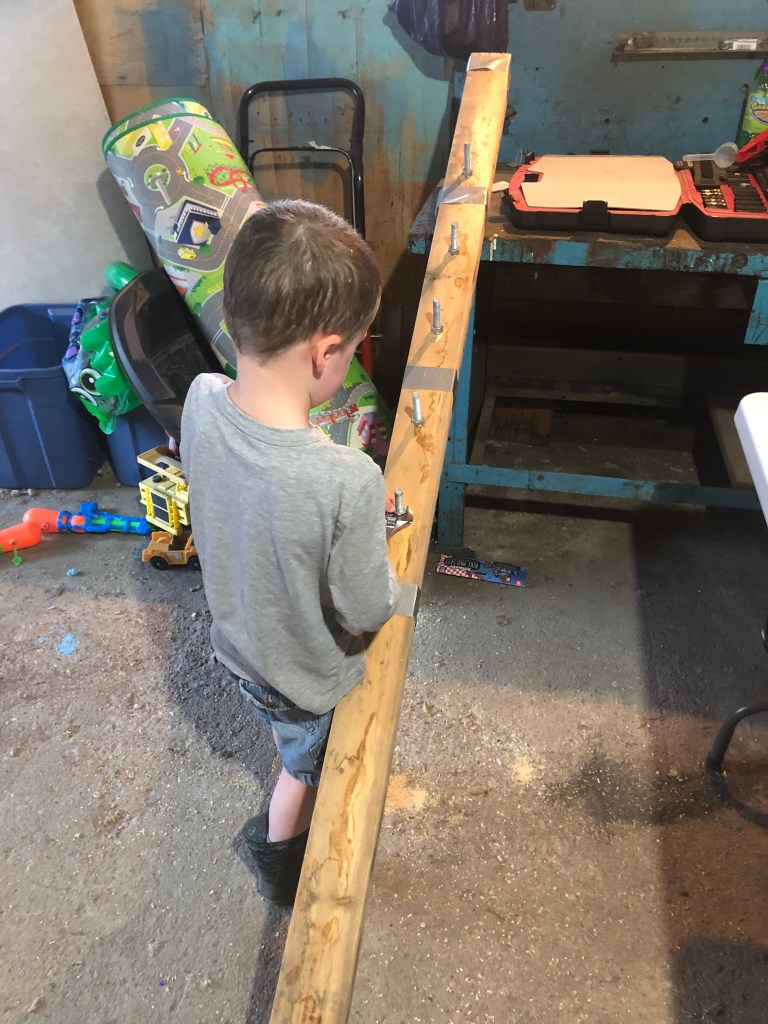
Nathan hard at work, screwing the bolts into place
Nathan and I duct-taped the two boards together so that they were flush, them I drilled 3/4-inch holes at five-inch intervals through both boards. I hammered the iron bolts through the holes and Nathan screwed the washers and nuts into place. Once all six bolts were firmly in place, we were able to remove the duct tape and move on to the striking surface.
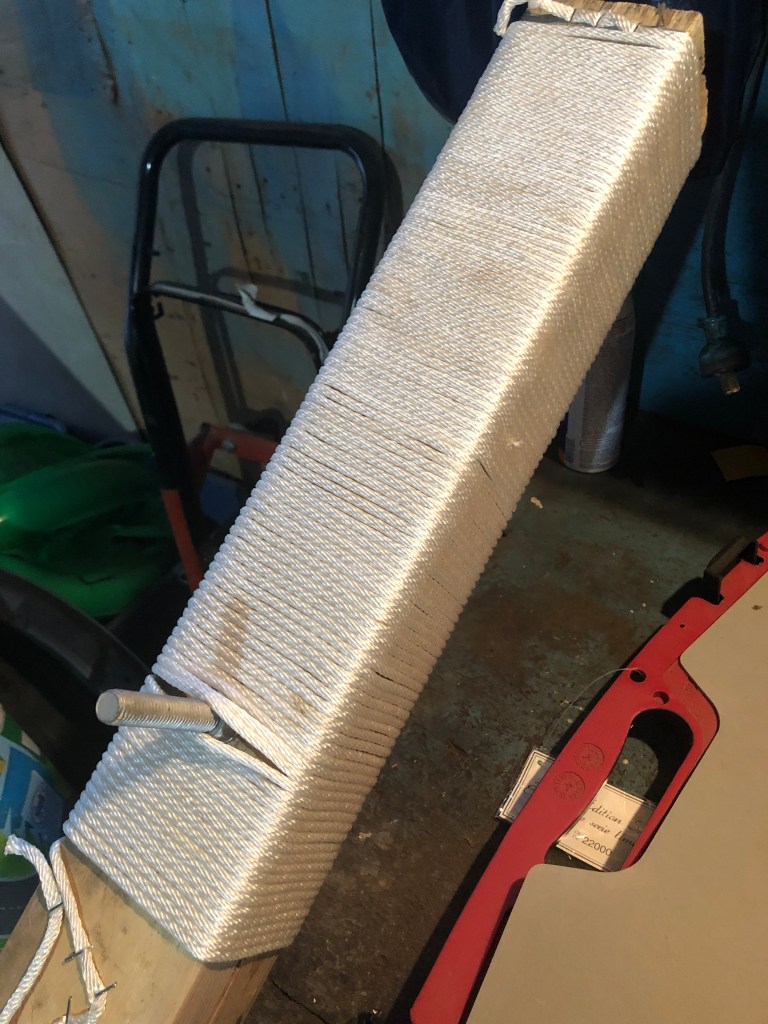
The wrapping of the makiwara
I left the top strip of duct tape and used a staple hammer to fasten the end of cord to the board, followed by twenty minutes of fastidious wrapping and tightening of one hundred feet of cord. With the exception of Nathan complaining he wasn’t allowed to do this part (and climbing over and under the project while I worked), it went reasonably well and I used the same staple hammer to fasten the other end once the cord was all wrapped.
The completed striking surface
The makiwara was now complete. The next step would require digging a two or three foot hole in the ground, placing the post and filling the remainder with some firm, affixing soil. That was over a week ago. The entire project took a little over an hour and Nathan and I were already tired. So we decided we’d put off the installation until we were able to get some rest and start digging when we were fresh.
Our long-weekend was cut short due to unforeseen circumstances. So on Sunday, Nathan and I took two shovels and a metal bucket and started digging. I didn’t take any photos of that part of the project, since Nathan and I were up to our elbows in dirt. The soil in Regina is a clay composite, which is what’s caused the damage to my basement. It sucks (royally) but it DOES have a benefit for this particular project. Nathan and I reached about twenty-eight inches, which was adequate for the makiwara.
We lowered the post into the hole and packed the remaining space around the pole with the dug up soil. We packed it down after every few shovelfuls, and the clay soil held the post firmly in place. I followed it up with a short length of board to firm up the bracing, placed at an angle at the back. The end result came out quite well, and Nathan and I are quite proud of the job we did.
The finished product!
All said and done, a training tool that would have cost several hundreds of dollars wound up costing less than fifty dollars! Now I just have to find the motivation to get outside to use it. My neighbours have all seen the post and seem to understand the concept behind it, since I explained what it was for. But it may be interesting to see their reactions once I start striking it. There you have it! My do-it-yourself project. ☯
Fear of failure is a very real thing. Most people have it, whether they realize it or not. If you think carefully on your past, you’ll likely find one and/or many instances when you were afraid you wouldn’t succeed at something. Maybe it was a potential job opportunity or an important exam at school. Whatever. At some point, you would have been worried about the prospect of making a critical mistake or failing at something.
This phenomenon is very prominent in martial arts circles, especially given the strict discipline and structured requirements that come with traditional martial arts. I even remember myself, three decades ago, standing at the back of the class trying to move through my techniques without error and trying to avoid Sensei’s gaze. It didn’t matter if I was screwing it up, I was just afraid of doing it wrong. This effect wore off as the years melted away and I increased in skill.
People are afraid of making mistakes. For some folks, it’s about pride. Some people are too proud to admit that they can make a mistake. Others are afraid they may cause disappointment in others, parents, instructors or otherwise. Some are afraid of the windfall that comes from failure and facing the potential consequences. For myself, I was mostly afraid of people seeing me do it improperly.
Whether you’re a newcomer to martial arts or even if you’re experienced, or maybe you have some other endeavours that you’re tempted to try out, I’ll let you in on a little secret: mistakes are an important part of the lesson. The only way you’ll learn is by making mistakes and having them corrected. We all start from the same place; the beginning. And like anything else in life, you need to make the mistakes in order to learn the skills.
It’s like learning to ride a bike. You may fall off a couple of times, you may even get skinned knees. But the important thing is to climb back on and keep peddling. The same can be said of any skill, martial arts or otherwise you may be trying to learn. Don’t be afraid of making mistakes. Don’t be afraid of being corrected or asking for help. It’s the only way you’ll learn. And grow. ☯
The martial arts style I’ve trained in the most is karate. This is the one I’ve studied all my life, and its lessons have carried me far in life. Even to this day, I train consistently and have often joined my local karate schools so that I can enjoy the training dynamic that one can only find by working out within a dojo. But Karate Do (or Karate, as it’s known in the western world) translates as “way of the empty hand” because the art primarily uses empty-hand techniques. This means that a significant amount of conditioning needs to go into the hands.
When people work out, they tend to focus on the major muscle groups that show the best results, like biceps, triceps, chest and shoulders. There’s been a running joke for decades about how people tend to skip leg days, and with good reason. People like to focus on what shows, which is why many professional weightlifters look like they have chicken legs. All of this is a pretty broad generalization, but the truth of the matter is that one of the most overlooked aspects of working out happens to be grip strength.
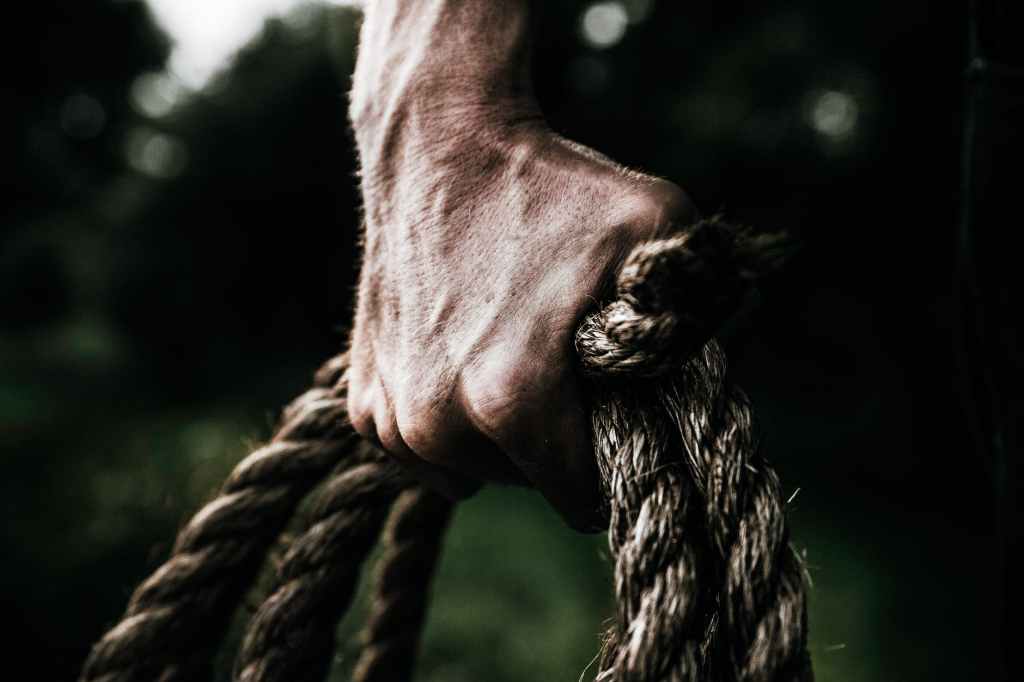
Grip strength is exceptionally important in all martial arts, regardless of style. You can have ripped arms and legs but if you have no strength in your grip, your fighting skills will be greatly lacking. Think about it; if you study Judo or other grappling styles, you need your grip to, well… grapple! Having the grip strength to grab on to your opponent’s gi, clothing, flesh, whatever, in order to flip and/or throw them is critical. In normal striking arts, grip strength is critical for the proper execution of pressure points and grabbing/holding your opponent in order to execute techniques. Grip strength is even important for weapons styles, since it’s kind of important to have enough grip strength to hold your baton, staff or sword.
There are plenty of ways to increase your grip strength, including grip strengtheners you can buy at your local retail or fitness location, to rubber expander rings that you can squeeze and stretch. I used to keep one of the former at my desk at work and flex whichever hand was free as I’d work. Even those so-called “stress balls” can be handy, although the amount of resistance they provide is pretty limited.
Okinawan Gripping Jar, known as Nigiri Game
You can also use a more traditional training tool called Okinawan Gripping Jars. This involves clay jars that have a thick lip at the opening. The jar could be filled with water or sand and gripped at the lip and carried in order to strengthen the hands. Beginners would usually start by carrying them while empty and work their way up from there. If you happen NOT to live in Okinawa and have no skill with a potter’s wheel or a kiln, you can make your own “do it yourself” gripping jars by taking large, glass mason jars and filling them with stones or water. Once the lid is properly secured, the jar is narrow enough to grip at the top.
Hand strength in general is an important aspect of martial arts, and there are many ways to increase that strength. Knuckle push-ups are one of my favourite, as they toughen up the knuckles and strengthen the wrists. Installing a makiwara board in your backyard is also ideal, since it allows you to work on wrist strength and finger strength by working your knife hands, finger thrusts and punches.
Speaking of finger strength, did you know that your fingers are part of your hands? And you should strengthen THOSE as well? No? Well, step right on over for some education. There is supplemental strength training for the hands in the martial arts, known as jari bako. This involves filling a bowl or a bucket with sand, gravel or small stones. The exercise involves thrusting one’s fingers into the bowl or bucket, which results in the strengthening of the fingers and fingertips.
The receptacle would occasionally be filled with hot water as well, especially if you were a naughty student who acted out in class and required some additional motivation to behave. Not that I’m speaking from experience, of course. But the science behind this technique is that the trauma caused to the musculature causes an increase in finger strength, much like any other physical exercise.
As usual, extra care and starting slowly is required when working the hands and fingers as they contain small bones that can be easily injured. This is one of those times when I tend to disagree with the Okinawan masters of old, in that it isn’t necessary to traumatize and disfigure your knuckles or hands in order to increase your striking and grip strength.
My two foreknuckles on both hands are slightly increased in size but aren’t disfigured. That should be the extent of the damage. Anything more is unnecessary and may cause long term problems without necessarily increasing strength. If in doubt, seek instruction from someone experienced teacher or instructor who’s been there and done that! ☯
Without a doubt, one of my biggest pet peeves in recent years is the growing trend where folks are trying to “debunk” martial arts and “prove” why traditional fighting arts don’t work. Considering the fact that I’ve been studying karate for about 32 years at this point, it stands to reason that it has become more than just a hobby or pastime, and is factually a big part of not only what I do, but who I am. So when I see a post or hear someone who claims “karate wouldn’t work in a real street fight,” it not only gets my blood boiling but I can personally attest to karate being quite effective in both my personal and professional life.
This is not to be mistaken with people who spend their time exposing fake martial artists, the ones who claim to be black belts but are not and who take people’s money in exchange for teaching them a watered down version of their favourite movie fight scene. And there are unfortunately a lot of those. You can search “exposing fake black belts” on YouTube for some pretty awkward examples. But once you start creeping into the realm of “why martial arts don’t work,” you’ve gone too far.
Rather than piss and moan about it like a snowflake, I thought I would take the time to compile a list of the most ignorant yet often repeated comments I’ve heard about the martial arts over the years. Here are my top 5:
Karate doesn’t work: Starting strong, right out of the gate! I’ve heard this comment so many times in the past three decades that it often feels like it’s tattooed on my forehead. The irony is that the comment is usually made by someone who has never studied or trained in the martial arts and doesn’t know any better. But coming from someone who has studied and used it on more occasions than I can count, I can tell you that karate, and martial arts in general does work;
Martial arts isn’t “real” fighting, like MMA: Yeah okay, Kyle! Calm the fuck down and have another Monster energy drink… I’m not a big fan of MMA. Not because it isn’t intensive and hard-hitting, but because of the fact that its called “mixed martial arts.” Although I’ve often written that variety is the spice of life, martial arts still requires you to adhere to only one style in order to develop some level of consistency. You can’t study “mixed” martial arts. There’s no such thing. You can be a proficient student in one discipline and choose to dabble and explore another. In fact, that’s highly recommended as limiting yourself also limits your abilities. But to claim that MMA is more effective or more “real” than traditional martial arts is not only laughable, its ignorant of the facts. I usually like to remind MMA fans that shows like the UFC has its roots in traditional martial arts. In fact, the first few UFC pay-per-view events pitted traditional martial arts styles against one another, before they all started wearing bike shorts and fingered boxing gloves. Furthermore, it’s well-known that most if not all MMA fighters have some background and/or training in some traditional combat art. George St.-Pierre, for example, holds black belts in karate and jiujitsu. Ronda Rousey, who happens to be one of my personal idols, holds a black belt in Judo. Those are just a couple of examples. Hey, I’m a fan of MMA as a sport and enjoy watching a good match. Just don’t go calling yourself “mixed martial arts”;
Karate only works in class where it’s controlled: Hmm, this is an interesting one because I can’t even come CLOSE to denying that a dojo environment is a controlled one. But the whole idea is that class is structured and controlled in order for you to learn properly in the event you ever need to use martial arts as a weapon. Think about firearms training. If you dropped a gun into the hands of someone inexperienced who hasn’t been trained, the odds of misuse greatly increases. A safe firearms user only becomes so after extensive training, drills and target practice. The same can be said for karate. It’s only after extensive training, drills and practice that you learn to use martial arts for the protection of yourself and others. This can only be accomplished in a controlled classroom environment;
In a real fight, you don’t have time to stretch and warm up like you do in karate: That’s right. You don’t. But here’s the thing: you stretch and warm up in class so that you can learn properly and develop your skills without injuring yourself. And the more you work out, the better the chance that a sudden exertive burst can be used without injury as you build and strengthen your body’s muscle tissue. This is the same concept as in any other physical activity or sport that a person trains in, so karate isn’t any different;
Martial arts weapons have no modern day, real-world application: Wanna bet? Yes, I’ll admit that you don’t encounter many sword fights in this day and age. But if you look at the majority of the weapons that most schools train with (bo staff, batons, knives and swords), the skills are still transferable. If it means protecting yourself or others, a stick is a stick. And all those training drills you performed will suddenly become pertinent as muscle memory kicks in. A weapon is nothing but an extension of yourself, and should be used accordingly.
So, does martial arts work? Yes. Is it an all-encompassing skill that can defeat anyone and anything and where you can participate in long, drawn out fights, taking and delivering multiple strikes to the head and body like you see in the movies? No. And obviously, the movie depiction of one martial artist facing off against a dozen opponents and coming out on top is unlikely. I don’t care how much skill you have; if a dozen guys come at you at once, you’re getting your ass kicked. Plain and simple. The important thing one also needs to remember is that martial arts isn’t for everyone. And not every style will suit every person.
I’ve encountered people who trained for a few classes and quit, then claimed that it was a waste of time or that it seemed stupid and they didn’t think it would work. If you approach it with that attitude, obviously it won’t work for you. But maybe it isn’t for you. And that’s the difference. Martial arts IS effective and has saved my skin on a number of occasions. But like many things in life, it’s also all in the eye of the beholder. ☯
I remember the first week that I opened my karate school’s kid’s class as a junior instructor. Boys, was I nervous! I’m not really sure why; I was qualified, well-trained and they were kids. I was in my late 20’s and there was nobody in the class older than 13 years old. But there was something particular about teaching the first class in “my” school. It only took a couple of weeks to find a groove and begin feeling comfortable with classes. And only a couple of months AFTER that for me to realize that teaching karate is not all it’s cracked up to be…
There’s a certain prestige that comes with being able to teach something to someone else, especially in the martial arts. After all, if you’re teaching someone else it probably means that you’ve learn said skill to a sufficient level that it allows you to pass on that knowledge to someone else. I had been a been a black belt for a few years at this point, and already accustomed to leading the class whenever Sensei would request it. But this would be my first foray into being the focus of attention if/when students or parents would be displeased about something.
Now, don’t get me wrong! I can deal with complaints with the best of ’em. After all, I’ve got years of management experience in retail, food service and public sectors so dealing with customer complaints is no problem. But karate is particular, because it’s personal. It’s not a job, it’s a part of my lifestyle that I not only study but thoroughly enjoy. And I’m not well-known for my ability to put up with other people’s bullshit. Enter: the league of disgruntled parents…
By the time the kid’s class had been up and running for six months, a few of my students had graduated a yellow stripe or two. My particular system has a LOT of yellow stripes for kids prior to testing for yellow belt, which is a good way to keep them focused and motivated. One of the disadvantages of opening a school from scratch, is that everybody starts off as a white belt and there’s no established belt hierarchy in place. This can be a good thing or a bad thing. It’s good in the sense that you don’t have to worry about branching off your teaching to accommodate the different ranks. It’s bad in the sense that the first people to promote usually set off alarm bells in others.
Sensei and I had agreed from the very beginning that as a junior instructor, I would teach the class while he tested for stripes. I would assist him with belt tests, but until I developed my teaching legs, he would deal with pulling out the students who were progressing and issue the stripes as required. That was an easy agreement. But as a few of the students climbed in rank, the ones who didn’t began to question why they didn’t. This concern was obviously passed on to their parents who apparently felt this meant their kids were being ignored. Can you guess what happened next?
I began receiving phone calls and having parents confront me in the dojo, questioning my audacity in promoting other students but not their kid, especially when everyone had started at the same level. These were some of the same parents that would often bring food or drinks into my dojo, take phone calls or carry on conversations at the back while I’d be trying to teach. I believe in picking one’s battles, but these are issues I had to discuss with them on previous occasions.
I tried explaining to these parents that every child is different and that every child learns in a different way and at a different pace (a lesson the public schools should no doubt adopt) and that stripes would NOT be issued if a particular student had not reach the required skill and knowledge level associated with it. This was like throwing gasoline on a campfire and caused further indignation from parents. Although we were still a few years before the true advent of the snowflake and parents who believe their kids can do no wrong, these parents were clearly adamant that the promoted students were no better skilled than their kids and that it wasn’t fair of me to promote some and not others.
I closed out the argument by explaining to the parents that karate was not a generic skill and that there were things the students could do on their own time in order to improve and help ensure promotion when the time came, but that it wasn’t fair to the students or my school, in fact, for me to issue a promotion someone hadn’t earned. This led to all sorts of threats about pulling their students out and enrolling them elsewhere, to contacting the parents of students who had promoted and a score of other idle threats to ludicrous to repeat.
Between these issues, which unbelievably never really went away, and the fact that I moved to Ottawa about six months later led me to close the doors of my kid’s school. That’s one of the benefits of not doing it for a living; you can close your doors without destructive repercussions. It was unfortunate for the kids more than anyone else, but it was also a sad mix of behaviour on the parents’ behalf, who should have been supporting the growth instead of trying to influence it. Some of the kids transitioned into the regular class and continued to train, so it wasn’t a total loss.
Folks, karate is not a cookie-cutter art. What this means is that if ten people started karate at the white belt rank today, you will see ten different people at ten different skill levels and likely ten different ranks. This is because each and every person is different and every person learns and absorbs information in a different way. if you’re studying the martial arts, it’s important to remember that even if someone progresses to a higher rank than you, it doesn’t mean they’re “better” than you, it simply means that you need to grow in your way. Every person’s martial arts journey is their own. ☯
I’m a bit of a weird contradiction when it comes to action movies. The guy in me absolutely loves the action, the plots and the effects. But the martial artist in me usually hates how a fight is actually portrayed on shows and movies. You know how it is… The protagonist and the antagonist square off, maybe circle each other for several minutes minutes exchanging sarcastic quips about who will kick whose ass… Then they spend the last twenty minutes of the movie locked in a heated exchange of strike after strike to each other’s head and body, most of which would have crippled a normal human being after the first or second strike.
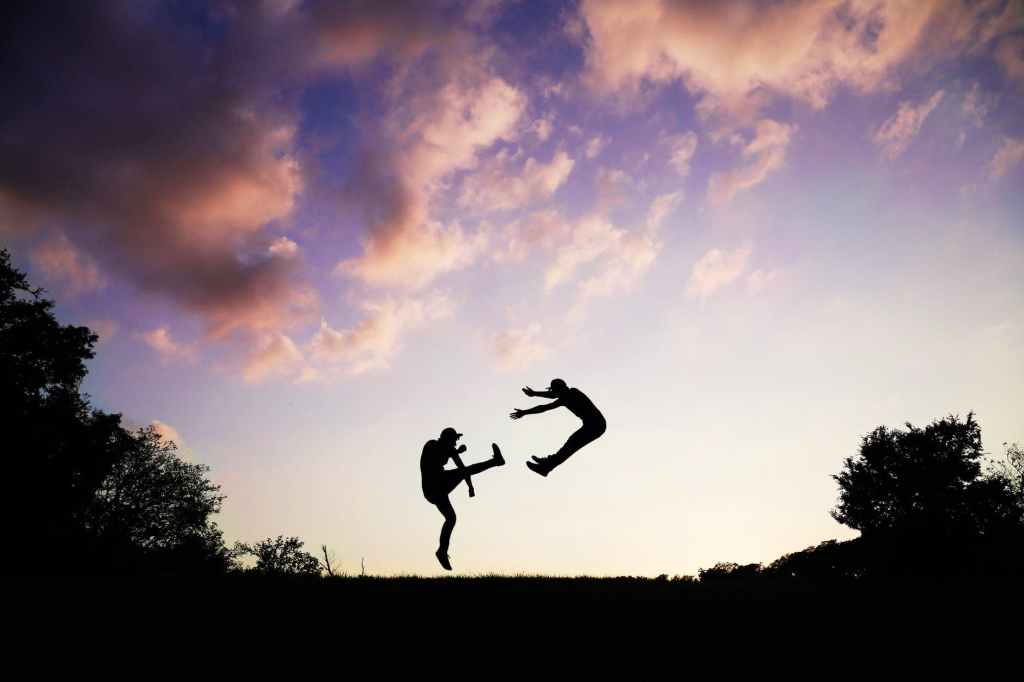
Yes, a good action movie is fun and all. But the reality is that a fight will not only NEVER last as long as they’re portrayed, but if someone spin kicks you to the head, it’s pretty unlikely that you’ll just whip your head to the side, wipe the dribble o blood off your chin and keep fighting! The safe bet is that you’ll drop like a bag of sand, unconscious or stunned beyond the ability to continue. THAT’S reality. But actual full-contact fighting will also cause injuries to the person doing the striking.
I’ve written about this before, but let’s take a good old fashion punch to the head as our example. If you strike someone to the head with your fist, you’ll injure your hand. Notice that I didn’t say “might.” You WILL injure your hand in some way, shape or form. On the milder side of it, your knuckles will get inflamed and possibly swell. At worst, you may sprain your wrist, fracture some carpals or flat out break your hand. And that’s if you’re lucky. Most people have a hard head. A fist is comparatively smaller. Maybe go for an elbow strike instead. Yes, you’ll have to get in closer but you’ll also increase your chances of preventing injury.
That’s just one example, but this concept applies to just about any attack you use on another person. Unlike the movies, getting punched to the head will put you down. But you’ll also get hurt in the process. Unless your wrists are wrapped and you’re wearing padded gloves, the chances are slim that you’ll get multiples hits in without injury. Throwing a proper strike takes technique and precision, which can only be achieved through drills and practice. This is why we do form and work out in a dojo, so that muscle memory kicks in and your strike will be effective.
True self-defence isn’t about a long, drawn out battle or fancy techniques that look like they belong on the big screen. This is one of the reasons why there are so many videos circulating about people exposing “why martial arts don’t work.” It’s not that they don’t work; it’s that people have a skewed misconception about how martial arts would actually be used in a real fight. Self-defence is about protecting yourself and others, and being the one who walks away. ☯