Excuse Me, Have You Seen My Dojo?

Most people have been adversely affected by COVID-19 over the past six to eight months. Either their finances or their jobs have been affected, people unable to pay their mortgages or rental fees, not to mention the poor souls who have contracted the virus and those who have unfortunately succumbed to it. Some areas of Canada have been doing fine, with the virus practically non-existent. Other areas haven’t been so lucky (like Ontario and Quebec).

But some of the smaller things can have a big impact on a person’s day-to-day life as well. For myself, one of the biggest losses I’ve suffered throughout the pandemic is the closing of the karate school I frequent. Although fortunate and grateful that my job, finances and home have not been affected and that no one in my family has contracted COVID-19, Tuesdays and Thursdays bring about a reminder that not only do I no longer have a dojo to train in, but the world is a long way from returning to normal.

Riding on the coat tails of yesterday’s post, the colder weather has had a profound effect on my level of motivation. Every joint in my body has started to ache every morning, thanks to 32 years of intensive training that’s caused wear and tear on almost everything. My feet are cold due to lack of circulation, thanks to Type-1 Diabetes. My sleep has always been horrible, but it’s all the worse now, with the fact that the sun doesn’t rise for almost an hour AFTER my alarm goes off.

All in all, the cold weather and pandemic have had a profound effect on my level of fitness and motivation. It’s already starting to be too cold for extended bicycle rides, even if I could sneak in a short one here and there in the afternoons. And with the renovation of our basement starting in a couple of weeks, we’ve started to move most of our belongings from the basement to the garage, thereby taking away my little “at home dojo” that I recently wrote about. I’ve also started to indulge in morning naps when my 1-year old takes his (my 5-year old is gone to school), which is a terrible habit to get into as my body has come to expect it. It’s gonna suck when I go back to regular work!

Can I train at home? Absolutely. DO I train at home? Most certainly. But there’s a lot to be said for training in the dojo environment. Not only to you get to feed off everyone’s else energy and motivation, thereby increasing your own, there’s a camaraderie that one gets to enjoy that can’t be found elsewhere. Unlike working out in a gym or by yourself, social interaction within the dojo is basically a requirement. Although not impossible, it’s quite difficult to train for an entire class without interacting with at least a few of your classmates.

The selfish side of me is disgruntled at the fact my dojo has remained closed throughout all of this. Considering the dojo runs on the school schedule and schools have let in, and the few students we have ensures a better chance at social distancing and lower percentage of contracting the virus than most classroom settings currently have, in some ways it makes little sense. The sensible side of me understands that a karate school is a far cry from being a “necessary service,” and that it would be an unnecessary risk to allow classes to resume.

There are some sources that have expressed that the world may factually never completely return to normal and that social distancing practices will become the new standard. If this is so, perhaps the dojo will never reopen. That would truly be heart-breaking, as it could mean the severe decline of modern martial arts and the possibilities that some arts may be lost. Only time will tell. In the meantime, I need to find my own motivation and continue to forge ahead, feeling that small twinge of loss every week when Tuesdays and Thursdays roll around. ☯

Cold Thoughts

If there’s one thing that’s usually consistent, it’s the changing of the seasons. Maybe not consistent in the fact that it always starts happening on the exact same date every year, but one could bet good money that autumn will follow summer and winter will follow autumn. So on and so forth. Although most people I know aren’t exactly huge fans of the cold, the seasons bring about the same process where most people complain about the heat in the summer and complain about the cold in the winter.

Personally, I’m a fan of autumn. Not only is the weather cooler so that I’m not sweating bullets when I’m outside, I’m not forced to shovel the copious amounts of snow that drift into my vehicle due to Saskatchewan winds. The autumn also brings a lot of beauty with the changing of the leaves and it almost feels like there’s a change in the atmosphere. Because there is. Even though we’re not in the swing of winter yet and there’s no snow on the ground (at least here in Saskatchewan), the weather has already started to drop and this has some measurable effects on the body and one’s mood.

First thing’s first: let’s dispel the old rumour that the cold weather causes a person’s blood to thicken. Not only is that total bullshit, your blood actually has a better chance of thickening in the hot weather, due to the dehydrating of fluids in the blood. But the colder weather does seem to bring a yearning for curling up and binge-watching a show with various pumpkin spice-flavoured snacks, compulsive napping and most importantly, lack of motivation.

That last one is rather important, especially if you have Type-1 Diabetes. Motivation is a key element in maintaining one’s eating habits, sleeping habits and fitness habits; all of which are affected by colder weather. One of the main conditions that help to make things worse is the fact that the days get shorter and darkness hangs around for longer. This causes change in our moods, appetite and sleep cycles, which brings us to the next problem: Seasonal Affective Disorder.

Yes, cold weather can bring on an actual disorder and it can play hell on your system. According to an article posted by the Mayo Clinic, Seasonal Affective Disorder, or SAD, can cause lower levels in energy, lack of motivation or mood, difficulties concentrating and loss of interest in activities you once enjoyed. There are a lot more symptoms, and I’d invite you to click the Mayo Clinic’s link to see them all.

The problem with SAD, especially during the colder seasons (the article does show that there’s a summer version as well) is that it can lead to nasty things like overeating, weight gain, lack of energy and flat out, good old fashioned laziness. As previously mentioned, all of these things are absolutely horrible for people in general, but even more so if you have Diabetes.

Although most health professionals will tell you that you can eat whatever you want so long as you take the appropriate level of insulin for it, that doesn’t protect you form the weight gain you may experience from doing so. If your sleep is affected, your blood sugar levels will be affected. If you have a lack of energy and motivation, the lack of exercise will also adversely affect your blood sugar levels and your overall health.

It can get tough to focus on routine and the status quo, when cold weather kicks in and all a person wants to do is curl up under a warm blanket and binge-watch Star Trek reruns for hours on end. No? Just me? Alrighty, then… But it’s important to maintain proper diet, sleep and exercise, Diabetic or not, in order to maintain one’s health and well-being. Especially since the winter season has the highest percentage of depression of the rest of the year. With the colder weather approaching, self-care and keeping a routine is most important. ☯

Can You Fight With No Hands?

When the average person hears the word “karate,” they picture kicking and punching. This stands to reason, since mainstream cinema has provided that portrayal for decades. But martial arts is so much more than just kicking and punching. There’s an entire way of life behind it; and knowing its proper application is just one piece of the puzzle.

“Before I Learned The Art, A Punch Was Just A Punch, And A Kick, Just A Kick. After I Learned The Art, A Punch Was No Longer A Punch, A Kick, No Longer A Kick. Now That I Understand The Art, A Punch Is Just A Punch, A Kick Is Just A Kick.”

– Bruce Lee

I’ve been doing Okinawan karate for over 32 years, and I’ve learned a great deal. I’m still learning. Despite that fact, my abilities within the art have limitations. Like anything else in life, there are aspects I’m quite good at and some that I’m NOT so good at. One of those aspects happens to be kicking. Kicking is a bit of a strange creature, in my opinion. Although stronger than punching and in some ways more effective, there are inherent risks involved.

My style of karate has taught me never to attempt a kick above the waistline. That may seem pretty restrictive, but why would you risk trying to put your foot that high when you have two very effective arms that can do the damage without compromising yourself. A real fight isn’t like what you see in the movies; opponents don’t spend forty minutes exchanging devastating blows to each other’s bodies and heads with only one winner declared once the penultimate strike is delivered.

In fact, any serious impact to the head will cause dizziness, nausea and disorientation. The recipient will likely be on their ass for a day or more before they’d be ready to do anything more than wipe their own backsides. That’s the difference between what you see in the movies and real life. The human body has backups and defences that prevent sustained battle when you get kicked in the head. But I digress…

A proper fight, even in the street, requires a combination of balance mixed with techniques and attacks that won’t compromise you. Your legs should be squared in such a way to maintain proper balance while allowing fluidity of movement. This is something that can really only be achieved after serious hours of intense training and development. You have multiple striking weapons on your body that allow you to effectively deliver attacks without compromising your balance and stance, including your fists, elbow, knees and forehead (a headbutt is a fantastic thing, but that’s for another post).

People see a lot of fancy, high-flying kicks in colourful styles like Tae Kwon Do. But these kicks are reasonably useless, unless you’re fighting someone who’s willing to sit there and take it. Let’s look at the illustration above. This is a free stock image of a kickboxing match. To the average spectator, this likely looks reasonably impressive. A nice high kick, poised to strike his opponent’s head.

Want to know what I see? I see an exposed groin. I see a lack of proper balance on the red guy’s part, due to the supporting foot being on its fuckin’ tippy-toes. And I see the guy in blue, ready to bob his head down and deliver a nice, devastating blow to the red guys’ groin. Obviously, this is a professional fight and a groin strike wouldn’t be permitted. But I deal with the real world, not organized fights with referees. The blue guy can take his sweet time striking anywhere on the red guy. Or better still, he can simply grab the leg and push back. This will throw the red guy completely to the floor. And as anyone who has watched an MMA match can attest, falling to the ground and having someone else come on top of you is usually the end of the match.

In Okinawan karate, we focus mainly on front kick to the abdomen, roundhouse and blade kick to the legs and knees. We let our hands do the work, if it involves the upper body. There’s just too much risk of injury, in any actual fight. And although I don’t advocate fighting, if you must fight, you must win. Anything else is simply not acceptable. ☯

It’s Okay To Skip A Step…

I hate cardio. This probably comes as a surprise, coming from someone who believes that if you aren’t dripping in sweat when you’re done, it wasn’t a workout. And the truth of it is, I do enjoy cycling. But that’s mostly because it allows me to get outside, reconnect with nature (to a degree) and keeps the cardio aspect buried in the background. The best of both worlds. But to say that I’m heading out for a run or doing cardio for the sake of doing cardio would be a stretch.

Cardiovascular endurance training is important for one’s health. According to an article posted by the Mayo Clinic, cardio exercises help to strengthen your heart and muscles, burn calories, help control your appetite, increases sleep, promotes joint movement and helps to manage Diabetes. Cardio can be a long-term or long-distance thing, like long-distance cycling or swimming 30 laps in a pool, or something incorporated into a weight or resistance workout, such as jumping rope.

Jumping rope is an easy, convenient way of including some light cardio into your workout routine. I’ve kept a jump rope in my gym bag for the past ten years, and I make use of it whenever I get the chance. Jumping rope can burn a wicked amount of calories; several hundred calories in a 15-minute period, in fact. It can help improve overall balance and coordination, not to mention that the heart benefits are the same as with traditional cardio. And although it can be taxing on the knees and leg joints, doing it properly is considered a lower-impact than something like running.

I like to incorporate it by using it with circuit or interval training with karate techniques. For example, I’ll do a minute of front kicks, followed by a minute of high-speed jump rope. Then a minute of the next kick and a minute of high-speed jump rope. So on and so forth. Sometimes I’ll simply use it as a warm-up or a cool down. A good quality jump rope is portable, convenient and low-cost. You can stuff it into any gym back or backpack and all you need is about a 25-foot square of space.

As much as I dislike cardio, it is a necessary aspect to proper health and fitness. And there’s no denying that it also helps with the blood sugar control and sleep quality required for someone with Type-1 Diabetes. If the last time you used a jump rope was during a spirited game of double dutch during your school years, you’ll want to start slow and ensure you do it on a stable surface. Avoid grass or carpet as it can snag the rope or catch against your footwear. ☯

Chishi! Gesundheit!

The martial arts can incorporate some pretty eclectic training techniques that can often appear strange or unusual to those who don’t use them. Often, certain techniques or training tools may remind us of the Karate Kid’s Mr. Miyagi, teaching Daniel karate by having him perform yard chores. Although I wouldn’t recommend trying to do karate against an opponent simply because you’ve been waxing your car or painting your fence all summer, there are some atypical things that traditional, Okinawan karate styles employ. Enter: the Chishi.

And no, despite my comedic title, it’s not the sound of someone sneezing. The Chishi is an Okinawan training tool used in Hojo Undo, which basically means “supplementary exercises.” It covers strength, stamina, muscle tone and posture by using a specific set of prescribed exercises and some rather arcane looking training tools. In fact, the makiwara, which I’ve written about in a few previous posts, is used in Hojo Undo for conditioning of the wrists and knuckles.

Example of a pair of Chishi

The basic construction of the Chichi consists of a lump of concrete attached to a wooden pole. That’s it. Pretty straightforward, right? There’s little more to it, especially if you’re making your own at home. You’ll need to get a few screws or solid nails through the end of the pole that sits in the concrete, to make for a stable setting. These weight clubs are used in Okinawan karate as a means of strengthening the fingers, wrists, hands and arms, as well as the shoulders. If you’d be looking to make your own at home, there are several really good DIY videos on YouTube that show you how.

If you’re like me and you’re a little on the cheap side, you may not want to buy a bag of cement simply to make a couple of these. After all, you can easily train in karate without them, since most modern dojos don’t use them. But if you’re looking to change up your training routine and get back to karate’s roots, a chishi can definitely be the way to go. You can easily recycle old materials (wooden pole, screw or nails) and go easy on the concrete.

The best I’ve found is a 10-pound bucket of “Quikrete” for about 20 dollars, which is a small bucket of quick-drying cement. And since you probably shouldn’t start with anything more than 5 pounds per chishi (since it’s a weighted lever effect, it will feel like more than 5 pounds when using it), this small pail can provide you with exactly what you need to start out. Or you can be a stubborn practitioner and do what I do… Use a fuckin’ sledgehammer!

The ending portion of a chishi exercise

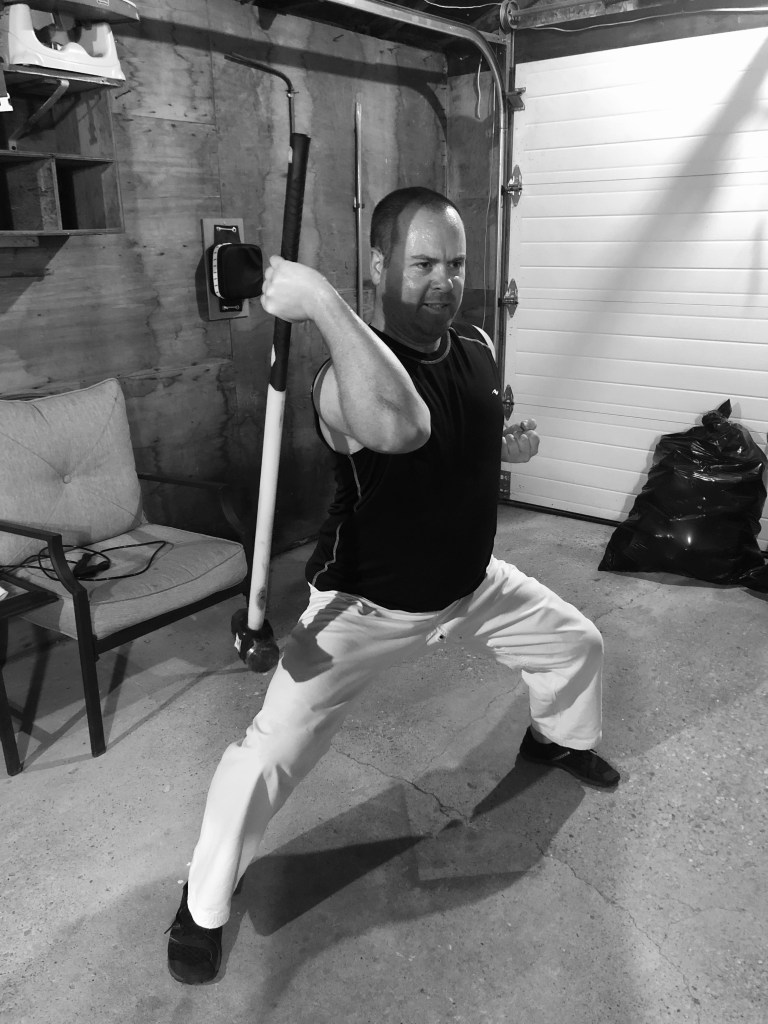
In the photo above, you see me using an 8-pound sledgehammer as a makeshift chishi. The handle of a traditional chishi would usually be shorter than the handle of a sledgehammer, so some adjustment usually needs to be made. But here, you can see me doing an exercise where I’m in a seated horse-stance position, and I’m thrusting the hammer out and bringing it back in towards my chest in repeated succession. The balance of the weight at the very top, combined with the movement of the arms, feels a bit strange at first.

In this next photo, I’m doing an exercise meant to strengthen the forearms and wrists. You can tell I’m getting fatigued at this point, since my horse-stance is starting to rise and the positioning of my right forearm and wrist isn’t where it’s supposed to be. But I can tell you that after repeated reps on each side, 8 pounds starts to feel like 80!

In this last photo, I demonstrate how a sledgehammer can also be used for some more traditional weight lifting exercises, with an added twist. The photo above is the starting position to a dozen squat thrusts, using the sledgehammer as a bar. I drop into a deep squat, followed by pushing the bar out in front of me as though I were doing a chest press, bring the hammer back to my chest and rise to my feet. Not only do I get the benefit of squats, performing a thrust with all the weight on one side and nothing on the other adds a certain amount of muscle confusion, which is great for working the core and some of the stabilizing muscles we often neglect.

This isn’t something that’s all too easy to purchase. For the most part, most practitioners make their own or use a substitute, like I do. Plus I get to feel a little like Chris Hemsworth, holding that hammer. But the best I’ve managed to find online are some shitty-looking units on Amazon or from the UK that range anywhere between $20 to 30$ (before shipping and all that good stuff). I’m certain there’s more out there, I just haven’t dug too deeply. Since that small, 10-pound pail of Quikrete I mentioned earlier costs about $20, you may consider it easier to simply order one online. To each their own.

There are all sorts of stabilizing and weightlifting exercises that you can do with a chishi. It allows you to incorporate whatever’s needed during your workout with a traditional feel, while remaining true to the roots of your art, presuming your art is Okinawan karate! But even if it isn’t, any practitioner can benefit from the exercise one can do with a chishi. Since you’re dealing with a heavy, concrete weight levered at the end of a stick, you just want to be mindful that you don’t bash your head in or drop it on any of your limbs. And as usual, consult your medical practitioner or at least an experienced Sensei before starting any new training regimen. ☯

Clothes Don’t Make The Karateka

I’m wearing a worn, black pair of gi pants and a Star Wars t-shirt. Far from formal dojo apparel. The sweat has rendered the grey t-shirt black and droplets coming off my forehead splash on the unfinished concrete floor. I just finished a set of shadow boxing and I’ve been using an 8-pound sledgehammer as a workout implement for the past fifteen minutes as my son watches in fascination from the corner. My muscles and joints are all screaming for me to stop, and my knuckles are throbbing from the use of my newly-installed makiwara post outside, but I’m only half way through my workout as the next hour will bring a minimum of three of each of my katas…

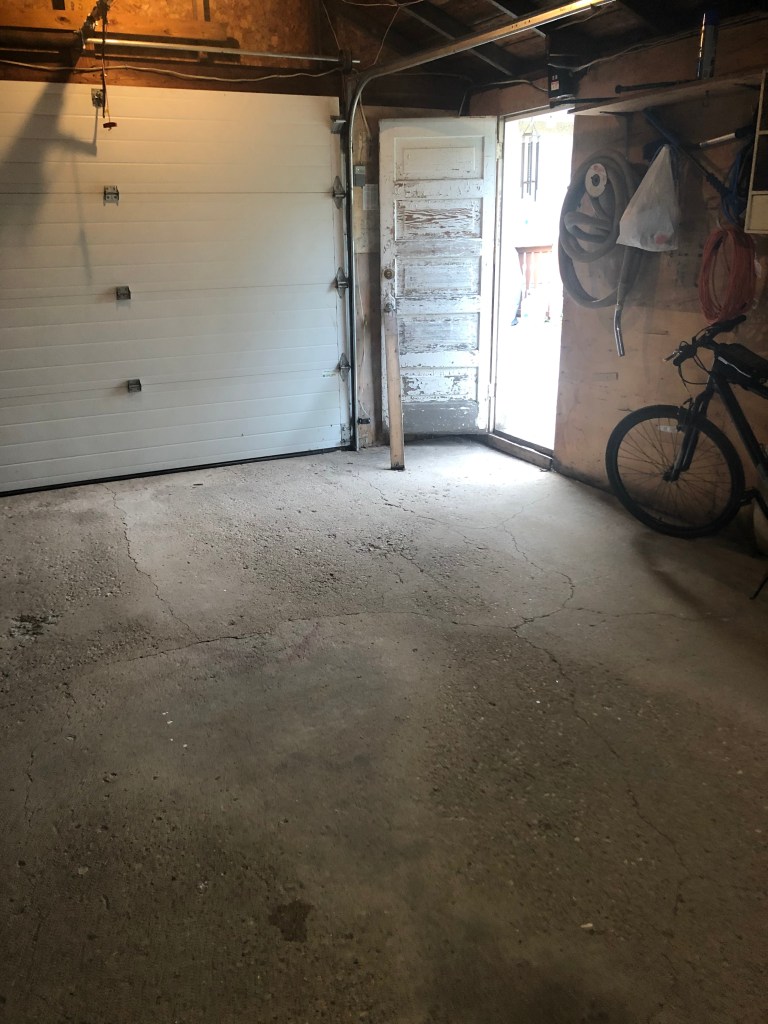
Clean, emptied out garage makes for a decent training area

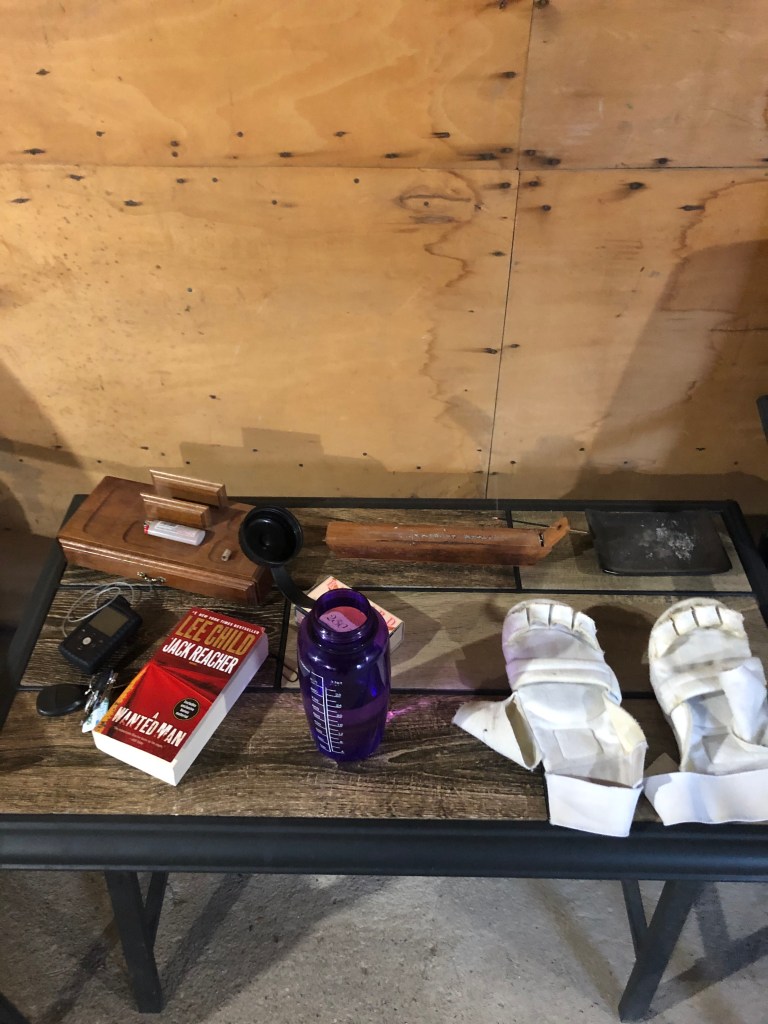
For the past couple of weeks, I’ve been using my garage as a makeshift dojo. The floor is bare, unfinished concrete and is pock-marked everywhere that something heavy or frequent traffic has damaged it. I fastened a padded punching square to the south wall and have a jumprope, an 8-pound sledgehammer and a small table to hold my water, phone and small training implements as may be required for any given session. I have a small incense burner to provide an ambiance to the environment, but with little to no ventilation inside the garage short of opening the large overhead door, I keep incense burning at a minimum.

When people hear about the martial arts, they have some pretty stereotypical images of a dojo in their heads. For the most part, people imagine a polished, hardwood floor, tatami mats in the corner, punching bags and kanji banners across every wall. Or at least, over whatever walls don’t contain photographs of the style’s masters or some the weaponry associated with the style. It’s clean and pretty and usually oozes a “karate movie” feel. But in fact, most traditional dojos (unless they’re the head of the school) never look like that.

The small table in my “dojo” holding everything I need and nothing that I don’t

When I travelled to Japan and Okinawa in 2001, one of the things that surprised me was the venue in which we spent most of our time training. Unlike the expected image of a karate school, or dojo as it is properly referred to as, we trained in a variety of different locations, including but not limited to the beach, on rocks, in school gyms, in garages and in back yards. One school we trained at the most was owned by my Sensei’s instructor and was located above his house. It contained some of the fancy elements, such as a hardwood floor and his training certifications, but little else.

There was nothing fancy. The entire ambiance was created by the efforts and energy put forward by the student body. And what energy there was! We didn’t have a single morning or evening where we weren’t drenched in sweat and felling pain along some or most of our body parts. But we learned a lot. I recently sent photos of my garage to one of my friends back home in New Brunswick and identified it as my “dojo.” His response was to laugh at the appearance. The sad part is, he’s trained in my style of karate, as well.

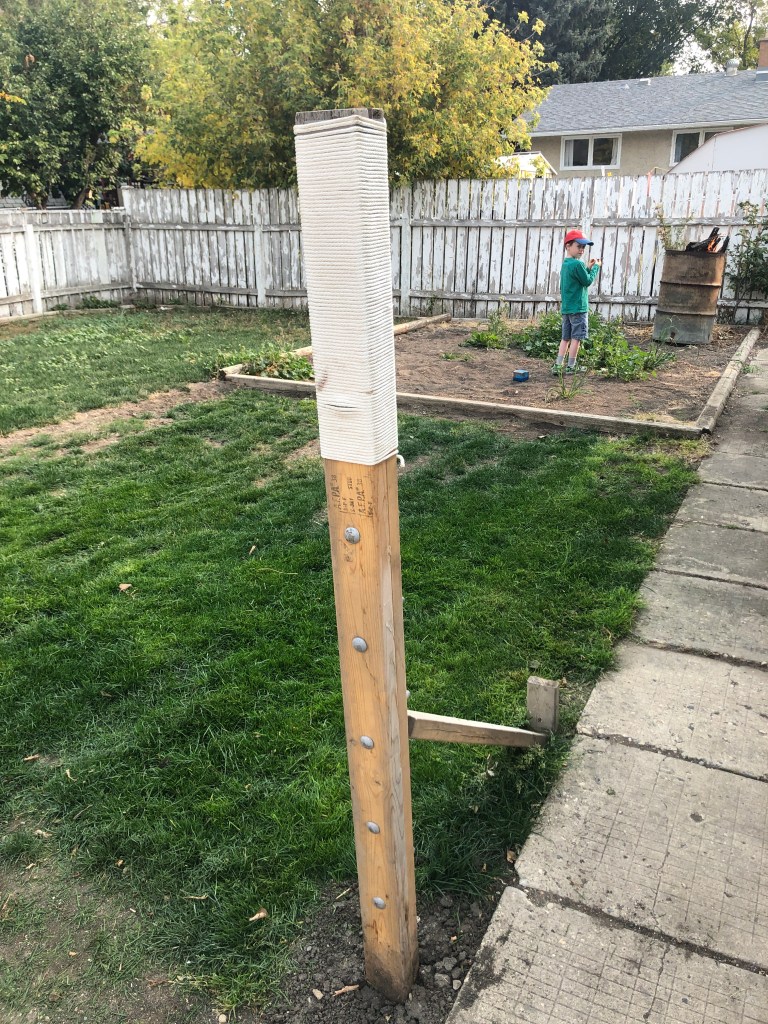
After only two weeks of use, my makiwara (just outside the garage door) has already shifted and has had to be adjusted. Not sure if that’s a good thing or a bad thing…

The point is, you don’t need a fancy or expensive location. You don’t need tons of equipment or have your training area look like something out of a bad 50’s samurai movie. In fact, if you study traditional karate, you can perform the majority of your (solitary) exercises within a 1-square metre space. That’s it! You can perform your katas, bunkai and kumites as well as a huge score of exercises too numerous to list out, including every push-up variation, squats, lunges and shadow boxing.

You reach certain limitations once you incorporate a partner or students, but let’s be honest: at that point, you may be using a local school gymnasium or go outdoors to a soccer field or something of the like. Some of the most traditional karate schools in Okinawa are tucked away behind a single, unmarked door in a back alley. Karate is a free-floating art, which can literally be practiced anywhere. ☯

Give It Some Style! 🥋

If you don’t run in martial arts circles, all the terminology and the different forms of martial arts can be somewhat overwhelming. With more than a couple of hundred different styles/types of martial arts from all around the world, divided by style, type, school and sub-styles, it can all get a little convoluted. You have striking styles, grappling styles, weapons styles and uncounted numbers of hybrid styles. Without delving too deeply in how some styles are descendent from another and so forth, let’s focus mainly on the style I’ve been studying all my life: Uechi Ryu Okinawan Karate.

First, let’s cover off some basics so that we’re all on the same page. Karate is an Okinawan martial art, not to be mistaken with a Japanese martial art. Yes, yes, I know… Okinawa is part of Japan; a prefecture of Japan, in fact. For those who don’t know, a prefecture is a sort of jurisdictional division, like a country, Province or state. And although some descendent styles of karate were founded in Japan, karate owes its roots to Okinawa. Hence, the distinction.

Karate, or Karate Do as it’s meant to be pronounced, means “empty hand” with the latter term meaning “way of the empty hand.” The fighting style came about when the original masters returned from China where they had learned a number of different styles of Kung Fu. In the case of my style’s founder, he fled to China in order to escape the military draft. But hey, nobody’s perfect!

Originally, martial arts in Okinawa were referred to as Te, or “martial skill. Once the inclusion of Chinese Kung Fu came about, it was renamed Tode, or “Chinese Hand.” For the most part, Te was used as a fighting art for law enforcement and the rich and generally included the use of a sword or other edged weapon. Te is also way, WAY older than Tode. This is why the true origins of karate as I know it come from Tode.

Once karate made its way to Okinawa, it became divided by three separates schools or “styles” (although they never referred to them as separate styles): Naha-Te, Tomari-Te and Shuri-Te, after the three main cities on Okinawa. To some extent, every traditional style of karate, including the subsequent Japanese styles, can trace their roots to one of these three original schools. In the case of my style, (Uechi-Ryu) it got it’s humble beginnings in Naha, making it a part of Naha-Te.

In the beginning, there were no differing styles. Karate was karate and students from those three cities would train together with no discerning difference in techniques and style with the exception of small, cosmetic aspects. As specific “styles” began to emerge due to the inclusion of specific forms and techniques, most were named in honour or remembrance of their founders, which is the case for Uechi-Ryu, which was so-named by students after Master Kanbun Uechi’s death in 1948.

The only real distinction that could be made amongst the three styles were that Tomari-Te and Shuri-Te were pretty linear styles with Naha-Te being more of a circular style. But in speaking with some of the original masters way back then, most of them were surprised and even indifferent to the prospect that people were referring to their karate as “this style” or “that style.” For them, it was all just karate.

One of the things that makes me sad is that Uechi Ryu is not a mainstream form of karate like many of the more recognizable styles, like Shotokan, Kyokushinkai or Goju-Ryu. Ironically, Goju-Ryu is Uechi-Ryu’s sister style and is almost identical to Uechi-Ryu. Same katas, same circular blocks and movements, same original background. But this means that if you try to see Karate’s family tree, Uechi-Ryu is often not included.

You can check out Uechi-Ryu’s full background by reading the Wikipedia entry, which I have to say is pretty accurate and complete. But today’s face of karate differs quite a bit from it’s humble beginnings two centuries ago. Many popular styles of karate are simply hybrids or combinations of previous or traditional styles. The aforementioned Kyokushinkai, for example, is a hybrid combination of Goju-Ryu and Shotokan karate. And new schools and styles seem to emerge with every passing decade. At the end of the day, karate is karate. A punch is still a punch and a kick is still a kick. Finding the style that works for you and that you can commit yourself to is the key. But knowing the roots that started it all will open the door. ☯

Fumio Demura

I just got through watching both seasons of Cobra Kai, which are now available on Netflix. The series follows the exploits of Johnny Lawrence and Daniel Larusso, respective antagonist and protagonist from the 1985 original “Karate Kid.” This time around, Lawrence is the focus as he struggles through a failed marriage, an estranged son and bringing back his Sensei’s failed karate dojo, which is Cobra Kai. It’s a fantastic martial arts series, focused on karate. I can’t wait to see what Season 3 will bring.

It got me feeling nostalgic for the original Karate Kid movies, which included two sequels and a rebirth with “The Next Karate Kid.” You’ll noticed I haven’t mentioned 2010’s remake of the The Karate Kid, starring Jackie Chan and Jaden Smith. Although it was a decent movie, it’s based on Kung Fu, not karate and was basically a slap in the face to the original. But through that nostalgia, I started researching and falling down the YouTube rabbit hole and discovered some interesting facts about the film series, including the involvement of Fumio Demura.

Fumio Demura is a well-known martial artist who studies Shito-Ryu karate and kobudo. I came to find out that Demura played the stunt double for Pat Morita’s “Mr. Miyagi.” This came as a surprise to me, since I knew of Demura through his books. Demura wrote a series of books in the 1980’s covering a number of weapons used in Kobudo. Since joining Kempo Karate in 2016, I’ve slowly introduced the bo staff and sat into my training regimen.

Since there’s a limited amount of coaching time on weapons in the dojo, I decided to order two of Demura’s books, Bo: Karate Weapon of Self-Defence and Sai: Karate Weapon of Self-Defence. In these books, Demura covers a number of basic concepts for both weapons and includes several photos and diagrams. They’ve been helpful, despite the fact that I don’t focus heavily on weapons.

It was cool to read about his involvement. We’re all aware that movie actors use stunt doubles, but it was neat to find that one of my favourite movies included a stunt double that I’ve read and studied about. If you study karate or kobudo, I highly recommend you search “Fumio Demura” online and see what you can find. Any of his books are definitely worth a read. ☯

A Shout Out To My Style

I just finished writing a post some days ago about different styles of karate and how I often regret that my own style, Uechi-Ryu, doesn’t get more attention when the original Okinawan styles are listed. In fact, if you look at most “family trees” of karate, Uechi-Ryu is rarely included, despite being Goju-Ryu’s sister-style and comparable to Shotokan and a few others.

That’s when I came across this YouTube video posted by Jesse Enkamp. Enkamp is a reasonably well-known practitioner of karate who has studied in Okinawa and in Sweden under the tutelage of his parents, who are karate instructors. As quoted from his website, Enkamp is “a best-selling author, entrepreneur, traveller, athlete, educator, carrot cake connoisseur and founder of Seishin International,” which is a fantastic line of martial arts apparel featuring karate gis.

He also has a YouTube Channel that I recently subscribed to, and he has some really great perspectives on karate and martial arts in general. We different on some of the perspectives, but as the old saying goes, “variety is the spice of life.” It’s unclear as to what style Enkamp actually Studies. This is because he claims he studies karate and not so much any specific style. I can’t say I entirely agree with his way of thinking, but he has pretty good reasoning behind this concept.

Regardless, he recently posted a YouTube video entitled, “The Best KARATE Style For Self-Defense,” where he talks about a traditional style of Okinawan karate that winds up being Uechi-Ryu. I had a pretty good idea that this was where he was headed (since the kanji symbols for Uechi-Ryu were in the title), but it was nice to have someone outside my system actually show some love for one of the best circular systems of Okinawan karate ever founded.

Enkamp’s YouTube entry on Uechi-Ryu

I don’t usually share or link YouTube videos as I consider someone’s video submissions to be theirs and theirs alone. But like I said, this one hit close to home and got me excited that someone was ACTUALLY talking about Uechi-ryu. This just goes to show a style is never really dead, so long as there are people willing to talk about it.

And Jesse, if you’re reading this, I hope you’ll like and follow my blog as I follow your YouTube channel. We karate practitioners need to stick together. ☯

Don’t Change Your Routine

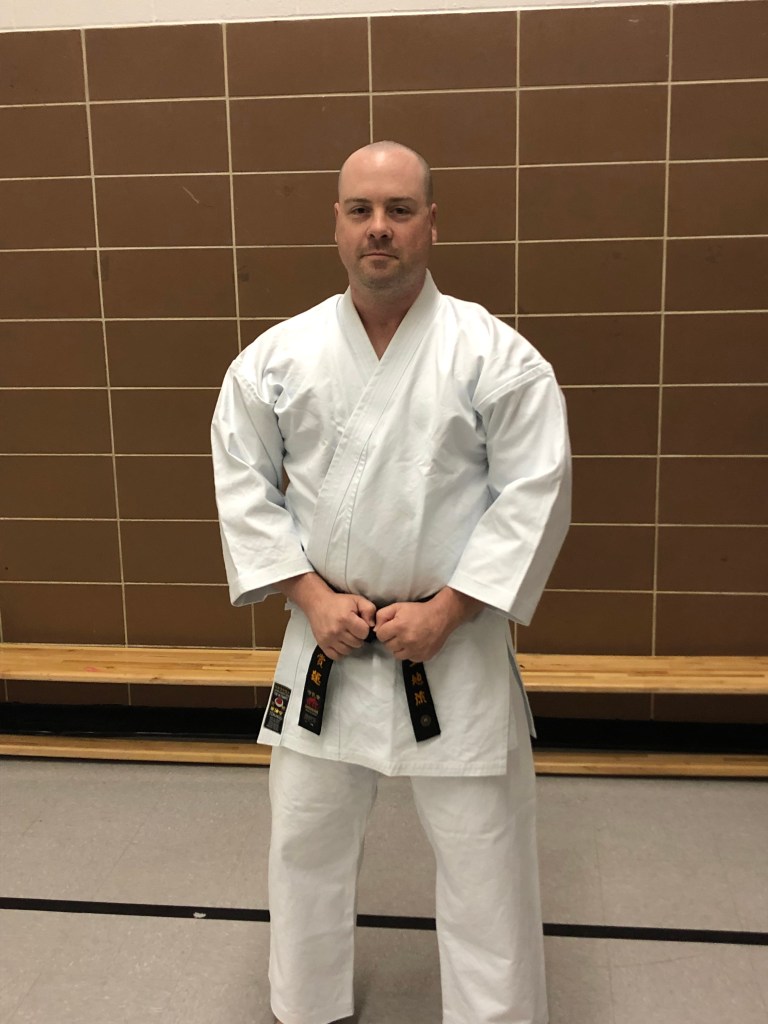
I remember training for my black belt in karate, and doing my very best to prepare for it in a Rocky-style format. I used to get up at five in the morning and run five miles, followed by an hour of intensive shadow boxing and forms. Without getting into the specifics of the test, I knew that I would be facing the challenge of my life, and I wanted to do everything I could to ensure I would be successful.

The last class before the weekend of the test, I attended class and tried to blend into the background, which wasn’t easy considering I stood at the front as one of the senior students. I didn’t speak to anyone about the upcoming test I would be subjected to, over the weekend, as was the custom in our dojo. Test dates were kept private until the student walked into the next class with a new belt colour around their waist.

After that last class, Sensei and I took an hour together and discussed the test and what would be involved. We went over some of the material that I knew I had some mild difficulty with, and I made a point of explaining that I planned on having a light meal and getting to bed early, in order to get some extra rest. Sensei smacked me in the back of the head and spoke three very important words: Don’t. Change. Anything.

Essentially, Sensei explained that despite being faced with a very important and very physical test the following day, I should have the supper I’d usually have. I should follow it up by having the evening I would usually have and go to bed no earlier than I usually would. The idea was that altering my usual routine would cause a disruption in my rest as opposed to helping it, and potentially increase my test anxiety.

Change and variety are good. Of this, I have no doubt and there is no question. But when it comes to facing something out of the ordinary, it’s important to remember that we shouldn’t alter our routines. We need to trust our gut and follow our usual routine. trying to do anything out of the ordinary will only stress and tax your body further and increase one’s anxiety. Stick to what you know. It’ll serve you better in the long run. ☯