Oops, Boards No Hit Back…

Last autumn, I decided to step up my at-home karate game by making and installing my own makiwara. You can read the post here, but I have to say that I was pretty proud of the accomplishment and I did get SOME use out of it before the winter hit and training outside was no longer optimal. My son Nathan was quite helpful with drilling the holes and installing the bolts that hold the 2×4 wooden planks together, as well as binding the cord and making it stable. Although many makiwaras are floor-mounted, I had no such place to appropriately install one. So Nathan and I dug a 3-foot deep hole at the corner of our backyard and placed the post into the hole, filling it with dirt and yellow clay.

In case you haven’t read the previous post (or any of the others where I’ve used the term makiwara), a makiwara is a hard, stable striking surface that’s usually made of wood. Depending on your style, background and training methods, they usually have a pad or designated striking area. In Okinawa, they usually scoff at the use of padding with preference for striking the bare, wooden surface. If you’ve ever seen photos of an Okinawan karate master’s knuckles, you know why this can be a problem. I built mine so that the top, striking area is wrapped in nylon cord. This allows for a harder striking surface than a punching bag, while preserving some of the bone structure in my hand.

The results of my punches!

Anyway, a couple of weeks ago I was in the middle of a rather spirited boxing circuit in my garage. It involved a full minute on the punching bag followed by 45 seconds on the makiwara. That was one set. I did this for 30 minutes in total with no breaks in between. Somewhere around the 15-minute mark, I was striking the makiwara and the entire post shifted sideways and the dirt and founding around the bottom collapsed. The next couple of punches basically had the makiwara bouncing up and down as I struck. I had uprooted my homemade striking post. It was now useless.
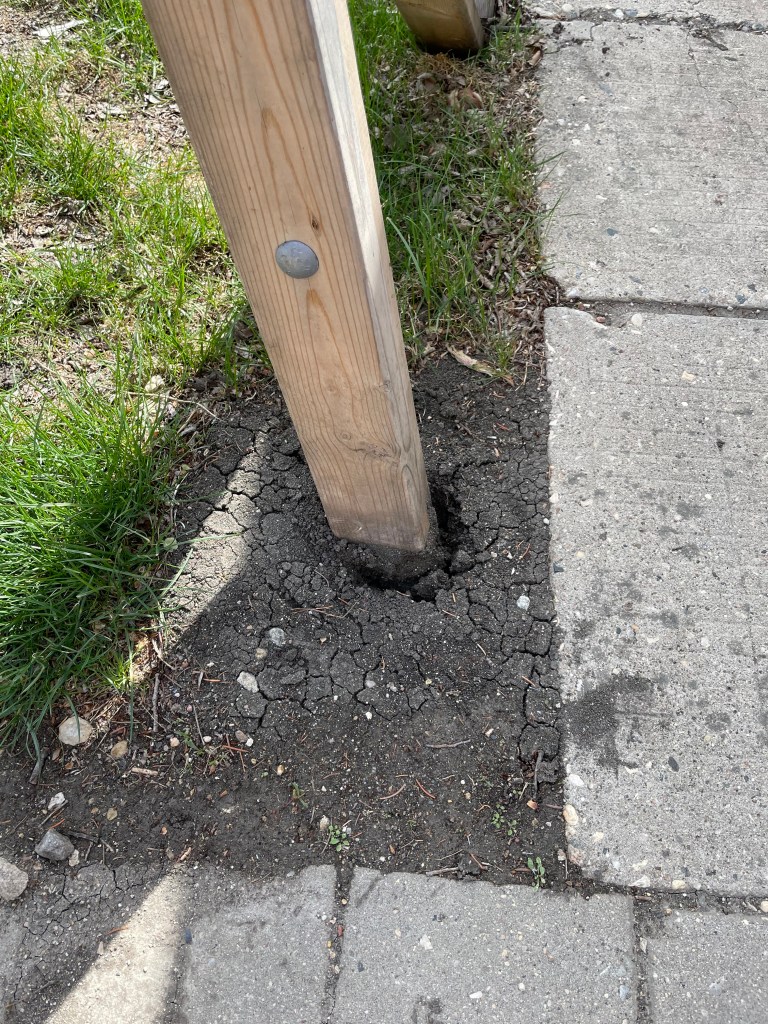
Strength depends on the foundation.

Because I’m not a big of giving up, I put some thought into how I could repair it and ensure the same thing wouldn’t happen again. Just to be clear, I’m no Hercules. I have no illusions that my strikes are so powerful that nothing can withstand them. But even though water is the softest stuff in the world, single drops will eventually penetrate stone, if continued on a consistent basis. I had to recognize that prolonged use of the makiwara would always result in some level of damage, in the long term. The question was how to prolong its existence.

Nathan and I went to a home improvement store and purchased a bag of “Post Haste” concrete. Basically, this stuff is designed to harden and set within half an hour. Perfect. We followed up with a trip to our local dollar store and bought a plastic, 10-galloon bucket to mix the concrete in. $8 for the concrete and $4 for the bucket. Probably one of my cheapest repair projects. We were good to go. Nathan was excited and was itching to help me repair the makiwara and wanted to be involved in all the steps. Great.

The stuff!

I started by removing the makiwara, which unfortunately came out of the ground far too easily. This spoke to how unstable I had it, in the first place. I then used a shovel to scoop out the excess dirt and yellow clay and set it aside. I followed the instructions on the bag and placed two litres of clean water in my bucket, followed by emptying the contents of the concrete bag into the water. I was surprised that the water came to the surface, displaced by the density of the cement powder. I used an old wooden staff to start mixing the concrete.

Nathan measuring exactly 2 litres as per instructions. See, men CAN follow instructions!

It was tougher than I thought and it started getting too dense to move the stick. I had Nathan add a bit of water to help with consistency but when the stick came free and moved, I splashed myself with concrete. All over my left leg and all on and in my sneaker. Bloody marvellous. I would need to hose all of that off before going inside, as I really didn’t want to try running concrete through my washing machine. It gave Nathan a laugh though, who was quick to comment, “Haha, Daddy messed up…” He’s such a GREAT helper!

Nothing like cement all over oneself to add to the weight of the world…

Now that I had it mixed at least to some level of consistency I felt would work, I had Nathan hold the post wile I poured the cement mixture all around the post into the hole. It was rough going and didn’t pour nicely since it was so thick. I had to scoop it out with a small dowel and pat it down to ensure that it filled all the cracks and crevices within the hole. It also didn’t help that Nathan’s idea of holding the post steady included allowing it to slip at an angle every few moments. Kids…

Set in stone.

Once I managed to get the concrete poured properly, the hole was filled almost to the top, which would be topped off with yellow clay at a later time once the concrete cured completely. Within about five minutes, the concrete had set and hardened enough that the post could stand on its own without being held. Despite having made a mess with the water and splashing myself with concrete, I had managed to repair the makiwara and it would only require some quick finishing touches once the concrete finished setting the following day.

The finished repair!

As of yesterday, the makiwara seemed to be firmly in place, with the concrete doing its job and holding it strongly. I added the bracing to the rear and replaced the yellow clay over top the concrete. Although I have my eye injections today and didn’t have time to test it out, I can’t wait to reef on this bad boy and see how strong it’s become. At just $12, it was a much cheaper alternative than finding a different means of striking a stable surface. Only time will tell how long the repair, or the makiwara, will last. ☯
Cobra Kai, Season 4

I’m not going to lie… I’m stoked for the continuation of this Netflix series! When YouTube first released Cobra kai, a continuation series based on 1984’s the Karate Kid, ill admit that I was a bit sceptical. I was even more irked by the fact that if they were going to release a series picking up 30-odd years after the fact, that they’d focus on Johnny Lawrence as opposed to Daniel Larusso. Those fears were quickly put to rest with the inclusion of both characters.

Cobrai Kai focuses on showing how during the original film, Johnny was at the top of his game, winning trophies, being an alpha dog while Daniel was a down-on-his-luck new kid who unfortunately crossed paths with Johnny and paid a physical price. This is where Mr. Miyagi comes in and trains Daniel in the way of karate so that he can go on to the All Valley tournament and win against Johnny, albeit with an illegal kick to the face that even i didn’t agree with. but it’s all in good-natured 80’s fun, so it works.

Some three decades later, Johnny is seen as single, having fathered one estranged son, living within limited means and down on his luck, while Daniel is the owner of a multi-location car dealership franchise, appears to be wealthy and is happy in a successful marriage with a teenage daughter and young son. The first couple of seasons focus on Johnny reopening the Cobra Kai dojo and beginning to teach students, which prompts Daniel to do the same.

The end of Season 2 shows both dojos coming to a head as their students square off against one another in school and a non-literal bloodbath ensues, with one of the main protagonist characters becoming severely injured. Season sees both dojos come together against a common enemy from the past (I’m trying not to provide TOO many spoilers) and combining their students into a singular class. The upcoming Season promises the return of a key character from The Karate Kid III, which although not universally well-received, I thought stood well on it’s own merit.

The Karate Kid III saw Daniel continue his karate training with Mr. Miyagi while facing a new opponent who forces him to defend his title in the All Valley tournament. It shows the return of John Kreese as Johnny Lawrence’s disgraced Sensei and a new character, Terry Silver, as the antagonist of the entire ordeal. It’s an inspirational movie that sits well with me, from a martial artist’s standpoint. Season 4 of Cobrai Kai will apparently see the return of Terry Silver.

I know that I usually try to focus my posts on informational content, but the nerdy boy in me can’t help but write about this. I grew up on the Karate kid movies (as well as the ill-fated and ill-received Karate kid Animated series, which only ran for 13 episodes after The Karate Kid III) and absolutely love how Cobra Kai allows me to dip my toe in the waters of nostalgia. It also provides that minty hint of inspiration to continue working hard at my own martial arts training, especially since one of the main characters, played by Mary Mouser is Type-1 Diabetic and uses an insulin pump. If you haven’t watched it yet, I highly recommend it. ☯

Clean Yourself Up…

Cleanliness is important, especially as it relates to physical fitness. This means cleaning yourself, as well as cleaning the equipment you use. When you work out, you sweat. That’s no big secret. So, what happens if you don’t clean up properly? Believe it or not, it can be quite important to your overall health. It sure as hell affects the people around you, when you don’t.

Sweat is your body’s main function to control overall body temperature. You get too hot from working out, you sweat. Pretty simple, right? There are a few problems with that. Your body has pores, and that’s usually where your sweat comes from. Over the course of the day, your pores fill up with dirt, dust and bacteria. Part of your body’s sweating function is to eliminate all of that. You know, along with the elimination of a bunch of other nasty stuff. But it’s the bacterial content that usually makes sweat smell bad.

There’s nothing worse than an unwashed body. I know a lot of guys who go to the gym, then sit in their own sweat for the remainder of the day. The thing is, sweat is composed of ammonia, salts and urea. In case you’re not familiar with that last one, it’s one of the main components of piss. That’s right… Sweating is basically pissing out of every pore in your body. If that doesn’t gross you out enough, think about laying on a piece of gym equipment that hasn’t been wiped down!

If you don’t shower or clean yourself up, your pores will tend to clog as the sweat dries. Not only does that lead to some pretty nasty “B.O.” but it can also lead to rashes, infections and illness. Even if you don’t work out regularly, you can potentially face these issues if you DON’T wash your body on a regular basis. When you don’t bathe regularly, it can lead to a build up of dirt, sweat and bacteria. That’s where you’ll start to notice increased acne and sores, rashes and skin issues.

This might seem like a pretty obvious post, and I don’t think I’m sharing any new information. But I’ve trained in enough gyms and dojos to know that a lot of people don’t take personal hygiene to heart. And the big clue is when someone has an extreme level of funk BEFORE working out. And there are those, and those are they, who make the gym all the more difficult for others. Don’t take wiping down gym equipment for granted. Not only for yourself, but for other users. Launder your damn karate gi or gym gear and for the love of all the light, shower or bathe daily! Ax Body Spray is not a substitute for soap! ☯

You Say “To-May-To,” I Say “To-Mah-To”

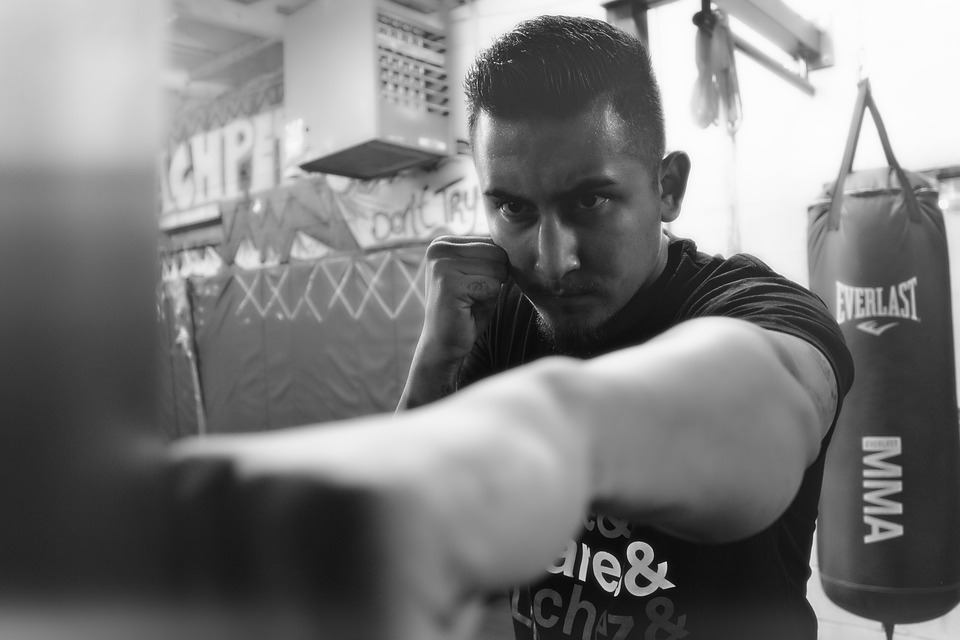
A punch is a punch. Until you learn that it isn’t. To the untrained eye, nothing seems quite so basic as throwing a punch. But in reality, there are many small intricacies involved in the proper execution of a punch. Keeping the fist tight, proper bone alignment and technique are all critical aspects to making sure that your target will feel your strike as opposed to pointing and laughing as you sprain/break your wrist, fingers and/or knuckles against a hard, bony surface. So keeping this in mind, different styles train to throw a punch in different ways. This has been widely debated and written about, so I’m not providing anything original here; simply putting in my two cents. I’m referring to punching with your fist vertically or horizontally.

Example of a horizontal punch. You can ignore the terrible guard by sticking the other fist against the face!

In Uechi-Ryu karate, I’ve always been trained to punch horizontally. This means that my arm extends and the hand is horizontal to the ground, with the two foreknuckles of the fist being used as the striking surface. It’s what I’ve been training to do for over thirty years. For the most part, it’s always served me well and has always seemed to be effective (as effective as an individual person CAN make their punch).

Over the years as I’ve studied and examined other styles, I’ve come to realize that there are a number of different martial arts that use a vertical fist as opposed to a horizontal one. This means that the arm extends and the hand is vertical, with the striking surface being the last three knuckles of the hand. Some styles will still use the two foreknuckles for a vertical punch, but I personally feel it forces me to turn my wrist downward, compromising proper bone alignment. But to each their own… So, which is better? IS there a better one? Interestingly enough, I’ve used and trained with both.

Probably one of the most famous examples of a vertical punch, is Bruce Lee. yes, yes, I know… Not everything martial arts related needs to be compared to Bruce Lee. But the reality is he represents one of the clearest and easiest examples of the vertical punch, a fact that confirms that many (if not most) kung fu styles rely on this method. There are some benefits to vertical punching. Of most importance, it feels like a faster punch, as it relates to how it’s executed. Maybe that’s all in my head. But I definitely feel as though I can execute more vertical punches in the same amount of time than horizontal punches.

Another important issue is the fact that a vertical punch involves less telegraphing of the strike, since the elbow stays down. Considering most students train poorly during repetitive drills and tend to throw out their elbows when executing a horizontal punch. This is an important aspect, especially as it relates to letting your opponent know what’s coming. It also opens up your rib cage in an extremely uncomfortable way. Unless you train and execute for the horizontal punch correctly. You can do the horizontal punch without your elbow flaring out, and in fact you should!

Not all styles of karate use a horizontal punch. In fact, Isshin Ryu is a style of Okinawan karate that originates from very much the same source as my own style. They use a vertical punch that has a unique thumb placement involving pressing the thumb down on top of the second knuckle of the index finger. Many styles of martial arts use a vertical punch, but Isshin Ryu has made a point of having it as their way of doing it, with a unique twist.

A great article posted on Jesse Enkamp’s blog (KARATEbyJesse) outlines some of the differences, pros and cons of horizontal vs. vertical punching. Depending on the martial artist you speak to, everyone has their preference. Especially as it relates to their specific training. What’s important to remember is that just because a technique is done differently than how you’ve been taught, that doesn’t make it bad or incorrect. It’s all in how you execute it. As Jesse pointed out in the last sentence of the linked post above, “The tool depends on the target.” ☯

My Kids & Karate

I decided to put out a brief video clip of my two boys, imitating their daddy! The first part is Nathan, doing a horse stance with a double-handed downward strike. The second part is Alexander having a pretty fair go at the punching bag after watching me on it for about 30 minutes. What’s interesting is that both boys were just a bit older than 1-year old in their respective clips, and I never formally taught them any of what’s seen in the video. It just goes to show that some skills can be inherent. ☯

Didn’t Your Mother Teach You To Stand Up Straight???

It’s a classic scene. You’re at the kitchen table or in someone else’s home and your mother will quietly but firmly tell you to “Sit up straight,” or “Stand up straight…” Who’d have thought that you should have perhaps listened to that advice as it would serve you well, as it relates to your martial arts journey. I’ve witnessed and trained in a lot of different styles; sometimes for fun and sometimes to add a little something to my self-defence repertoire. And of all things that I’ve learned over the decades, one of the most important ones is to maintain a proper posture and a good centre of balance.

Standing up straight and keeping your weight centred are integral aspects of martial arts and self-defence. When you lean or all your weight is moved forward over a single leg, you put yourself at risk and expose areas that you should probably be thinking about protecting, instead. It often seems that so many arts are willing to allow practitioners to overreach, stand on one leg through extended techniques or have their heads bobbing and weaving every which way… Don’t even get me started on the concept of holding your hands in FRONT of your face.

Have you ever had that ONE friend who, when you were younger would suddenly push you for no good reason other than being a jackass? No? Just me? Alrighty, then… My point is, if you’ve ever experienced this you’ll notice that you can fall over quite easily once your centre of balance is no longer directly below you. And just to be clear, I’m not referring to issues surrounding forms or pre-arranged techniques; I’m referring specifically to issues surrounding a real-world combat scenario where you need to defend yourself.

I’ve always noticed that a strong tendency with some people who fight is to bob and weave their bodies back and forth to avoid strikes. I suppose that if you’re faced with an actual fight, you’ll do whatever is necessary in order to avoid being struck and to ultimately win. But if you bend at the waist in order to avoid a punch, your centre of gravity suddenly finds itself over open air, which will leave you vulnerable in a way that’s much much than what the above-mentioned jackass would cause.

I’m going to be a bit of a bully for a moment and pick on boxers because they’re the best example. They’re definitely not the ONLY ones, but they have a tendency to bend and sway in a variety of directions and what’s worse, they do it with the torso OR the head. I’ll remind all of you that I categorized this post under the “opinion” tab, so there’s no need to lose your cool. The worst is when I’ve seen people who do that frowny, lowered head posture that they believe makes them look so bad-ass. In reality, you’re obscuring your field of vision and exposing sides of your head that will get you smacked!

In traditional Okinawan karate, we’re taught that not only are extremely high kicks dangerous, as they expose the groin and various other areas, they throw off your centre of balance. A quick, prepared opponent can take advantage of this and send you spiralling to the ground. Once you’re down, the game’s pretty much over unless you have increased skill in defending against a standing opponent who’s dropping his boot down on your head. (Cue the voice of Obi-Wan Kenobi… “Don’t do it, Anakin! I have the high ground…)

The same applies to hand techniques and you head, as well. If you overreach during a strike, you face the possibility that someone quick who may have training in grappling (or even someone who doesn’t) could grab your hand and drag you forward. Once you’re off balance, you’ll be too busy trying to regain your footing to avoid the plethora of strikes that may come at you, immediately following your stumble. And anyone I’ve ever sparred against who’s taken the chance of lowering their heads to give me a frowny look has usually been rewarded with a hook punch to the visual cortex.

Although getting into a real world fight scenario is a fluid and unpredictable situation, you should bear the following things in mind:

  • Stand up straight and keep your centre of gravity beneath you;
  • Keep your hands in front of you, but don’t block your face. You don’t want to obstruct your view of the opponent;
  • Keep your head up. Avoid burying your head in your fists as you’ll be unable to see and/or block, if your opponent decides to throw a kick or some other technique at you;
  • If you’re going to perform kicks, be reasonable and keep them at waist-height or lower. High kicks may result in a loss of balance; and
  • Don’t overreach! You should be able to know the distance of your reach. If your opponent is outside of your reach, the proper recourse is to step in BEFORE punching, not try to overreach.

You can get into the proper mindset on all of those with one simple method: drills! Drills, drills, drills! Keep practicing and build that muscle memory. If you develop safe habits and techniques in training, you’ll have a much better chance of doing the same in the streets if you find yourself in a fight situation. ☯

Don’t Let The Mud Drag You Down…

There’s an unfortunate side-effect that comes with having Type-1 Diabetes that people often ignore or fail to recognize. For the most part, it isn’t their fault. After all, Diabetes involves so many side effects and necessary treatments for various aspects that we often tend to ignore the symptoms that aren’t detrimental. What I mean is a significant and noticeable lack of personal energy. It’s a common side-effect of someone with Diabetes but in reality, it can affect absolutely anybody.

In my teens and through the majority of my twenties, I had significant difficulty finding my “get up and go.” A lot of that had to do with improperly balance blood sugars as a result of poor insulin dosing and a diet that DIDN’T involve the calculation of carbohydrates (my family basically thought that “no sugar” was all the diet I needed). But I would often have to melt out of my bed, stagger to the washroom and physically struggle to eat, get dressed and get out the door. To say that I was thankful to have no responsibilities beyond sitting in class and listening to teachers was an understatement.

I’ve had incidents where I’ve faltered or fallen asleep in class, often because my blood sugars were too high or too low. I would usually be okay by the time classes let out, which was definitely a good thing since Sensei wouldn’t have taken that grogginess with stoic silence. He’d have punched and kicked the grogginess right out of me. But there were nights where even karate class saw me feel as though lifting my limbs was like lifting blocks of concrete and I didn’t feel as though I had the energy to put forth my best effort.

This kind of effect isn’t simply limited to someone with Diabetes, and there’s a lot you can do to reduce/eliminate that “checked out” feeling one often gets on those days where the energy to get shit done just doesn’t seem to be there. One good example I like to use when it comes to this, is how a person starts their day. I usually make a point to wake up roughly two hours before my scheduled work time. If I use a specific morning last week as an example, I awoke about five minutes before my alarm went off. Annoying, but decent.

I started by putting away all the dried dishes I had done the night before, took my prescribed medications and began sucking back some caffeine and made Nathan’s lunch for school. This was followed by preparing a work lunch for myself, getting cleaned up and dressed and getting all the trash receptacles in house emptied as it was trash day. I got dressed, brushed my teeth and stepped out to put the trash bin to the curb. I finished with ten minutes of relaxation, sitting in the living room as my infant son Alex, climbed around my legs to get some much-needed attention before I left.

I walked out the door feeling pretty good. Blood sugars were normal and my day had begun. I know some folks who get up a couple of hours before work, but basically sit like a lump until they almost literally have to step out the door. What’s the point? May as well get some extra sleep, if that’s all you’re gonna do! But my point is how you start your day sets the standard for how the remainder will go. If you start your day on a negative kick with no “get up and go,” it’s almost a certainty that you’ll like feel stagnant throughout the day. If you hit the ground running, well… An object in motion tends to stay in motion.

What people need to understand is that the energy is already there. But it’s how you promote it and use it, that makes the difference. You don’t need to be an all-star athlete in top shape in order to feel energized throughout the day. You just need to be smart about it. Light knows, I have my days where I have to hammer through the sluggishness to make it back to the pillow at night. But it’s important to remember that even the most powerful 4×4 truck will still struggle and spin its wheels, when trying to get out of the mud.

Energy creates life. Life promotes movement. Movement promotes energy. And on, and on, and on… If you get you and get moving, your energy will be better allocated and you’ll feel better. You may have to struggle through that first little bit, but it’ll happen. If you settle in like a rock, you don’t get that promoting of one’s energy that’s so critical to a healthy and energized day. So when the alarm goes off, first thing in the morning, start by getting up immediately. Avoid the temptation to hit the snooze button and stay curled up. Hit the ground running. You always be tired at the end of the day but then again, that’s when you’re SUPPOSED to be tired. And as I always say, balanced blood sugars and regular exercise are always a great help. ☯

A Fistful Of Fun

Training in the martial can involve a number of different bags, pads and striking surfaces. It can be a bit confusing as to which one you should use. Should you have something firm and moveable? Should you have a punching bag, which allows some variety and movement? Maybe your best option is to have someone hold some striking mitts… Watch the video below that posted to my YouTube channel for my thoughts and opinions on what striking surfaces you can use. ☯

Progress, Not Perfection

The title is a quote from a favoured movie of mine, The Equalizer. It stars Denzel Washington who plays the protagonist, a retired secret agent/assassin who seeks vengeance for harm brought against an innocent. At some point in the movie, he’s helping a fellow co-worker get into shape in order to become a security guard, and he states, “Progress, not perfection.” The quote has stuck with me since I watched the movie, and I use it often in my daily life. Wisdom from unlikely sources, right?

A couple of weeks ago, I started using a newly-purchased punching bag in my garage. As an ending to the workout, I also started hammering out a fast, 1-kilometre sprint on the bike. It’s been rough, with most of my sprints ending with me gasping for dear life and being unable to catch my breath for several minutes. It’s a fantastic measure of progress, as opposed to cycling for 10 kilometres or more, where I potentially get exhausted after the third or fourth kilometre.

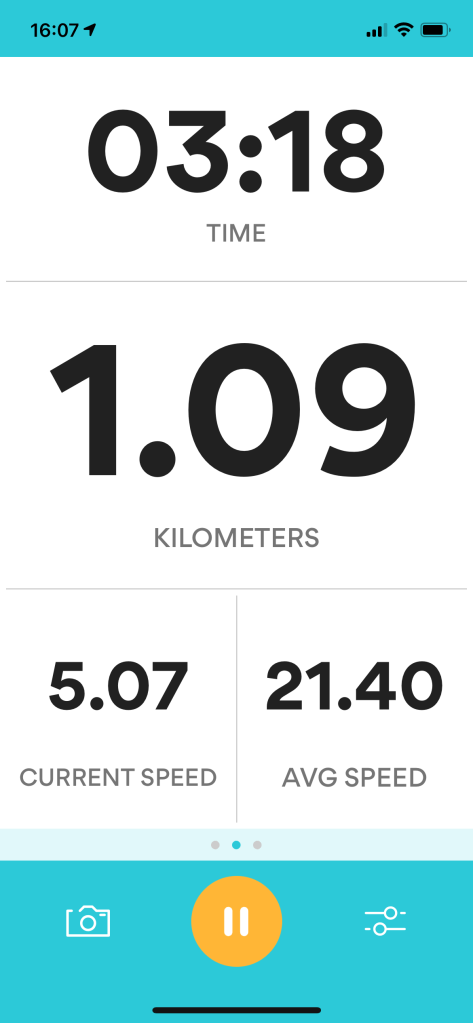
A few days ago, I hammered out a kilometre in just 3:02. My best time prior to that was a dozen seconds short of 4:00 minutes. Although this doesn’t seem like a big deal, the number of seconds shaved serves to tell me how far I’ve been progressing and how much faster I’m becoming. Hopefully, once summer kicks into high gear, I can reach last year’s failed goal of 200 kilometres in a single run. Last year, I was reaching nearly 80 kilometres in one afternoon, which is still a far cry from 200. but as the title says, progress, not perfection.

As you can see, my pace reads as 3:02/km, which is why I say I completed the kilometre in 3:02 instead of the 3:18 that’s displayed in the previous photo. The previous photo is the total time for the 1.09 kilometres. I’m hoping to shave it down to below the 3:00 minute mark before starting longer journeys throughout the summer.

Persistence and perseverance can serve you well, in all things related to self-development. If you’re willing to push yourself a bit, you can climb, ever so slowly. Progress, not perfection. Its the only way to increase one’s health, skills and well-being. ☯

The Chi Effect

There’s no arguing that positive energy is contagious. Ask yourself how many times you’ve felt in a bit of a foul mood, only to be lifted up and singing along with a great, upbeat song on the radio… Positive energy creates positive results; a fact that more people should be able to recognize. By the same token, you can be in an excellent mood, only to be brought down by someone negative who is in a bad mood or spreading sad information. I was chatting about this very thing a short while ago with a colleague of mine from work.

I’ve never been one of those martial arts practitioners who put a great deal of stock into being able to “project” energy or that my Chi or Hara could be used as a weapon. There’s are plenty of idiots on YouTube professing that kind of thing. But there’s no arguing that we are all and everything is energy. Not only do basic physics say so, it’s probably one of the few points of existence that both science and religion agree on. At my core, I’m made of energy. You’re made of energy. The screen you’re reading this post on is energy. The entire world and all things are composed and made of energy.

If you’re still reading and aren’t convinced that I’m nuts, I bring this up because although I don’t believe in projecting energy to knock down opponents (There are seriously people who believe they can do this! Google it!), I can admit to being able to focus my energies into my strikes, my focus and my concentration. This is an entirely different ball game, and I’ve experienced it firsthand while training in karate. Just imagine those times when you’ve been floored by a workout but somehow dug deep and found the strength to carry on for that last little bit. That’s tapping into your energy!

For the purposes of this post, I refer primarily to Chi, because it’s more widely recognized as the vital energy flow that all people have. In karate, we usually refer to the Hara, which is defined as the focused centre of the body where the person’s true nature and vitality reside. But when I say “Hara,” I usually get confused looks. And I can admit that there are some differences, so since we’re discussing energy I’ll simply stick with Chi. Still with me? Good.

Decades ago, when I was younger and more about the skill than the meaning, I began noticing a certain phenomenon around my Sensei. Random people would often approach him and speak to him, sometimes to take photographs or simply ask how his day was going. I never thought much about it beyond considering it odd, considering there was usually a number of us around but he would usually be the only one approached. Then one day, such an encounter finally had me ask the question.

We were in Naha, Okinawa. The year was 2001 and I was 23-years old. I was full of the ol’ proverbial piss & vinegar and I was raring to train. But since the temperatures in Okinawa during the month of October reached somewhere in the low 40 degrees Celsius, Sensei felt our afternoons could best be spent relaxing on the beach. I should have been willing to relax and enjoy the sun and sand, but like I said: I was too focused on the skill than the meaning. So it irked me to no end that we were just sitting there, when we were actually in a Japanese prefecture and there was so much to see.

Anyway, Sensei was walking along the beach with a towel around his shoulders when five or six Okinawans approached him and started talking to him and asked to take photographs with him. I had seen similar things happen with him on numerous occasions, so I asked his wife, who was on the beach with us why this always seemed to be happening. She explained that it seemed as though people had always been drawn to him, without him ever trying or drawing attention to himself. It struck me as an odd thing. Until some years later, when it started happening to me.

Once my youthful shenanigans started dying away and I became more of an instructor and more about the art than the skill, I started to notice that people would often approach me without reason. Sometimes it would just be a general “Hi, how’s your day been?” But sometimes I would have random strangers approach me and talk to me at length without reason, without knowing me and without begging for change or trying to sign me up to their multi-level marketing scheme. It seemed as though I could manage to provide advice, encouragement and perk people up without much effort. Folks would often even come to me for advice, even if I never put myself out as someone who would provide it. I never paid much attention to it; until it went away.

The last three years have been the most difficult years of my life. I’ve been depressed, despondent and at my lowest. I’ve had some good times during those three years, such as the birth of my son Alexander. But it’s been rough waters and it’s taken some time for me to see bright shores ahead. They say you never know what you’ve got until it’s gone. I never noticed the effect I described above disappearing, until last weekend when it came back out of nowhere.

I was at the local corner store, checking my lotto ticket. Yeah, yeah, I know… Let’s move on as the lotto ticket isn’t the topic of the post. As I was walking towards my vehicle, a random elderly lady walked towards me and asked me how my day was going. I replied that it was going well. I thought it strange that she was walking towards me, specifically since there were about a dozen vehicles and people milling about. I thought that perhaps she’d ask me for money or something. I hate that I even think this way, but the world has made me this way. She approached and told me she was feeling very happy today as it was Mother’s Day and her children would be bringing her supper.

We chatted for several minutes about her children and how her day was going as well. When I mentioned my own children, she asked me to wish my wife a Happy Mother’s Day as well. I promised that I would. We wished each other a great remainder of our weekend and she carried on her way. When I got into the car, I recognized the phenomenon for what it was and when my wife asked, I explained that it was the “Chi Effect,” and sat in bewilderment for a few moments as I recognized that I had been lacking it for the past few years. It made me happy. It renewed my sense of how my life had changed.

I’m not a guru or a sage. I don’t profess to project my aura, I don’t practice Reiki and I believe my energy is my own and no one else’s. I’m not deeply rooted in metaphysics, although I will confess that I’ve studied it a bit. But what I do believe is that positive energy is contagious, and I believe that when you’re happy and you give off that positive energy, others will pick up on it. And I think that’s what happened with this lady and I, last weekend.

My life and existence have involved the martial arts in every respect. I’ve learned and developed to a level that I realize that the same aspects I’ve seen in Sensei in my younger years are now being reflected in me. The past couple of months have seen some of the shadows lifted from my soul. And the past month in specific has seen me happier than I’ve been in a long, long time. And I think that people can sense that, albeit in a passive way. As my wife once said, many years ago, “happiness heals.” Perhaps some new wounds are starting mend, with some old wounds beginning to make way for new happiness. Food for thought… ☯