With the general grind of modern life, we often forget to stop and smell the roses… or whatever flower suits your fancy. My point is, we get so caught up in the daily grind of doing what’s expected, we forget to enjoy the positive things that happened because of it.
Case in point: Ten years ago I started on a journey that would forever change my life. I quit my job, closed my karate school and left behind all my family and friends to make my way out to the Prairies. I was scared and alone, even though I had travelled across the country with someone. I started a new career and spent years forging myself into a new image of the person I used to be. I progressed. Plans were made and goals were reached.
Somewhere along my journey, I met someone who would join me on my (mis)adventures. She’s put up with some much of my weirdness that I often wonder how she’s still maintaining her sanity. She’s been the living embodiment of for better or worse, as she has been with me through very much of both.
In my line of work, we’re often left feeling alone. And we often feel like we have to face that journey alone. But when my wife stepped into the picture, I knew I would never have to face the journey alone ever again.
I think it’s a wonderful thing when you can be with someone who has you thinking that if you had free choice of any person in the world, you would still choose her.
Our goofy side in 2013.
Tonight, we returned to the town where we met and had supper. That’s it. Just a little thing. It wasn’t an Alaskan cruise or a destination vacation somewhere on the other side of the world. But I got to enjoy a quiet meal with my favourite person in the world. That’s what makes this little thing the biggest. Because when two people can sit in each other’s company fiver years later and still be happy and still have things to talk about, that’s a treasure beyond measure.
The current world population of women sits at 3,599,655,150 world-wide. You know how most people say “Hey, look at her! She’s one in a million”? That’s a cute sentiment, but my wife? She’s one in 3.6 billion. And I’m the one who got her. Sorry guys, she’s taken!
Happy 5-year anniversary to my wife. Here’s hoping she can put up with my weirdness for another 5! ❤️
Friendships are important. As I’ve written in previous posts, humans are pack animals, much to the chagrin of those who consider themselves loners. But inherently, we are designed to be amongst our own and to travel in packs. It’s always been this way, and modern society has cultivated that instinct. This is why we gather and build cities and communities.
But what is a friendship? Well, according to what one might find online, a friendship is simply defined as a relationship of mutual affection between people and is a stronger form of interpersonal bond than an association. Obviously that’s a bit of a fancy way of simply saying that it is a relationship between friends.
There are a lot of benefits to cultivating and maintaining friendships. These might include a sense of belonging, increasing your confidence and self-worth as well as boost your happiness level and reduce stress. Friendships also help get us through the difficult times in our lives as friends tend to be a shoulder to lean on during difficult trials.
Unless you’re a teenager or in your early twenties, a friendship doesn’t necessarily mean you’re hanging out every day or spending full weekends together. But true friendship comes from the occasional communication simply to ask how you’re doing, or to lend aid when needed. Helping a friend pack a moving truck or having their back in a tough situation are good examples. As adults, friendships can be a bit more about the little things and less about the quantity of time spent with said friend. Quality over quantity, I suppose.
These differences are easy to spot. I have people I’ve known literally my entire life who have become too involved or too busy with the grind of daily life to even respond in a timely manner when I reach out. Can this happen? Oh, yes! Life can often make it difficult, and it’s understandable that things get in the way. The flip side to that is that I have some folks (and you know who you are) that I’ve only known for a few short years, some even less than years, who make an effort and reach out often before I can reach out to them.
Sometimes, the willingness to make an effort means more than spending a measurable amount of time together.
And hopefully, some of you will have caught the Tolkien reference I made in my title…
First and foremost, let me clarify that I drink about 3 to 4 litres of water a day. Between my fitness regiment and the facts I have Diabetes, water plays an integral role in my daily routine. But I do have an affinity for tea, and green tea is especially high on the list (with orange blossom and cinnamon being my top choice).
There’s a lot of attention being given to tea. Specifically, green tea. Studies have shown that green tea has a surprising amount of positive effects on the body. Most recently, I read about how drinking at least 5 cups of green tea a day can help in losing weight, most of it in the belly. Since Type 1 Diabetics have difficulty losing weight in the gut due to insulin use, this would be fantastic. True, there are no hard and fast beverages that melt off the fat for you. And it becomes most important to pair your tea consumption with other healthy habits, such as limiting your alcohol intake, eating well and exercising regularly.
Some of the health benefits include, but are not limited to improving blood flow and lowering cholesterol, aiding with blood sugar control and contains a number of antioxidants. These are just to name a few, and the studies are still happening as we speak.
One important benefit is the relaxing routine that comes with consuming tea. In fact, most Buddhist monasteries include the consumption of tea as part of the morning routine, as we believe that it helps with the cultivation of body and mind. It isn’t always necessarily green tea, but it usually involves a similar blend. Green tea has also been used in traditional and holistic medicine for next to forever.
I’ll be trying the whole “5 cups a day” thing for the next little while. In addition to how I’ve been killing myself on a bicycle lately, we’ll see if it does help to trim the gut a touch. I’ll also be watching my blood sugar levels to see what effect it may have. I’ll be providing updates as I go along.
My “short” little bike ride tonight…
So grab yourself a cup of green… When preparing your tea, it is recommended not to use boiling water as it can be damaging to some of the good stuff in the tea. Hot but not boiling water is best, and remove the tea bag once it has achieved the desired strength.
So I’ve often mentioned that it’s important to have goals. Goals are what drive us. We use them to define who we are, what we do and what steps we take in life. But an important part of having goals is to dream. Dreaming is essential.
Dreaming about future goals will help you to achieve them. We learn this from an early age, when we gaze longingly at the picture of the item you asked your parents for Christmas in the Sears catalogue. The last instance I had of this was when the Nintendo GameBoy came out in 1989. (For you younger buggers who aren’t aware of “Sears” or why one would use a catalogue, Google it! I don’t need to age myself further…)
But this concept applies to adult goals as well. Think about something you really want out of life… I don’t mean the extravagant goals that most people have, like being famous or getting rich; although this concept could apply to that as well. After all, where there’s a will, there’s a way.
There can be a number of benefits if you daydream. Thinking and daydreaming about your goals can help you relax, helps to release stress and as you focus on goals you’ll think of things that will help you achieve said goals. As long as your daydreaming time doesn’t interfere with your work or your home obligations, you’re golden. Picture sitting at your desk, leaning on one hand with your eyes cast off into the distance with a small trickle of drool hanging down… You know who you are!
Working on goals and accomplishing them has been linked to happier overall lives and better moods, which tends to help a person be more successful. It’s important to keep building goals. Sometimes, when we reach a certain point in our lives, we have a job and/or career and we get settled into a routine, our motivation gets stagnant. And that’s where life grinds to a stand still.
So keep those goals coming! Life won’t get you anywhere unless you keep trying, dreaming and planning. There’ll always be something else to accomplish.
One of the biggest struggles I face when trying to adhere to certain Buddhist habits is noise. The modern world is loaded with noise. Even when you try to sit in silence, in your own home, you can and will often hear a lot of background noise from the environment around you.
Ever try to meditate with an excited four year old running circles around you? (I ask this as my son Nathan is violently bouncing a rubber ball against the walls next to me as I type, despite asking him several times to quiet down!)
The point is that modern life doesn’t allow for a lot of the serenity you would get from more traditional locations. When I visited the Buddhist temples in Narita and Tokyo, one of the first things I noticed was how quiet the environment was, despite being in the midst of a heavy urban centre. Now, these temples have walls, structures and trees that we obviously don’t have the benefit of having here!
The important point I’m making tonight is that you need to find some quiet time for yourself. This doesn’t just apply to Buddhists and people who meditate, but for everyone in general. Even if it means putting time aside when the kids are at school, or taking a quiet walk outside the city, or whatever you can manage. We often allow life in general to get in the way of our well-being; a big part of which requires some quiet time to ourselves (and no, sleep doesn’t count).
And now, my son is having a spa out tantrum in his bed because he refused to put on his pyjamas! I’m in the basement and I can hear him yelling through the floor! Definitely not the serene environment of the Shinsho-ji Temple! But as with all things in life, where there’s a will, there’s a way! Be certain to find that way, and help maintain your mental and emotional well being.
Where does humanity’s honour lie…? And where does friendship end and obligation and duty begin? Sometimes it’s a fine line and we can’t be sure which choice is the most correct. Sometimes, the subject of our friendship doesn’t leave us with much choice…
In 1990, Robert Jordan wrote “Death is lighter than a feather, but duty is heavier than a mountain.” The quote always stuck with me, as I’ve read the Eye of the World a number of times. It’s Book One out of Fourteen of the Wheel of Time series. Fantastic read. I highly recommend it, if you have a few years to contribute to such a long series. But absolutely fantastic.
It wouldn’t be until years later, during my studies of the Japanese culture through the martial arts, that I would come to realize that the quote was actually part of a document issued by the Imperial Japanese Army in the early 1880’s.
But what does it mean? I always took it to mean that the duties and obligations of life provided a burden to one’s shoulders akin to Atlas holding up the world; I’ve never contemplated the second part of the quote… Certainly, death comes to us all, but not until we’ve accomplished what we’re here for. But enough of the philosophical…
When a person swears an oath, it has to mean something. One can’t simply swear an oath for the sake of getting what one wants. An oath carries an obligation along with it. In its very definition, an oath states that you are making a solemn promise regarding your future behaviour or actions.
What happens when you’ve sworn oaths that are being violated by a friend? Do you side with the friend? Cast aside your oath in exchange of a moment’s favour? Does it make it easier when you know that the friend was aware of the oath and its violation and chose to proceed anyway?
We live in a society of self service. It has become much easier to do what feels right instead of what IS right. And that sometimes puts those who are your friend in an awkward position. We don’t always get to chose how we deal with these situations. Always remember that you should respect your oaths and do what’s right.
Years ago, I was working in a small rural Saskatchewan town that had a quote by Suzy Kassem painted onto a mural in the local school. It read: Stand up for what’s right, even if you stand alone. Yet another quote that has always stuck with me. Sometimes, it’s hard for us to recognize what’s right. It becomes even harder for us to DO what’s right even when we do. But ultimately, what’s right exists despite our associations. And one should always do what’s right.
As humans, we are pack creatures. No matter how much of a loner you may think you are, inherently you are designed to run with the pack and be among your own. This is why people have often used the expression “go with the flow”… Because it’s much easier to follow the pack than to stand alone.
Some good examples I can provide include that at some point in humanity’s history, the population believe that Earth was the centre of the universe and that the Sun revolved around us. This was eventually opposed in the 3rd century BC when the notion of the planets orbiting the sun was introduced. The population rejected the notion and fought against it, as a whole. It wasn’t until the 16th century, when Nicolas Copernicus revived the notion and helped to prove it as the established standard. (This is known as Heliocentrism, you can Google it!)
Another good example is how people used to believe the Earth was flat! (I know that some people still believe this concept, despite all the scientific evidence to the contrary. But I’m not here to argue against the Flat Earth Society!) The concept of a spherical Earth was proposed as early as 6th century BC by the Greeks, although it wasn’t accepted as a given until the 3rd century BC and only started to gain leverage as the standard after Ferdinand Magellan’s circumnavigation expedition in the 1500’s.
For the longest time, the world’s greatest scientific minds believed that everything in the universe was made up of molecules and atoms and that these were the smallest particles! It wasn’t until the late 1800’s when they examined atoms up close and discovered the distinct particles that composed them. They found even smaller and weirder stuff once they cracked those suckers open and discovered sub-atomic particles, quarks and all that jazz… But enough of the physics lesson!
Even in modern society, certain histories and beliefs have been proven wrong or incorrect because of newfound evidence, lending to the premise that some histories need to be rewritten.
My point is, in order for humanity to continue to advance and become more than what we are, we need to keep our minds open to new ideas. Just because something has always been “the standard”, doesn’t mean that it will always be so. (Insert something here about teaching an old dog new tricks…) It is important that we be able to hear new ideas, acknowledge them and examine them, even though they may never be proven right. The concept of brainstorming is fast becoming a lost art in modern society, due to the availability of the world’s knowledge at our literal fingertips. But it’s up to us to continue to allow our minds to come up with, and share, new ideas and information.
Stress. It has become a defining factor of modern day society. Unfortunately, you would be extremely hard pressed to find someone who doesn’t experience some level of stress in today’s world. In fact, even the wealthy and philanthropic have their own stresses, albeit stresses we likely don’t understand.
Some of my more religious associates would say that “God never throws more at you than you can handle…” If this is true, then I must have shoulders of fortified steel.
If stress simply involved worrying about something, it wouldn’t be such a big deal. The major issue with stress is the physiological and psychological effects it can carry with it. Sometimes, even the more trivial symptoms can be overlooked, such as a headache or back ache. But these physical symptoms can often be associated to the stresses on your life. Some of them can be more severe. Depression, change of mood or appetite and constant fatigue despite being unable to sleep can all be caused by stress.
So, what can one do to alleviate this? Well, the most obvious thing would be to eliminate the source of the stress. If possible, that would be the most effective way to reduce and eliminate your symptoms. However, when the stress in your life is caused by something you can’t eliminate, like perhaps your career that you’ve worked your whole life for, eliminating the cause becomes a little more difficult.
There are some traditional ways to manage stress. My obvious go-to and favourite one would include getting regular physical activity. Exercising releases certain hormones and helps to relax you. It also keeps your metabolism up and will help you sleep better. These are all things that will alleviate stress. I can certainly attest to the measurable benefits of working out on a punching bag.
Obviously, I’m a big fan of relaxation techniques, such as deep breathing, meditation or yoga. But it sometimes becomes hard to focus and concentrate on these things, depending on what’s bothering you.
As appealing as it may seem, you want to try and stay away from hobbies that will leave you sitting idle. Binge watching television or surfing the Internet may seem like a distraction, but in the long term it leaves you in a position where you can dwell on the things that are causing the issue.
Last but not least, prolonged bouts of stress can cause some serious, life-threatening physiological changes. If you notice that you have taken steps to control your stress but it lingers on, it might be time to chat with your doctor. If you start experiencing chest pains, random sweats and dizziness, it could be a sign of a heart attack. Be sure to take good care of yourselves.
I’ve always been an avid reader. As a child, I would often have two, three, often four or five books on the go at once. I still do. When my folks would try and get me to bed at night, they never had to read me a bedtime story as I would already be curled up with a paperback in my hands.
This isn’t to mean that it was all constructive reading… I would often read Archie comics or regular comic books. These numbered in the thousands by the time I reached the end of my teen years. But the reading was constant, and even the comic books helped to develop my imagination and creativity. My grandmother worked as a nurse, back in the days when nurses did a lot of the work that doctor would do, simply by virtue of availability. As a result, we had hundreds of medical textbooks from the 60’s in our home. And since there was only one room with enough space to fit a bookshelf to place them, they ended up in my room. My father wasn’t overly fond of me reading them, but I used to love going through them and seeing how the human body functioned. I think that may have been one of the divining factors behind my fascination with science (that, and Star Trek).
One of my mother’s biggest pet peeves when I was a child, was my tendency to bring books to the table. Although quiet and well-behaved (at least according to her) I had a tendency of having a book in front of my face as soon as I sat at the table. Both my parents would insist I cast the book aside to allow me to spend the meal with them. My parents believed that mealtime was an important time for a family to speak with one another, discuss the day’s events and simply be in each other’s presence. They were right.
How a Family Dinner Should be. That’s not me, by the way!
There have been a number of studies in recent years related to the development of our children and the use of electronic devices. Although not inherently bad on their own, most professionals agree that child development depends on touch, visualization and speaking; many aspects we don’t get from a tablet. Even if your child’s device is “blessed” with educational app and games, their frequent use, especially at the dinner table and out at social gatherings (restaurants and get togethers) damage the child’s ability to develop certain social functions required as we grow into adulthood.
Mari K. Swingle, PhD. wrote a book on the subject called “i-Minds”, which covers the use of technology and its effect on our brains as well as our health and happiness. It will be released at the end of this month The National Post website has posted an interesting article, which cites some of Dr. Swingle’s concerns and can be read here: https://nationalpost.com/health/kids-are-getting-too-much-screen-time-and-its-affecting-their-development
My wife and I recently started imposing a “no devices” policy at the dinner table. It hasn’t been easy, and my son has often balked at the prospect. He’s even taken to using the trick we’ve often seen joked about online where he puts the iPad just outside the dining room but still within viewing distance. It’s been a challenge, but he is starting to have his meals on a more consistent level and chats with us at the table.
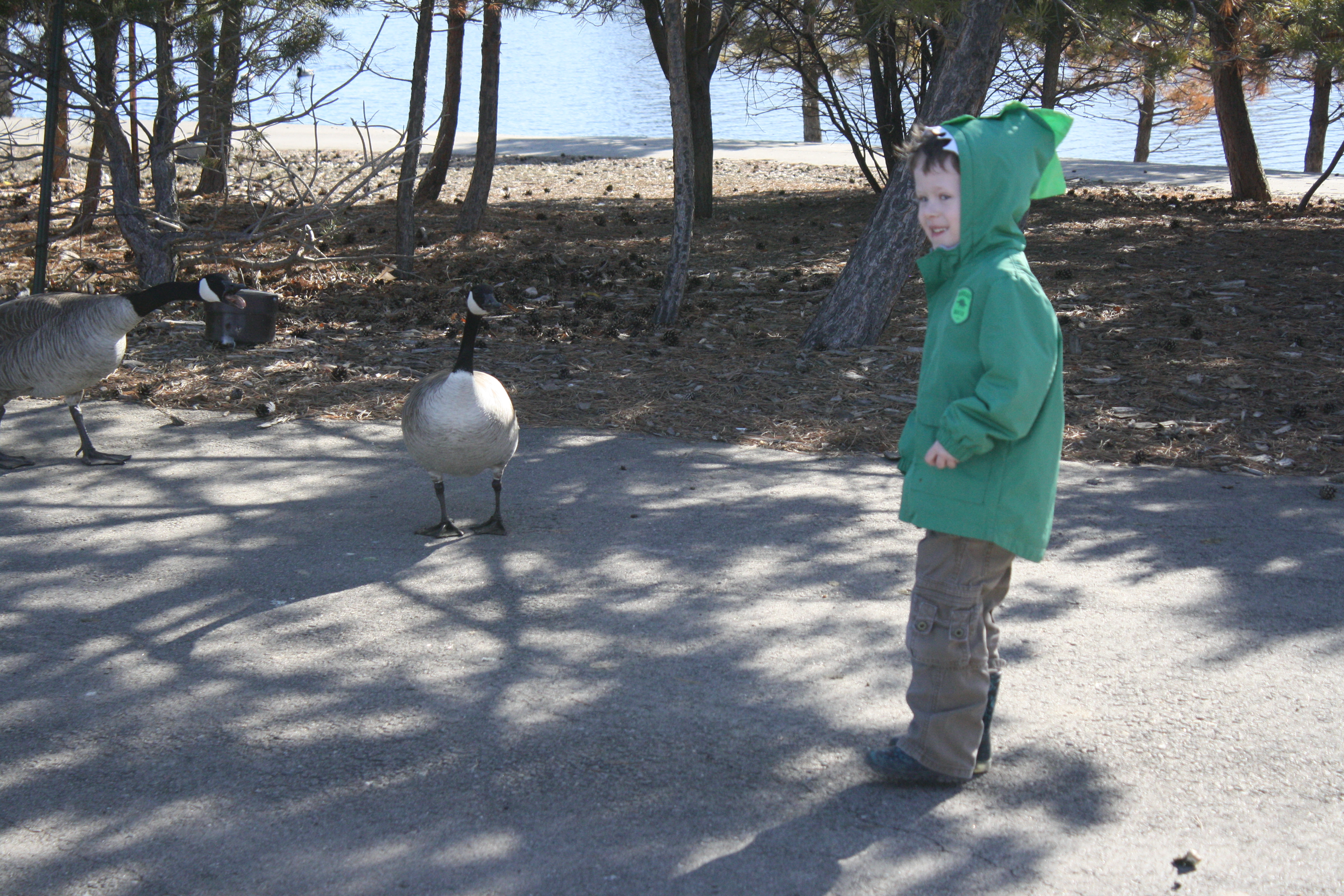
Nathan, chasing ducks.
This morning, I took my son to Wascana Lake. Situated in Regina, Saskatchewan, it’s a man-made lake that was created in 1883 and it sits just north of the Parliament Building. It contains a lot of avian animals and is usually a favourite for people who run, cycle and take photographs.
Nathan was doing fine until the goose hissed at him!
Now, I could have shown Nathan some photos of the Parliament Building on his device. I could have looked up ducks and geese on his iPad and explained what he was seeing. He would have enjoyed it and would have “ooh-ed” and “aah-ed” at seeing the animals. But it certainly wouldn’t have substituted taking a walk together, approaching and seeing the animals in real life and interacting with them. His laughter and enjoyment, coupled with running and fresh air has no comparison!
Although fun to look at, these large buggers can be aggressive
Technology and smart devices can certainly make life easier, in some respects. I’ll be the first to admit that I’ve been guilty of planting Nathan in front of his iPad on occasion in exchange for a few moments of peace and quiet. And while the advancement of technology has aided society in many ways, it’s important that we not lose sight of our humanity. Sit and talk with your children. Spend time doing things with them. This is how we will ensure the continued growth of our society. Not through the screen of a smart device.
Abraham Lincoln made the above noted comment as the opening line to his acceptance address for the Illinois Republican Party in 1858. Although I’m not referring to anything political today, I want to discuss foundations.
A good foundation is the basis for any house. And no matter how big and luxurious the house, it will eventually falter if the foundation is weak.
When getting into any kind of sport or martial art, it’s important to bear in mind that you need to learn the basics before you learn what most people consider the “fun stuff”. In my experience, I’ve found that people will often walk into a karate dojo hoping to do flying spin kicks and back flips within their first month. (For the record, in thirty years of karate I have never done either of those as they are all but useless in an actual fight)
One good example is the originator of my karate style, Kanbun Uechi (1877-1948), once explained that when he went to Fujien Province and learned Kung Fu, he spent three years training and practicing Sanchin kata before the monks would teach him anything else. Can you imagine? Doing the same structured form, over and over again, for three straight years before learning something else? Today’s modern student wouldn’t stand for it. But the monks at the monastery swore that Sanchin was the foundation for everything that followed and needed to be mastered first and foremost. Master Uechi went on to share this belief when he propagated the style in Okinawa.
When studying any martial art or sport, it is of the utmost importance that students learn and master the basics before moving on to something else. One would think this is common sense, but I’ve seen far too many students walk away once they realized that repetition was a constant within the dojo. Repetition is key in mastering any movement.
So, make sure you lay your foundation before building your house, and make it a strong one. This will guarantee that no matter how big your house gets, you can count on it being held up by the foundation you’ve taken the time to master.