We can’t always be aware of some of the help we receive. Every person has had someone in their lives that has done or said something, or perhaps even acted on their behalf, in order to help them in some way. And this often happens in the background, in such a manner that we don’t perceive it. Being helpful is not always an easy thing, as some people are pretty demanding and/or specific about the help they’d want and how it’s done.
And last but not least is the fact that if YOU are one of the people looking to help out a friend, family member or even a stranger, you should be prepared to help out with no thought of remuneration or reward. Otherwise, what’s the point? If you expect something in return, that’s not helping! That’s called a job. I’ve often heard people telling me, “You didn’t have to…” or “You shouldn’t have…” Well, of course I didn’t have to. That’s what makes it significant.
But now that I’ve rendered my opinion on the matter, which like everything else in life may not be shared by everybody, I wanted to share something I read last week that got me thinking about a people’s perspective. There was no author associated to the paragraph I read and I couldn’t find a source on the web, so if anybody knows where this comes from, feel free to let me know in the comments. Here’s what it says:
I Gave You $10,
He Gave You $20.
You Felt That He WasBetter Just Because HeGave You More. But He Had$200 dollars, And All I HadWas $10.
The verse is significant, as it demonstrates a bit of the selfishness of current society. More often than not, we tend to view more as better when we should be viewing better as more. I know some people who would do just as the verse describes; they would give their last dollar in order to help someone out. And that kind of help is invaluable. But we often lack the perspective to see it. As the saying goes, every little bit helps. And sometimes it’s the quality of the help that’s more important. ☯
I feel that before I start writing about today’s topic, I should throw up a quick reminder that I am not a doctor. I have no formal training in any medical field, and everything I write about has been researched and has a source, or is something I have directly experienced or have trained in personally. So if anything I’ve written feels incorrect, please feel free to reach out on the “Contact Me” link on my Home page and feel free to voice your concerns. I’m definitely not above, nor do I object, to being corrected.
I think the title speaks for itself, and this is the topic of today’s post. This topic hits close to home for me. Much like Diabetes, this condition has affected many people I know and care about and I have in fact been affected by PTSD, myself. There has been a significant increase in attention on PTSD in the past two decades, and it has started to be recognized as a genuine mental health condition and not simply a passing thought process that the sufferer has the option of ignoring. Previously known as “shell shock” during the World Wars, it was originally associated mostly to combat veterans who had seen active military service, especially during times of war, and were exposed to the traumatic aspects of said war. This is no longer the case, and research has come to show that PTSD can affect anyone, based on their specific circumstances.
I’ll start with my usual, which is to define PTSD or Post-traumatic Stress Disorder so that we can all be on the same page about what’s being discussed. According to the American Psychiatric Association, PTSD is defined as “a psychiatric disorder that may occur in people who have experienced or witnessed a traumatic event such as a natural disaster, a serious accident, a terrorist act, war/combat, rape or who have been threatened with death, sexual violence or serious injury.”
Although accurate, this definition is certainly a broad and generalized one. And whether or not something is traumatic is usually subjective to the sufferer. But the symptoms are generally pretty universal, which can include flashbacks, nightmares, insomnia, anger and irritability, hyper vigilance and aversion to social gatherings or constant noise. According to an article posted by the Mayo Clinic, it may even be possible to develop PTSD without having personally suffered the trauma. For some people, just learning about the event can be enough to cause the damage. Like I said before, it can be pretty subjective to the sufferer.
At the outset, it can also be a condition that the sufferer isn’t even aware that he/she has. I can recall the story of a law enforcement colleague from years ago, who had been initiating a traffic stop along a busy highway. He walked towards the stopped vehicle and he saw something small sitting on the edge of the roadway. When he stopped and looked at the object, he identified it as a small child’s sneaker. He immediately threw up and went into convulsions, got vivid flashbacks of an investigation he had been working on that involved a small child who had been killed. Although he had coped well to that point, the sight of the child’s sneaker brought all the traumatic memories to the surface and he basically shut down, right on the edge of the highway.
Although it isn’t always to that extreme, I’ve heard a lot of stories like this one. And have had plenty of colleagues who have suffered in silence. The ultimate symptom of PTSD and the one that often takes hold before friends and family become aware that there’s a problem, is suicide. Because of the stigma associated with PTSD in previous decades, many people choose to stay silent about their condition and try to self-medicate or isolate from others. When that fails, many often feel the only remaining option is to end their own lives.
For myself, nightmares and insomnia have certainly been the prevalent symptoms. But hyper vigilance, irritability and anger are high on the list as well. I have difficulty being in large crowds and will often find myself with increased sense of anxiety and shaking when I’m surrounded by people, especially if it’s a room full of conversation and noise. I’m quick to anger when consistent loud noise is happening in my immediate environment, which makes my days difficult considering I have an infant in the house.
There is a lot a person can do to lessen and help treat symptoms of PTSD. I find meditation helps, although having the time and opportunity to do so has been far less in recent years. A rigorous fitness regime and plenty of fresh air. From a medical standpoint, there are many therapies and medications that can help manage and lessen, if not eliminate PTSD. I’m not a big fan of the medications route myself, but I’ve known folks that have benefited from it.
I think the big thing is to talk about it. There’s no shame and no embarrassment to having PTSD. It’s part of who you are and certainly isn’t your fault. And talking about it to family and loved ones can be a powerful means of treating PTSD, in and of itself. And if your family at least understands what’s happening, it can go a long way towards preserving those relationships in the face of the difficulties you’re facing. And if you or someone you know may be thinking of harming themselves, the Suicide Prevention Hotline is always available at 1-833-456-4566. That’s a Canadian line, of course. If you’re one of my readers from out-of-country, you’ll have to search for whatever equivalent number you may have in your country.
We’ve come a long way from the time when friends, family or employers would say, “you’re just making excuses” or “you’re just being lazy.” But there’s still a long road to travel. There’s plenty of research and articles on the diagnosis, treatment and assumed causes of PTSD. So feel free to have a read and educate yourself. And be certain that if someone you know says they have PTSD, don’t take it as a passing thing; they’re likely dealing with it as best they can. ☯
Every once in a while, I find something funny or interesting online when I’m researching other posts. I like to throw these up in a post when I find them so that others can enjoy them and get a chuckle out of it. Plus it allows me to provide a short post where I don’t go on for several thousand words. Of course, despite saying I’m trying to keep it short, here I am jabbering on…
Although I get a kick out of this, it also serves to provide an important lesson. It’s important to keep your cool in daily life. After all, things would get pretty bad if one lost their proverbial shit for every little thing. But by the same token, everyone needs to cut loose and find an outlet every now and again. Fresh air, exercise and rigorous fitness routines can help to provide an outlet so that you don’t cause a shit storm of your own. ☯
Every once in a while, I get someone who asks me a very particular question. It’s one that always baffles me and makes me wonder where they figure it’s a good idea to ask, but one I usually try to answer anyway. That question is, what are the different types of Buddhism? It’s not that it’s an inherently bad question, per se. It’s simply a wonder as to how I’m supposed to know about them all. It would be like asking a Catholic how many Christian denominations there are in the world. Belonging to one wouldn’t necessarily give insight to the other.
That being said, I can provide a brief answer based on what I’ve researched (and of course, what I study myself). Let’s start with the basics, shall we? Buddhism originated in India, sometime between the 6th and 4th Century BC. Given its depth of spirituality, philosophies and beliefs, it can seem like a pretty complicated religion. But it’s actually a quite simple way of life. And although it can easily be viewed as a generalization by those who have studied in-depth, Buddhism can be classified as two main branches: Mahayana and Theravada, with some sources citing one or two other branches. But I’ll leave those alone.
Both branches follow the Four Noble Truths, The Noble Eightfold Path as well as The Three Jewels (Buddha, Dharma and Sangha). But from there, the branches move away from one another in that their perspectives and sources of information, as well as how they believe nirvana can be achieved, start to differ. Each of these two main branches have multiple sects, offshoots and schools of thought.
This separation is often thought to be a result of some of the Buddha’s original followers heading out and establishing their own group of followers, following the Buddha’s death. This would without a doubt lead to some minute, almost imperceptible changes in some of the teachings as they were passed down, leading to a separation in what would have originally been Buddha’s teaching.
I, myself, for example study Zen Buddhism, which is an offshoot of a Chinese Mahayana form of Buddhism. Zen focuses heavily on meditation, awareness, equanimity and empty-mindness, which functionally speaking, works extremely well in tandem with training in traditional martial arts. Zen Buddhists believe that mental purity and ignorance block the path to enlightenment, hence the emphasis on meditation.
Equanimity is an aspect of Zen that I focus on quite a bit and usually freaks some people out. In the event that you’re too lazy or not interested enough to Google it, equanimity is a practice of composure and controlling one’s emotions while preventing any outward displays of said emotions. You could almost say that Zen Buddhists are the vulcans of the Buddhist world. It’s given me the ability to keep myself in check and maintain composure in situations where most people would have lost their proverbial shit.
There are so many details and SOOOOOO much information on this subject, that in order for me to write a composite post that would explain everything would take a greater amount of time than I actually have available to me, especially with a five-year old who hangs off my every movement! There are a number of decent websites that can provide a synopsis of what every main branch and sub-type is based on. My best suggestion would be to find some that truly interest you and to research it further.
The only warning I would provide is that while learning about any given subject is a good thing, it’s easy to fall down a rabbit hole and fall prey to inaccurate information. If curiosity fuels your fire, I would even suggest seeking out your nearest Buddhist temple, monastery or school and see about speaking to someone in person. I can promise it would be an enlightening experience (see what I did there?) ☯
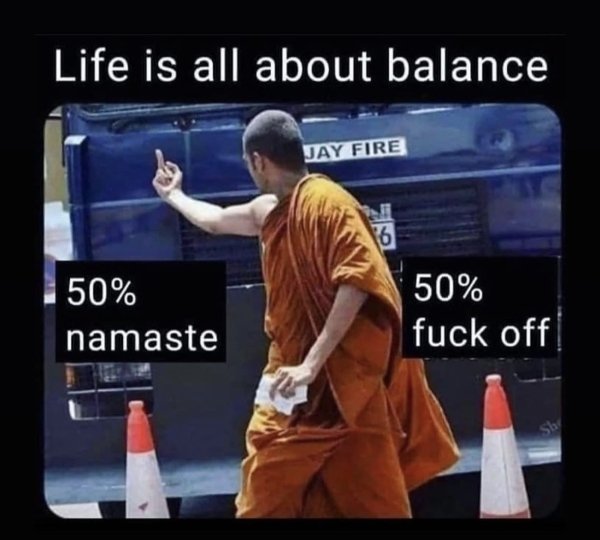
Sometimes, you need to just sit back, take a breath and have a laugh. I found this little gem while cruising the World Wide Web for something else and I couldn’t help but chuckle. I can totally admit that I don’t know the story behind what’s happening in this photograph, but besides making me giggle like a schoolgirl, I think it also illustrates a few important life lessons.
The first is that life is, in fact, a matter of balance. As my friend Daryl once told me, life is like a battery; some positive, some negative, all POWER. But the balance among all things is what’s important. The second lesson is that no matter how disciplined you are or how hard you’ve conditioned yourself, the world can sometimes be overwhelming and cause an overt reaction from even the most serene of people.
That being said, I should once again point out that I don’t know what the story is behind this photo. There was a story a few years ago about a group claiming to be Buddhist monks collecting donation money for a temple in Thailand. I think this was in New York, and the “monks” would approach arriving tourists and try to hit them up for donations. They would apparently become aggressive and even violent if people refused. That probably should have been a sign that they weren’t genuine. But the photo certainly gave me a laugh. ☯
Some say the grass is always greener on the other side. This saying is based on a quote by Ovid, who wrote a poem entitled “Art of Love,” which is believed to have been written sometime in the first century. The quote reads “The harvest is always richer in another man’s field.” The idea behind this quote is that as a people, we generally tend to want what we don’t have. Own a house? Probably wish it had more rooms or space like your neighbour’s home. Got a family vehicle? Probably wish you had that sports car the resident up the streets drives around with.
No matter where you find yourself in life, it’s human nature to want what others already have. I remember being almost destitute in my early 20’s, living in a cramped, moldy apartment that was substandard and eating canned peas and ramen noodles to survive. I remember wishing I had the kind of home that many of my friends had, including multi-room apartments or houses. Looking back now, I understand that I was in a position that warranted wanting more. But when I look at what I have now, a family home, reliable transportation and a family, I consider it enough. Always wanting more can be an unhealthy habit.
Part of the problem is the biological aspect that makes us believe that when someone has something greater or of better worth, it’s necessary to our survival. Another aspect is that the population tends to be inherently jealous of what others have. But it’s far more important to acknowledge and appreciate what we already have as opposed to yearning for what we don’t. It reminds me of a story that I heard, years ago when I was in college. There have been a number of iterations of this story, but this is the one I remember the best:
A professor stood in front of his philosophy class and had some items in front of him. When the class began, he wordlessly picked up a very large and empty mayonnaise jar and proceeded to fill it with golf balls. He then asked the students if the jar was full. They agreed that it was.
The professor then picked up a box of pebbles and poured them into the jar. He shook the jar slightly. The pebbles rolled into the open areas between the golf balls. He then asked the students again if the jar was full. They agreed it was.
The professor next picked up a box of sand and poured it into the jar. Of course, the sand filled up everything else. He then asked once more if the jar was full. The students responded with a unanimous YES.
The professor then produced two bottles of beer from under the table and poured their entire contents into the jar effectively filling the empty space between the sand. The students laughed.
“Now,” said the professor as the laughter subsided, “I want you to recognize that this jar represents your life. The golf balls are the important things such as family, your children, your health, your friends and your favourite passions. And if everything else was lost and only they remained, your life would still be full. The pebbles are the other things that matter like your job, your house and your car. The sand is everything else, the small stuff. If you were to put the sand into the jar first, there would be no room for the pebbles or the golf balls. The same goes for life. If you spend all your time and energy on the small stuff you will never have room for the things that are important to you.”
Life isn’t easy, and there will always be situations that are critical and need to be immediately dealt with. So I’m certainly not making light of anyone’s difficulties. But it is of the utmost importance to recognize the things we do have and appreciate them. Especially in light of the current world situation, the bright side of things can mean the difference between continuing to fight, or lying down to be trampled.
Take care of the golf balls first, the things that really matter. Set your priorities. The rest is just sand.
One of the professor’s students raiser her hand and inquired what the beer represented. The professor smiled and said, “I’m glad you asked that. The beer just shows you that no matter how full your life may seem, there’s always room for a couple of beer with friends or family.” ☯
This may be a question you’ve never asked yourself before, but take a moment to think about it. To be clear, I’m not talking about someone who has lost their sight at some given point in life. I’m referring to someone who was born blind and has never actually set eyes on another human being. How does this person know how to smile? And how do they know and acknowledge that this is a sign of happiness and/or contentment?
There’s a lot to be said for human instinct and we often take it for granted. Smiling is just one of those instinctive forms of expression that humans know, and it’s universally recognized around the world as a sign of positive emotion, even if it’s not necessarily taught. This like explains why my 1-year old son smiles his biggest smile, right around the time he’s filled his diaper for me. Kids.
What this teaches us is that humans have the ability to use aspects of themselves that are instinctive. Or in simpler terms, sometimes you gotta go with your gut. It takes a lot of effort to trust yourself enough to make tough decisions and hope for a positive outcome. And the truth is that your outcome may not always be positive. Sometimes, you may fail more often than you succeed. But you need to trust yourself and be comfortable n your choices. This is truly the only way you WILL succeed.
We all doubt ourselves, sometimes. But self-doubt is what usually leads to failure. Trust your instincts. They’ll bring you farther than you may think. And even if they sometimes lead you astray, always remember that failure also helps you to learn and grow. ☯
Life certainly throws out a more-than-fair amount of challenges into one’s daily life. Even when you think you can fight your way through one obstacle, another one pops up to either take the first one’s place or make matters even worse. It certainly seems that way, over the past two years.
If anyone is keeping score, issues in my professional life have caused me difficulties and sent me home long before COVID-19 took hold. Despite this radical change of life and the reckless endangerment of my dream job by others, I kept on pushing and fighting. Then, job interview after job interview came and went. Most left me feeling pretty good and certain that I wold turn a corner. But I’ve been consistently passed up over and over.
Then at the beginning of the year, the world fell into chaos (more so than it usually is) and the pandemic struck. I’m sure that at this point, I don’t need to explain the problems and issues that having the world self-isolate and essentially lock itself down has caused. Even six months later, the world is still licking its wounds and trying to recover.
Then, we attempted to sell our home. We came to this decision as a result of my current job situation and the fact that we’re trying to eliminate debt. Despite many people who came to view our home, structural issues with our foundation caused most people to pass. We have come to the decision that we need to repair our foundation, which requires the demolishing of our finished basement. This sucks, because it also meant we had to take our house off the market as we can’t really show the house while we’re in mid-construction/renovating.
It almost feels as though everything is coming up bullshit and sometimes it certainly feels as though it would be easier to simply give up and let go. And no, I’m not being fatalistic or trying to send out red flags; I simply mean that the Buddhist side of me feels that life shouldn’t be such a struggle, that I shouldn’t have to force so hard in order for life to be good. The martial artist in me believes that I need to keep fighting and win, no matter what the struggle. If it comes down to me or them, it won’t be me! More often than not, the martial artist wins over the Buddhist. Such is life.
“Success Is Stumbling From Failure To Failure With No Loss Of Enthusiasm.”
– Winston S. Churchill
As a general rule, most people are afraid of failure. They see it as a weakness and they believe that it’s an embarrassment or shameful to fail at something. But the irony is that I can promise beyond any reasonable doubt that every living person has failed at something. It’s inevitable. You show me someone who claims they’ve never failed at something in life, I’ll show you a liar.
But failure is an important part of life. You see, life believes in showing you what you’re doing wrong. It sucks, can be painful and can even be disruptive to one’s life. But it sure shows you what path you should be taking. Failure isn’t a failure, it’s a learning tool. It helps you to grow and become the person you’re meant to be. I’ve been defeated and failed at a number of things in my life. But I keep on fighting. Because what’s the point of the lesson if you do nothing with it?
Don’t be afraid of failing at something. As long as you keep pushing, fighting and moving forward, you’ll eventually clear the storm and come out on top. And should you happen to fall and fail, the important part is to rise, dust yourself off and find a new and different path to pursue. ☯
Since a lot of people are stuck at home until the world returns to normal, many have chosen to undertake some DIY projects within the home. I, myself, have decided that the patch of bare dirt in our backyard deserved to get some love and I started working the soil. Much to my surprise, the past few summers of weeding and spraying made the soil pretty easy to till and plant some grass seed.
I managed to make myself proud as a full half of our backyard now contains a full, lush green lawn that requires mowing twice as often as the front yard. The other half contains a quarter space where we plan on planting our own vegetables and a quarter space that I had left for Nathan to dig with. I have since seeded the digging quarter as Nathan has given up his mining ambitions in favour of his razor scooter. but I digress…
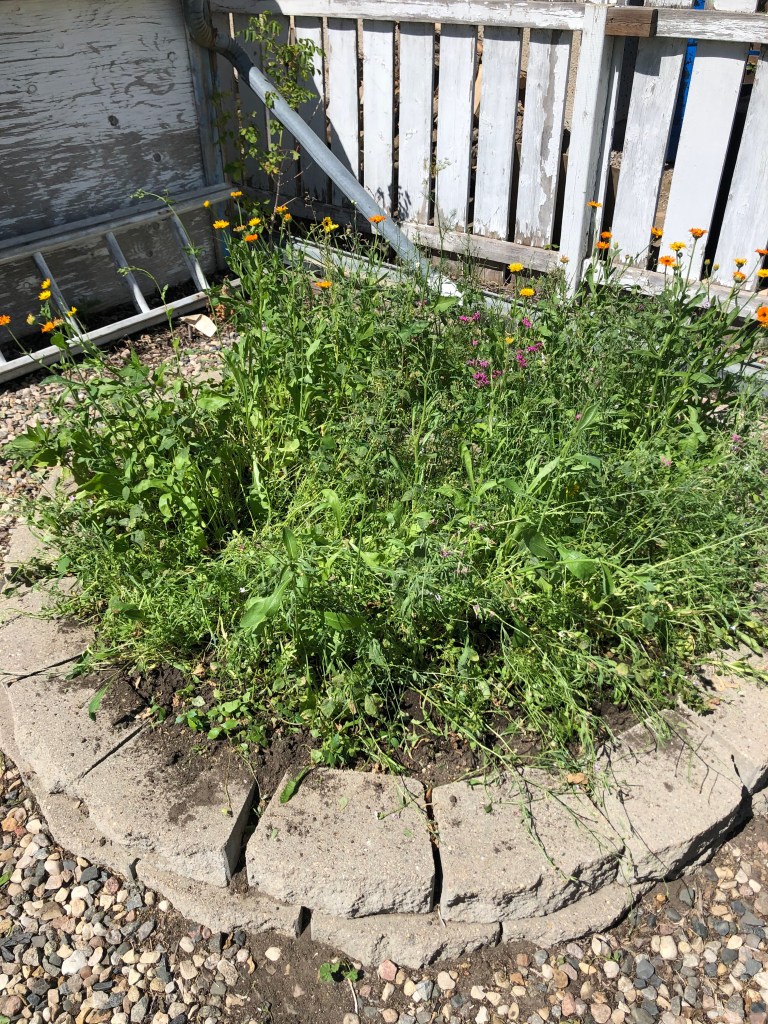
Our back yard has a circle of grey bricks that had apparently been arranged to ring a tree that had been in the backyard. When we moved in, the tree was cut down at its base and nothing remained but a slim stump. So I decided to till the soil within the ring and plant some flower seeds. I felt that the back yard could use a little color. Within a few weeks, the entire ring grew some greenage that was over half my height! I was tickled pink (not literally) and like an unaware idiot, kept watering daily and trying to get everything to grow as much as possible.
The decimated centre area, once my wife and I removed all the weeds
Turns out that the tall, green stalks I was watering and so proud of, were invasive weeds that were preventing the actual flowers from fully blooming. I have to admit that I had no clue and I thought the thick stalks were a species of flower that would bloom fully. Once we found out, my wife and I took an afternoon to remove as much of the weed as we could in an effort to let the flowers take hold.
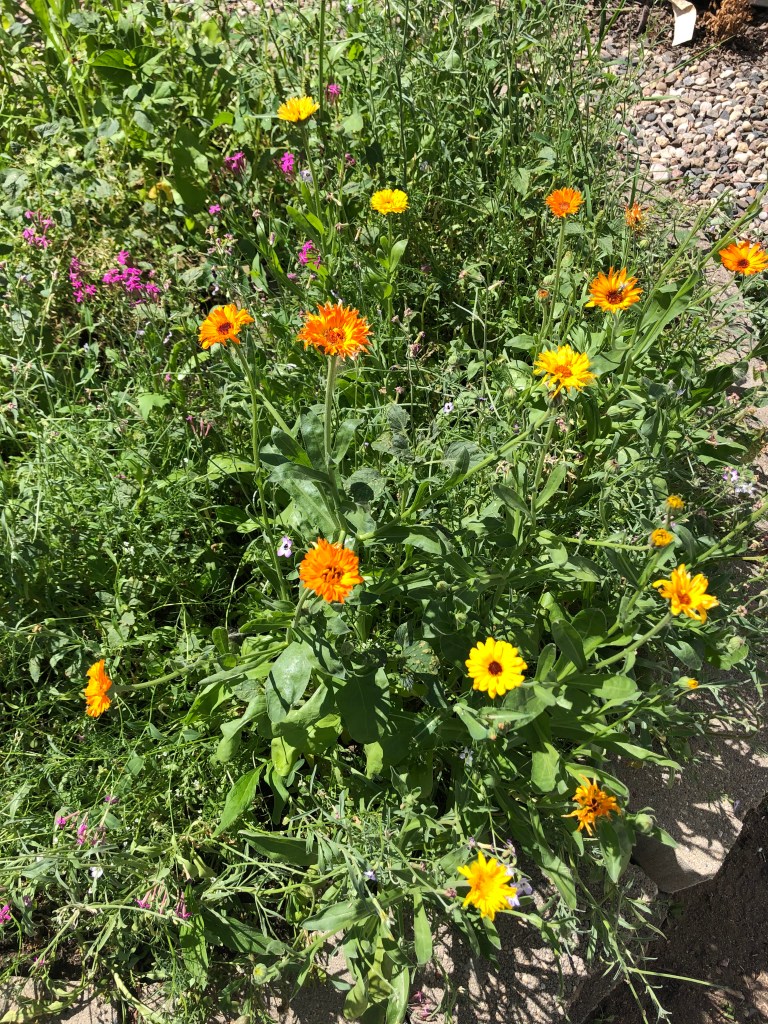
The flowers that come in when they’re permitted to bloom
Flowers are starting to take over and some are already in full bloom. But as usual, it got me to thinking about perspective. Until I was told the tall stalks were weeds, I was happily and cluelessly watering the weeds like they were worth their weight in gold. Once I knew they were weeds, I got angry and became hell-bent on removing them from my garden. But I would have been oblivious, otherwise.
And this is something that applies to life, as a general rule. Something that may be unpleasant to one person could easily be a benefit to another. Sometimes, things may seem like they don’t belong but even things that are not preferred can be important to someone else. Dandelions are considered weeds, but it sure doesn’t stop my son from loving the yellow ones and blowing the fluff off the white ones. It’s all about one’s perspective. ☯
I first heard the quote in today’s title all the way back in the early 1990’s when I started reading Robert Jordan’s Wheel of Time series for the first time. At the time, I thought it was just a cool quote, “Duty is heavier than a mountain, death is light as a feather.” It’s a quote that the main protagonist ends up carrying with him throughout the entire series. Since the release of the books, many people have been quick to point out that the quote actually comes from an old Japanese military text (myself included, since I wrote about it last year).
But by the time I had reached the end of the series, the expression had come to mean a great deal more to me than simply a line in a book. And in truth, there are a lot of values that are important to me; loyalty, honor, duty and obligation. These are things that are surprisingly not thought about in any great depth by most people. But the martial arts (at least traditional schools) are steeped in these values. And I’ve grown with these values ingrained as part of who I am.
“Loyalty Above All Else, Except Honor…”
– Lt. Vincent Hardy, Striking Distance
Doing the right thing should be easy. People think it’s hard to do the right thing, but it really isn’t. Unless you’re values are a bit shady, doing the right thing should come smoothly and easily and should be done without thinking. It shouldn’t be a chore, it should feel like what you’re SUPPOSED to do; because it is. It should be. Key word: should. Sometimes, it can be harmful to yourself to do the right thing because it can cost you.
Doing the right thing can sometimes take something from you that you endeavoured to obtain for yourself. So the important question becomes, if you know that being loyal and doing the right thing will take something important away from you, do you still do it? Yes. The answer you’re looking for is yes…
Duty is ever-present. There will always be things in your life that you have a bound duty to, so you should roll with that. Honor is always important. It helps you to do what’s right, even when it seems hard. Loyalty should be earned. But if someone in your life has become important enough to earn that loyalty, then you should be true to that loyalty to the best of your ability. ☯