The home of Buddhism, Martial Arts, Diabetes and health…
Author: Shawn
I am a practitioner of the martial arts and student of the Buddhist faith. I have been a Type 1 Diabetic since I was 4 years old and have been fighting the uphill battle it includes ever since. I enjoy fitness and health and looking for new ways to improve both, as well as examining the many questions of life. Although I have no formal medical training, I have amassed a wealth of knowledge regarding health, Diabetes, martial arts as well as Buddhism and philosophy. My goal is to share this information with the world, and perhaps provide some sarcastic humour along the way. Welcome!
Believe it or not, April Fools, which is an unofficial holiday celebrated on April 1st, has been around for hundreds of years and is observed across the world by playing pranks or jokes on an unassuming person. This is usually followed by yelling “April Fools” when the prank has been executed. You may not get this unless you speak French, but I found an article on History.com that explains that the origins of April Fools potentially dates back to when France switched from the Julian to the Gregorian calendar. Those who were behind the times and still celebrated the New Year during the last week of March/first week of April were considered “April Fools” and would often have pranks played on them, such as sticking paper fish on their backs. This is why in French, these folks would be called “poisson d’avril,” which would have been nice to know when I was a kid. But I digress…
I thought that today, instead of a top-heavy post with tons of information, I’d keep things light and share some of the pranks I’ve had played on me through the decades. I can honestly admit that I was never one to play the pranks, myself. I usually found myself being on the receiving end. So without further ado, here are some of the top pranks I’ve had played on me by others…
Years ago, I was a manager for a fast-food chain and was working a tandem shift with another manager through a reasonably busy dinner period. Some of the younger staff knew me as an easy-going supervisor and had no qualms about pranking me. At one point, I get told that the employee at the drive thru window badly needed change for the customer currently at her window. They said it was a rush, since it was holding up the line. I responded accordingly and ran down the drive thru hallway, which my loyal staff had sprinkled with floor soap (without the water). The result was my so-called “no slip” shoes sending me careening down the hallway and slamming into a wall, with half a dozen teenagers laughing hysterically as I picked myself up. I thought having them mop up the soap would have been deserved justice, but they considered it a small price to pay for the laughs they got.
Some time ago, I was working at my computer and I had my supervisor come running past me while strapping on his gear saying, “Come on, Shawn! We have an emergency, we gotta go!” I jumped out of my seat, grabbed my coat and slammed my arm through the sleeve only to be rewarded by a showering spray of shredded paper flying out of the hand-hole and littering the floor. My co-workers dropped their panicked facade and doubled over laughing, once again making me the butt of the joke. Don’t even get me started on how my field coach used to throw a quick squirt of pepper spray into my morning coffee when I wasn’t looking…
There’s a lot more, but some of it isn’t suitable for print and some are rather embarrassing. I know, I know… That’s probably the good stuff you’d love to ACTUALLY hear about. But I also want to keep this post reasonably short. The point is, I’ve never really been much of one for playing pranks, but they can be fun in the right context. The important thing is to make sure you do nothing that has the potential to cause damage or injure anyone. And if playing pranks on your co-workers, be sure to keep it appropriate to the work environment AND the person you’re doing it on. We don’t all have the same sensibilities… ☯
People tend to have bad habits in their daily routine. And very few people are the exception. Hell, I have many bad habits that I often TRY to avoid but I would lying if I said that my efforts are often half-hearted. But a VERY bad habit that people have is skipping breakfast. Now, I’ve written posts about the importance of breakfast before and whether or not it genuinely is the “most important meal of the day.” On the home front, the jury is still out but there certainly are important benefits to ensuring that you consume that first meal of the day upon waking up.
The whole point behind the breakfast meal is to do just that: break your fast. And as most of you already know, a “fast” is a period of time where you don’t eat. When you hear of someone “fasting,” it’s usually associated with a LONG period of time often for medical or dietary reasons. But the reality is that we fast every night, from the moment we go to bed until we wake up in the morning. Unless you compulsively snack at night. Which is another bad habit. Which I also occasionally have. My point is that breakfast is intended to be the first meal of your day that breaks your overnight fast, hence the term “breakfast.”
You may be thinking, “Why is this cheeky mother-f%&ker giving us the definition of breakfast?” Well, simply to impress upon you the importance of starting your day with a proper meal. The take-home lesson is that you should have your breakfast within an hour or two of waking up as it will be the first batch of vitamins, minerals and nutrients your body receives after a period of fasting. You should also think of it as refilling the fuel tank for your engine after it’s emptied itself out.
According to a good article on WebMD, “Skipping the morning meal can throw off your body’s rhythm of fasting and eating. […] If your body doesn’t get that fuel from food, you may fell zapped of energy — and you’ll be more likely to overeat later in the day.” The article goes on to say that your breakfast doesn’t need to be huge, but should include a variety of carbohydrates, protein, healthy fats and fibre.
However, an article posted by HealthLine.com seems to have an opposing view in that they claim that there is no evidence that breakfast eaters are healthier, that eating breakfast boosts your metabolism for the day and that in fact, skipping breakfast can have some benefits for folks who do intermittent fasting. It’s unusual for me to find a topic where those two sources oppose each other, but it’s kind of refreshing. The article caps off by explaining that breakfast is optional, won’t boost your metabolism and doesn’t automatically lead to weight gain and obesity. Basically, if you don’t find yourself hungry when you wake up in the morning, there’s no need to eat.
I’ll be the first one to agree that every person is different. Actually, I’ve written about that very thing on more occasions than I can recall. So although it may be true that skipping your first meal of the day is a matter of choice, it may not be the smart one for everyone. And this is where the Diabetic aspect of this post comes in. If you have Type-1 Diabetes, skipping a meal can be problematic. Especially if your insulin’s basal rates and your specific condition requires you to eat, first thing in the morning. You may wake up extremely high or low blood sugar.
Although I’m a big believer that a person with Diabetes can do anything that a non-Diabetic can, intermittent fasting is possible but problematic and skipping meals will skew your blood sugar control. And despite what any source material may say, I believe it’s critically important for all people to start their day with a good hit of nutritional fuel to start your day. It may not stroke your metabolism and may not affect your weight, but it helps to guarantee you won’t have that “early-morning slump” because of an empty stomach.
As I mentioned in the opening paragraph, the jury is still out on whether or not breakfast is the MOST important meal of the day. But it’s safe to say that it is IMPORTANT. Most people unfortunately tend to skip breakfast because they’re rushing off to work or taking care of their children before taking care of themselves. Personally, I usually enjoy a toasted english muffin with a slice of cheese. Some carbs and protein, doesn’t fill me to bursting and gets me on my way. It can be just as simple as that. And speaking of which, look at that! It’s breakfast time… ☯
I usually write my posts ad nauseam, and often require a number of edits to eliminate them being twice as long as they are once they’re posted. Once in a while, I like to post something that simply to look at, without all the necessary background, citations and references. So, here’s what I found last week while randomly surfing the web…
I forget exactly where I found this little gem, but I’ve seen it floating around in a few places. What I love about this photo is the absolute look of intensity and determination on the kid’s face, despite the fact he’s tethered to what appears to be an oxygen tank. I’m ignoring the fact that he appears to be one belt shy of black, despite his young age. Let’s not go there.
But it goes a long way towards showing how much determination can pay off in the long run, and the fact that motivation has to come from within. This little guy reminds me of myself when I was younger. All guts and determined to live and grow stronger, despite the pitfalls and medical challenges that life threw at me. As long as you keep fighting, may lose some battles but eventually you’ll win the war. ☯
I wrote a post about karate gis yesterday, and focused a bit on brands, cost and durability, which I think can be pretty important if you’re a life-long student OR you’re just starting out and thinking of taking the Nestea plunge and buying your first gi. It can be a pretty particular decision, especially when the cost involved can be substantial. But since you can read about that here, I won’t get into all of that. Rather, today’s post will focus on what you wear OUTSIDE the dojo. Yes, you read that correctly…
There’s an interesting phenomenon that takes place when someone joins a club or organization that I’ll reluctantly admit that I’ve been guilty of, myself. They tend to purchase and wear a lot of swag. Basically, what I mean is that if a student joins a dojo, it usually won’t take long for them to start purchasing and wearing a club t-shirt or hoodie, wearing a track suit or buying the “yearly” dri-fit shirt. These items will often be worn out in public, either through a sense of pride or because they paid for it and don’t want to leave it sitting in their drawers.
And I get that… As I mentioned, I’ve been guilty of this myself. In fact, I still have some stuff that I occasionally wear, albeit under something else or in such a way as I don’t turn myself into a walking billboard for whatever location is involved OR I don’t turn myself into a walking target, which is the bigger concern. I was having a comment conversation with a fellow blogger who also happens to be a fellow martial artist (here’s looking at you, Silk Cords) and we were talking about how talking about karate or wearing karate apparel outside the dojo will usually incite short-sighted fools to try and prove themselves by fighting you.
My favourite hoodie, with my “old school” crest from 30 years ago
Just to be clear, it’s not a BAD thing… Being excited and proud to have joined a dojo can be a good thing. And if you feel the need to wear a dry fit shirt with a giant yin yang on the back that says “karate” (I have one of those) then by all means, fill your proverbial boots. Just be aware of the type of attention you may draw. It kind of falls under the same category as avoiding the muscled idiot who goes to the bar wearing a “Tap Out” t-shirt… If he or she if advertising themselves in THAT manner, in THAT environment, the safe bet is they’re likely looking for trouble. I could be wrong and/or biased, but that’s also based on observation.
After a while, the fascination with wearing all the swag wears off, and the student becomes aware that such clothing items are best left to memory. Even students in Okinawa don’t wear karate apparel outside the dojo, and karate is the equivalent of what hockey is, here in Canada. Except the kids, of course. On class nights, you can them running to the dojos clad in their gis. I have an exception that comes in the form of the hoodie you see in the image above.
The crest I have on the shoulder reads “New England Academy of Karate and Judo,” which is Sensei’s school. I got that crest all the way back in my early white belt days and my intention is to never let it go. But let’s be honest, unless you get real cozy, you won’t be able to read what it says anyway. But the best way to win a fight is to never have had it in the first place. So, best practice is to keep from advertising yourself in such a way as to make a target of yourself. ☯
I’m not one for posting more than once per day, but today was particular… Anyone who’s been following my blog for a while is aware that I frequently posted about my bicycling milestones, all through out the summer and fall last year. Given that temperatures hit the high teens today, the whole family took advantage of the warm weather to spend some time outside. During this time, I opened up my garage and cleaned my SUV… You know, typical warm weather stuff.
One of the things I did was grease up the chain on my bike and inflate the tires to the proper pressure. Once that was done, I couldn’t resist taking a quick spin around the block to try the ol’ girl out. I was wearing a hoodie and jeans, completely unstretched and unprepared. But I managed 1.5 kilometres in just a few seconds over 5 minutes. I spent the early afternoon running some errands and picking up my Diabetic supplies, all the while thinking about my bike. Once I got home, I couldn’t resist changing into fitness gear and going for a more substantial ride. Especially since a snowstorm is calling for tonight.
My first outing of the season. Not bad for a first run.
My wife was taking advantage of a quick nap while the baby was sleeping and Nathan was occupied, so I threw in the earbuds, slapped on my helmet and took a ride. 10 kilometres in 37 minutes is far from my best time, and I can admit that I didn’t really do any cross-training through the winter months. But it felt nice to get out and peddle, listen to some rocking’ tunes and enjoy my first outing since snow hit the ground.
I don’t know if a snowstorm will hit as expected, as it’s still 14 degrees out and we’re slipping into the wee hours of the late evening. But once this weather starts holding permanently, I’m looking forward to training to reach my goal of 200 kilometres. This is the goal I had for last year, but I only ever reached about 75 kilometres before it started getting too cold to be out. I’ll try not to be a constant pain in the ass and post about nothing but cycling. But I intend on keeping track of my progress and hopefully reaching the goals I fell short on last year. ☯
So if I haven’t grossed you out or scared you off with the title and you’re still reading at the moment, today’s post will be about karate uniforms. The “crotch” comment mostly references the wear and tear that the stitching on the crotch of one’s pants potentially go through during karate training. Mostly. But we won’t get into the “not mostly.” That can be for another day. But I digress… Moving on!
Karate is most often associated with the wearing of a white, cotton uniform or gi. But what most people are usually unaware of, is that karateka or students originally didn’t wear any sort of uniform while studying karate at all. In fact, you can still find a number of old black and white photos of Okinawan practitioners, training on the beach in nothing but a pair of shorts. In a lot of ways, this was preferable as it allowed teachers to see if proper muscle tension was being used by the students.
An example of a typical, white karate gi
The introduction of the recognizable, white karate gi as we wear it today came about as a result of it being introduced by Jigaro Kano, the founder of Judo, who developed the gi, which was later adapted by Okinawan Karate. Nowadays, you can see all kinds of ridiculous bullshit, depending on where you are and what dojos are available. I’ve seen karate gi of all colours, including blue, red, pink, camouflage and even multi-coloured. Since some of those colours have snuck their way into some dojos’ ranking systems, I think the whole thing is rather stupid and moves away from tradition. But that’s mostly because I’m a traditionalist.
Others may feel that it’s an evolution and one that’s unavoidable. After all, karate started with no ranking system at all. You had a teacher and you had students. No matter what your opinion or thoughts on the subject may be, the reality is that joining a modern karate dojo will usually involve the purchasing and wearing of a karate gi at some point, which brings me to the content of today’s post. Over the past 30-plus years, I’ve burned my way through about a dozen different gis, for many different reasons. I’m going to share some of that here, so that if you’re looking to buy a martial arts uniform for the first time, you’ll have an unbiased opinion of multiple brands. This is where I should clarify that I neither endorse nor discourage any specific brand of sports apparel, nor have I accepted any compensation for any positive comments provided herein. Buckle up!
First, let’s start with the basic, bare bones options. As seen in the photo above, I use a black, cotton karate gi that’s manufactured by Century Martial Arts. I use this one because the Regina Institute of Kempo Karate where I currently train, use black gis as opposed to white. Not a big deal and I’ve often worn my white gi on laundry days when I didn’t have my black one available. This cotton gi is single-layered and single stitched, making it ideal for beginners and junior belts, since there may not be as intensive a level of grappling and grabbing involved. It’s also comfortable and easy to wash, making easier to maintain even though it may not last as long as the subsequent brands below.
There are a few of these really good North American companies that manufacture some reasonably low cost karate gis. I love Century Martial Arts! They have an American and a Canadian website and have a ton of martial arts training equipment. But I need to calm down; we’re talking about uniforms. In New Brunswick, Sensei used to obtain his basic karate gis from a company called GeneSport, which is based out of Quebec. They had that same single layer and single stitch hem, making them an excellent, low-cost option for beginners. I went through three of them during my time climbing the junior ranks. But once I stepped up to brown belt and things got rougher, I needed something that could keep up.
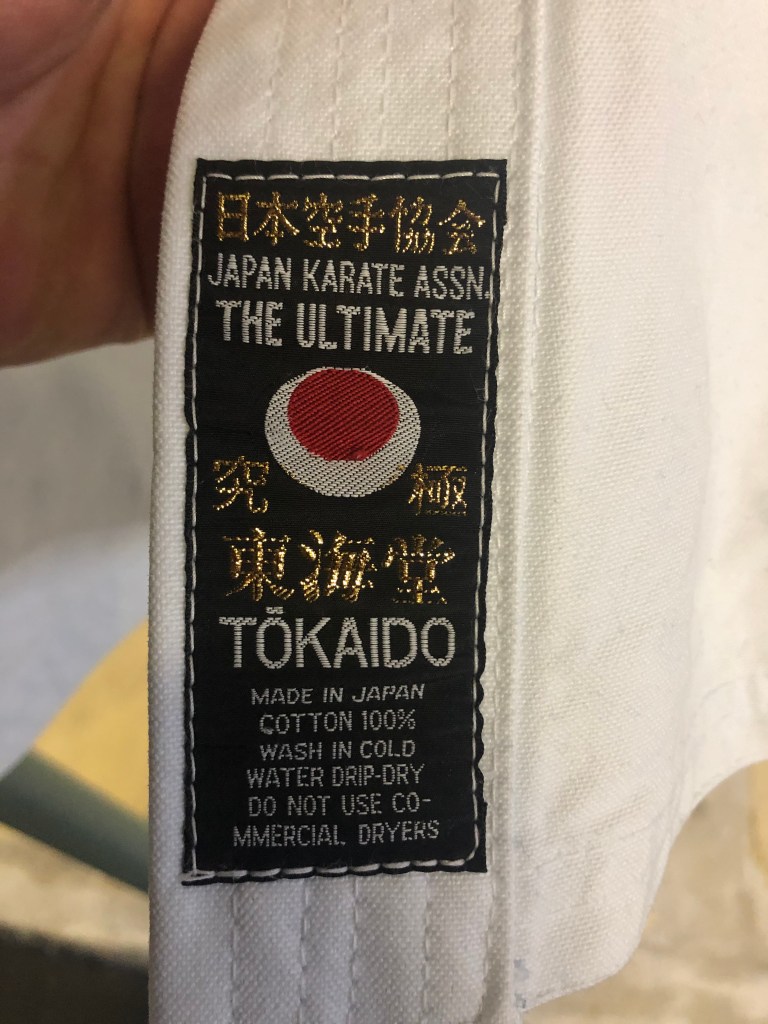
Next, we have the Tokaido. As you can see from the tag above, this is a 100% cotton karate gi that has double and sometimes triple-stitched hems for durability and strength. This company boasts being the oldest manufacturer of karate uniforms. I went through two of these during my years climbing through brown and black belt. They’re of a much thicker cotton and are an excellent quality. I can highly recommend this brand to someone making a long-term commitment to karate. I still have one today!
That being said, buyers should be aware that you’re paying quite a bit for that quality. As a comparison, my last GeneSport gi was roughly $40 (in 1996) and my Century gi was approximately $60 (2016). My last Tokaido cost me $230, but I still HAVE it! And it’s still functional, despite some holes here and there. So deciding on which brand to settle may have a great deal to do with one’s budget, especially if you join a McDojo that’ll charge you an arm and a leg for absolutely everything. But before I go on a rant, let’s move on to the last one…
The last brand I’ll touch on in this post, is Shureido. This company holds a special place in my heart, as it is a small, privately owned manufacturer of karate gi and martial arts weapons and equipment located in Naha, Okinawa. I visited this location in 2001 when I traveled to Japan, and I had the pleasure of getting myself a karate gi with Uechi Ryu’s banner embossed directly on the gi jacket. My black belt is also from Shureido and is stitched with my name and karate style. It’s pretty sharp.
Although they have a US distributor and an official Facebook page, there doesn’t seem to be an actual website available. This puts them in a bit of a different category than other manufacturers. I’ve recently reached out to the US distributors as well as sending a message to the Facebook page, without any response thus far. But since they cover all Okinawan and Japanese territories as they relate to karate and kobudo, I would imagine that they’re pretty busy. Cotton material and double or triple-stitched, these gis are top-of-the-line and are prominently used in the tournament environment. At least they were, when I was there in ’01.
These are the top-tier of price range, with a gi costing anywhere ranging from $250 to several hundred dollars, depending on size and accessories. Since I got a specialized gi and specialized belt, my package cost me well over $350. So it may not be ideal in terms of budget. Another issue is that my increase in size over the past five or six years has made it to snug to train in, which is problem. But I’ve had that gi for twenty years, at this point. It’s seen me through my black belt test and all the fun, in-class violence that ensued.
What level and quality of gi you decide to purchase depends on your perspective. An advanced student who buys one of the lower-priced, single-stitch gis may find themselves replacing it within a year or two as it’ll get torn to shit while sparring and grappling. That’s the issue I used to face. So if you burn through three or four of those gis, you’re already halfway to the cost of a basic Tokaido gi, which will be tougher and last longer overall. So you need to find a way to balance the scales.
You may also find yourself limited by the requirements of your dojo and what THEY require. Most traditional and functional dojos don’t care what their students wear, so long as they train hard and put in some effort. That is, until the time comes for a significant climb in rank. Most dojos don’t want to issue a green, brown or black belt to someone in their sweats and a Blink-182 t-shirt. But if you reach those ranks, the safe bet is you’ve invested in a gi already. The important thing is to have your gi loose enough to be comfortable and allow movement, while being snug enough to prevent snagging and grabbing on your opponent’s end. ☯
One of the beautiful things that I’ve discovered about meditation over the decades, is that there are so many ways to do it. In fact, I would challenge you to go Google “Types of meditation” and I can promise you, you’ll get some lists. Some of the best and more prominent examples I can think of include yoga, which is stretching movements that prepare the body for extended periods of sitting for meditation, and Tai Chi, which although a martial art, holds many aspects of moving meditation and almost puts you in a meditative state if you’re practiced enough to go through your movements on muscle memory alone.
But if you look into it, even on its surface, you’ve got moving meditation, sitting meditation, mindfulness meditation, focused meditation… It can become a bit convoluted, especially if you’re a beginner and are looking to TRY meditation and aren’t certain which type would be right for you. In Zen Buddhism, we practice a form of meditation referred to as “Zazen,” which is loosely translated as “seated meditation. Since some different branches of Buddhism describe and define Zazen differently, I won’t muddy the waters by going into deep detail. But there are some really great pages that provide insight on the specifics.
As for myself, meditation can be difficult even if I’ve been doing it for decades, thanks to a lovely batch of medically-defined acronyms that make the inside of my mind feel like it’s hurtling through space on hyperdrive on a constant basis. This is why, through the practice of meditation, I usually try to empty my mind and think of nothing. Depending on your philosophical background, thinking of nothing is still thinking of something so it opens up a whole can of worms. But the practice of “no mindness” is described by the term mushin.
Mushin is translated simply as “no mind” and since thinking about not thinking or “nonthinking” is a part of Zazen, they go very well, hand-in-hand. Confused yet? Got a headache? Need to go do a quick shot of whiskey to get through all my confusing etymology? Go ahead. I’ll wait… Mushin is a term used a lot in karate as well, as the development and practice of our forms, or kata, require us to know them well enough to allow the body to do them on instinct while thinking of nothing. So I’ve been familiar with the term for some time.
But when your mind is as busy as mine, you sometimes need an extra bit of something to help you focus. And this is where music comes in. Although traditional dojos won’t usually play music during training, I’ve found that music can be an excellent addition to your training regiment and adds a certain little something. IN fact, you can read my thoughts on that very topic here. I’m surprised I found that old post, since I wrote it in February of LAST year and after almost 800 posts in just over two years, I’m starting to forget what I’ve written about and what I haven’t. But I digress…
My point is, a little touch of music can go a long way towards making your meditation efforts easier and more effective. For myself, I enjoy having some classical music playing in the background. The complexity of sound and varying tones and volumes occupy my conscious mind, making it possible for my subconscious to stretch its legs and feel around a bit, unhindered. By focusing on one singular aspect of external stimuli, it allows thoughts and ideas to float on by without my getting involved with them, which is a big part of Zazen.
I also have several hundred “spa” type instrumental songs or “meditative music” on my devices, and those are extremely helpful as well. If you meditate frequently but have never tried music, I highly recommend it. Listening to music on its own has been proven to reduce stress, depression and elevate your mood. There are even studies that have shown it helps with heart-health as it improves blood flow. I have no source on that last one, but it’s pretty cool if it’s true. So add music to meditation, and I’d say that’s a pretty calming combination.
Meditation is one of those things I could write about or talk about at length. But in the interest of keeping my posts readable without having y’all fall asleep at the keyboard or on your devices, I’ll call it quits here. But should any of you have questions or curiosities about meditation, I’m always up for a good discussion. Feel free to reach out. Otherwise, settle into a nice seiza, put on some soft music and let your mind think of not thinking… ☯
We do a lot of pre-arranged drills in karate, and for good reason. The development and perfection of most techniques requires hundreds if not thousands of constant repetitions in order for a practitioner to be able to use it on the fly, spurred on solely by muscle memory. Some may argue that drills are useless since you’ll never be able to predict what a random opponent may do on the street. And while this true, there is a means of being able to tell what said opponent may do. I’m referring to telegraphing.
Just to provide some clarification to any non-practitioners out there, the term telegraphing refers to any physical “tell” that may warn you of an opponent’s movement and/or intention. A good example is if you happen to be having a heated discussion with someone who suddenly decides to take a bladed stance. What may have been solely verbal to that point has suddenly become your opponent’s intention to attack you. Another example and the most prominent one, is the lifting or shifting of an opponent’s foot, right before they strike,
Sensei used to be really good at telling me what I’d do before I’d do it. In my earlier days, sparring with him would be challenge, since he’d refuse to attack and insisted that I got used to moving in. So I’d be eyeballing him up and down, tapping into my internal repertoire of techniques and deciding on how best to attack. I’d tense up and get ready for a strike and he’d say, “You’re about to front kick…” or “You’re going to throw a left…” It used to piss me off quite a bit, but he’d be right 99% of the time and the reality is that by observing your opponent, you’re able to watch for those physical tells that will warn you of what your opponent will do.
In some ways (many ways), telegraphing is almost unavoidable. At least to avoid it completely. This is mostly because basic physics teaches us that in order for you to move your body in some given way, there needs to be a shift in weight, shift in centre of gravity and movement of the remaining limbs to maintain balance and precision. The idea is to train yourself to REDUCE visible telegraphing as much as humanly possible so that your opponent won’t catch on to your intended movement. That being said, this is where I refer you back to my earlier comments about drills, which teach you balance and precision and how NOT to flay your hands around because you may happen to be doing a front kick.
Another Sensei story, is how he’d always ask me, “You don’t eat your cereal in the morning like this, do you?” And he’d mimic bringing a spoon to his mouth while lifting the opposing leg each time. The joke was to illustrate that one limb should be able to move independently of the others, and shouldn’t depend on one another unless you experience total loss of balance and need to make them work together to regain said balance. In order words, if you’re performing a kick to your opponent, your hands shouldn’t be falling behind you, or flailing around to keep your balance. If so, you need to work on that kick AND on your balance.
There are plenty of things you can do to try and mitigate telegraphing your movements. Training yourself to push forward from the rear leg as opposed to lifting the front leg to move in, is a great start. However, this requires sliding that front foot as you move, which isn’t always possible depending on what surface you’re standing on, what footwear you’re using, etc, etc… But other things will include performing balancing exercises to help yo stay centred. If you were walking down the street and someone suddenly shoved you from the side, would you fall into a stance and remain standing or would you topple over? Don’t answer that, it’s just food for thought.
Other things you can do is to practice your techniques while maintaining your centre of gravity well enough that you don’t shift your head up and down, don’t move other limbs and don’t lean forward or backwards (or side to side) while performing techniques. I know, I know… It’s easy to say all of this while sitting behind a keyboard. And I’ll admit that it can take a long time and a lot of work to make all of this flow together. But martial arts is a life-long journey, right? Some of it can also simply come down to overall speed and precision. If you’ve trained yourself and are fast enough, it’ll reduce the amount of time for your opponent to be able to identify any tells you may have. As the old saying goes, “Don’t train ’til you get it right. Train ’til you can’t get it wrong!” ☯
I think it’s a pretty fair assumption to say that war is a horrible thing. Although will will, by definition be a winning side and a losing side, I think we can all agree that everyone loses when war becomes the only viable option. It should be obvious that I would oppose war, given that it kind of goes against the whole “don’t spread suffering” thing that we Buddhist likes to tell people. But in an effort to let go of this morning’s sarcasm (like I could ever do that), there have been countless wars throughout human history; many of which we don’t even know about as they haven’t been covered by mainstream media.
Every war and/or battle has its horror and losses, but few have resonated with the world quite like the dropping of the atomic bombs “Little Boy” and “Fat Man” on the cities of Hiroshima and Nagasaki, respectively. Japan has always held a special place in my heart, as I’ve grown up and been exposed to its history and culture almost more so than my own. And once in a blue moon, while researching one thing I’ll stumble upon something else. This brings me to Mr. Tsutomu Yamaguchi.
I was following a routine for a while where I would write about an influential martial artist that either inspired me through their films or impressed me and drew me to the martial arts through their skills. But it dawns on me that the martial arts incorporates a lot of values that are rarely discussed. Things such as indomitable will, perseverance and survival instinct. And those values can be inspiring as well. Yamaguchi’s story resonates with me, because it shows how indomitable a person can really be, even when faced with lethal devastation.
To provide a bit of background, Yamaguchi was employed by the Mitsubishi Heavy Industries as an engineer. On August 6th, 1945 he unfortunately found himself in Hiroshima when “Little Boy” was dropped. He had been in Hiroshima for a period of time on business, and was a only a couple of miles away from the spot that Little Boy exploded. He suffered several injuries, including temporary blindness, ruptured eardrums and radiation burns. But he managed to make his way to a bomb shelter and take refuge. He spent the night in this shelter before returning to Nagasaki the following day, which is where he lived.
Now, I want all of you to think about this for a second… A massive explosion takes place, miles away from where you’re standing. Not only does it still manage to knock you off your feet, but you find yourself temporarily blind, deaf and burned. But you still have the sheer strength of will and wantonness to survive and crawl yourself to a shelter. I don’t know about you, but I think that’s pretty badass, all things considered. I don’t know if I’d have that much fortitude and I think that a good percentage of people in today’s society would likely curl up into the fetal position ad wait to be rescued. I’ve seen some people do that for non-lethal injuries. But I digress…
On August 7th, 1945 Yamaguchi returned to Nagasaki and on the morning of August 9th, he reported to work. Are you kidding me??? I’ve seen coworkers of mine call in sick because their SPOUSE didn’t get enough sleep but this guy survives a nuclear bomb drop and goes to work just over 48 hours afterwards, despite being injured? Like I said… badass! Anyway, to add salt to the wound, Yamaguchi was at work describing the Hiroshima blast to his boss when “Fat Boy” was dropped on Nagasaki. Once again, he found himself at a couple miles away from the blast and survived once again.
Despite being present at both atomic bombings, Yamaguchi went on to live a long and reasonably healthy life before succumbing to stomach cancer and passing away in 2010 at 93 years old. He kind of reminds me of my grandfather, with the exception that my grandfather was a soldier when exposed to war. The takeaway is that Yamaguchi was an engineer, a civilian and the unfortunate reality is that the innocent always pay a cost when wars are fought.
Tsutomu Yamaguchi’s story is inspiring to me because he continued to push on and fight, despite the deadly adversity he faced throughout that period in history. He was a husband and father of two daughters and live nearly a century. His will to survive was incredible and if nothing else, the man deserves a tip of the cap for his work ethic. I’m pretty certain that if an atomic bomb got dropped in Regina today, I likely wouldn’t be reporting to work a couple days later and discussing it with my boss as though it was nothing.
There were apparently many people to survive both bombings, but Yamaguchi became the only one recognized by his government as having done so. Either way, he may not know of the impact and influence he’s had on the world as a result of his will to survive. But he definitely inspired me. It’s important to keep on fighting the good fight and survive no matter the obstacles you face. You’ll be all the better for it. ☯
I harsh on the complications associated with Diabetes a LOT, and usually with good reason. There’s a whole bunch of shit that usually happens when a person has Type-1 Diabetes, especially if it’s uncontrolled. Even when it IS controlled, there can be a number of obstacles that keep you from having a smooth day, night, sleep or whatever. I’m ridiculously grateful for the miracle that is insulin pump therapy, but I would be lying if I said that I don’t have days where I’d like to throw the damn thing across the room. A week ago was one of those nights…
My pump has a number of nifty alarm functions built in, designed to alert me in the event of an extreme high or low blood sugar level and asking for calibrations every twelve hours. For the most part, I can control these alarms through proper blood sugar control and by making sure I perform my calibration tests at proper twelve hour intervals that don’t include the 8-hour period that I try to sleep. But there are certain conditions where the pump will pester me, even when it shouldn’t.
If my blood sugars are level for too long, an alarm will go off because the pump is wondering why there’s no variation. BG is required. If the pump hasn’t had to provide micro-bolusing for four hours or more, an alarm will go off. BG is required. If my blood happens to be running a touch on the higher side and the pump has had to micro-bolus for too long, an alarm will sound. BG is required. If I roll over in my sleep and happen to put pressure on the CGM sensor, it’ll interfere with the signal and BG is required. Are you shitting me, pump? Really?
So my point is, how many of those alarms do you think take place while I’m sleeping? It’s a genuine issue. Sleep escapes me at the best of times… One of the disadvantages of having ADHD, OCD, PTSD and a host of acronyms too annoying to get into. But the Diabetic equation just makes it all that much worse. On the night in question, I had a request fro calibration in the middle of the night. This usually doesn’t happen, if I’m organized enough. But since I had installed a new sensor, the 12-hour cycle started at about 3 o’clock in the afternoon. So… 3 o’clock in the morning came a’calling!
Calibration is worse than “BG required,” because you can just enter the sensor glucose for “BG required.” But a calibration request actually gets you out of bed to test with an actual glucometer, which really sucks in the middle of the night. I did the calibration and went back to bed. All’s good, right? Two hours later, “minimum insulin provided for 2.5 hours. BG require to continue on Auto Mode.” Fuck you, insulin pump. Just keep doing your thing.
At 5 o’clock, the damn thing tells me that “BG is required.” No reason. No explanation. What the hell!? I ignored it until it became an audible alarm and entered the sensor glucose. At 6 o’clock, the same damn thing happened. Entered the sensor glucose again. Damned brutal. My alarm (actual alarm) went off at 6:30. So I got about four hours’ sleep before my pump started going all “Russian Sleep Experiment” on me.
My point to all of this, and maybe it’s just my day to be bitchy about life, is that despite the beauties of technology there are always some downfalls. This is DESPITE the benefits I’ve seen in the last year in relation to insulin pump therapy. But technology is only as good as the user who controls it. There are still some ups and downs that I have to deal with, but I’ve come a long way from the brick-shaped glucometer I had in 1982, or the one-a-day BG test and multiple comas. All things are relative. Now if you’ll excuse me, I have to go get some sleep… ☯













 The Blogging Buddhist