
Most people, especially in the western world, consider obtaining a black belt as being the ultimate goal for a martial artist. While it certainly is ONE of the goals to aspire to, it’s far from the end of the journey and there are several goals that should come before, during and after grading for shodan. But thanks to mainstream media and the commercialization of martial arts, people think black is the finish line and you become an expert. And once you’re there, you’ve completed your journey. In a world where tons of McDojo’s will allow you to promote to black belt simply by paying the fees, not only is this perspective incredibly inaccurate, but it’s a dishonor to the style and the rank itself, as well as to the actual, dedicated senseis that work towards training and developing students who are committed to the art and not just pushing through those who want the prestige of the belt around their waist. And now that I’ve finished with that rambling, long-winded sentence, I’ll step down off my soapbox and get to the point of today’s post: can a student actually fail a belt test?

I recently read a post of social media that raised this important question and a lot of good arguments came out of it, which I’ll cover off here. I tend to be cautious when I write a post based off of someone else’s. After all, i want to be fair and clear that this idea was prompted AS A RESULT of someone else’s writing and opinion and not a fresh useable that I came up with myself. That being said, I DO have a lot of my own opinions on this topic, and they hit close to home. When I started karate 36 years ago (holy shit, eh?), I walked into the dojo with a white belt around my waist. Personally, I didn’t care about the uniform, the color of the belt or any of the prestige that would come from training in karatedo. Even when I started to climb some of the initial ranks, i was never one to brag or boast that i was training in the martial arts. To me, there was no point; I was training to improve my health, learn to defend myself and all around save my own life. Granted, not everyone has that same perspective. Some folks love to puff out their chest and talk about their belt, their proficiency or their status within a dojo. None of this ever made a difference to me.
Now, it’s important that you don’t get me wrong, here. I was dedicated, committed and proud of every belt I achieved. But that pride is reserved to a personal space where I can look at old photos, such as the one above, and the belts themselves (yes, I still have them all) and reminisce about the times when I trained through blood, sweat and tears, the sacrifices I made to get to where I am in my karate journey and the friends and relationships I’ve lost because I wouldn’t compromise that. In my world, it was always more important to stay humble since you never know what someone else can teach you. I’m a black belt? Sure, but I can still learn from you. There’s always something more to learn. But getting back to the belt tests, I don’t understand the concept of someone potentially NOT passing their belt test. Many have commented that if a sensor is worth their merit, their students wouldn’t even be put up for testing until they’re ready to pass. Unfortunately, that isn’t the purpose of a test, nor is it realistic.

I can only speak to my own experience and many dojos have different perspectives in this area. sent I was a white belt, I was all in and committed. I would pass up opportunities to hang out with friends, my high school girlfriend and I broke up (more than once) because I’d go hit up class instead of sticking around and I preferred to stay home and practice kata instead of going out and partying and drinking like most people my age. I climbed the kyu ladder and made my way to a level where it came time for me to test for my form belt. Now at this stage, given that it WAS my first change of belt color, my Sensei would usually be the one to determine when the student was ready to test. I won’t get into the specific of the test, given the importance of keeping such things within the dojo. If you want to know what grading for green belt is like, join a solid dojo and experience it. But when Sensei told me it was time to grade for gokyu (green belt), I was struck with equal parts anxiety and excitement. The prospect of wearing something other than white around my waist presented a curiosity that I hadn’t known I had.
But the anxiety was prominent, as well. What if I failed the test? What would it do to my confidence, my drive and my will to train above everything else? While I can easily and readily agree with those whose opinion indicates that a student shouldn’t be put up for grading until their ready, the post I ready made an extremely important distinction; there’s a difference between being ready to test and being ready to pass. While one may train diligently, nail down the skills, forms and techniques necessary for their next belt test, there is a big difference between training with your class in the dojo environment and testing for a belt by yourself with no one but Sensei watching your every move and step. For some, the nerves, stress and pressure that comes with such a test can prove to be too much and one can easily fuck up some key areas that may result in a failure of the test. For me, I had to steady myself and promise myself to give the same energy and enthusiasm during grading as I would have in the dojo. If I did my best and pushed as hard as I could, even if I didn’t pass, I would learn the areas that I needed in order to continue to progress.
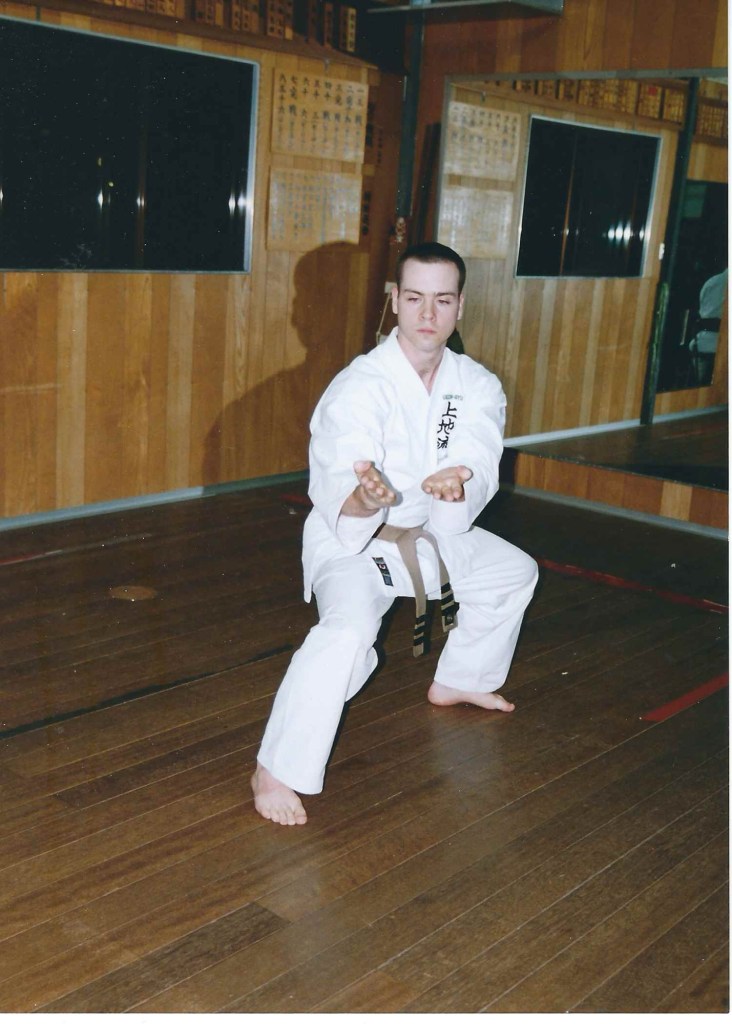
When I finally finished testing, I collapsed on the floor, exhausted and worn from four hours of intensive testing. And yes, you read that right. My green belt test was just shy of four hours long! When Sensei finally handed over my green belt and I wrapped it around my waist for the fire time, I felt a renewed sense of purpose to start learning my next forms, continue to develop my skills and maintain my health. I felt no inclination to go out and party, brag about my new rank or puff out my chest as a tough guy. But the lingering thought always sat in the back of my mind: what if I had failed the test? Turns out the answer was fairly straightforward; you don’t promote. You go back to the drawing board and continue training. While that can be a hard reality to deal with, it simply goes to prove that a student still has more work to accomplish. And at least in my dojo, the students were given the time and resources to develop and improve the areas that may have caused the failure. As long as they recognize that it’s only one piece in a much larger puzzle and that they’ll get their chance at that piece again, it should be a ‘no harm, no foul’ kind of scenario.
Turns out that in my dojo, while exceptionally rare, there were some who would fail their belt tests. I learned pretty quick that Sensei favored a more confidential environment where the test was not disclosed to the other students, nor was the result. Granted, passing meant you walked in with a different belt, so it was a difficult thing to hide. But in speaking with some who came back from a test with the same belt, they’d simply shrug and say they weren’t ready. So, what might be some of the reasons that someone WOULDN’T pass a belt grading? After all and in line with several popular opinions, if the sensei only schedules a test for a student ready to grade, why would they fail? Right? Maybe. But there can be a lot of underlying reasons. The first is what I discussed above. In many cases, the stress, anxiety and even fear of testing can throw a significant monkey wrench into one’s ability to be successful. We’re all prisoners of our own mind, after all. This can especially suck for someone who lacks the tools to overcome their own, internal anxieties.

And for some people, they simply lack the WILL. what I mean by this, is that some people are perfectly content to train and learn but have no interest in going through the rigorous demands of a belt test. Or worse, they walk into the grading thinking they’ve earned their place and rank and that the test of similes formality. Such students will rarely pass a belt test, if they just go through the motions without putting in the will and determination to push through. Senseis will usually see that and deem the student unready to step into the next belt level. Vanity and entitlement have no place in the dojo. And finally, some folks may simply shit the bed. After all, a test is a test is a test, right? And a person can be a ready as possible to test, have the skill and ability, practice efficiently and still walk out of that test having failed because they suddenly blanked on something, something they can’t remember, that may be integral to passing the test. Depending on the dojo you train in, of course.
At the end of the day, karatedo did not originally carry a belt system. Originally, it was a simple hierarchy; teach and student. It isn’t until later that belt grades were introduced as a way of determining someone’s seniority and skill level with a dojo. But it’s important to remember that it isn’t about the rank. It isn’t about the color of the belt around your waist. No matter what your reason for wanting to train, your time in the dojo has to be about dedication, commitment, discipline and hard work. Only then, can you truly learn the skills that are the martial arts in the manner it was intended. And only then, will you become a karateka who will carry and show actual skill, instead of puffing out your chest and acting like a tough guy because you have a black belt around your waist. That belt won’t stop a threat against you. Only diligent training and the antiseptic of actual skill will do that for you. Food for thought… ☯️


