
Parenthood is a challenging part of life. I’ve yet to meet a parent who can say with any firm honesty that raising children is smooth sailing with no inherent concerns. Even if you have a child who happens to be well-behaved and eats everything placed in front of them, there are still challenges that can lend some difficulties to the overall daily operation of one’s household. I happen to have two boys, 11 and 6 years old, respectively. And while I absolutely love them to the moon and back and would protect them with my very essence, they certainly do their fair share of seeing how easily they can crack my zen-like veneer. But setting that aside, and recognizing that there is no manual on how to properly raise one’s children, one of the unique obstacles I’ve faced for more than the past stable, is how to address and deal with Type-1 Diabetes with my sons.
All children, even the best-behaved ones, will eventually get into some shenanigans, take things they didn’t ask for, cause unintentional damage to things within the home (at least one HOPES it’s unintentional) and cause issues in areas that a first time parent may not think of. For myself, my issues came in when I started on my very first insulin pump. When this happened, my firstborn son was barely past a year old. While pump training and adapting to its use came easily enough for me, infants have a tendency of grabbing at everything that’s within reach. This is normal for them, and part of their sensory development and growth. However, it can be chaotic as it relates to grabbing pump tubing and playing tug of war with the infusion set injected into one’s stomach. It took me a significantly amount of time to strategically place myself so that my pump, the tubing and other components were safely out of my baby’s reach. Obviously, he can’t be faulted for his reflexive instincts, but it certainly makes things difficult.
I remember the one time, when Nathan was about two years old and we were rolling around on the floor and wrestling. He was giggling and we were having just a grand ol’ time. That is, until his little hands wrapped tightly around my pump tubing and I happened to be moving away from him right when he closed his fist. The infusion set tore free of my abdomen, leaving me to expel a sound from my mouth that I’m almost certain neighborhood dogs were able to hear. He immediately released his grip and started crying, Hanna been startled by my reaction. I writhed on the floor momentarily, uncertain which hurt more; the adhesive ripping away at my tummy hair or the infusion tube being ripped from my abdomen and the resulting blood that poured out for minutes afterwards. It was a definite lesson for me, in the management of my equipment around small children. IN the couple of years that followed, I educated my son on the purpose of the device on my abdomen, how it helped to keep me alive and healthy, and the importance of never touching it or fooling around with it.
I ended up going through all the same issues with my second son, who was born a few years later. I guess at least that my children’s are consistent. But one significant problem is keeping any fast-actions carbohydrates anywhere in the house. For the most part and for me specifically, the best thing is either jellybeans or Skittles. Sometimes some gummy candies will work as well, but jelly beans or Skittles seem to act almost immediately, where I can wolf down a dozen jellybeans and be back in the game within fifteen minutes. Same thing with Skittles. Pedant juice and some of the more traditional “give it to a Diabetic if they’re low” options have never worked for me quite as efficiently. And some of the carbohydrate capsules and gels you can buy at most pharmacies carry an increased cost that just isn’t worth it, when I can get a huge bag of jellybeans for about $10 and it lasts for weeks, instead of one or two episodes. But I digress…
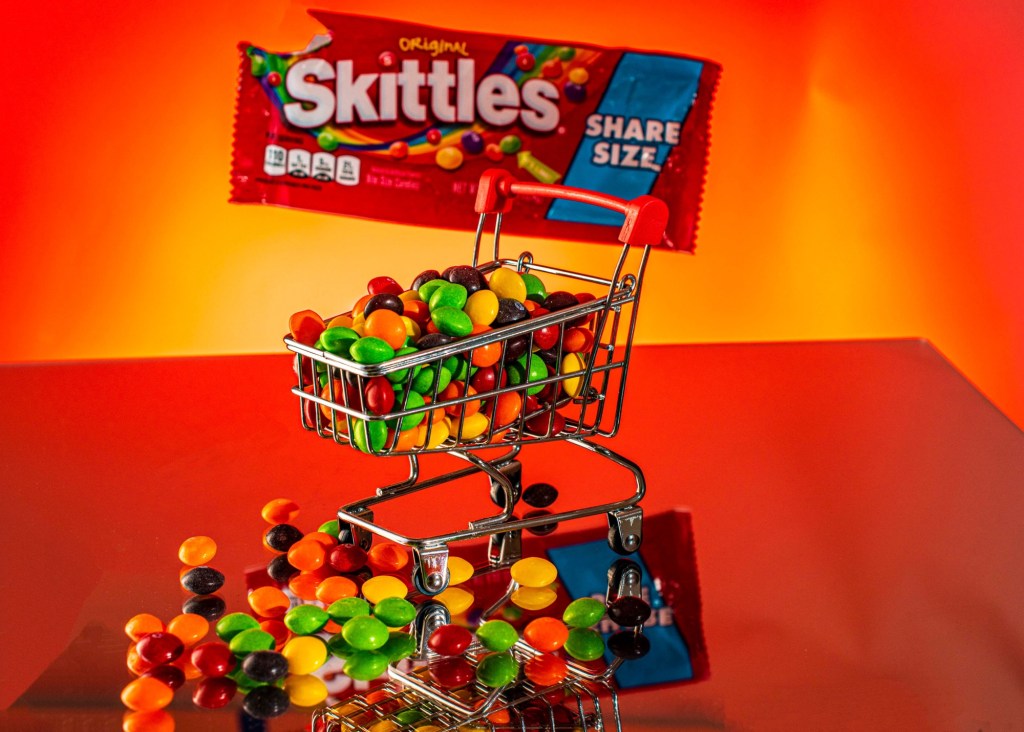
The issue is that if small children see their parents wolfing down candy, they begin to ask why they can’t wolf down candy, as well. This is also a normal reaction and instinct, since most small children will moving the behavior of the parent. And the consumption of candy is obviously no exception. It can be hard for a child, who may not have eaten their meal yet, to ask why daddy gets to eat jellybeans but he can’t. It’s a valid question but trying to explain that I’m eating candy so I won’t die only serves to have the kid also believe they need candy to stay alive. And this can lead to some unexpected consequences. The best example is something that happened about six years ago, which changed my approach to storing, keeping and ensuring my candy is available to me for when I really need it.
I’m a particular night, when my first son was about four or five years old, he was wandering the house, playing quietly and doing his own thing. His mother and I were watching television and had essentially tuned out, since he was entertaining himself, allegedly in his room. After a while, we realized we could no longer hear him playing. Ever see those jokes online about how silence is the worst thing to hear when you have small children? That’s no joke. We wandered the hallways of our home looking for him but couldn’t locate him anywhere. We were calling out and receiving no response, which is obviously triggering to any parent. The doors or the house were still locked, so he hadn’t gone outside. I finally found him hunkered underneath my bed on his stomach, just absolutely going to town, wolfing down as many jellybeans as he could fit in his mouth.

He had gotten through quite a bit of the tub, too, which as a side note was impressive. I experienced the same thing with the youngest when he was about the same age, which was only about a year or two ago. I usually replenish my fast-acting carbs a couple of times a month. I’m this occasion, it was close to Halloween and sometimes those Halloween-sized packets are just perfect. So, I bought myself a box of 100 treats. I left it down by the desk of my home office, having long ago abandoned keeping them by the bed. In most circumstances and if I wake up during the night with a low, I would prefer to go down to my home office to consumer, rather than unnecessarily waking my wife. But I came home from work the one day, coming in at action 3.4 mmol/L and looking forward to scarfing down some candy to raise it up. I discovered the box nearly empty, which compromised my ability to get my blood sugar up quickly.
Once I had treated the low, I started investigating and found dozens of wrappers hidden among our storage totes in the basement. I won’t get into the details but it was determined and clear that the youngest had helped himself and pilfered most of my supply. Once again, I had to have an in-depth conversation about not touching daddy’s candy as it was needed to help keep him alive. Only this time, it was with the youngest. Now, I’ve obtained a small tool box, of all things, that allows me to place a lock on it. As sad as it sounds, I had to start locking my candy over recent years to ensure it isn’t snuck away by little hands. I can’t imagine what would be the result, if my fast-acting carbs were suddenly just not available. I’d probably make it through by eating straight granulated sugar, but it wouldn’t be ideal.

Another distinct complication is Diabetic fatigue. Whether from fluctuating blood sugars, fighting a high and trying to bring it down or a host of other reasons directly tied to Type-1, the reality is that in most cases, one’s energy level simply isn’t there. And that sucks! There’s nothing worse than having a smiling little face ask you to play and you have to tell him that you can’t because you’re “too tired.” To little ears, understanding simply isn’t there and disappointment sets in quickly. In most cases, a kid eventually stops asking because they assume you’ll say no. Then actually trying to do something with them becomes all the more difficult because THEY will start saying no. It’s a painful cycle. Luckily, I have my meds, supplements and workout routine somewhat down pat, which allows me to enjoy a level of energy I haven’t had for the past few years. But my oldest is at the age where all he wants to do is hide out in his room. Luckily, the youngest is still engaged and shows promise as he wants to learn karate.
The last concern for a Diabetic daddy, is a possible genetic component. Because Type-1 Diabetes is effectively an immune disorder targeting your body insulin-carrying beta cells, there’s a genetic component involved. One of my biggest fears is that my sons, or their children after them, would have to live through all the difficulties and obstacles that I’ve experienced in my life. Considering I’ve been comas, had stomach ulcers and a variety of visual complications as a result or Type-1 Diabetes, I can’t think of a single parent who wouldn’t be concerned about this altering passed on to their children. Luckily, both my sons have been tested and have come out clear and clean. Granted, even if it hasn’t taken hold yet, the possibility of becoming Diabetic can still exist, up until the early teen years. My oldest is essentially in the clear, but I’m still watching my youngest pretty closely for some telltale signs that he may be developing recognizable symptoms.
So, that’s it, folks! The only thing more challenging than being a modern-day parent, is being a modern-day parent trying to navigate Type-1 Diabetes with young children. There are plenty of other challenges that come as a result of my condition. But these are just the most prominent that I can think of, based on the past decade. It hasn’t always been easy but I’ve muddled through. Regardless on how great a challenge parenting can be, I saw something online a while back that got me thinking. Basically, it read that when the writer was a kid, he’d look at his father and assume he knew everything and could do everything. Now that he’s reached his father’s age, he realizes that his dad knew nothing, and was making a lot of it up as he went along. That’s kind o delay I’m learning now. While my sons come to me with questions, problems and curiosities of life, thinking that I have all the answers, there is no manual. No playbook. All we can do is our best and help them become the best people they can be. And not become Diabetic. That’s a pretty important goal. Food for thought…☯️


