Oh, You’re THAT Buddhist!

Every once in a while, I get someone who asks me a very particular question. It’s one that always baffles me and makes me wonder where they figure it’s a good idea to ask, but one I usually try to answer anyway. That question is, what are the different types of Buddhism? It’s not that it’s an inherently bad question, per se. It’s simply a wonder as to how I’m supposed to know about them all. It would be like asking a Catholic how many Christian denominations there are in the world. Belonging to one wouldn’t necessarily give insight to the other.

That being said, I can provide a brief answer based on what I’ve researched (and of course, what I study myself). Let’s start with the basics, shall we? Buddhism originated in India, sometime between the 6th and 4th Century BC. Given its depth of spirituality, philosophies and beliefs, it can seem like a pretty complicated religion. But it’s actually a quite simple way of life. And although it can easily be viewed as a generalization by those who have studied in-depth, Buddhism can be classified as two main branches: Mahayana and Theravada, with some sources citing one or two other branches. But I’ll leave those alone.

Both branches follow the Four Noble Truths, The Noble Eightfold Path as well as The Three Jewels (Buddha, Dharma and Sangha). But from there, the branches move away from one another in that their perspectives and sources of information, as well as how they believe nirvana can be achieved, start to differ. Each of these two main branches have multiple sects, offshoots and schools of thought.

This separation is often thought to be a result of some of the Buddha’s original followers heading out and establishing their own group of followers, following the Buddha’s death. This would without a doubt lead to some minute, almost imperceptible changes in some of the teachings as they were passed down, leading to a separation in what would have originally been Buddha’s teaching.

I, myself, for example study Zen Buddhism, which is an offshoot of a Chinese Mahayana form of Buddhism. Zen focuses heavily on meditation, awareness, equanimity and empty-mindness, which functionally speaking, works extremely well in tandem with training in traditional martial arts. Zen Buddhists believe that mental purity and ignorance block the path to enlightenment, hence the emphasis on meditation.

Equanimity is an aspect of Zen that I focus on quite a bit and usually freaks some people out. In the event that you’re too lazy or not interested enough to Google it, equanimity is a practice of composure and controlling one’s emotions while preventing any outward displays of said emotions. You could almost say that Zen Buddhists are the vulcans of the Buddhist world. It’s given me the ability to keep myself in check and maintain composure in situations where most people would have lost their proverbial shit.

There are so many details and SOOOOOO much information on this subject, that in order for me to write a composite post that would explain everything would take a greater amount of time than I actually have available to me, especially with a five-year old who hangs off my every movement! There are a number of decent websites that can provide a synopsis of what every main branch and sub-type is based on. My best suggestion would be to find some that truly interest you and to research it further.

The only warning I would provide is that while learning about any given subject is a good thing, it’s easy to fall down a rabbit hole and fall prey to inaccurate information. If curiosity fuels your fire, I would even suggest seeking out your nearest Buddhist temple, monastery or school and see about speaking to someone in person. I can promise it would be an enlightening experience (see what I did there?) ☯

It’s Okay To Skip A Step…

I hate cardio. This probably comes as a surprise, coming from someone who believes that if you aren’t dripping in sweat when you’re done, it wasn’t a workout. And the truth of it is, I do enjoy cycling. But that’s mostly because it allows me to get outside, reconnect with nature (to a degree) and keeps the cardio aspect buried in the background. The best of both worlds. But to say that I’m heading out for a run or doing cardio for the sake of doing cardio would be a stretch.

Cardiovascular endurance training is important for one’s health. According to an article posted by the Mayo Clinic, cardio exercises help to strengthen your heart and muscles, burn calories, help control your appetite, increases sleep, promotes joint movement and helps to manage Diabetes. Cardio can be a long-term or long-distance thing, like long-distance cycling or swimming 30 laps in a pool, or something incorporated into a weight or resistance workout, such as jumping rope.

Jumping rope is an easy, convenient way of including some light cardio into your workout routine. I’ve kept a jump rope in my gym bag for the past ten years, and I make use of it whenever I get the chance. Jumping rope can burn a wicked amount of calories; several hundred calories in a 15-minute period, in fact. It can help improve overall balance and coordination, not to mention that the heart benefits are the same as with traditional cardio. And although it can be taxing on the knees and leg joints, doing it properly is considered a lower-impact than something like running.

I like to incorporate it by using it with circuit or interval training with karate techniques. For example, I’ll do a minute of front kicks, followed by a minute of high-speed jump rope. Then a minute of the next kick and a minute of high-speed jump rope. So on and so forth. Sometimes I’ll simply use it as a warm-up or a cool down. A good quality jump rope is portable, convenient and low-cost. You can stuff it into any gym back or backpack and all you need is about a 25-foot square of space.

As much as I dislike cardio, it is a necessary aspect to proper health and fitness. And there’s no denying that it also helps with the blood sugar control and sleep quality required for someone with Type-1 Diabetes. If the last time you used a jump rope was during a spirited game of double dutch during your school years, you’ll want to start slow and ensure you do it on a stable surface. Avoid grass or carpet as it can snag the rope or catch against your footwear. ☯

Chishi! Gesundheit!

The martial arts can incorporate some pretty eclectic training techniques that can often appear strange or unusual to those who don’t use them. Often, certain techniques or training tools may remind us of the Karate Kid’s Mr. Miyagi, teaching Daniel karate by having him perform yard chores. Although I wouldn’t recommend trying to do karate against an opponent simply because you’ve been waxing your car or painting your fence all summer, there are some atypical things that traditional, Okinawan karate styles employ. Enter: the Chishi.

And no, despite my comedic title, it’s not the sound of someone sneezing. The Chishi is an Okinawan training tool used in Hojo Undo, which basically means “supplementary exercises.” It covers strength, stamina, muscle tone and posture by using a specific set of prescribed exercises and some rather arcane looking training tools. In fact, the makiwara, which I’ve written about in a few previous posts, is used in Hojo Undo for conditioning of the wrists and knuckles.

Example of a pair of Chishi

The basic construction of the Chichi consists of a lump of concrete attached to a wooden pole. That’s it. Pretty straightforward, right? There’s little more to it, especially if you’re making your own at home. You’ll need to get a few screws or solid nails through the end of the pole that sits in the concrete, to make for a stable setting. These weight clubs are used in Okinawan karate as a means of strengthening the fingers, wrists, hands and arms, as well as the shoulders. If you’d be looking to make your own at home, there are several really good DIY videos on YouTube that show you how.

If you’re like me and you’re a little on the cheap side, you may not want to buy a bag of cement simply to make a couple of these. After all, you can easily train in karate without them, since most modern dojos don’t use them. But if you’re looking to change up your training routine and get back to karate’s roots, a chishi can definitely be the way to go. You can easily recycle old materials (wooden pole, screw or nails) and go easy on the concrete.

The best I’ve found is a 10-pound bucket of “Quikrete” for about 20 dollars, which is a small bucket of quick-drying cement. And since you probably shouldn’t start with anything more than 5 pounds per chishi (since it’s a weighted lever effect, it will feel like more than 5 pounds when using it), this small pail can provide you with exactly what you need to start out. Or you can be a stubborn practitioner and do what I do… Use a fuckin’ sledgehammer!

The ending portion of a chishi exercise

In the photo above, you see me using an 8-pound sledgehammer as a makeshift chishi. The handle of a traditional chishi would usually be shorter than the handle of a sledgehammer, so some adjustment usually needs to be made. But here, you can see me doing an exercise where I’m in a seated horse-stance position, and I’m thrusting the hammer out and bringing it back in towards my chest in repeated succession. The balance of the weight at the very top, combined with the movement of the arms, feels a bit strange at first.

In this next photo, I’m doing an exercise meant to strengthen the forearms and wrists. You can tell I’m getting fatigued at this point, since my horse-stance is starting to rise and the positioning of my right forearm and wrist isn’t where it’s supposed to be. But I can tell you that after repeated reps on each side, 8 pounds starts to feel like 80!

In this last photo, I demonstrate how a sledgehammer can also be used for some more traditional weight lifting exercises, with an added twist. The photo above is the starting position to a dozen squat thrusts, using the sledgehammer as a bar. I drop into a deep squat, followed by pushing the bar out in front of me as though I were doing a chest press, bring the hammer back to my chest and rise to my feet. Not only do I get the benefit of squats, performing a thrust with all the weight on one side and nothing on the other adds a certain amount of muscle confusion, which is great for working the core and some of the stabilizing muscles we often neglect.

This isn’t something that’s all too easy to purchase. For the most part, most practitioners make their own or use a substitute, like I do. Plus I get to feel a little like Chris Hemsworth, holding that hammer. But the best I’ve managed to find online are some shitty-looking units on Amazon or from the UK that range anywhere between $20 to 30$ (before shipping and all that good stuff). I’m certain there’s more out there, I just haven’t dug too deeply. Since that small, 10-pound pail of Quikrete I mentioned earlier costs about $20, you may consider it easier to simply order one online. To each their own.

There are all sorts of stabilizing and weightlifting exercises that you can do with a chishi. It allows you to incorporate whatever’s needed during your workout with a traditional feel, while remaining true to the roots of your art, presuming your art is Okinawan karate! But even if it isn’t, any practitioner can benefit from the exercise one can do with a chishi. Since you’re dealing with a heavy, concrete weight levered at the end of a stick, you just want to be mindful that you don’t bash your head in or drop it on any of your limbs. And as usual, consult your medical practitioner or at least an experienced Sensei before starting any new training regimen. ☯

Clothes Don’t Make The Karateka

I’m wearing a worn, black pair of gi pants and a Star Wars t-shirt. Far from formal dojo apparel. The sweat has rendered the grey t-shirt black and droplets coming off my forehead splash on the unfinished concrete floor. I just finished a set of shadow boxing and I’ve been using an 8-pound sledgehammer as a workout implement for the past fifteen minutes as my son watches in fascination from the corner. My muscles and joints are all screaming for me to stop, and my knuckles are throbbing from the use of my newly-installed makiwara post outside, but I’m only half way through my workout as the next hour will bring a minimum of three of each of my katas…

Clean, emptied out garage makes for a decent training area

For the past couple of weeks, I’ve been using my garage as a makeshift dojo. The floor is bare, unfinished concrete and is pock-marked everywhere that something heavy or frequent traffic has damaged it. I fastened a padded punching square to the south wall and have a jumprope, an 8-pound sledgehammer and a small table to hold my water, phone and small training implements as may be required for any given session. I have a small incense burner to provide an ambiance to the environment, but with little to no ventilation inside the garage short of opening the large overhead door, I keep incense burning at a minimum.

When people hear about the martial arts, they have some pretty stereotypical images of a dojo in their heads. For the most part, people imagine a polished, hardwood floor, tatami mats in the corner, punching bags and kanji banners across every wall. Or at least, over whatever walls don’t contain photographs of the style’s masters or some the weaponry associated with the style. It’s clean and pretty and usually oozes a “karate movie” feel. But in fact, most traditional dojos (unless they’re the head of the school) never look like that.

The small table in my “dojo” holding everything I need and nothing that I don’t

When I travelled to Japan and Okinawa in 2001, one of the things that surprised me was the venue in which we spent most of our time training. Unlike the expected image of a karate school, or dojo as it is properly referred to as, we trained in a variety of different locations, including but not limited to the beach, on rocks, in school gyms, in garages and in back yards. One school we trained at the most was owned by my Sensei’s instructor and was located above his house. It contained some of the fancy elements, such as a hardwood floor and his training certifications, but little else.

There was nothing fancy. The entire ambiance was created by the efforts and energy put forward by the student body. And what energy there was! We didn’t have a single morning or evening where we weren’t drenched in sweat and felling pain along some or most of our body parts. But we learned a lot. I recently sent photos of my garage to one of my friends back home in New Brunswick and identified it as my “dojo.” His response was to laugh at the appearance. The sad part is, he’s trained in my style of karate, as well.

After only two weeks of use, my makiwara (just outside the garage door) has already shifted and has had to be adjusted. Not sure if that’s a good thing or a bad thing…

The point is, you don’t need a fancy or expensive location. You don’t need tons of equipment or have your training area look like something out of a bad 50’s samurai movie. In fact, if you study traditional karate, you can perform the majority of your (solitary) exercises within a 1-square metre space. That’s it! You can perform your katas, bunkai and kumites as well as a huge score of exercises too numerous to list out, including every push-up variation, squats, lunges and shadow boxing.

You reach certain limitations once you incorporate a partner or students, but let’s be honest: at that point, you may be using a local school gymnasium or go outdoors to a soccer field or something of the like. Some of the most traditional karate schools in Okinawa are tucked away behind a single, unmarked door in a back alley. Karate is a free-floating art, which can literally be practiced anywhere. ☯

Growing Sometimes Means Getting Smaller

I have clear memories of all the stuff I had to go through when I was first diagnosed with Type-1 Diabetes. Since my older brother had a wide variety of illnesses, junk food and sugary snacks were never really a staple in my household anyway, but I remember that certain things took a dramatic change nonetheless. I was no longer allowed to drink juice whenever I wanted. I was subjected to frequent daily shots for insulin and finger pokes for blood glucose testing. It was a traumatic time for a 4-year old who hadn’t even had the opportunity to grab life by the horns.

The irony is that all the traumatic stuff is the only reason I’m still alive, even if some of it was misguided, wrong and in some ways caused more harm than good. Back in good ol’ 1982, carbohydrate counting wasn’t a thing at my hospital. Maybe if I had lived in a larger centre, there would have been better Diabetes education available. But in my hometown, there was a singular mantra when it came to the control of Diabetes: Don’t eat sugar! That was it. In tandem with a morning injection of short-term insulin and an evening injection of basal insulin, my blood was tested once a day before bed and I was good to go.

Yes, you read that right! My blood was only tested once a day. Quite a far cry from the dozen times I finger poke myself these days, or the Sensor Glucose readings I get from my pump every five minutes. Not to mention that my first glucometer was roughly the size and shape of a brick. (There’s an illustration of that glucometer in my previous post: When Diabetics Get High… (but not the way you think) But Diabetes therapy has come a long way from it’s beginning, when a person diagnosed with Type-1 Diabetes usually considered it a death sentence.

A photo of the first insulin pump

Pump therapy, along with carb-counting and exercise, have made the life of a Type-1 Diabetic easier by scores from what it previously was! As illustrated above, the first insulin pump was basically the size of a large backpack and included metal parts and was cumbersome and impractical. It looks like something Tony Stark developed in a cave. Would I use something like this today? Obviously not, but back in 1963 when Dr. Arnold Kadish designed it, it would prove to be the launching pad for an insulin therapy device that would be widely accepted.

Smaller insulin pump. Source: Wikipedia

Smaller versions were developed by others roughly a decade later and they started being developed with wearability and accessibility in mind. But it wouldn’t be until the early 2000’s that insulin pump therapy would catch on as a common thing. One of the main obstacles is the overall cost. Although I don’t remember the exact retail price of my most recent insulin pump, I do know that it ran to the tune of about $8,500. If I didn’t have benefits through my work, I wouldn’t be on pump therapy.

That’s without taking into consideration that a box of infusion sets runs at about $200/month, reservoirs are about $50/month and the CGM sensors are about $400/month, making for a lovely total of almost $1,000/month when you factor in the insulin and test strips and anything else I may not have mentioned. Is it any wonder why people without solid medical insurance can’t take proper care of themselves? But I digress…

My point is that Diabetes therapy follows the very same trends as modern electronics and technology. When computers started becoming a thing, the average computer took up an entire room that had to be temperature controlled. Imagine trying to play Candy Crush on one of those bastards? The concept of a “personal computer” didn’t take hold until the 1970’s and even then they were boxy, clunky, difficult to move around and were pretty limited in what they could do. Today, the average smart phone has more computing power than what astronauts originally used to land on the moon.

The same can be said for insulin pumps. What started out as a huge, boxy, metallic backpack has now become a small, inconspicuous 3-ounce plastic box. Smaller than most cell phones. And technology is just getting better and better. There are different aspects being developed, including an artificial pancreas going through clinical trials, which could be promising for the future of improved Diabetes control. Who knows, maybe we’ll reach a technology that will allow for the wearing of a simple “insulin patch,” like a nicotine patch, and forego injections and needles altogether! We’ll get there, eventually. But getting there is the obvious problem and as the old saying goes, the waiting is the hardest part. ☯

The Customer Is Always Right…

I feel like today is as good a day as any to stagger up onto my soapbox and talk about some of the trends I’ve noticed when out in public. The way we do business and how consumers behave have long been influenced by everyone’s needs and expectations. These days, the internet has become the top choice for the newer generation, where online shopping, communication and even ordering food has become the new “normal.” This has become even truer in the past six to eight months since the onset of COVID-19.

But there’s been a strange shift in the balance between competent employees and consumers who understand that they’re at any given location to exchange money in return for a product or service and not to be catered to like royalty. Although most “normal” people simply go in, get what they need, pay and get out, there’s a percentage of the population that just isn’t happy until they’ve complained about something, gotten someone fired or received free products or services (Looking at you, Karen!). This is where one of the biggest running jokes of the retail world comes in: The customer is always right…

The expression “The Customer Is Always Right,” comes from all the way back in the early 1900’s and is thought to have first been used by a British department store owner named Harry Gordon Selfridge. You can Google/Wikipedia this guy for his background, as he isn’t necessarily the focus of today’s post, despite the title. But the expression was originally intended to convince staff to provide top-notch service to their customers AND provide patrons with the belief that they’d receive nothing but that good service.

Oh, how times have changed! Over the past century, this expression has become less about the business and more of a weapon that consumers use to get more than what they pay for. I’m not saying that the customer is always wrong, per se. I’m simply saying that it’s irresponsible and naive to think that the customer is always right, because they very rarely are.

There are, of course, exceptions to the rule (I SAID NO PICKLES ON MY BURGER KYLE!!! SERIOUSLY, HOW HARD IS IT NOT TO PUT PICKLES ON MY BURGER…) Some facets of industry tend to employ people who fall under the influence of becoming automatons, who are not stimulated or challenged by their work and who feel that being paid for their efforts is not enough. A lot of the time, this leads to sloppy work, laziness and will actually cause the problems that lead to the misnomer that the customer is always right.

It wouldn’t be one of my rants if I didn’t tell a story, so here we go! About a decade and a half ago, I was a front store manager for a well-known pharmacy chain in Canada. Part of my duties included the ordering of stock for our shelves with the products that were required and to reduce shrinkage. Like most businesses, we had a return policy that was limited in the sense that unless it was our own store brand, we only accepted returns if it could be proven that the item was purchased at our location (receipt) and that the fault lied with us (expired items, etc).

I feel that I need to explain that retail locations in Canada are under absolutely NO obligation to issue refunds or accept returns. Once money has been exchanged in return for a product or service, you’re basically on your own. Whether or not you can return an item totally falls on the specific location’s policies and you’re basically at THEIR mercy, not the other way around. Any business can refuse service, even if that service involves a refund or a return and even if most businesses do genuinely try to keep the customer happy by complying. But back to my story…

In walks a Karen… And this was back in the day before the term “Karen” was coined for the running joke the internet has made of it. Just to keep from constantly picking on people named Karen, I’ll simply refer to this person as “the customer.” Anyway, Karen… I mean the customer came into my retail location with the intention of making a return. A usual and typical part of every cashier’s daily duties, this normally wouldn’t have been a big issue.

The customer waited her turn in line and when she finally reached the cashier, explained that she had purchase a package of name-brand batteries and wanted to return them. Although I wasn’t there for this part, I was told that even the customer’s explanation was abrasive. The cashier did her job well and inquired as to what the problem was. Were we past the expiration date on the package? No. Was the package open before you got it home? No (which wouldn’t have made sense anyway, since we weren’t in the habit of selling open products).

The cashier asked the customer what the company had said when she called their customer service line marked on the packaging, and that’s where shit slipped off the rails! The customer explained that it isn’t her job to make calls and try and get her product replaced and she wanted her money refunded. My cashier explained that our store’s return policy didn’t allow her to accept a return for an item that was sold in good faith in a sealed package and that the responsibility for replacement now fell to the battery’s company and/or manufacturer. This led to one of the most self-entitled demands in retail history: “I want to speak to your manager!”

Now, I wouldn’t necessarily describe myself as a stoic. But I do have a significantly higher ability than most to maintain a control over my reactions; a result of a lifetime of training and control. But despite this fact, I don’t suffer fools easily and I tend not to take crap from self-entitled people, whether it comes on the job or not. So when I got to the front and was instantly confronted with an angry customer who is ranting about how my cashier provides terrible customer service and should be fired, I was already working towards trying to find my inner Zen.

Once the customer explained what had happened, I calmly explained our store’s return policy (which my cashier had already done) and how we wouldn’t be able to refund her money. The only thing such a customer hates more than not getting what they want, is having the manager they requested tell them the EXACT same thing that the employee did. It’s like their kryptonite. She got flustered and red-faced and started screaming at me in front of the line of customers, all of whom she was holding up because of her bullshit.

At this point, I felt that it was no longer a worthy battle and simply a matter of removing her from the store. Since one needs to know and accept WHEN to pick their battles, I didn’t feel that a pack of batteries priced at a few dollars was worth upsetting and disrupting the flow of waiting customers who WERE actually just there to conduct normal purchases. I go the customer hustled out the door, eventually on the threat of contacting police. I joined her outside, where I had a frank conversation with her.

Folks, I’m not a total asshole! (Most of the time) If this customer had calmly asked for the manager and had maturely explained her situation as opposed to kicking and screaming like a petulant child with a loaded diaper, I likely would have done something for her. Anything. Replaced the package. Provided store credit on a gift card. Something. There was a god chance that even though I wasn’t supposed to, my vendor would have reimbursed me for the faulty batteries and I could have helped this lady out.

But once she turned into Bitch-zilla, all bets were off. And the reality is that this type of behaviour from consumers is becoming more and more prominent. It’s almost as though consumers fail to understand that they’re there for the exchange of money for a product and nothing else. Do we want your business? Oh yes. Do we want your repeat business in order to maintain our profits? Most definitely. Let’s not kid ourselves, businesses are there to make money. But that doesn’t mean that businesses should allow their staff to be abused by the likes of people like that.

“The customer is always right” has become harmful to modern-day businesses, because employees, and most managers if they’re worth their salt are having none of it. You can go on Google and YouTube and find all sorts of videos of employees reaching their breaking point and basically sending rude and entitled customers straight to hell on the next thing burning. But there are a lot of reasons WHY this slogan is not only false, but has become harmful to businesses everywhere.

I found a pretty good article on Huffpost.com entitled, “Top 5 Reasons Why ‘The Customer Is Always Right’ Is Wrong.” It’s a pretty good article, and covers certain aspects including but not limited to the fact that working on the basis of the customer always being right makes the employees feel less valued and unhappy, which results in worse customer service. It also provides an unfair advantage to rude customers who just wanna watch the world burn.

It’s important to be decent and reasonable when dealing with the businesses you frequent. No one owes you anything, and even though most businesses will do what they can to keep your business, I think we’re all mature enough to understand that most overall companies (especially franchise chains) won’t miss the small amount of money your shopping provides. Especially if it means the comfort and protection of their staff. For toxic customers who are genuinely bad for a business, there’s the door. Be sure to let it smack your ass on the way out, the way your momma should have!

In closing, one last little detail about my story that just adds the icing on the cake… The package of batteries the customer purchased were on special and she demanded having them refunded at the original, full retail price. So not only did she expect a refund, she expected more money back than she had paid! Snowflakes… I think we owe it to ourselves to be better to each other than that. We all have times when we get frustrated because of something retail-related. Maybe you bought the wrong size. Maybe it wasn’t the product you expected. Shit happens. You simply need to understand that it’s not the employees fault, and businesses won’t roll out a red carpet and massage your feet as a result. There’s enough suffering in the world without intentionally adding to it. Shop safely, my friends! ☯

It’s All About The Mood

Never, in the history of mankind has anyone ever calmed down after being told to calm down. Has this ever happened to you? There’s nothing I dislike more than being genuinely upset about something and having someone try and tell me to calm down. The same concept applies to bad moods. I’ve never understood why people feel compelled to assume that one’s bad mood is attached to an underlying condition. For example, have you ever tried assuming that a lady’s bad mood is because of a particular “time of the month?” How did THAT exchange go for you? You probably can’t answer on account of your wife/girlfriend/sister breaking your jaw for making the assumption…

This same concept can be applied to Diabetes. I know I harp on the pitfalls of Diabetes in a lot of my posts, but that’s because the list of symptoms and complications is almost endless. And mood swings are one of the worst. Although every person is different, there’s no denying that uncontrolled blood sugars will cause a change in one’s mood and emotional well-being. For myself, high blood sugars will turn me into the loveable care bear you all recognize into an angry grizzly hell-bent on destroying anything in his path. I’m usually the same before my morning coffee. But I digress…

There have been so many times in my youth when this phenomenon affected my position in life or my relationship with others. Since my blood sugar control was limited to testing about once or twice a day and treating when I “felt” a low, there were times when I was a mean grump and treated those in my immediate surroundings harshly. Most times I wouldn’t even be aware that I was being a total ass but that wouldn’t stop the damage from being done.

Eventually, some relationships ended and some were forever altered into something less special. I mean, who wants to be around a cranky bastard all the time, right? But I’ve had times when my increasing bad mood has caused friends to avoid me and relationships to be damaged or lost. And this is not even including the fact that badly controlled blood sugars will usually make you sluggish and lethargic, making people believe you’re lazy or unmotivated. There have been days when I would just sit there with no energy, while friends and associates would try and convince me to go do something, anything other than sitting like a lump.

Knowing what I know now (say THAT three times fast), I understand that the frequent testing of one’s blood sugars and proper control of one’s Diabetes could have prevented those symptoms and I likely would have had a much happier adolescence. Hindsight is a hell of a bitch. At least I understand and have a much better control now. Life in general is the only thing that makes me cranky now, hahaha… haha… ha (cries a little while laughing). ☯

Just For Laughs…

Sometimes, you need to just sit back, take a breath and have a laugh. I found this little gem while cruising the World Wide Web for something else and I couldn’t help but chuckle. I can totally admit that I don’t know the story behind what’s happening in this photograph, but besides making me giggle like a schoolgirl, I think it also illustrates a few important life lessons.

The first is that life is, in fact, a matter of balance. As my friend Daryl once told me, life is like a battery; some positive, some negative, all POWER. But the balance among all things is what’s important. The second lesson is that no matter how disciplined you are or how hard you’ve conditioned yourself, the world can sometimes be overwhelming and cause an overt reaction from even the most serene of people.

That being said, I should once again point out that I don’t know what the story is behind this photo. There was a story a few years ago about a group claiming to be Buddhist monks collecting donation money for a temple in Thailand. I think this was in New York, and the “monks” would approach arriving tourists and try to hit them up for donations. They would apparently become aggressive and even violent if people refused. That probably should have been a sign that they weren’t genuine. But the photo certainly gave me a laugh. ☯

Toilet Troubles

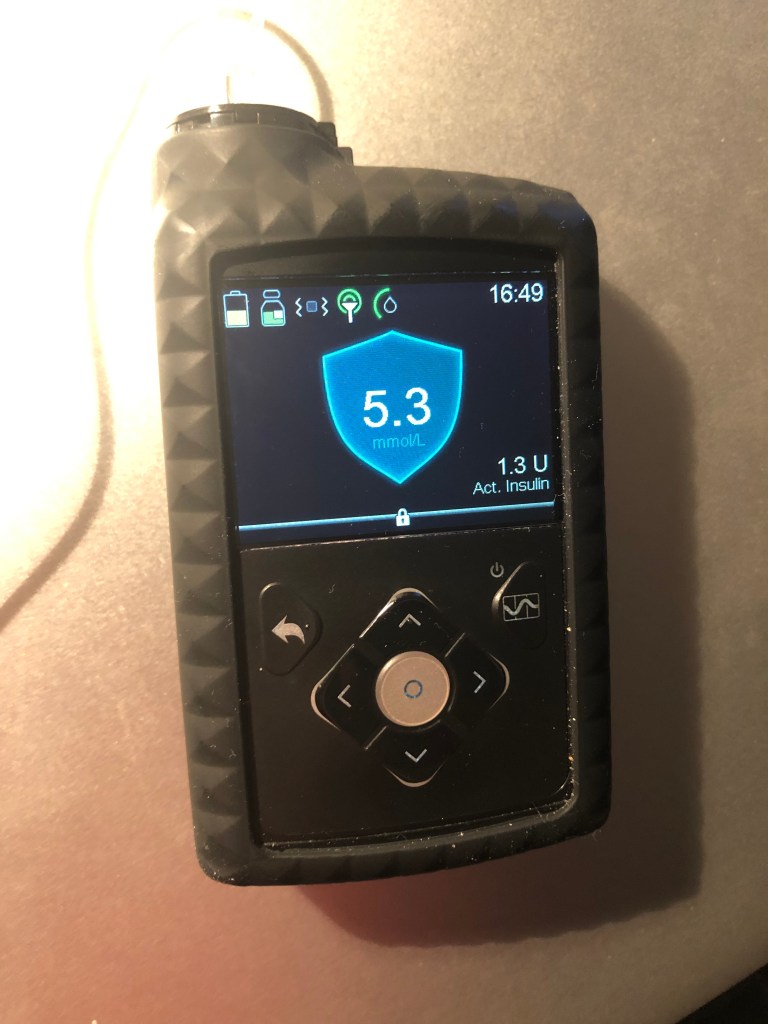
No, before you panic and scroll beyond my post, this isn’t about difficulties in the washroom! At least, not in the traditional sense… As most of you know, I make use of an insulin pump for my insulin delivery. I’ve been on pump therapy for over five years now, and recently upgraded to the Medtronic 670G. I’ve also started using Continuous Glucose Monitoring, which has presented its fair share of challenges, despite being a comfort now.

But my “toilet troubles” came in the shape of an issue I faced about two weeks ago during a change of infusion set. I had been doing work in my back yard and worked up quite a sweat. As a result, I decided I should grab a shower. But once I was in the shower, I remembered that I only had about 8 or 10 units left in my current reservoir and I would need to change my set up once I got out of the shower.

As any Type-1 Diabetic using a pump would agree, “naked” showers are a rare treat. For those who may not understand, a “naked” shower refers to one you get to have where you don’t have an infusion set attached to your gut and can enjoy the shower without the dangers of pulling the set out from washing. Having a shower line up with the actual change of one’s infusion set is rare, so I chose to rip the infusion set out while I was in the shower in order to reap the benefits.

The infusion set includes a round piece of sticky adhesive material, fastened to a hard piece of plastic that hold the actual cannula that delivers the insulin. I decided to pull an NBA imitation and toss the infusion set over the top of the shower door and hopefully get it into the trash bin. Instead, I successfully managed to come up a bit short and it landed right into the open toilet bowl!

Once I was out of the shower, I stood there and tried to decide how I would get this discarded piece of medical equipment out of my toilet bowl. I judged that I didn’t want to take the chance flushing it, as I didn’t want to risk clogging the line. I’m also not one for submerging my hand into an open toilet bowl, despite how often I clean it. As a result, I needed something that could successfully grab the infusion set without contaminating say, a kitchen utensil or an implement that I would never feel quite right using again, regardless of how well I cleaned it.

My solution is that I ended up using two Q-tips to try and pick it out. I struggled for several minutes looking like some dark comedy of someone with paper chopsticks, eating leftover Chinese food out of the grossest carton possible. Plastic and wet adhesive are reasonably slippery when wet. Add in trying to grab onto them with wet cotton swabs and you’d have yourself $10,000 if this were the 1990’s and someone caught it on film and gave it to Bob Saget!

I did finally manage to fish the infusion set out and toss it in the trash, after several attempts. I’ve often given my son Nathan a hard time about closing the toilet lid, since there’s a small shelving unit with toothbrushes and my electric shaver hovering right above the toilet. Leaving the toilet lid up is often a recipe for disaster since Nathan is quite clumsy and has come close to dropping his brush in the toilet on more than one occasion.

I should have followed my own directions, as this could have been avoided if I had closed the toilet lid before showering. Of course, I could have simply kept the infusion set on a shower shelf until I got out too, I suppose. But it made for a funny incident and goes to prove that Diabetic problems are not simply limited to medical ones. ☯

The Answer is Only Important If You Ask The Right Question

Something that occasionally crosses my mind is how there will be a significant employment exodus in the fact that a number of industries have unfortunately discovered that some of the employees they’ve sent home are no longer essential. Months and months of having certain positions sent home without the benefit of a “work at home” plan have rendered some jobs obsolete. The flip side to this, is that all the people who are no longer able to work in their chosen industry will turn to many of the employment positions that were intentionally abandoned by folks who didn’t want to go out into the world during the pandemic.

Regardless what your position or chosen career may be, we’ve all found ourselves in a very specific position at one time or another. The position I’m referring to, is subjecting ourselves to a job interview. No matter how confident in your material you may be, no matter if you’ve worked in the industry you’re interviewing with before, the stress and anxiety that comes with sitting through a job interview can do a number on you.

Throughout my life, I’ve found myself on both sides of the table. I’ve been the interviewer and the interviewee. And especially in the past year, I must have sat through about a dozen interviews while I’ve been busy trying to “find” myself and I’ve learned a thing or two. So despite the fact it has nothing to do with Buddhism, martial arts or Diabetes, I thought I would share some of the gems I’ve discovered about interviewing.

These are a combination of things that have worked for me, as well as things that I’ve noted when interviewing others. So some of it might seem pretty obvious, but not necessarily to everyone. Here we go…

  1. Show up early: You would think this one is obvious, but you’d be surprised at how many people are fine with walking in at the last minute. I’m not saying you need to show up an hour before your scheduled appointment and sit in the waiting area like some sort of psycho. But arriving fifteen minutes ahead of your appointment makes a good impression and can even be important in helping you deal with unexpected obstacles, like construction zones, finding an unknown address and being available in the event the appointment prior to yours ends early;
  2. Dress professionally, not for the job you want: I don’t care if you’re applying to work for waste management or if you’re applying to be CEO of a fortune-500 company… Dress properly. Dress pants, shirt and tie at a minimum. People always say “dress for the job you want,” but that’s total bullshit! Dress to the nines, no matter what the position you’re applying for. It shows your commitment to getting the job and your level of professionalism;
  3. Make eye contact and smile: You want to give your interviewer your utmost attention. There’s nothing worse than an interviewee who drifts off and has you repeat a question. Pay attention and listen. Actively listen;
  4. Don’t be afraid to admit you don’t know: If you’re asked a question and you don’t know the answer, then you should admit that you don’t know. Potential employers don’t like it when you make up some random shit. And you’re almost guaranteed to get called out on it. Employers much prefer someone that can admit they don’t know and are willing to look it up or learn, than someone who will phone it in by trying to lie or make stuff up;
  5. Use the power of “WE”: You want to be a part of that specific company? You want that job? Then include yourself! When asking questions or answering theirs, use “we” to start creating the idea that you consider yourself a part of that organization. What benefits do “we” have included? What schedule do “we” use? It creates the impression that you’re part of the company. You’ll be surprised at the effect it has;
  6. Study up: You can’t know everything, but if you apply for a specific job you should have some rudimentary knowledge about the industry you’re interviewing with. Applying to be an insurance broker? Maybe you want to study up on your Province’s insurance laws and regulations. Applying to be a government employee? Try learning some of the legislation that regulates the specific branch of government you’re interviewing with. This ensures that you can show some minimal knowledge in the job you’re trying to get;
  7. End the interview with a “thank you” and a handshake: No matter how you think the interview went, good or bad, be certain to thank your interviewer(s) for their time and provide a firm farewell handshake. This not only shows your commitment to professionalism, it shows your gratitude for the time that was taken to interview you.

It feels a little strange writing about something that isn’t my usual forte, in terms of this blog. But given the state of the world and how the employment industry is going, knowledge can be an incredible advantage. being qualified for a position is only half the battle. Being able to PROVE you’re a fit for the job and being confident is the other half. ☯