Time To KID Around, Part 3 (The Religion Aspect)

I’m going to start out this post by saying that it isn’t intended to judge or denounce anyone’s personal choices in relation to their children, nor am I trying to say that any one school of faith is better than another. Hey, I’m a man of pretty deep faith myself. But in today’s charged climate of becoming offended at absolutely anything and everything, I feel it’s important to point out that the content of this post is my opinion only. Although I’m always open to other people’s comments and/or questions, please keep them respectful, should you happen NOT to agree with my perspective here. As the last and most controversial post in my KID trilogy, religion continues to play a pretty dominant role in some households.

While faith can be a good thing, forcing one’s kids into it can have negative and even detrimental effects. When I was a child, I had Catholicism forced down my throat. My mother had gone to the seminary during an earlier chapter of her life. I had aunts who were missionary nuns and my Grandmother was about as close to the term “Bible thumper” as you can get without becoming offensive. One of the bigger problems is the fact that an hour-long sermon can be pretty damned boring to a small child, especially when they don’t understand what’s going on. It’s even worse when it’s forced upon you.

My Father worked shift work and I’ve never seen him set foot in a church for anything but a wedding or a funeral. But even on days when my brother was sick and my mother had to stay at home, I was still expected (forced, actually) to jump on my bike and go sit through church on my own. My mother would even go as far as asking me what the topic of the day’s sermon was, ensuring that I paid attention and stayed awake. Kids don’t like having things imposed on them at the best of times. Is it any wonder that I stepped away from organized religion as soon as my mother allowed me the choice?

The irony is, I have a deep love for the Holy Bible. I own two copies. Have you ever read that thing? There’s a reason why it’s one of the all-time most popular books in the world. If I had been permitted to explore the aspects of Catholicism on my own, there’s no telling what level of interest I would have developed during my formative years. Instead, I turned away and renounced any association with organized religion, much to my family’s dismay.

I found Buddhism almost by accident as a byproduct of my martial art’s training. What drew me to it was the peace of mind, body and soul. Also, the acceptance of everyone else’s faith-based perspective is a winning aspect as well. My wife’s family is of a different faith, but it’s not something that ever caused a problem between the two of us. And the important thing is that neither faith will be imposed on our children. Not everyone will necessarily agree with that perspective, and that’s okay. But I believe it’s important for someone to FIND their faith and understand what it is they’re getting into. I’ve seen too many young ones who are introduced into a school of faith without properly learning the basics concepts of birth, life and death.

Nathan, pretending to meditate

I feel that religion falls under the same category as martial arts; you shouldn’t force your children into it. Rather, be the example, guide them in the right direction and teach them right from wrong. No matter what your religion, if you let them choose and show them the way you’ll be surprised at how easily their curiosity will lead them to come to you. We’ve grown and evolved to the extent that although faith is still an important aspect of modern society, the right to choose is just as important. As I bring this trilogy post to a close, I feel it’s important for me to repeat what I mentioned in the opening paragraph. This post isn’t intended as a judgement against people’s choices or how they deal with the topic of religion with their children or within their household.

Rather, it’s simply meant get one’s wheels turning in relation to all three of the main topics that my blog is based on: martial arts, Diabetes and Buddhism. My son has seen me meditating on numerous occasions and has occasionally asked what I’m doing and why. Sometimes he imitates me, sometimes he just sits there and watches. Perhaps eventually he’ll get curious enough to ask deeper questions. Until then, as with all things related to our children, patience is key. ☯

Never Back Down, Except When You Do…

Most people like to act tough, especially those who are trained to fight. There’s a “never back down” mentality that kicks in when someone aggressive is challenged, but real fights never quite turn out the way we see it in the movies. For example, one of my favourite movies that just came out recently (recently, being a loosely-used term) is Creed II. The movie has the kind of inspirational tone one would expect from a Rocky spinoff; the protagonist is defeated by a larger, stronger opponent and is laid up in a hospital with severe injuries. Once he recovers, he goes on this wicked training montage to train and build himself back up before defeating the antagonist in an awesome rematch.

It’s very 80’s, which means I absolutely love it. Despite the unrealistic nature of it. Most people who suffer such injuries will usually call it quits and step away from fighting such opponents. Even in the most traditional of styles, we see a sort of expectation that you’ll hammer forward, even when the odds are against you. I’ve never been one who much felt this way, which makes sense when you recognize that I live my life trying to eliminate suffering and propagate peace. But even Sensei used to say, “If you’re going to fight, make sure you win…” I believe he was mostly referring to competing, which our school never did (officially). But it certainly applies to how we train.

I’ve always been a firm believer in drills. Correction and repetition are important in order to establish muscle memory and make it more likely that your body will react properly in a “real fight” scenario. But you’ll notice that the majority of dojos practice these drills by stepping forward, stepping into the opponent or meeting an attack head on. And there’s nothing wrong with that, but it’s also important to perform drills where the practitioner is stepping BACK. Most schools or dojos don’t recognize this, but it can be extremely important if you find yourself in a real fight.

Stepping back while performing drills holds many benefits. The first one is that it can be helpful in better positioning yourself to block an incoming attack. Sometimes a strike may be close enough to be effective against you without leaving you any room to block properly. Another benefit is that you may need to back away in order to set YOURSELF up for a particular attack. Although one needs to recognize that a real fight scenario likely won’t leave you with enough time to “plan out” an attack, a preferred technique that you’ve worked extensively may need some setting up.

The last point is that there is no shame in stepping away from a fight. If you can avoid the fight altogether, that’s always the best option. But if it means protecting yourself or someone else, avoidance isn’t always an option. This is where backing up or “tactically repositioning” becomes important. Maybe you need that little bit of space to examine and reevaluate the situation in order to make a proper decision. When you get right down to it, backing away isn’t cowardly but quite smart, in terms of finding a way to win your confrontation.

Never back down? Well, I’m not saying you should always quit or give up. You should never give up. But backing down is not the same as giving up. I’ll always be more than happy letting some ‘roided douchebag think he’s the tougher one, if it means I walk away uninjured and safe. As long as I can do without it being at the expense of someone else’s safety and/or wellbeing. The lesson here is that in very much the same way as a karateka should be ambidextrous in his or her techniques, said techniques should also be practice stepping in or stepping back. ☯

Can There Be Hatred In Honor?

The title of today’s post poses an important question: Can you have honor while simultaneously hating another person/thing? The easy answer would be no. No you can’t. And the reason is quite simple. At its core, honor suggests a level of respect that you can’t achieve while hating something. This brings us to the question of whether you can respect a person or thing while hating them, but I don’t want to fall too far down the rabbit hole. Rather, the subject of today’s post is to focus on a strange phenomenon that I’ve seen in the martial for decades. I’m talking about the tendency to dislike and/or hate styles that are not our own. And it happens much more than one thinks.

I first ran into this phenomenon in the late 90’s, early 2000’s when I met a guy who had mutual friends within my small group of associates. We got to chatting one night and it was discovered that he also studied karate. I was a brown belt at the time and somewhat in the prime of my physical abilities, such as they were. But we got to discussing karate in greater detail and he revealed that he studied a style called Kyokushinkai. For those who may not be familiar with this style, it’s one that was developed and founded in 1964 by Masutatsu Oyama and loosely translates as “the ultimate truth,” making it less than a century old and one of the youngest styles of Japanese karate, with the exception of its own off-shoot styles.

When he asked what style I studied and I answered Uechi-Ryu, he asked if that was a style descendent from Naha-Te. I replied that it was and he sniffed and hitched his pants up and said, “Kyokushinkai incorporates Naha-Te as well…” He went on to explain the premise of his style involved constant, full-contact training to overcome the fear of being struck. I was always one to prefer learning to effectively block to PREVENT being struck, but that’s just me. But he showed a visible level of disgust at the fact I would study anything but the style he was in, and his bravado showed that he thought very little of MY karate.

Now, don’t get me wrong… Kyokushinkai is an effective style of karate, despite the fact that Master Oyama created it by bastardizing and combining elements from Shuri-te, Naha-Te, Tomari-te, Goju-Ryu, Shotokan and Shito-Ryu. Quite a colourful soup bowl, which rather goes against the whole premise of “One life, one love, one style” that most Okinawan karate practitioners believe in. But the style even practices Sanchin, one of the basic katas associated with my style, proving that most styles of karate share a background or ancestry that can be measured.

There’s a big difference between feeling one’s style is the better one and openly disrespecting and disliking another. I sincerely felt that the other martial artist disrespected my years of training and hard work with his belief that his style was “superior” and “the only real school of karate.” The boasting and the bravado went against what I was taught as a martial artist and what’s more, ended the friendship before it truly began. He might have been a great guy, overall. But when the first thing you have in common becomes a thorn in your foot, it’s a little hard to carry on.

Truthfully, one needs to understand that there is no such thing as a “bad style.” Simply a style that’s better suited to the practitioner. There are plenty of reasons why I would never practice Tae Kwon Do, but it can be easily argued as an effective martial art. In fact, one of the few combatants who genuinely rang my bell but good, was a practitioner of TKD, and he was more than quite good. The same can be said of any style, unless you refer to one of these jokers “knocking” people out by waving a hand at them… That shit’s crazy! But I digress…

A good analogy that I’ve enjoyed using to explain this to others, is one that I’ve used in martial arts circles and in my professional life. Imagine you’re installing a new bathroom in your home and the time has come to run water lines into your shower. In order to do the necessary plumbing, you’ll contact a plumber versus an electrician. By the same principle, you’ll contact the electrician to install your lighting and electricity as opposed to letting the plumber do it. Both are trained professionals, capable and necessary in their respective fields. But what they do is inherently different. Neither one is better than the other; just different.

This analogy applies to the martial arts, as well. All schools, styles and types of martial arts are different. No one style is better than any other; just different. I’ve been studying Uechi-Ryu for 33 years, this year. But I’ve trained and practiced in Kobudo, Kenpo, Kendo, Judo and Tae Kwon Do. No one will ever convince me that any of those styles are better than mine. But I can respect that they’re just as good, in their own way and offer a different perspective into an art I’ve studied for most of my life.

This is why it’s so important to respect other schools and styles and to understand that if you tried it and didn’t like it, it isn’t because it was inherently bad. It simply wasn’t for you. This is without including the whole McDojo element in the equation, of course. But if one is to have true honor and respect, then genuine dislike and hatred for other styles can’t be something one permits oneself to feel. After all, this isn’t a bad, old-school kung-fu movie. Dojo rivalries were never really a thing on Okinawa, and that’s where karate was founded. It would be reasonable to think that it should exist today, either. ☯

Not All Karateka Are Created Equal (The Invisible Armor)

One of the problems with telling people you do karate, besides what I wrote about a few days ago in relation to having others prove how tough they are, is the fact that the average person will assume you’re able to kick ass. The truth is, people join karate for a variety of reasons, including but not limited to wanting to lose weight, get in shape, improve their physical and/or mental state and potentially learn how to fight or defend themselves. Honestly, I’ve even seen some folks who join karate with the only goal being to socialize and be around other people. Granted there are a lot of better, easier ways to socialize than joining something as complex and intricate as karate.

But so long as your goal isn’t to intentionally harm others or turn yourself into a bully, the sky’s the limit. One of the beautiful things about karate is that there’s something for everyone. But the reality is that not all of us are top-tier fighters who can fend off any opponent. Movies and television have also done a pretty good job of spreading this belief, when you see a protagonist fighting off large groups of assailants with reasonable ease and skill. But none of that is realistic and if I’m being honest, only about one percent of people who join martial arts will become proficient at the skills they study.

That may seem like a bit of a narrow view, so allow me to explain with an example. Some years ago when I was still in New Brunswick and training in Sensei’s dojo, one of my high school teachers decided to join. I won’t guess at her age and it would have been rude to ask, but I knew she was of at least one generation older than myself. Obviously, since she was a teacher of mine when i was in high school. But suffice it to say that she joined for the physical and mental improvement aspects and had no physical constitution to allow her to participate in combat or even light sparring. Although she no doubt learned SOME skill while training with us, it would be doubtful that she would have the ability to fight off anyone but a much weaker assailant.

The truth is that this will apply to quite a number of karate students, regardless of how much they train. And if we’re being honest here, everyone kind of has their “specialty.” Some favour forms, others like pressure points or weapons, some may enjoy sparring and fighting. Most students will become reasonably proficient at the specialty they enjoy and as much as it would be nice to say that all karateka are jack and jill-of-all-trades, this is rarely the case. Although I’m quite fond of forms and absolutely LOVE doing kata, I consider myself a sledgehammer as compared to a scalpel. I can brawl with the best of them, but I’m not so great with the specific, fine-muscle techniques.

My point behind all of this, and the message is mostly for the non-martial artists, is that just because someone studies karate or any other martial art, that doesn’t mean that they’re good to go and can pull an Ip Man and fight off a crowd of enemies in one sitting. And the realities of actual fighting versus what the majority of people see on television also make such things impossible. So, if someone you know tells you they study karate, don’t bother to ask, “Could you kick THAT person’s ass?” Because the likely answer will be, “No. No, I can’t.” ☯

It Ain’t All Gear And Logos…

I wrote a post about karate gis yesterday, and focused a bit on brands, cost and durability, which I think can be pretty important if you’re a life-long student OR you’re just starting out and thinking of taking the Nestea plunge and buying your first gi. It can be a pretty particular decision, especially when the cost involved can be substantial. But since you can read about that here, I won’t get into all of that. Rather, today’s post will focus on what you wear OUTSIDE the dojo. Yes, you read that correctly…

There’s an interesting phenomenon that takes place when someone joins a club or organization that I’ll reluctantly admit that I’ve been guilty of, myself. They tend to purchase and wear a lot of swag. Basically, what I mean is that if a student joins a dojo, it usually won’t take long for them to start purchasing and wearing a club t-shirt or hoodie, wearing a track suit or buying the “yearly” dri-fit shirt. These items will often be worn out in public, either through a sense of pride or because they paid for it and don’t want to leave it sitting in their drawers.

And I get that… As I mentioned, I’ve been guilty of this myself. In fact, I still have some stuff that I occasionally wear, albeit under something else or in such a way as I don’t turn myself into a walking billboard for whatever location is involved OR I don’t turn myself into a walking target, which is the bigger concern. I was having a comment conversation with a fellow blogger who also happens to be a fellow martial artist (here’s looking at you, Silk Cords) and we were talking about how talking about karate or wearing karate apparel outside the dojo will usually incite short-sighted fools to try and prove themselves by fighting you.

My favourite hoodie, with my “old school” crest from 30 years ago

Just to be clear, it’s not a BAD thing… Being excited and proud to have joined a dojo can be a good thing. And if you feel the need to wear a dry fit shirt with a giant yin yang on the back that says “karate” (I have one of those) then by all means, fill your proverbial boots. Just be aware of the type of attention you may draw. It kind of falls under the same category as avoiding the muscled idiot who goes to the bar wearing a “Tap Out” t-shirt… If he or she if advertising themselves in THAT manner, in THAT environment, the safe bet is they’re likely looking for trouble. I could be wrong and/or biased, but that’s also based on observation.

After a while, the fascination with wearing all the swag wears off, and the student becomes aware that such clothing items are best left to memory. Even students in Okinawa don’t wear karate apparel outside the dojo, and karate is the equivalent of what hockey is, here in Canada. Except the kids, of course. On class nights, you can them running to the dojos clad in their gis. I have an exception that comes in the form of the hoodie you see in the image above.

The crest I have on the shoulder reads “New England Academy of Karate and Judo,” which is Sensei’s school. I got that crest all the way back in my early white belt days and my intention is to never let it go. But let’s be honest, unless you get real cozy, you won’t be able to read what it says anyway. But the best way to win a fight is to never have had it in the first place. So, best practice is to keep from advertising yourself in such a way as to make a target of yourself. ☯

I’ve Worn Out My Crotch…

So if I haven’t grossed you out or scared you off with the title and you’re still reading at the moment, today’s post will be about karate uniforms. The “crotch” comment mostly references the wear and tear that the stitching on the crotch of one’s pants potentially go through during karate training. Mostly. But we won’t get into the “not mostly.” That can be for another day. But I digress… Moving on!

Karate is most often associated with the wearing of a white, cotton uniform or gi. But what most people are usually unaware of, is that karateka or students originally didn’t wear any sort of uniform while studying karate at all. In fact, you can still find a number of old black and white photos of Okinawan practitioners, training on the beach in nothing but a pair of shorts. In a lot of ways, this was preferable as it allowed teachers to see if proper muscle tension was being used by the students.

An example of a typical, white karate gi

The introduction of the recognizable, white karate gi as we wear it today came about as a result of it being introduced by Jigaro Kano, the founder of Judo, who developed the gi, which was later adapted by Okinawan Karate. Nowadays, you can see all kinds of ridiculous bullshit, depending on where you are and what dojos are available. I’ve seen karate gi of all colours, including blue, red, pink, camouflage and even multi-coloured. Since some of those colours have snuck their way into some dojos’ ranking systems, I think the whole thing is rather stupid and moves away from tradition. But that’s mostly because I’m a traditionalist.

Others may feel that it’s an evolution and one that’s unavoidable. After all, karate started with no ranking system at all. You had a teacher and you had students. No matter what your opinion or thoughts on the subject may be, the reality is that joining a modern karate dojo will usually involve the purchasing and wearing of a karate gi at some point, which brings me to the content of today’s post. Over the past 30-plus years, I’ve burned my way through about a dozen different gis, for many different reasons. I’m going to share some of that here, so that if you’re looking to buy a martial arts uniform for the first time, you’ll have an unbiased opinion of multiple brands. This is where I should clarify that I neither endorse nor discourage any specific brand of sports apparel, nor have I accepted any compensation for any positive comments provided herein. Buckle up!

First, let’s start with the basic, bare bones options. As seen in the photo above, I use a black, cotton karate gi that’s manufactured by Century Martial Arts. I use this one because the Regina Institute of Kempo Karate where I currently train, use black gis as opposed to white. Not a big deal and I’ve often worn my white gi on laundry days when I didn’t have my black one available. This cotton gi is single-layered and single stitched, making it ideal for beginners and junior belts, since there may not be as intensive a level of grappling and grabbing involved. It’s also comfortable and easy to wash, making easier to maintain even though it may not last as long as the subsequent brands below.

There are a few of these really good North American companies that manufacture some reasonably low cost karate gis. I love Century Martial Arts! They have an American and a Canadian website and have a ton of martial arts training equipment. But I need to calm down; we’re talking about uniforms. In New Brunswick, Sensei used to obtain his basic karate gis from a company called GeneSport, which is based out of Quebec. They had that same single layer and single stitch hem, making them an excellent, low-cost option for beginners. I went through three of them during my time climbing the junior ranks. But once I stepped up to brown belt and things got rougher, I needed something that could keep up.

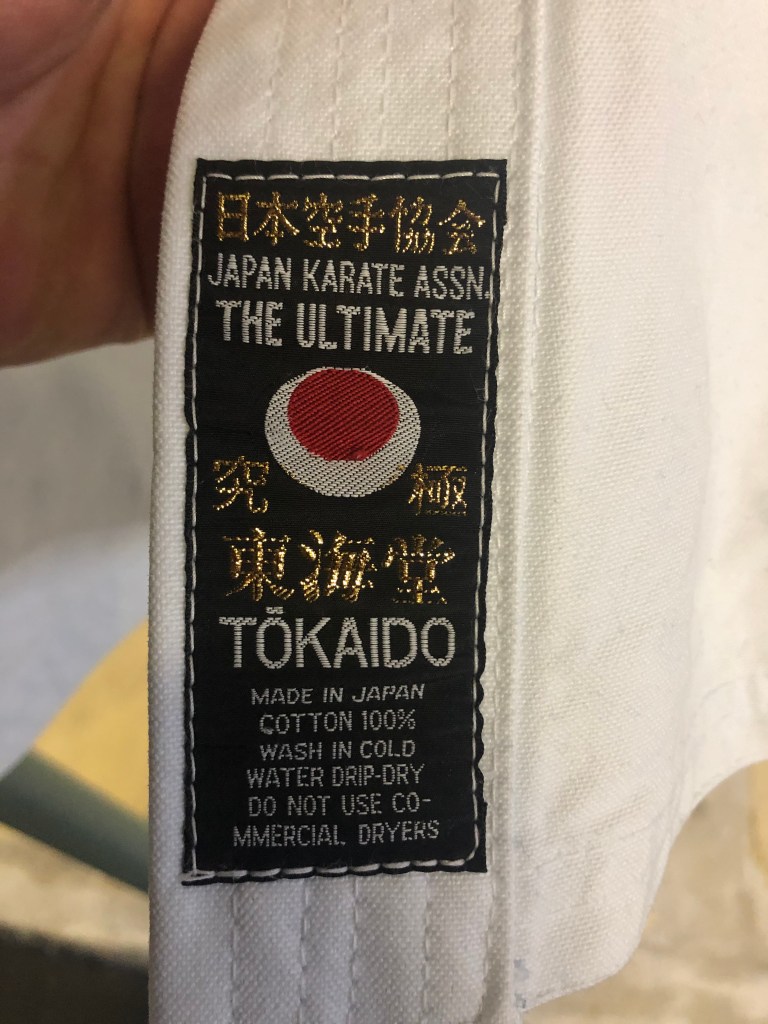
Next, we have the Tokaido. As you can see from the tag above, this is a 100% cotton karate gi that has double and sometimes triple-stitched hems for durability and strength. This company boasts being the oldest manufacturer of karate uniforms. I went through two of these during my years climbing through brown and black belt. They’re of a much thicker cotton and are an excellent quality. I can highly recommend this brand to someone making a long-term commitment to karate. I still have one today!

That being said, buyers should be aware that you’re paying quite a bit for that quality. As a comparison, my last GeneSport gi was roughly $40 (in 1996) and my Century gi was approximately $60 (2016). My last Tokaido cost me $230, but I still HAVE it! And it’s still functional, despite some holes here and there. So deciding on which brand to settle may have a great deal to do with one’s budget, especially if you join a McDojo that’ll charge you an arm and a leg for absolutely everything. But before I go on a rant, let’s move on to the last one…

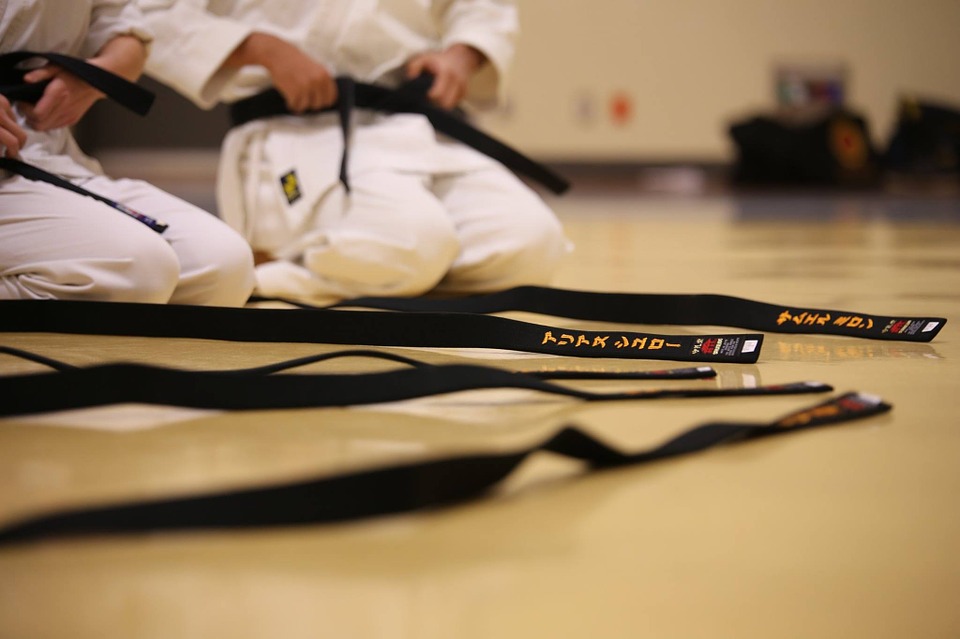
The last brand I’ll touch on in this post, is Shureido. This company holds a special place in my heart, as it is a small, privately owned manufacturer of karate gi and martial arts weapons and equipment located in Naha, Okinawa. I visited this location in 2001 when I traveled to Japan, and I had the pleasure of getting myself a karate gi with Uechi Ryu’s banner embossed directly on the gi jacket. My black belt is also from Shureido and is stitched with my name and karate style. It’s pretty sharp.

Although they have a US distributor and an official Facebook page, there doesn’t seem to be an actual website available. This puts them in a bit of a different category than other manufacturers. I’ve recently reached out to the US distributors as well as sending a message to the Facebook page, without any response thus far. But since they cover all Okinawan and Japanese territories as they relate to karate and kobudo, I would imagine that they’re pretty busy. Cotton material and double or triple-stitched, these gis are top-of-the-line and are prominently used in the tournament environment. At least they were, when I was there in ’01.

These are the top-tier of price range, with a gi costing anywhere ranging from $250 to several hundred dollars, depending on size and accessories. Since I got a specialized gi and specialized belt, my package cost me well over $350. So it may not be ideal in terms of budget. Another issue is that my increase in size over the past five or six years has made it to snug to train in, which is problem. But I’ve had that gi for twenty years, at this point. It’s seen me through my black belt test and all the fun, in-class violence that ensued.

What level and quality of gi you decide to purchase depends on your perspective. An advanced student who buys one of the lower-priced, single-stitch gis may find themselves replacing it within a year or two as it’ll get torn to shit while sparring and grappling. That’s the issue I used to face. So if you burn through three or four of those gis, you’re already halfway to the cost of a basic Tokaido gi, which will be tougher and last longer overall. So you need to find a way to balance the scales.

You may also find yourself limited by the requirements of your dojo and what THEY require. Most traditional and functional dojos don’t care what their students wear, so long as they train hard and put in some effort. That is, until the time comes for a significant climb in rank. Most dojos don’t want to issue a green, brown or black belt to someone in their sweats and a Blink-182 t-shirt. But if you reach those ranks, the safe bet is you’ve invested in a gi already. The important thing is to have your gi loose enough to be comfortable and allow movement, while being snug enough to prevent snagging and grabbing on your opponent’s end. ☯

How Traditional Is TOO Traditional?

One of the defining characteristics of martial arts is the fact that it’s steeped in ceremony and tradition. For the most part, students usually learn to incorporate those traditions and ceremonies into their practice of whatever art they’ve chosen. If they don’t, they soon discover that they may be better suited to something that doesn’t require all the formalities, like boxing. Or MMA.

Many modern dojos and martial arts studios are of the opinion that the pomp and ceremony is unnecessary and hinders the faster progression of students as it takes away from time that they could be training on actual techniques or drills. Those dojos couldn’t be more wrong. And yes, that may simply be one person’s opinion. But the truth is that the formalities also teach students some important aspects of discipline, routine and attention to fine detail. Such aspects are important to the integrity and proper absorption of the essence of karate. And I have no doubt the same can be said of other styles.

So how does that apply outside the dojo? And that is the question that brings us to today’s post. Is it appropriate or even REQUIRED to refer to your Sensei as “Sensei” when you meet him or her on the street? Considering that it’s a show of respect to refer to your instructor as “Sensei,” why wouldn’t you use it regardless of the environment? But some are not quite as willing to use titles outside the dojo. And in fact, some instructors aren’t comfortable having them used on them in a public setting. It reminds me of two scenarios, of opposing views. You’re probably saying, “Of course it does…”

When I started karate, all those decades ago, I spent the first few classes hiding at the very back. I copied and emulated everything I saw, but I never really had any opportunity to call on Sensei to ask any questions. This is one of the downfalls of being a beginner at the back of the class and is why it’s so important to pay attention to your white belts. But I digress… We reached a class on my second week where we all gathered at the back of dojo and were shown drills, which we’d perform all the way up the class. We’d run along the outer edge of the dojo to the back and repeat the drill.

At one point, I was unclear on the specifics of a certain technique, so when Sensei approached I got his attention by raising my hand and saying, “Excuse me, sir?” He walked over, I asked my question, he answered it and I was back in line to continue. Then as an afterthought, he added, “And when you’re in this class you call me ‘Sensei’ and nothing else. If you ever refer to me as anything else while in the dojo, it will be a hundred push-ups.” Then he walked away. I was mildly taken aback, but it had the required effect. It’s over 32 years later, and I’ve never called him anything other than ‘Sensei’ unless I’m referring to him to somebody outside the martial arts environment.

On the flip side, one of the senior belts who used to teach in Sensei’s absence was usually referred to as “Senpai,” which is a term for “instructor” or the like. I saw the guy at a local grocery store the one day and when we saw each other, I called out “Hey, Senpai…” He paled and quickly hushed me by saying, “Man, quiet down! We’re not in the dojo…” I felt as though he was embarrassed by it. To each their own, I guess. My students consistently called me Sensei regardless of the environment. It’s been almost fifteen years since I had to shut down my dojo to move out to Saskatchewan, and I STILL have some old students who will call me Sensei when they see me. As a sign of respect, it’s kind of nice.

Either Sensei, Sifu, Master or whatever title may be associated to the lead instructor of your school or dojo, it may take some feeling out as to how you’ll refer to them outside the dojo. They may also have a preference in regards to how they’d like to be addressed. Personally, I don’t believe it should be embarrassing if a student refers to an instructor but their title outside the dojo. After all, if you’re in some sort of team sport the safe bet is you’ll likely say, “Hey, Coach!” if you see your coach out in public. Sensei should be no different. ☯

Sign, Sign, Everywhere A Sign…

Sometimes it blows my mind how society has grown to do some rather, well… stupid things. I’ve made a point of flagging this blog post strictly as an opinion piece, because I’m going to be doing a significant amount of venting. Y’all are going to feel the experience of a frustrated and angry Buddhist. Buckle up. Like everyone else, I occasionally find myself in a “mood,” and if I should happen to be in front of a key board when this happens, posts like this come into existence.

About a year and a half ago, I wrote a rather lengthy post (aren’t they all?), which you can read here where I described the futility and stupidity behind things like “No Nut November,” the consuming of Tide Pods and condom snorting, as well as a variety of things like the Cinnamon Challenge. It seems as though every six months or so, there’s some new, idiotic thing that society decides to try as a challenge or to try and obtain as many clicks on social media as possible.

A good example of this year’s collection of Darwin Award nominees includes a woman in the United States that decided it would be a good idea to use a spray version of Gorilla Glue in her hair instead of her usual hair spray. Have any of you read about this? To make matters worse, she thought it would be a good idea to document the whole thing via one of their social media accounts and post it for the world to see. Obviously, there was a significant amount of backlash from the public, which should be expected when one does something as monumentally idiotic as using glue on one’s hair and sharing it with the world.

The part that’s sad is the fact that this woman seems to have increased her following as a result of this, has acquired significant amounts of money through crowd funding and received celebrity attention. For gluing her hair!!! It took significant hospital resources as well as a four-hour surgery to rectify the bad case of helmet head, which I honestly feel could have been surgical time used for people with genuine medical dilemmas as opposed to this bullshit. But maybe I’m just bitter at the fact that the world loves to focus on this shit when my fellow bloggers and I struggle to develop a following while producing readable content. But I digress…

The lady in question is apparently making a full recovery and will be fine, despite the stupidity of her actions. But rumour now has it (since I couldn’t find a confirming source) that she and her lawyer have the intention of suing the Gorilla Glue company since there’s no warning label explicitly explaining that one should not use their glue as an alternative to hair spray. Did I miss something? Was I comatose during the pandemic at the Zoom meeting where it was decided that we, as a society no longer need to use common sense?

I recently used Gorilla Glue to fix a broken pirate eye-patch of my son’s and I have to say… All the while I was using the glue, I had absolutely NO irresistible urge to apply some of the glue to ANY part of my body. It would seem unnecessary, under the circumstances, to REQUIRE that a warning not to use something like chemical glue in one’s hair be placed on a specific product. Nor does it seem fair that this company should be sued or held to task because of someone else’s stupidity. It makes me ask the important question: Why does everybody need a sign?

A little music release to ease the tension of the post…

It reminds me of the “landmark” case in the early 1990’s when a woman sued McDonald’s Restaurants because she scalded herself with a cup of their coffee. She was awarded nearly a million dollars from that lawsuit and it prompted almost ALL coffee-serving locations in the world to start printing “Caution: Hot” on their coffee cups. Some people think it was a worthy cause while others think it was a frivolous use of the court system. I don’t know about you, but I already knew coffee was hot. I’ve always known coffee is hot. And when I’m handed a cup of coffee at a restaurant or eatery, I do two things. I thank my server and I ensure the lid is on tight. Wash, rinse and repeat.

The latter would seem important, as a woman in BC has apparently filed a lawsuit against McDonald’s as well in January of 2020, for receiving a coffee and having the lid pop off and spilling hot coffee on her. Really, people? Why with all the suing? This isn’t the answer to all of life’s problems. Unless the employee intentionally pours the coffee on you, clean yourself up, learn from the lesson and move on! In fact, it has more of a feel of people trying to cash in on whatever they can find. It’s a rather sad state of affairs, really. There’s so much in the world that deserves our attention and that we should be working on. Instead, we’re growing into a society where the dumber and more frivolous the act, the more support and social media gathering it garners.

The morbid side of me is anxious to see what the remainder of 2021 will bring, since the whole glue thing has started the year off with a bang. The last but likely not least bit I’ll complain about, is how a lot of people these days are now making a living off of doing things of this nature. Ever hear of “social influencers?” I won’t even start on THAT one, it can be another post for another day when I feel that climbing on my soapbox is a worthy workout for the day. But when I think about how hard I’ve worked my entire life for to salary I make, only to have things like this spring into existence, it makes me seriously reconsider moving my family to a remote location and setting up, off the grid. End rant. ☯

The Most Difficult Choice…

As is the case when I have a few free moments, I was letting myself fall down the YouTube rabbit hole last week when I came across a short video that I thought was some sort of Spider-Man fan fiction. I enjoy Spider-Man as much as the next comic enthusiast and it was only a four-minute video, so I clicked on it to see what it contained. It turns out that it was the ending to “Marvel’s Spider-Man” video game on the Playstation 4 and it was emotionally crushing…

I’ll link the YouTube video at the end so that you can watch for yourself but despite the lesser graphics involved in the facial expressions, this is the first time that the ending to a video game nearly moved me to tears. Anyone who’s read any of the comics or watched any of the movies is likely aware that Peter Parker, AKA Spider-Man’s Aunt May is the one who deals with raising a super-powered teenager on her own after her husband dies.

I haven’t played this video game; in fact, I haven’t had a game system in this house since I sold my xBox 360 last year. But the game seems to involve a sickness of some sort that requires inoculation through a serum. The clip I watched shows Aunt May laid up in a surgical bed, apparently dying of this sickness with Spider-Man standing nearby holding the only vial of serum. The doctor who’s apparently overseeing things tells Spider-Man that he can give May the serum and she’ll live, but the cost will be that there will none left to replicate and millions will die. Or he can let Aunt May die and allow the serum to be replicate, thereby stopping the sickness and saving uncountable lives.

The scene is powerful and emotional, and you can feel the tortured effort as Spider-Man makes the difficult yet apparently correct choice by slamming the vial down and walking away. The YouTube clip ends with the scene of May’s burial, where her headstone reads, “When you help someone, you help everyone.” Despite the dim, cold basement I was watching this from, I felt the heat rise in my face and the telltale lump in my throat that predicted the tears that would inevitably start welling up. In the midst of my emotional vulnerability, it led me to wonder: could I have made that choice? Could I have let someone I love die in order to save millions?

This isn’t the first time that an impossible dilemma is presented to a protagonist. I’m reminded of “Sophie’s Choice,” a movie from 1982 where the lead character portrays a polish immigrant who had to choose which one of her two children would be killed and which one would accompany her to a concentration camp. The terror and internal struggle, not to mention living with the decision afterwards, is unimaginable. There have been plenty of other such examples in cinema and books but that ones sticks with me.

Imagine this scenario for a moment… You’re sitting by a loved one’s bedside. Maybe it’s a spouse or a child. And you’re given a choice: cure them and let them live but others will die or let your loved one die and possibly save the lives of multiple people. Could you make that choice? WOULD you make that choice? I think that at the heart of it, we’re all aware of what the right thing to do would be, but acknowledging it and being capable of it are two entirely different things. I’ve always considered myself a good person, yet I don’t know if I could bring myself to let my wife or one of my children die, even if meant saving multiple lives. Some would call this selfish, but it’s part of the internal morals we all have that sees us want to protect the ones we love above all.

Anyway, I know this isn’t a bright, happy post but it’s certainly one to get you thinking. We often take life for granted and the reality is that choices that are depicted in the clip below often do happen, albeit maybe not including costumed heroes and a city-wide sickness. People are forced to make “live or die” choices for loved ones on a daily basis and I can’t imagine the torture involved in making such a choice. Hug your loved ones close, folks. And pray that such a choice is never yours to make. Here’s the video clip… ☯

Why So Negative?

There is suffering in the world. You may have heard me say this a time or two, and it’s one of the basics behind the study of Buddhism and trying to find inner peace. In my experience, a good amount of that suffering stems from people’s negativity and complaining. I’m certainly not innocent of this, as I occasionally do my fair share of complaining about stuff, but long-term negativity can lead to a host of problematic issues within one’s own life (which I wrote about here).

A few months ago, after some soul-searching and because of certain professional needs, I decided to reconnect with the social media world. I had closed down all of my social media accounts back in late-2018 and with the exception of this blog and email, I had no contact with the online world. I got my news and current events from the radio like I did when I was a kid, and from word-of-mouth. The latter is nice, especially due to the current state of the world as it allows me to connect with people in a direct way as opposed to through a computer screen.

Although it’s been wonderful to reconnect with some old friends that I would otherwise be unable to communicate with, I’ve also been bombarded with a social feed FILLED with negativity. The worst part, and what’s caught me by surprise, is that most of it always seems to come from the same handful of people. Although one can easily believe that we all have some of “those days” when we need to vent and complain, there’s something inherently wrong if every day, every post and every comment includes negative content or “speaking out” against someone or something.

I’m actually a big fan of the “scroll on by” concept, wherein one can simply ignore and move on when they see something they don’t agree with online. But despite that concept, there’s a definite effect that involves negativity encouraging negativity. It’s kind of the same effect that leads to riots and mass disturbances; being exposed to it in the immediate moment or the long term will eventually cause you to join in. After all, human beings are inherently pack animals.

If you haven’t read the previous post that I linked in the opening paragraph, take a quick look to see what actual physiological effects that constant negativity will have on your body. People don’t realize that when they’re in a constant state of complaining and negativity that they’re not just working towards pissing off the people in their immediate environment, they also cause damage to themselves. Take a look at someone who has an ulcer as a result of years of stress, fear and/or trauma. Negativity can easily takes its toll…

Folks, it’s easy for me to sit behind my keyboard and try to tell everyone to stop being so fuckin’ negative… I would love it if society understood that the problems of the world should be dealt with rather than posted about. I often think about my chosen career as a prime example. There are a lot of people who like to complain about my industry. But those people are always more than welcome to train for it and see if they can do better. But at the end of the day, we should all be working a little bit harder to try and keep things positive.

More than anything else, this is what the world needs, right now. Not complaining about the state of affairs, how matters in the public are dealt with or constantly bashing one’s own industries. And not everyone needs to hear you complain about why you think something is wrong, especially when law and perspective may prove otherwise. Negativity is insidious, and you’ll be surprise to look up eventually and realize that if all you do is complain and be negative, that’ll be the environment you exist in. And there’s no easier way to guarantee unhappiness than to be negative all the time. I’m sure y’all know some people like this. Now if you’ll excuse me, I got some folks to unfollow and scroll on past… ☯