The Burden Of Knowledge…

To teach is an interesting prospect. It requires a person to take the accumulated knowledge they’ve gained on any given subject and impart it on others in a way that is clearly and easily understood and absorbed. Since people aren’t exact copies of one another, this becomes all the more difficult when one considers that every person absorbs knowledge in a different way; some people listen, some people watch and some people must DO in order to learn. And I have dealt with them all…

Through the years, especially the past decade or so, I’ve had plenty of people ask me why I haven’t opened a school of karate. One of the biggest obstacles that I’ve faced is that my job usually has me moving to a different location every three to five years, which is definitely not conducive to the long-term teaching required for martial arts.

But the main reason, and the one that keeps me from slapping my style’s logo on a door is simply this: I just don’t want to. I should probably explain that statement. When a prospective student walks into the doors of any dojo, they take in the wonder and fascination that comes with watching a karate class. The students, garbed in crisp, white uniforms lined up facing the head instructor. The head instructor, or Sensei, providing the evening’s teaching in whatever form is required, be it calisthenics, forms, techniques or otherwise…

Meanwhile, what does the instructor get out of all of it? Yes, it’s important to acknowledge that learning and teaching go hand-in-hand in karate, no doubt about it. But teaching a class on any sort of permanent basis requires a certain level of loss that not all sensei are willing to pay.

If I take myself as an example, I have a certain amount of material that I need in order to pass my next grade of black belt. Now, I can train for probably about 90% of that required material by myself. But the remaining 10% usually requires a partner, specifically one who has the skill and technique to match what I’m trying to learn.

When I had opened my previous school, I would head to the dojo full of proverbial piss & vinegar, raring to go. Then I would face the dozen or so students who had attended class that night and begin our warm-up. As class progressed, my focus would always lean towards what the students required for their next grading or for the proper learning of the techniques. Sure, I’d enjoy myself and even get a good workout from the class (I could never do otherwise) but ultimately, my training and requirements came to a standstill.

And this is usually a common element of any instructor worth the belt around their waist. They put their own needs and requirements aside in favour of providing the best learning environment for the students. The students usually don’t recognize just how much of a commitment that actually becomes. I can even recall evenings where my own Sensei would only have three or four students and would openly ask what we wanted to work on that night. No matter what the answer, I would often hear a sigh and a far off look in his eyes, which I have no doubt was his recognition of the fact that he would be teaching and doing the same thing for what probably seemed like the umpteenth time, setting his own needs and wants for that matter, aside.

The only thing that ensures the survival of any martial art is to teach it to others. And most people who embark on that journey are genuinely interested in learning. But the commitment and sacrifice that happens is required from both sides: student and teacher. So, if you enjoy your training and consider it an important part of your life, thank your Sensei. He or she is giving more of themselves than you know.

As for me, the day may come when I’ll open the doors of my own dojo again. And when I do, I’ll show up and train my students with the same enthusiasm and commitment they require. No true student of the way would do anything less. ☯
All Shiny And Pretty…

All clean and pretty…

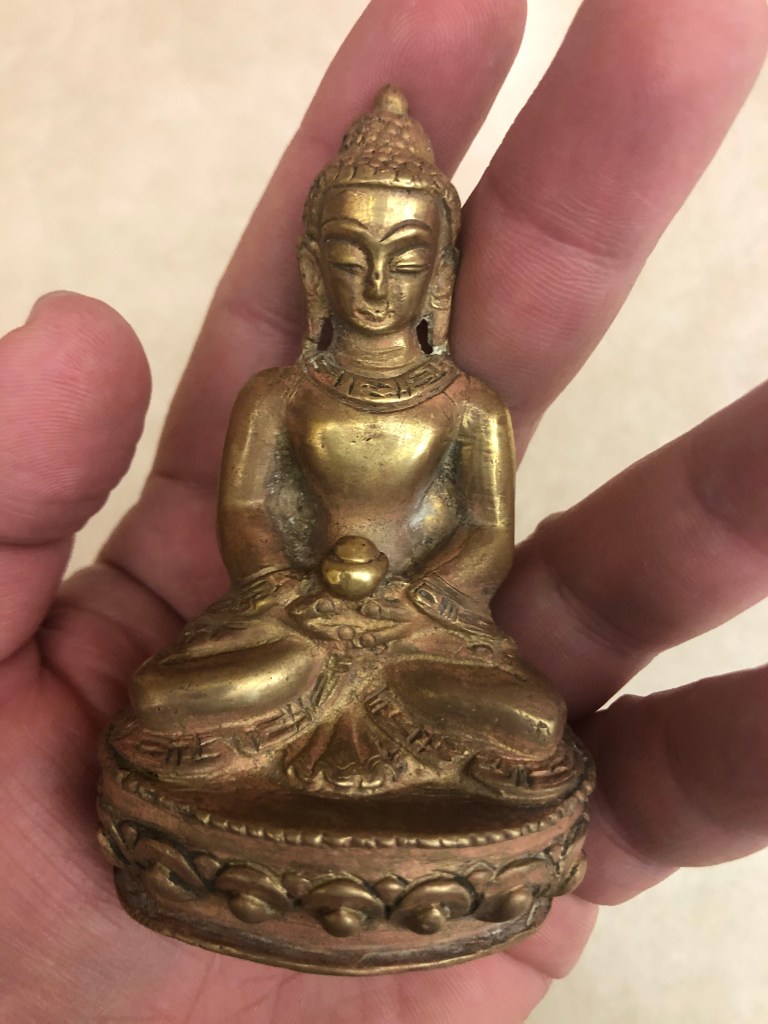
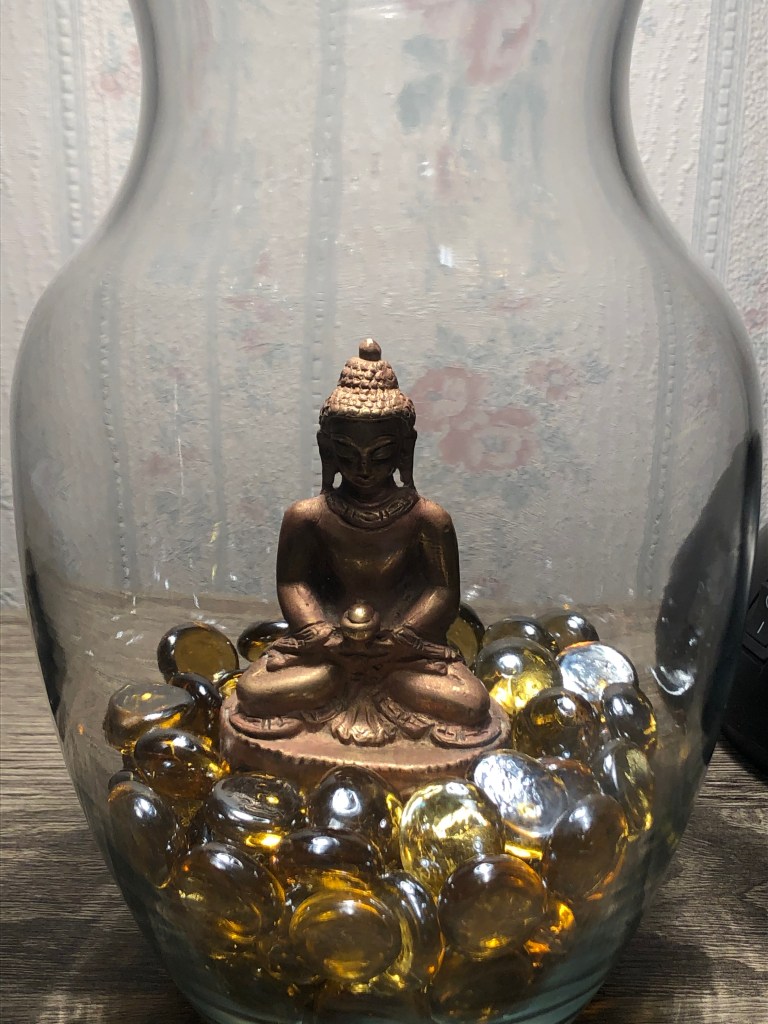
I received this statue of Buddha as a gift, more than twenty years ago. It’s a solid piece of brass, and as such, tends to tarnish and turn black over the course of a long period of time.

The last time I polished this statue was over ten years ago. It had started to turn black and I bought a small bottle of a product called Brasso. I followed the instructions to the letter, pouring a small amount of the product on a clean cloth and buffing the statue until the tarnish got cleaned off. Unfortunately, the statue has enough detail that a cloth couldn’t get into all the nooks and crannies. It left enough tarnish to bother me.

Ten years later, the statue tarnished enough that it was almost black. I wish I had taken a before photo… I contemplated how I would clean it, this time around. I went to a local store and found some Brasso, but it was almost ten dollars for a tiny bottle. I don’t use the stuff often enough to make it worth that price.

I found a homemade solution online that simply involved one part vinegar and one part water. Scrub the statue with a toothbrush or clean cloth then rinse under warm water and buff.

Back in its place

I filled a glass measuring cup with the mixture of vinegar and water and submerged the statue for about an hour. As I was doing other chores around the kitchen, I would occasionally check on the statue and noticed the tarnish progressively disappearing. A quick wipe down and a buff, and the statue is almost cleaner than the day I got it two decades ago. ☯

Keep Your Eyes On The Prize

Most of us go through our daily lives just trying to get through the day so that our heads can hit the pillow. I’ve rather preferred to make it to the rising sun, as it means I’ve lived through the night and can rise to fight another day, but that’s just me. So, what do we rise everyday for? What is it that keeps us from just pulling the covers over our heads and staying in bed? The answer is simple: you need to have a goal.

Goals are important. Even for those who don’t think about it, having a goal can be a driving force behind what keeps you going. You’ll notice I keep saying “goal”, as in a singular goal. One of the biggest mistakes people make is trying to accomplish multiple goals at the same time. Now don’t misinterpret this as not being able to multitask; the two are very, VERY different.

There’s an old proverb that says, “If you chase two rabbits, both will escape.” This is a simple way of saying that dividing your focus on more than one goal at a time likely means you won’t accomplish any of them. It’s important to place your gaze on one goal at a time. And this goal can be simple. There’s nothing saying you need to become a millionaire. If that’s your goal, then by all means, pursue it. Hopefully you will have fixed a singular goal to accomplish it. Nothing is saying that you have to have grand goals, such as finding a cure for a chronic illness. But if such is your goal, it’s definitely one worthy of a life’s work.

Now, if you were to try becoming a millionaire AND find a cure for, oh, let’s say Diabetes… at the same time? Chances are that you’ll fall short somewhere. Focus and effort are required for any definitive goal, and no matter how simple or complicated that goal may be, the requirements are ultimately the same.

So, tackle one thing at a time. Accomplishing one goal can lead into developing the next, and so on… This guarantees that you can wake every morning with a fresh perspective and the ability to focus on your goal. ☯

The Cost Of Advancement…

This afternoon, I went to an eatery of the fast-food variety with my family. For liability reasons, I’ll be a good boy and not name the establishment but suffice it to say that I spent almost a decade working at one, during my late teens and twenties. During our visit, I noted a number of changes to this establishment from when I used to work there. And in the face of those changes, I can only say this: I’m disappointed.

Back in the day, everyone had to order their food from a front counter till, handled by a live, flesh-and-blood human being. At my location, we had a general rule that no person was to stand at the counter for longer than thirty seconds before being approached and helped. This meant that even if you were in the middle of doing something else, you HAD to approach the customer, even if it was to tell them that you would be right with them. There was a face-to-face requirement when you ordered and received your food, and as such, there was a level of service that was only bested by the old days when girls would roller skate up to your window. The customer was the top priority! After all, without the customer there would be no need for me. Oh, how times have changed…

These days, one is usually expected to walk up to a touch screen terminal to place one’s order. Once done, you have the option of paying at the terminal or if you’re told school and have cash you can pay at a till, although there will likely only be one available. Then you either have the food delivered to your table (which I’ll admit is kind of nice) or you wait for your number to be called, something akin to being at a butcher’s counter.

I can’t say that any of this is really of any benefit, as I’ve noted that there always seems to be at least four of five people who return to the counter to complain about something amiss with their order. I can’t help but feel that this lack of human contact at point-of-purchase plays a significant role in this lapse. In fact, on the few occasions where I’ve been missing an item or required something extra, such as a fork or spoon, I’ve often been left standing at the counter while several employees ran back and forth. Even when calling out, I’ve rarely been acknowledged and usually make do without the item I was looking for.

Don’t get me wrong; I’m not trying to bash fast-food establishments. They aren’t unique in this phenomenon and this kind of automation seems to be evolving into the expected norm for most establishments. And if it weren’t for the availability of play structures at some of these locations, I’d probably lose my mind trying to get Nathan to burn off excess energy.

The point I’m trying to make is that face-to-face communication is fast becoming a dying custom in modern society. The advancement of our technology is eliminating our need to directly interact with people and if you pay attention, you can feel its noticeable effect.

The human condition is still as such that we need that interaction with one another. Our humanity depends on it. Although technology can have some fantastic benefits to how we live, we shouldn’t let that technology be our only contact with the world. ☯

On The Brighter Side…

I was reading a post written by a fellow blogger last Monday. The blog is called “Diabetics to Dietetics”, you can search for it through WordPress.com. In this post, she made a number of very important points regarding the negative light the world shines on Diabetes and how the majority of articles seem to focus on Type-2 as opposed to Type-1. The post is fantastic, and you can find it here: https://katiebartel.ca/2019/12/09/time-to-shine-the-spotlight-on-t1d/

Yes, any disease or medical condition is terrible. There are issues, complications, forced life changes and medications that can cause further complications and side effects. In terms of Type-1 Diabetes, depending on how well you manage your blood sugar levels, you can expect organ failure, blindness and a shortened life span. Sounds pretty bleak, right?

Here’s the thing: I’ve often closed my eyes at night and wondered what my life would have been, had I never been diagnosed with Type-1 Diabetes. Would I have joined sports teams? Maybe I would have made different choices in my life and ended up somewhere different.

But I WAS diagnosed… And I’ve flourished. Despite spending my youth dealing with insulin resistance, Diabetic comas and extreme highs and lows, I’ve managed to accomplish so many of the things that many of my counterparts who aren’t Diabetic have failed to do.

When I started the martial arts in the late 1980’s, it was done against protest from my family and my doctors. They claimed that the rigorous training and “violence” involved would be too much for me and that I would never be able to keep up. The year to come will mark 32 years that I have been studying karate. And teaching it, in fact. I have travelled to Japan and trained with some of the world’s best and developed myself. It has helped with my T1D in ways that nothing else could.

When I decided on the career that would encompass my life, I was not only told I couldn’t do it by doctors and family, the industry itself held a stigma against T1D and had medical policies that prohibited the hiring of a Type-1 Diabetic. Luckily, they were smart enough to recognize the error of their ways and I have been working my dream job for over ten years (minus some recent complications unrelated to Diabetes).

When I reached my twenties, I was told that there would be a 1 in 3 chance that I would never be able to bear children, as sterility is a side effect of Type-1 Diabetes. In just under three weeks, my second son will be 3-months old.

You see, I’ve pushed myself throughout my entire life. Always endeavoured to be the best I could be, otherwise my condition would overtake me. In response to that, I’ve achieved everything I was meant to. And more. For some people, being told they can’t have something makes them want it even more. And that’s totally me.

Your condition doesn’t define you. Whether it’s Diabetes or something else, it doesn’t make you the person you become. Only you can do that. But sometimes, if you have the right perspective and are willing to fight for what you need, Diabetes can easily be the fuel that stokes the fire of your ambition. ☯

Peace Or Power Through?

Life certainly has its share of difficulties and nothing is intended to be easy. As I’ve often said before, life doesn’t care about your plan. Given the various schools of thought that I study, I frequently find myself in conflict. What do you do when your faith conflicts with what you’re built to do?

I have often found that my faith tells me that I should pursue the most peaceful way possible, to follow the path of least resistance. I’m inclined to eliminate suffering as much as possible, if you will. And to be honest, this is the normal human condition, if you think about it.

As humans, we are biologically designed to take the easiest path to any result. Like the flowing of water, we tend to follow until we reach our lowest point. This isn’t always ideal, and can sometimes cause more issues than it solves.

Sensei has always told me that I shouldn’t force things so much, that I should go with the flow and allow life to guide me on the path I’m meant to take. Although the prospect of simply sitting back and allowing life to guide me along the lazy river, this isn’t the easiest thing to do when you have a home and a family to support and need to follow the expected requirements of modern life.

Meditation can often provide some clarity when trying to decide one’s path

The other side of the coin is that I was unfortunately raised as a fighter. I don’t give up and I never surrender, even when it causes me pain. If my life, my way of life, my family or my country are threatened, I won’t stop fighting until I win. For obvious reasons, this is also not always the best path.

It’s kind of ironic, because the same man who raised me to never stop fighting is also the same man telling me not to force things so much! That’s how things tend to get convoluted, when messages get confused and you don’t know which direction to take.

Ultimately, I don’t have an answer. If I did, I can promise that I wouldn’t be writing this post! No matter what path you choose to follow, life takes a lot of work. There’s no getting out of it. And when you carry the weight of the world on your shoulders, it makes the journey take twice as long. ☯

Just Call Me “Teacher”

Over the decades, I’ve had the honour and pleasure of studying and training with a number of different martial arts and fighting styles. During these studies, I’ve taken note of some of the similarities and the difference between those styles. One of the important aspects is how to address the instructor of one’s respective martial arts style…

Depending on the background and what origin your martial art may have, the title given to the instructor may differ. Some styles may actually have no title for the lead instructor and may resort to something simple, such as “sir”. In this post, I will endeavour to cover the most common terms for martial arts instructors.

  • Sensei: Obviously, I’m going to start with mine! The term Sensei means “one who comes before” but literally translates as “teacher”. The term is used in most Japanese martial arts (such as karate, d-uh, Judo, JiuJutsu, Kendo, etc) and in SOME Chinese styles. The term Sensei can be used to address anyone qualified who teaches you a particular subject, and isn’t limited to the martial arts. For someone ranked at 5th Dan or higher, the instructor can be addressed by the title of “Master”. This is generally an honorific title and many instructors will choose to continue to be called “Sensei” regardless of what degree of black belt they hold;
  • Sifu: This is the term for an instructor in the Chinese styles of martial arts, most prominently Kung Fu. It can mean both “master” and “teacher” and in some circles can also be used to mean “spiritual father”. The problem with this term is that it can have different pronunciations depending on the art you’re studying;
  • TKD: TaeKwonDo is one of those complicated creatures, because they have so many different organizations, rules and denominations of the style, that they differ a great deal from one another. Depending on what TKD organization your school may fall under, terms such as “Boosabum”, “Sabum” and “Sahyun”. That being said, TKD is one of those schools where all the instructors I’ve ever met have been referred to as “Sir” (In Canada, at least);
  • Coach: This is a term used in most schools of Brazilian Jiu-Jitsu schools, albeit some of them will use the term “Professor”, which is just an honorific. The term translates directly from the Brazilian term for “teacher”.

There are plenty more terms out there, but I’ve covered the most common ones: karate, kung fu, Tae Kwon Do and Jiu-Jitsu. Believe me when I say that there are many more styles and terms out there that may be different. The important thing, especially if you’ve just started a new style, is to ask. Don’t be afraid to ask how you should be addressing the instructor.

I still remember my first encounter with Sensei. We were doing kicking and punching drills, and I was confused on the exact step for one of the techniques we were studying. I tried getting Sensei’s attention for several minutes, until I finally yelled out, “Sir, I need your help…”

Sensei was good enough to wait and let me ask my question, then took the time to answer it. Then he asked “Got it?” I said yes and stepped back into line, at which point Sensei said, “Oh, and by the way… My name is Sensei and if you ever call me something different, you’ll owe me a hundred push-ups…” Then he walked away from me, leaving my jaw dropped wondering if he was kidding. He wasn’t. But that’s another story…

The point is, if someone has successfully opened a martial arts school and is successfully teaching, he or she has earned the respect to be addressed by the title their art entitles them to. So, be certain to be respectful and ask if you’re not sure and use the title once you are. After all, respect and discipline are practically synonymous with the martial arts.

FYI, it’s been 31 years and I’ve never had to pay out those hundred push-ups. Jus’ sayin’… ☯

Here Comes The New Year…

December is in full swing and the holidays are fast approaching. Once Christmas has come and gone, most people enjoy living it up with the New Year’s holiday. New Year’s Eve parties, the countdown and the kiss at midnight… It can be a fun time. This upcoming New Year’s is a special one, because it’s the end of the decade and we get the return of the Roaring 20’s! Cue all the jokes and comebacks here…

With the New Year comes a special tradition that people have been observing for a very long time: the New Year’s Resolution. Although people have been doing this for a while, most don’t put any thought into how long it’s been happening.

According to History.com, the New Year’s Resolution may have been started as far back as 4,000 years ago by the Babylonians, who would make promises to the gods to return borrowed objects and pay off debts. These promises are believed to be the forerunners of the New Year’s Resolution. (https://www.history.com/news/the-history-of-new-years-resolutions)

The Romans also adopted a similar practice when Julius Ceasar established January 1st as the beginning of the New Year. Named for the Roman God “Janus”, it was believed that this God looked back at the past and ahead to the future simultaneously, allowing for the Romans to make promises of good conduct in the coming year. Through this established change in the calendar, Christians began using the New Year as a means of looking at past mistakes and resolving to do better in the future.

These days, people use the prospect of the New Year’s Resolution as a means of self-improvement and a way to make critical changes in one’s life. Some good examples are getting into shape, losing weight, going after that wanted career or cutting out bad habits, such as drinking, smoking or gambling. That’s why most people have difficulty sticking to resolutions and they usually fizzle out by March.

First page of the blank spreadsheet I intend to use for my New Year’s Resolution

I usually don’t worry too much about making a resolution. After all, Diabetes has me observing enough stringent conditions in my day-to-day life that making a resolution has always seemed a bit like overkill. But considering I’m now in that wonderful “change of life” decade known as my forties, I thought it would be a good idea to give it a whirl.

Given that I can never do anything simply, I’ve drawn up a spreadsheet (pictured above) that outlines every week of 2020. The top row outlines the things I’ll be looking to do as part of my New Year’s Resolution. For example, if I get through the week without alcohol I will put in a green checkmark. If I slipped up or had an exception like going for a beer with a friend (Come on, Daryl! Of course we’ll still go for beers!), I would put in a red “X”.

I made it a weekly checklist because, let’s be honest, the spreadsheet would be WAY too huge if I made it a daily checklist. You’ll notice that the last three columns are blank. This is where I’m leaning on you, dear reader, to provide some ideas of what I can include. The only conditions is that it has to be something that can be tracked and/or avoided. For example, my workouts are tracked by my Runkeeper app. My water intake is tracked by my MyWater app. Anything that I’m to avoid, such as “No Added Salt” is pretty easy, I simply DON’T add salt!

Feel free to comment on what added items I should put in the spreadsheet. They’re all good things that should help towards improving health, improving weight, fitness and blood sugars. So hopefully, I won’t fizzle out by March! But I’ll keep y’all in the loop as it progresses. ☯

A Society Of Automatons

I’m not a HUGE fan of modern technology, despite the fact I can admit to being an avid user. Although modern technology has brought us ahead in relation to medicine and research, the effects it’s had on modern society is almost palpable. And nauseating.

After enjoying supper with my family last night (I made Chicken Alfredo, it was quite delicious) I made a quick run to the grocery store. I needed milk and whipped cream for a chocolate pudding dessert I was making. Boy, to hear the recipes I prepare, you’d never think I have Type-1 Diabetes…

Anyway, I consider myself to be something I call a cluster-shopper. What this means is that rather than do a month’s worth of groceries in one sitting, I’ll go to the grocery store every few days instead, sometimes daily, in order to acquire the ingredients we need for our meals.

To make a long story short, going to the grocery store on a Friday evening turned out to be laborious. The grocery store was crowded, and filled with mindless automatons who were more concerned about looking around aimlessly than paying attention to their surroundings. Besides having people in front of me who were walking down the middle of the aisle at, as Ron White would say, “half the speed of smell” and preventing anyone from getting by them, I also had the pleasure of having multiple people cut out in front of me from a cross aisle, make eye contact with me and seeing my hustle, yet slow me to half the speed by coming to a crawl in front of me… FML!!!

It amazes me at how people are so communicative and quick when it comes to their smart phones and devices, yet they become mindless automatons simply going through the motions once they’re out in public. They don’t pay any mind to what’s happening around them, almost to the point where they cause strife in others around them. Their lives revolve around their social media accounts and smart devices, and they run on instinct once they return to the real world. It’s a real shame.

Folks, don’t forget that the real world still exists. You spend the majority of your day in it and there’s a lot to see, despite the fact it isn’t reflected into your eyes by the screen of a device. Take time to appreciate it and pay attention to your surroundings. You may be surprised at what you’ll see. ☯

It Could Always Be Worse…

No… No, it really couldn’t be! I mean yeah, it could be if you look at it from a perspective of, “Wow, I broke my leg! I guess it could be worse; I cold have broken my neck…” But really, how efficient and effective a mindset is that?

It’s no secret that people who say “it could be worse” are a serious pet peeve of mine. I’ve been hearing it all my life, especially in relation to my Diabetes. It’s unbelievable how often I’ve heard people throw comments at me. Here are some of the gems:

  • “It could be worse, you still have all your legs and toes…”
  • “It could be worse, you could be blind…”
  • “It could be worse, you could have heart or kidney failure…”
  • “It could be worse, you could have cancer…” (my personal favourite, and the word cancer is often interchanged with just about ANY other illness)

Why do people do this? For some people, it’s a defence mechanism. They simply don’t know what to tell you. If you mention an issue in your life and they believe that explaining a worse alternative will somehow make your current predicament better. Your car got totalled in a collision? “It could be worse, your house could have burned down…” As if losing your primary source of transportation suddenly isn’t terrible when compared to the imaginary scenario in which your house catches fire…

In our defence (“our” being the people with Diabetes who talk about it) we become so used to our condition that we often discuss things without realizing that a non-Diabetic may not consider it so normal. Like when I casually mention to someone I just had my bimonthly eye injections. Most times I get disgusted looks and dropped jaws. But it’s become so routine and normal to me, I usually think nothing of it.

But the reality is that even if something COULD be worse, it doesn’t take away from whatever bad or negative situation one may be facing at the moment. Everyone has a story, right? And not everyone may handle difficulty the same way, so it’s important to acknowledge a person’s situation for how they’re feeling it.

Although looking on the bright side is a fantastic perspective for life, trying to explain to someone why their situation could be worse is definitely not ideal. It certainly shouldn’t be said to someone suffering a medical condition, no matter how much worse a different condition may be. ☯