Put Some Oomph In Your Ouch! ðŸŽ

Music is awesome. It has the means to allow a person to express themselves in a very unique way. Music also has the means to reach every person. There are so many types of music that there is always at least one genre that appeals to any given person. Music can also communicate. There are few genuinely universal ways of communicating, but shaking your booty to great music is well understood anywhere in the world.

Music can also play an important role in how your workout plays out. It’s no secret that having an awesome playlist and some sick beats (I promise never to use that term again) can improve your workout and make you push harder towards a wicked sweat. So, why is this? IS it just our imagination? NO. There are actually some measurable reasons why music can help improve your fitness.

According to an article by the Huffington Post, “Listening to music while exercising can release feel-good chemicals – such as dopamine and opioids – that may boost your mood, dull pain and make you less tired […]” (https://www.huffingtonpost.ca/entry/how-music-affects-workout_n_55d746a3e4b0a40aa3aaa9da?ri18n=true) If this is true, than having some music blaring while you workout is definitely beneficial.

Some other theories include the fact that music is a distraction. If you are distracted from the agonizing shin-splints keeping you from completing your 3K-run in record time, you’re more likely to push hard and keep going. Speaking from experience here, folks! Another theory is that good music, or rather what may be good to you, will help increase your confidence. This causes us to push harder.

No matter what the reasons, and no definite evidence has been found despite many studies, you can’t argue that having your earbuds in while you push yourself adds a definite plus to your workout. Think about it. When was the last time you went to a gym that DIDN’T have at least some of the people wearing headphones or earbuds? And it’s almost a sure guarantee that fitness locations will usually have music playing on the intercom system. Unless it’s one of those heathen locations that have a sporting event blaring, but that’s an entirely separate problem.

My current karate school even uses music during the warm-up portion of the class. This is a bit of a controversial thing, considering that most martial arts schools include an aspect of discipline that doesn’t include having Metallica blaring while shadow boxing! But I’d be lying if I said that the addition of music didn’t get even the laziest of students moving a bit better.

So whatever your reasons for doing so, crank up the tunes. Whether it’s to make you feel better, distract you from the now or simply helps you follow along with a beat, it can be nothing but beneficial. Unless you work out to country music. Then you’re just asking for trouble. You know who who are! ☯
Don’t Try To Walk In Others’ Footsteps

Life is pretty dynamic. If you don’t wake up in the morning wondering what the day will bring, you’re not facing it head-on the way you should. Life also doesn’t care about your plan. I’ve said that more times than I can count, to more people than I can remember. No matter how well you plan, life will usually find a way to throw a wrench into your gears. Although it’s important to have goals, plans aren’t always ideal.

“You Don’t Always Need A Plan. Sometimes You Just Need To Breathe, Trust, Let Go, And See What Happens.”

– Mandy Hale

I was talking to an old friend of mine, some time ago. He was in his 30’s, single, still had debt and hadn’t met any of his goals. He was pretty disappointed and hard on himself, and he was of the opinion that he was “behind in life” because of these things. He had a good career-level job and was saving up nicely, but the missing aspects that he considered societal expectations weighed on him.

I tried explaining to him that his life was exactly that: his life. And there was no expectation to follow any kind of set expectations where life was concerned. Every person is different and so is the manner in which their lives will play out. All the so-called rules that say you should be married and settled down by a certain age are made up.

“Although No One Can Go Back And Make A Brand New Start, Anyone Can Start From Now And Make A Brand New Ending.”

– Carl Bard

My friend is now about to get married, owns a house and is building a family. It took him longer than he PLANNED, but he’s still reaching his goals. And that’s what’s important. There’s no need to be so hard on ourselves. As long as we keep trucking forward and working towards goals, life will keep you exactly where you need to be. ☯

Swimming In The Benefits!

I brought my son to a public swimming pool, yesterday afternoon. He enjoyed that pool party for his classmate so much a couple of weeks ago, that I thought it would be a great way for us both to get some exercise and burn him out for the night. It would have been nice to snap a photo or two of the fun, but you DON’T want to be that adult taking photos at a public pool!

Swimming is often an overlooked activity by most people, because it seems rather inconvenient. You have to pack swimwear and towels, go to a specific location to swim (especially if it’s winter) and you need to worry about getting properly dry and dragging a bunch of wet things with you when you leave. But is that really any different than working out at a conventional gym? If you said yes, there’s something wrong with your workouts. Unless you have a full gym in the basement of your home (a slight tinge of jealousy over my brother-in-law’s basement comes to mind) then you still need to pack or wear workout gear, go to the gym’s specific location and if you aren’t soaking wet when you finish your workout, then you aren’t pushing hard enough!

Spending time in a pool can have a number of benefits, from a health and fitness standpoint. If you happen to be swimming with my son Nathan, I guarantee that you’ll lose track of the number of calories you burn. And that’s the nice thing: you’re burning through calories while having so much fun that you don’t notice it.

You work just about every muscle group. Even if all you’re doing is splashing around with your kids, working your way around under water requires the use of just about all your muscle groups, making for a great workout. It’s also a very low-impact way to workout, since the water takes a portion of the weight off of your back and joints.

The increased heart rate will improve your heart and lungs, and will help to reduce stress while improving your flexibility and mobility. That last one is particularly important if you need to maintain your fitness level through an injury like, oh let’s say… shin splints! The low impact will allow your injury to heal while still allowing you to burn calories.

It goes without saying, even if I’m saying it, that anyone with Diabetes needs to closely monitor their blood glucose levels while swimming. Often, your blood sugars can start to drop suddenly, especially if you’re caught up in the fun. When going to a public pool, I always arrange to keep my gym bag close by. It contains fast-acting glucose, my glucometer and my cell phone, which allows mw to test my blood sugar through my Freestyle Libre.

Last but not least, it’ll fire up your hunger and make you tired. This is a good sign that you’ve had a god burn and can retire to your home for a rest. One of the first things Nathan told me as we were towelling off to leave was, “Daddy, I’m tired…” Yes! He’ll be sleeping early tonight… No such luck. He got his second wind and was his typical destructive self.

Swimming can be beneficial in all sorts of ways and do nothing but good for the body. I spent most of my life living in the East Coast of Canada where i could spend the entirety of my summer, swimming on beaches, rivers and lakes. It was glorious! If you do swim outdoors, be sure you know how to swim and are aware of how to swim in bodies of water that may have currents and other dangers. Otherwise, you can’t go wrong. So get out there and dive in; the water’s fine! ☯

A Real Ankle-Biting Problem…

I recently posted that I’ve incorporated running into my exercise routine. I don’t usually run; I tend to think that I have the centre of gravity of a boulder. This doesn’t mean that I don’t incorporate cardio into my workouts; it simply means that I’ve recently felt the need to up my game a bit.

Now just to be clear, the terms associated with running are subjective. Depending on who you speak to, what I’ve been doing may or may not be “running”. I was speaking with a colleague a few days ago and when I mentioned that I had started running, he said, “Are you actually running, or you’re just jogging? To me, jogging is just jogging. But running is when you go all out!”

I was quick to point out that running all out was usually referred to as sprinting, to which he was quick to offer suggestions that my smart-ass go fornicate itself on a hot rock. But I digress…

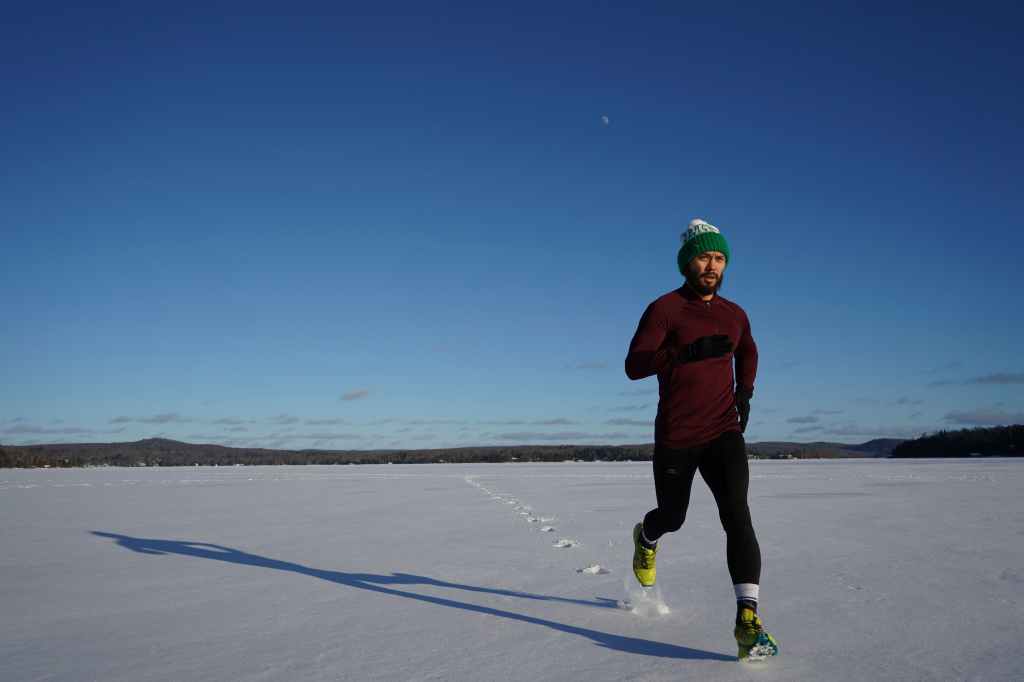
Running on different terrains and surfaces present different issues while running

Running, much like any exercise, has many different complications and injuries that one can suffer while enjoying it. And “enjoying” is a very lightly-used term… You can pull or tear muscles, twist joints, suffer micro-fractures or experience dehydration or exhaustion. But the condition I want to address today is one that I’ve suffered before and that I seem to be revisiting now: shin splints!

Shin Splints, or what’s medically known as Medial Tibial Stress Syndrome, is a condition that one develops from repetitive, physical stress on the musculature in the leg between the knees and the ankle. You can usually recognize it from a dull or sharp pain in the muscles of the lower leg when exercising and can often be accompanied by some swelling. Sometimes the pain can be excruciating enough that one is forced to stop the physical activity. Continued exercising when one has shin splints can result in micro fractures, which can result in a complete fracture.

What causes shin splints? It can be caused by a number of things, such as starting a new running regiment (sound familiar?), running on a hard surface (I unfortunately run on the street!) or using worn-out shoes that no longer provide proper support to your feet (like my tac boots). Shin splints can also result from the exhaustion of the specified muscle groups, where one continues to exert stress on them. These are only the most common causes and there are many more.

So, what can one do to prevent shin splints? Well, this is one of those situations where less is more. If you’re starting to run, do it gradually. Don’t try to run long distances at great speed on your first week. Stretch out the muscle group, same as you would for any other muscle group before any other type of workout. Make sure your shoes are replaced if worn out, and this will also help to lessen the impact if you’re forced to run on concrete or asphalt.

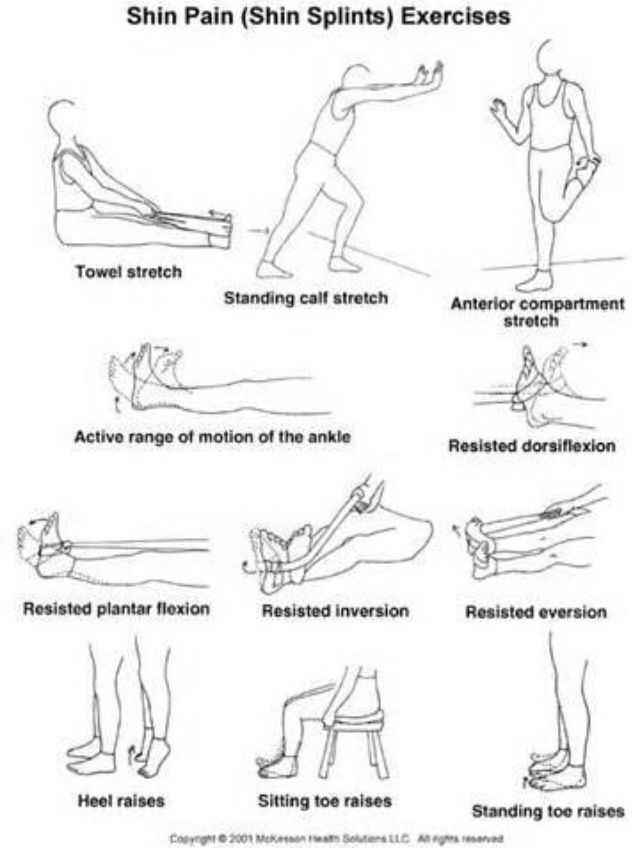
Some stretching exercises found on Pinterest

If you think you may have developed shin splints, there are a few things you can do from home. Keeping your feet elevated and icing your shins is the first step. As with any icing of tissues, keep an ice pack on your shins for no longer than 15 minutes at a time. Massaging the shins can also be a help. Over-the-counter anti-inflammatories, such as ibuprofen can be taken. But only temporarily and in small doses. Depending n what caused the actual shin splints, the time needed to recovery will differ from person to person. The general recommendation is about two weeks, and if you haven’t recovered by that point, you should consult your medical practitioner.

The important thing is not to rush back into it. This is one of those injuries that genuinely require that you allow your body time to rest and heal. Pushing yourself in this situation can result in true fractures of the leg and force an even LONGER recovery time. Take your time getting back into the routine and be sure to start in small increments. Now, if you’ll excuse me, I’m going to go ice my shins! ☯

Quit Bitching About It If You Won’t Fix It!

There is an undeniable truth in modern society that it’s far easier to whine and complain about things than it is to put in a genuine effort to try and fix whatever may be bothering you. This is not a generality, you understand. But for most people, it is much, much easier to complain about not getting that raise you wanted, or were overlooked for a promotion, than it is to constructively sit down with your boss and say, “I recognize that I wasn’t chosen for the promotional opportunity. Can we discuss what I can do to make myself a competitive candidate for the next one?”

This concept applies to most areas of life. Part of the reason is because it is, for the most part, much easier to complain than it is to do something about it. Diabetes and general health is no exception. I’ve had a lot of friends through the years with Type-1 who have often complained about their blood sugar levels, A1C levels and their weight or condition of their body. To these people, I’ve always asked the same question: What are you doing about it?

“Gardens Are Not Made By Singing ‘Oh, How Beautiful’, And Sitting In The Shade.”

– Rudyard Kipling

There needs to be a recognized acknowledgement that if you’re overweight and are not comfortable, healthy or happy with your body, then you need to do something about it. Start working out. Work on your health. Work on your diet. Consult a professional and get some help. There’s no shame in that. Some people feel they’ve become so far gone that they no longer believe it’s worth the effort. What are you doing about it?

If your blood sugars are running rampant and you’re suffering all sorts of complications with your eyes, kidneys and nervous system, then you need to start taking better control of your Diabetes management. If you only test your blood sugar once a month and indulge in every baked good that passes by, you’ve chosen an extremely slow and torturous form of suicide! There are nutritionists, dietitians, Endocrinologists and family physicians that can help bring you up to a healthier standard and get you to where you need to be. What are you doing about it?

If your fitness has gone to shit and you get winded walking from your couch to your kitchen, there’s a distinct problem. Humanity may have become sedentary, but staying in good physical condition is still an important aspect of a healthy life, whether you have Diabetes or not. Go for a walk, ride a bike, join a fitness club or go for a run. And if you’re uncertain how to go about any of it, there are plenty of resources both online and off that can help get you started and help you along. What are you doing about it?

“The Only Mistake You Can Make Is Not Asking For Help.”

– Sandeep Jauhar

There are obvious exceptions to every rule. It can be hard to get yourself going and there are people who have genuine conditions that make weight-loss difficult. Medical conditions can make it hard to achieve certain goals. For example, if you’ve gone blind, one would not expect that you’ll take up competitive archery! But the lesson here, is that if you find yourself capable of making a start but refuse to do so then you shouldn’t (as my title so eloquently put it) be bitching about it if you won’t fix it.

I think it was Confucius who said, “A journey of a thousand miles begins with a first step.” So take that step! Get off the couch and move a little. Test your blood sugar a few times a day instead of once a week. Opt for something healthier for your next meal instead of grabbing take-out or popping in a frozen tv dinner. Make a start. Improve yourself. Improve your life. And throughout all the progress, when faced with obstacles or adversity, keep asking yourself: What are you doing about it? ☯

Rainbows Are Prettier ðŸŒˆ

There’s a strange phenomenon that tends to happen when people train in the martial arts. Everyone becomes obsessed with black belts. I mean, I get it… Most people, especially when they start training in martial arts, consider obtaining a black belt to be “the” goal. This is a true falsehood, considering that obtaining a black belt is really only the beginning.

Last week during a karate class I attended, something was said that struck a chord… It’s been said a great deal in the past three years that I’ve been training there, but I really only noticed a problem last Thursday. While practicing some specific techniques, we were paired up with the following words:

“Grab a partner. Make sure that they’re as close to your belt and height level as possible…”

Hmm… Does anyone else see what the problem with this statement might be? I totally understand what the thought may be, behind this thought. By training with someone of your same basic height and build, it guarantees a consistency. By raining with someone close to your own belt rank, it guarantees that speed and skill will be a closer match. Wow, THAT sounds like it’s conducive to learning and improving…

One needs to ask a basic question: What are the odds that someone you may face in a confrontation will be the same height? Same weight and build? Same level of fighting skill? I can almost guarantee that there’s no chance of all those aspect lining up in your favour. That’s why it becomes important to acknowledge that training with a diverse number of different people is of the utmost importance.

I paired myself up with a white belt who has only been coming to class for about a month. Halfway through the drill, he apologized to me and shared his thought that I would be better off with one of the other black belts so I could practice harder and faster. I explained him that he was providing all the opposition I needed and that I could learn as much from him as I could coach.

And that’s the important lesson, here. A variety of different belt levels, skill sets and body types are what will help you to develop your skills and techniques properly. If you only ever train with people of the same skill level, there’s no opportunity for either one to progress. Make sense? So mix those belt colours up! Don’t be afraid to train with someone of a higher rank; they should be able to coach and teach you. Don’t be afraid to train to train with someone of lower rank; not only do we learn by teaching, but they have plenty to teach you as well. ☯

Doin’ It Just To Do It…

I’ve been asked on a few occasions why I write a blog and how easy it is. The truth is, it happens to be a very subjective thing and unless you’ve tried it yourself, you may not understand what it requires. In a lot of ways, writing a blog is just like the martial arts. I’ve often written that everyone has a reason for joining the martial arts and that there usually isn’t a BAD reason, unless it involves wanting to harm someone else.

Blogging falls very much under the same category. Most people have different reasons for why they write a blog, and there isn’t really a BAD reason. To a point. There are some unfortunate exceptions, and my fellow bloggers are welcome to expand on this at their leisure. For example, there’s a blog out there that is a “blog about how to blog.” Although that’s a cute concept, eventually you need to post more content than just repetitively posting that you’ll teach someone everything they need to know to successfully blog if you send the writer money through PayPal.

There are some points you should bear in mind, if you intend on drafting your own blog. These are just my perspective, of course. But that makes them no less important.

  1. It’s not a diary! This is probably one of my biggest pet peeves. A blog is not intended to be a diary or a journal of your daily activities. If this is your intention, go buy yourself a paper journal at a stationary store or, better yet, write a digital journal that you can save on an external media;
  2. You need a topic. If you expect to draw and attract readers, you need to have a topic in which you base your blog. For example, this blog focuses on Buddhism, Martial Arts and Diabetes. Even if I stray from those three, whatever I’m writing about usually falls under the realm of those three main topics. If you write about anything and everything that crosses your mind, you spread yourself a little too thin and readers may become confused as to what you’re writing about;
  3. Make sure you love what you’re writing about. You have to be passionate about what you’re writing about. Not only does this make it easy to come up with pertinent blog posts, but it also shows in your writing. The reader can sense whether you’re writing for the sake of writing or if you’re passionate about your topic. I’ve spent my life studying and practicing the martial arts and I’ve had Type-1 Diabetes since the age of 4. This makes it exceptionally easy to come up with aspects to write about and be passionate about it. For most posts, I have to forcibly cut my writing short, otherwise it would be WAY too long for a blog;
  4. Post to your blog daily. I can’t stress this enough. It’s all well and good that you create a blog, but you need to add content daily. Yes, DAILY! If you only throw something up there once every few weeks, your blog will have difficulty getting off the ground and propagating to multiple readers; and
  5. Advertise yourself! I’m one of those few, rare individuals of my generation who doesn’t use social media. This makes it all the more difficult to advertise and spread the word about my blog. Luckily, I have some friends who have taken care of this aspect for me. But if you have the ability to spread your posts through your Twitter, FaceBook and other popular social media platforms, it will go a LONG way towards increasing your readership. What I did for the first six months that I was writing this blog, was create business cards at home with my web address and email and I would post them to bulletin boards at local grocery stores and coffee shops. I would also provide them to folks, since most of the time, even when you say, “Hey, I have a blog. You should check it out” people usually won’t. With that business card in their back pocket, they’re far more likely to look up the web address.

So, there you have it. At the end of the day, even if you’re doing the opposite of all five points I wrote out above, you’re not hurting anybody and your blog is ultimately meant to be an expression of yourself. As long as you keep pumping out that content and you enjoy doing it, you can’t go wrong. ☯

Warming Up Isn’t Just For The Cold

When people hear the term “warm up”, they usually associate it with stretching and getting the muscles warm. But there’s a whole bunch of other stuff that you should be paying attention to, especially if you want to prevent injury while doing your preferred activity. Warming up becomes all the more important when your fitness is taking place in a colder climate or during the winter season.

Muscle tissue is elastic. The whole point to stretching is to provide a bit of “give” to that elastic tissue, allowing for a greater range of motion with less chance of injury. take note that I say “less” chance as opposed to “no” chance… Stretching doesn’t guarantee you won’t pull o tear a muscle and in fact, muscle damage is actually how you get an increase in muscle mass. But I don’t want to get too technical on that aspect.

Most people seem to forget (or they simply don’t know) that it’s important to focus on your joints, cartilage and the fluid between your joints as well. This fluid is known as Synovial Fluid, and it’s responsible for reducing the friction in your joints as you move around. I’ll just let y’all Google that term, but these things need to be warmed up prior to a heavy workout as well, and are often neglected by most people. This is often because they aren’t even aware that these parts of the body require any warming up. But they do.

When stretching and warming, it’s important to chose a wide range of full-motion exercises that will include the joints by rolling them and getting a full articulation of movement. This ensures that you warm up that fluid and “activate it”, ensuring that your joints are as ready to go as your muscles.

The human body is an amazing machine. Despite the aches and pains we feel on a daily basis, the average human body thinks of almost everything. But you still need to nudge it along and give it the help it needs to work as efficiently as possible. Make sure that when you get ready for any strenuous, physical activity, you prepare muscles and joints for the hell you’re about to put them through. this will help to prevent injuries and potentially, long-lasting pain. ☯

Protocol And Ceremony ≠ Discipline And Effort

One of the biggest issues facing any martial arts club is when the club as a whole focus more on the bowing and ceremony and less on putting in the honest effort to break a sweat. Unfortunately, this is a trend I’ve seen all too often in some karate clubs, and although it provides the illusion of a nice, fancy martial arts studio, it actually provides nothing beneficial to the students. Or the instructors.

Picture this: The entire class is standing at the back of the dojo. the head instructor provides instructions on a specific set of techniques that he wants the students to practice while moving up the length of the dojo. The head instructor bows to everyone, and everyone bows back. The students perform their respective versions of the demonstrated technique and make their way to the very front of the dojo where they end their techniques and bow to the front. Then they run to the back, bowing to senior belts as they pass them. Some of them no doubt develop hip dysplasia from all the bowing they do. It doesn’t matter that they aren’t doing the technique properly; the importance is placed on ceremony and protocol of the class.

Now, I’m going to be very clear about one thing right now: proper respect and dojo etiquette are VERY important to me. There’s nothing worse than someone who can’t maintain discipline within a karate dojo and shows no respect to those who have been where they are. But you HAVE to be able to work on the learning at the same time! While it may look nice to have a clean, pressed karate gi, and bow at every opportunity, you’re essentially wasting your time and the time of your instructors if you don’t commit to what you’re trying to learn and break a damn sweat!

Some martial arts clubs focus on the “club” and neglect the “martial arts”. That’s all well and good if all you happen to be looking for is a place to congregate and socialize with like-minded people. But while you’re busy exchanging Instagram user names, don’t forget that you’re actually there to learn a skill set that’s centuries and even thousands (depending on your style) of years old. Show it the respect it deserves or go join a knitting circle. ☯

Runnin’ With The Devil…

I come up with these ideas, sometimes. They always have the POTENTIAL to be good, but getting through them can be something of a laborious endeavour. A few days ago when I started getting over the illness I’ve been dealing with, I had this bright idea about going for an early-morning jog. Under regular circumstances, this wouldn’t be a big deal. But one of the ideas behind this decision is that I haven’t really focused on cardio in quite a while and some of my job requirements involve something more than a mastery of the martial arts.

Since I already broke my “no working out” seal on Saturday with a pool party I attended with my son, I thought yesterday morning would be an ideal time to just give it a try. When I was training for my job, I was able to run 3 kilometres in about 21 minutes (see my post about it here: https://thebloggingbuddhist.com/2020/02/08/it-isnt-about-what-youve-done-but-what-youll-move-on-to/)

Since my cardio has been pretty limited to the warm-ups we do at karate, I thought it might be a good idea to do something to increase my cardio and attempt the 3-kilometre run I used to do. I tried to get permission to use the gym facilities through my work, but they stopped me cold. So, I figured I may as well try an early-morning run in from home. Especially since I’m not much of a fan of treadmills.

My alarm went off at 6 a.m. yesterday morning and I rolled over and groaned as my body made a sound similar to a bowling ball rolling over a grocery bag full of corn flakes. Once all of my joints acknowledged the sudden movement I was forcing them into, I walked out to the living room to wake my wife, who had been up a few hours previous to deal with our infant. I didn’t have much time, since it was a school day for Nathan and I would have to get HIM out of bed in an hour.

I dressed up in thermals and slipped on my ear buds and stepped out into the morning chill. The streets were quiet and although I’m certain i wasn’t the only one who was awake at this hour, the streets hadn’t quite come to life yet and everything was quiet. I started my fitness app, which tracks my distance, elevation and plays my workout music.

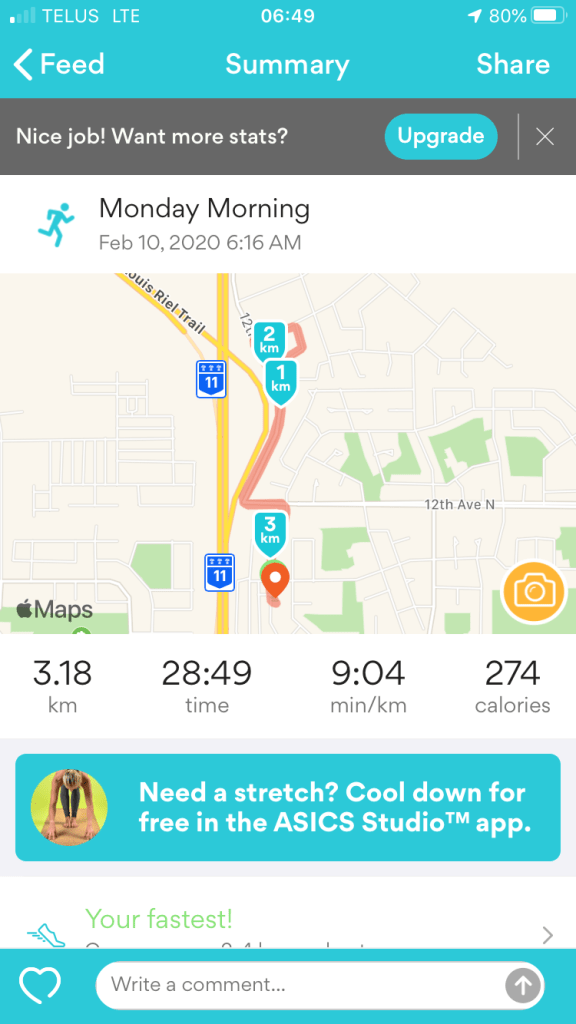
Monday morning’s stats on my run

The temperature was only -8 degrees Celsius, but that was apparently cold enough to cause my lungs to seize within the first half-kilometre. Running was fairly difficult, despite the quiet streets. But as you can see from the image above, I managed 3.18 kilometres in just under 29 minutes. Not too shabby, considering how long it’s been since I ran like that.

If I were to have planned it out better, I would have done a few things differently:

  1. I would have laced my boots tighter. It stands to reason that I couldn’t run during the winter months with my sneakers, so I had to wear a pair of my tactical boots. I’m reasonably used to running in those on the job, so I figured it would be the best bet. But those boots have a zipper down the side of each boot for easy removal, so I rarely have to tie them. This resulted in them being a bit loose yesterday while I ran. not only is this bad for your feet, it can cause blisters;
  2. I would have mapped out my route a bit better. My goal was to run a definite 3 miles. I used Google maps to track 1.5 kilometres with the intention of simply performing a round trip. The round trip should have totalled 3 kilometres, but either Google maps was a touch off, my RunKeeper app was a touch off or I don’t know how to trace a map properly. Luckily, the app calculates the average speed for me, so it took some of the math out of the equation; and
  3. I would have chosen my layers a bit better. I wore thermal pants and a long-sleeved thermal shirt, with nylon splash pants and a cotton t-shirt over that, followed by a winter jacket, balaclava and leather gloves. The balaclava was a good choice, as minutes into the run, I needed to cover my cheeks and it worked well for this purpose. However, my layering caused excess sweating (right, it was the layering!) and the cold was causing discomfort.

All in all, it was an alright run and it woke me up better than my usual first hit of caffeine. By the time I got back home, I was tired and sweaty but I felt good. This is encouraging for future runs. Not only will I be doing it again, but the goal now is to work on lowering that total time for a 3-kilometre run. The best part is that my blood sugar levels stayed consistent throughout the entire run. The worst part is that I have to go to karate tonight, and my legs are still screaming at me. this should be interesting! ☯