Just Because I’m Wrong Doesn’t Mean You’re Right…

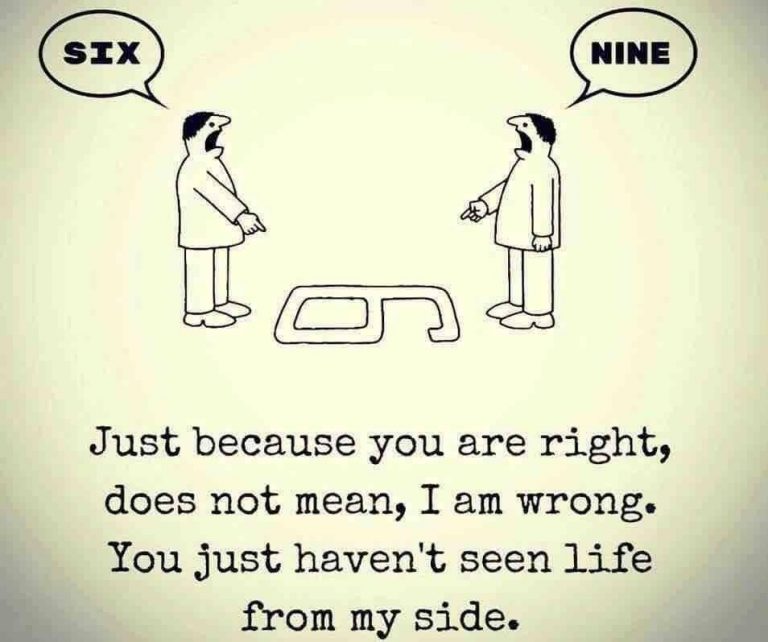
People hate to be wrong. I’m not sure why that is, but it’s a well-documented fact. Maybe it’s the fear of showing weakness in front of others, maybe it’s narcism or self-indulgence. But people flat out hate to be wrong. I’d be lying if I said that I enjoy being wrong, but knowing to accept it when you are is one of life’s big lessons. And for some reason, some will go out of their way to prove that they’re right even when they’re wrong.

Here’s the thing: whether or not you’re right will often be a matter of perspective. And a person’s perspective is very dependent on a number of different factors. One’s upbringing, values and beliefs will all go a very long way to molding a person’s perspective and lead them to where they believe they may be right about something, even when they’re not. It can be very difficult to navigate.

Always remember to be open-minded. Be willing to hear the other side of the story. It can mean the difference between fostering peace and causing unnecessary suffering. Maybe you’ll even learn something along the way. Sensei always used to say, “You have two ears and one mouth. That means you should listen TWICE as much as you talk.” Sound advice. Even if something being put out into the world is right, it doesn’t mean that you’re absolutely wrong.

But when we open ourselves to other perspectives and beliefs, it’s amazing how often it dissolves conflict. Being open-minded isn’t just something that happens on its own. It’s a choice. And a practice. ☯

Party ‘Til You Drop? No, Eating ‘Til You Drop!

It’s no secret that having Diabetes requires something of a fine balance of give and take for most aspects of one’s overall health and diet. However, when those two factors collide it can cause some chaotic issues that causes a role coaster of events that usually last for hours afterwards. What I’m referring to, is the act of overeating when one slips into Hypoglycemia or low blood sugar. It’s a common issue, but one that can cause untold damage.

Just a few short years ago, I used to have a nasty habit that when my blood sugar dropped below normal I would start eating carbs to bring it up. Sounds reasonable, right? The problem would arise when I’d KEEP eating until I felt better. That’s a problem, because if I’m still eating when I start feeling better it means that carbohydrates have already started correcting my levels quite some time ago and I’ve eaten WAY more than I need. In which case I need to buckle up, because I’m about to slingshot into Hyperglycaemia territory and I’m about to embark on a ride I like to call the roller coaster (but not a fun one!).

A few things to keep in mind when treating a low is that you have to trust that your body will do what it must, so long as you give it what it needs. Treating a low should involve consuming a fast-acting carbohydrate, such as fruit juice, regular sodas or gummy candies. Personally, I like a particular brand of jellybeans because eating a dozen of them packs a wicked carb-punch, kicks in reasonably quick AND I can buy bulk bags of them. You want to avoid things like chocolate, as they’ll take forever to kick in. They’ll still work since carbs are carbs; it’ll just take forever since chocolate is basically a slab of fat and your body will process the fat down before moving on to the carbohydrates.

The next thing to keep in mind is what might be happening with your body at any given moment. If you’re suffering a low during a workout, guess what? You’re gonna have to stop until you’ve corrected. It’s all well and good to “push yourself,” but low blood sugar isn’t one of those scenarios where you can try and reach new levels. Trust me, low blood sugar is not a place that you want to hang out. But I can personally attest to how annoying it is to be in a karate class and get a low. Stopping a workout is bad enough; leaving a class is even worse.

It’s important to know how many units of insulin you have on board at the moment, as well. If you’re suffering a low and you still have 14 units of insulin coursing through your system, your correction may need to be bigger or over a period of time as opposed to all at once, since the insulin will keep working. You want to avoid yo-yo-ing all over the place by correcting this low only to have the carbs in your actual meal kick in and make you skyrocket.

One really good example of this is pizza. The average slice of pizza is approximately 20 grams of carbohydrates (this is based on my specific experience and the pizza I consume, so always be certain to check nutritional information before bolusing) so if I’m having two or three slices, I’ll provide insulin as required. This means I’ll bolus for 40 or 60 grams of carbs, depending on how much I eat. Makes sense, right? But pizza is extremely slow to be processed.

This means that if I take ALL the insulin at once (which my current pump leaves me no choice on Auto Mode), I will likely suffer a low after a very short period of time. If I correct this low, it’s all well and good until the carbs in the pizza actually kick in and I suddenly find my blood sugar levels climbing to Everest-level heights. For foods that are that slow-acting, it’s better to deliver insulin in parts or slowly over a period of time. Some insulin pumps have the option of “square” or “dual” bolusing, which means to deliver over a chosen period of time or, some right away and some over a period of time, respectively.

It can be intimidating, since you have to face the possibility of sitting at low blood sugars for a period of time while your body processes the carbs and you start climbing to a normal level. This can be scary and sometimes not possible. For example, if you’re work doesn’t allow you to sit calmly and wait to go back to normal you may find yourself wolfing down sugar faster than your body will process it, which means you’ll experience high blood sugar soon thereafter. In the case of something like pizza, you may fall DANGEROUSLY low before the carbs finally kick and you may not have the choice but to treat the low and deal with delivering added insulin later to correct.

Riding the insulin roller coaster is no fun and can leave you feeling like crap, during and afterwards. With a little time and experience, you can learnt o adjust and know exactly what you’ll require to properly correct a low, what works for you and what works the fastest. But the important thing is to learn patience. Avoid overeating and give your fast-acting carbs the time to do their job. This is likely the hardest aspect of having low blood sugar, because no one wants to sit still when they feel shitty and they know their levels are low.

But if you correct, sit and rest and allow the carbs to kick in, you can avoid the roller coaster and be all the healthier for it. As usual, this is the part where I recommend a reasonable amount of exercise throughout the week as exercise will help to improve insulin sensitivity and takes at least one element off the table. Having Type-1 Diabetes involves many moving parts, but forewarned is forearmed. So, know your body and stay healthy! ☯

Is It Enough To Say It?

With the exception of this blog because, well… that’s the whole point of it, I don’t really go around advertising that I study Buddhism. It’s obviously not a shame thing, and it isn’t as though I’m not prepared to discussed the specifics of my beliefs when someone asks; it simply isn’t something I’m in the habit of doing. And I think that this is something important in relation to anyone’s faith. Having faith or being faithful shouldn’t require you to bring others into the fold. I often think about the poor practitioners who go from door to door…

I’m sure you can think of what faith system applies, although you may be surprised to know there are several who have this practice. What’s even more surprising is when these canvassers come to my door and are greeted by conversation and an exchange of information as opposed to having a door slammed in their face. Their faith is no threat to anyone. And if one is secure enough in their own faith, there should be no fear or worry in discussing it with others. But I certainly don’t envy them the task of walking all over neighbourhoods being rejected and refused, oftentimes in the cold or inclement weather.

It often surprises some to learn that I was born into a French Catholic family, and that I was in fact raised in the Catholic faith, well into my teens. I believe this surprise comes as the converting of one’s faith is not a frequent “genuine” event. What I mean by this is that there are plenty of newer-generation folks who will claim to follow one belief system or another, often to continue adhering to a previous one or changing to another whenever it suits them.

But when I reached my teens and started studying the martial arts, I fell into Buddhism almost as easily as one starts breathing at birth. This was one of the reasons why I chose to pursue it. I faced a surprising amount of opposition, especially from my family. You would think that family would be the most supportive, but considering my mother studied at a seminary in her youth and most of my aunts of my grandmother’s generation were nuns or missionaries, I think there was an expectation there, of automatic acceptance and perhaps a minty hint of obedience. I’ve even had an ex-girlfriend who once had the audacity to flat out tell me, “You’re not Buddhist! Stop saying that…” Needless to say, there’s a reason she’s an ex…

This has always made me wonder, is it enough to simply SAY that you follow a certain system of beliefs in order to be part of it? I think back to those formative years when I started studying Buddhism and knew next to nothing. I knew the ultimate goal was to find enlightenment and peace, which is what drew me to it in the first place. It seemed far more appealing than praying to an unseen, unknown deity that never responded or helped no matter how frequent prayer was leaned upon. But to some, it harmed my credibility that I lacked the knowledge to appropriately answer some of their questions.

During my youth, I was subjected to all the usual steps involved in someone’s indoctrination into a particular school of beliefs. I was baptized shortly after my birth, had First Communion and something referred to as “Confirmation,” which is a rite that involves confirming one’s adherence to that particular religion. I think this is interesting, because for all three of these rites I was too young and had no clear concept of what I was agreeing to or accepting; a fact that has long been argued in my mother’s household.

And granted, nothing in the Holy Bible actually speaks of NOT baptizing babies and children, but all the depictions I’ve ever seen of John the Baptist depict the baptism of an adult. How can one adhere to a system of beliefs without knowing WHAT they’re adhering to? It’s a question that’s plagued my noodle for decades and in some ways, many ways, I don’t feel this is right. Every person should have the ability to choose and understand what they’re agreeing to. But once you’ve made that decision, make sure you’ve made it because it’s right for you. And because it’s something you genuinely believe in.

Consider this for a moment: What is the point of saying that you’re Catholic if you never go to church, never pray, never study the Bible and adhere to NONE of the customs? Are you still Catholic? Or is is perhaps a label you’ve chosen to accept because it was imposed on you earlier in life? Or does it make your life simpler to have yourself categorized in a world where belief systems are considered important? I use Catholicism as the example because it’s what I was born into, but the same can apply to any system of beliefs.

I don’t have the answers. I can’t answer EVERY single question about Buddhism that comes my way, but I certainly aim to learn as much as I can. And maybe that’s the point. If I knew everything, there would be no purpose to life. I study Buddhism because I ultimately know that eventually I’ll find all the answers I seek and find peace. Perhaps that realization, in and of itself, is the enlightenment I seek and I simply haven’t realized it yet. But someday I will.

Be true to yourself. Be sure that your faith does not harm you, bring harm to others or create chaos within life and you can’t go wrong. At the end of the day, the story of everyone’s life begins and ends the same way. It’s how we fill the days in between that define who we are and the mark we leave on the world when we’re gone. And do your best to encourage peace. ☯

“There Is A Misconception That Buddhism Is A Religion, And That You Worship Buddha. Buddhism Is A Practice, Like Yoga. You Can Be A Christian And Practice Buddhism. I Met A Catholic Priest Who Lives In A Buddhist Monastery In France. He Told Me That Buddhism Makes Him A Better Christian. I Love That.”

– Thich Nhat Hanh

A Weak House Of Cards

You know, I’m a big fan of how far society and technology have come. If it weren’t for said advances in technology, my Diabetes control would likely be far less than what it is now. But there’s something to be said for the good ol’ days; the days when people actually dealt with the situation in front of them instead of taking the easy way out. And like a fragile house of cards, it can be amazing how removing one card from the pile will usually make the whole, planned thing fall asunder…

Life rarely cares about one’s plan and it can be pretty frustrating when things don’t go according to them. A week ago, I had an appointment to travel to Saskatoon for my eye injections, which take place every eight weeks. After only about six hours’ sleep, my wife and I began receiving multiple text messages followed by phone calls. It seems that due to cold weather, the bus system that would transport my son Nathan to school was being cancelled.

Not classes themselves, mind you… Just the buses. Weird. Must be a Prairie thing. This is one of those times when I become the old man who complains and tells the epic story of how every day was a 4-mile walk to school, uphill, through ten feet of snow while fighting wolves… The problem is, I really DID have an 4-mile walk to school. Not the rest of the stuff, mind you. Living in Northern New Brunswick, I used to leave the house an hour and a half before first bell in order to walk half way around the base of a mountain to reach my school. Y’all can look it up, it was a small town called Dalhousie, New Brunswick. Both French and English high schools are STILL at the top of a mountain. Granted, I had the benefit of walking on a groomed snowmobile trail. But I digress…

In my day, they cancelled schools not the vehicles that transported the students, which meant that cancellations would be announced via radio WHILE I was on foot to reach school. I would only find out that classes had been cancelled once I walked in and some cranky janitor would ask me why I was there and to go home. This would be followed by my inevitable trek back home, regardless of the cold or weather, since classes had been cancelled.

But these text messages and phone calls my wife and I received were to advise us that the bus systems meant to transport my son to school were being cancelled due to the cold weather. Not classes. Classes would still be taking place. Just the buses. Fuck. I won’t get into the specifics as to why it made it unlikely that Nathan would be going to school other than to provide that our schedules as well as the distance and location of the school meant that Nathan couldn’t walk and transporting him there ourselves couldn’t happen, either.

He missed school on Monday and Tuesday because I was absent for my eyes and we don’t have a second vehicle. The school bus system got back into the groove for Wednesday, but that was short-lived as they started cancelling it out on Thursday again. This is where that question of technology from my opening paragraph comes into play. It’s 2021, people! We’ve put people on the moon; surely there’s a way to have school buses running during winter weather. This is Saskatchewan, the cold ain’t going anywhere!

And just like that, the house of cards with which the week was standing on came tumbling down. Now, I’m not a mechanic or an expert. And I can admit that my son’s school bus is likely older than our family vehicle. I use the term “likely,” because they all look the same, regardless of their age. So it can be hard to gauge. But I can guarantee that since block heaters were invented in 1947 and covered transportation hubs are a thing, I find it hard to understand why the transportation option would be unable to run while they would still expect teachers and staff to start their own vehicles and make their way to school.

And it’s a pretty safe guarantee that most parents are not in a position to get their kids to school themselves, present company included. I don’t do the whole “wind chill” thing. If the weather says -35 degrees, then it’s -35 degrees! And I’m sure that Nathan was more than happy to have a couple of snow days, sleep in and relax at home with his baby brother. But it’s pretty weak sauce that they don’t seem able to start industrial transportation vehicles and clear them of snow in order for our children to be transported to school. Kinda makes me reconsider how advanced this whole technology thing really… (end rant). ☯

Happy Valentine’s Day ❤️

Happy Valentine’s Day! Hopefully amidst the state of the world, y’all have someone special to curl up under a blanket and stay warm with. And if you don’t, remember that loving oneself is just as important and something special can still be done. Despite my typical habit of being sarcastic and making puns, I genuinely mean that and am not trying to be lewd or suggestive. Here are a few quick facts about the origins of this particular day:

Valentine’s Day is based on Valentinus, a martyred saint that is thought to have defied the Roman Emperor by continuing to perform marriages in secret for young lovers after they were outlawed;

Some historical writings suggest as many as three different men who may have been the actual “Valentine,” who were all martyred and executed;

One of the stories depicts Valentine being imprisoned and falling in love with his jailor’s daughter. When Valentine sent her a note prior to his execution, he signed it “From your Valentine,” which is the popular phrase still used today.

I’ll keep this one short and I don’t have any sources to cite. These are just facts that I’ve read about throughout the years that have stuck with me. There are even articles that explain how Valentine’s Day was created by the Christian church to cover up and outlawed pagan holiday called “Lupercalia.” But I ain’t gonna get into any of that.

In modern days, Valentine’s Day has become heavily commercialized, with the sale of cards, chocolate and various “romantic” trinkets becoming a huge cash cow for retail locations. I’ve always been a fond believer that if you’re genuinely in love, you don’t need one specific day of the year to express it. Such a thing can be done on any day of the year and in fact, should be done all days of the year. Now if you’ll excuse me, I have some chocolate to go eat… ☯

“Seiza” The Opportunity For Meditation Facts…

A couple of weeks ago I was chatting with a fellow blogger who asked me an interesting question in relation to how I meditate. We had been discussing the ability and opportunity to meditate in the midst of being at home with family, pretty much around the clock. This discussion led to a question about what posture I use and how I deal with comfort issues and positioning during meditation. Since I effectively never do anything the easy way, the answer is not as simple as one specific pose or position.

The kneeling position, known in martial arts circles as “Seiza”

For the most part, I sit in a kneeling position during meditation. That doesn’t mean that this is always the OPTIMAL position, and I do tend to use a few different ones. But the position you see illustrated above is one that’s also associated with karate and some formal Japanese settings, so I’ve had most of my life to get used to it. Named “Seiza,” this position requires the person to kneel on the floor, placing their calves beneath their thighs and pointing the toes out behind them. The big toe on the right foot overlaps the left one, and the butt rests on the heels of the feet.

There’s a bunch of pomp and ceremony that goes into how to sit down and get up when using this posture, as well as when it’s appropriate and/or required to use it. But this post ain’t about all that. This is a posture that Sensei would often have us close out in, as it allows for a few moments of deep breathing and contemplation at the end of a workout. It also makes it significantly easier to bow respectfully when karate class closes. This posture is also used at the current karate school I train with, both at the beginning and the end of class.

From a meditation standpoint, I like this posture because it effectively forces me to sit up straight. I can breathe fully and unlike the lotus position, which I’ll cover off next, this posture doesn’t allow much room for me to slouch or slump. The downside is that sitting on one’s legs for more than about 20 or 30 minutes can lead to a condition called “paresthesia,” which is where some of the nerves and the blood flow in the legs become compromised resulting in the “pins and needles” sensation when a limb falls asleep. It’s never a good thing to block circulation, and since a Type-1 Diabetic’s circulation isn’t all that great to begin with, this can be a concern if you plan on meditating for a long period of time.

The next important posture is the lotus position. This is the classic and most recognizable posture in meditation. In fact, any time you see a statue of Buddha, he’s likely seated in the lotus position. This involves sitting with your butt on the floor with the left foot resting on top of the right thigh and the right foot resting on top of the left thigh in a cross-legged position. The hands are generally resting on top of the thighs, usually with the index and thumb of each hand joined together. This pose is not only used in meditation but is also used in forms of yoga, and is thought to promote the proper channeling of the body’s energy.

This can be a more comfortable posture to assume if you plan on meditating for a half hour or longer, as it won’t necessarily constrict blood circulation the way Seiza does. The problem I find with this posture is that unless I’m propped against a wall, I tend to let my shoulders slump or I start slouching at the upper back, which can become uncomfortable and damaging to the spine over long periods of time. Lotus has many variations to it and I usually favour the “half lotus,” which involves only setting one of the feet on top of the opposing knee with the other one simply being on the floor. This prevents the usual possible circulatory issues.

If you have Diabetes (or any other circulatory issues) there are a few things you can do to help facilitate meditation, regardless of what pose you use. You can get a meditation pillow. These are great as they keep your butt about four to six inches up off the ground, putting less stress on the knees, hips and various joints associated with meditative postures. The Japanese have special little folding stools that allow for the appearance of the kneeling position while taking the stress off of joints and allowing proper circulation.

Last but not least, you can try traditional postures, such as sitting in a chair. This is fine and I’d be lying if I said that I’ve NEVER done it. It just feels weird to me. Probably because I’ve spent my entire life using formal postures. Sitting in a chair just feels like it takes something away from the experience. You can also try lying flat, either on the floor, a yoga mat or on your bed. The only problem with this is if you lie on your bed and start breathing deeply with your eyes closed, you face the risk of falling asleep. Although I’m a big fan of naps and falling asleep isn’t necessarily a bad thing, it also usually isn’t my goal when I meditate. So I try to avoid this posture unless I’m having difficulty sleeping and I’m intentionally trying to meditate my way to dreamland.

Obviously, there are different types of meditation and postures that go along with them. Depending on what your goal is with meditation, you can’t really go wrong. The important thing is to find a posture that’s comfortable and suits YOU. It should accommodate your body and allow you to relax so that breathing, energy and blood flow are facilitated and you can focus on the mindfulness required for proper meditation. As I’ve often written, every person is different so it should be no surprise that each person’s needs and preference may be different from a meditative standpoint. ☯

Family Ties In The Dojo

We love our families and want nothing but the best for them. Sometimes, the best is not what we think it is and can only be sought out by the family members themselves. But health and fitness doesn’t discriminate, and it’s important that everyone in the family get off the couch and do something physical at least a few times a week. This isn’t always an easy thing to encourage, and some family members will often be less than enthusiastic about being put through the ringer; especially if you happen to be the instructor…

If you happen to be an instructor of a sports club or a martial arts dojo, getting your family involved can be a good or a bad thing. I’ve seen it all… Family members who have basically been forced or coerced to join and family members who feel it necessary to “tag along” even if their efforts are far below what would usually be required of the environment. It can be a difficult and awkward situation, especially since you need to go home and live in relative peace with these people once class is done.

Trying to teach Nathan the basics back in 2019. Kid can’t take a hit…

One of the best examples I can think of are Sensei and his son. As his only male child, Sensei expected his son to train diligently and consistently. And to excel. A bit of an archaic way of thinking by today’s standards but remember that I’m referring to 40 years ago. The son was made to attend every class, train every day and even to start teaching at a young age, despite the fact that by the time he reached his pre-teens, he expressed no interest in karate. As a practitioner myself, I can certainly relate to how heartbreaking that would be. But it’s important to remember that even if karate is your thing, it may not be your child’s.

The result of that forced learning is that decades later, Sensei’s son is no longer an active practitioner. Oh sure, he has skills that will always be with him. And appropriately, he was Sensei’s first student to pass black belt. Those are all important milestones for both of them. But when you compare it to someone like me, who has been eating, breathing and sleeping karate for over 30 years but who joined and trained of his own volition, the difference is I still make it a part of my daily life and have ambitions to teach.

Training with a spouse or loved one has its own set of complications. Imagine having your spouse in your karate class, yelling at her, making her do knuckle push-ups and basically flooring her physically. Then getting home that evening and expecting to share a shower or snuggling up as though you DIDN’T just make her life a living hell. Much to the same tune as working a job with a spouse, training with them can be rough waters to navigate. And if it’s to be attempted, clearly defined parameters and guidelines for what’s expected and what will be done need to be established. By the same token, making sure that nothing is done that could be considered favouritism needs to be kept in mind as well.

It’s important to remember that the familial title should be the priority. If you’re a husband, then that’s your role and it would be very difficult to be a slave-driving instructor to your spouse. They can hate an instructor all they want, so long as they get the results they seek. But it’s a little hard to release and use that hatred against your husband. The same can be said of your children, as forcing them into something they don’t want to do could potentially sour them from being interested in any similar activities in the future. And it’s just as important that ALL family members be active, albeit occasionally for different reasons.

This doesn’t mean that you can’t be active with your family. You can participate in a variety of sports and activities that can get the heart pumping without necessarily taking on an instructional role. Taking walks, snowball fights or sledding are great family activities. Even a good old fashion pillow fight, so long as you have the space and a safe environment to do so. Nathan and I often just roll on the floor mats downstairs, wrestling and grappling. He has a blast playing around while I’m slowly teaching him some grappling techniques. And he’s started showing interest in picking up the 3-pound dumbbells and imitating what I do during at-home workouts.

My wife does not train in karate, but we still work out together whenever we have the chance. Couples who get fit together, stay together. But it would be a different story if I had to act in a capacity where I had to constantly push her and force her to do more. Such student/teacher relationships can lead to resentment and hard feelings. That’s why it’s very difficult, bordering on the impossible for anyone to fill that role while still maintaining the relationship.

There’s no problem with encouraging family members to exercise together and get fit together. In fact, in can even be an inexpensive way of keeping the family involved together during trying times while getting some much needed exercise. But the day your spouse or child decides to walk into your dojo may require some wariness and caution on your part. The difference between “Yes, Sensei!” and “Yes, Dear!” or “Yes, Daddy!” can mean the difference between a happy household or a few slammed doors. ☯

Are You Making Faces At Me?

Unless I’m engaging someone in conversation, I usually tend to stay silent on my shopping excursions. I acknowledge and greet the employees of whatever location I may frequent with a smile and a nod, sometimes even allowing the smile to reach my eyes, which can also speak volumes. So, how does it affect communication when we all wear a facial mask that covers our facial expressions? Do we NEED those facial expressions? Are they necessary for everyday communication? The simple is answer is yes. And no. Of course I won’t make it simple…

There are plenty of animals who use facial expressions as part of communication. In fact, horses, dogs and chimpanzees all have a plethora of facial expressions although they may be using them for different reasons. I’m not a veterinarian. But humans use facial expressions as part of their communication with other humans, which can be found lacking if the recipient can’t see your face. I’ve found this to be an issue during this entire pandemic, when a smile and nod still looks as though you’re deadpan even when you aren’t.

Think about a simple email you sent that was completely misinterpreted… Maybe you were in a perfectly good mood when you sent it and had no malicious intent behind it. THEN you get an aggressive response from the recipient, accusing you of being rude and aggressive with THEM. Ever happen to you? I’ve had supervisors who I’ve asked for help with something, only to have them snap back, accusing me of telling them how to do their jobs. It actually happens a lot.

Despite the words being the same, the recipient can’t see your body language, sense your tone or feel the intonations behind your communication. For example, your spouse saying “you’re such an asshole!” while smiling shyly and shaking her head at you can seem playful and can even be interpreted as a sign of affection. Having that same spouse text message “you’re such an asshole!” without any context will likely have you thinking you’re in trouble for something. This is the same deal. Facial expressions are integral to proper communication.

It’s taken me a while to recognize that when someone out in public says hello or thank you, a simple smile is no longer enough. Because they won’t see it. Oh, there may some small movements of the mask that could potentially tell an observant person that there’s something happening beneath the mask. But for the most part, I look like a creepy mute guy, squinting at the door greeter on my way out. I’ve had to make a concerted effort to remember to actually say “thank you” or “have a nice day.” First world problems, right?

To be honest, I’m not sure where I was going with this post. I admittedly just throw my thoughts out on occasion. But this is another instance where the pandemic has affected our daily lives, much without us thinking about it. Lack of visible facial expressions makes it harder to communicate in public on top of our voices being somewhat muffled by the mask. Added on top of steamy glasses and the unexpected belch that basically makes you hotbox yourself and it adds a bit of speed to your grocery shopping. ☯

My New YouTube Channel

Hey folks! I know I’m not in the habit of drafting two posts in a day and it’s a bit late in the game to be posting a second one, but I’ve decided to put my face on camera and started my own YouTube channel. I only have one video on there, which is scheduled to go live in about ten minutes. But I’m hoping to use the video aspect to discuss and demonstrate things that are a bit difficult to explain with words and photos. If y’all wouldn’t mind visiting the channel and clicking those little “like” and “follow” buttons, I can start pumping out videos in tandem with my blog posts. For any one interested, here’s the link to the YouTube channel.

Check out this first video, which I recoded tonight…

Hopefully, it doesn’t bore everyone any worse than my long-winded posts usually do. I look forward to sharing more in the future. If anyone has any thoughts on something I should be posting in video format as opposed to in written form, please let me know in the comments. ☯

The Unexpected Prejudice

When we think about the word “prejudice,” we mostly think about race, culture, ethnic background or religion. To name a few. But in reality, the term “prejudice” refers to preconceived notions or opinions about someone else, based on something that is KNOWN about the person. This opinion or notions, however, are never based on fact or actual knowledge. Having someone be prejudice against you for any reason can be hurtful, harmful and cause damage to a person’s self-esteem and even prevent certain advancements on life.

I bring this up because believe it or not, I’ve spent a good portion of my life having folks be prejudice against me, because of my Diabetes. Hard to believe? I know. It SHOULD be hard to believe because it isn’t something that should occur. But believe me when I say that it has happened to me far too many times to recount, for a variety of different reasons. I started being “pigeonholed” at a very young age; essentially being dropped into a category that defined me according to my condition as opposed to who I was as a person or what contributions or goals I could achieve.

This started extremely early; as far back as when I was first diagnosed. I was part of a younger group of Scouts, called Beavers (let’s keep the NSFW jokes to a minimum, shall we?). I joined this group when I was 4 years old, and believe me when I say that I was pretty excited about it. Then I was diagnosed with Type-1 Diabetes. A group “camping” event, which entailed staying in the community hall with sleeping bags over a weekend, was denied me on the basis that I had Diabetes. My parents objected to this and tried to do everything possible to allow me to attend. At the end of the argument, my mother even volunteered to attend and stay the weekend as well, in order to deal with the Diabetes aspect of the issue. I was still refused.

I know what you’re going to say; as an adult I understand what the Scouts’ view of the situation might have been. There are risks and liabilities and issues that Scouts Canada simply wouldn’t have wanted to take responsibility for. I get it. But I probably would have been far more understanding at the time, had they made an effort to understand what was going on rather than simply say, “Sorry, we can’t accommodate him.” Effectively, my time as a Scout was over before it began. It shouldn’t have been a big deal. But given my age, it set the tone for all the things that would follow through my life.

My diagnosis came while I was attending kindergarten. This was the big one, because it set the tone for the next decade, in terms of who befriended me and what groups I could have been part of. I still remember the embarrassing “speech” the teacher gave about how I was a “special kind of sick,” and that the children had to treat me gently and tell her immediately if I was found to be acting strangely or seemed too sleepy. ARE YOU FUCKIN’ KIDDING ME???? Setting aside the fact that I’m already weirder than a pillowcase full of angry ferrets, this basically told a bunch of 4 and 5 year olds that there was something strange and different about me. The effect was that most of the kids avoided me unless they were forced to join me for a group lesson during class.

All throughout my formative years in school, I was denied certain group activities, sports and/or teams on the basis of my Diabetes. Some years, I was automatically excused from gym classes and given a basic passing mark for sitting on the side while the rest of my class would play ball, run and exercise, leaving me to rot as opposed to growing my physical capabilities. One would be inclined to think that teachers and adults would be more enlightened and ask certain questions about my condition before simply writing me off. After all, this was well before the snowflake generation of getting offended at everything, so my parents and I would have gladly answered any questions got assuage any concerns.

But instead, it was easier for all of them to live within their (incorrect) preconceived notions and cats me aside, refusing to take responsibility or take a chance on the possibility that something could happen to me while I was in their care. And I get that. Now. Back then, it was a constant feeling of being rejected and segregated. No wonder my health waned and I took a downward turn when I was nearing 10 years old. I was never allowed the opportunity to participate in sports and be a part of the group. If this happened now, there’d be an uproar! People would mount protests, parents’ groups would petition the school board, people would lose their jobs… Anarchy! But I just took it in stride.

I’d like to say that when I finally joined karate that things turned around. And yes, they turned around from a health standpoint, but even karate was a problem. Because my parents refused to let me join, thinking I’d get hurt or that my blood sugars wouldn’t allow me to survive a 2-hour class. As I’ve mentioned in previous posts, I had to join in secret, using my merger allowance to pay what tuition I could. Sensei was really good about never asking questions and trained me no differently than anybody else. That’s when I started to accumulate some mass, gained strength, speed and reflexes and discovered that I could have potentially have had a different path if I could have started to gain these benefits at a younger age as opposed to having everyone simply sit me on the side to watch. After all, life isn’t a spectator sport.

It’s extremely important that you never assume something about someone else’s condition. For my specific example, I may have had a rough start during my childhood. But once I took control of my health and fitness, I took huge strides and have suffered almost none of the usual complications associated with Diabetes. And what’s more is I’ve trained in the martial arts for over three decades, still have all my toes and appendages and have fathered two children. Many said I’d never accomplish any of that. Shame on them. ☯