The Hood-Gi…

I pride myself on the fact that I don’t usually endorse or encourage the purchase and/or use of any particular product. My blog isn’t intended as a “shopping” site where I throw out goods or services. That being said, any person who regularly reads my blog on any browser has noticed there are advertisements on my posts but if I’m being honest, they do very little for my bottom line. I’ll often make a point of reviewing books, movies and certain key products without necessarily endorsing them.

But once in a while, I treat myself to something that I feel is worth sharing, and today’s post is just that kind of exception. Like most couples, Valentine’s Day brings an opportunity to do something romantic for our partners, in whatever way we recognize will be something that pleases them and lets them know much we love them. For myself, I actually had a very nice item that I had ordered for my wife but when the product in question arrived, it was nothing like what I assumed it would. I was back to the drawing board.

My wife, for her part, asked me what I would like. And this is where I introduced her to the Hood-Gi. This garment is exactly what it sounds like; the combination of a hoodie and a martial arts Gi. Since I’m subscribed to a plethora of martial arts pages through my Facebook and social media platforms, the good ol’ AI bots that monitor social media pages will often throw martial arts-related pages at me. Sometimes they’re interesting, sometimes they’re not. On this occasion, I found the Budo Brothers website…

My Hood-Gi…

I was intrigued by this concept of a Hood-Gi, so I visited the webpage. I found a couple of martial artists who came together almost a decade ago and began designing clothing and equipment aimed at the interest and functionality required by martial artists. My intrigued continued as I found a variety of products on the website ranging from batons, kali sticks and cloths, to the Hood-Gi, which is what I ended up ordering.

Gotta love the blue…

So, what makes this garment so special? Well, the outside of the hoodie is made from actual Gi material. It’s pretty heavy and has some toughness to it. I spent the majority of last weekend wearing it in order to break it in, much like I would with a traditional Gi. The inner liner has a beautiful Japanese “wave” liner inside. Unlike a traditional Gi, which fastens by tying it off at two corners, the Hood-Gi uses magnetic buttons, which I was sceptical about at first but actually hold the garment securely closed.

There’s a normal traditional front pocket as you’d find on any standard hoodie. But the garment also contains side pockets for self-defence items and an inner pocket that can hold your smart phone. The hood is slightly oversized, which almost give it a “Jedi” look. All in all the garment is incredibly comfortable and I’m looking forward to wearing it outside the house as the weather gets warmer (it’s too thick to be worn under a jacket).

All in all, it’s definitely a fun piece of clothing and if any of you decide you want to check out their website, you can find them here. They have a variety of products and just as an FYI, it appears that they ship out of the United States, so just be aware if you’re ordering from another country. Otherwise, the martial artist in me can appreciate the asthetic and functionality of this garment while the old, dad-bod in me appreciates the comfort and look. ☯️

From This Life To The Next One…

Walking in martial arts circles usually brings with it a fairly rich family tree of karate. One is generally taught by one’s Sensei, who is taught by their Sensei and so on and so forth. For many, if not most students, being able to trace that lineage beyond the first step is pretty rare. After all, most practitioners in the western world open a dojo and may have a photo of those who taught before them, but general contact is pretty rare. I was fortunate n the fact that Sensei has always kept contact with me. Sensei has always kept contact with HIS Sensei and as a result, I had the pleasure and opportunity to take steps up the ladder to train with those individuals.

One of the most notable individuals that I’ve had the pleasure to meet, was Sensei Bob Blaisdell. My Sensei first met Sensei Blaisdell through a magazine advertisement in the early 1970’s. Sensei jumped into his rundown Mustang and travelled on his own to Massachusetts, intent on convincing Sensei Blaisdell to train him in the Okinawan art of Uechi-Ryu karate. Sensei Blaisdell was leery of this random, French, New Brunswicker who left behind his wife and daughter to travel across the border to learn karate. But something in Sensei’s eyes convinced Sensei Blaisdell to take him on and he became his trusted teacher and mentor. He became his friend. He became his Sensei. Over the years that followed, Sensei would travel down to Massachusetts intermittently for coaching, testing and guidance on teaching at his own school.

Me, Sensei, Sensei Eva and Sensei Blaisdell

I just found out yesterday that after 49 years of being my mentor’s Sensei, Sensei Blaisdell has passed away.

I first met Sensei Blaisdell in the early 1990’s, when I was still a skinny punk who thought he knew it all without the common sense to prevent trying to prove it. We had arranged to bring Sensei Blaisdell up to New Brunswick to help us celebrate Sensei’s 30-year anniversary of teaching. I had the privilege of training with him and getting to know him over the weekend. Armed with a heavy Boston accent and swearing as heavily as a Maritimer, it was an instructive and enlightening weekend. The fact he had embarrassing stories about Sensei certainly helped. Usually, it’s the other way around and Sensei shares embarrassing stories about me.

For the years that followed, Sensei Blaisdell’s influence would carry on through all of us. And rightly so, since my Sensei learned directly from him. The thing that most students fail to understand is that their skills and capabilities are a direct result of those who came before them. Had my Sensei not trained with Sensei Blaisdell and then subsequently trained me, I wouldn’t be the martial artists that I am today. Through his actions, Uechi-ryu karate was brought to Northern New Brunswick and endured as one of the only traditional Okinawan karate schools under Sensei’s teachings in that part of the Maritimes for almost five decades. The man’s signature is on my black belt certificate, for light’s sake…

Sensei Bob Blaisdell

It’s always important to know where one’s roots come from, in order to acknowledge where we’re going. We’ve lost touched over the past couple of decades. Some of that is my doing. Life rarely cares about one’s plans. That makes his death all the more tragic. Time is fleeting and can never be taken back. And maybe that’s what makes this loss so hard. Or maybe it’s the knowledge that death comes to us all, and that Sensei may be the next loss I suffer. Or maybe, just maybe, it’s making me acknowledge my own mortality. In either scenario, Sensei Blaisdell’s influence continues to teach me something, even in his passing. Rest in peace, Sensei Bob. You will be missed. ☯️

Feelin’ The Burn…

It’s not secret that I enjoy trying out new workouts. More than anything else, I fell it’s an important step in keeping things fresh, which in turn will help to keep things interesting when trying to stick to a fitness regime. But different workouts will work different muscle groups and provide different short and long term results, so it’s always good to mix it up and try something different. A couple of years ago, I found a simple body weight workout used by submarine occupants. The idea is that they needed something that could be done on a confined space, without the use of much equipment.

I bring it up because I did the workout the day before last and I’m only today feeling the deep, muscular pain associated with it. But it is a genuinely fantastic workout that works all the large muscle groups and helps to increase strength and stamina. It only takes twenty to thirty minutes to perform and I often use it as an alternative if I’m staying in a hotel or need something quick and easy because I don’t have time for anything else. Admittedly, the portion I use is only part 1 of 2 but believe me when I say it’s enough to get a solid sweat and have your limbs praying for mercy. Here we go…

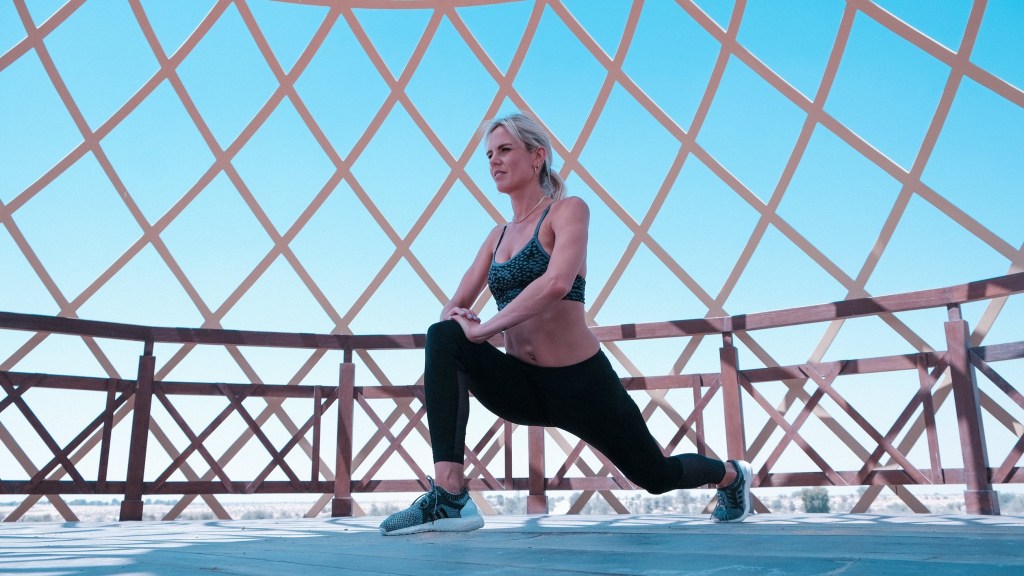
The circuit is pretty basic. You start with 15 normal squats (pictured above, go all the way down and don’t be lazy) followed by 10 diamond push-ups (push-ups where your hands are touching in front of you, below your chest), 10 regular lunges and 15 regular push-ups. Once you’ve completed that circuit, you start again but this you’ll be doing 14-9-9-14. Keep repeating the circuit and dropping everything by one rep for every circuit. Make sense?

As you work through it, the entire workout should look like this:

Squats/Diamond P-Ups/Lunges/P-Ups
15-10-10-15
14-9-9-14
13-8-8-13
12-7-7-12
11-6-6-11
10-5-5-10
9-4-4-9
8-3-3-8
7-2-2-7
6-1-1-6
5-0-0-5
4-0-0-4
3-0-0-3
2-0-0-2
1-0-0-1
Fall to the floor and pass out… Kidding!

I normally take about 30 to 45 seconds to rest and sip water between each circuit. That being said, once the first and last exercises reach 5 and I’m no longer doing diamond push-ups or lunges, I try to hammer through the last five circuits without resting. It tends to provide that added little bit of burn at the end when one typically wants to throw in the towel. Your lunges can be done with some light dumbbells, if you have them.

For myself, I’ve started doing the entire workout with a 20-pound weighted vest, which has certainly made it more challenging and has given me a better appreciation for folks who live their everyday with 20 pounds more weight than I carry. It’s amazing how such a low addition of weight to one’s overall body makes a significant and noticeable difference. Despite how taxing the workout is, it’s low impact and simple, making it extremely flexible in terms of adding in extras or modifying the exercises.

So there you have it! If you’re looking for something that’s quick, simple and provides an insane burn to your muscles, look no further. I’ve also noticed that this workout doesn’t seem to drop my blood sugars in any significant way. If anything, it sometimes rises by a half point. Remember to stay well hydrated as this circuit will have you sweating out every drop of bodily fluid you may have. And as usual, if you feel unexpected sharp pains, shortness of breath or dizziness, you should stop immediately. Even if the circuit takes a little less than 30 minutes, there’s no reason not to take more time to complete it during the first few times you use it. Stay healthy! ☯️

Punching Pads, A Mixed Bag…

Yesterday I wrote about a fantastic opportunity I had last weekend, to go work out on my trusty punching bag. During this workout, I mentioned a punch pad I had in the garage as well and some inquiries to my inbox led me to think that folks didn’t know what I was referring to. The thing is, I have to striking stations in my garage. The first is my punching bag. The second is a small, square pad bolted to the wall. This pad was originally installed against the wall in my basement but since renovating, was relocated to the outside.

My punching bag, with the punch pad clearly visible on the wall to its right…

Striking a punch pad that firmly in place provides different benefits to one’s strike training. For example, I think we can all agree that for the most part, when you strike a person, they’re going to move. Unless they’re Kryptonian, it’s unlikely that they’ll be firm in where they stand if you punch or kick them. A punching bag is pretty good at simulating that effect. A punching bag also allows for a variety of striking techniques, from kicks to punches, elbow strikes to knee strikes. The pad won’t necessarily allow for all of that.

That being said, the pad has some distinctive advantages as well. Besides making my strikes look more impressive to my son (the garage shakes when I punch it), its small size requires a level of precision to my aim that the punching bag is far more forgiving on. So long as I throw a punch at the bag and be cautious not to roll my wrist on it, I can pretty much punch anywhere with the understanding that I’ll hit it. The pad is far less forgiving, having a surface area of about 6×6 inches, requiring me to ensure my aim is true. The alternative is punching a solid wall…

The pad also won’t give or move away once struck. This changes the dynamic behind how I strike. The possibility of sprains or injury increases, but so does muscle development and strength. Since the pad doesn’t yield under my strike, every punch builds greater power. This can be handy when one is learning to punch properly or is looking to ensure proper bone alignment during strikes, since a few degrees in the wrong direction will hurt you more than whomever you intend to strike.

My pad, when it was still newish and fastened on my basement wall

As useful as this punch pad can be, it has it’s disadvantages. Kicking the pad is less than ideal. Some other striking techniques, such as varieties of elbow strikes, can’t be performed on the pad or depend on the angle of approach. Admittedly, I purchased this striking pad a few years ago when I was too cheap to purchase a full punching bag for myself. It was a cost-effective alternative that still let me add some striking to my training routine. Eventually, I moved the pad out to the garage when we demolished and renovated the basement. I got my punching bag soon after.

Since the basement renovations were completed in the fall of 2023, I could have moved the pad back inside. this would make strike training more accessible during the winter months. But i just can’t bring myself to mar the newly dry walled surface of my basement walls. And given that we have a little one in the house, making the walls shake by constantly pounding on them likely isn’t ideal either. But there you have it! That’s the difference between my punching bag and my striking pad. ☯️

Frosted Fun In Milder Weather…

One of the big things that makes winter drag on for me, is the inability to use my bicycle or my punching bag. Oh, sure… I could be like of those sorry idiots you see riding the city streets on a bike in the snow. But I value my life a little too much for that. And the issue with the punching is imply managing to stay outside in the cold for that long. Even if I only use the bag for a half hour, the extremes colds we get in Saskatchewan are often enough to make it unwise, if not outright dangerous.

That’s why let weekend was a welcome gift, with temperatures actually rising above 0 degrees. Recently, my wife and I have started sending our oldest outside to play on the weekends. That likely makes it sound like we didn’t before and I should probably clarify… Because he now has a Nintendo Switch as well as a disabled iPhone on which to do homework and stream Netflix Kids, he very rarely wants to do anything else. Getting him to play in the great outdoors has become something of a challenge, despite the vast plethora of toys and gadgets he has in his play shed that he can use to entertain himself. but I digress…

On Saturday, I noticed it was only -1 degrees outside. As usual, I shut down all of his devices and coaxed him outside to play. He put in his hour and came back in, citing fatigue. Once he was curled back up in a corner and playing his games, it dawned on me that I should have joined him. The milder weather would have been an excellent opportunity to hit the bag. Instead, I ended up doing a workout inside, as I usually do. Recently, I’ve been trying to push myself to workout on a daily basis so that I can hopefully start to shed some of the winter blubber from my mid-section.

The following day held weather just as nice, so I decided to join Nathan outside and do a 30-minute punching bag circuit that I have on my phone. It involves striking the bag for a full minute, then taking a 30-second break. Wash, rinse and repeat for a half hour. It’s pretty good at working up a sweat and as long as you put in the effort, it’s a pretty good way to burn calories and tone the arms, as well. I got through the circuit and made my way back inside the house, tired and sweaty but satisfied. I noted some pros and cons to working out on the bag in colder weather. And I’m gonna share ‘em with you now…

On the positive side, it was remarkably easier to breathe. Since I usually spend time on the bag in the summer, the heavy humidity and high heat not only make it difficult to breathe but it also brings me closer to dehydration with every punch. I didn’t have that issue. I also didn’t need to stop for water as often or sweat as profusely into my eyes. That being said, now is a good time to remind everyone that just because you’re not sweating, doesn’t mean you shouldn’t work to stay hydrated. That can be a bit of a slippery slope, kind of like neglecting to use sunblock in the winter.

Another good thing is that I had to keep moving in order to stay warm. Granted, it was only about -4 degrees but wearing a long-sleeved dry-fit shirt under a sleeveless hoodie didn’t do much to keep the chill at bay. This resulted in a need to keep moving constantly in order to maintain my body’s warmth. The result is less stopping and less breaks throughout the workout, resulting in a better burn. I’ll be the first to admit that I tend to lag and slow down once I reach the halfway mark of my bag workouts. This was an easy way to ensure that didn’t happen. Keep moving or get cold.

Of course, as with all things in life, there is a con to every pro and this workout was no exception. Although it was great to get out on the bag and blow off some steam, there were some negative aspects to this workout. The first is that my Bluetooth speaker died. Kaput. Done. Useless. Despite having nearly a full charge when I went outside, the cold weather drained the battery and the music died. Don McLean would have a conniption. Worst part is, it died in the last ten minutes or so of the workout, which is when I’m at my most fatigued and need that slight boost that good music gives you, in order to push through.

This same effect happened to my phone, having gone outside with a battery nearing 100%, only to step back inside at less than 25%. Although neither of those things may seem like a big deal, and I’ll admit that they’re not, they still affect the overall workout. But neither of those were as important as the fact that the battery to my insulin pump also drained. Not completely, thankfully, but it still drained. The user’s guide for the pump also clarifies that it should not be kept in constant heat or cold, and this would be one of the reasons why. A more ideal solution would have been to disconnect the pump for the 30 minutes I was outside and preserve the battery. Hindsight, am I right?

Lastly, were my blood sugars. Working out in colder weather has a harsher effect on the body. Not only are you working out but your body is actively trying to warm you up/keep you warm. As a result, my blood sugars dropped quite drastically over the 30 minutes that I slammed the bag. No big deal for someone constantly prepared for blood sugar issues, but less than ideal. And that’s something to bear in mind, should one decide on a workout that takes them away from the house, like jogging or skiing. Close monitoring of one’s blood sugars and good preparation can mean the difference between being in danger or enjoying the milder but still cold, weather.

All in all, it was good to get out of the house and get back to the bag. It certainly renewed my appetite for the striking aspect of my training. Although forms and shadow boxing are great, sometimes you just need to actually strike something in order to properly develop your techniques. I would say that being outside was a positive influence on Nathan but the little lazy ass came and sat in the garage for the entire time I was outside. Despite being supposed to play and get some exercise, he opted instead to just sit there. Bloody kid! My attempts to get him to use the punch pad didn’t fly, either. Oh, well. Here’s hoping next weekend is just as nice and I can put my lessons learned into practice. ☯️

Nah, I Don’t Wanna…

Having children can be a wonderful experience, for the most part. On the one hand, you get to see a tiny version of yourself grow and develop into their own person, with their own interests, hobbies and personality. On the other hand, it can be extremely frustrating, especially when you see them doing things you know could be done better or you recognize that there are certain things that you should teach them that they simply don’t want to learn. This can have a measurable effect, both on each of you as well as on the relationship as a whole.

I grew up with an intense craving for martial arts training. Like most kids my age, I was taken with action movies and the prospect of learning how to fight. As I was the victim of bullying throughout my formative years AND I had an immune disorder that was snaking my childhood hell (Type-1 Diabetes, if you hadn’t guessed), karate was a good fit for me. But it didn’t come without some searching, trying and experimenting with different schools and styles. It wasn’t until I found Uechi Ryu that I developed the deep love for karate that I still have to this day, or managed to control my ADHD and Diabetes, none of which I believe would have been as effectively accomplished as it was due to karate.

That’s why, when my wife gave birth to our son in 2014, I started seeing down a narrow tunnel into the future, one that allowed em to see the potential of passing on my skills and teachings to the next generation who would carry Uechi Ryu into the future. As Nathan learned how to walk and run, he began emulating movements that he’d see me do, which included kicking, punching and a variety of karate movements that he wouldn’t learn otherwise. The future looked bright, indeed.

Nathan and I, when he was three years old

When I was younger and training full time, I got to see the results of a parent forcing their child through karate. Sensei’s son, who happened to be one of my closest friends growing up, was Sensei’s only son and first black belt graduate. In “old school” martial arts circles, that’s a big deal. Sensei wanted his son, not only to be skilled but to be the best student he had. The only problem with that is that his son didn’t want it. He didn’t hunger for it. He saw no reason to pursue it. But he was pushed through it until he managed to reach Shodan, after which time he allowed his training to falter.

Oh, he’s returned to it on occasion. One can’t train for as long and as intensively as he had without it leaving some sort of impression. But having been forced to study karate for so many years left an impression on him that never went away. Nowadays, despite having three children of his own, his karate training is all but gone. This is one of the reasons why I pledged never to force my children to learn karate. If the time came that they wanted to train, I would be there for them. In the meantime, I would continue to let them see me train, take it all in and make the decision for themselves.

Nathan, trying to learn to meditate…

That’s why recently, I heard the most wonderful words a Sensei could hear from their first-born son: “Dad, I wan’t to learn karate…” I was ecstatic! I made plans. I brought in old equipment from the garage I hadn’t touched in years. I monitored my blood sugars closely so that I could ensure I could train for an hour without needing to stop. I told my wife about it. I told my work colleagues about. Suddenly, I saw the potential for my son and his own ADHD that I hadn’t contemplated before and recognized it would be something long-lasting that we could do together for years to come.

On the fateful day, which was only yesterday, I got home from work, full of piss and vinegar. I dropped my bags at the door, briefly greeted my wife then looked at Nathan and said, “Tonight, we start training in karate.” I wasn’t prepared for the bursting of my proverbial bubble that came next; “Nah, I don’t wanna…” I was floored. He had been hounding me to learn karate for the past month and now that the opportunity presented itself, he wanted nothing to do with it. I did my best to try and understand why he had suddenly changed his mind or his reluctance but, like most children, all he would say is that he had changed his mind.

I made my way downstairs and trained on my own, with a brief visit from my wife for a short sparring session. It was nearly impossible, hiding my disappointment. The worst part was recognizing that I seemed to be looking forward to it more than he was. I‘ve come to recognize in recent years that I have more years behind me than I do in front. The amount of time I have to impart whatever I’ve learned to my children grows shorter with every passing day and my hope is that Nathan will see me work out just once, where he’ll decide to jump in. In the meantime, I have to be patient. I don’t want to be that parent that forces their child into something like this. Because I want him to retain and carry it for his entire life and allow it to guide him. Such things won’t be possible if it feels like a chore. ☯️

Fits Like A Glove…

There are a number of little specifics that you’ll see in different schools of martial arts, depending on how they train, how they operate and what philosophies they follow. Sparring is one of those things that different styles will approach differently. For example, one school I trained with rarely focuses on sparring and rather focuses on kumite. Alright, good for you but kumite is a structured, pre-planned sparring exercise to practice very specific techniques. Another school I trained with does SOME sparring but does so without any protection , which is concerning since they use little to no control methods to ensure their safety. Which is where today’s post comes in…

Proper equipment use and safety is integral to good martial arts training. Growing up, we used to spar at minimum, once a week and our style focuses on striking behind our intended target. This means that we strike hard with the intention of landing several inches behind the surface of what we want to strike, to avoid pulling our punches or potentially falling short of our target. We practice control, where we develop the ability to stop on a dime but there’s no denying that “in the heat of the moment,” accidents can happen and sparring partners can get struck. An obvious example of this would be last April when a very experienced black belt managed to get in under my defences and fractured my ribs.

My sparring gloves, purchased in Okinawa in 2001

First and foremost, the wearing of protective gloves is an important step. I’ve lots count of the number of times a training partner has struck me in the face, ribs or elsewhere and the only thing that has prevented serious injury is the fact that their fists were padded. If you look at the photo above, these are fingerless sparring gloves that I had the opportunity to purchase at Shureido in Okinawa, when I was there in 2001. Fingerless sparring gloves have become more of a norm outside of martial arts, thanks to sports such as MMA. But they have significant benefits that closed gloves won’t have.

The open-handed nature of these gloves allows me to grab and grapple with my opponent much easier than I would if my gloves were closed at the palm. Although other gloves may have more padding and be better for striking, the ability to use a better variety of techniques, such as finger jabbing, thrusting and knife hands, is integral to karate. At least in my style. For the most part, I believe that my rib fracture likely would have been avoided, had my opponent been wearing sparring gloves as opposed to being bare-knuckled.

The next important aspect is wearing a protective cup. The last dojo I trained with never bothered to include it in their training unless they actively WERE sparring. This is a mistake and it can, in fact, be a painful one if you happens to get accidentally struck by a stray technique, even while practicing outside the sparring ring. And contrary to popular opinion, this doesn’t only apply to guys; there are protective cups for women, as well as chest guards to prevent painful impacts to sensitive points on the body.

Martial arts is not a knitting circle; one needs to expect that at some point in training, they’ll be struck and potentially even suffer some injuries. It’s part of the learning process. You don’t want to get hit, go join a chess club. But that doesn’t mean that there shouldn’t be precautions, both physical and instructional, that students should take to avoid injury. Respect and care for your fellow practitioners are important first steps. If you’re intentionally trying to “win” or injure your sparring partner, you may want to reconsider your presence in the dojo. But taking some reasonable, physical precautions can also go a long way towards preventing injuries that can debilitate you for weeks and even months. Food for thought… ☯️

A Foundation Without Form Will Still Be Weak…

I saw an interesting post on my Facebook feed a couple of days ago… Since I tend to check out martial arts pages and subscribe to some on occasion, I often have suggestions that pop into my feed. Some help to plant seeds for good blog posts, some just look like nonsense (to me) and I scroll right on by. But this one threw out a thought that resonated with me. It read something comparing kata and kumite to the body and soul of karate and how you can have kata without kumite but you can’t have kumite without kata.

This would be a point of heated discussion among martial artists of different styles, as some would argue that neither is needed to support the other. I was raised on a system where kata, or forms, are the base foundation for everything that follows. Kumite is a physical application of those forms. If you try to do kumite before properly learning the forms, you’ll be lacking in certain respects. Again, this can differ from style to style and I‘ve even trained in dojos where they teach their students kumite and even sparring well before they properly learn kata.

A big problem I have is that learning to spar or doing kumite before learning the proper foundational elements is sort of like trying o run before you’ve learned how to walk. It doesn’t work well in anyone’s favour. But one of the main issues, which has always been something that’s irked me as well, is that people want the flashy, high-flying techniques. They want the kicking and the punching and the speed… Most people don’t have the patience to learn kata and develop themselves.

And if I’m being honest, kata shouldn’t be sold short. Doing a half dozen forms with proper muscle tension and power will usually work up more of a sweat than anything else will. I was well-reminded of this recently when I watched the Karate kid III for the bajillionth time… The main protagonist is training in the antagonist’s dojo and is asked what was the last thing he learned. The protagonist says, “kata,” to which the antagonist says that kata is great for working up a sweat but it doesn’t win tournaments. Although I don’t necessarily agree that form won’t help win a tournament, I can easily agree that it works up a wicked sweat…

Traditional martial arts isn’t a fast process and you won’t be ready to kick ass and fight like an action star, even after a couple of years of training. Katas are not just a nice-to-have, they are the requirements needed to develop your foundation in order to build your skill set properly and efficiently. Plus, they’re hard as shit to master. After almost four decades of studying karate, I still have difficulty managing some of the steps and techniques included in my katas. Time and patience, folks. That’s the spice that makes an effective martial artist. ☯️

Because Sometimes, You Have No Choice…

I’m a firm believer that something as complicated and intricate as martial arts can’t be learned solely from a book. I know some people who have tried. The problem is that even the best illustrated book will lack the context, body movements and essential coaching one needs to properly learn the art. That being said, books can definitely be a good addition to one’s learning and supplement your in-person training. Certain books can also be read simply for the purpose of curiosity, allowing the reader to explore a particular art or skill that they aren’t actively studying.

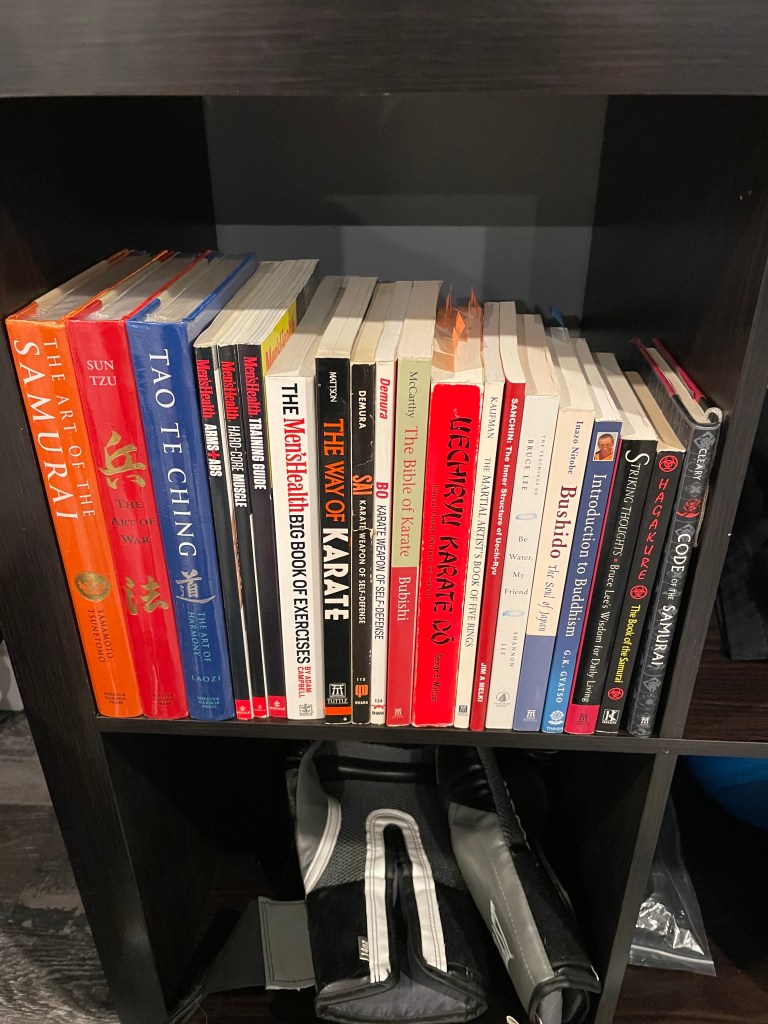
I keep a varied library of training books, as seen in the photo above. Some are a bit more on the philosophical side, such as Bruce Lee’s “Striking Thoughts.” The first three books on the left are the ones I got for Christmas that I wrote about in a previous post. Despite the philosophical nature of these books, they still contain knowledge and lessons that can be valuable to a martial artists. As I write this, I notice that my copy of the Book of Five Rings ins’t there! Where the fuck did I put that thing…? But I digress…

For the past fourteen years or so, I’ve had to train in karate on my own, with Sensei being 3,400 kilometres away from me. I’ve had the opportunity to train with him an average of once a year during that time, which has slowed and hindered the rightful progression of my learning path. because of this, I’ve had to lean on my books for a certain amount of training. The red book entitled “Uechi Ryu Karate Do” is a comprehensive manual covering the art of Uechi Ryu, written by George Matteson, who brought Uechi to the United States from Okinawa. It contains illustrations of all the basic exercises and forms one needs to learn Uechi Ryu karate.

This works in my case because I already know all the forms and basic exercises. This allows me to use the manual as a corrective tool to smooth out and perfect my techniques as opposed to trying to learn from scratch, which I stand by the opinion would be improbable. What I particularly like are the Men’s Health manuals that teach a number of different weight workouts. Either way, building a personal library of reference manuals can be a good addition to your overall training and help you out on the occasions where you need to be reminded of a technique or exercise and your instructors aren’t readily availability. ☯️

What Is A Dojo?

I get this question once in a while and with mainstream shows like Cobrai Kai being all the rage, it rather surprises me that I still do. But those of you who know me are fully aware that I can talk an elephant’s ear off, so here I am, ready to explain once again. In short and from a high level, the term “dojo” is actually the joining of two Japanese characters that are combined to mean “Place of the Way.” A dojo is generally a special place that is set aside and laid out specifically as a gathering place for students of the martial arts, like Karate and Judo. The term has been used in other forums as well. Interestingly enough, Zen Buddhists refer to their meditation chambers as dojos, as well.

Unlike other training locations, a dojo is intended to maintain a certain level of decorum and ceremony and is intended to be treated with respect. A clean, proper uniform is required when training in one, and bowing respectfully when entering or leaving is also expected. Unlike training locations like your local gym and only under special circumstances, the dojo is intended for structured training, with a Sensei or senior student leading the other students through drills, lessons and teachings, which can include forms, sparring and even meditation, in some styles.

The important aspects to look for when visiting a dojo include the cleanliness. As I mentioned earlier, a dojo must be treated with respect and filth does not align with that. Unlike what you may have seen on television and in movies, a dojo doesn’t need to look like a bad Japanese tourist trap, with the polished wood everywhere and fancy decorations. Literally four walls, a floor and a roof are all that are required. Any additional equipment or accoutrements should be limited to what’s required for training and not include a bunch of decorations or trappings intended to make an onlooker believe the dojo is fancier than it is. Because a dojo isn’t MEANT to be fancy.

I’ve trained with students who have had a small, square ten foot by ten foot space set aside on their home. That’s their dojo. And it’s adequate for training and all they need. Although it can be enticing to see all the gilded decorations and weaponry on the walls of some dojo, it’s important to bear in mind that such things don’t speak to the quality of the art or its teachings but to the quality of their decorator. And that won’t provide much in terms of learning the martial arts. If a student chooses what style to study based on how fancy the dojo looks, they may be in for a rough ride. ☯️