Nah, I Don’t Wanna…

Having children can be a wonderful experience, for the most part. On the one hand, you get to see a tiny version of yourself grow and develop into their own person, with their own interests, hobbies and personality. On the other hand, it can be extremely frustrating, especially when you see them doing things you know could be done better or you recognize that there are certain things that you should teach them that they simply don’t want to learn. This can have a measurable effect, both on each of you as well as on the relationship as a whole.

I grew up with an intense craving for martial arts training. Like most kids my age, I was taken with action movies and the prospect of learning how to fight. As I was the victim of bullying throughout my formative years AND I had an immune disorder that was snaking my childhood hell (Type-1 Diabetes, if you hadn’t guessed), karate was a good fit for me. But it didn’t come without some searching, trying and experimenting with different schools and styles. It wasn’t until I found Uechi Ryu that I developed the deep love for karate that I still have to this day, or managed to control my ADHD and Diabetes, none of which I believe would have been as effectively accomplished as it was due to karate.

That’s why, when my wife gave birth to our son in 2014, I started seeing down a narrow tunnel into the future, one that allowed em to see the potential of passing on my skills and teachings to the next generation who would carry Uechi Ryu into the future. As Nathan learned how to walk and run, he began emulating movements that he’d see me do, which included kicking, punching and a variety of karate movements that he wouldn’t learn otherwise. The future looked bright, indeed.

Nathan and I, when he was three years old

When I was younger and training full time, I got to see the results of a parent forcing their child through karate. Sensei’s son, who happened to be one of my closest friends growing up, was Sensei’s only son and first black belt graduate. In “old school” martial arts circles, that’s a big deal. Sensei wanted his son, not only to be skilled but to be the best student he had. The only problem with that is that his son didn’t want it. He didn’t hunger for it. He saw no reason to pursue it. But he was pushed through it until he managed to reach Shodan, after which time he allowed his training to falter.

Oh, he’s returned to it on occasion. One can’t train for as long and as intensively as he had without it leaving some sort of impression. But having been forced to study karate for so many years left an impression on him that never went away. Nowadays, despite having three children of his own, his karate training is all but gone. This is one of the reasons why I pledged never to force my children to learn karate. If the time came that they wanted to train, I would be there for them. In the meantime, I would continue to let them see me train, take it all in and make the decision for themselves.

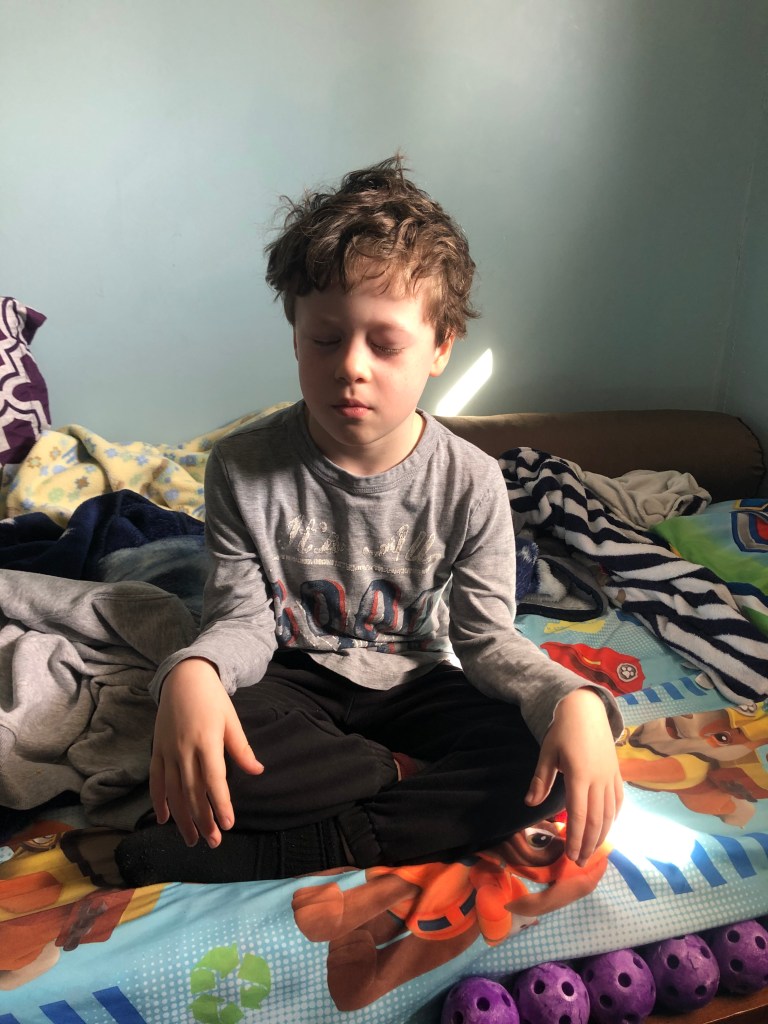
Nathan, trying to learn to meditate…

That’s why recently, I heard the most wonderful words a Sensei could hear from their first-born son: “Dad, I wan’t to learn karate…” I was ecstatic! I made plans. I brought in old equipment from the garage I hadn’t touched in years. I monitored my blood sugars closely so that I could ensure I could train for an hour without needing to stop. I told my wife about it. I told my work colleagues about. Suddenly, I saw the potential for my son and his own ADHD that I hadn’t contemplated before and recognized it would be something long-lasting that we could do together for years to come.

On the fateful day, which was only yesterday, I got home from work, full of piss and vinegar. I dropped my bags at the door, briefly greeted my wife then looked at Nathan and said, “Tonight, we start training in karate.” I wasn’t prepared for the bursting of my proverbial bubble that came next; “Nah, I don’t wanna…” I was floored. He had been hounding me to learn karate for the past month and now that the opportunity presented itself, he wanted nothing to do with it. I did my best to try and understand why he had suddenly changed his mind or his reluctance but, like most children, all he would say is that he had changed his mind.

I made my way downstairs and trained on my own, with a brief visit from my wife for a short sparring session. It was nearly impossible, hiding my disappointment. The worst part was recognizing that I seemed to be looking forward to it more than he was. I‘ve come to recognize in recent years that I have more years behind me than I do in front. The amount of time I have to impart whatever I’ve learned to my children grows shorter with every passing day and my hope is that Nathan will see me work out just once, where he’ll decide to jump in. In the meantime, I have to be patient. I don’t want to be that parent that forces their child into something like this. Because I want him to retain and carry it for his entire life and allow it to guide him. Such things won’t be possible if it feels like a chore. ☯️

Fits Like A Glove…

There are a number of little specifics that you’ll see in different schools of martial arts, depending on how they train, how they operate and what philosophies they follow. Sparring is one of those things that different styles will approach differently. For example, one school I trained with rarely focuses on sparring and rather focuses on kumite. Alright, good for you but kumite is a structured, pre-planned sparring exercise to practice very specific techniques. Another school I trained with does SOME sparring but does so without any protection , which is concerning since they use little to no control methods to ensure their safety. Which is where today’s post comes in…

Proper equipment use and safety is integral to good martial arts training. Growing up, we used to spar at minimum, once a week and our style focuses on striking behind our intended target. This means that we strike hard with the intention of landing several inches behind the surface of what we want to strike, to avoid pulling our punches or potentially falling short of our target. We practice control, where we develop the ability to stop on a dime but there’s no denying that “in the heat of the moment,” accidents can happen and sparring partners can get struck. An obvious example of this would be last April when a very experienced black belt managed to get in under my defences and fractured my ribs.

My sparring gloves, purchased in Okinawa in 2001

First and foremost, the wearing of protective gloves is an important step. I’ve lots count of the number of times a training partner has struck me in the face, ribs or elsewhere and the only thing that has prevented serious injury is the fact that their fists were padded. If you look at the photo above, these are fingerless sparring gloves that I had the opportunity to purchase at Shureido in Okinawa, when I was there in 2001. Fingerless sparring gloves have become more of a norm outside of martial arts, thanks to sports such as MMA. But they have significant benefits that closed gloves won’t have.

The open-handed nature of these gloves allows me to grab and grapple with my opponent much easier than I would if my gloves were closed at the palm. Although other gloves may have more padding and be better for striking, the ability to use a better variety of techniques, such as finger jabbing, thrusting and knife hands, is integral to karate. At least in my style. For the most part, I believe that my rib fracture likely would have been avoided, had my opponent been wearing sparring gloves as opposed to being bare-knuckled.

The next important aspect is wearing a protective cup. The last dojo I trained with never bothered to include it in their training unless they actively WERE sparring. This is a mistake and it can, in fact, be a painful one if you happens to get accidentally struck by a stray technique, even while practicing outside the sparring ring. And contrary to popular opinion, this doesn’t only apply to guys; there are protective cups for women, as well as chest guards to prevent painful impacts to sensitive points on the body.

Martial arts is not a knitting circle; one needs to expect that at some point in training, they’ll be struck and potentially even suffer some injuries. It’s part of the learning process. You don’t want to get hit, go join a chess club. But that doesn’t mean that there shouldn’t be precautions, both physical and instructional, that students should take to avoid injury. Respect and care for your fellow practitioners are important first steps. If you’re intentionally trying to “win” or injure your sparring partner, you may want to reconsider your presence in the dojo. But taking some reasonable, physical precautions can also go a long way towards preventing injuries that can debilitate you for weeks and even months. Food for thought… ☯️

A Foundation Without Form Will Still Be Weak…

I saw an interesting post on my Facebook feed a couple of days ago… Since I tend to check out martial arts pages and subscribe to some on occasion, I often have suggestions that pop into my feed. Some help to plant seeds for good blog posts, some just look like nonsense (to me) and I scroll right on by. But this one threw out a thought that resonated with me. It read something comparing kata and kumite to the body and soul of karate and how you can have kata without kumite but you can’t have kumite without kata.

This would be a point of heated discussion among martial artists of different styles, as some would argue that neither is needed to support the other. I was raised on a system where kata, or forms, are the base foundation for everything that follows. Kumite is a physical application of those forms. If you try to do kumite before properly learning the forms, you’ll be lacking in certain respects. Again, this can differ from style to style and I‘ve even trained in dojos where they teach their students kumite and even sparring well before they properly learn kata.

A big problem I have is that learning to spar or doing kumite before learning the proper foundational elements is sort of like trying o run before you’ve learned how to walk. It doesn’t work well in anyone’s favour. But one of the main issues, which has always been something that’s irked me as well, is that people want the flashy, high-flying techniques. They want the kicking and the punching and the speed… Most people don’t have the patience to learn kata and develop themselves.

And if I’m being honest, kata shouldn’t be sold short. Doing a half dozen forms with proper muscle tension and power will usually work up more of a sweat than anything else will. I was well-reminded of this recently when I watched the Karate kid III for the bajillionth time… The main protagonist is training in the antagonist’s dojo and is asked what was the last thing he learned. The protagonist says, “kata,” to which the antagonist says that kata is great for working up a sweat but it doesn’t win tournaments. Although I don’t necessarily agree that form won’t help win a tournament, I can easily agree that it works up a wicked sweat…

Traditional martial arts isn’t a fast process and you won’t be ready to kick ass and fight like an action star, even after a couple of years of training. Katas are not just a nice-to-have, they are the requirements needed to develop your foundation in order to build your skill set properly and efficiently. Plus, they’re hard as shit to master. After almost four decades of studying karate, I still have difficulty managing some of the steps and techniques included in my katas. Time and patience, folks. That’s the spice that makes an effective martial artist. ☯️

Because Sometimes, You Have No Choice…

I’m a firm believer that something as complicated and intricate as martial arts can’t be learned solely from a book. I know some people who have tried. The problem is that even the best illustrated book will lack the context, body movements and essential coaching one needs to properly learn the art. That being said, books can definitely be a good addition to one’s learning and supplement your in-person training. Certain books can also be read simply for the purpose of curiosity, allowing the reader to explore a particular art or skill that they aren’t actively studying.

I keep a varied library of training books, as seen in the photo above. Some are a bit more on the philosophical side, such as Bruce Lee’s “Striking Thoughts.” The first three books on the left are the ones I got for Christmas that I wrote about in a previous post. Despite the philosophical nature of these books, they still contain knowledge and lessons that can be valuable to a martial artists. As I write this, I notice that my copy of the Book of Five Rings ins’t there! Where the fuck did I put that thing…? But I digress…

For the past fourteen years or so, I’ve had to train in karate on my own, with Sensei being 3,400 kilometres away from me. I’ve had the opportunity to train with him an average of once a year during that time, which has slowed and hindered the rightful progression of my learning path. because of this, I’ve had to lean on my books for a certain amount of training. The red book entitled “Uechi Ryu Karate Do” is a comprehensive manual covering the art of Uechi Ryu, written by George Matteson, who brought Uechi to the United States from Okinawa. It contains illustrations of all the basic exercises and forms one needs to learn Uechi Ryu karate.

This works in my case because I already know all the forms and basic exercises. This allows me to use the manual as a corrective tool to smooth out and perfect my techniques as opposed to trying to learn from scratch, which I stand by the opinion would be improbable. What I particularly like are the Men’s Health manuals that teach a number of different weight workouts. Either way, building a personal library of reference manuals can be a good addition to your overall training and help you out on the occasions where you need to be reminded of a technique or exercise and your instructors aren’t readily availability. ☯️

What Is A Dojo?

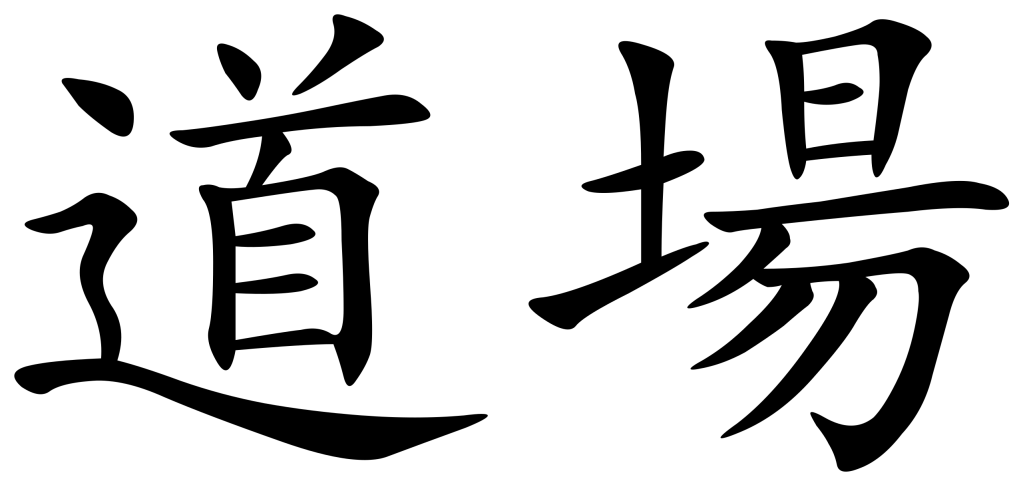
I get this question once in a while and with mainstream shows like Cobrai Kai being all the rage, it rather surprises me that I still do. But those of you who know me are fully aware that I can talk an elephant’s ear off, so here I am, ready to explain once again. In short and from a high level, the term “dojo” is actually the joining of two Japanese characters that are combined to mean “Place of the Way.” A dojo is generally a special place that is set aside and laid out specifically as a gathering place for students of the martial arts, like Karate and Judo. The term has been used in other forums as well. Interestingly enough, Zen Buddhists refer to their meditation chambers as dojos, as well.

Unlike other training locations, a dojo is intended to maintain a certain level of decorum and ceremony and is intended to be treated with respect. A clean, proper uniform is required when training in one, and bowing respectfully when entering or leaving is also expected. Unlike training locations like your local gym and only under special circumstances, the dojo is intended for structured training, with a Sensei or senior student leading the other students through drills, lessons and teachings, which can include forms, sparring and even meditation, in some styles.

The important aspects to look for when visiting a dojo include the cleanliness. As I mentioned earlier, a dojo must be treated with respect and filth does not align with that. Unlike what you may have seen on television and in movies, a dojo doesn’t need to look like a bad Japanese tourist trap, with the polished wood everywhere and fancy decorations. Literally four walls, a floor and a roof are all that are required. Any additional equipment or accoutrements should be limited to what’s required for training and not include a bunch of decorations or trappings intended to make an onlooker believe the dojo is fancier than it is. Because a dojo isn’t MEANT to be fancy.

I’ve trained with students who have had a small, square ten foot by ten foot space set aside on their home. That’s their dojo. And it’s adequate for training and all they need. Although it can be enticing to see all the gilded decorations and weaponry on the walls of some dojo, it’s important to bear in mind that such things don’t speak to the quality of the art or its teachings but to the quality of their decorator. And that won’t provide much in terms of learning the martial arts. If a student chooses what style to study based on how fancy the dojo looks, they may be in for a rough ride. ☯️

George Michael Was Right…

Sometimes, you gotta have faith… Ah, that song brings me back. released in the late 80’s, it used to come on the radio in the mornings when I’d be on my way to school. Gets my foot tapping, even now. But I haven’t even gotten into today’s topic and I’m already slipping off the rails, so I’m going to rein myself in. As I said in the opener, sometimes, you gotta have faith. This is especially true when. You make the conscious decision to join a dojo or a sports club.

In general, people who walk into a dojo for the first time are likely to be inexperienced and unaware of the art they’re choosing to undertake. This makes it so very important that one be able to trust and have faith in what they’re being taught and who is teaching it. I remember when i first walked into a dojo, all the way back when I was a kid… Ironically not long after George Michael’s “Faith” was released, I had a head full of karate movie scenes and high expectations. I never could have imagined the journey I was about to embark on, or how it would ultimately change my life.

But imagine how that journey would have been different if I didn’t trust Sensei and the other senior students? Imagine if I questioned and doubted everything I was being shown and taught? I’d say it’s hard to fill a cup that’s already full but the joke is that if you’re walking into a dojo for the first time, your cup should be fuckin’ empty. Unless you’re one of these black belts who move to a different Province and end up having to train with a different style… *cough, cough* Moving on!

That trust and ability to have faith in the teachings you receive is a two-way door. You need to trust the people teaching you but they also have to be able to trust your. The dojo will only be as traditional and strong as its weakest student but it’s everybody’s responsibility to raise that weakest student up in order to ensure the strength and effectiveness of the curriculum and the reputation of the style. I recently had an associate who told me about a dojo he trained in, where he was put through hell for years on end to reach black belt.

Although he’s found himself moving on from there due to other obligations and responsibilities, he’s occasionally visited and has been disheartened by how the curriculum has weakened and become watered down to accommodate those who prefer not to get hurt or don’t want to put in as much effort. This is a sad and dangerous path for a dojo to follow. Not only will it dilute the style and make it less effective, those who grow in rank will be nowhere near as effective and skilled as their rank suggests and could put them in danger, should they ever be in a situation where they need to defend themselves.

Sensei saw this trend start to take shape about six or seven years ago, which ultimately led to him closing his dojo doors permanently. As sad as I am about that, I’m comforted in the fact that I trained hard, learned well and have confidence in my skills, which have been time-tested and proven. I rather that than have my beloved school turned into a cookie-cutter producer of people who don’t put their full effort into it or train the right way for the right reasons.

It’s important to trust in your dojo. If you have doubts or question what’s being taught, maybe that means that the school isn’t for you and you should likely move on. This doesn’t mean you should never question ANYTHING. But how can a dojo be strong if its students don’t trust each other, raise each other up and you don’t believe in what the sensei is teaching? Not only does this make it hard on you but on the dojo as a whole, as well. Always remember that choosing a style or a school to train with is a subjective thing. There’s nothing wrong with a school being wrong for you and moving on. Food for thought… ☯️

Even The Finest Armour Can Rust…

There’s a consistent truth to life that eventually, we all get older. I never got it or understood it when I was younger. My parents felt old to me when they were almost twenty years younger than I am now. I never understood all the jokes and memes about how waking up in the morning was like the sound of a thousand mouse traps. But I swear that my joints are the reason why mice stay the fuck away from our house in the winter. A little touch of cold and all of a sudden I have to rock back and forth a dozen times to roll myself out of bed. But I digress…

I’ve always prided myself on maintaining my health as best I could. Getting the basic equivalent of a death sentence from my doctors at the tender age of 10-years old woke me up in a way that most adults wouldn’t appreciate, at the time. I started training in the martial arts, taking control of my food and make conscious choices about my health and my future. Having been educated on all the complications Type-1 Diabetes can bring, I refused to become part of the overall statistic. There was no fuckin’ way in hell anyone was going to amputate one of my limbs. losing my eyesight or having a heart attack also didn’t sound too appealing.

I’ve had the benefit of navigating the rough seas of Diabetes with a certain amount of pride. And zeal, I guess. Given my increased level of fitness, proper diet and attention to my condition has allowed me the benefit of reaching my current age with all my limbs and organs intact, a clean nervous system and essentially no complications after over four decades of dealing with Type-1. In my early twenties, I travelled to Japan and subsequently, Okinawa. I soon after passed my first degree black belt. I became a teacher of others. I excelled in every job I ever held. Despite all odds and opposition, I graduated from the RCMP Training Academy in Regina, Saskatchewan and became a Mountie. Despite what some may say and mistakes I’ve made, I have a story to tell…

Despite how hard I’ve worked and how many obstacles I’ve faced, time is beginning to show me that I need to slow down. I don’t move quite as quickly as I did years ago, which was premised by the broken rib I suffered last April from a punch I should have easily blocked. Getting out of bed, even after a full eight hours of sleep, has become more difficult. Getting through the day without increased amounts of caffeine (or a nap, if its the weekend) is becoming more and more difficult. I worry about things like cholesterol and blood pressure now, and have prescribed “preventative” pills for both. Apparently, that’s a good idea if you’re above the age of 30 and have Type-1 Diabetes.

If you would have told me, twenty years ago, that I would have to constantly check and worry about my blood pressure, I would have told you to, as the French would say, go fuck yourself. But believe it or not, here I am! Taking preventative measures for my health and slowing down, as time is wont to do. But slowing down doesn’t mean stopping. As I’ve always said, life brings movement. Movement brings energy. Energy brings life. If there’s one thing I can guarantee, it’s that I’ve never done anything less than 100% and I don’t intend to stop, creaky joints and all… ☯️

What Do YOU Know?

When you’ve trained and travelled as much as i have over the course of my life, you get to see a few things. I’ve seen people who know nothing that thought they knew everything. I’ve seen people who knew plenty who were humble enough to recognize they knew nothing. I’ve always fancied myself as somewhere in between but I would be lying if I said that it was easy backing down, especially when I was of the opinion that I was right or had the better way.

I’ve always fancied myself as the type of guy who could be humble enough to allow someone, especially of a different style, to express themselves and provide a different perspective. After all, the only real difference in any style of karate is that we all do the same thing in slightly different ways. Until we don’t. And that’s a situation the practitioners should all remember when butting heads on techniques. I got to experience that firsthand, less than a year ago.

Uechi Ryu is significantly different from Shotokan, in that the former focuses on tight, small circle techniques with a focus on fine-point strike. The latter focuses on crossing long distances, elongated stances and full impact strikes for every technique. There are a number of significant differences beyond that, but that’s a very generalized summary of how the styles differ. Uechi Ryu also owes its origins to Okinawa and Shotokan is a Japanese style that descended from Shorin Ryu, which is also an originating Okinawan style. You’d think coming from Okinawan roots would make the Japanese style a little more humble. It did not.

I encountered a particular situation some time ago; one that made me question whether I should take a firmer stance or simply let it go. For the most part, the easy route is usually to let it go. I guess the question is how far do you let it go before you wind up compromising your teachings in exchange for those of another? It’s important to be respectful of other styles’ perspective and techniques. But how far do you allow that respect to go, if it contravenes your own style’s way of doing thing? That is the question and that is what I faced all those months ago.

We were performing lines of techniques that included a simple front kick. How ironic that one of the most basic of techniques would be the one that two black belts would differ on? The Shotokan black belt commented on how I should be using the ball of my foot as an impact point. I argued that Uechi uses the bog toe, training to focus the dynamic tension of the remaining toes to strengthen the impact point as such. He countered that doing it this way posed too much of a chance that the technique would break the practitioner’s big toe. I stated it would only happen if the practitioner did it incorrectly… Impass.

I chose not to argue. I was comparing our respective training and found my opposition lacking. He was in his early 20’s and had only been doing karate for about a third of the time that I had. I felt that I definitely had time and experience on my side. The difference is that I was in HIS dojo and was there to learn HIS style. Even though I felt that he might have been wrong, I acknowledged that it would have been rude to correct an instructor in his own dojo. I stayed silent on the matter but it might go a short distance towards explaining why I no longer train there. Besides their exorbitant costs…

Cross-training in different styles can be rough, especially if that other style differs significantly from yours. But a big part of the dojo culture is respect and understanding. Even if someone’s way of doing something may be different from yours or the techniques differ, be willing to keep your mind open to learning a new way of doing things. This is genuinely the only way to expand your overall martial arts toolbox. Food for thought… ☯️

Testing One’s Medal…

I think I’ve gone overboard… A couple of years ago, I signed up for an app called the Conqueror Challenges. In short, you pay a marathon entry fee, which is pretty standard when you enter a marathon, and you perform a “virtual marathon,” completed a certain amount of distance in a certain amount NPF time. It’s a neat concept and the money you pay goes to planting trees or cleaning up plastic on the oceans. All in all, it’s pretty neat as a concept.

I started seeing advertisements for this thing on facebook and as I am with all things, I was a bit sceptical. After all, we now live in a world where almost EVERY advertisement for a downloadable game fails to accurately reflect what the actualmy is. For that reason, I sought out the guidance of others. I had a Facebook contact who often shared their link, so I asked him if he’d participated and/or ever received any medals. He said that he hadn’t participated himself but that one of his coworkers had, and he had physically seen the medals.

Alright, I was reasonably certain this wasn’t a scam and could be something worth trying. Considering the total cost was under $40 Canadian, I was willing to risk the loss if it fell through. Considering I’m not a big fan of large crowds and mass public gatherings at the best of times, this suited me perfectly. I downloaded the app and signed up for my first challenge. If memory serves me correctly, it was a “Marathon to Athens” and was 42.2 kilometres in distance and was to be completed over 3 weeks.

The collection… a few are missing, sitting at home.

The beauty part about these challenges is that you get to set your own pace, set your own timeline and you can include any of your fitness workouts that involve distance. Cycling, running, elliptical, even swimming! When I started doing these, I focused primarily on cycling but I started incorporating my walks, as well. Since I was measuring on a daily basis, it became an interesting challenge to see how far I actually walked in the course of a day. On average, I was putting in about 6 to 8 kilometres of walking, just around the office and going on breaks. That didn’t even include going to the grocery store or running errands after work!

When the summer ended this year, I decided to back it off a notch. At about $40 a piece, there’s a whole lotta money sitting on that wall. Plus, my summer was somewhat tame in terms of how much I cycled, compared to last year. That’s why I opened by saying I think I’ve overdone it a bit. But the medals are definitely gorgeous and if you’re looking for something to spice up your fitness routine, this will definitely do it. I don’t have any link to share but if you Google “Conqueror Challenge,” you’ll find it. If you’re an iPhone user, the app is also available through the App Store. ☯️

Commando: A Review (Heavy Spoilers)

It feels like I’m writing a fair bit of reviews on films and television series… And that’s because I am! No big secret, I’m a fan of a god flic, especially something that was aired in the good ol’ 1980’s. There’s just something about that decade that’s near and dear to my heart; likely the fact that my formative years took place during that decade. But there’s something about watching a solid action film that doesn’t stress out too much about the script or even the plot points and focuses on plenty of action and explosions. 1985’s Commando, starring Arnold Schwarzenegger, is no exception.

Commando tells the story of a retired Special Forces commander named John Matrix who lives a secluded, quiet life with his young daughter, who just happens to be played by Alyssa Milano. I was a HUGE “Who’s the Boss” fan, so Milano is just the icing on the cake. Their lives are disturbed when members of Matrix’s team are systemically killed and the military assumes Matrix is next, and warns him. Matrix’s daughter is kidnapped and Matrix is blackmailed into performing a heinous act to get her back. Of course, instead of complying, Matrix becomes a one-man army of vengeance as he works to getting his daughter back.

I’d like to say the movie still totally holds up to modern times. The truth is that I likely only think so because I was a child of the 80’s. Most people nowadays likely wouldn’t get the references and comedy behind all the violence. Basically, Matrix makes his way back and enlists the help of an unwitting flight attendant who not only helps him gear up and get equipped to rescue his daughter but ends up being a key point to the story. It should be noted that the girl’s mother is never mentioned or referenced during the movie.

The movie reaches its climax when Matrix flies to a remote, private island where he absolutely decimates an army of opposing soldiers who are guarding the antagonist holding Matrix’s daughter hostage. Although I’m sure there are plenty of forums and discussion threads that would identify the impossibilities or inconsistencies of what takes place in this movie, sometimes it’s important to just sit back and enjoy the ride. This movies does just that, providing a gratuitous amount of action scenes while managing not to take itself too seriously.

As one would expect from a classic 80’s action movie, matrix rescues his daughter, annihilates everyone in sight and manages to kill the bad and save the day. The movie ends on a pretty cheesy note, with matrix marching down to the beachfront where U.S. Army forces storm the beach and somehow immediately recognize Matrix as a friendly, despite the fact that majority of them likely never served with him. He’s permitted to simply walk away and fly off with his daughter and newfound “associate,” without any debrief or information on what went down during his time on the island.

Honestly, it’s a pretty fun thrill ride, if you can get past the dated format of the movie and its plot points. It’s a guilty pleasure of mine, worthy of being included among classics like Conan the Barbarian, Predator and Red Sonja (yeah, I said it! Fight me!) I know not many people were pleased with Brigitte Nielsen’s portrayal of the famous, red-haired comic book heroine, but I think it totally stands up. If you’re looking for something action-packed, fun and easy to watch on a Saturday night, Commando is currently streaming on Disney+ and I highly recommend it. ☯️