Good Form, Top Form, Bad Form, No Form…

Given the westernization of the martial arts, a lot of people think of fighting, kicking and punching as soon as they hear the word “karate.” This is unfortunately a very narrow and uninformed view, as any style of martial arts involves so very much more. The martial arts is a lifelong puzzle of a million pieces, with the student’s goal being to obtain a new piece with every session, adding to overall tableau of their martial arts journey. But it wouldn’t be the only thing that the western world gets wrong.

For example, let’s look at the word “karate.” The actual martial art is called “karate do.” A practitioner does not “do karate.” They practice/study/train in karate do and the student is actually referred to as a karateka. These may seem like somewhat menial details that don’t change a great deal but to someone who still adheres to the traditions and old ways of studying the art, they can mean quite a bit. And that doesn’t always mesh well with the modern world and people’s need for immediate gratification. A great example of this phenomenon, is kata…

For those who don’t study martial arts, kata is a Japanese word for “form,” and usually involves a formal, pre-arranged sequences of techniques and blocks. Kata serves multiple purposes, including creating muscle memory to help the practitioner perfect the skills they’re trying to memorize. In Uechi Ryu, kata also helps to strengthen and build muscle as the dynamic tension used in the body during kata is constant (or should be). Kata can be performed slowly or quickly, depending on the stage of training the student is in, and can be used to hone one’s skills as easily as sparring or using a bag.

In most cases, you learn your techniques in a more proper manner during kata, since you aren’t striking a surface and can develop your bone alignment and proper posture BEFORE you start actually hitting something. Granted, it should be one or the other; kata and active striking should be used in tandem, depending on the student’s level of skill and experience. The issue with the modern practitioner is that a kata can be slow work and requires a degree of time and patience that most people nowadays seem to lack.

Although kata doesn’t seem as glamorous or exciting as learning spin kicks and fancy techniques (which my style doesn’t incorporate anyway), form is every bit as important as learning to punch and kick properly. It’s important to remember that everything taught in the martial arts serves a purpose. No thing is for nothing. So even if doing kata may seem boring now, sticking with it will help you get stronger, faster and polish up you or techniques to increase your overall martial arts toolbox. If you’ve ever seen the original Karate kid movies, one of the things they got right was when they said that in karate, not everything is always as it seems. Cue the pan flute soundtrack… ☯️

A White Gi Is Useless…

I chose this title carefully, as practitioners of traditional arts that use a white gi might take offence to such a statement. But it can apply to many things. White sneakers are also useless. Dusty weights serve no one. Take your pick, they’re basically all the same and have the same meaning. It basically refers to the purchase and/or use of equipment of any sort that usually just ends up sitting there and is neglected or rarely used. My biggest pet peeve is when someone buys a decent pair of training shoes and worries about using them for fear of the white parts becoming stained or coloured. To do so is to prevent the intended use of that equipment. This is especially true for a gi.

I have a karate gi from years ago that I purchased when I achieved my brown belt. I remember the odd comments I got from other students, asking why I would pay so much for a uniform when I had not yet achieved my black belt. Up until that point, my dojo usually purchased thin, loose-fitting gi from a Canadian company called GeneSport. Based in Montreal, Quebec and having opened in 1969, Sensei purchased everything from there; karate gi, punching bags, sparring gloves… you name it. Their equipment was an inexpensive option for beginners and intermediate students (a standard gi would cost you $40) and they were close enough to our Northern new Brunswick location that getting an order took only days. Unfortunately, they closed permanently in 2017.

My point is, my dedication and commitment to my training was as such that I felt I needed something thicker, stronger and of better quality. I ordered myself a Tokaido, which is a high-quality gi made of thick, sanforized cotton. I used that uniform for years. Over the course of those years, I sweat heavily into it, causing its pristine whiteness to slowly gain a light, yellowish hue. Further, several missed techniques resulted in bleeding noses or bleeding fingers and toes. For those who are not aware, blood does not come out of white cotton easily, especially if it’s left to sit there for the remainder of the class and well into getting home. Really seals in the colour. I still have that gi and occasionally use it. The crotch is worn out and the stitching has frayed. But those decades-old bloodstains certainly make for conversation starters when seen.

the same can be said of any and all fitness equipment, not only martial arts uniforms. I know so many people who purchased weight sets, exercise machines or equipment, only to have it sit for months, unused. The dust that gathers on them speaks volumes to their neglect of use and also speaks to the owner’s lack of commitment and dedication to what they’ve intended to accomplish. I feel the urge to get out on my bike as soon as the snow has left the ground, usually. I have weights and a variety of equipment that I have at home and usually LOVE incorporating them into my workout routines. Our recent renovations have forced most of my equipment into an unusable corner but once I can clear up some floor space, I can guarantee it’s all coming back out.

Staying on track can be difficult and tedious. Between keeping one’s motivation going and finding time (and having one’s children getting in the way), keeping the dust off one’s equipment can be difficult. It’s important not have goals but one should not bite off more than one can chew. There’s no point in paying thousands of dollars for an elliptical machine, for example, if you’re just going to use it to hang your sweatshirts on. And if you do take the opportunity to get some equipment or clothing, don’t be afraid to get it dirty. Use it, stain it, tear it, restitch it… All of this tells a story of one’s fitness journey. And that story should be yours to show and share. ☯️

Genkyu Nashi…

You know what really grinds my gears??? Just kidding, this won’t be that kind of post. At least not yet; I have a tendency of getting myself worked up on occasion but at the moment, I’m mostly looking to bring up a strange tendency I’ve noticed online. Since I write a blog that often focuses on karate and have subscribed through social media to a number of martial arts pages and websites, the good ol’ online AI’s have made it so that all the “suggested pages” and such usually have something to do with karate. This isn’t a bad thing, especially since it often allows me to learn about other styles, other techniques and methods and interesting subject matter. There is, however, one thing I’ve noticed that seems to nag at me; there is rarely any mention of Uechi Ryu…

I started to notice this trend some time ago when I read an article about top ten karate styles. The usual contenders were mentioned, Shotokan, Shito-Ryu and Wado-Ryu… And no list would be complete without the inclusion of Kyokushinkai, which everyone seems to think is bee’s knees of karate. Oh, I have no doubt that Kyokushinkai has its effectiveness, but I don’t believe that it is truly the “ultimate” way, considering that the proper fit of any given martial arts style is subjective to the practitioner. But when you hear about karate, the majority of the time, it will be one of the styles listed above. Which once again raises the question as to why Uechi-Ryu is rarely if ever, brought up.

For those who are less familiar with Uechi-Ryu, the style was created after its founder, Kanbun Uechi, studied under a Chinese martial artist named Shu Shiwa. Uechi studied with him for over a decade and even opened a school of his own in China. Uechi called the style “pangai-noon,” or “half-hard, half-soft.” Uechi returned to Okinawa and refused to teach ever agin, after one of his Chinese students allegedly killed one of his neighbours. It wouldn’t be until the 1920’s that Uechi would begin teaching students in Okinawa and the style was renamed in 1940 to Uechi-Ryu Karate-jutsu by his students and son. When Uechi passed in 1948, his son, Kanei Uechi, took over leadership of the style and renamed it simply “Uechi-Ryu.”

My style is unique in its focus on hardening the muscle and a combination of contained, focused circular and linear movements. We don’t focus on crossing long distances as many other style do, nor do we dip and lean quite as much as other styles do. Many other styles and martial artists have claimed that Uechi-Ryu is more effective at self-defence than its more offensive counterparts. But yet, when you look up top ten most renowned karate styles or something of the like, there’s almost never any mention of Uechi-Ryu. And I find that odd…

At one point, I posed the question to Sensei and his response was that our style was subtle and traditional and because we cared nothing about competition or how many students we created, people knew less of us than they knew of other styles. Maybe that’s the case. Who knows? there’s a really good video on Jesse Enkamp’s YouTube channel that talks about the ins and outs of Uechi-Ryu karate. I’ll link the video below. ☯️

It’s Treason, Then…

Before I even get into the actual content of my post, I have to say that Star Wars’ prequel trilogy is largely underrated. And the Emperor’s line in Episode III, when Mace Windu and senior members of the Jedi Council finally approach him and recognize him as the Dark Lord of the Sith is iconic. If I was facing a number of skilled, experienced Jedi, I might not be so bold and calm as Emperor Palpatine was. But the line was fantastic, no less. I’ve often made a case for the fact that Jedi are basically just martial artists with modern, energy-based weapons. Even their robes are reminiscent of a karate gi… But I digress… Let’s get on with the subject of today’s post…

There’s a strange phenomenon that occurs for martial artists; it happens when one begins to gain skill and experience and begins to believe that they’re actually “good.” Now that I’ve achieved the age, wisdom and experience level that I have, I understand that being “good” is simply a state of mind and that one is genuinely never done learning the martial arts, regardless of one’s rank. This is something I came to learn the hard way, with some unfortunate happenstance, which I was recently reminded of. That brings us to the here and now, where I’ve come to see that the phenomenon is still quite prevalent and exists in some way, shape or form.

When I was in my early 20’s, I reached a point that I consider to be the pinnacle of my physical skills. I had speed, skill, accuracy and knowledge. Because of these factors, I became arrogant and boastful; something that isn’t becoming of a traditional martial artist. I reached a point where, even when I taught others, it was done through the lens of someone who knew better than they. It reached a point where I became frustrated and even angered by Sensei’s continued scrutiny of my knowledge and skills. It reached an unfortunate point where I thought I knew better. It reached a point where I even skipped on classes where I felt I was being slightled.

Sensei felt this change in me, probably before I even felt it in myself. It didn’t help that his son, one of my best friends, was in the same position as I was. We had conversations about how tired we were with the repetitive training, the constant drills that we’d already mastered, etc… It got to a point where for the first time, I did something I had never done before at that stage in my life; I started to skip out on training in favour of trivial things. I shot pool with friends. I went swimming in the forest. I hung out with my girlfriend. it last almost three months before I snapped out of it and realized I needed to go back.

When I finally returned to the dojo, Sensei acted as though i had never left. It wasn’t until I managed to get him alone after a class one night, when I asked him about what had happened. he explained that he knew what I was going through and had, in fact, gone through it himself. He knew that there would have been no convincing me that I needed to go back until I realized it myself. A part of my inner ego had to be permitted to inflate and pop on its own before I would recognize that this was exactly what I was dealing with; my ego. only once I realized that I didn’t know everything, didn’t know BETTER, could I start to recognize that martial arts is not a journey one can walk alone.

And that’s the lesson… Sometimes, one has to allow oneself to become built up before one realizes the only solution is to break it all down to allow yourself to grow. As the old saying goes, it is hard to fill a cup that is already full. Ego takes up a lot of space. If one is unable to set aside one’s ego, one will never truly be able to successfully learn and progress within the martial arts. Food for thought… ☯️

Fumio Demura

I’m not one to follow mainstream media and I’m not sue this would have been covered in mainstream media, anyway. But I just became aware that two days ago on April 24th, Fumio Demura passed away at the age of 84 years old. To anyone who hasn’t followed the martial way, the name likely won’t mean much. to me, it means the death of another influential icon that inspired the path of life that has made me who I am. In fact, I only came by this information by accident… If I hadn’t been subscribed to several martial arts pages, I would have been oblivious to the incident. But hopefully, as I write about some of his details, you may come to recognize this martial arts icon that has led so many in previous decades…

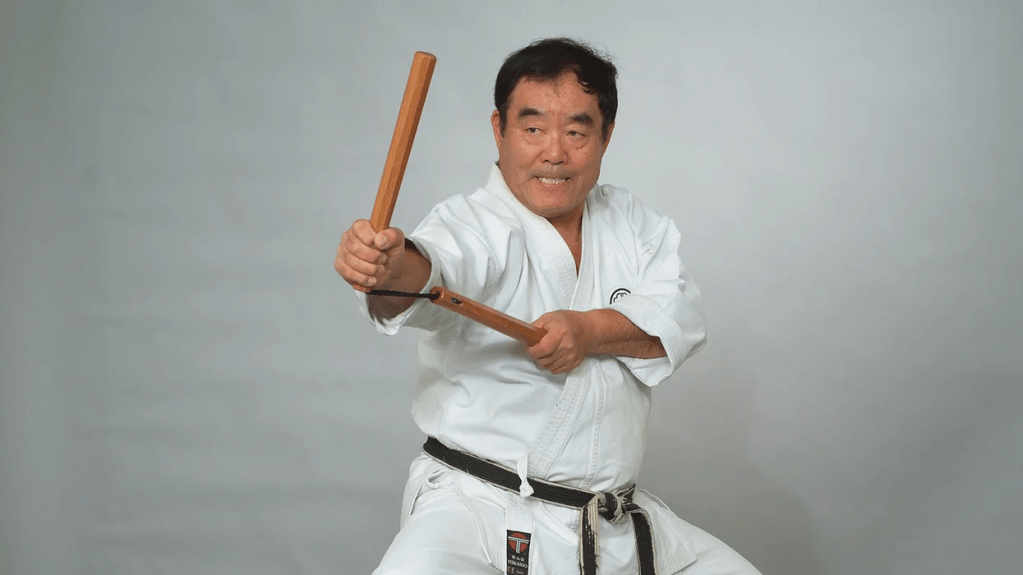
During my youth, I obtained a number of Demura’s books, including “Bo: Karate Weapon of Self-dense” and “Sai: karate Weapon of Self-defense.” During the 1980’s and without even realizing it, Demura was seen on the big screen as Pat Morita’s stunt double in the Karate kid movies. Interestingly enough, Morita knew nothing of karate and had absolutely no skill, despite being cast as the teacher in those movies. Demura would stand in as the one who performed the majority of the fight scenes, including the iconic scene where the Cobra Kai students corner the protagonist outside a chain-link fence where Mister Miyagi beats the ever-loving shit out of all of them. Yeah, that was Fumio Demura…

A practitioner of Shito-Ryu Okinawan karate, Demura began studying the martial arts at the tender age of 9, only a couple of years earlier than I did, myself. He committed himself to the art, and at the age of 21 he began studying the art of Kobudo, the art of Okinawan weaponry that I came to know him through. I’ve read several of his books and learned a great deal, even from the printed page. Throughout the 1970’s Demura would come to the United States and write several books, among those, the ones I mentioned in this post. in the late 1980’s, he would be awarded his 7th dan in Shito-Ryu and would go on to obtain his 9th dan in the early 2000’s.

All of these are statistics that one can easily find anywhere online. For me, Master Demura is recognized as a a true traditionalist, a practitioner of the martial way and an inspiration to one who would dedicate their life to the martial arts. Although I never had the honour of meeting him, Master Demura had an impact on my life and even in his death, he reminds me of the shortness of one’s life and how our existence is but a flicker; and the importance of making the most of our time while in this life. He left his mark and he won’t be forgotten; even if it’s by an unknown practitioner of Uechi-Ryu in the Canadian Prairies. Rest in peace, Master Demura. We’ll take it from here… ☯️

Rise And Grind…

I’ve never been much of a morning person in general. I know what you’re thinking; is ANYONE ever really a morning person? But in my case, it’s pretty much always been an issue of consciously forcing myself to function for the first few hours of my mornings. I’m often surprised that my posts are so coherent. During my school years, I always attributed it to just being a teenager. I mean, what teenager DOESN’T fall asleep in class, right? But considering it’s carried on into my adulthood, it’s pretty clear that I just can’t handle morning in general. At least not without several hundred milligrams of caffeine pumped into my system.

For years, I’ve tried to find a way to incorporate fitness into my morning routine. The thought behind this is pretty simple; increased fitness first thing in the morning will increase blood flow, raise my heart rate and start my day off with a kick. I may even potentially need less caffeine, if I’d manage to get my little dynamo pumping. But most attempts I’ve made have failed. What usually happens is when m,y alarm goes off, I’ll roll over, nope the fuck out of it and reset the alarm for an hour later.

The root of the issue is it has to start with you. No matter which way you look at it, you have to show up. Tired? Sore? Don’t feel like it? Too fuckin’ bad! Keep showing up and do it. It sounds ideal but most people, myself included, often can’t bring myself to do this. I’m not suggesting that you should work out if you’re injured or ill but otherwise, “pushing through it” is a very necessary part of a successful fitness routine.

A few months ago, I had this bright idea to get a membership for. A local swimming pool, since they have lane swimming that starts at about 5:30 in the morning. I figured I could sneak in there in the morning, hammer out 30 minutes of laps, grab a shower and make my way into work. I recall from my academy days that lap swimming is an incredible cardio workout and works almost all the muscle groups in the body. It would have been fantastic. Would have been. Had I been able to get myself out of bed to start doing it.

I needed to do something simpler. Something more straightforward. Something that allowed me to just jump straight into it without thinking about not and didn’t involve dealing with the public, first thing in the morning. This is where I came up with a simple circuit that I could do as soon as I woke up. It only takes about fifteen minutes, or closer to twenty, depending on how exhausted I am, I can do it in my basement before grabbing a shower and heading to work. I have a set group of exercises for Monday to Friday and I do it despite whatever structured workouts I do in the evening when i get home from work. I call it my “tragic warm-up to help embrace the pain.” Here it is:

Monday
– 30 jumping jacks;
– 30 push-ups;
– 25 high knees;
– 10 burpees; and
– 25 crunches.

Tuesday
– 20 squats;
– 35 push-ups;
– 35 crunches;
– 35 jumping jacks; and
– 35 high knees.

Wednesday
– 30 jumping jacks;
– 30 push-ups;
– 25 high knees;
– 10 burpees; and
– 25 crunches.

Thursday
– 20 squats;
– 35 push-ups;
– 35 crunches;
– 35 jumping jacks; and
– 35 high knees.

Friday
– 30 jumping jacks;
– 30 push-ups;
– 25 high knees;
– 10 burpees; and
– 25 crunches.

It’s reasonably gruelling, especially first thing in the morning. I’ve also had days where I’ve simply skipped working out in the evenings by virtue of having done this morning gem. But it’s had the desired effect, in that my caffeine intake has lowered and I have a bit more energy and drive. granted, I also bottom out and get tired as shit by the time the end of my day comes along, but this is when you should be winding down and getting tired so you can sleep a full night, right?

Anyway, because I believe that variety is the spice of fitness, I thought I would share this with you. To be honest, I printed off the sheet this workout is on so long ago, I can’t remember if I found it somewhere or created it, myself. But it suits the purpose. Tomorrow is Monday and I will once again be seeing if I can’t “rise” to the occasion and make my way through the circuit. But it’s definitely worth trying, if you’re looking for something quick and effective to kickstart your mornings. Enjoy! ☯️

It’s All Just One Step At A Time…

Roughly 99% of people who walk into a dojo to join a style is doing so for the very first time. That is to say, they’ve never done martial arts before. And no, before y’all get snippy, I’m not saying that’s an actual statistic, it’s just my observations over decades of training in several dojos. One of the biggest challenges the new students face is the fact that they walk in, knowing nothing. This can leave them anxious, awkward and shy, which can make the learning experience harder and occasionally embarrassing. What sometimes makes things harder, is when you have a new student who thinks they know everything. That just makes things harder on the current students and can even be disruptive to the class in general.

The concept of learning in traditional martial arts will usually involve learning from someone who ISN’T the Sensei… As odd as this may sound, one needs to recognize that there are usually several students and only one Sensei, meaning that he or she may not necessarily have the time to spend with every student, even on their first day. This means that assistant instructors and even junior belts may be charged with teaching new students their basics on the first day. And this doesn’t sit well with everybody, especially those who think they already know better and feel they’re entitled to the Sensei’s attention. And as we all know, entitlement is currently the spice of society…

I remember an experience from years ago, when I was still back home in New Brunswick. Sensei had a policy that when a new student stepped into the dojo, one of the junior belts would show them the basic exercises and opening of our first kata, so that they would be able to keep up during their initial classes. This would usually involve fifteen minutes of kicks, punches and the opening of Sanchin, which is the first (and last) kata we learn in my style. this can be important and prevents the embarrassment of a new student standing there watching as the rest of the class engages in something they aren’t familiar with. There can be some of that even IF they get that initial show ‘n tell but at least it’s mitigated, somewhat.

I remember this one time, a large, muscled, athletic-looking guy came into the dojo. one of the first things he mentioned while introducing himself was that he was a hockey player and weightlifter. Although it isn’t completely unexpected that someone athletic would expect to be able to catch on to something athletic quicker than the average person, it would be a grave error in judgement to try and assume you know better than others who have been doing the art for years. Apparently, my turn had come around as Sensei asked me to show this individual the basics before his first class. I was comfortable with my level of skill and had no issues in showing the basics to someone else. I was motivated and pleased to be helping someone out.

I walked up to the guy and introduced myself. He was pleasant enough during the introduction. That is, until I explained that Sensei had asked me to show him the basics. He glanced down at my belt and saw that it was white. granted, my belt had a green bar on it, which in adult grading, is only one level prior to testing for green belt. But to his credit, this guy wouldn’t have known that. he held up his hands in a placating gesture and said, “no offence.” I don’t know about you, but experience has taught me that whenever someone says “no offence,” they’re about to say something that will likely offend.

He explained that he didn’t feel it was appropriate for a beginner to be teaching him and wanted to wait for Sensei. I responded that although I understood that perspective, Sensei usually used the 15-20 minutes before class to stretch and counted on the junior belts to show new students the basics. he said “no thanks,” walked away and began stretching in imitation of Sensei. When class began, the new student was completely lost. He gave it his best try and followed along with the class as best he could. Sensei noticed his struggle and the fact that he appeared not to know the basics and asked what I had shown him. he told Sensei I had shown him nothing.

The class carried on and Sensei came to talk to me about it after class let out. I explained what had happened and what had been said. He instructed us not to provide guidance or instruction to the new student unless he came and asked for it. Which he didn’t. Ever. The guy showed up for a couple more classes and then we never saw him again. Some say that was a harsh approach but the reality is that it was karate, not a fuckin’ knitting class. Besides, if you’re told something needs to happen a certain way in order to learn properly, one would assume that you should give the benefit of the doubt and do it. This guy chose to struggle and go against the flow before realizing he wouldn’t catch on. Be like water, dude!

Of course, had he stuck it out, he would have eventually caught on, received correction and started learning. But that was his choice. Martial arts is like a ladder. The students above need to help bring up the students below, in the hopes they’ll someday be above and help those who helped them. That being said, the one below needs to be willing to receive that help in climbing to the next rung on the ladder. Otherwise, they’ll always find themselves watching from below, while others continue to climb the martial arts ladder. This is something important to bear in mind, whether you’re currently a student of the Way or someone new contemplating joining a dojo. ☯️

Revisiting A “Sharp” Friend…

I’ve mentioned recently that I’ve been studying martial arts for over three decades and I’ve trained in a number of different disciplines during that time. Two of the styles I’ve played around with involve the sword. I mentioned the wakizashi in that post, which prompted questions about exactly what that was. Since I wrote a very nice post back in 2020 about this very thing, I thought I would re-post since, well, after 1,500 posts, I’m bound to repeat myself somewhere, right? It also gives me the opportunity to correct a few typos from the original post that I hadn’t noticed at the time. With that in mind, everything below this first paragraph was posted here on April of 2020. Enjoy…

Although it’s normally ideal to stick to one style so that you can master it (or at least attempt to), it gets a bit difficult NOT to dip your toes in the proverbial martial arts pool, from time to time. Training in the Way of the Empty Hand is usually the best option as it means that you’re never disarmed. But I would be lying if I said that the prospect of training with a weapon hasn’t appealed to me, from time to time. With that in mind, I began studying Kendo and Iaido. I studied for a number of years, although I didn’t stick to it long enough to reach mastery. But I have enough skill with a blade to make it a useful implement of self-defence if necessary.

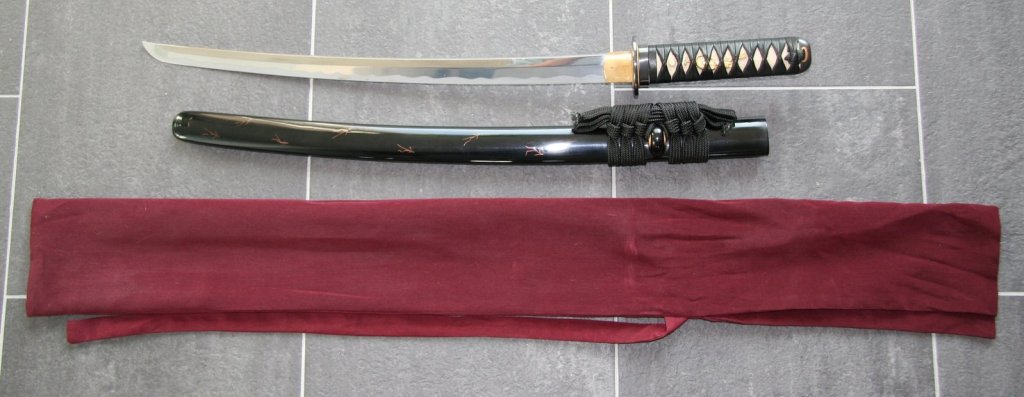
A wakizashi or “short” sword

Samurai swords are iconic and have come to be recognized in and out of the martial arts world. An extremely fluid weapon, the samurai sword was normally a symbol of military nobility in feudal Japan, and was considered to be the soul of a samurai. The wearing two swords was outlawed by the Japanese government during the Meiji Restoration (I’ll let you Google that) but they continued to be used by police and military personnel.

So, what’s known about these famous swords? Well, samurai swords are unlike any other swords in the world, with their unique curvature and single-edged blade. They’ve been forged since as far back as the 10th century, and there are legends of the first actual katana being forged by a wordsmith named Amakuni Yasutsuna as far back as 700AD.

Samurai swords, or katanas as I will refer to them from here on in, are characterized by a long, curved, single-edged blade that is at least twenty-four inches in length and a grip that is long enough for both hands to hold. When samurais wore the two swords, the katana was the longer of the two, with the shorter sword being between twelve to twenty-four inches in length and called a wakizashi.

Because the wakizashi was shorter and had a grip that would only accommodate a single hand, it was generally used for closer combat as opposed to the katana, which was better suited for full combat (once the samurai worked their way through the plethora of other weapons they carried BESIDES swords).

Last but not least is the tanto. This is a short, dagger-style sword that usually measures six to twelve inches in length. Although intended more as a stabbing weapon for close combat, the edge could also be used for slashing. Over time, it became more ornate and acted as a ceremonial dagger, but there is a martial art called tantojutsu, which focuses on the use of the tanto.

The creation of a katana is an entirely unique process. Unlike most swords that are forged by pouring molten steel into a mold, then tempered, katanas are created by forging and combining multiple layers of different types of steel. The layers are folded, over and over again and the curvature happens over a long process of curing and tempering.

The forging process creates a curved blade that combines softer and harder metals. Hard and soft… Sound familiar? (☯) The curve and flexibility of the blade makes the katana incredibly fluid and durable. Then the blade is sent to be polished, which can take weeks, in order to get that mirrored look.

Katanas are fascinating weapons, and would often be customized with images, lacquered scabbards and even family crests and symbols on the guard and grip. And as Ryan Reynolds said in X-men Origins: Wolverine, “I love this weapon more than any other thing in the whole wide world […]. You whip out a couple of swords at your ex-girlfriend’s wedding, they will never, ever forget it.”

At the end of the day, learning to defend oneself with your bare hands should be your primary goal. After all, you’re more likely to find yourself WITHOUT a weapon than carrying one. But should you find yourself with a weapon, it’s also nice to be able to use it properly. The sword is definitely an ideal weapon to train with as it can translate to basically any stick or length of weapon you may wrap your hands around. Food for thought… ☯️

One Weapon In The Hand Is Worth…

I’ve been doing martial for well over thirty years now. In fact, I’ve reached the point where I’ve somewhat forgotten EXACTLY when I started, which makes it difficult to put a firm number on the years I’ve been a practitioner. If I go from memory, I’m pretty confident I started karate when I was ten years old, which means I’ve been practicing for thirty-five years this Spring. on the other hand, the year 1990 sticks out in my head for some reason, which would make it only thirty-three years. Not much of a difference and the only way I could confirm would be to see my original registration form, which Sensei would have back in new Brunswick. Fat chance of that, even if he should happen to still have it.

Even though my focus over those decades has been Uechi-Ryu Okinawan karate, I’ve dipped my toes in the proverbial pool and tried out a few different things in my time. If I had to put a number on it, I’ve trained in at least seven or eight styles, with some of them involving arts that don’t involve empty-hand fighting. When you ask the average person what they know about karate, they’ll usually point out the punching and the kicking, with rarely a mention of weapons. Which makes sense, if you look at the literal translation of karate. But it might surprise some to know that the average karateka usually WILL train with weapons at some point…

Outside of Uechi Ryu, I’ve trained in Kobudo, Kendo and Iaido. The first was because Kobudo goes very much hand-in-hand (pun intended) with karate and owes its roots to Okinawa. The last two, I got into because my parents were kind enough to buy me a wakizashi when I was younger and I wanted to learn how to use it, as opposed to leaving it in my closet. Most people are familiar with Kendo, given the use of the armour and grilled helmets you see when they square off, combined with the bamboo sword known as a shinai. Iaido is a bit of a different, still focused on the sword, that trains the practitioner to draw and execute techniques quickly, with a focus on situational and environmental awareness. It focuses on speed and accuracy.

Although everyone’s martial experience will differ based on their wants, needs and expectations, I chose to pick up a weapon because I knew that the day could potentially come when I would face an armed opponent and it’s never a good idea to do that empty-handed. I mean, if someone came at me with a sword and I had nowhere to go, what the hell am I supposed to do??? That bullshit that you see in movies where the person “catches” the sword between their palms is total bullshit. A properly honed sword, moving at a speed intended to kill, would slip past a defender’s palms with ease. And even if all the stars aligned and the defender managed to stem the sword’s approach, a skilled practitioner of the sword need only adjust the forward angle by a couple of degrees in order to cleave the defender’s hand off at the wrist. Assuming the sword is properly sharpened, of course. But I digress…

It paints a bit of a bleak picture but it’s a realistic one, which most people don’t usually adopt. What I like about Kendo and Iaido, is that the teachings allow me to apply techniques without necessarily holding a sword. If I find myself against someone with a weapon, I can adequately defend myself using a length of broomstick, a baseball bat or a random stick on the ground. It’s a better prospect than facing off against an armed opponent, empty-handed. Kobudo, for me, has its place but has been less useful throughout the years. After all, you won’t find most weapons associated with the art easily. Nunchucks are illegal in Canada, finding properly-weighed kamas is unlikely and walking around with a pair of sai on the streets is cumbersome and not recommended. The bo or staff is effective training as it falls under that same umbrella as sword training. I still own the last two, but seldom do I ever get to effectively train with them.

But let’s get into the meat of the post, which for those of you who frequently read my stuff, already know that I’m going to cover some of the positive and the negative aspects. And there are some of both, with weapons training. The positives are pretty obvious and I’ve already mentioned them; additional techniques, ability to defend against an armed opponent and the overall ability to actually USE the weapons you’ve trained with. By virtue of that, one would ask what possible negatives there could be. The biggest and most concerning is one that most people don’t consider, going into a confrontation: you could be disarmed. The problem with that is it opens the possibility of your chosen weapon falling into your opponent’s hands and being used against you. Not so ideal, if you train with a bladed weapon.

The second is more of a personal dislike but it ties up one or both of your hands. In karate, we use a variety of techniques that involve the open hand and grappling. If you’re using weapons that include both hands, like kama, sai, tonfa and even the bo, both your hands are tied up with your weapon and the ability to isolate and grip your opponent is lost. As I said, this is a personal dislike, since my karate style involves getting in close to one’s opponent an often involves gripping the gi, clothing, hair or other parts of your opponent so you can deliver the blow without them backing away or dodging. The last disadvantage I’ll point out, although I’m sure there are more, is the fact that training in some of these weapons styles may alter and change one’s stances and overall techniques they use in their home style. That can be detrimental to your advancement and progress.

All in all, training and familiarizing yourself with weapons is a positive thing. It’s a good addition to one’s martial arts toolbox and can be useful in certain situations. The same rules apply, when searching for a weapons school to train with. Make sure the style suits your wants, needs and expectations and be wary of the McDojo aspects I’ve written about so many times before. If a teacher is trying to sell you on joining by twirling a staff above their head, you should probably walk out. That theatrical shit has no use in the streets and may look cool but will likely get you hurt, more than anything else. Food for thought… ☯️

To Fit, Or Not To Fit…

Recently, I wrote a post about a new garment I purchased, which is designed to look like a karate Gi. It’s called the “Hood-Gi,” and in case you missed the post, you can shop for one by visiting the Budo Brother’s website here. An no, before anyone gets high and mighty, I’m not being paid endorsement for referring their website to you, this is not an advertisement post and I’m not recommending this product over another. My post was literally just a person, excited at getting a piece of clothing that suits him and seems practical for its intended purpose.

Although I will confess that I draw some level of morbid fascination about receiving such comments, especially in a world where everyone and their dog post daily “fit checks,”showing their outfit for the day, it does raise an important question; one I wrote about in a post a couple of years ago but I’ve written so many posts now that I can basically start recycling from scratch… how much is too much and what kind of swag should one wear?

We all know the scenario. A new students joins the gym or the dojo, they’re excited about being part of something new, something they enjoy, so they start buying swag. All of sudden, the new students is wearing a karate shirt, karate jacket, karate pants and karate g-string… okay, maybe not that last one and I can’t imagine how uncomfortable that would be to train in, but you get my point. A student that joins something new will be motivated to show their pride and represent their club, which is not nothing to be ashamed of. But as the old saying goes, if you paint a target on your back, you should complain about the arrow in your shoulder.

Ironically, a solid example of this is from one of my favourite martial arts show, Cobra Kai. Anyone who’s watched it can instantly tell who’s with the dojo or not. How? By all the fuckin’ Cobra Kai clothing almost EVERYONE seems to be wearing. And one can easily see the issue this causes, considering multiple members of that dojo are easily identified and attacked as a result. Granted, I’ll admit that in the real world, Senseis usually aren’t rich and buying clothes for the entire student roster but the premise is sound.

one would honestly be better suited, emulating the Miyagi-Do students. I totally get that they’re supposed to be the protagonists anyway, but they don’t even train IN their dojo in swag. And this is likely the better approach. I’ve seen the same phenomenon with recently-graduated police officers, who go around flashing their agency’s hoodies or wearing police apparel off duty. no need for me to explain why THAT could be a potential problem! Although on a somewhat lower level, the same could be said of karate swag…

I’ll admit that I’m guilty of this myself. When I was in my formative years of karate training, I had t-shirts, track suits, gym bags and all sorts of other shit that let the world know that I was a practitioner of Uechi-Ryu karate. Hell, I have a tattoo on my left pec of our school’s name. It was rare for me to leave the house without at least one item of clothing that reflected our school crest. But as the years have passed and wisdom has slowly set in, I’ve come to realize that subtlety is the better option and although I do still have some “swag,” discretion is the better option and I try and keep myself from becoming a martial arts billboard.

One might ask, what’s the problem with wearing apparel or advertising one’s school? That’s a valid question and some may feel that I’m being paranoid in taking this position. The reality is that we live in a world where violence is often inflicted on others for no good reason other than for the sake of it. And in some cases, broadcasting that you practice a fighting art can make you a potential target to those who wish to impart said violence. Picturing walking into a bar or club with your friends, wearing karate apparel. Imagine a group of drunken idiots who are actually hungry for a fight… Seeing your “ABC Karate Club” t-shirt might just be what they need to say, “Hey, let’s fight THAT guy…”

Admittedly, that’s an extreme example but a valid one. That’s why for the most part, I keep my karate swag and apparel on the down-low. My recently-purchased Hood-Gi basically looks like a canvass hoodie and is pretty difficult to identify as a karate garment. That said, I’ve yet to wear it out in public. At the end of the day, it isn’t about hiding your style or not being proud of your skills. It’s about being humble enough to realize that you don’t have to. And it’s about your safety. Wanna wear your karate t-shirt under your hoodie or jacket? Have at it; you obviously paid for it. Simply consider that it may be in your better interest not to broadcast that you’re a karateka to the world. Food for thought… ☯️