You Can Be Much More Influential If People Are Not Aware Of Your Influence…

It seems like a good day for a story…

A wise old master recalled a story from a century ago, where a young martial arts student came to a large city in Japan. The student began asking about martial arts schools in the area, as he wished to train during his stay. The local residents provided him with a number of local schools that were considered good.

The student travelled throughout the city and found a small, unknown dojo that was nestled in a quiet back alley, away from the beaten path. He trained for several classes until his skill was recognized and spoken about throughout the city.

Some of the masters heard of the student’s skill and asked him why he was training at this unknown school. The masters indicated that this school was reasonably unskilled, their techniques were inadequate and their students weren’t very strong. The student bowed his head humbly and responded to the masters:

“No matter the status of the school, no matter their reputation… Training with them is a win-win situation for everyone. If they have something worth teaching, I will learn it. If they have nothing to teach me, perhaps I can help them learn something. Either way, there will be an exchange of knowledge. And that can only benefit everyone involved…”

The point is, we often don’t understand the influence we have on others. I’ve had instructors and teachers who have taught me so much, but they have carried on, never knowing the impact or the amount of knowledge they’ve passed on to me (you likely know who you are!)

Be certain to take every opportunity to pass on your knowledge to the best of your ability. Sometimes, the rewards of passing on our knowledge can outweigh the rewards of gaining something from the places we travel through.

That student was travelling and sought out to learn something. The important lesson here, is that we can always earn something important when we teach. And we often learn just as much when we pass on what we already know. ☯

Aches and Pains, They Don’t just Happen To Old Guys Like Me!

People who practice a sport or martial art for any length of time will likely suffer from some level of sports injury at some point. Although I’m not a doctor, I’ve suffered my fair share and they tend to keep on coming as I accumulate a larger number to my age (insert “old dog” jokes here).

I think it’s important to understand the difference between an ache, which one might feel after a particularly intense workout, and pain, which can be the result of an injury. If you’re uncertain as to which you’re feeling, you just might have an injury.

Today’s modern lifestyle helps to encourage unfortunate injuries. Most people work a sedentary or desk position from Monday to Friday, then try to become weekend warriors by sliding into home base on the company softball team or laser tag! When we sit idle for long periods of time, our muscles tend to atrophy and tighten up, making it easier to get hurt once you DO engage in physical activity.

The most common injuries are sprains, which is the pulling of the elastic tendons connecting the joints and bones. But there are some common injuries that occur, such as ACL tears or strains, groin pulls, concussions, shin splints and Tennis Elbow. Those all sound pleasant, right? I’ve experienced all of those, on one level or another, EXCEPT an ACL tear.

If you wake up the following morning and your body and muscles in general just kinda seem to hurt, you’ve probably just gotten the ache of a deep workout. However, if you notice swelling, discolouration or excessive pain that feels as though lightning is shooting through the affected area, it signifies an actual injury.

According to an article on WebMD written by Matthew Hoffman, MD, mild injuries can be treated at home by following the PRICE method:

P – Protect From Further Injury: For more severe injuries, protect the injured area with splints or bandages. Obviously this would involve an open wound. Torn muscles or dislocations may simply require splinting or elastic bandaging until you can get to a doctor;

R – Restrict Activity: Stop doing what you’re doing! Continuing to work out when you have an injury will worsen or aggravate it. It’s one thing to “work through the pain”, but continuing to push yourself when you’re genuinely hurt can lead to permanent injury;

I – Apply Ice: Apply ice to the injury immediately. This will help reduce the swelling, which is common with sports injuries. Ice is considered a natural anti-inflammatory without any side effects. Health professionals recommend icing for 20 minutes every 2 hours for the first two days. Contrary to some opinion, professionals don’t recommend heat as it can encourage further swelling;

C – Apply Compression: applying an elastic bandage will help to reduce swelling;

E – Elevate the Injured Area: Raising the injured appendage above the heart will also help to reduce swelling.

If you have aches and mildly pulled muscles, analgesic creams and warming blankets can help alleviate the pain. Over the counter pain killers such as Ibuprofen can also be useful in small doses, and only in the short term. Anything that persists for more than a few days should be examined by a health practitioner.

One of the best preventative measures is, of course to work out regularly. By maintaining a regular exercise regiment, you’re less likely to injure yourself. When you do work out, ensure to perform a light warm-up before starting. Once your muscles and joints are warm, they can be worked and developed with less risk of you hurting yourself.

A House Divided Against Itself Cannot Stand…

Abraham Lincoln made the above noted comment as the opening line to his acceptance address for the Illinois Republican Party in 1858. Although I’m not referring to anything political today, I want to discuss foundations.

A good foundation is the basis for any house. And no matter how big and luxurious the house, it will eventually falter if the foundation is weak.

When getting into any kind of sport or martial art, it’s important to bear in mind that you need to learn the basics before you learn what most people consider the “fun stuff”. In my experience, I’ve found that people will often walk into a karate dojo hoping to do flying spin kicks and back flips within their first month. (For the record, in thirty years of karate I have never done either of those as they are all but useless in an actual fight)

One good example is the originator of my karate style, Kanbun Uechi (1877-1948), once explained that when he went to Fujien Province and learned Kung Fu, he spent three years training and practicing Sanchin kata before the monks would teach him anything else. Can you imagine? Doing the same structured form, over and over again, for three straight years before learning something else? Today’s modern student wouldn’t stand for it. But the monks at the monastery swore that Sanchin was the foundation for everything that followed and needed to be mastered first and foremost. Master Uechi went on to share this belief when he propagated the style in Okinawa.

When studying any martial art or sport, it is of the utmost importance that students learn and master the basics before moving on to something else. One would think this is common sense, but I’ve seen far too many students walk away once they realized that repetition was a constant within the dojo. Repetition is key in mastering any movement.

So, make sure you lay your foundation before building your house, and make it a strong one. This will guarantee that no matter how big your house gets, you can count on it being held up by the foundation you’ve taken the time to master.

No Pain, No Gain! Let’s Be Honest… There Was Pain!!!

It’s important to keep some variety in your workouts. Doing different things helps to build different muscle groups and keeps things interesting. In my case, it also helps with better blood sugar management. This is referred to as Cross Training.

Cross training refers to training in a routine that covers off several different forms of exercise. In order to excel in your chosen sport (such as martial arts), it’s important to train consistently in that discipline. however, cross training allows you to vary your workouts and helps to develop an overall high level of fitness. It can help to prevent injury by ensuring more areas of the body are developed, can help with weight loss and will help to ensure you stick to exercising since it won’t get boring.

Ace Fitness has a good article on this and can be read here: https://www.acefitness.org/education-and-resources/lifestyle/blog/36/what-is-cross-training-and-why-is-it-important

This morning, I decided to do something different. I got up at 6:30 am, slipped on some dry fit gear and a helmet and hit the frosty streets on my bicycle. It was -3 degrees Celsius, the windows of most vehicles were frosted over. Since I was wearing a bike helmet, I had no protection for my nearly bald head and my face was seized with cold.

One of the benefits of biking like this is that no matter how uncomfortable or cold I got, the only way for me to get home is to keep peddling! This morning, I faced that exact situation. Within five minutes, I had left the suburban neighbourhood and was faced with endless open fields (I live in Saskatchewan, after all). The morning breeze was light, but combined with the speed of cycling along, caused the muscles in my face and neck to twitch and beg me to seek shelter.

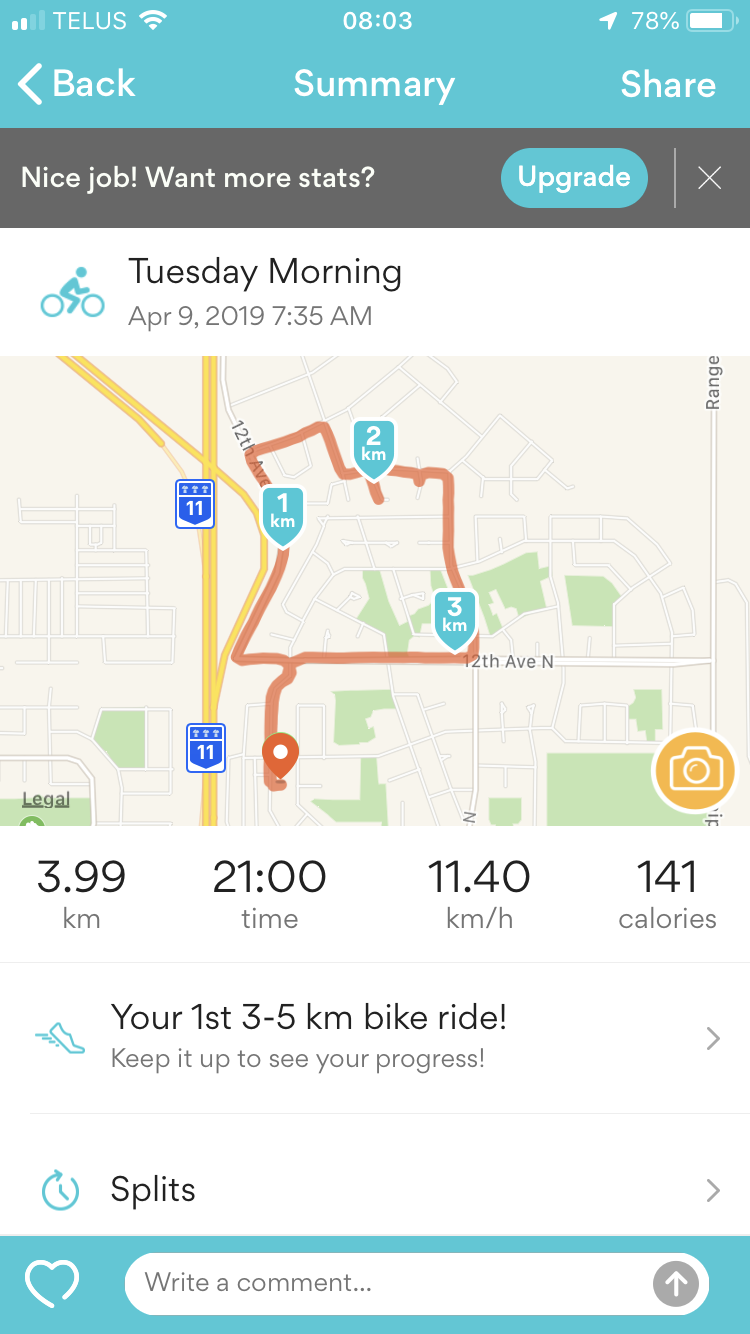
By the end of my run (when I reached my driveway and hit stop on the tracker app), I had reached 4 kms in 21 minutes. That’s a far cry from what I wanted to accomplish and it sure didn’t burn as many calories as I expected, but I got outside, stuck with it and did something different. I’m hoping to start shaving that time through consistent biking over the months to come. Who knows? I may even start biking to work… (someone’ll make me eat those words eventually)

It was nice to do something different. I spend so much time lifting weights and doing martial arts, I realized I have a few muscle groups I don’t use often, and I don’t often include cardio. I may or may not be cursing my legs at the moment.

Right now, I’m using an app called RunKeeper. It’s pretty sweet, it allows me to track distance, time and pace with just about any type of workout one can imagine. In fact, I also use it as a passive log to document my karate classes and weight workouts.

A screenshot of this morning’s bicycle adventure

The above image is what you can look at once you’ve ended your workout. There’s a lot more information available on the previous screen and as you screen down, I just think the map function is super cool!

Although you kinda need to download the app on your smart phone, since that’s the point, you can check it out at the following website: https://runkeeper.com and sign up for it for free.

Now if you’ll excuse me, I’m going to go load my legs with analgesic cream and nap before karate class tonight!

Take It Easy, Or Take It Properly…

This month will mark thirty years for me, in the study of Okinawan karate. I still remember the spring evening in 1989 when I walked into the New England Academy of Karate and Judo for the first time. Sensei was absent that evening and the class was being taught by a brown belt. I watched the entire class and was impressed enough that I chose to attend the following Monday. When I showed up, I met my Sensei and started the journey that I still haven’t completed.

One of the benefits of having done martial arts for so long is I generally know what I’m looking at when I walk into a martial arts school. People have frequently asked me what they should be looking for when thinking about joining. That’s often a dangerous question…

First and foremost, students should try and avoid schools that are open for the prospect of making money. The term “McDojo” was coined a long time ago, and refers to a martial arts school that teaches a watered down version of its art in order to make money. These are often noticeable by the fact that EVERYTHING has a fee. Belts, uniforms, registration, seminars, books the student is “required” to read and even belt tests that have no inherent cost to the instructor, will generally have a cost attached to them. To be honest, one of the first questions a prospective student should ask the head instructor is “What can you tell me about your style?” If the instructor immediately goes into the historical background and particulars about the style, then it should be fine. But if they start by explaining their fee structure, it may be an issue. These are not the only signs, but they are certainly points to watch out for.

Another problem are schools that promote students to black belt within five years. Realistically, with some very rare exceptions, most students should take approximately ten years to achieve the rank of first-degree black belt. Unless one already holds an extensive background in the martial arts, where most of the basics have already been mastered, one cannot truly achieve the skill required for such a rank in that short a time.

The purpose of this post is not necessarily a checklist as to how to find a proper martial arts school, but rather what to do once you’ve found one. Let’s say you’ve found a dojo that suits your needs; the style feels right, the instructor is sound and they have a good reputation. What should you be looking for next?

The martial arts can only be properly achieved through three obstacles, and require only one thing. These three obstacles are blood, sweat and tears. Plain and simple. In my decades of training, I’ve had lots of all three. The one thing required in order to make it through these obstacles is concentration. Through proper concentration, one can achieve a great many things. In fact, I’ve often seen athletes in prime shape be unable to continue beyond the first few classes.

The thing is, there are lots of martial arts schools where you’ll get a decent sweat, everyone high fives each other and you have lots of fun. You get a long with everyone in the dojo and you actively enjoy going to class. But there needs to be more…

There will be classes where you’ll feel as though you can no longer go on. Some classes where you’ll be learning the combat side of the martial arts and your nose will bleed, muscles may get pulled or sprained and after some belt tests, you’ll ache for days. I remember there being times when I would sit at home, weeping into my hands because I had felt I couldn’t advance any further. But these are all parts of the learning process and the need to grow as person in tandem with your chosen martial art.

Everyone has a different reason for getting into the martial arts. Maybe it’s to improve one’s health or get into shape. Perhaps you want to learn to defend yourself or you’re looking to learn about something old and traditional. You simply need to ensure that the school you’re joining has what you’re looking for. If you’re looking for a place to socialize and have a work out, great! It won’t matter if your school focuses on belt ranks, proper process or how long it takes to achieve belts. In fact, you could join anything you like; it wouldn’t have to be martial arts. Go join a yoga or Zumba class. Join a gym group. If you want to test yourself and learn to fight, you may want to join a school that focuses on tournament attendance.

It’s important to find what’s right for you, and to stick with it once you do. As Bruce Cockburn once said “Nothing worth having comes without some kind of fight.” True words. I’ll let y’all folks Google who Bruce Cockburn is.

Lethargy and Apathy are NOT countries in Eastern Europe…

One of the many pitfalls of Diabetes is that is can often cause sluggishness and lack of energy. Many people tend to see this as laziness, but it is often attributed to out of control blood sugars and the physical tolls it takes on the human body.

Just to clarify, lethargy and apathy are pretty similar. the first means a lack of energy and enthusiasm; the latter means a lack of interest, enthusiasm or concern. Sometimes it’s easy to confuse the two.

People often wonder how to “push through” and get their workouts or exercise done, despite the lack of energy. This takes concentration and the willingness to push beyond what your body is telling you. Don’t get me wrong; it is important to take rest when it is required. Your body will eventually need to recharge and replenish itself. This is why most trainers and health professionals will tell you that you shouldn’t work out seven days a week. Eventually, you start doing more damage than good.

But as a matter of course, it is important to push yourself. When you get those days where you just don’t feel like getting off the couch, those are exactly the days where you should. Yesterday, I skipped a karate class. This is not a common practice for me, but some days one simply can’t find the motivation. Is that a bad thing? Not necessarily. But the throbbing pain in my upper back and right shoulder, coupled with my inability to keep my eyes open, told me that if I didn’t take a rest and allow these muscles to heal, I would likely injure or harm myself further.

So it becomes important to know the difference between required rest and lethargy. It is also important to recognize the difference between the ache of a rigorous workout and the pain of an injury. If you are ever uncertain as to which you are feeling, don’t hesitate to visit your family practitioner, chiropractor, massage therapist, whatever you need. Even if it turns out to be nothing, it’s always better to err on there side of caution. Your body will thank you.

Bone Alignment and Proper Form

When training in the martial arts, or any sport really, it becomes ultimately important to maintain proper form. Having improper bone alignment can lead to pulled muscles, injuries in the tendons and other serious sports-related injuries.

As it relates to the martial arts, the power behind a strike comes not only from one’s brute strength but a number of different factors that people often don’t think about. For example, a properly executed punch will draw some of its power from the ground. Don’t believe me?

A good example is if you’ve ever seen two people on the street breaking out into a fight. You’ll never see someone throw a punch from a normal standing position. They’ll usually blade or take a step back or something to allow themselves the opportunity to properly chamber the strike.

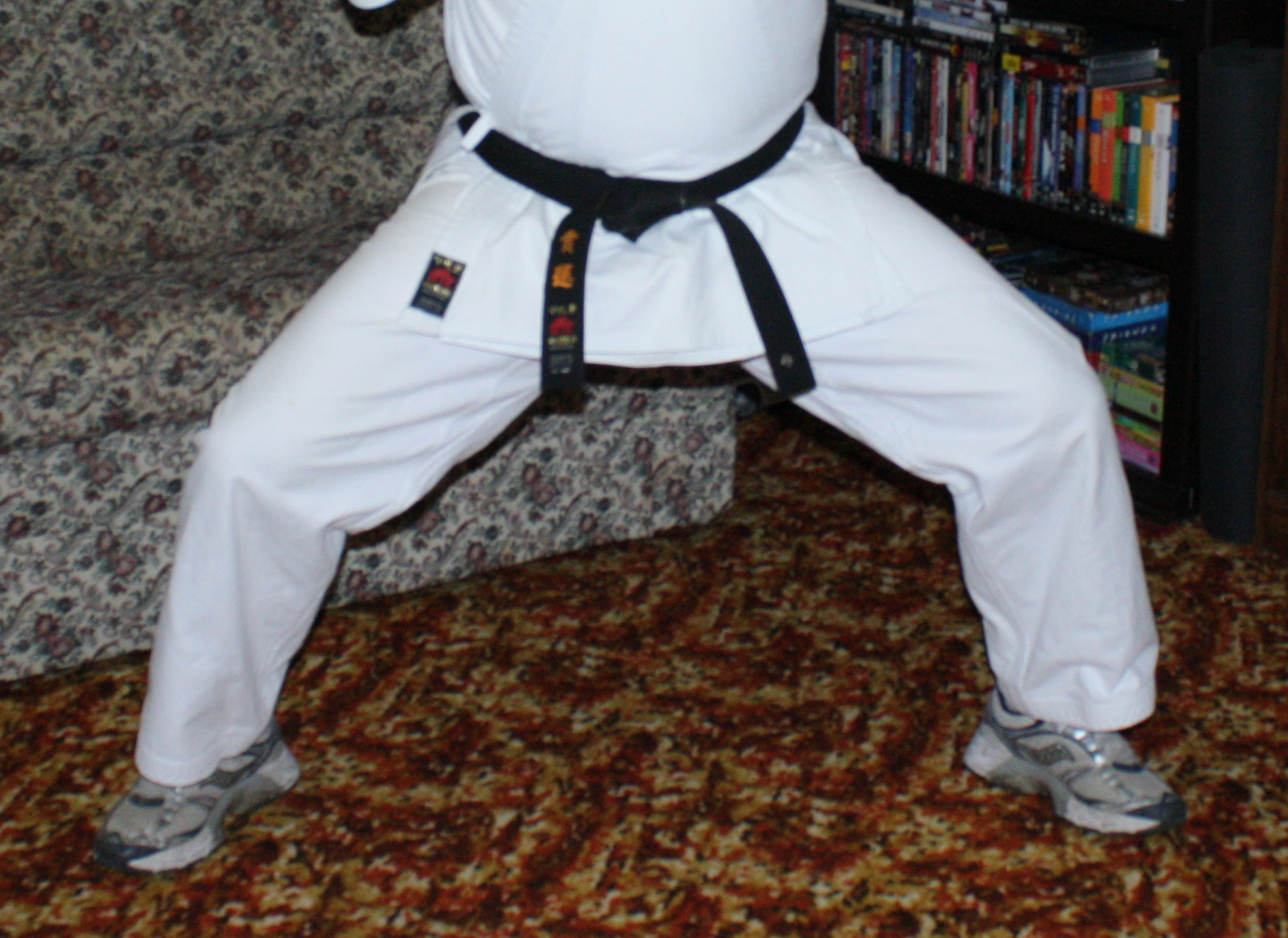
Another very important aspect to examine is your body’s natural pronation and supination. These refer to the natural alignment and rotation of your bones and joints. It becomes extremely important to acknowledge these and to try not to move against it. For example, when doing a “horse stance” movement in karate, one should keep the back straight and allow for the feet and knees to point slightly outward from the body. This is the natural movement of the body and the only way to effectively perform this movement.

The beginning of a good horse stance. I continue by getting lower into the seated position (no laughing at my orange carpet!)

Some styles try to point the feet directly forward or keep the knees pointed forward, but as you squat down in a horse stance, this movement becomes unnatural and taxing on the body.

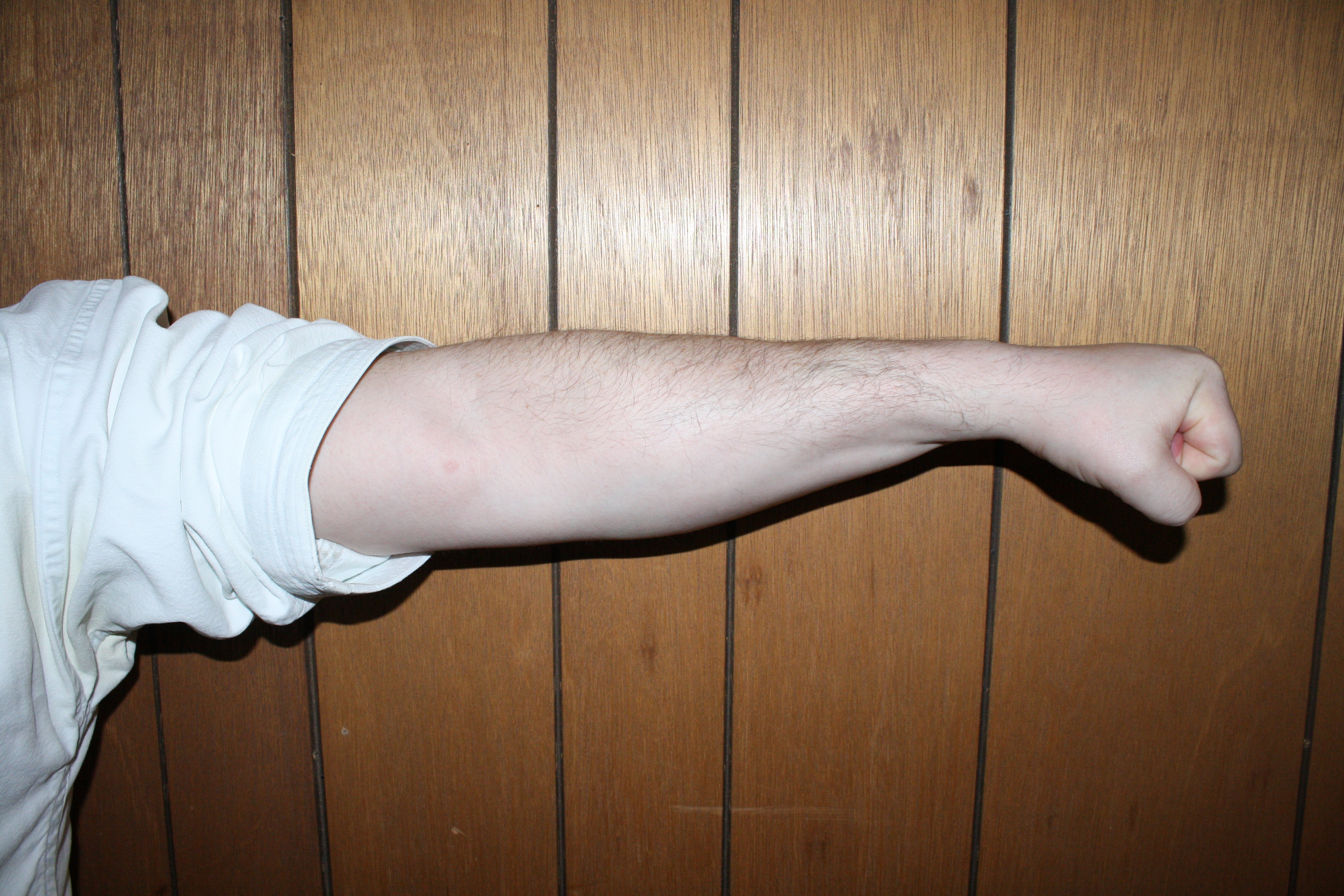
The same goes with any of the limbs or joints. When one throws a proper punch, it becomes important to strike, keeping the knuckles, wrist and elbow lined up perfectly. This not only guarantees a stronger punch, it also prevents injury.

This is one of the reasons why boxers, muay thai and MMA fighters generally have to wrap their hands. They have lots of striking power, but no precision or ability to align their joints. Without the additional wrapping, they would likely injure themselves after the first few strikes.

A punch, demonstrated with proper alignment of the knuckles, wrist and elbow

Now, don’t get me wrong… I sure as hell wouldn’t want to take a punch from any one of those types of athletes! They have tremendous power to their strikes. But in a situation of true self-defence, one needs to train the body to be ready to strike without the benefit of padding or wrapping.

Normally, your body will tell you if something is unnatural. But this doesn’t mean that the movement your body HAS gotten used to, is correct. Sometimes we need to be corrected and adjusted in order to promote that natural movement.

The Martial Arts Ladder

My Sensei used to say that martial arts was like a ladder; we all want to climb up the rungs and get higher. But once you’ve made it up a few levels, it’s important to look back and help up the ones below you. Once they progress, they could potentially make their way higher than you and they would, in turn, reach back and help lift you up to the higher level you have not yet achieved. This is the beauty and wonder of the martial arts…

Years ago, we used to have three regular classes a week. Now, just to be clear… this was back in New Brunswick and I’m talkin’ turn of the century/millenium when everyone was freaked out over Y2K but all I could think about was graduating my black belt in karate! I was training hard. But the world’s perspective on martial arts was changing. People didn’t want to shed blood, sweat and tears like they used to. The next generation was growing strong and people were more interested in the 3-year black belt that some particular schools and styles catered to as opposed to hard work and developing oneself.

When I achieved my green belt (this was the first adult belt in my system after four ranking stripes), it became my responsibility to show the new arrivals their first steps and katas. I had climbed up the first rungs, so now I had to look back and pull the new climbers up.

When I achieved my brown belt, it became my responsibility to teach the entire class and guide them during their basic exercises and aiding movements. I would guide new students through their first couple of forms and help with correction and checking on some body conditioning.

When I achieved my black belt, it dawned on me just how little I knew. I realized that a kick was just kick and a punch was just a punch (sound familiar?). Who was I, to try and guide these newcomers into their journey towards whatever it was they were trying to learn? But as I progressed, I came to understand that white belts also needed to understand how to kick and how to punch, and wouldn’t learn unless someone showed them.

I guess my point is that as a student learns, it becomes important to help the newer students to progress so that they can show the newest practitioners, and so on and so forth. You can’t be an efficient teacher without somehow helping the students to grow to to the point where they will teach others. Makes sense, doesn’t it?

Tonight, I had the benefit of having an experienced black belt teach me and show me a form in his particular martial art. It was humbling, because he could have spent his time practicing his own thing, but he spent time showing me the way instead. And isn’t that what’s important? No matter what level you reach, someone will need to carry on the way.

And this, dear friends, is the martial arts ladder. We grow, we learn, and we teach. So for every two steps you take, be sure to help someone else take one as well. Someday, that white belt may become a Sensei who teaches someone one new.

Lactic Acid, NOT An Ingredient In Your Milk…

We’ve all been there, right? Maybe you’re on a wicked jog, or participating in an intense spinning or Zumba class…. Maybe you’ve lost your mind and decided to drag your wife through a particularly sweating hypertrophy workout because it’s “something different”…

No? Just me? Alright then, think back to a time when you’ve been working out or exercising strenuously. Do you remember feeling that sudden burning feeling in your lungs? A noticeable lack of strength in your muscles and your body is essentially telling you to stop and rest? That, my friend, is a build-up of lactic acid in your muscle tissue.

Lactic Acid, or Lactate, is caused when you’re body is burning through more oxygen than it is carrying while exercising. Lactic Acid can be used by your body to produce energy without the use of oxygen, but it leaves some unpleasant side effects in its wake. The buildup of Lactic Acid is sometimes referred to Lactic Acidosis and the big problem is that your body will generally produce more Lactic Acid than you can quickly burn off and this is what causes you to feel symptoms like pain, cramping, nausea, weakness and exhaustion. One can sometimes fight one’s way through the effects of Lactic Acid buildup, but the result is more Lactic Acid. Rinse and repeat. Fun.

Once you hit that point, or what’s called the “Lactate Threshold”, it’s important to start your cool down. Your body’s exhaustion will likely tell your brain that it’s time to stop completely and maybe lie down for a nap, but this is not the proper thing to do. You need to cool down and allow your excess Lactic Acid to burn away.

There’s no real way to prevent Lactic Acidosis, other than to exercise regularly and increase the intensity gradually. I think WebMD said it best: “Don’t go from being a couch potato to trying to run a marathon […].” But if you build yourself up gradually, it will increase your threshold and make you capable of a lot more physical exertion before Lactic Acid builds up. The reality is that our ancestors sometimes had to face threats that didn’t allow them to build their intensity gradually, and this is why our bodies have this backup. But it is meant to be temporary. Unless your life is in jeopardy or the immediate situation mandates it, continuing to fight through Lactic Acidosis can be harmful (at the very least, it hurts like hell!).

But once you’ve hit that point, be sure to rest up and drink plenty of water as it helps to eliminate the excess acid. In some rare cases, medical conditions can cause Lactic Acidosis without intense exercise. Believe it or not, people who use Metformin for Type 2 Diabetes can experience Lactic Acidosis as a side effect of this medication. If you’re getting any of these symptoms as a result of a medical condition or medications, obviously you should speak with your doctor.

Otherwise, stretch properly, drink plenty of water and eat a balanced diet, chase all of that with a good night’s sleep and keep working out. I often hear people think that they believe Lactic Acidosis lasts for a couple of days after the workout; this is part of the recovery and not the actual Lactic Acid. Lactic Acidosis is an event that happens in the moment, and is usually gone soon after the workout ends.

The Next Generation Carries On…

Today’s blog post comes with a thick, heavy ounce of frustration as the power has been out at our home since about 6:30 this morning. We are currently sitting at a local fast-food eatery while my 4-year old indulges in a play structure and I stuff my visage with calorie-rich foods (only because we can’t make breakfast at home, of course!) But I digress…

One of the many benefits of being in martial arts for many decades is that I have been able to see many generations walk through the doors. Believe me when I say that students come in all shapes and sizes, walks of life and backgrounds. A good number of them have been children, and for a brief period in 2007, I actually had a “kids'” school of karate. It was there that I learned how hard some parents push their children. And this is coming from a karate instructor!

Martial arts has always been a passion for me, ever since I saw “Enter the Dragon” with Bruce Lee in 1982. This was further compounded by a ninja-based television series I used to watch called “The Master”, which started airing in the early 1980’s. I was never much of a team sport kind of kid, especially with all the difficulties that came from Diabetes at a young age. Needless to say, my parents didn’t have to encourage me to stay in karate. In fact, they didn’t even know I was practicing it for the first few years!

But to any casual observer watching a class, one thing is immediately obvious: some want to be there; some do not!

When I was teaching my students, one of the deepest lessons I tried to teach was honesty. I made a point of telling them that if they were unable to tell the truth, they would ultimately be unable to properly learn martial arts. This was driven home for me one day when I noticed a pre-teen student who was rather phoning it in during his workouts. This had been his general attitude for a number of weeks and I decided it was time to discuss it with him. I had the opportunity to sit him down after class and I asked him outright if he wanted to be in karate. I was somewhat taken aback when his immediate and unrehearsed response was a firm “no”. When I asked him why he was still coming to class when he didn’t want to be there, he explained that his parents were making him attend.

The following week before class started, I had the opportunity to speak with this young boy’s parents, who told me that they wanted their child to be involved in a sport to learn discipline and get in shape, and that he would remain in the class whether he wanted to or not!

Were they right? This is a fine line, folks. And if I’m being honest, as an instructor and a practitioner, I have to say that if you’re trying to teach your child a lesson by forcing them into something that isn’t a requirement to keep them alive and well, you’re teaching them the wrong lesson.

Here’s the thing: It’s important for kids to get into something. Although it is EXTREMELY important for kids to learnt to self-entertain, they also need to learn some of the basic socialization skills that are required to be carried into adulthood. Sports and leisure activities outside of school help teach this, but it also helps to instil a sense of commitment and accomplishment in a way that they won’t learn otherwise. But how far should we push this point if the kid really doesn’t want to keep doing it?

As part of the lessons about commitment and accomplishment, there are a number of factors to bear in mind. If the child has chosen the activity in question, and money has been provided to allow them to do so, then it becomes important for them to understand that they should stick with it and finish what they’ve started, especially since the family and household have sacrificed to make it so. There’s nothing wrong with them choosing something else once this commitment has been fulfilled. However, if the parent has chosen the activity and are actively forcing the child to stay with it, they may be doing more harm than good.

The other side of the coin is that if you decide to be a progressive parent and allow the child to quit, you may be teaching them that it’s okay to drop something once it becomes boring or played out. And in today’s world of electronically fuelled entertainment, that’s a slippery slope indeed.

Ultimately, I ended up “kicking” the young boy out. I had a talk with him and explained that if he genuinely didn’t want to stay with karate, he was damaging the class by only putting half the effort in. I told him he should talk with his parents and try to choose something that would suit him and make him happy. He was grateful. His parents were not. They didn’t understand that by having a child who didn’t put in the effort, he was damaging the energy and drive of the class, as younger students saw him basically phoning it in and thought this was okay.

And this is the unspoken side of this issue: kids who don’t want to be there will cause certain damage to the school and the goal it’s trying to reach with the children. I would recommend that if your child hasn’t chosen the intended sport or activity, maybe talk with them and see what they would like to do. This will insure a better chance of having them stick with it.

Last but not least, I should point out that every situation and child involved is different. What works for one parent and child may not work for the other. Although we want our kids learning important values such as commitment, dedication and seeing things through, we have to be careful to maintain the balance with respecting their rights and helping them reach THEIR goals.