Dojo Code Of Conduct


I wrote this post all the way back in December of 2019 and reposted it for the last time, almost two years ago. Although I try to avoid just recycling posts I’ve already written, this post outlines the proper guidelines a prospective student should follow when attending ANY martial arts school. Some of these are simply a matter of tradition, some of them are necessary to ensure that a dojo runs smoothly. Some, mostly all of them, are also a show of respect for the school you’ve chosen to attend. I think we can all agree that even if you’ve studied in a different style or have a different set of core beliefs, you should still show respect when inside someone else’s dojo. ESPECIALLY if your goal is to have it become your dojo, as well.

One of the big points I make when listing these things, is if your core beliefs don’t align with the school you’re visiting, you likely shouldn’t be joining. Not all styles are created equal and not all schools will suit every student. Martial arts is a very subjective journey and the first step should always be to find the school that works for you. But I digress… Given that my significantly delayed but anticipated return to the dojo is forthcoming, I’ve decided to repost this list as a reminder.

I’ve had the opportunity to observe some students, visitors and outsiders in many dojos. Taking into consideration some of the things I’ve observed, these are some of the basic principles of conduct when training within the dojo. This is never an exhaustive list and is often subjective to what’s been seen in the dojo but it’s all good stuff. Here we go:

  1. Bow when entering or exiting the dojo: This seems like a bit of a tiny detail, but it is an important one. It provides a show of respect; respect towards the instructors, respect towards the ones who trained before you, and respect towards the school. It also evokes a sense of discipline. Even though you may not realize it now, that tiny detail begins to lay the foundational discipline that should become the cornerstone of your training;
  2. Ensure your Gi, or karate uniform, is clean and pressed: This one is important not only for protocol and etiquette, but for hygiene reasons as well. And you would be surprised how many people overlook it. There’s nothing worse than someone who assumes that their last workout wasn’t intense enough to warrant laundering their uniform. Make sure it’s clean. Not only does that ensure a more “pleasant” environment for yourself and the other students, it shows proper respect for the uniform you wear on your journey. Keep an eye on the condition of your uniform. If it’s become yellowed and stained, regardless of washing, it’s time to replace it. If there are tears and/or holes, have them repaired (unless they’re unsightly even once fixed). You shouldn’t have to iron your gi but if you do, for the love of ALL that’s good and holy, don’t iron a crease down the center of your pants. Your going to karate class, not a business meeting;
  3. Stand straight and pay attention: When not executing a movement in the immediate moment, it is imperative that you stand straight and tall, heels together and thumbs tucked into the front of your belt. Keep your gaze towards the front and pay close attention to what the head instructor is saying. Try to avoid looking around and fidgeting. A big part of discipline is being able to focus long enough to build an attention span beyond that of a goldfish and if you fidget and waste your time, you may miss an integral piece of information you needed for what you’re working on;
  4. Acknowledge every instruction given: Different styles will have different ways of doing this. Some will choose a shallow bow when the head instructor provides instruction, some will answer in the affirmative by saying Hai (Japanese for “yes”) or something of the like… The method of acknowledgment will depend on the style and school you’re in. But once it’s clear that the instructor has completed providing instruction, this small acknowledgment is not only a sign of respect but provides the instructor with some cursory way of knowing that you’ve understood what’s been said;
  5. No food or drink within the dojo: You would think this one would be common sense, but a martial arts school is no place for you to sip your mocha-choca latte while your kid trains. Since the average martial arts class only lasts about an hour and a half to two hours, you can manage this easily without having food and drink within the confines of a training environment. In recent years, I’ve noticed that it’s become a bit more of a common thing for the practitioners to carry water bottles into the dojo and take water breaks throughout training. I’m pretty divided on this, considering Sensei always use to tell us to use the washroom and grab our drink BEFORE class started, because once you bowed in, you were in until you bowed out. But from a health perspective, I understand better than most that proper hydration is important. That being said, my current classes are only an hour in length and the average person should be able to make it through that short period without necessarily sucking back on a bottle;
  6. Get out of the way: If you become injured or over-tired, bow, step back and sit in seiza (on your knees) at the rear of the class. Stay out of the way and remove yourself from the flow of the class until your fatigue passes or your injury allows you to continue. Of course, if your injury is severe or serious enough to think you need to remove yourself, you likely shouldn’t continue as you could aggravate the injury further. The point is, there’s nothing to be served by standing in the way while others continue and you shouldn’t expect that everyone will stop and wait. After all, this is their time, too;
  7. Don’t show up late: This one is and always has been, a personal pet peeve of mine. Some instructors will say that if you show up late, it’s better to get “some of the workout” in rather than none at all. Although that is a great concept, showing up late can be disruptive to a class and shows great disrespect to your class and instructors. We all have busy lives. It falls to you to plan ahead and schedule things so that you may attend class. Whether or not showing up late is appropriate will be up to your head instructor, but true respect dictates that if you aren’t fifteen minutes early for class, you’re already late. A good example is a recent evening where I had to fight off a bout of low blood sugar and didn’t make it to class. I’m sure that if I really pushed it and fought my way down there, I would have been able to make it only a short period after start of class. But such disrespect for the flow of a dojo’s operations shouldn’t be encouraged;
  8. Don’t waste your instructor’s time: Although you’ve likely paid a fee for your presence, the instructor(s) within the school are there to impart their knowledge and skills to you and others. If you aren’t going to put in your full effort, then you’re wasting your instructors time. Effectively, you’re also wasting your time AND the fee you paid. You’re also affecting the other student’s ability to learn properly. Karate isn’t something you can walk into a few 1-hour classes and expect to progress. You need to put in some supplementary time training outside the dojo, on your own. This is the only way you’ll truly progress and make any headway. Otherwise, you may as well join a knitting circle;
  9. Respect and train based on your partner: You will sometimes be paired with someone of lower or higher rank than yourself. If you’re paired with someone of lower rank, you become the example of what is to be taught. If you inflict injury upon your partner, you may discourage them from further learning and you will have gained nothing yourself. If training with someone of higher rank, respect should be given and you should take every advantage to learn from this person as they are in the same position you would be if training with a lower ranked belt. Granted, time has proven that there is just as much you can learn from a lower rank. It depends on how positive your perspective may be; and
  10. Don’t be afraid to share some personal information: This is a new one that I haven’t included in the previous iterations of this post but I feel it’s significantly important, especially since it also plays in to some of the previous points about food and drink and disrupting the dojo. I’ve always made a point of sharing the fact I have Type-1 Diabetes with all of my instructors and students. We live in a world of wanting privacy but such a step is important, not only for my health and well-being but because there may be occasions where I’ll need to excuse myself to eat some fast-acting carbs or rest for a few moments. Beyond the respect component, such steps can be necessary to ensure I don’t pass out on the dojo floor. Be sure to discuss such things with your head instructor so that there are no misunderstandings.

I’ve seen everything from kids running around, coffee, students fidgeting and looking around… In a school I trained in, there was even one guy who showed up forty minutes late for class with a bag of cheeseburgers and ate while the rest of us did calisthenics! Besides the fact that the smell of burgers was killing me, a karate dojo is definitely NOT the place to eating, much less junk food. Even though some of these points could be viewed simply as one’s person’s opinion, it stands to reason that tradition and respect are things that should never be ignored in the dojo.

Folks, no matter what sport or art you study, there will always be guidelines to follow. The martial arts simply have more, and that’s part of the charm. Although the above guidelines are only basic, they apply to any martial arts school you attend. Your specific dojo may have more, and this is one of those moments where it’s important to take the initiative and ask. After all, respect is a primary aspect of karate and all martial arts. Food for thought… ☯

Have A Little Style While Showcasing Your Style…

One of the biggest issues and trends I’ve noticed in recent years, especially online, is when martial artists take a position or basically bash or call out other styles. Although I can fully admit to not endorsing certain schools of thought or how certain techniques are done by others, I’ve always maintained a respect for how other styles may do something that is different than my own way. Respect is a very large piece of the martial arts puzzle and should be considered when commenting on someone else’s style.

The thing is, and I’ll likely take shit from some commenters on this, is that no style is perfect. I’ve had the benefit of training with a number of different schools and styles and can honestly say that I’ve seen many different ways of performing the same technique. Some good, some bad. The problem is that this is a matter of perspective. What I assume is a poor technique may be quite an effective one for practitioners of a particular style. Since I don’t have the advantage of having trained extensively in this style, I may not have the vision or perspective to recognize this.

For example, I would never attempt or use the multiple high kicks employed with certain styles. The concept of balancing on one leg for any length of time in an actual fight seems ludicrous, at best. But for someone who’s drilled and built muscle memory using those techniques, using them may be efficient and precise. The same kick or punch performed by two different practitioners will only be as effective as the practitioner’s skill level, experience and effort, regardless of the style.

One of the most notable examples I can think of is when I trained for a period of time with a karate dojo that used long, striding steps to reach and attack their opponent. On my side of the table, this seems incredibly ineffective. After all, why would I stretch myself out and actively try to walk towards an enemy who is out of arm’s length? If I can’t reach them, then they can’t reach me, right? Fight’s over! Uechi Ryu has always focused on strikes when the opponent is within reach, to ensure contact. Oh sure, we step and slide the same as any karateka but some styles will practically cross half a room in doing so. Does this mean my style is better? No. It just means it’s different and one can potentially be as effective as the other. It’s all in the eye of the practitioner.

A lot of people are often reminded of the old classic Kung Fu movies where you’d get two students from competing schools, yelling that one’s Kung Fu style is stronger. Strength is found in the practitioner, not the style. And with that strength needs to come with the respect not to constantly judge a technique or assume it “won’t work in real life.” I swear to the light, if I go the rest of my life without someone saying that to me, it’ll be too soon. But I digress… Take the time to appreciate the technique. The discipline. The effort. And never forget that if something is done in form or drills, it likely serves a deeper purpose than in actual practice. Honour and respect your fellow martial artists. Food for thought…☯️

A Better Resolve…

I guess first and foremost, I should start by wishing everyone happy holidays and a Happy New Year, considering I haven’t posted since before the holidays. For the most part, we had some pretty quiet holidays, with a nice stay-at-home Christmas Day and some brief travel to see family during the last weekend before New Year’s Day. All in all, it was pretty nice, despite my constant coughing and hacking, but that’s a post for a different day. Today’s post is about the strangest and most curious of traditions; the New Year’s resolution…

Now, I need to be very clear that I’m a big fan of setting goals and making resolutions. I think it’s a fantastic thing to do and helps one work towards specific outcomes in terms of their overall health and fitness (or whatever else you may be looking to alter or improve in your life). Hell, I’ve even been guilty of jumping on the resolution train a time or two myself, in the past few decades. But I will be the first to admit that the farthest I’ve gotten with a New Year’s resolution is about three or four months before I faltered and threw in the towel. The question becomes, why do people make such resolutions at what is without a doubt the very worst time of the year to do so?

What do I mean but that? Well, simply put, the beginning of January is the very worst time to make any sort of commitment towards improving your fitness or health or commit to dieting or changes in lifestyle. The reasons for this are quite simple. It’s the winter time and it’s cold. This limits a person’s motivation at the best of times but it’s even more limiting, considering you can’t spend extended periods of time outdoors to help you along, there isn’t as much sunlight and the days are shorter and last but certainly not least, you just spent the past couple of weeks seeing family, opening gifts and celebrating the New Year.

The period immediately following all of that includes a likely return to work, payment of bills and preparation for tax time (in Canada, at least). Then, you tack on a commitment to eat better or limit your diet or exercise for X number of times a week or whatever you’ve chosen, and it’s a sure recipe for failure. With that lessened feeling of motivation, it’s no wonder that people often falter in their resolutions within weeks of starting it.

The idea should be that one should resolve to increase their fitness and nutrition throughout the entire year. Instead of commuting to something on January 1st, when it feels more like a hindrance and you’re likely to give up, make a point of finding your resolution throughout the year. Another tool that’s extremely useful is having a resolution buddy. If you have someone working right long with you, it helps keep you on the path and keeps you accountable. By going this route, you’re less likely to fail so early into your goals. Last but not least, we’re all human. You may falter sometimes. You may take a cheat day or an added rest day here and there (proper fitness requires the occasional rest day, anyway). That doesn’t mean you’ve failed in your resolution; it just means you need to refocus your efforts and keep on going. Food for thought… 😜

My Wise Words Usually Come From Someone Else…

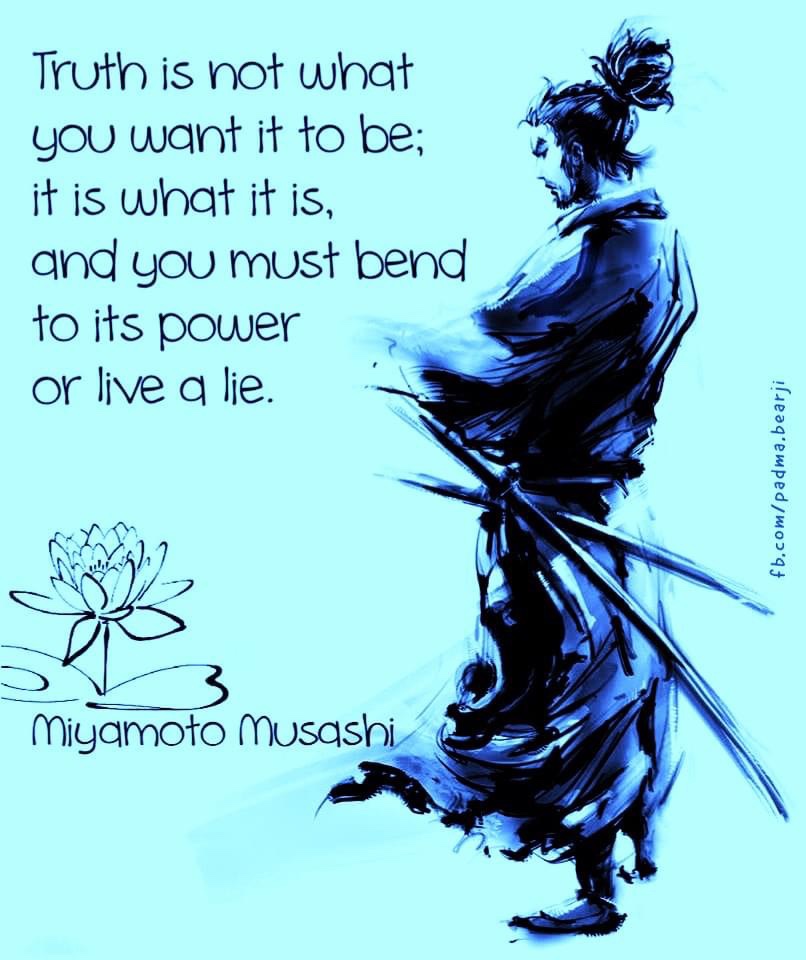
It’s been a while since I posted something I’ve found online just for the sake of sharing it, so I thought I would do so today. I say this as I slam a paragraph in my opening instead of simply posting the photo! I’ll reign myself in just long enough o share today’s quote. Here is is…

Miyamoto Musashi has been a significant role model for me through my martial arts journey. He was a Japanese swordsman who developed his own style of Two-bladed swordsmanship. He was also an artist and philosopher, which gave him a unique perspective on the ins and outs of martial arts and how one should approach life. He wrote a book in the late 1600’s famously titled The Book of Five Rings, which was intended as a means for Musashi to leave behind the teachings he provided to his students.

Whenever I share a quote that’s said to be attributed to someone, I’m always cautious to point out that the quote is only as good (and accurate) as its content. There are a lot of memes and supposed quotes out there that are credited to persons who may actually have never said it. In that spirit and if you haven’t done so, I would highly recommend getting a copy of Musashi’s book and read for yourself. Although this one quote hits deeply, his book reflects on so much more and gets the mind working. Stay healthy. ☯️

A puzzle With A Million Pieces…

Sensei always says that karate is a puzzle with a million pieces; the only way to ensure you learn is to take home one new piece, every night. I’ve always felt that this applies to almost anything in life, but it’s particularly true where it involves karate. To the average layman, karate may look simple and it may be assumed that it’s all kicking and punching. In reality, there are multiple moving parts (pun fully intended) behind learning and developing one’s skills in karate.

I bring this up because I recently read a post online that basically says that you need everything to learn karate. You need kata, you need limited, you need sparring, you need drills, etc… And that’s quite accurate. You need all aspects of the art in order to achieve mastery over it. Depending on how spiritual you find yourself, you may understand that one truly never completely masters karate. There will always be SOMETHING to learn. But I’m referring to karate in its most simple and general terms.

What I mean by this and why I bring it up, is that one can’t choose to “specialize” in karate. I’ve known students and practitioners who were far better at sparring than they were at learning and developing their katas. Unfortunately, they need their katas no less than the one who seems to be poetry in motion while doing them. Learning the foundation of proper form before jumping into sparring is integral to one’s safety and proper self-defence; not least of which is the need to learn the art properly.

I’ve seen students who depend solely on form. They make their way through the lessons without ever making contact with a target or another practitioner. This is also a flawed approach, as karate requires the practitioner to experience the sensation of the impact of their strikes, to develop muscle memory and to learn how to have proper bone alignment so you don’t break every fucking bone in your hand because you decided to throw a punch! Form alone won’t get you there…

That’s why it’s so important to get all the pieces of the very large puzzle that is karate. You need form. You need sparring. Hell, you need cardio and muscle development. Meditation, proper nutrition, proper sleep… I can go all day, the point is, the are many moving parts to ensuring that your martial arts journey not only safe and effective but a good use of your time. You may like the look and feeling of pounding away on the punching bag. You may even be quite fast and good at getting that strike out. But it will serve you quite poorly if you haven’t learned the proper form to get the result you need from that strike. So be sure to collect all your pieces. A puzzle with a missing piece looks terrible, indeed. ☯️

Do You Really Need To Strike…?

If you’re talking about karate, the short is yes. Yes, you do. But is it really that’s black and white? I’m talking about the training environment, of course, not an actual fight. If you’re in an actual fight and you don’t strike your opponent, you’re in for a bit of a bad time. But even in those circumstances, there can often be alternatives. I bring this up today because, having been in my fair share of fights, both on the street and in the dojo, I know a little something about having to strike and in most cases, striking first to avoid getting injured.

I recently saw a meme online that quoted a Shorin-Ryu practitioner named Hiya Yuchoku. Yuchoku studied under a number fo well-known teachers, including Chojun Miyagi, who is known as the founder of Japanese Goju-Ryu. He was awarded his 10th degree in the late 1970’s, almost 20 years before his death in 1994. I’m never one to speak ill of the departed, especially such a revered martial artist. But I’m also quite leery of any quote that’s attributed to a source that is no longer around to confirm or deny what words they may have said. Here’s the quote I read:

“It’s not Karate if you interrupt the blow before contact. It is impossible to fight without the possibility of injury. Injuries are often inevitable.

Karate is essentially not fit for Tournaments. It is not feasible to make real Karate a competitive sport.”

– Hugs Yuchoku

There’s a lot to unpack in those two short, little paragraphs. For the most part, I tend to agree with the second paragraph. Karate was never intended to be a competitive sport. Although we do see karate tournaments, the spirit and intent of the art was never meant to score points or win trophies. I know that’s for myself, personally, I’ve never competed. Sensei doesn’t approve of such things and neither do I. My karate has always been about self-defence and the defence of others. But, to each their own, right?

What concerns me with the quote is the first paragraph, specifically the first sentence. “It’s not karate if you interrupt the blow before contact.” Let’s examine that statement, for a moment. For decades, I’ve trained myself to have an accurate control over my strikes so that I can stop on a dime or plow through my target with the intention of only stopping on the other side. And quite frankly, every possible degree in between. This is important. being able to strike something/someone is easy. Any poor bastard who can close a tight fist can throw a punch and make an impact.

But to have the control to be able to spar in a full contact environment and still stop a hair’s width from your target takes skill, concentration and focus. Three very important aspects that most would argue is integral to learning karate properly. To be able to put full strength behind a strike but still maintain enough control to stop on a dime develops a level of muscle memory that one simply won’t get by always plowing right through.

The second part of the first paragraph, where injuries are referenced, is quite accurate. Let‘s be real, for a moment… Karate isn’t a fuckin’ knitting circle. If you want to avoid injury completely, maybe you should take up checkers, instead. The “possibility” of injury always exists, even in the training environment. This is why firm control, concentration and focus, as well as respect for your opponent, are so very, very important to effectively learning karate.

As is always the case, different styles and martial artists will have different views and opinions on this. I invite any of you who have input to please feel free to provide your thoughts in the comments section. I always welcome a good debate. Food for thought… ☯️

A Little Respect…

When you include all the variations and offshoots, there are hundreds of different martial arts styles, hailing from several different countries. This includes a martial art called “Kalaripayattu,” which has origins in India and is said to be thousands of years’ old. Some styles owe their creation to the existence of previously-existing styles, like Brazilian Jiu-Jitsu. That style seems to be all the rage and everyone always praises it but did you know that the style is actually a combination of Japanese Judo and Jujutsu? The style that a good portion of the world seems to think is “oh so great,” is actually a combination of two already-great styles. But the fact I could make that snarky last comment speaks to what today’s post is all about.

I’d love to say that my style is the ultimate one and can outdo any other style that could possibly be out there. But the reality is that it isn’t just about the style but how you train and how much you put into it. I’ve had people I’ve trained with that royally shit the bed in terms of how they’ve developed themselves. Meanwhile, I’m pretty convinced that my Sensei could not only beat the shit out of a team comprised of Bruce Lee, Jackie Chan and Jet Li but he would follow up by walking away slowly as an explosion happens in the background. But I may be JUST a little bit biased. The point is that most practitioners tend to develop that bias, since most dedicated martial artists will find and stay with one style for the majority of their training career. Because of this, they tend to believe that their style is THE style.

There’s nothing wrong with a little bit of loyalty and it’s certainly important to bear in mind that style hopping tends to water down a student’s overall skills. But the style you choose is exceptionally subjective and the idea is to choose a style that suits you, fits your needs and helps to provide you with what you need, overall. You have some exceptions, like Chuck Norris and Jean Claude Van Damme. Say what you will about some of the movies, both those fuckers have multiple black belts in various styles. But that tends to be the exception, not the rule. The idea is that sticking with one style doesn’t mean that every other style is wrong or ineffective.

That’s why it’s important to show a little respect. If the original developers of martial arts styles hadn’t kept an open mind and showed a bit of willingness to learn something new, the style you’ve dedicated yourself to would probably never exist. Or at the very least, it might be significantly different than what you know. In my time, I’ve had the opportunity to study with a variety of schools touching on a number of different styles. These different styles have had different ways of doing things, including how to stand, how to execute techniques and even how to close one’s fist and throw a punch, which seems quite basic but there’s apparently more than one way to do it. Imagine that! And although these styles were different, there was always something for me to learn. It wasn’t always easy… Adjusting to different techniques when you’ve been doing it a certain way for decades can be rough. But through all of that, respect has always been there.

No matter what style you study, how long you’ve been at it or how effective you think it is, always remember that anyone else likely feels the same way about their style. There should be no lack of respect for the other styles you may encounter. There are far too many people who bash and bad-talk other styles and always assume that their style is the ultimate one and that no other style has any value. The truth is that there is value in all styles and they’ve all had their journey. So keep an open mind and be willing to consider different perspectives. Although dedication to one style is important, respect for ALL styles holds a seat on the same platform. Food for thought… ☯️

Simply The Best…

One of the questions I’ve often been asked, especially when speaking with other prospective martial artists, is which technique I feel is the best in an actual fight situation. This is a loaded question and one that is almost impossible to answer. The reason for that is that most traditional martial arts have enough techniques to make choosing only one seem a bit like trying to identify one’s favourite drop of water in a lake. It’s all water, it all gets you wet… Choosing one makes very little difference. The same can be said of a martial arts technique. Every technique has its use, its place and its function. Each also has its own set of advantages and disadvantages that people don’t necessarily consider when using them, which is a bit of what I’m going to try and touch on within this post.

If you would have asked me twenty years ago, I likely would have said that the roundhouse kick was my favourite technique. It had reach, it had flexibility in its application and could be applied to anywhere along the vertical axis of an opponent’s body. It also had the look of karate; meaning that one could almost channel their inner Van Damme while performing it, without having to completely leave the ground. However, as the years have dragged on and one’s flexibility and reach diminishes with time, delivering an effective roundhouse kick becomes less and less possible. Although a solid roundhouse kick will provide an effective result when applied to the legs, I have a tendency to unfortunately pull more muscles than I strike these days, when using the roundhouse kick. It also doesn’t seem to have as much of a range as it used to, likely as a direct result of that lack of flexibility.

This can be said of most kicks, considering that as one gets older, muscle tissue has less flexibility and requires more time to stretch and warm up before explosive use. But in a real fight situation, there IS no time to warm up and stretch. The idea is meant to be that one should train and develop consistently in order to be able to rely on muscle memory in the event a technique needs to be used. But even consistent training will not keep up with the ravages of time and age. But enough about me being old. The reality is that I’ve never been a fan of kicking as a general rule. That likely sounds odd, coming from a karateka but the reality is that in a real fight, lifting your feet off the ground, even for a brief moment, can mean the difference between getting out of a sticky situation or finding yourself taken to the ground where your opponent may cause unexpected damage and injury. A bleak thought? You fuckin’ right it is! And accurate. We ain’t talking about a knitting circle, here…

My style has always focused on close in, small circle techniques that require your opponent to actually be within your reach. I’ve trained with other styles and I’m certain there’s value in it for them but I really don’t see the value in trying to cross half a room to deliver a punch. In my world, if you’re outside my reach, I’m outside your reach and there’s no reason to strike and/or block. To any practitioner of Uechi Ryu, this would make sense. When I see someone in a lowered leaning stance, stepping almost five feet forward, simply to throw a punch at an opponent who would no doubt see them coming, I cringe for the art! I’m sure there are technical practicalities to it, including flexibility and leg strength and a bunch of others. My point is that I’ve been trained that trying to strike an opponent that’s outside your reach is a waste of energy and potentially opens you up to being struck, yourself, which brings us to punches…

Punches in any variety are by far the techniques that I’ve worked the most with. In any variety or form, a punch is direct, effective, easier to aim and can deliver an impact to anywhere on an opponent’s body. Given the nature of one’s hands, you can deliver a punch with the front of the knuckles, back of the knuckles, ridge knuckles or even some limited jabbing strikes with the fingers, if you’re brave enough. Punching is the safest means to deliver a strike to an opponent who is in reach, while maintaining one’s balance and stability by leaving both feet on the ground. Not exactly the flashiest or movie-worthy of techniques, but certainly the best. Of course, as with all things in life, there is a negative to the positive and punching is no exception. The human hand contains more than two dozen bones…

When you consider all the metacarpals and phalanges in the human hand, punching poses a particular risk; a broken bone will incapacitate the hand and likely render it unusable for the remainder of the fight. It isn’t like in the movies where, after getting their hand broken, the protagonist continues to fight and even use the broken hand. Although this is cinematically fantastic, it isn’t very realistic. If you break your hand, you have a number of obstacles to deal with, if the fight hasn’t concluded. This includes debilitating pain and potentially shock. Fighting while in shock is nearly impossible, as the whole point is that your body is trying to conserve energy and blood flow as a result of an injury. So all those times you’ve seen an action hero punching someone repeatedly in the skull is highly unlikely, as well. Punching requires a certain level of precision that’s necessary to ensure that you don’t strike something hard that will damage your hand or break bones.

So, what’s the verdict on this? What do I believe to be the best technique to use in a real fight? All things being equal and if I’m being realistic, there is none. This is the big reason why it’s generally best suggested to NOT get into any fights to start with. That way, it’s a problem you don’t need to have. However, the reality of life is as such that you may not always have that choice. And if you’re backed into a corner and your only choice is to fight or be injured, only a proper combination of blocking and striking will prove effective and trying to get yourself out of that jam. You’ll likely get injured… Let’s be clear; being in a fight is harmful, whether you are delivering the strikes or are on the receiving end. The nature and severity of those injuries is what you need to consider. So, although you may train to fight, the most successful martial artist is the one who consistently sharpens their skills without ever having to use them. Food for thought… ☯️

Oops, What Have I Done…?

To say that I can occasionally become overzealous with some of my workouts would be a severe understatement. Anyone who has done sparring or drills with me in the past ten years could attest to this. In my home dojo, Sensei always focused on the fact that strength and accuracy, as well as speed, were important for EVERY strike. This means that if you spend a full minute striking a surface like a pad or a punching bag, one should strive to make even the last strike as strong as the first. We all know that once fatigue sets in, this can be a difficult task.

My point, despite the very detailed rant above, is that I always try to strike at full strength while training. I don’t do this against my sparring partners, of course but on pads and punching bags, all bets are off and I make a point of hammering as hard as I humanly can. Although this sounds like a good idea in practice, it can cause some difficulty. For example, going full out will often cause a lack of precision and form, which will affect the overall effectiveness of your technique. But what we’re talking about today, is when one manages to damage their equipment…

The unfortunate, busted stitching on my punching bag…

Last week, during a rather spirited session on the punching bag while listening to my favourite instrumental group, Two Steps From Hell, I somehow managed to deliver a strong enough impact to the bag to bust some of the stitching. I didn’t necessarily realize this until I had completed my workout but I was certainly grateful that the inside wasn’t a bunch of beans or beads that came pouring out once the lining was damaged. As it stands, it appears as though the interior bag is sound and solid, which means I can likely try and find a way to re-stitch the damage or simply do what every other striker does, which is wrap the main body of the bag with duct tape.

That being said, it did bring to mind the importance of ensuring that one’s fitness equipment is sound and undamaged before use. This can be especially important if you’re using some sort of machine or even something that you balance or stand on. In my case, the worst that would have happened is the bag would have collapsed and become unusable. If it’s the welds or mechanism on a weight machine or an exercise machine like a bike or elliptical, one could be in potential danger if one continues to use these items while they’re damaged.

When one decides to hammer out a workout, one will often jump into it without necessarily checking and confirming the safety of their equipment. I’ve certainly been guilty of this a number of times. There hasn’t been an invasion, ever, where I’ve used a public or hotel gym that I’ve double checked the soundness of the machines before I dove in. The damage to my punching bag has certainly made me rethink that approach, as damaged equipment can easily lead to injury.

Much in the same way a driver should do a quick walk around of their vehicle to confirm no flat tires or visible damage to their vehicle, a person should always do a quick check of their equipment prior to working out. This can prevent potential injuries or further damage to the equipment or the surrounding area, should there be damage, of course. Food for thought… ☯️

Take A Break Before You Break…

Maintaining one’s fitness is an ongoing battle, usually with absolutely no end on sight. Usually and for the most part, people develop and maintain a routine for themselves that isn’t always conducive to proper fitness. one of the big realities, and the one people tend to overlook the most, is that rest is just as important and integral to one’s fitness journey as staying consistent and committed. And foregoing appropriate rest can have some nasty effects on your overall health as well as your fitness goals.

When you have Type-1 Diabetes, proper exercise and maintaining one’s fitness becomes an entirely different kind of fight. Without proper, consistent exercise, blood sugars can run amok, your health will decline and your condition will be all the harder to manage. Granted, some of that can happen even if you DON’T have Diabetes, but I do, so I tend to focus on that. The problem is that you can go past consistency and slowly stray into working out TOO much.

Our bodies are designed to respond to physical exertion in a number of different ways. When it comes to building muscle, growth is achieved by exerting the muscle tissue to the point where micro tears occur. Through the healing process and the proper consumption of protein, fibre and water, the muscle tissue grows back at an increased size to compensate for the level of exertion the body noted during the previous workout. This only part of the aches and pains that one might feel after a significant workout.

The issue comes into play when those aches and pains grow severe enough that you lose mobility or use of those particular muscle groups. For example, if you had a wicked leg day and the following morning, you can barely walk, this means that you’ve over-exerted yourself and you should consider taking a period of rest and treating the affected area with heat and/or cold to aid in the healing process. To continue to work out and exercise in those circumstances can lead to injury, which would require longer recovery time and some circumstances, medical intervention.

So, what can or should be done in these types of circumstances? Well, some people rotate the muscle groups that they exercise. This means that if they do leg exercises today, they may do arms and chest tomorrow. That kind of thing. That’s a good practice to have, regardless of the level of exertion that you put yourself through, especially since you should work towards developing the body as a whole and not necessarily focus on only one aspect. But it’s important to bear in mind that resting one particular part of your body isn’t always enough. N o matter you’re level of commitment or your goals, you sometimes need to allow the body as a whole to get some rest.

A strong, consistent fitness habit will help to ensure better health, better weight management and better overall blood sugar control. proper exercise contributes to better blood pressure, better sleep habits and has been shown to improve one’s overall mood. Although having a fixed routine doesn’t always work for every person as each of us is different, there’s always a way to work towards something that works for you. Just remember to drink plenty of fluids, get adequate rest and don’t push your body beyond the warning signs it’s giving you. You’ll recover faster and although you may think that working out none-stop will get you to your goals faster, it’s good to remember that sometimes, slow and easy wins the race. Food for thought… ☯️