To Chi Or Not To Chi…

Does Chi exist? What is Chi? Chi can go by a number of different names: Chi, Ki or Qi, this energy is said to be the animating force behind all living things. In karate, we learn that our energy comes from the hara, or the belly area. This would be why ritual suicide in medieval japan was done by slicing open the belly as opposed to other “conventional” means.

But… Does it exist? This is the question that has been debated, especially in the Western world, for a very long time. Depending on what culture and/or background you may be referring to, Chi is what gives you the energy to keep going. We all have Chi and each person has the same amount throughout all of our lives. The use of that energy is simply allocated to different aspects as we get older. This would be one of the reasons why my 5-year old seems as though he has an endless pool of daddy-crushing energy while I wake up most mornings wondering if my body will actually get me out of bed.

It’s not magic or wild fantasy… I’ve seen some “scientists” speak about how Chi does not exist, there’s no evidence of it and there’s no way to prove its existence. Hmm. Perhaps they’re right, but some of the concepts behind Chi are also rooted in modern science. For example, the Law of Conservation of Energy teaches us that energy never ceases to exist; it is merely transformed or transferred. The amount of energy within a contained system remains constant.

So, ask yourself an important question: What are you? Are you simply the sum of your physical body? Nothing but a mass of tissue, water and bone? If so, what about the essence that makes you, well… you? The person you are, the sentience, the awareness, your personality and the living being that has put in years of existence in this life… What happens to that after you die? Is it simply a light switch that flicks off, or do you believe that your energy will be transformed or transferred?

Thinking about some of these questions can be scary. After all, no one likes to conceive of their own death. But as my uncle always says, “We only do TWO things in life; pay taxes and die!” The joke is many people get away from paying taxes. But death comes for us all. And the question of what comes after can yield anxious results.

I am totally on board with the fact that Chi isn’t some “magic” energy that can be harnessed. When you see people claiming to be able to push over opponents from behind a wall and shatter stone with the power of their Chi and other wild things, I can understand why people would be reluctant to believe or understand Chi. But just because a few charlatans have demonstrated fraudulently aspects, doesn’t mean it doesn’t exist.

That certain “something,” the unspoken quality that makes you sentient and self-aware, can’t be denied. It makes no difference whether or not you believe in gravity; it’ll still keep you firmly rooted to the ground. The same can be said about the energy that makes you who you are. Whether you choose to believe in its existence or not, won’t change the fact that you are still here. ☯

It’s Going Semi-Well, And I May Have Woken Up…

Back in December of 2019, I wrote a post called Here Comes The New Year. I wrote about the New Year’s resolution I was making and I maybe bragged a bit about the fact that I was starting my resolution a month early in order to get a leg up on my goals. I’ll admit that for the most part, things were going decently. Then the world went to hell and everyone had to stay home in self-isolation…

I know I promised I wouldn’t constantly be posting about my New Year’s resolution. But since we’ve already gotten through a third of the year, I felt it might be a good time to provide at least a rudimentary update. Especially since I’ve already identified my weak spots. See, people tend to need something to fill their time. No matter how much we usually think that some quiet, down time would be nice, humans become bored reasonably quick and will do whatever seems reasonable and safe in the moment, in order to entertain themselves.

Friends and associates who know me personally are aware that I experienced my first beer at the age of 23. Since then, I’ve allowed myself the occasional indulgence whenever time and location permits. Although never consuming in order to become intoxicated, some of the gut-swelling effects will take place even if you drink very little.

My Resolution spreadsheet at a glance

If you take a look at the image above, it isn’t hard to see where my problem spot may be. Granted, I didn’t exactly make the spreadsheet easy to adhere to. Perhaps if I’d made the spreadsheet a day-to-day checklist as opposed to a weekly one, there would be more green in the first column. But one drink at anytime during the week currently results in a red “X” as opposed to a green check mark.

Workouts are workouts. I make no excuses for the red in that column. One can clearly see some occasions where I’ve been ill or absent in some manner. Once in early February where I was down and out with a cold and the first week of March when I travelled to New Brunswick, limiting the number of times I was able to fit in a workout. I know, I know… But you always tell us that’s you can workout anywhere and there’s no excuses… As right as that statement may be, sometime life gets in the way.

And the soda in recent weeks is a result of deciding I wanted a little something different than water. I found cases of mini-cans of Diet Coke Xtra. This is a blend that has an extra hit of caffeine in it and, well… y’all know me and my caffeine. Definitely not a permanent issue, but I don’t allow for a green check mark unless I’ve had a full week without having any.

The obvious problem is that first column… Whether one random beer, or the indulgence of several days of quarantine, I’ve only had five green check marks out of eighteen weeks. Last Monday, I travelled to Saskatoon for my usual eye injections. I was upgraded to a jacuzzi suite at my hotel, which allowed for me to soak and relax my back, which has been bothering me lately.

Because I have no sense of temperature and I enjoy making myself suffer, I made the water in the jacuzzi tub far too hot. As a result, I occasionally had to sit on the edge of the tub and allow myself to cool. I unfortunately caught a glimpse of myself in the mirrors that make up the wall behind the tub. I did NOT like what I saw. It seems that months of isolation and beer have had a noticeable effect on the “life-preserver” area of my torso. We are not impressed…

I only have myself to blame, considering the fact that I KNOW full well that people with Diabetes have difficulties with weight fluctuations. Adding beer into the mix has obviously had a negative effect. And even though I’m fully on board with the fact that a person’s value has to do with more than one’s physical appearance, there’s also something to be said about being happy with the person you see in the mirror.

Now, I’m not seriously suggesting that I’m obese. Simply that, for lack of a better term, I’ve pudged up in all the wrong places. As I’ve often written before, weight loss HAS to include a combination of fitness AND proper nutrition. So even though I work out consistently (for the most part, but I did work out 6 days in a row last week), my body will still pack on some pounds unless I cut out the bad and maintain the good.

Hence why I’ve decided to knuckle down and cut out the beer for the next while. I already knew going in that I would have some squares with a red “X” on the sheet. After all, one is more prone to failure if an indulgence isn’t permitted on occasion. But sometimes we need a swift kick in the keister; a wake-up call, if you will. It will be interesting to see what the spreadsheet looks like in September. ☯

When You’ve Bruised More Than Your Ego…

Don’t let the title fool you, today’s post is about actual, physical bruising. let’s leave the emotional bruising for another day… If you train in the martial arts, it stands to reason that you’ll get bruises. Let me repeat that: YOU WILL GET BRUISES!!! If you think, for one moment, that you’ll train extensively in karate or any other style in the hopes of becoming proficient without suffering bumps, bruises and abrasions, you’re kidding yourself.

I’ve recently written about the fact that proper martial arts training requires hitting something. I’ve mostly been referring to the use of pads or punching bags. But when training with a partner, speed and precision need to be developed. This can usually only be accomplished by executing techniques to their fullest extent against your partner. Your partner, on their end, need to develop their blocks in such a way that they can intercept and counter.

I have unfortunately known quite a number of instructors who have adopted a policy of “no touching” in their dojo. Although this can seem ideal, especially in a modern society where everyone gets easily offended and can construe physical contact as something inappropriate (despite martial arts being a contact sport), such a policy does you no favours. It prevents your ability to learn martial skills in the way they were meant to. If your instructor preaches no contact, he or she is doing you a great disservice.

But if you’ll indulge me for a moment as I climb down off my soap box, let’s discuss actual bruising for a moment. A bruise is basically a pooling of blood beneath the surface of the skin. There are different types of bruising, but we’re keeping it simple (for a change). Bruising happens when your tissues come into some traumatic level of contact with something solid. The capillaries beneath your skin burst and release blood into the tissue beneath the skin. The collection of this blood is what we see as a bruise.

Although bruises will initially hurt or ache, the feeling should pass within a day or two. And you should likely know that the bruise will change colours as it heals. That being said, there are certain medical conditions that can cause bruising without trauma to the tissues. Some bleeding disorders like hemophilia, and some forms of cancer, can cause abstract bruising that you may not be able to explain.

You should definitely seek medical help if your bruise is accompanied by swelling and extreme pain, bruising without knowing how it happened and if you suspect you may have broken a bone. If you have bruising and also have blood coming from ANY extremity (nose, mouth, urine…) then it requires immediate medical attention. On the milder side, bruises will usually heal on their own within a week or two at most, depending on the cause.

If you have Type-1 Diabetes, you’re likely already aware that it’s tougher for us to heal ANY wound. A simple bumping of your leg can cause bruising that will need to be treated by a medical professional, through draining or medication. This all depends on how well you manage your Diabetes, especially through the practice of good nutrition, exercise and frequent blood sugar testing. ☯

Don’t Knuckle Under 👊

Yesterday, I wrote a post about the importance of striking in the martial arts; not only from a technique perspective, but the actual practice of striking solid objects (punching bags, pads and mitts) in order to refine and develop the techniques your specific style uses. After all, how can you learn to punch if you never PUNCH something? Makes sense, right?

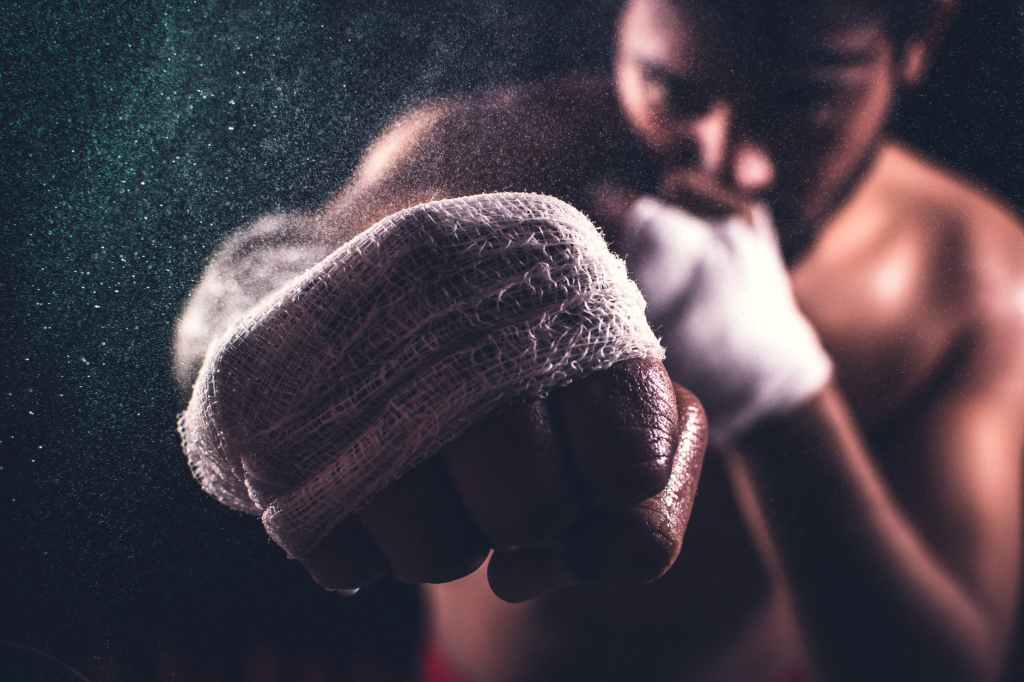
I think that people in general tend to underestimate the importance of proper technique and practice when it comes to throwing an efficient punch. There are a number of elements to consider: bone alignment, stance, knuckle use and where to chamber the punch from… It’s not a matter of simply throwing the fist out there and hoping to make contact. This is one of the reasons why that first punch in an actual fight usually results in injury.

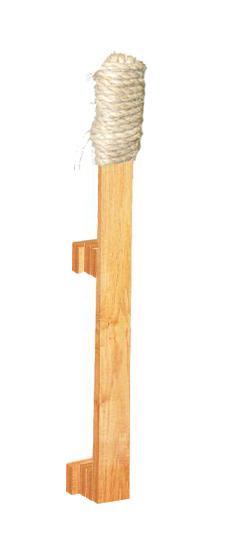
For years, karate practitioners conditioned their strike through the use of a punching post called a Makiwara. Although some may argue with this perspective, the Makiwara was originally developed in Okinawa. It involved a post driven into the ground and wrapped in rope or padded with rubber or a rice pad. Practitioners would strike the Makiwara in order to develop the knuckles on the index and middle finger, which are the two that SHOULD be used during a proper punch (unless you’re using Kung Fu’s punch, which uses the last three knuckles).

Example of a Makiwara

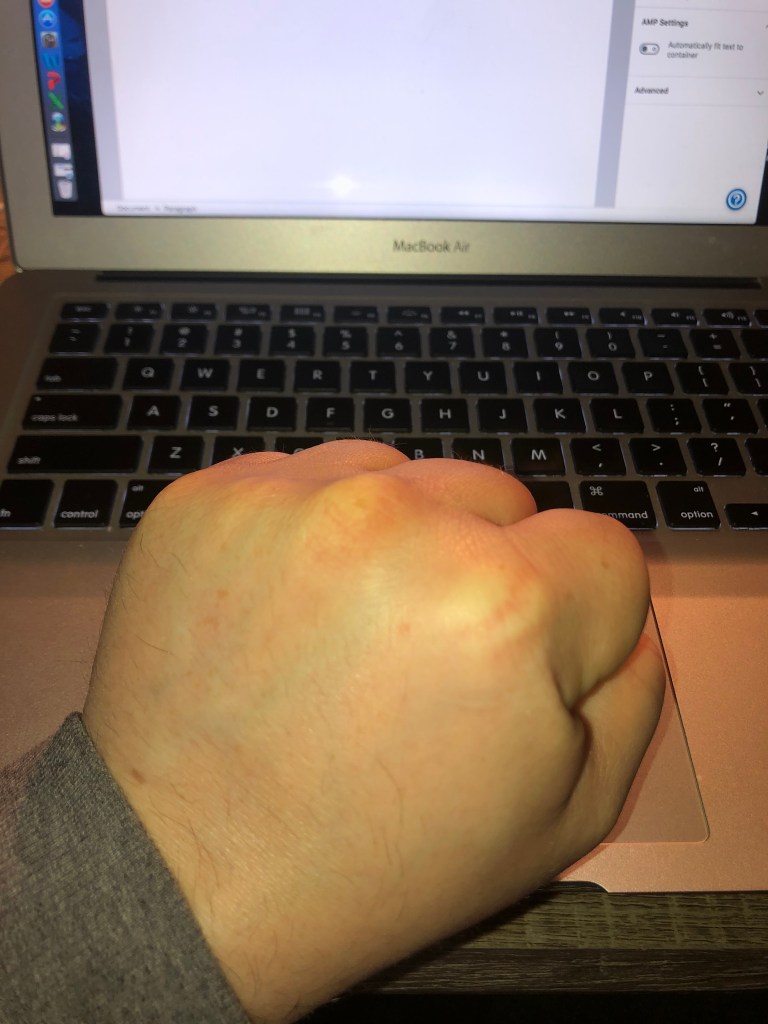
I tried to find an image of what a karate practitioner’s knuckles look like after years of Makiwara training, but all I found were extreme photos of excessively calloused and swollen fore-knuckles that don’t ACTUALLY happen to martial artists, even when they train consistently. After three decades of hitting everything in sight and doing knuckle push-ups during every class, my knuckles STILL don’t look like the examples provided online. Seriously, Google “karate knuckles” and you’ll see what I’m talking about.

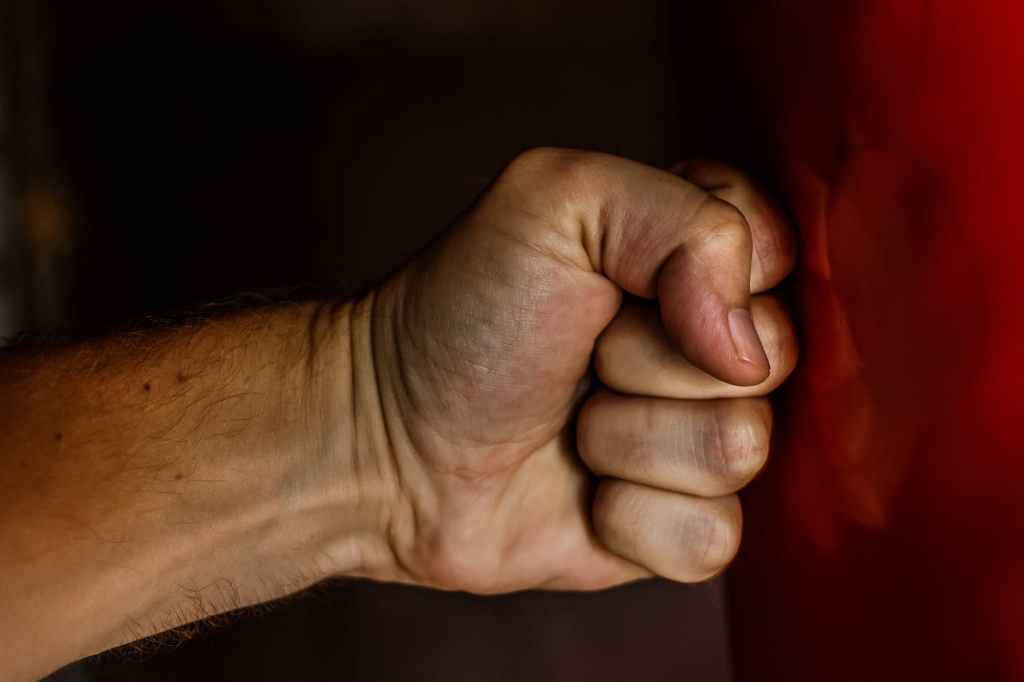
That’s MY left fist. Notice the enlarged fore-knuckles without callouses

Those knuckles are the result of years of knuckle push-ups and punching bags. If you do your punch properly, your knuckles, wrist, forearm and elbow are aligned and the two fore-knuckles will be the ones performing the strike. To do otherwise leaves you open to injury; wrist sprains, fractures and breaks, injured knuckles and lack of power behind the punch.

Knuckle push-ups are another controversial subject in martial arts circles. Are they worth it? Are they better than traditional push-ups? Well, speaking from experience, I can say that they provide a certain amount of conditioning for the fore-knuckles. They also help build the forearms, develop bone alignment for punches and builds the chest and triceps. It also helps to strengthen your wrists, but there’s a catch-22 to doing them…

You’re doing push-ups using a smaller area of stability, which can cause loss of balance and risk of falling over and spraining something. You can also injure the small bones in your hand due to the focused stress that knuckle push-ups put on them. So there is some risk in doing them, but they also offer all the same benefits that traditional push-ups do.

As with any other technique in the martial arts, the learning never stops. If you think you’ve mastered the perfect punch, I can promise you that you’re wrong. There’s always room for improvement, so work on finding the technique that works for you. Then train, train, train… ☯

Making An Impact

Of the many benefits associated with the martial arts, being able to train by yourself is likely one of my favourites. In fact, karate is one of the very few methods of training that you can literally do anywhere, anytime and with minimal equipment requirements. Given the current state of the world and the need for everyone to self-isolate, this is a comforting aspect to something familiar that I’ve been doing for most of my life.

But one of the things that is often lacking in some students’ workouts is a fundamental aspect of the martial arts… You need to hit something. Regardless of your reasons for training in the martial arts, you need to ask yourself: Have you ever punched someone? Have you ever initiated a technique and made contact with a solid object, be it a punching bag, board or a brick?

Depending on who you talk to, board breaking has been a topic of hot debate among martial arts practitioners for decades. For some practitioners, board and/or brick breaking is a pointless exercise. In the words of Bruce Lee in Enter The Dragon, “Boards Don’t Hit Back.” I’ve never been a fan of “breaking” something in order to develop my strikes properly. I’ve always been more of a bag or pad kind of guy. This is because you can practice and develop your strikes ad nauseam on pads, where boards and bricks require clean up and replacement.

But all jokes aside, you can train by yourself to your heart’s content. But honestly: YOU NEED TO HIT SOMETHING!!! How can you properly train in a striking art without actually striking something. Form and drills are fantastic for building your stamina and developing a technique. But in order to avoid injury in the event you ever ACTUALLY need to hit someone, you need to experience the feeling of your strikes making contact with a solid object; preferably something that won’t yield or give when you strike it.

This is the 8×8-inch punch pad I installed on my basement wall last Wednesday. Believe it or not, I only paid 10 dollars for this bad boy from a shopping website. I mounted it onto a piece of pressed wood, then I bolted the entire thing to the wall stud beneath this gnarly-looking 70’s clapboard. I placed it at chest height, allowing me to practice my punches, elbow strikes, knife and ridge hands. If I were still in my younger years, I’d probably even try doing my roundhouse kicks on this puppy.

Before finding this pad, I was looking into making one of my own. All you need is a square piece of high-density foam. Wrap it in canvass, leather or vinyl and stitch it shut. Then mount it on a backboard and decide where you’ll bolt it. Some of that green foam used for fake flowers can work pretty well as long as dense enough and it’s properly wrapped.

If you can’t get your hands on a punch pad or bag, and don’t feel you’re skilled enough to make one of your own (what am I, a seamstress?), another option is sand punching. Used in a variety of martial arts including karate, fill a bucket two thirds of the way with a fine grain of sand. Then you can practice punching into the bucket in order to build strength in the forearms, wrists and knuckles. If you want to add a little density to the mix, add some water to the sand.

Although fine grains of sand are generally used, my Sensei used to have a canvass sack of crushed rock hanging from a chain in his gym. I’ve never used it, but I can imagine he has. Density and type will depend on your preference and how you want to develop. You just need to be mindful of technique so that you avoid potential injury.

The bottom line is simply that even if you’re training to get in shape or learn to defend yourself, you can’t strike empty air indefinitely. Eventually, you gotta get in there and hit something. After all, you can play Grand Theft Auto until you’re blue in the face, but it won’t qualify you to drive. You need to get behind the wheel of an actual vehicle to do that. That same can be said for your strikes. ☯

Tai Chi, The Underestimated Martial Art ☯

When one thinks of martial arts, what springs to mind are the mainstream styles that almost everyone has heard about. In that respect, I’m referring to Karate, Tae Kwon Do and Kung Fu as prime examples. And any of their offshoot styles, of course. But when someone tells you that they study the martial arts, the first thing that comes to mind likely isn’t Tai Chi

First of all, what is Tai Chi? According to a page on the Tai Chi Foundation’s website, “Based on softness and awareness instead of force and resistance, tai chi chuan (also referred to as tai chi, taiji or taijiquan) has been recognized for centuries as a method of self-cultivation and an unexcelled form of self-defence. In Chinese, tai chi means “Supreme Ultimate.” (https://taichifoundation.org/what-tai-chi-chuan?gclid=EAIaIQobChMIupeU-Kjr6AIVLf_jBx2uOA6SEAAYASAAEgLrrfD_BwE)

Fitness group doing tai chi in park on a sunny day

That’s just scratching the surface, really. Tai Chi is a Chinese martial art, which makes it a style of Kung Fu. In the Western hemisphere, people associate Tai Chi with something that the older population does to improve flexibility and blood flow in the body. Although these certainly are some of the benefits, people often seem to forget that Tai Chi is actually a fantastic style of self-defence, and traditional Tai Chi includes all the same aspects as any other martial art including weapons, forms and faster movements than the slow and steady pace we usually see happening at a public park.

The beauty of Tai Chi, which has often been referred to as “meditation in motion”, is that it’s low impact and places very little strain on the joints. For an old dog such as myself, who has been practicing high impact and full-contact martial arts for over 30 years, this can be a welcome change. The movements automatically cause you to inhale and exhale appropriately to control breathing and helps you to solidify your posture.

Tai Chi also helps by providing other benefits, including but not limited to improved flexibility, balance and muscle strength despite the slow speed and low impact. These are a result of circular movements that never extend or stretch the joints or connective tissue. The Mayo Clinic’s website has an excellent article on further benefits and advantages of Tai Chi, which can be read here: https://www.mayoclinic.org/healthy-lifestyle/stress-management/in-depth/tai-chi/art-20045184

Much like Karate, Tai Chi boasts a number of different styles and offshoots that focus on different aspects as they relate to their respective benefits. So if you’re thinking of starting Tai Chi, you may want to observe a couple of classes before you make a choice. Like any martial art, styles are subjective to the practitioner so you’ll want to ensure that you join a school that will fit your needs and requirements.

Lastly, I’d invite anyone who still thinks of Tai Chi as an “old person” style of the martial arts to do some research into the more traditional forms of the art. In fact, there are a number of reasonable videos on YouTube that demonstrate Tai Chi at combat speed and some with weapons. I, personally, have studied Taoist Tai Chi, which is an offshoot of Yang-style Tai Chi. I never stuck with it, given everything else I try to cram into my brain, but it was certainly an enjoyable experience. ☯

Hollywood Magic…🥋

You could probably kick my ass. No, really… I have every confidence that anybody who made a serious effort would likely beat the brown emoji out of me. One of the important things that any student of the martial arts knows is that no mater how hard you train and how “good” you get, there will always be someone better. I put the word “good” in quotations, because a martial artist who genuinely believes that they are good, usually isn’t.

I can freely admit that as a child, besides my waning health, martial arts movies were one of the driving forces behind my interest in training. Watching such films as Enter the Dragon gave me the inspiration I needed to make the journey towards the martial arts. But there’s a lot you can do with a movie camera. Even create a martial arts master where none exists. And that’s just a little bit sad. But I digress…

Now, don’t get me wrong. There are a number of actors who have traditional martial arts backgrounds; some whom you wouldn’t even believe! For example, did you know that Elvis Presley held a black belt in Chito Ryu Karate? A style that by all accounts, happens to be Okinawan like my own, but was developed mainly in Japan?

My point in this post, and I will attempt to keep it brief, is that you can’t always believe the skill you see on the silver screen. Actors often take supplementary training in order to fulfill the requirements of their roles. And in some instances, stories can be told that may not have necessarily happened. I am speaking, of course, of Mr. Frank Dux…

One of the most iconic and inspiring movies of my childhood was a movie released in 1988 called Bloodsport. The movie was said to be based on the true life of Frank W. Dux, although in recent years, many of Mr. Dux’s claims were found to be fraudulent and false.

This was heart-breaking for me, since Bloodsport was one of those inspirational movies that moved me to the martial arts. Although I had already started looking into different styles and training on a rudimentary level, Bloodsport push me over the top. With the inspirational story of a troubled youth seeking out the training and guidance of a well-rounded martial arts master, which leads him to a life of the straight and narrow…

I would be lying if I said that this DIDN’T bear some passing resemblance to my own youth, where I sought out Sensei’s teachings in order to improve my health, well-being and provide for a better future. I often attribute the positives ion my life to the fact that I was able to stick with it and train the way I have, and continue to do so. But this movie was based on a life that the character DIDN’T actually live!

Most people can still agree that Bloodsport was an awesome movie, a fine example of 80’s action and martial arts films. I’m not a fan of propaganda and disinformation, so I’ll let you make your own determinations on this one. If you search for Frank Dux on YouTube or Google, you’ll get plenty of articles on what I’m talking about. I will once again point out that I think it’s sad when a person can’t make their own way through life without creating a persona or a history for themselves. ☯

To Train Or Not To Train…

Not a month goes by where I don’t see a blog post, video or article that shows some average, everyday schmuck off the street, talking trash and challenging a trained fighter. It NEVER ends well, with the average Joe (or Jane) getting their proverbial clocks cleaned. As the saying goes, “You would be better off sand papering a lion’s ass in a pair of pork chop panties…”

A part of me totally understands the instinct; you’re watching a fight or watching an action movie and you may think, “That’s ridiculous! I’d totally block that and do this, instead.” But depending on whether or not you’ve received any level of training (or have trained at all), challenging someone who trains in the combat arts is a foolish endeavour at best; a dangerous one at worse.

When I trained in my younger decades, I had three two-hour classes a week, two days of training on my own at the beach or at home, several bouts of cycling, weights and rock climbing… This was all in addition to whatever materials I’d read or study, as well. I’ve always been what I would consider “skilled”, but even I wouldn’t be foolish enough to intentionally challenge someone who spends their time learning how to kick someone’s ass.

Especially in today’s modern society of armchair warriors, people who just love to chime in and provide their two cents even when it’s worth less than that, it’s a trend that I seem to notice more and more. The beauty of the martial arts is that it’s not about being bigger. Or stronger. Or faster. The martial arts is a unique journey for every student, but intense study makes for a deadly warrior, regardless of one’s motivations.

Why anyone would choose to challenge a trained fighter is beyond me. It’s one of those things that I rank right up there with snorting condoms or eating Tide pods. But it certainly makes for some entertaining videos. There are plenty on YouTube, if you feel like having a laugh… ☯

Take Time To Heal

Like most martial artists, I’m no stranger to blood, sweat and tears. There have been multiple times in the past thirty tears when I’ve “pushed through the pain” and trained and/or worked out even when I felt ill or weaker than I should have. It’s no mystery that high blood sugar and other Diabetic issues can weaken the body’s immune system and make Type-1 Diabetics more prone to colds and other annoying illnesses.

But despite one’s pride and hard-headedness, is it IDEAL to train when one is sick? Depending on who you speak to, recovery time is always the best route. Allowing your body the time it needs to heal is preferable, especially when Diabetic, to pushing your body to where you compromise your immune system and potentially open yourself up to infection.

I’ve been struggling with a cold for the past four days. At the risk of being accused of having “man flu,” my face has been swollen and in pain, sinuses are pooched and I have an extreme lack of energy. Today is one of the first days that I’ve begun to feel better. I’ve stayed off my feet and taken it easy but my wife has suggested that maybe the best medicine would be a solid workout to build up a sweat and burn the illness out of me.

I’ve done some reading from all of my general go-to websites, including WebMD and the Mayo Clinic. I’m surprised to find that most of the sources I consulted all seem to agree on the same limitations and factors when considering working out when sick.

According to a quote on WebMD by Neil Schachter, MD, “if your symptoms are above the neck, including a sore throat, nasal congestion, sneezing, and tearing eyes, then it’s okay to exercise,” He goes on to explain, “If your symptoms are below the neck, such as coughing, body aches, fever and fatigue, then it’s time to hang up the running shoes until these symptoms subside.” (https://www.webmd.com/cold-and-flu/features/exercising-when-sick#1)

According to a Q&A response provided by Edward R. Laskowski, MD on the Mayo Clinic’s website, the same “neck check’ rule is to be considered when thinking of working out while sick (https://www.mayoclinic.org/healthy-lifestyle/fitness/expert-answers/exercise/faq-20058494)

The point at which you should NOT work out, includes when one is suffering from a fever. Having a fever puts you at higher risk of dehydration, muscle cramps and aggravated Diabetic issues. Below the neck symptoms that should be considered include vomiting, diarrhea, coughing where something is expelled, body pain and fatigue.

At the end of the day, the decision whether you work out or not falls on your shoulders. If you’re not feeling up to it, don’t do it. Another option, if you feel well enough to do anything, is to simply tone down your workout so that it doesn’t floor you. Take a walk instead of a run. Do Tai Chi as opposed to shadow boxing. And if you are returning to your workout routine, do it gradually.

If your workouts are done in a public setting, such as a gym or fitness centre, then be considerate of others in relation to your illness. Don’t be blowing your nose every five minutes and putting your hands all over the equipment, spreading your phlegm on every surface. Carry a towel and be certain to place it on the bench before you lay on it. Use an alcohol-based sanitizer after you’re done with the equipment. And be certain to scrub your hands with soap and hot water often.

At the end of the day, you and your body will dictate whether you decide to continue exercising or not. Considering my cough, fatigue and all over bodily aches, I don’t regret choosing not to workout over the past several days. And a decent workout can even be beneficial as it can provide benefits such as opening the breathing passages. But I’ll admit that I can’t wait to get back at it. And don’t forget to test your blood sugar often. ☯

Sharpen Up With Some Knowledge

I’ve been studying martial arts for over three decades (32 years this month, actually) and I’ve trained in a number of different disciplines during that time. Although it’s normally ideal to stick to one style so that you can master it (or at least attempt to), it gets a bit difficult NOT to dip your toes in the proverbial martial arts pool, from time to time.

Training in the Way of the Empty Hand is usually the best option as it means that you’re never disarmed. But I would be lying if I said that the prospect of training with a weapon hasn’t appealed to me, from time to time. With that in mind, I began studying Kendo and Iaido. I studied for a number of years, although I didn’t stick to it long enough to reach a mastery. But I have enough skill with a blade to make it a useful implement of self-defence if necessary.

A wakizashi or “short” sword

Samurai swords are iconic and have come to be recognized in and out of the martial arts world. An extremely fluid weapon, the samurai sword was normally a symbol of military nobility in feudal Japan, and was considered to be the soul of a samurai. The wearing two swords was outlawed by the Japanese government during the Meiji Restoration (I’ll let you Google that) but they continued to be used by police and military personnel.

So, what’s known about these famous swords? Well, samurai swords are unlike any other swords in the world, with their unique curvature and single-edged blade. They’ve been forged since as far back as the 10th century, and there are legends of the first actual katana being forged by a wordsmith named Amakuni Yasutsuna as far back as 700AD.

Samurai swords, or katanas as I will refer to them from here on in, are characterized by a long, curved, single-edged blade that is at least twenty-four inches in length and a grip that is long enough for both hands to hold. When samurais wore the two swords, the katana was the longer of the two, with the shorter sword being between twelve to twenty-four inches in length and called a wakizashi.

Because the wakizashi was shorter and had a grip that would only accommodate a single hand, it was generally used for closer combat as opposed to the katana, which was better suited for full combat (once they worked their way through the plethora of weapons they carried BESIDES swords).

Last but not least is the tanto. This is a short, dagger-style sword that usually measures six to twelve inches in length. Although intended more as a stabbing weapon for close combat, the edge could also be used for slashing. Over time, it became more ornate and acted as a ceremonial dagger, but a martial art called tantojutsu.

The creation of a katana is an entirely unique process. Unlike most swords that are forged by pouring molten steel into a mold, then tempered, katanas are created by forging and combining multiple layers of different types of steel. The layers are folded, over and over again and the curvature happens over a long process of curing and tempering.

The forging process creates a curved blade that combines softer and harder metals. Hard and soft… Sound familiar? (☯) The curve and flexibility of the blade makes the katana incredibly fluid and durable. Then the blade is sent to be polished, which can take weeks, in order to get that mirrored look.

Katanas are fascinating weapons, and would often be customized with images, lacquered scabbards and even family crests and symbols on the guard and grip. And as Ryan Reynolds said in X-men Origins: Wolverine, “I love this weapon more than any other thing in the whole wide world […]. You whip out a couple of swords at your ex-girlfriend’s wedding, they will never, ever forget it.”

At the end of the day, learning to defend oneself with your bare hands should be your primary goal. After all, you’re more likely to find yourself WITHOUT a weapon than carrying one. But should you find yourself with a weapon, it’s also nice to be able to use it properly.