The Sword Saint

This week, I’ve decided to focus my attentions on someone whom I’ve read about since I was a young child: Miyamoto Musashi. Most people aren’t familiar with the name, though he was well-known in feudal Japan as the greatest swordsman to have ever been. People are more familiar with the book he wrote before the end of his life: The Book of Five Rings.

Musashi is thought to have been born in Japan in the late 1500’s by the name “Bennosuke” to a farmer. The history is a bit difficult to trace, but there is some debate as to exactly where and in what Province Musashi was born. Musashi was raised by his uncle after the death of his father, and was taught Buddhism, reading and writing (which was not a common thing in that era).

Musashi’s name was changed to “Takezo” later in life and he began to study the sword, either from his father or under his uncle, fighting and winning his first duel at the age of thirteen. Musashi was said to have fought (and won) 61 duels and battles, leading to the creation of a legend in his own right. He developed and refined his own style of two-sword combat called Niten Ichi-ryu, making use of both a katana and a wakizashi in combat.

Although best known as a swordsman, Musashi was a philosopher, artist, painter and calligrapher. I could go on about the different skills he developed and mastered throughout the course of his life, but suffice it to say that Musashi was a firm believer in studying one thing in order to master another. For example, if you study only the sword you will grow to be ignorant and unaware of anything else. In order to truly master a skill, you need to branch out and have some variety.

Miyamoto Musashi is a source of inspiration for me, because he walked his own path. Although receiving instruction at some point in his young age, he went on to develop and master his own style, suited to his own needs. A variation of his style of swordsmanship is still studied today. He’s written various works and created multiple pieces of art, and can be cited as a source of popular quotes (feel free to Google “Musashi quotes”).

To be honest, I could share quotes and passages from some of his works, but that would scarcely do him justice. If you want to learn all you can about Miyamoto Musashi, my best suggestion would be to get tour hands on a copy of his book, The Book Of Five Rings. The version translated and written by Hanshi Stephen Kaufman is the most popular version (and the most complete one). It’s a fascinating read, and the material can apply to many aspects of life, not just combat. ☯

The Right Frame Of Mind

Developing yourself and reaching a goal can be difficult. Especially when you don’t allow yourself to have a strong frame of mind or proper perspective. Having a partner when you work out can be extremely helpful, as I wrote about in a previous post It Takes Two, Baby…🎶. But although having someone there to spot you and motivate you can be quite the benefit, you need to allow yourself to have a correct frame of mind behind your workout.

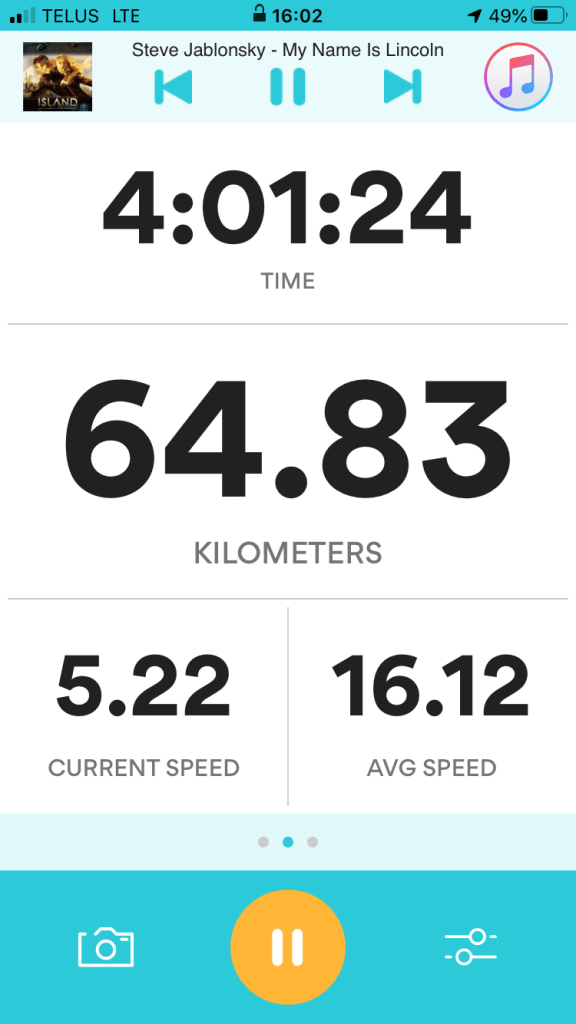
The distance I achieved yesterday

A friend of mine recently pointed out something important as it relates to fitness. Let’s say that you’re trying to lose some weight. You intend on climbing the nearby mountain with a partner, which is not only smart for safety reasons but can motivate you to push further in order to keep up. As you start climbing, you begin to feel tired. Your body is having difficulty continuing due to the excess weight that you’re trying to shed, and you feel compelled to stop.

Perhaps you tell your partner you need a rest. Or perhaps you tell them you can’t go on. Maybe you surrender to your body’s urge to have you sit down and give up. A terrible thing to allow, especially if you’ve set yourself some fitness goals that can be important for your health. For someone with Type-1 Diabetes, this can be a common occurrence, since fluctuating blood glucose levels can have the unfortunate side effect of making a person groggy and sluggish.

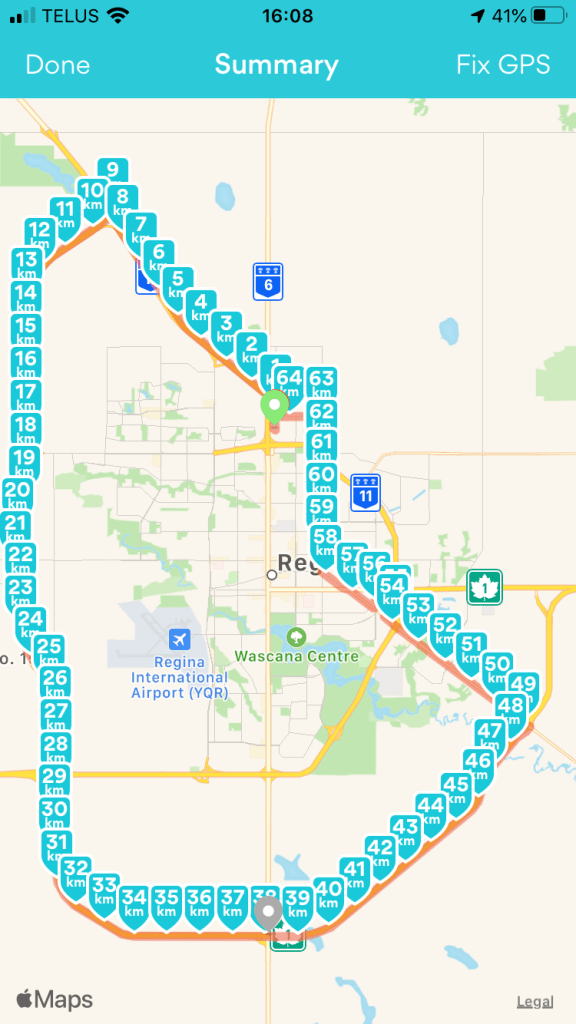
Yesterday’s route around the Regina Bypass

As I’ve often mentioned before, it’s important to ask yourself why? What is the reason behind your motivation? Your body should and will give out, long before you do. Why do you think people listen to music when they work out? It’s not simply for their love of it, although for some I would believe that’s included. It’s because music motivates us (and in some ways, distracts us from the physical exertion we’re going through).

This is why it’s so important to motivate yourself and stay positive. When I started cycling for fitness this year, I would get home after about a dozen kilometres and my legs would kill, I’d be exhausted and I would feel like total crap. But as you can see from the images above, the day before last saw me hit 65 kilometres. And yes, when I got home my legs killed, I was exhausted and dehydrated and needed food. But I can promise that a dozen kilometres now seem like a trivial amount, and I can do it quite easily in only about half an hour. This is something I wouldn’t have imagined when I started.

Sometimes it’s better to take things in small increments. If I’d hopped on my bike and tried to reach 60k on one of my first times out, I likely would have floored myself and became discouraged. But by staying consistent and building myself slowly, I’ve been able to keep building and developing how far I can go. The same can be said of martial arts or any fitness regimen that you may be attempting.

Let’s get back to our friend who’s attempting to climb the mountain. When exhaustion sets in and you feel like you can’t go any further, there’s no shame in taking a breather. But then, look ahead and spot a point further up the trail and tell yourself, “I can push at LEAST until that tree…” Then go for it. Once you reach that tree, maybe you’ll need another breather, maybe you won’t. But fix yourself another short goal and strive for it.

I think it was a Navy Seal that I had seen years ago, who described taking his training in steps, from day to day. At the beginning of the day, he would tell himself to simply get past breakfast. That’s it. Once this period had passed, he would focus simply on getting through the afternoon. Nothing more. With each piece of the day’s puzzle reached, he would be able to shift his focus and move on to the next, thereby guaranteeing he would make it through the day before hitting the rack. If he were to focus on completing the entire day, he would likely become discouraged and lack motivation. This is a concept that anyone can apply to their daily routines.

The idea is to allow yourself the time to grow. Have a positive and motivated perspective and you’ll go much further. If your thoughts are negative as soon as you begin, you’re sure to fail. how can you be motivated if you’re already defeating yourself? But if you focus on the positive, music, goals, health benefits, perhaps the scenery that surrounds you as you climb, you’re more likely to push farther and accomplish more.

Your own health and fitness is important; critical to your survival, really. And the proper mindset is what will help get you there. For someone with weight issues or Diabetes, staying fit and healthy can mean the difference between life and death. This is one of the reasons I push so hard. Life has too much to offer to lay down and die sooner than necessary.

And Diabetes or not, death will take me. Of this, there is no doubt. But I can promise two things: Death will lose ten pounds in sweat trying to make it happen and he’ll lose a mouth of teeth in the attempt. I intend to go down fighting. (Gee, that would make a great t-shirt) ☯

“Rowdy” Ronda Rousey

As usual, I’ve been reserving my Sunday posts for people that have inspired me or motivated me in some way. While going through my Kobo with my wife, we came upon the autobiography of Ronda Rousey, entitled “My Fight/Your Fight.” I started talking about the autobiography and about everything Rousey has been through in her life (up to that point) to get to where she is today. My wife suggested that I seemed pretty inspired by Rousey and that perhaps I should write about her. And here we are…

Many people in martial arts circles and non-fitness circles alike have expressed a love/hate relationship with Rousey. Some believing her to be more of a passing fad than a genuine athlete, some idolizing her as a true martial artist and pioneer in the women’s division of one of the most male-dominated forms of sport entertainment currently in existence. But the truth of it is she’s accomplished many great things. Most of which were accomplished through sheer force of will and has beaten odds that would have crushed a lesser person.

Rousey was born in California in the late 80’s and was born with a condition known as apraxia, which is a particular childhood speech disorder that made it difficult for Rousey to speak in a coherent manner for the first years of her life. This would be one of the first obstacles she’d overcome as she would eventually go on to speak normally, as anyone who has heard her speak in recent years could attest.

Rousey suffered tragedy early in her life as her father broke his back while sledding with Rousey and her sisters. Rousey’s father became a paraplegic as a result and took his own life in 1995. Years later, Rousey would begin training in the martial art of Judo, as her mother had been an accomplished athlete in Judo, having been the first American to win the World Judo Championship in 1984.

Rousey progressed, promoted and moved up the ranks in Judo and won more medals and trophies than I could possibly list here (you should read her biography for deeper details) and never gave up along the way. She faced personal difficulties at home, which saw her leave her family to train elsewhere and injuries that made continued training and development difficult. But along the way, she never stopped fighting, in the physical and metaphorical sense. Rousey became an Olympian by winning a bronze medal at the 2008 Olympic games, becoming the first American to win an Olympic medal in women’s Judo since its creation.

After winning an Olympic medal, Rousey retired from Judo professionally, and sought some direction in her life. Without getting into the nitty-gritty of it, my impression was that she slipped off the rails a bit when she failed to find that direction in her own life. I can definitely relate to that, on a number of levels.

Rousey fell into the world of Mixed Martial Arts in 2010 as an amateur, a term that wouldn’t apply to her for very long. She trained with the same passion and fervour in MMA and she had in Judo, and quickly came to make her mark on the sport and ultimately, the world. Her signature move was submission by armbar, and it seemed that no opponent could best her.

Rousey stepped into professional MMA in the following year and became Strikeforce’s Women’s Bantamweight Champion in 2012. Rousey would go on to be the first female signed with the Ultimate Fighting Championship, after a great deal of debate whether women would ever be in the UFC. Once part of UFC, Rousey was named the UFC’s first Women’s Bantamweight Champion, a title she defended over and over until her loss to another fighter in 2015.

Rousey was away from MMA for about a year before she returned to reclaim her title. She ultimately suffered another loss and unofficially retired from the UFC in late 2016. She was, however, inducted into the UFC Hall of Fame in 2018. Rousey has since moved on to professional wrestling, and has continued to make an impact there, as well.

The thing about Ronda Rousey is that despite the obstacles, difficulties and losses she’s faced in life and career, she never stopped fighting. Even at her lowest, when she felt she had nothing more she could lose, she found ways to rise up and pick herself up like a proverbial phoenix. Rousey has gone on to author books, star in action films accomplish inspirational things despite said obstacles.

If you want to learn about Ronda Rousey the person, I would definitely recommend picking up her autobiography, My Fight/Your Fight. You can get it from your local bookstore or you can get it as an e-book for your Kobo, which is what I did. It’s definitely worth the read and will give you insight on her character and her development as a person, as opposed to an entertainer and athlete. But, what an athlete! If you need some proof, just Google her fight record… From Judo to MMA to professional wrestling, the scales definitely tip in her favour.

As most of you know, I’ve never been a great fan of MMA. To a traditional martial artist, the term “mixed martial arts” doesn’t ring true under any circumstance. So, for me to be inspired and motivated by an MMA athlete is a bit of a step out of my comfort zone. That being said, holding a 6th degree black belt in Judo definitely helps. She’s a good combination of traditional and modern, with a warrior spirit to back it up. ☯

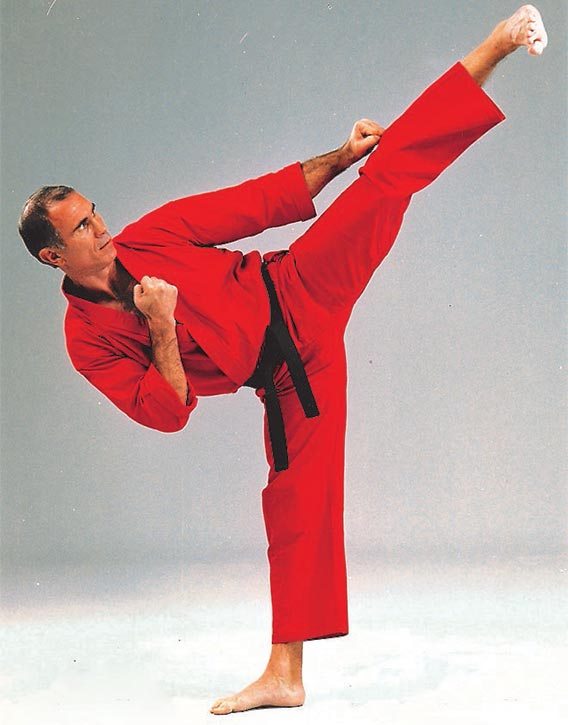
Bill “Superfoot” Wallace

You may have noticed that I’ve started taking the habit of writing about someone influential every Sunday. Influential to me, obviously, but hopefully somewhat influential to others once they read about them and learn bit about their accomplishments. This week, I thought I would write about an accomplished martial artist whom I’ve been reading about since my childhood: Bill “Superfoot” Wallace…

Wallace was born in 1945 in the United States and started to dip into the fighting arts through high school when he joined the wrestling team. He later went on to include Judo and had studied this for a number of years as well, but an injury to his right knee forced him to quit the art before he could pursue it to any extend. In 1967, Wallace served in the united States Air Force and it was there that he began studying the Okinawan karate style of Shorin-Ryu, which is a sister style to my own style of Uechi-Ryu.

I remember reading about Wallace as a child, in Black Belt Magazine. I was fascinated by the speed and accuracy of his kicks, and just a little bit jealous of the fact that I could never kick quite as high as he could. My constant practice and development of my roundhouse kick is a result of watching him in action.

Wallace spent many years in the karate tournament circuit, winning the Professional Karate Association’s middleweight full-contact karate championship and retired undefeated. Wallace eventually moved on to kickboxing tournaments, since these tournaments allowed for kicking while the PKA’s karate tournaments did not.

“Have A Blast. Have An Absolute Ball. Because It’s Something You Can Do Absolutely Forever, Your Entire Life. And It’s Just Fun… So Do It.”

– Bill “Superfoot” Wallace

Wallace became known for his fast and devastating kicks, which earned him the name of “Superfoot.” Wallace normally focused his kicks on his left foot, since the injury to his right knee that occurred during his time in Judo made kicking with the right foot more difficult (although not impossible, if you’ve watched any footage of him). This certainly didn’t slow him down in any respect.

Although most people tend to focus on the popular aspect of a person, which in this case is karate, Wallace holds a bachelor’s Degree in Physical Education and a Master’s Degree in Kinesiology. Wallace has written many books and has taught karate and coached many others, notably Elvis Presley and John Belushi.

What inspires me the most about Wallace is his undying dedication to the art and to his own self-development. He’s been known to say that no matter how fast or strong his kick may be, he’d continue to work it and develop it in order to improve himself. Having injured himself early on in his martial arts career, most people in his position would throw in the towel and take it easy. Not this man. He stuck to his goals and ambitions and to this day continues to speak and give seminars. ☯

It Takes Two, Baby…🎶

Depending on what your motivation may be, working out by yourself can suck. Royally. On the other hand, certain activities that I train in, like meditation, learning a new karate form or burning off steam on a punching bag, can work quite well when I’m alone. But it stands to reason that having a partner when you break a sweat can have some measurable, noticeable and unexpected benefits.

When I first started the martial arts, I felt exposed. I’m sure some of you have been there; you walk into an environment where EVERYBODY knows more than you do. Potentially. So even though you happen to be standing at the back of the class, you feel like everyone’s eyes are on you, judging you, watching you excessively sweat and gasp for air as they go through the motions barely showing any effort… Nah? Just me? Whatever… let’s carry on…

According to an online article I found on NBC News of all places, working out in a group has the benefit of others’ healthy habits rubbing off on us. The article states that a 2016 study found that “overweight people tend to lose more weight if they spend time with their fit friends […]” Which can certainly make sense if all the time you spend with said “fit friends” happens to be at spin class, yoga, zumba, cycling and etc.

Certainly, there is a great deal to be said for the accountability factor, where it’s more difficult to skip the workout when it’s part of a pre-organized program with others. And you inevitably end up kicking your workouts into high gear in order to accommodate and keep up with others who are doing the same. The above-linked article touches on these aspects as well.

All of this can certainly be true of karate. After those first few classes, I found myself pushing hard to keep up with the other students. Karate is one of those “keep up or be left in the dust” environments where you’re totally free to move at your own pace, but eventually it just won’t be enough. But the camaraderie that develops once you start holding your own is particular. It’s one of the aspects I most enjoy within the dojo.

Ultimately, working out with a friend or loved one doesn’t just keep you accountable through fewer skipped workouts. It can also encourage you to try out new exercises or activities you may not have thought of and may encourage you to push harder in order to keep going. Surprisingly, you may even catch yourself working out for longer periods as you’ll discover something other than fitness. You’ll discover that working out with a partner is fun.

My wife and I occasionally enjoy some fitness circuits together. She’s a champ and is always a good sport, no matter what I throw at her. I enjoy it a great deal, because it not only helps her to stay fit and get the blood pumping, it also allows me to include her in an important aspect of my life. So working out with your spouse is very important. It doesn’t have to be an all-out sweat storm that flattens you for the next couple of days; I rather save those for my friends whose suffering I enjoy (looking at you, Jayden!).

In closing, working out with a partner can also ensure your safety. If you happen to be doing something like lifting heavy weights or hiking in a remote area, having someone with you can ensure that you’ll have immediate help should something go wrong, which can be an important aspect if you happen to have Diabetes and suffer a low at an inopportune time. Not to mention that a little healthy competition amongst friends or loved ones is never a bad thing. So get out there and challenge yourselves. The only limits are the ones we set ourselves. ☯

Getting Caught In The Mouse Trap…

I’ve been doing martial arts for a LONG time, as long as the median age of some of my readers. And I’ve had a lot of role models and inspiring people who have helped me along the way. As a child, I would be lying if I said that I wasn’t inspired by some of the on-screen talent that I’ve seen. Some have been traditional, some have been a bit more, shall we say eclectic? And I feel that once in a while, I should pay homage to some of these martial artists, for they’ve done what many have dreamt about through their teens: they became famous.

There’s something of a stigma against on-screen martial artists. And this is for good reason. A lot of what we see on screen isn’t genuine, and is usually choreographed and arranged before being filmed. But once in a while, a little light shines through. And by “little,” I am referring of course, to one of my childhood idols, Michele “The Mouse” Krasnoo…

Due to licensing and copyright laws, I won’t be sharing an image of Krasnoo, but she can be found easily by Googling her name. Krasnoo is originally from California and began studying the Korean art of Tang Soo Do in 1980 when she was just 6 years old! She reached black belt level by her early teens, which although I’m typically not a fan of, she made it work for her.

Over the years that followed, Krasnoo studied and became proficient in a few other styles of martial arts (sound familiar?). She got into acting and became known for her intricate martial arts forms and the colourful use of uniforms. In 2006, she was inducted into the Black Belt Hall of Fame. She’s also proficient in various weapons.

I first saw her on screen in the mid-80’s when No Retreat, No Surrender was released on tape (it was probably Beta cassette, just in case you’re interested in guessing how old I am!) I’ve seen her in a handful of other films, and she became a favourite of mine. I found myself able to relate to her because of her dedication, her study of multiple styles and the fact that she gained her nickname (The Mouse) due to her short height of 5 feet. Considering I’ve felt small through a good portion of my life.

As of the early 2000’s, Krasnoo held a 5th-degree black belt in Tang Soo Do, 1st-degree black belt in Shorin-Ryu, which is a similar style to my own Uechi-Ryu, 1st-degree black belt in Tae Kwon Do and a black sash in Wushu Kung Fu. She holds a ridiculous number of championship titles and despite her on-screen time, is a traditional martial artist in the most rudimentary of ways.

Krasnoo has moved on in her life, married with children and all. But she still does some acting and has been a source of inspiration for this martial artist for years. I still watch Kickboxer 4 on occasion and enjoy watching her kick the crap out of people three times her size. We find our role models in the least likely of places, but we take ’em where we can get ’em! ☯

When The Way Is Right…☸️

I don’t deny that one could say I became a Buddhist almost by accident. I hadn’t even HEARD of Buddhism when I started martial arts in the late 80’s, yet here I am. Decades later, constant study and trying to follow the right path. A good portion of my story is a prime example of cause and effect. As I progressed in the martial arts, I was introduced to concepts such as Budo, Bushido’s code and my first introductions to Buddhism.

Despite the accidental introductions (or not so accidental, if one believes that all things happen for a reason) there have been a number of measurable benefits to my years of Buddhist study and martial arts. I originally got into martial arts for the purposes of improving my health, and it has turned out to provide more benefit than that scrawny kid ever could have imagined when he set out on the journey…

There’s no denying that the martial arts has provided me with a number of significant advantages.  The physical requirements and exercise has helped to improve my insulin sensitivity and fight off insulin resistance.  The intense training has provided me with better blood circulation, which as most of you likely know, is VERY important to someone with Diabetes.  Measurable improvements in body mass and appetite followed, allowing me to survive well past the window of expectation that most of my doctors had for me in the late 80’s, early 90’s.

  When I started studying Buddhism, some of the most important aspects that I began to work on were mindfulness, meditation and control of my inner thoughts and emotions.  This is not to say that I don’t display emotions (my wife can attest to that), but my practice has allowed me to control how I externalize my reactions and emotions.  Over the years, this has allowed me to deal with problems and face issues in my personal and professional life in an almost detached manner that allows for logic to step in and for the emotion to come out at a later time.

Something I need to point out is that most people automatically associate Buddhism with meditation, but the truth is that you can reap the benefits of meditation on its own.  Not only from a Diabetes standpoint but for people in general, meditation can do a world of good.  This is becoming a well-known fact, and plenty of people are getting on board.  Meditation is offered/taught in some places of work, schools and a variety of classes where different varieties of meditation are taught.

And yes, there are different types of meditation.  Some of the most popular ones are transcendental meditation, focused meditation, mantra meditation and relaxation meditation are but a few, and it all depends on what you’re trying to accomplish with the meditation that you do.  Just like there are a variety of types of yoga and types of martial arts. 

But some of the benefits of meditation can include lowering one’s blood pressure, controlling pain within the body, improving one’s sleep, helps one to focus and increase self-awareness and helps with stress and anxiety.  All of these things can be helpful with the control of blood sugars and overall Diabetic health.  You can find introductory classes on guided meditation in most major cities, and there are plenty of books on the subject as well.  Be sure to keep an open mind, and if it doesn’t feel right to you, don’t be afraid to  seek out different classes as every instructor or teacher may have a different method of imparting the knowledge.

I may have fallen into some of what I do by accident or coincidence, but I’ll never look back.  One of the beautiful aspects of meditation is that you can basically do it anywhere.  All you need is a comfortable place to sit/lie down, whatever your preference may be.  ☯

To Chi Or Not To Chi…

Does Chi exist? What is Chi? Chi can go by a number of different names: Chi, Ki or Qi, this energy is said to be the animating force behind all living things. In karate, we learn that our energy comes from the hara, or the belly area. This would be why ritual suicide in medieval japan was done by slicing open the belly as opposed to other “conventional” means.

But… Does it exist? This is the question that has been debated, especially in the Western world, for a very long time. Depending on what culture and/or background you may be referring to, Chi is what gives you the energy to keep going. We all have Chi and each person has the same amount throughout all of our lives. The use of that energy is simply allocated to different aspects as we get older. This would be one of the reasons why my 5-year old seems as though he has an endless pool of daddy-crushing energy while I wake up most mornings wondering if my body will actually get me out of bed.

It’s not magic or wild fantasy… I’ve seen some “scientists” speak about how Chi does not exist, there’s no evidence of it and there’s no way to prove its existence. Hmm. Perhaps they’re right, but some of the concepts behind Chi are also rooted in modern science. For example, the Law of Conservation of Energy teaches us that energy never ceases to exist; it is merely transformed or transferred. The amount of energy within a contained system remains constant.

So, ask yourself an important question: What are you? Are you simply the sum of your physical body? Nothing but a mass of tissue, water and bone? If so, what about the essence that makes you, well… you? The person you are, the sentience, the awareness, your personality and the living being that has put in years of existence in this life… What happens to that after you die? Is it simply a light switch that flicks off, or do you believe that your energy will be transformed or transferred?

Thinking about some of these questions can be scary. After all, no one likes to conceive of their own death. But as my uncle always says, “We only do TWO things in life; pay taxes and die!” The joke is many people get away from paying taxes. But death comes for us all. And the question of what comes after can yield anxious results.

I am totally on board with the fact that Chi isn’t some “magic” energy that can be harnessed. When you see people claiming to be able to push over opponents from behind a wall and shatter stone with the power of their Chi and other wild things, I can understand why people would be reluctant to believe or understand Chi. But just because a few charlatans have demonstrated fraudulently aspects, doesn’t mean it doesn’t exist.

That certain “something,” the unspoken quality that makes you sentient and self-aware, can’t be denied. It makes no difference whether or not you believe in gravity; it’ll still keep you firmly rooted to the ground. The same can be said about the energy that makes you who you are. Whether you choose to believe in its existence or not, won’t change the fact that you are still here. ☯

It’s Going Semi-Well, And I May Have Woken Up…

Back in December of 2019, I wrote a post called Here Comes The New Year. I wrote about the New Year’s resolution I was making and I maybe bragged a bit about the fact that I was starting my resolution a month early in order to get a leg up on my goals. I’ll admit that for the most part, things were going decently. Then the world went to hell and everyone had to stay home in self-isolation…

I know I promised I wouldn’t constantly be posting about my New Year’s resolution. But since we’ve already gotten through a third of the year, I felt it might be a good time to provide at least a rudimentary update. Especially since I’ve already identified my weak spots. See, people tend to need something to fill their time. No matter how much we usually think that some quiet, down time would be nice, humans become bored reasonably quick and will do whatever seems reasonable and safe in the moment, in order to entertain themselves.

Friends and associates who know me personally are aware that I experienced my first beer at the age of 23. Since then, I’ve allowed myself the occasional indulgence whenever time and location permits. Although never consuming in order to become intoxicated, some of the gut-swelling effects will take place even if you drink very little.

My Resolution spreadsheet at a glance

If you take a look at the image above, it isn’t hard to see where my problem spot may be. Granted, I didn’t exactly make the spreadsheet easy to adhere to. Perhaps if I’d made the spreadsheet a day-to-day checklist as opposed to a weekly one, there would be more green in the first column. But one drink at anytime during the week currently results in a red “X” as opposed to a green check mark.

Workouts are workouts. I make no excuses for the red in that column. One can clearly see some occasions where I’ve been ill or absent in some manner. Once in early February where I was down and out with a cold and the first week of March when I travelled to New Brunswick, limiting the number of times I was able to fit in a workout. I know, I know… But you always tell us that’s you can workout anywhere and there’s no excuses… As right as that statement may be, sometime life gets in the way.

And the soda in recent weeks is a result of deciding I wanted a little something different than water. I found cases of mini-cans of Diet Coke Xtra. This is a blend that has an extra hit of caffeine in it and, well… y’all know me and my caffeine. Definitely not a permanent issue, but I don’t allow for a green check mark unless I’ve had a full week without having any.

The obvious problem is that first column… Whether one random beer, or the indulgence of several days of quarantine, I’ve only had five green check marks out of eighteen weeks. Last Monday, I travelled to Saskatoon for my usual eye injections. I was upgraded to a jacuzzi suite at my hotel, which allowed for me to soak and relax my back, which has been bothering me lately.

Because I have no sense of temperature and I enjoy making myself suffer, I made the water in the jacuzzi tub far too hot. As a result, I occasionally had to sit on the edge of the tub and allow myself to cool. I unfortunately caught a glimpse of myself in the mirrors that make up the wall behind the tub. I did NOT like what I saw. It seems that months of isolation and beer have had a noticeable effect on the “life-preserver” area of my torso. We are not impressed…

I only have myself to blame, considering the fact that I KNOW full well that people with Diabetes have difficulties with weight fluctuations. Adding beer into the mix has obviously had a negative effect. And even though I’m fully on board with the fact that a person’s value has to do with more than one’s physical appearance, there’s also something to be said about being happy with the person you see in the mirror.

Now, I’m not seriously suggesting that I’m obese. Simply that, for lack of a better term, I’ve pudged up in all the wrong places. As I’ve often written before, weight loss HAS to include a combination of fitness AND proper nutrition. So even though I work out consistently (for the most part, but I did work out 6 days in a row last week), my body will still pack on some pounds unless I cut out the bad and maintain the good.

Hence why I’ve decided to knuckle down and cut out the beer for the next while. I already knew going in that I would have some squares with a red “X” on the sheet. After all, one is more prone to failure if an indulgence isn’t permitted on occasion. But sometimes we need a swift kick in the keister; a wake-up call, if you will. It will be interesting to see what the spreadsheet looks like in September. ☯

When You’ve Bruised More Than Your Ego…

Don’t let the title fool you, today’s post is about actual, physical bruising. let’s leave the emotional bruising for another day… If you train in the martial arts, it stands to reason that you’ll get bruises. Let me repeat that: YOU WILL GET BRUISES!!! If you think, for one moment, that you’ll train extensively in karate or any other style in the hopes of becoming proficient without suffering bumps, bruises and abrasions, you’re kidding yourself.

I’ve recently written about the fact that proper martial arts training requires hitting something. I’ve mostly been referring to the use of pads or punching bags. But when training with a partner, speed and precision need to be developed. This can usually only be accomplished by executing techniques to their fullest extent against your partner. Your partner, on their end, need to develop their blocks in such a way that they can intercept and counter.

I have unfortunately known quite a number of instructors who have adopted a policy of “no touching” in their dojo. Although this can seem ideal, especially in a modern society where everyone gets easily offended and can construe physical contact as something inappropriate (despite martial arts being a contact sport), such a policy does you no favours. It prevents your ability to learn martial skills in the way they were meant to. If your instructor preaches no contact, he or she is doing you a great disservice.

But if you’ll indulge me for a moment as I climb down off my soap box, let’s discuss actual bruising for a moment. A bruise is basically a pooling of blood beneath the surface of the skin. There are different types of bruising, but we’re keeping it simple (for a change). Bruising happens when your tissues come into some traumatic level of contact with something solid. The capillaries beneath your skin burst and release blood into the tissue beneath the skin. The collection of this blood is what we see as a bruise.

Although bruises will initially hurt or ache, the feeling should pass within a day or two. And you should likely know that the bruise will change colours as it heals. That being said, there are certain medical conditions that can cause bruising without trauma to the tissues. Some bleeding disorders like hemophilia, and some forms of cancer, can cause abstract bruising that you may not be able to explain.

You should definitely seek medical help if your bruise is accompanied by swelling and extreme pain, bruising without knowing how it happened and if you suspect you may have broken a bone. If you have bruising and also have blood coming from ANY extremity (nose, mouth, urine…) then it requires immediate medical attention. On the milder side, bruises will usually heal on their own within a week or two at most, depending on the cause.

If you have Type-1 Diabetes, you’re likely already aware that it’s tougher for us to heal ANY wound. A simple bumping of your leg can cause bruising that will need to be treated by a medical professional, through draining or medication. This all depends on how well you manage your Diabetes, especially through the practice of good nutrition, exercise and frequent blood sugar testing. ☯