There Are No Cookie-Cutters In This Dojo…

I remember the first week that I opened my karate school’s kid’s class as a junior instructor. Boys, was I nervous! I’m not really sure why; I was qualified, well-trained and they were kids. I was in my late 20’s and there was nobody in the class older than 13 years old. But there was something particular about teaching the first class in “my” school. It only took a couple of weeks to find a groove and begin feeling comfortable with classes. And only a couple of months AFTER that for me to realize that teaching karate is not all it’s cracked up to be…

There’s a certain prestige that comes with being able to teach something to someone else, especially in the martial arts. After all, if you’re teaching someone else it probably means that you’ve learn said skill to a sufficient level that it allows you to pass on that knowledge to someone else. I had been a been a black belt for a few years at this point, and already accustomed to leading the class whenever Sensei would request it. But this would be my first foray into being the focus of attention if/when students or parents would be displeased about something.

Now, don’t get me wrong! I can deal with complaints with the best of ’em. After all, I’ve got years of management experience in retail, food service and public sectors so dealing with customer complaints is no problem. But karate is particular, because it’s personal. It’s not a job, it’s a part of my lifestyle that I not only study but thoroughly enjoy. And I’m not well-known for my ability to put up with other people’s bullshit. Enter: the league of disgruntled parents…

By the time the kid’s class had been up and running for six months, a few of my students had graduated a yellow stripe or two. My particular system has a LOT of yellow stripes for kids prior to testing for yellow belt, which is a good way to keep them focused and motivated. One of the disadvantages of opening a school from scratch, is that everybody starts off as a white belt and there’s no established belt hierarchy in place. This can be a good thing or a bad thing. It’s good in the sense that you don’t have to worry about branching off your teaching to accommodate the different ranks. It’s bad in the sense that the first people to promote usually set off alarm bells in others.

Sensei and I had agreed from the very beginning that as a junior instructor, I would teach the class while he tested for stripes. I would assist him with belt tests, but until I developed my teaching legs, he would deal with pulling out the students who were progressing and issue the stripes as required. That was an easy agreement. But as a few of the students climbed in rank, the ones who didn’t began to question why they didn’t. This concern was obviously passed on to their parents who apparently felt this meant their kids were being ignored. Can you guess what happened next?

I began receiving phone calls and having parents confront me in the dojo, questioning my audacity in promoting other students but not their kid, especially when everyone had started at the same level. These were some of the same parents that would often bring food or drinks into my dojo, take phone calls or carry on conversations at the back while I’d be trying to teach. I believe in picking one’s battles, but these are issues I had to discuss with them on previous occasions.

I tried explaining to these parents that every child is different and that every child learns in a different way and at a different pace (a lesson the public schools should no doubt adopt) and that stripes would NOT be issued if a particular student had not reach the required skill and knowledge level associated with it. This was like throwing gasoline on a campfire and caused further indignation from parents. Although we were still a few years before the true advent of the snowflake and parents who believe their kids can do no wrong, these parents were clearly adamant that the promoted students were no better skilled than their kids and that it wasn’t fair of me to promote some and not others.

I closed out the argument by explaining to the parents that karate was not a generic skill and that there were things the students could do on their own time in order to improve and help ensure promotion when the time came, but that it wasn’t fair to the students or my school, in fact, for me to issue a promotion someone hadn’t earned. This led to all sorts of threats about pulling their students out and enrolling them elsewhere, to contacting the parents of students who had promoted and a score of other idle threats to ludicrous to repeat.

Between these issues, which unbelievably never really went away, and the fact that I moved to Ottawa about six months later led me to close the doors of my kid’s school. That’s one of the benefits of not doing it for a living; you can close your doors without destructive repercussions. It was unfortunate for the kids more than anyone else, but it was also a sad mix of behaviour on the parents’ behalf, who should have been supporting the growth instead of trying to influence it. Some of the kids transitioned into the regular class and continued to train, so it wasn’t a total loss.

Folks, karate is not a cookie-cutter art. What this means is that if ten people started karate at the white belt rank today, you will see ten different people at ten different skill levels and likely ten different ranks. This is because each and every person is different and every person learns and absorbs information in a different way. if you’re studying the martial arts, it’s important to remember that even if someone progresses to a higher rank than you, it doesn’t mean they’re “better” than you, it simply means that you need to grow in your way. Every person’s martial arts journey is their own. ☯

An Attack Is Only As Good As The Result

I’m a bit of a weird contradiction when it comes to action movies. The guy in me absolutely loves the action, the plots and the effects. But the martial artist in me usually hates how a fight is actually portrayed on shows and movies. You know how it is… The protagonist and the antagonist square off, maybe circle each other for several minutes minutes exchanging sarcastic quips about who will kick whose ass… Then they spend the last twenty minutes of the movie locked in a heated exchange of strike after strike to each other’s head and body, most of which would have crippled a normal human being after the first or second strike.

Yes, a good action movie is fun and all. But the reality is that a fight will not only NEVER last as long as they’re portrayed, but if someone spin kicks you to the head, it’s pretty unlikely that you’ll just whip your head to the side, wipe the dribble o blood off your chin and keep fighting! The safe bet is that you’ll drop like a bag of sand, unconscious or stunned beyond the ability to continue. THAT’S reality. But actual full-contact fighting will also cause injuries to the person doing the striking.

I’ve written about this before, but let’s take a good old fashion punch to the head as our example. If you strike someone to the head with your fist, you’ll injure your hand. Notice that I didn’t say “might.” You WILL injure your hand in some way, shape or form. On the milder side of it, your knuckles will get inflamed and possibly swell. At worst, you may sprain your wrist, fracture some carpals or flat out break your hand. And that’s if you’re lucky. Most people have a hard head. A fist is comparatively smaller. Maybe go for an elbow strike instead. Yes, you’ll have to get in closer but you’ll also increase your chances of preventing injury.

That’s just one example, but this concept applies to just about any attack you use on another person. Unlike the movies, getting punched to the head will put you down. But you’ll also get hurt in the process. Unless your wrists are wrapped and you’re wearing padded gloves, the chances are slim that you’ll get multiples hits in without injury. Throwing a proper strike takes technique and precision, which can only be achieved through drills and practice. This is why we do form and work out in a dojo, so that muscle memory kicks in and your strike will be effective.

True self-defence isn’t about a long, drawn out battle or fancy techniques that look like they belong on the big screen. This is one of the reasons why there are so many videos circulating about people exposing “why martial arts don’t work.” It’s not that they don’t work; it’s that people have a skewed misconception about how martial arts would actually be used in a real fight. Self-defence is about protecting yourself and others, and being the one who walks away. ☯

Duty Is Heavier Than A Mountain…

I first heard the quote in today’s title all the way back in the early 1990’s when I started reading Robert Jordan’s Wheel of Time series for the first time. At the time, I thought it was just a cool quote, “Duty is heavier than a mountain, death is light as a feather.” It’s a quote that the main protagonist ends up carrying with him throughout the entire series. Since the release of the books, many people have been quick to point out that the quote actually comes from an old Japanese military text (myself included, since I wrote about it last year).

But by the time I had reached the end of the series, the expression had come to mean a great deal more to me than simply a line in a book. And in truth, there are a lot of values that are important to me; loyalty, honor, duty and obligation. These are things that are surprisingly not thought about in any great depth by most people. But the martial arts (at least traditional schools) are steeped in these values. And I’ve grown with these values ingrained as part of who I am.

“Loyalty Above All Else, Except Honor…”

– Lt. Vincent Hardy, Striking Distance

Doing the right thing should be easy. People think it’s hard to do the right thing, but it really isn’t. Unless you’re values are a bit shady, doing the right thing should come smoothly and easily and should be done without thinking. It shouldn’t be a chore, it should feel like what you’re SUPPOSED to do; because it is. It should be. Key word: should. Sometimes, it can be harmful to yourself to do the right thing because it can cost you.

Doing the right thing can sometimes take something from you that you endeavoured to obtain for yourself. So the important question becomes, if you know that being loyal and doing the right thing will take something important away from you, do you still do it? Yes. The answer you’re looking for is yes…

Duty is ever-present. There will always be things in your life that you have a bound duty to, so you should roll with that. Honor is always important. It helps you to do what’s right, even when it seems hard. Loyalty should be earned. But if someone in your life has become important enough to earn that loyalty, then you should be true to that loyalty to the best of your ability. ☯

Push Without Moving

There’s certainly no lack of different exercises and fitness routines out there. And I usually like to try them all. I’m not saying I stick with everything I try, but variety is the spice of life and what successfully works for one person may not be effective or successful for another. This is why it’s so important to keep an open mind and try different things. This is why the focus of today’s post is an exercise method used by one of the world’s most well-known martial artists: Bruce Lee.

Even if you’re not into martial arts, the safe bet is that you’ve at least HEARD of Bruce Lee, who can be recognized for his speed and martial arts prowess as well as his lean, muscular physique. Lee was a practitioner with very much the same mind set as my own, that the martial arts is a fluid and evolving thing and one needs to keep an open mind and try different things. One of his preferred methods of exercising, besides all the extra stuff he did, was isometric exercises.

In case you’re unfamiliar, isometric exercises are exercises that are performed by contracting muscle groups without moving the specified body part. And example of this would be to place your closed fist against a solid wall and pushing hard. The muscles on your arms will contract and flex without any full movement of the arms (unless your wall caves in, in which you’ve got bigger problems to worry about than fitness!)

Isometrics is an interesting concept, especially if you want to do some strength training but don’t have the room in your home for a weight gym and/or can’t afford a commercial fitness centre’s outrageous monthly fees. For myself, I especially like certain isometric exercises, because they allow me to get some rudimentary strength training in, considering my propensity for selling and/or eliminating all my belongings.

But like everything else in life, there are pros and cons to isometrics, and that’s what I’d like to cover today. I’ll start with the pros, since it’s always more fun to start with the positive:

  1. You can strength train with minimal space: Like I mentioned above, isometric exercises allow you to flex and contract your muscle groups without moving your body. You can do this with the majority of your body’s muscle groups, and you can easily find a batch by searching Google for “isometric exercises”;
  2. It strengthens your muscles rapidly: Isometrics essentially forces you to keep your muscles contracted for a longer period of time than a traditional weight exercise. This means that your muscle is providing a maximum effort for a longer period, which is what causes the muscle damage needed to increase strength. You may only have a second or two of “max effort” during a traditional exercise, but if you hold the pressure during the isometric equivalent for 8 to 12 seconds (which is what’s suggested on Bruce Lee’s workout website) you increase that max effort tenfold;
  3. Isometrics can be done while injured: Now, take this one with grain of salt… I often mention that I’m not a doctor, and I am NOT advocating that you work out while you are injured. But given the nature of this type of exercise, it can be performed without any movement, thereby ensuring you don’t aggravate the injury while continuing your strength training.

Now that I’ve covered off some of the pros, let’s look at some of the cons behind isometric training. I found most of this on the Mayo Clinic’s website, with some of my own thrown in as well.

  1. Isometric training provides limited strength range. Because your limb is sitting in only one position, it’s only strengthened in that one position. One would need to perform isometric exercises in various positions with the same limb in order to improve your strength throughout its full range;
  2. Isometric exercises ONLY improve strength. According to the Mayo Clinic article, “since isometric exercises are done in a static position, they won’t help improve speed or athletic performance.” This means that it’s extremely important to include other types of physical exertion in order to ensure you gain the full benefits of working out;
  3. Isometric exercises can raise your blood pressure. Isometric exercises can increase your blood pressure, and can cause a dramatic increase if you already have high blood pressure issues. So you either need to exercise at a lower level of intensity or check with your medical practitioner before getting too deeply into it. Of course, you should consult your doctor before starting ANY radical change in your workout routine.

There you have it; some good and some bad. A balance, if you will. As should be the case with all things in life. Isometrics looks pretty interesting, and I look forward to trying it out in conjunction with my other stuff. It’s particularly good for people who work at a desk over long hours. It’s super easy to tense, hold and release your abs, gluten, arms and legs while sitting at one’s desk.

The arms might be a bit problematic, especially if you have to, you know, consistently type and stuff… One of the best aspects about fitness is that there’s always something new to learn and try. Everyone is different, so it’s important to find something suited to your likes and needs. ☯

Concentration Goes A Long Way

It stands to reason that over the decades, I’ve been asked about karate and the martial arts on a number of occasions. Many people have made a point of saying that they could never do what I do, as they don’t feel as though they have the physical abilities or the patience to do so. I usually try to explain that there is no specific physical pattern one must have to study the way, and I’ve trained with people who have had debilitating conditions and they’ve still gone on to become skilled martial artists.

Despite this fact, most people are of the opinion that the martial arts is a level of fitness that they could never achieve. The truth is, my body was essentially giving out on me when I started karate. But I stuck with it and thirty-one years later, I have a better constitution than most non-Diabetics of my age group who haven’t studied martial arts. But the biggest question during these conversations is usually what does it take? It often goes a little something like this:

“So you do karate, huh? I could never do that…”

“Why Not?”

“I don’t really think I’ve got what it takes to train in karate…”

“And what, exactly, do you think it takes?”

“I don’t know, I assume you need to be physically fit?”

“Nope.”

“Do you need to be strong?”

“Nope.”

“Well, if you don’t need those things, then what does it take to study karate?”

“Commitment and concentration. With those two things, which anyone can have, you can be successful in the martial arts.”

Now, this is a generalized conversation, of course. But it’s usually the gist of it. I’ve had some colleagues and students watch me when I use a punching bag or practice my forms and I’ve even had some ask me how I put so much power into my strikes. In recent years, this would be where I would insert a Mark Ruffalo joke about how “that’s my secret, I’m always angry.” But I usually like to use the analogy of a bullet versus a fist.

A bullet is a minuscule thing. It usually weighs in at about 40 grams or more depending on the size and caliber, and doesn’t really seem all that intimidating when it’s sitting on a table. If I were to pick up that bullet and flick it at you, it would bounce harmlessly off your chest and fall to the floor. For the most part, a bullet in and of itself is pretty harmless.

But take that same bullet, wrap a bunch of gunpowder behind it and ignite that powder and that same 40 grams of lead will be propelled at about 1,400 feet per second. At that speed, the bullet will penetrate flesh, bone and even some solid structures. The “minuscule” object that was harmlessly flicked at your chest in the previous paragraph is now capable of serious bodily harm. Doesn’t seem so harmless now, does it?

The same can be said of any technique you train with in the martial arts. When you train constantly and consistently, focusing on your form, technique and speed, the size of your bicep really doesn’t matter in terms of what physical power you exert. It all comes down to physics and Newton’s Second Law (F = ma). That formula basically means that an object’s Force (F) is equal to its mass (m) multiplied by its acceleration (a). It doesn’t take a math whiz to acknowledge that the greater the acceleration, even if the mass doesn’t change, the greater the overall Force.

This is why I usually tell people that their current physical state is never a reason NOT to try the martial arts. I know that when you see martial arts’ movies with actors like Jean-Claude Van Damme, you tend to assume that the musculature is a necessary aspect, but it really isn’t. In fact, if you check out any footage of Shaolin monks, they’re generally of average musculature. So the harder and faster you throw the punch, the better and more effective it will become. Same with your kicks and any other striking technique.

I’ve seen people with terminal cancer, heart issues, colostomy bags and even artificial limbs train in the martial arts and even go on to achieve a black belt. One good example of this would be Shoham Das, a young boy I wrote about some time ago in a post entitled Half A Heart, All Of The Will who literally had a piece of his heart missing but trained consistently and has gained black belt level.

The bottom line is that anyone can train and achieve the level they want. All it takes is the commitment and concentration required to keep going, even when it gets tough. This is what martial artists are referring to when they say “mind and body.” If you think you don’t have what it takes to do martial arts but you’ve always wanted to, you should give it a try. You might just surprise yourself. ☯

Slow And Steady Wins The Occasional Race

You know, they say that good things take time and that patience is a virtue. Yeah,… I’ve heard that on occasion. I’ll be the first to admit that I’m usually more of a proponent of hammering through at top speed. Going cycling for 60 kilometres? Nothing slower than 3 minutes per kilometre is acceptable. Practicing karate forms? Maximum strength and maximum speed! If I ain’t sweating, I ain’t happy!

But on occasion, going slowly can be a good thing. Whether you’re weightlifting, doing martial arts or learning a new fitness routine, there are a number of benefits that can be enjoyed if you just take your time and go slowly. According to an article I just read by Fitness Republic, lifting weights slowly can help you to prevent injury, help to maintain your form and people with minimal muscle mass or medical conditions can do it much easier than if they’d be expected to go at normal speed.

One of the key points is that it can also help you to build larger muscle mass. The thought behind this is “[…] lifting slowly forces your muscles to hold the weight longer. […] If you go faster, momentum will do a lot of the work for you, and your muscles will be active for a shorter amount of time.” In fact, the article goes on to explain that lifting slowly will also target your skeletal muscles, which are essential for everyday movement.

I’ve read a few articles where this is the focal point, and most of them agree that slow movements can be beneficial. I became curious about this after my latest MetaShred workout entitled Thermogenic Tempo Training. The workout had you do a set of six different exercises. During the first cycle, you’d lift slowly, hold and release. Then repeat. On the next cycle, you’d lift, hold and lower slowly over several seconds. The third set had me lifting and lowering slowly.

You wouldn’t think that doing exercise slowly would be challenging, but it was gruelling! I had sweat dripping off my forehead in no time. Now, I’ve begun incorporating this process with some of the more basic exercises I perform: squats, push-ups, etc… You ever try to do more than ten push-ups where it takes you several seconds to reach the floor and come back up? It’s painful as hell, and I’ve grown accustomed to doing dozens of push-ups at regular speed but I sure as hell can’t get past ten going slowly. At least not yet.

Without even realizing it, I’ve been training with slow movements all my life. From my very first day in the dojo, I’ve practiced forms and techniques slowly until I grew accustomed to them and could begin to perform them faster. And even to this day, I’ll perform katas slowly and methodically in order to ensure proper form and technique.

Hey, there’s nothing wrong with doing a fast-paced workout. But not every workout needs to be a spine crushing cross-fit style lightning round. Sometimes, as with many things in life, it’s better to slow it down and take your time. It doesn’t mean you aren’t still putting a maximum effort into it; it simply means you’re doing it a slightly slower pace. ☯

Ohm, Excuse Me…

Do you have a personal mantra? Do you have ANY mantra? What the hell is a mantra, anyway? The term is used fairly often in modern society. Not a month goes by where I don’t hear someone say, “Oh, yes! It’s my personal mantra…” For the most part, they’re referring to some clever quip or saying that they feel has significant impact on their daily lives and/or their existence. But what is an actual mantra, and what purpose does it serve?

Simply and traditionally speaking, a mantra is defined as “a word or sound repeated to aid concentration in meditation.” Typically originating from the Hindu or Buddhist faiths, the using of a mantra focuses your active mind’s attention in such a way that it allows your thoughts and mind to float freely. It can help with relaxation and does, in fact, focus your meditation. It can be extremely handy if you’re a newcomer to the meditation scene and are having difficulty sitting still or concentrating.

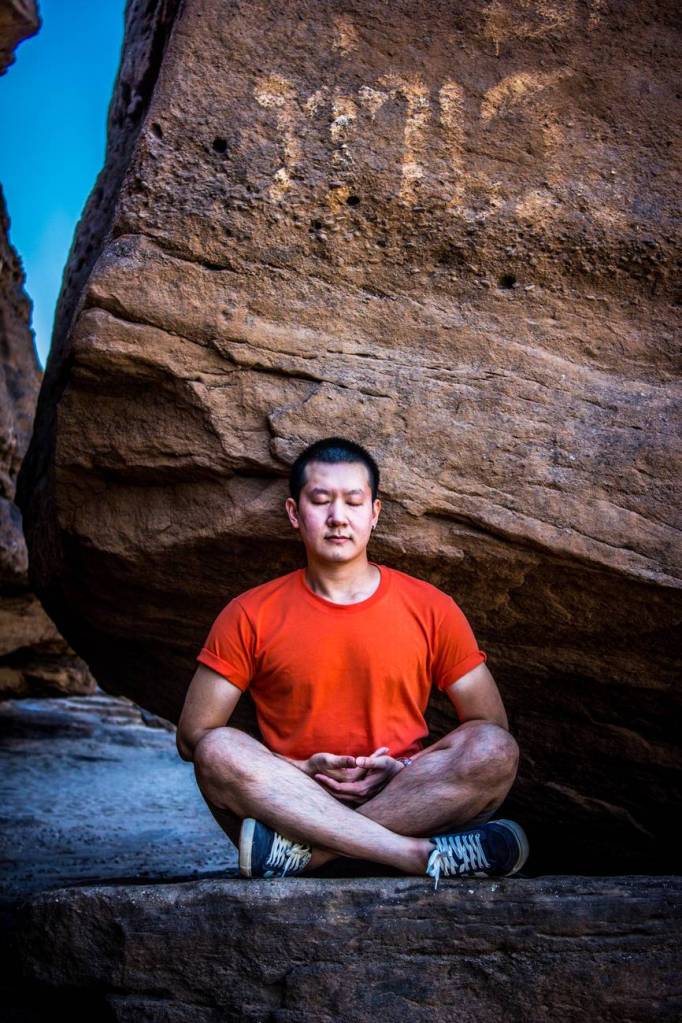
That being said, I should reiterate a point I’ve often made in the past that there are various forms of meditation, from the traditional image most people have as illustrated above, to moving meditations such as Tai Chi or even Yoga. Not every method and/or form will require a mantra, and not every mantra is a simple “ohm.” It can be pretty much anything you choose, so long as it works to help you focus and concentrate.

Personally, I don’t use a mantra when I meditate. I prefer silence or some soft background music with forest or ocean sounds. By focusing on these sounds, I’m focusing my mind. I’ve usually referred to this as an “external mantra.” Silence can also be an effective mantra, since focusing solely on the silence and concentrating on it will have most of the same benefits as an active, repetitive mantra.

Depending on what school of thought you prescribe to, the use of the mantra “ohm” causes a reverberation throughout the body that religious monks believe has spiritual or religious effects on the body. I couldn’t find a stock photo to demonstrate it and I’m too cheap to buy one, but there is a Hindu symbol that represents “ohm,” (also spelled aum or om) and you can hit up Wikipedia under “mantra” if you want to see it. It’s been made popular in such a way that the symbol is represented on yoga gear, jewellery and clothing apparel.

On a last note, a personal mantra is something a bit different. This usually involves a saying or quote that resonates with a person and has a direct impact on how they live their life. Something along the lines of, “Forgiveness is divine, but never pay full price for late pizza…” Anyone who recognizes that quote will understand how badly I just aged myself, but it’s usually something a person repeats or states to themselves or others often but has nothing to do with an actual mantra or meditation.

Although you don’t NEED a mantra in order to meditate, it can be a handy and useful practice to help you focus and concentration when doing so. Sometimes life makes it a bit difficult to find a quiet moment to meditate and a mantra can also help block the outside world. In fact, there are some YouTube videos with hours of mantra chanting, for those who want to have a listen at what it should sound like. ☯

I Will Return To My Shadows

One of the great things about having my childhood (if it can be called as much) take place throughout the 80’s is all the great movies that started to come out. We got the Christopher Reeve Superman sequels (even if they weren’t well received), the last two original Star Wars trilogy chapters and a saturation of “Brat Pack” movies, including The Breakfast Club, Sixteen Candles and Pretty In Pink (I’m partial to Molly Ringwald, sue me!)

But there is a particular movie genre that also became popular during the 1980’s and it still holds a certain level of fascination to the public, even today. I’m talking about ninja movies. I’m sure you’ve seen at least SOME of these movies; stealthy assassins cloaked in mystery and garbed in black hoods, they seemed almost unstoppable and were usually trained in a variety of weaponry and were usually depicted in the movies as being exceptionally skilled in hand-to-hand combat.

But how accurate was that portrayal? To be honest, there is a common misconception that ninjas are martial artists. And although I’m no ninja myself, I can say for a fact that this isn’t true. The ninja were covert assassins, believed to have existed during the feudal era of Japan. They were basically mercenaries who could be bought by whomever could afford them.

Their preferred method of operation was to spy and assassinate through the use of disguises, deception and avoidance. They considered escape and living to see the conclusion of their mission to be paramount over active engagements or fighting. Because of this, the ninja were often considered dishonourable and the samurai considered the ninja beneath them.

When referring to martial arts circles, people usually tend to immediately associate a ninja with Ninjutsu (or ninjitsu) and consider it to be a martial art. The reality is that Ninjutsu is anything BUT… Ninjutsu, as it is, is classified as a system of espionage and assassination, normally including infiltrating locations, spying and accomplishing specific tasks that included but were not limited to capturing criminals and other individuals, obtaining private information and whatever other tasks that could not be accomplished through conventional means. This explanation clearly does not include the martial arts, which are defined as a means of self-defence.

A ninja would be trained in Ninjutsu and expected to develop some proficiency in a number of different weapons and offensive tools that would allow infiltration without notice, evasion and exfiltration. All of this would happen without the victim(s) even knowing that they are there. Ninjas would often originate from the samurai class and would already have some familiarity with an actual martial art. Since some of their tasks would often unavoidably include combat, ninjas would often train in some form of martial arts as well as the expected weapons and tools of the trade.

So the portrayal you see in the movies, where a ninja suddenly stands up out of a small shadow in the corner of a room to face off against an opponent is far from accurate, although it still makes for great cinema (if you haven’t seen 2009’s Ninja Assassin, I highly recommend it!) And if a martial arts practitioner tells you that he or she is a ninja, then by definition they are not. Especially since the ninja were not in the habit of revealing themselves to anyone outside of their clan. ☯

If You Don’t Like It, Then Split!

It should go without saying that if you train in the martial arts, you’re going to get hurt. It isn’t a knitting class, so you should expect that at some point in your martial arts career, you’ll take a hit. Even for people who have been training for decades, mistakes and accidents can happen. I’m reminded of last year, when one of the fellow black belts in my club cracked me in the nose with an elbow. It stunned me and my nose started bleeding, but I was lucky enough that he didn’t fracture or break it.

Whether by accident during drills or because you zigged when you should have zagged, getting hit is the LEAST of the injuries you could suffer while doing most traditional martial arts, such as karate. I’ve had pulled and torn muscles, damaged ligaments, bruising, hairline fractures and a score of other injuries too numerous for me to name or even remember after thirty-two years of Okinawan karate. But these injuries were sustained due to the necessary aspects of karate that I had to learn, and were mostly accidental.

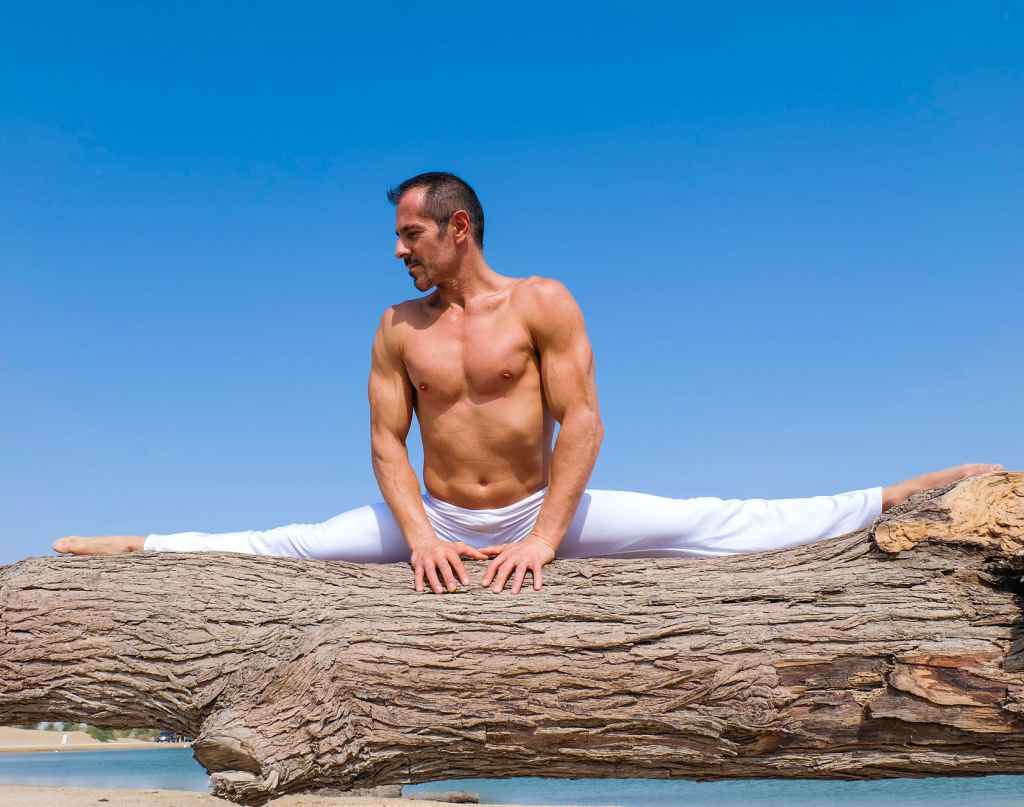
This is where we discuss what is, in my opinion, one of the most WORTHLESS movements taught in the martial arts: the splits. Surprisingly, there are a number of styles that teach and train with middle splits. Just to be clear, a middle split is the one illustrated above, where you open the legs and hips and lower yourself down to the floor and come to rest on your inner thighs. Although this type of split is generally used in things like gymnastics, it’s also considered a staple in certain martial arts styles that use high kicks, such as Tae Kwon Do.

Don’t get me wrong, Tae Kwon Do is an excellent system (for those it suits) and is absolutely challenging. But I’m a realist and I believe in always examining how effective any technique would be in a real-world application. It’s always fun to learn fancy and flashy techniques that look god in the dojo, but why learn self-defence if the technique you’re practicing can’t be used to, well… defend yourself?

This is where the splits start to give me problems. There is, honestly speaking, no practical application for a full split in the martial arts. Right about now, I can almost hear the chairs of every martial artist reading this, creaking in protest as they hold up their hands and say, “Now, hold on just one damn minute…” But bear with me for a moment as I explain my logic behind this assertion.

We’ve all seen the splits done, either on television or in movies. Some action heroes have even contributed to the wow factor behind doing the splits (I’m looking at you, Van Damme!) and it’s almost exclusively for practitioners who perform high-flying or fancy spinning kicks. And even though we can all agree that receiving someone’s heel to your face after they’ve spun it around once or twice would be an effective deterrent against your continued consciousness, these high kicks come with a batch of problems of their own.

A traditional martial artist will tell you that the smart money is on keeping your kicks no higher than the waist or lower abdomen. the reason for this is pretty simple. If you kick any higher than that, you’re shifting your centre of gravity and putting all of your weight on one foot. For anyone who’s ever been in a fight, I don’t need to explain why this is a bad idea. It opens up a plethora of vulnerable spots EVERYWHERE on your body and leaves you open to getting your ass kicked. High and spinning kicks may be great for breaking boards in the dojo, but they serves very little purpose in actual self-defence.

Next, there’s the issue behind how this split is accomplished. You’re asking something of your body that it wasn’t designed to do. Our bodies aren’t designed to split open at the hips the way is required for a middle split. I mean, you have just about all the different tissues involved in that one movement: muscle, tendons, ligaments… You name it. Not to mention the hip joints and surrounding bones. And most students want to progress as fast as possible and often find themselves taxing their body before it’s ready.

Although some medical sources advise that doing the splits is generally okay, any medical source I’ve read has indicated that the most important aspect is to ensure that you work at it slowly and progressively, accepting that it may take weeks and even months to accomplish a middle split. If you ever do at all. I can split to about half way down to the floor and that’s it. But then, I enjoy and appreciate my groin and don’t want to cause it any damage.

If you’re new to the martial arts and the curriculum requires a full split prior to promoting to a certain belt, be sure to take your time. Stretch properly and work at it slowly. If you’re training for the actual purpose of defending yourself, maybe accept that this style isn’t the one for you and look elsewhere. There are already likely to be numerous injuries in your future without causing the intentional ones. No need to hurt yourself intentionally. ☯

Even When Your Hands Are Empty

There are certain styles of martial art that don’t always strike the observer as being something that would necessarily be effective on the street. And that makes sense, right? Think about something specific, like Kobudo. I’ve studied Kobudo on a rudimentary level, and although I love the fanciness and flourish of a traditional weapon, I would never study it BY ITSELF. The reason for this is quite simple: what if you found yourself without the weapon you trained yourself with?

The same can be said for a number of different arts. Some good examples include Kendo. How do you defend yourself if you’re not wielding a sword? Judo. How do you fight if you can’t get your hands on your opponent to throw them? Really, you can ask this question of many grappling and weapons-based martial arts. this is one of the reasons I enjoy and prefer the traditional, empty-hand fighting arts such as karate. Many, if not most styles not only teach the practitioner how to defend empty-handed, but they usually incorporate some weapons as well to ensure some familiarity.

One perfect example of this concept is a martial arts that has received some reasonably bad press in recent years, due to the very fact that it would likely be less than effective in a true combat situation on the street. I am referring, of course, to the Japanese art of Aikido.

Aikido was developed in the late 1920’s, early 1930’s by Morihei Ueshiba, who wanted to develop a grappling style of martial art that would allow a person to defend themselves using the opponent’s own momentum and energy, all while preventing serious injury to either party. His style was based on another Japanese form of grappling called Daito-Ryu, and incorporated Ueshiba’s core beliefs based on his following of an offshoot of the Shinto religion.

Aikido has received criticism from a number of different and popular sources, mostly because many feel that it lacks the appropriate training in areas that would make it effective in a real-life situation, such as striking and blocking. many have commented that unless your opponent is foolish enough to run straight at you in order to allow a fancy flip using their own momentum.

Granted, I can easily agree that if you put a boxer against someone who studies Aikido, you’d be faced with a situation of who will reach their goal first. If the boxer lands a hit, that’ll be it for the Aikido practitioner. If the Aikido practitioner manages to grapple and throw the boxer, the boxer will have very little in the way of a response to defend themselves. This is why, if you study a grappling art such as Aikido, you should incorporate a secondary style that incorporates striking and blocking as well.

Now, Aikido does include some rudimentary weapons training, but this is mostly as defence against such weapons as the staff, wooden sword and knife. On the whole, Aikido is mainly focused on grappling, throwing and wrist locks in order to redirect and control one’s opponent. It can be an extremely effective tool to be used in combat only IF you combine it with a traditional fighting art.

Even if I believe a person should only ever dedicate themselves to one art, I’m a big proponent of branching out so that a practitioner can experience various different perspectives on how best to defend themselves and others. Aikido is certainly a worthy style to examine if one is looking to do just that. Even if some of the criticisms are harsh, it’s important to make your own judgements. And the only way to do this is by finding your local Aikido school and giving it a shot. ☯