When You Just Can’t…

I recently had a reader comment on one of my posts, where it was mentioned that one of the issues faced with traditional forms of meditation is that staying in a relaxed position with one’s eyes closed will usually result in the body slipping into something akin to a dream/sleep state. At least for one of the posts, I was discussing the use of meditation as a means of refreshing oneself from fatigue, so this wouldn’t be an unexpected result. But the reader made a good point about the importance of experiencing one’s day with open eyes, to live in the moment to experience all the beauty that life can potentially offer.

I remember in my pre-teens when I started toying with the concept of meditation and more often than not, trying to meditate for more than ten minutes would typically result in my falling asleep. At that age, it was entirely a bad thing. But during adulthood, we scarcely have the free time to meditate in any form, much less being available to fall asleep randomly. Imagine taking your lunch hour to meditate at the office and falling asleep? Only to have your boss give your shoulder a shake and ask you what the hell is going on?

I’m not saying this has happened to me, and the fact that some employers not only encourage but provide the resources for lunch-hour naps notwithstanding, that’s a topic for another post. The question is, can one meditate with eyes open? Are there any benefits to such a practice and how does one do it? The answer isn’t as simple or easy as a yes or no. And there are a LOT of conflicting sources. Depending on what definition you read, meditation is simply defined as working towards an enlightened state of focus, concentration and awareness. It’s thought to be a technique capable of changing one’s consciousness, allowing for a number of physical and mental benefits. If you’re a reader of some old classics, you may remember that Marcus Aurelius wrote a book simply called “Meditations.” In this context, meditation is considered someone’s written discourse on a particular subject, weighing heavily on their opinion. The focus of today’s post is obviously the definition as I’ve provided it, above.

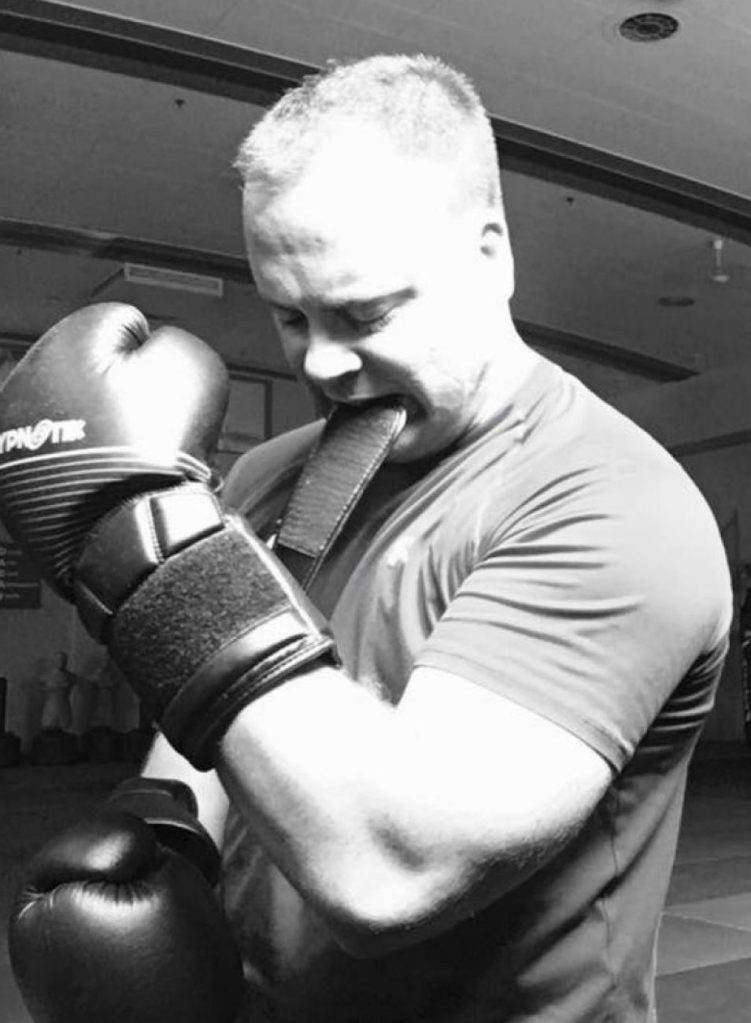
Nathan, taking his first crack at meditation

Meditating with your eyes open, or “wakeful meditation,” as I’ve heard it referred to, is a practice where one can go about one’s day and perform daily activities all while maintaining some basic level of awareness towards meditation. In some respects, this can be a handy tool for allowing yourself to be freed from distractions in one’s environment, to increase one’s focus and even in some circumstances, to block out certain forms of pain.

This is not without challenge, and I’d be lying if I said it was something that could be sustained indefinitely. But it’s certainly possible and definitely recommended. The thing about meditation that most people seem to forget, is that you don’t need to be dressed in robes, sitting in the lotus position with your eyes closed in order to achieve it. I had a math teacher when I was in high school, who would take the fifteen-minute recess to close his classroom door, sit at his desk and simply close his eyes and perform a simple, deep-breathing meditation. Fifteen minutes. That’s it. And it would leave him refreshed and ready to continue on with his day.

I found an analogy online that would seem to be fitting. The word “meditation” is a bit like the word “sports.” If you tell someone you play sports, they’d likely ask you what sport you play, since there would be hundreds upon hundreds of possibilities. Meditation is very much the dame thing. There are many ways of meditating, different methods, techniques and postures, all with the goal of helping one increase their overall awareness and consciousness. The key thing is to find a method that works for you and suits your purposes. Otherwise, it’s like picking out a car to buy. If you don’t get the model you want with the options you were looking for, it’ll get you from point “A” to point “B,” but there’ll always feel like there’s something missing. Meditation falls very much under the same comparison. A huge shout out to the reader who provided comments that elicited this post. If you’re reading this, inspiration is always appreciated. ☯️

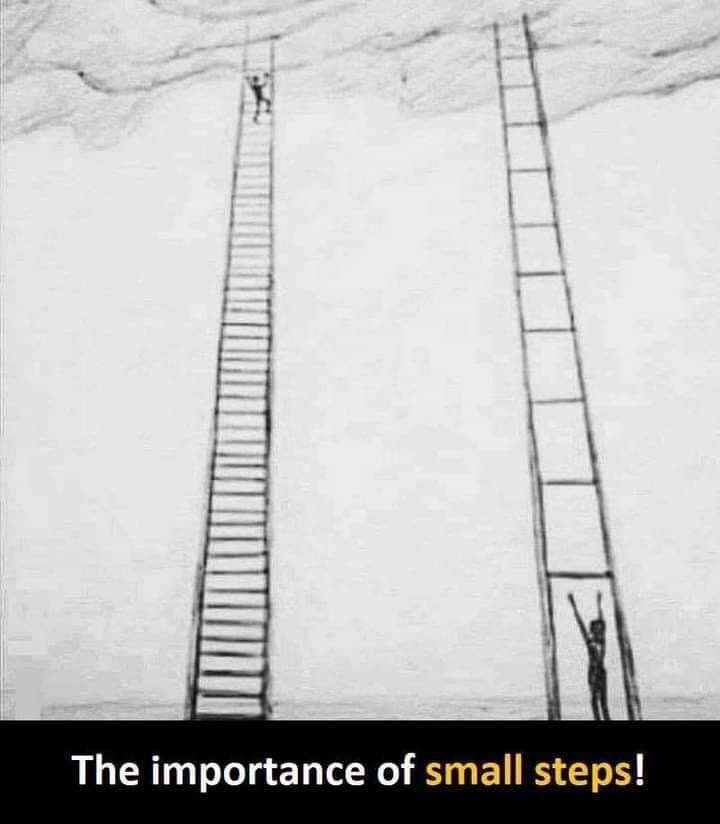
The Importance Of Small Steps

I found the above photo online and just couldn’t help but share it. It illustrates how trying to climb in grand leaps through life will put things out of your reach. More importantly, it should also be a clear message that should you need to take big steps in life, it shouldn’t be done alone and it’s okay to ask for help. If the subject on the right had a partner, they could help each other scale the ladder. Food for though… ☯️

Where Should You Be Sick?

Getting sick sucks, and I should know. I’ve spent most of my life, especially during my youth, being sick in one form or another. When Type-1 Diabetes is involved, illness proves to be something of a “chicken or the egg” scenario, where it can be difficult to tell if a particular illness has caused the chaos with your Diabetes or if your Diabetes caused you to become ill. In my youth, Diabetes was referred to as one’s pancreas not working, which we now know if not ENTIRELY accurate. But before I get completely off topic, the subject of today’s post is getting sick, not necessarily Diabetes.

I can’t tell you how many times I dealt with the important aspects of my life while sick. Whether it was school, work or karate, the prevailing attitude back then was “suck it up” and you were expected to carry on, unless you were in such a condition that you were hospitalized (which was often the case for me). These days and especially in the past two years, the concept of pushing through while sick is not only less encouraged, it’s frowned upon. Employers are pushing staff to stay home when they’re sick in an effort to prevent spreading illnesses.

Since I’ve had everything from severe dehydration, polyps, influenza, bronchitis and this little thing called Diabetes, I’ve had the opportunity to o deal with some pretty bad scenarios as it relates to all of these environments and I have stories relating to all of them. Of COURSE I have stories…. This is me. Here’s the top ones:

Being Sick During Karate
To say that I was mildly obsessed with my karate training in my youth would be an understatement. For the most part, I not only participated in all three weekly classes, I would also spend the remainder of the week cycling and practicing on my own time. This meant that whenever I wasn’t eating, sleeping or at school, I would be doing karate (and since I would often dream about karate, I’m not sure the sleep aspect can be included in that statement.

I remember this one time when I was doing bunkai with another student. For you non-practitioners, a bunkai is a pre-arranged, practical application of kata techniques. Moving on. It was one of those nights where we dissected and practiced every technique until it was burned into our brains. As such, I had been with the student I was partnered with for almost an hour. During that time, i noticed his voice had a nasal twinge and he kept sniffling, as though he couldn’t keep his snot in. Since this is karate class and one doesn’t carry a purse with them, at one point, he drags the sleeve of his uniform across his nose and face in an effort to dry up the flow of nasal discharge.

I was mildly disgusted, but who am I to judge? If my nose wouldn’t stop leaking, I likely would have done the same. During a particular exchange, I learned the hard way that some of his snot had gotten on his hand, which conveniently made it’s way across my forearm and hand as we executed a couple of techniques. Given the discipline requirements of the class, I continued on but my focus was mainly on the fact I had the contents of a Petri dish on my forearm. once the exercises were over, I bowed out and ran to the washroom where I thoroughly washed my arms and hands with soap and water as hot as I could stand.

Apparently the damage was done, because two days later, I got sick as a dying dog. Runny nose, head felt like it was stuffed with cotton. If I could prove beyond a doubt that he was the cause, I’d have cursed his name (or at least had at him in the sparring ring). But i guess it’s nowhere near as bad as having the runs during karate class. I’d say to say I’m assuming, but that’s happened on occasion, as well.

Being Sick At School
Classrooms are almost a perfect description of a Petri dish, with almost three dozen people crammed into a fitted space where everyone shares the same space, air and germs. Wow, I sound like such a germaphobe. But seriously, how often have you heard parents say that as soon as their children start school, they get sick? And that’s for good reason. Because it’s almost a statistical guarantee that if only one person in a classroom is sick, all of them will be, depending on what they have.

I had one of my many instances in high school where I was dehydrated. I hate to admit it, but this usually happened to me every few months, to the extent I had to spend a night in the hospital on an IV drip to properly rehydrate. Unlike most of my teenage counterparts, I didn’t rebel by drinking on weekends or being brought home by the cops. I displayed my stubbornness by neglecting to drink enough water. Such a rebel, eh? In an y event, this was one of those occasions where my insides were drying up.

By this point in my life, I had gotten used to the feelings and sensations associated with dehydration, so I kind of knew that this was what was happening. I was in biology class the one morning, after waking up feeling like absolute crap. I went to school anyway as most parents can agree, it tends to fuck the entire day when an unexpected illness keeps a kid at home. But once I was in class, my condition started to get the better of me. The teacher was in the middle of an impassioned lecture about one damn thing or another, and she was the type of teacher who not only despised being interrupted for any reason, she made that displeasure obvious by ruling her class with an iron fist.

I tried to relax my abdomen and keep myself calm for as long as I could, but I could feel the bile rising in my throat and I knew that if I continued to ignore the feeling I had, I would end up emptying what little contents I had in my stomach, all over my desk. As such, I started by taking the polite route and raised my hand to ask to be excused. I was answered by a firm, “Hold all your questions until the end, please!” The student seated next to me even asked if I was okay, as I could feel the clammy sweat on my face and could only imagine how pale I must have looked. This pre-dated my use of an insulin pump or even carrying a glucometre with me, so I had no idea if my blood sugars were wreaking havoc, as well.

I decided to take my life into my own hands by simply cutting in and asking to be excused. The teacher rolled her eyes and began giving me a lecture on the intricacies of paying attention and showing respect. My body chose that moment to cross the point of no return. I felt the heated sensation at the back of my throat that signalled the coming of the apocalypse. I rose from my seat and began staggering to the door. I hate to take pride in what happened next, but the teacher grabbed my arm in an effort to stop me from stepping out of her class, which resulted in my stomach emptying its contents right there on the classroom floor. Right next to her desk.

My retching couldn’t of lasted more than about ten to twenty seconds, but it felt like ten to twenty minutes of my body seizing every muscle it could while a sound much like humpback whales and alligators mating with each other came out of my throat, all while a hot, yellowish fluid splashed all over the classroom floor. Did I make that descriptive enough? There was a brief moment of complete silence and a look of utter shock and aww on the teacher’s face. then everyone in the classroom started screaming “Eeww…” like some sort of morbid choir and everyone started trying to vacate the classroom to escape the smell.

I felt briefly better upon emptying the contents of my stomach, so I managed to stand up straight and started walking out of the class with the intention of making my way to the classroom. The teacher once again tried to stop me, this time to order me to get something to clean up the mess I had made. Since I was a cheeky, sarcastic teenager at the time, my response included a verbal plethora of inappropriate language, somewhat suggesting to the teacher what she could do to herself and where, all while questioning her parents’ use of heavy narcotics while conceiving her. I don’t know what had pissed me off more; the fact she was ignoring a sick student who was trying to alert her to a problem or the fact that she was trying to get the same student to clean up a mess that was a result of her ignorance. I walked out and went home.

Obviously, I got into “some” trouble over this. I went to school back in those days where the students COULD still get in trouble as opposed to parents giving the teachers all the crap. They have an unbelievably difficult job, and I wasn’t an easy student. But even I have my limits, and that limit usually involves my health. Moving on…

Being Sick At Work
I’m not certain how many stories I have about this specific aspect, but there are a lot. The unfortunate phenomenon that seems to take place, especially in non-unionized environments, is that management will frequently expect you to work despite being under the weather. When I started to claw my way up into management, I started being made to administer those same expectations. Imagine this scenario, if you will. You’re working a job for minimum wage. You wake up feeling like absolute shit and you already know that any efforts to go to work will leave you feeling worse. Maybe it’s simply a cold. But either way, you make the conscious decision to phone in to your boss and tell them you won’t be in due to illness.

You’re already dealing with the fact that you’re likely losing a day’s wages, unless you’re lucky enough to have paid sick days. But then they hit you with the bombshell. They tell you that if you’re calling in sick, they’ll require a doctor’s note. You calmly try to explain to them that you’re not going to the hospital, you’re simply feeling under the weather and need some rest. they tell you that if you aren’t sick enough to see a doctor, you aren’t sick enough to miss work and they expect to see you on shift. You begrudgingly get dressed and go to work, sick.

I’d like to say I just made that scenario up. But I’ve actually had that exact conversation at a previous job. I think we can agree that most employees would just suck it up and go in, not wanting to risk the trouble they may get into with their respective bosses. The result is a lot of people going into work sick, which can be disastrous for all parties involved, regardless of what industry you work in. I had just such a disastrous situation that happened some years ago, while running someone else’s business…

I had been having pretty bad stomach pains for a couple of weeks. It was one of those things where the pain was bad, but it wasn’t so severe as to be debilitating, so I kept going in to work. During a particularly busy peak hour of work, I started to get dizzy and swayed on my feet a bit. I leaned on the table that was in front of me, but I suddenly fell sideways sand crashed to the floor. Next thing I know, I wake up in a hospital bed with an IV coming out of my arm. After some tests and description of what I had been feeling, that’s how I discovered I had polyps. Wonderful, eh?

The point behind these stories, besides being insanely entertaining to write (the classroom one is a favourite), is the fact that self-care is not only important; it starts with you. Is training hard in karate important? Absolutely. Is it worth it to try and make it through a class when you’re sick? Definitely not. Is education important? That’s a big 10-4! But how much actual knowledge are you absorbing when you’re sick? Likely not much. And even though money is needed for the basic necessities of life, money will never be worth your overall health.

The important thing to note here, as well, is that is only takes one person whose sick to pass it on to everyone in their environment, whether it’s at home, work or during leisure activities. This is especially important in today’s context, as it relates to the spreading of the COVID-19 virus. Tried coughing in public, recently? It’s highly not recommended. But no matter what environment one is referring to, take care of your health. Nothing is worth sacrificing your health. ☯️

Put Some Effort Into Reading This Post…

Nature has this tendency, one shared by the majority of humans, which is to always take the path of least resistance. Take a look at water; it will usually always flow to the lowest point until stopped by a barrier, since gravity does all the work FOR the water. In this respect, one could easily say that water will always follow the path of least resistance. Humans are typically hard-wired to make their way through the day in very much the same way and it can often be difficult to circumvent that path.

Picture this scenario: you have the day off. The sun is shining, you have no errands to run and no work that requires you or attention. What do you feel would be the easiest alternative for you? Sitting on the couch with your favourite snack and binge-watch a favourite show? Or jump on the bicycle and see how much mileage you can rack up in two hours? I can tell you what the smart answer would be, depending on where you’re at and what you’re trying to accomplish. But I think we all know what would be easier and feel better.

Obviously, it would be easier to enjoy the day by flopping down on the couch and doing nothing. THAT’s the path of least resistance. And honestly, there may be days when that’s actually the better option for you. Especially if you had a brutal week and need a chance to recharge and replenish your mental batteries. That being said, there’s an insidious effect that takes place if you always follow the path of least resistance…

It’s true what they say that nothing in life is free. There’s a cost to everything, even when we don’t recognize what that cost might be. For someone with Type-1 Diabetes, fitness and self-care are critically important. I’ve spent most of my life committing myself to fitness, martial arts and bettering myself. It’s never an easy battle and there are always obstacles in the way. But I recognize that life doesn’t care about my plan, and won’t do anything to help me on my journey.

The insidious effect I refer to, in regards to taking the path of least resistance, is that when you start “taking it easy” or skipping a workout, you begin setting yourself up for that trend. Again, I’m not referring to the times when you just flat out need a break. I’m referring to the trend where maybe you meant o take a break and then all of a sudden it’s been awhile couple of weeks without exercise and you’ve gotten all lazy and lethargic and maybe gained five pounds from all the salt ‘n pepper wings you’ve been eating…. I swear, I’m not speaking from experience. Moving on…

The point is, and what sets humans apart from most aspects of nature is that we have the awareness to recognize when we’re slipping or letting go. Making a difference in your own life takes effort. But that effort will never happen on its own. I find myself at an age where getting out of bed in the morning is an effort. Remember how I’ve written about the way you start your day sets you up for the remainder? If not, go back and read my posts, damn it! But seriously, most mornings my body is fighting hard to convince my mind that it wold be much easier and simpler to just lay my head back on the pillow and forget about getting up. It would be easier. That doesn’t make it better.

As you move through life, many if not most things will get in your way. Health, work, familial obligations, social obligations and one’s own excuses will often slow or hinder progress, as it relates to one’s commitment to fitness and health. If I look nasty myself as an example, I’ve had ample excuses to stop training. When the pandemic hit, my karate dojo closed. Okay, I no longer have a practical place to train. I set myself up with a training space in my basement. Then my basement flooded and I had to have the basement demolished.

I moved my training space to the garage. It was actually a pretty sweet set-up, too. But i had to move everything that was located in the basement to the garage, so I lost that space as well. I promised myself the purchase of some free weights and light equipment, but opted to wait until the basement was fully renovated. And on, and on, and on…. There will never be a lack of excuses available, if one chooses to find them.

I find that as life moves forward, the excuses become more prominent and convincing and it becomes harder to commit oneself to a consistency. But as age begins to climb, it becomes all the more important to not only continues, but to push harder in order to help maintain that fitness and physical health (and mental health) into the years to come. After all, Diabetes won’t take a break. Why should I? And that’s what’s important to remember. Stop for too long and the opportunity to o better yourself may pass you by.

The human body is like a dynamo. It’s always getting it going that’s the hardest part. But once you get your momentum, continuing is much easier than stopping and starting up again. So give yourself the effort. You need it. You deserve it. You’re worth it. Good health & fitness is a never ending battle. Just be sure that as you work through it, you guarantee that you’ll come out the clear winner. ☯️

Weighing In On Proper Form…

Ironically, I’m not referring to “form” as it relates to karate, which is a switch. I was having some interesting discussions with a few people about the importance of proper form while lifting weights and some key points were brought to my attention. As such, I thought it would be a good idea to share them here. These are all subjective opinions I gathered from a couple of friends (whom I won’t name), so take it for grain of salt.

Weightlifting and resistance training can be an important tool for getting into shape and can also have some practical uses as it relates to the martial arts. In karate, the strength behind one’s strikes comes from a combination of speed, accuracy and physical force. So, “strength training” in the form of weight lifting was never much encouraged in my Sensei’s dojo. Of course, Okinawan karate is filled with strength-building tools, such as the chishi or hojo undo. But strength training to make yourself bigger usually isn’t a thing in karate.

Depending on who you talk to, getting pumped up can actually have detrimental effects on your martial arts training. When you weight lift for size and gains, you eventually start sacrificing speed and mobility for the size you build. And the strength aspect isn’t all that better than if you simply condition yourself through other means. But let’s say that you’ve been watching one-too-many 80’s action flicks and you’ve decided to try and get some “Arnold-esque” biceps…. Here are some tips that my cohorts and I came to agree on:

1. Start Small: I get it; one’s pride will often make you want to walk into the gym and grab a pair of 50-pound weights and grunt like an animal while making yourself look tough. But it’s safer to start with lighter weights and work your way up as your strength increases. This will help prevent injury and help you maintain proper form. There’s that word again: form. Speaking of which;
2. Get Some Help With Form and Technique: If you’re walking into a gym or purchased some weights and are doing it for the first time, don’t be scared to ask for some help. Whether that means hiring a trainer for a single session to get the basics or learn proper technique, or leaning on a friend who’s been using the gym for some time. This will help prevent improper form while performing certain key exercises, which can lead to injury.
3. Don’t Overdo It: Is it a good idea to push yourself? Yes. Is it a good idea to continuously grow in your fitness efforts? Absolutely. Should you feel the burn after a good workout? Who doesn’t? But if you find yourself basically unable to move the following day and have to recover for the next week, you haven’t done yourself any favours. Taper it back a touch and work out safely and consistently, instead.

In order to prevent injuring yourself and causing damage, remember to learn proper form for the exercises you’re doing, build yourself up from the bottom and don’t overdo it. Damaged muscles not only take a while to heal (especially if you’re Diabetic) but they hurt the whole time they’re healing. And from a martial arts perspective, bigger isn’t better. If you’re doing strength training for something like karate, you want to prevent ballooning your muscles and making yourself huge. think swimmer’s build as opposed to body builder. ☯️

Walk Away And Keep Your Hands To Yourself…

De-escalation. It’s a word one rarely thinks of, when faced with a potential threat against one’s safety and well-being. For the most part, our survival instinct (fight or flight, if you will), will kick in and unless you’re some kind of macho jerk with a point to prove, you’ll do whatever is necessary to bring conflict to an end.

All that being said and without getting into the details of whatever self-defence laws your local jurisdiction may carry, every person has an inherent right to protect and defend themselves. And in most cases, others. But the ability to de-escalate a situation is one of the most effective resources in a properly trained martial artist’s toolbox; one that is usually and widely overlooked. There are tons of quotes and passages from martial arts’ reading that explain how the best victories are from the battles you didn’t have to fight and I would be inclined to agree.

As children, our parents were always very quick to tell us to “just walk away” and to “keep your hands to yourself,” when faced with confrontation. Speaking from experience, that rarely EVER worked during my childhood. Surprisingly, it works a bit better as an adult and it may be because adults are sometimes prone to actually consider another person’s words as opposed to being a kid hopped up on hormones and lack of sense. I say sometimes because I’ve definitely encountered adults who basically act like children. But I digress…

A colleague of mine recently clued me in to a YouTube channel that discusses and covers de-escalation and examines confrontations and what may have caused them. The channel is called Active Self Protection and it’s pretty good. I have to agree with my colleague, once you start watching some of the videos, it can get pretty addicting, especially from a martial arts perspective. It provides the opportunity of examining the question “what if,” without having to get into the actual situation.

The point is, a big part of learning martial arts the proper way is understanding that physical force isn’t always the way. I would personally push it one step further and point out that getting into a fight should ALWAYS be the last resort but I’m realistic enough to know one does not always have the choice. If someone attacks you, you can find yourself on the defensive trying to ward them off and likely answering their attack before you reasonably have time to try any “verbal judo.”

Throughout my personal and professional life, I’ve lost count of the number of times that I’ve managed to avoid a physical confrontation, simply by using my words to de-escalate the situation. Remember that there’s no shame in preferring not to fight. And it’s always amazing to look at a given situation after the fact and realize that it could have been avoided if the parties involved had tried to talk it out, rather than beat the snot out of each other. Build that verbal judo. It can be a life-saver. Food for thought… ☯️

You Can’t Walk A Mile In My Shoes, They’re Too Worn Out…

Most people who know me would agree that I can have a stubborn streak. And while dealing with someone stubborn can be tedious and even exhausting at times, there’s a lot to be said for stubbornness. I consider it to be one of the deterring factors that’s kept me alive for as long as I have been. If I were never this stubborn, I never would have overcome Diabetes complications as was child. I never would have reached the level of martial arts training that I have. And I definitely wouldn’t have made my way through basic training and enjoyed a reasonable foray into law enforcement over the past decade and a half.

But there were a lot of nay-sayers along the way. People who didn’t believe that any of those things could be accomplished and that I shouldn’t have been attempting them. In some cases, a lot of cases, I wish those people could be here to SEE what’s been accomplished. But such pride-filled fantasies are not only unnecessary, they accomplish nothing. But it’s always difficult when you have people who seem to want nothing more than to watch you fail. And I’ve seen this happen a lot.

The most classic scenario involves being at the gym. You walk in, change and start working up a sweat. Public gyms have a lot of positives and negatives, as I’ve often written about. But at one point, you look up and see a heavy-set person on a treadmill or elliptical machine. You can see that they’re soaked with sweat, breathing heavily and are doing their damndest to push through the inevitable fatigue that comes with moving a vessel that large. But they’re doing it. And then the inevitable happens: a couple of snooty bitches (male or female) will come by and “subtly” say something about the person on the treadmill. Maybe something to the tune of, “Wow, you can tell that they sure don’t belong here..” or “Why would they let someone like THAT in here? I didn’t come here to see someone fat in my gym.”

I wish I were making those sentences up. But these are ones I’ve personally heard while USING a public gym. It ties into my whole concept about how some people just want to watch the world burn. Folks, obesity and excess weight is no joke. But setting aside the whole concept of body-positivity and loving yourself as you are, excesses weight can have serious health repercussions and shortens your life in a plethora of ways. So, it would make sense that a person in that position would WANT to work towards getting into shape. And last time I checked, wasn’t the POINT of a gym to GET in shape? By that logic, it stands to reason that everyone in the locale isn’t going to look like a bad scene out of Baywatch.

That’s only one example of such a scenario and it’s a classic one. One I dealt with was actually from my parents. Yes, you read that right; the first people I had to deal with being negative about a choice I made was my mother and father. During my childhood, complications resulting from insulin resistance didn’t provide much of a positive outlook on the possibility of living to see my teens. When I took my health into my own hands and decided to join the martial arts, I was told that I was too weak, too frail, to join karate. They’d hit me and hurt me, and I’d never make it through a class without my blood sugars bottoming out. Ultimately, my parents and family at large were of the opinion that it would be contributing to my early death to join karate.

As a result, I wound up doing what a number of people have done through the centuries, in my situation. I joined in secret and did it anyway. The result was not only improved health, reduced insulin sensitivity and a lifestyle I never would have been exposed to otherwise but I went on to excel and teach others. Not too shabby, for someone who was told they could never do it. And that’s something that unfortunately happens far too much. This example involved my family, but I’ve faced this sort of negativity from friends and associates through the decades, as well.

Folks, one of the worst things you can do in this life, is knock down someone who‘a trying to climb. Everyone has a story, everyone has a journey and it’s far better and easier to help lift these folks up than try and knock them down. Imagine if I’d actually listened to my nay-sayers (parents notwithstanding) and stepped aside from martial arts? Maybe I wouldn’t be here today. Or if I was, maybe I’d be in much worse health and unable to enjoy life to the level that I do. I was lucky enough to have people who pushed me and encouraged me. So when you see someone working towards something amazing, be one of those people. ☯️

Hungry For Some Facts?

I was having a conversation with someone from work yesterday who had an unfortunate incident involving his lunch. Since he typically works out during his lunch hour, we were discussing whether he would walk to somewhere nearby and purchase some food or if he would simply go to his workout as usual. The conversation led to the benefits and disadvantages of working out on an empty stomach. And as with all things in life, there’s a case to be made for either one.

Sometimes, it’s more about HOW you do something than the actual WHAT. In this case, there are times when exercising on an empty stomach is fine. In fact, I’ve often heard that exercising on an empty stomach can lead to a better fat burn, since the only energy the body has to depend on is one’s fat stores. Unfortunately, this isn’t correct.

According to an article on WebMD, working out on an empty stomach will cause your body to use a source of energy that’s readily accessible, which may include breaking down sugars from the muscle tissue, followed by the production of sugar by the liver. Fat stores simply aren’t the go-to secondary fuel that many (myself included) believe it to be. By that logic, training heavily on an empty stomach may inadvertently cause you to sacrifice your own muscles in order to fuel them.

The article goes on to explain that if you’re doing a consistent form of aerobic exercise like running or cycling, doing it on an empty stomach can work. But the overall risks of a fasting workout aren’t worth it. The article suggests consuming small portions of low-glycemic, complex carbohydrates, like steel-cut oatmeal, apple slices or whole-grain cereal without the milk. Click on the article link for more of those suggestions. I won’t list them all here.

From the Diabetes standpoint, a fasting workout can be difficult at best. This is especially true since different types of workouts will affect different people’s blood sugars in different ways. Ain’t Diabetes grand??? It’s a wonderful kaleidoscope of bullshit. For example, if I head out on a long bicycle run and may blood sugar is normal, I can expect to hit a high before I get home. Unless my ride is wildly inconsistent in terms of speed and resistance. Then I’ll have a low. Working out on the punching bag or doing heavy weights will almost always make my levels drop. Unless I suspend or remove my pump, then they’ll sky rocket.

See what I mean? And those conditions may be different for each person. So if we add an empty stomach to the mix, it makes things all the more complicated. Not least of which is the fact that hunger can be extremely distracting. Try focusing on lifting weights or working the bag properly when your stomach won’t stop rumbling. It ain’t easy. Plus, hunger can cause fatigue, dizziness and/or nausea, none of which are ideal during exercise.

The next perspective is the martial arts. If your karate classes are anywhere near as intensive as mine are, the last thing you want is something heavy sitting in your gut, sloshing around and making the bile rise in your throat. This is where that small portion of complex carbohydrates comes in. Give yourself the fuel you need to get a more intense workout in, without the risk of throwing up all over the dojo. Contrary to SOME opinion, projectile vomiting is not an effective means of self-defence. That’s a story for another time…

Bottom line, fueling up before a workout will still allow you to burn fat. In fact, that WebMD article linked above indicates that “If you’re doing a killer workout… non-fasting is better. You’ll get to the fat burn because you’re going to deplete carb stores quickly by working out so intensely. You’ll start burning fat within 16 to 20 minutes.” Since I average workouts at 30 to 60 minutes, I’m getting a burn no matter what.

There you have it; empty stomach = not good. More or less. Some people just flat out can’t exercise with food in their stomach, so there are exceptions to any concept, right? For us Diabetic martial artists, eating the right foods at the right times in the right circumstances is all that it takes. Sounds easy enough… (rolls eyes sarcastically) ☯️

Hay, Don’t Be A Maker…

There’s nothing like a good, solid workout on a punching bag. Some motivational music on the Bluetooth speaker (I like instrumentals, personally. Audio Machine or Two Steps From Hell are pretty good), a thin pair of bag gloves or bare knuckles and the sweat dripping off my nose as I hammer combination after combination on the bag. I usually use a workout timer app called Seconds Pro, which I’ve written about in previous posts. But if you’re on the iOS platform, you can check it out on the App Store. I don’t know what the Android translation for that would be. But I digress…

I’m a big fan of using striking surfaces of varying types, as it allows you to build and develop your strikes against an actual surface/target as opposed to simple shadow boxing, which can only provide so much. I’ve seen people train for long years and become extremely fast and efficient in their strikes, only to falter, sprain a wrist or have no impact strength when it came to striking an actual object/opponent.

I’ve described different methods of striking such as using the punching bag, which carries the weight and yields somewhat like a live opponent would (and moves, so it challenges you to adjust since opponents don’t sit still). There’s also wall-mounted pads, which still allow for some solid striking power while providing a specific target, which one does not typically worry about on the punching bag. The last is the makiwara. Really, any hard, static striking surface. This would apply for specific targeting, certainly. But mostly, I use the makiwara to develop proper striking posture and knuckle development. As you may have heard, we Okinawan karate types are pretty nuts about our knuckles.

Although I favour the punching bag above all these options (having someone hold a pad for me in the dojo, notwithstanding), I’ll sometimes find myself using a technique that isn’t really favoured in my style and that I consider to be something of a risky proposition in an actual fight situation: the haymaker. Ahh, haymaker…. The go-to for drunks looking to end a fight quickly…

For those of you who may not be familiar with the fighting arts or who don’t watch boxing, a “haymaker” is basically a wide, whipping punch that’s thrown from the shoulder, coming from the outside in towards an opponent. There’s very little bend to the elbow and it has the potential to be a very strong, devastating blow. If you can land it. And under the right circumstances. Enter: my opinion…

Many of you may never have experienced a situation where you’ve gotten into a real fight. Consider yourselves lucky. As Dalton said in the movie Roadhouse, no one ever wins a fight. There have been many times when I’ve been stuck in a situation, both professionally and personally, where despite my best efforts to talk my way out, a fight was coming. And although I haven’t really made much use of the haymaker, I’ve seen others foolishly try to put it in action. Although it has the potential to provide some power, here are the disadvantages:

1. It Causes You To Telegraph Your Movements: There’s nothing worse in a fight than giving your opponent information about what you’re going to do next. That’s what telegraphing is, as it relates to a fight. The problem with a strike like the haymaker, is that you need to blade your stance in order to do it. Try executing a haymaker from a normal, standing position. Go ahead, I’ll wait…. You’ll notice that you’re able to swing your arm in the arc that constitutes a haymaker, but it will cause your entire body to twist and there’ll be no power behind the punch. This means that if you’ve reached the point of no return and it becomes either them or you, you’ll need to back a foot up in order to blade your stance to throw this bad boy out. And nothing quite lets your opponent know that something’s coming like blading your stance…
2. It Leaves You Exposed: It’s no secret that Uechi-Ryu Okinawan karate favours strikes kept within the boundaries of the practitioner’s body, so maybe I’m a bit biased in this regard. But it’s for good reason. If you ever see someone execute a haymaker (I was unable to find a stock photo of one) you’ll notice that their entire rib cage and the side of their face is open and exposed. An opponent who knows it’s coming will definitely take advantage of that and deliver a strike themselves, before your haymaker has the opportunity to land. One of the concepts behind striking while staying within the outer boundaries of one’s body, is to prevent opening up in such ways
3. It Takes An Eternity: Fights are something akin to a horse race; the ending is calculated in seconds or less. One of the biggest problems with a haymaker, besides the telegraphing and exposure, is that it takes far longer than other strikes. It should come as no surprise that the shortest distance between two points is a straight line. A haymaker is pretty much the antithesis of that. It’s wide, far-reaching arc combined with the additional distance it must travel before making contact, makes it less-than-ideal if you’re facing an opponent who may be on the ball and has any level of fight training as well.

I absolutely believe that there’s no such thing as a bad technique; simply how one uses it. So, I think the important detail about this technique is that it shouldn’t be used at the beginning, or even during an actual fight. Perhaps as a Hail Mary move or a finishing move when the fight is over. But then one needs to ask oneself: should I be striking an opponent with that much ferocity if the fight is all but over? The totality of your circumstances may dictate that. But this is a good time to point out that fighting should always be considered ONLY as a last resort. Be safe. ☯️