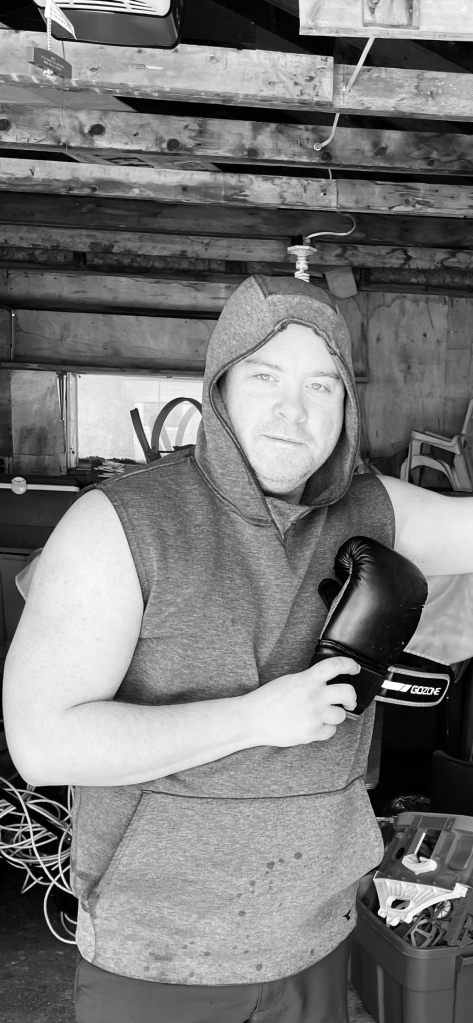
Less Than A Gentle “Ribbing”…

So, a few days ago I posted about how I attended an all-weekend karate seminar. this happened last weekend and was supposed to last all day, Saturday and Sunday. Sometime during the morning session on Sunday, I took a punch to the left side of my rib cage. The immediate feeling was having the wind knocked out of me. When I left the ring and stood off to the side, it took a few moments for the aching feeling and loss of breath to subside. once it did, i noticed a sharp pain in my side that I was able to ignore for at least the last twenty minutes until the session closed.

Once class closed, I was changing and noticed I was having difficulty getting out of my gi, with a sharp pain shooting up my left side and throwing bright, white stars behind both my eyes. I told some of the instructors that I wouldn’t be returning for the afternoon session. When I got home, I fell onto my bed and fell asleep from exhaustion. When i woke up, I could barely move. My first instinct was that my opponent had crushed a muscle and this was a muscle-based pain. But as the days passed and the pain worsened, I started to wonder if perhaps I had fractured/broken a rib.

It’s been a painfully brutal week. You really don’t realize how MUCH you use your core and abdominal muscles until you’ve suffered an injury that prevents it. The past week has seen me unable to comfortably sleep, do normal daily or chores or even get in and out of my car without wincing in severe pain. Hell, I haven’t been able to get in and out of a CHAIR without wincing in severe pain. And that sucks, since I don’t exactly have the most free time to be out of commission.

Once I realized I had a severe problem that wouldn’t be fixed on its own, I had to contemplate the possibility of finding a doctor. Problematically, finding a family doctor is quite, well… problematic, here in Saskatchewan. I still have a personal physician from my Mountie days but she’s located in Swift Current, which is a few hours away from where I am in Regina. Although making that trip wouldn’t usually be such a big deal, doing it when I’m in pain and my back is pooched isn’t the greatest. Luckily, my wife had a doctor’s appointment today that she no longer needed so she called in and had them exchange it to my name, instead.

I’m not sure what the doctor will determine, whether it’s a broken rib or damaged muscle. My sincere hope is that there’ll at least be SOMETHING that can be done to alleviate some of the pain. I feel as though I was JUST hitting my stride, being back in karate. Just in time to get injured and have to take a break for a couple of weeks. Figures. Either way, it’s important to take the necessary amount of time to heal properly when you suffer an injury. Better to wait it out and get better than return early and suffer potential further injury. ☯️

Your Body Isn’t All You Should Take Care Of…

Training in the martial arts can be taxing on the body. Hell, scratch that… It WILL be taxing on the body. Even if you manage to come out of years of training unscathed from being struck and/or injured in that fashion, any reasonable physical exertion will cause pulled muscles, bruising and sprains. And on top of nursing those injuries and taking care of one’s body, it’s also important to maintain proper hygiene of one’s body, as I wrote about here. But what many people seem to forget is that good hygiene and cleanliness doesn’t stop with one’s body. There’s also one’s equipment and uniform that need to be addressed…

I’ve often noticed that when someone finishes a class, they have a tendency of packing their gi into their gym bag and head home. Some may pull the gi out and let it dry/air out but many will actually just let it sit in the bag, especially if they happen to have class a couple of nights in a row. There are some significant problems with this. For one, sweating into a garment for a couple of hours then containing it inside a gym bag is just asking for trouble. We’re talking bacteria growth and even mold and mildew if it’s allowed to sit for too long.

All of these things will cause noticeable issues for the practitioner, if allowed to continue unchecked. re-wearing sweaty gear can cause all sorts of skin issues, like rashes and dermatitis. Add to that the fact that re-wearing a gi that has absorbed sweat can potentially emit a bad smell reminiscent of bad BO, whether it dried inside the bag or not. What’s worse, is that the wearer often won’t be aware of that odour themselves. It’s others who will notice it. That’s why it’s so important to keep your gi and equipment clean and washed after every use.

The obvious exception is if your gi is freshly washed and you walk into a light class where you haven’t broken a sweat. You get home, take your gi out of the bag and lay it out and you should be fine. but as a general rule, you should be washing your gi after every use and your bag and sparring gloves at least once a month (less for the gloves, depending on their composition and how often you use them). I was reminded of this fact recently, when a student I was training with exuded a funk that could have easily been described as leaving a wet beach towel sitting at the back of a musty closet for a month.

An important detail to remember as well, is that not all gis are created equal. ironically, the less expensive ones will come out of the laundry flexible and fitting the same as when it went in. Although usually composed of cotton, a gi can be sanforized or not. Sanforized basically means that it’s been pre-washed and shrunk to its current size, so washing in hot or cold water makes no difference. A non-sanforized gi will often come out of the laundry tighter than when it went in. This will make it more difficult to move freely while training. It’s not a bad idea to stretch out your gi prior to use.

Hygiene doesn’t just stop with oneself. Good cleanliness habits extend to one’s uniform and equipment. not only will you avoid tons of issues surrounding your personal hygiene, your dojo-mates will certainly appreciate the lack of bad smells. It’s also important from a respect standpoint. For your dojo AND for your uniform. ☯️

Clash Of The Titans!

It often surprises me how few people know of Uechi-ryu… In fact, even most people within martial arts circles don’t seem to know it and those who do, seem to know very little. But i consider my style to be a titan nonetheless… One of the original three Naha-Te styles from Okinawa and the one that has guided me through the challenges of life for over three decades. It wasn’t an easy choice to recently choose to start on a new journey with a new style, but Shotokan has treated me well; a fact that was reflected last weekend during a two-day seminar featuring several senior, high-ranking instructors.

The weekend started on Saturday morning. It was a gloomy, cloudy day that threatened to weep its load onto the world. I was a bit nervous, having never attended a “seminar” before. I had no idea what to expect. Would I be tested on what I knew? (which wasn’t much, at this point) Would I be asked to demonstrate my own style to see how I stacked up? (which wouldn’t have been a big deal) The mystery of the unknown caused a certain level of anxiety that I wasn’t enjoying. But I looked forward to it and packed my bag with some fast-acting glucose, water and my karate gi and made my way down the road to where the dojo was located.

I walked in and was greeted by one of the usual instructors I see on a nightly basis and another, whom I didn’t recognize. I was introduced and found out that he was an instructor from Saskatoon. I started to get dressed and realized I had forgotten an integral part of my uniform: the belt. Already, the day had not started on the right foot. I told the instructor I would be back shortly and dashed out the door. I got back just in time to get dressed for class and get lined up. A number of senior instructors had appeared but there was no chance for me to be introduced.

The morning went by in a blur, despite being two-hours long. Starting at 10:30, we went through a series of drills, techniques and concepts that tickled my brain and made me completely forget about the passage of time. By the time the noon hour hit and we broke for lunch, I was exhausted, sore and drenched in sweat. A little voice in the back of my head told me I should stay home in the afternoon and succumb to that fatigue. The next session was set to start at 2:30 in the afternoon. i had some time to contemplate my mortality and how difficult it had been to train all-out for two hours for the first time in years.

Although class was an absolute blast, I spoke to my wife about the prospect of staying home for the afternoon. In her infinite wisdom (she’s often far wiser than I) she explained that I had committed my Saturday to the seminar and that if I was seriously interested in learning Shotokan that i should at the very least finish out the day. I nodded my agreement and had a light lunch, followed by a forty-minute “old man nap” to refresh myself. I made my way back for the afternoon session.

The afternoon was an absolute blast. We did some pairs training and even some 3-on-1 techniques. My previous style never focused much on facing off multiple opponents so this was entirely new for me. Despite the initial vestiges of fatigue I felt, I was suddenly re-energized and hammered through the afternoon with an enthusiasm I haven’t felt since my 20’s. I got home with a grin splitting my face from ear-to-ear and my wife only had to take one look at my face to understand and asked, “You’re going back for tomorrow’s session, aren’t you?” I didn’t need to answer. She already knew.

The following morning’s session started at 9:30 and everyone was pleased and surprised to see me. Knowing my current limits, I had explained that I would only be attending one day’s worth of the seminar. It was nice to be received so well and we started off the morning with a bang, following up on the techniques and training that we had started the previous day. The morning’s session ended with doing one-on-one ju kumite, which is basically free fighting. At one point while sparring with another black belt, I zigged when i should have zagged and took a round punch to the back ribs. The wind fell out of me and I finished the match. But I felt an explosion of pain behind my ribs.

When the session closed up at 11:30 for lunch, I explained to the instructors that I was happy I had made the morning’s session but that I would not be back in the afternoon. By the time I got home, the left side of my back had almost completely seized up. The only saving grace is that I’ve suffered fractured ribs in the past and this didn’t feel like that. I was thinking I had managed to bruise the muscle tissue over the rib cage, which was why I could still breathe clearly but it was quite tender to the touch. A hot bath and a heating blanket later and it started ot feel better by the time I went to bed.

It’s feeling almost completely normal now, after a couple of days for recovery. But it taught me a couple of very important lessons. Or maybe reminders, since it’s stuff I should have already known. I need to guard better; I’m not in my 20’s anymore and I can’t depend on having greater speed than my opponents. And accidents will happen, sure. But when they happen in the dojo, injuries are likely to occur. After all, as I’ve often said, this is karate. You want to take up a hobby where you don’t get injured, go join a knitting circle! ☯️

There’s No Time…

I’ve trained in a variety of different dojos, with slightly different styles from my own. It’s been great from an experience perspective. I’ve had the opportunity to recognize that not everything is structured in only one way, which is a perspective I clearly lacked during my time back home. One particular detail is that not all classes have the same length. Sensei used to believe in a two-hour class and would never sway from that. I’ve taken classes that have been as short as an hour. In fact, my current dojo has one-hour class times.

Ultimately, it’s not the amount of time that the class lasts that really matters but what you do WITH that time. A twenty minute session can be invaluable, so long as you actually train and learn something while you’re there. If you’re spending half the class taking water breaks and stalling your instructor with questions you already know the answer to, so that you can recover, you’re wasting your time. And time is exactly the purpose behind today’s post.

They say that time flies when you’re having fun. I’ve heard that on a few occasions. Karate is fun. At least, I think it is. And anyone who practices it should be fully committed in this manner, as well. While I was coming up through my formative years, Sensei has a small wall clock mounted in the dojo. Now, our dojo was a small storage room off a large basketball gymnasium. I say small but it was about thirty by fifty feet. A decent space for a larger class. But the clock didn’t belong to us, it belonged to the building. The problem came when students started glancing at the clock repeatedly.

There’s nothing worse, and this is one of my biggest pet peeves, than training and trying to explain something when the student’s mind is a million miles away and staring at the clock. It eventually got to the point that Sensei just took the clock down and stuffed it aside. After all, Sensei would open the class and indicate when it ends. There’s no need for students to be watching the clock. Unless they’re bored or don’t want to be there.

Unfortunately, I’ve fallen victim to this phenomenon, as well. For a few years while I was training in a particular dojo, I would compulsively stare at the clock. The class was an hour and half long; definitely not the longest I’ve ever been through. But as the months elapsed, I began to notice that whenever there was a “lull” in the class I would glance at the class to see how long there was left to the class. It took me a while to recognize that it was because I was unfortunately bored.

At that point, I had a difficult decision to make. I could allow my stubbornness to keep me rooted where I was or I could realize that this style and class format wasn’t for me and move on. I have a history of sticking it out, long after In should move on. Ultimately, I moved on. Sometimes, sacrifice is necessary in order to gain clarity. But even in the current dojo I train with, some students watch the clock as though they’;re hoping to see the needle move quickly around the face, which leads me to feel some of them really don’t want to be there.

When you study the martial arts, you have to be in the moment. You have to focus and concentrate on what you’re doing and not worry about the time. Your instructor will let you know when class is done. there’s no need to watch the clock. If you find that time is ALWAYS dragging on for you and you just can’t help it, maybe where you are isn’t for you. Food for thought… ☯️

Hit The Bag Or Hit The Bricks…

Not literally… I mean, what have bricks ever done to you? But the bag comment stands. And for a bit of clarity going in, I’m referring to a punching bag, not just any random bag in general. Punching bags are a fun and easy way to blow off some stems and relieve stress but they’re also an integral part to learning your techniques and actually executing them properly.

When performing forms or kata, we learn techniques, strikes and blocks through repetition and muscle memory. Form teaches us proper movement, proper bone alignment, proper footing, proper steps and proper technique. When done properly, doing forms will help you to work up a sweat and can be a fantastic workout on their own. The only downfall is that you’ll eventually hit a wall (pun fully intended) by combating a phantom opponent through form. Eventually, y’all gotta hit something…

And this is where a punching bag comes in. I got this thought during a karate class last week when we took a break from forms to try and accurately executed a certain double-handed strike. It involved slide-stepping in and striking with the blade of both hands. The movement is a bit awkward, I’ll admit but the problem comes from needing enough flexibility in the wrists to prevent tensing while striking with the appropriate area of the hand.

After a number of attempts by some of the students who were trying hard to work at it, I recommended that it be applied to a punching bag. After all, this is intended to be a strike, so it should/could be developed by actually striking. This is something that I’ve often done when I find that trying to perfect a technique isn’t quite working. It’s pretty effective since, in order to prevent injury, you’re more likely to strike properly against a surface like a pad or punching bag than you will be when doing form.

Techniques in your forms may look pretty and smooth, but they hold no value unless they’re effective while being used. Let’s also not forget that if you spend years practicing and training without ever ACTUALLY striking something, you may get a nasty surprise if/when the day ever comes that you physically have to strike an actual opponent. After all, you may have been playing Grand Theft Auto for years but it doesn’t mean you’re ready to get behind the wheel of an actual car.

The same can be said of striking. I’ve lost track of how many students train and train well, maximum effort, developing their strikes and doing the best they can. Then, they step up to someone holding a strike pad or walk up to a heavy punching and try those same striking techniques only to have their shoulders sink back, sprain their wrists or perform a completely ineffectual strike. Then they’re right back at square one and have to re-learn the strike.

Punching bags are reasonably inexpensive, unless you go all out and buy some Cadillac of equipment. But even most big-box retailers will have some inexpensive options. Finding a second-hand sporting goods store can also be ideal, since people will often get rid of their strike pads or punching bags even if they’re still in excellent condition. The point is, if you’re going to learn something like karate, your training can only go so far until you start practicing your strikes on an actual surface. Food for thought… ☯️

Changes In Perspective Can Be Good…

One of the more interesting aspects of studying the martial arts is that there are so many different perspectives one can subscribe to. This is why it can be initially difficult to find a style or art that suits you. What seems to be absolutely great for one person may be completely wrong for another, and pushing yourself to study in an art that you aren’t fully invested in can be harmful and difficult. I’ve known a lot of students who have entered into my dojo because they WANTED to learn martial arts but couldn’t consolidate the fact that my style didn’t suit them. That, or they’d be forced in because of their parents.

The important thing to remember is to keep an open mind. For many people, the perspective they hav going in will change over time, especially if they’re learning a style that suits them and accommodates their life. It’s also important to remember that martial arts isn’t necessarily all about the fighting. I was reminded of this recently during a fascinating conversation about different styles that I was having with a colleague. If you want to learnt to fight, there are plenty of things you can do that would no doubt be easier than joining karate. People hear the word “karate” and they automatically assume one is learning to fight. in fact, when asked, most new students will say that they’ve joined in ORDER to learn to fight, despite the fact that karate and martial arts in general is a study, a philosophy, a way of life… and fighting is only one small aspect of it. Food for thought… ☯️

Warmer Weather Brings Warmer Muscles

With the warmer weather becoming more of the norm than the exception, my mind has been turning to all the fun, outdoor activities that I usually enjoy doing in order to supplement my martial arts training. Some of those activities include long-distance cycling and using the punching bag in my garage. Last Sunday, the weather reached 7 degrees Celsius in Regina. As such, I decided to spend some time outdoors. Nathan spent the afternoon with a neighbour boy his own age. Alexander and my wife decided to come outside and enjoy some of the warm weather and fresh air.

They also came outside to watch me break a sweat as I chose to have my first punching bag workout of the season. I’ve been waiting on pins and needles to get outside to use my bag and getting some kilometres on the bike. It was a good burn; I only pounded the bag for about 30 minutes but that was all I needed to get my heart rate up and break a solid sweat. By the time I was done, I was sore and tired but I felt good. It was a bit like shaking the cobwebs off and coming up for air. I love training in a dojo but it’s important to do some stuff on the side in order to maintain one’s cardio and weight management.

I didn’t get out on the bike like I had intended, given that I had no grease for my chain and my can of WD-40 was empty. I would have enjoyed throwing a few clicks under my belt as well, but I’m more than happy to save that for another day. In the meantime, I had a “training partner” who decided to pick up the gloves and take a shot. As you can see from the video below, he’s a bit rusty as well. But the effort was still there. Check it out…

He definitely shows potential and always wants to punch or kick something. Wonder who he gets THAT from? I’m definitely happy with the better weather and the opportunity to start training outdoors again. I can’t wait to get out on the bike. There’s nothing quite like having fresh air in your lungs, music in your ears and a heavy sweat as you peddle your way to better health. ☯️

A Partner In Crime Makes For A Much Better Time…

isolation can be a difficult concept to adapt to, and even some of the most diehard advocates for being alone can admit that life is always a bit better with some other people involved. Speaking strictly for myself, I’m not exactly “Mr. social” but I do enjoy the pleasure and benefits of a few good and valued friends. Considering my background and personality, if you’re still around and I speak to you regularly, I can say that you’re definitely doing something right.

But today’s post isn’t about me. It’s about having a partner as a means of getting things done. For the most part, when we set goals for ourselves, we usually do so through the lens of someone who intends on completing said goals on their own. But in reality, there’s a lot to be said for having a partner there to help you through, keep you motivated AND keep you accountable.

One good example is using a bench press. If you’ve seen any show that features a gym, you’ll usually see a scene where someone is using a bench press and has someone standing behind them to spot them. While this is done to prevent muscle failure from causing the steel bar to come crashing down on one’s trachea, it also helps to have that spotter cheering you on and pushing you. One has a greater tendency of lifting harder when one knows others are watching.

This is mostly because as people, we don’t like to feel failure or embarrassment in front of others. Although you shouldn’t necessarily care what others think of you, this reflex can be extremely handy in reaching any goal you set for yourself. This includes fitness, dieting or even learning a new skill. Knowing that a chosen partner will ask you if you completed the day’s workout or not makes you more likely to complete it for fear of having to admit otherwise, over the embarrassment of saying that you didn’t.

Having partners within one’s own household can be especially helpful, if said partners are willing to participate and join in on whatever goal you’re trying. On the other hand, if your goal is to stick to a particular diet and the people in your house are munching away on junk food while you’re wolfing down kale and tofu, it may be far more difficult to resist temptations and reach your goals.

In some instances, a partner will be a foregone conclusion. For example, if you join a karate class, you’ll often be partnered up with other people in order to train. Take it from me when I say that even though you CAN train by yourself in karate once you reach a certain experience level, it tends to suck. Big time. Most fitness and health goals will be not only easier but more fun when done with someone else.

The important thing to remember is to find a partner who has similar motivations and end goals as you do. Choosing a friend who usually quits things or has a different mindset can be frustrating, especially if they end up quitting shortly after starting. And a negative attitude will have the opposite effect of choosing a committed, dedicated partner. Food for thought… ☯️

An Empty Toolbox Is Useless…

I chose today’s post title based on something my father once told me when I was a child. He was repairing or installing some damned thing in the apartment we were icing in, when he asked me to fetch him a certain screwdriver. Always quick to help (and since my dad had a a booming voice that brings out one’s pucker factor) I immediately ran to his toolbox in our storage closet and it took me all of five full minutes to dig through the absolute plethora of tools and gadgets, most of which I’d never seen him use, before I found the screw driver and brought it to him.

When he got it, I asked him why he had all these tools if he never had need of any of them and he said, “When I see a tool that I MIGHT use, I make a point of picking it up. After all, it’s better to have it and not need it than the opposite and an empty toolbox is basically useless. Those words stuck with me and although completely unrelated, I realized during a period of contemplation that it also applies to the martial arts.

This certainly isn’t rocket science and in fact, I’ve written about this before. Martial arts, like many things in life is a very subjective thing and needs to be chosen with care. I walked in to several dojos before finally landing on karate and specifically, Uechi Ryu karate. And as much as I’d like to claim the crown for practicing the BEST style of karate around, I know that even though it was suited for me, that isn’t the case for everyone.

As a student, it can difficult to recognize the shortcomings of one’s style. During one’s formative years, one usually toes the line and follows instructions; step here, stand this way and strike like are usually what’s on a student’s mind as opposed to asking why, which can actually be one of the most important questions in karate. It doesn’t help that some instructors aren’t necessarily amenable to being questioned during training. I was lucky enough that Sensei welcomed his students’ questions. I often just didn’t know to ask.

The thing is, although it may be important to commit yourself to one style, it can also be extremely difficult to identify what that style’s shortcomings may be, if you never venture outside of it. A happy medium of exposure to other training and fighting methods, other styles and schools, can be useful in ensuring that your toolbox will be a full as possible.

Now, it’s important to recognize the difference between dabbling and exposing yourself to other styles and actively training in multiple styles at once. The former will allow you to identify some of the shortcomings you may have in your style while the latter will dilute and confuse your overall training and prevent you from mastering any one style. But identifying one’s weaknesses and shortcomings can be extremely important, especially if/when one ever faces a real-life situation.

Let me frame it with an example that most people will understand, since everyone is obsessed with hockey for some unknown reason… Imagine a professional hockey player who has the very best slap shot and can outshoot the puck on any other player. Now, imagine how ridiculous it would be if, despite being such a proficient puck handler, that same player can’t skate to save their life. They would need to recognize that gap and take steps to bridge it. The same is true for karate.

I’ve recently come to recognize that my style has a significant gap in that most of my techniques are close in and small circle. This means that if I have an opponent who is out of my reach, I won’t attack. This is how I’ve always been taught. But in a real world scenario, closing the gap between yourself and an opponent can be extremely important. This is where my new dojo comes in. there, I’m learning to extend my stances and learn different means of performing certain key techniques, which will ultimately make me a better overall martial artists.

Don’t be afraid to branch out and explore. Even if you’ve found a style that works for you, it can be useful to examine what other methods of training may have to offer. If you’re primarily a grappling style, maybe look into something with some striking. If you only employ hand techniques, look into something that focuses on kicks or pressure points. A little variety can good. After all, an empty toolbox is useless… Food for thought… ☯️

Don’t Get In Your Own Way

One of the more frustrating things when practicing the martial arts is being held back. And this happened a lot to me as I was growing and learning. It happens far more than the average person would be inclined to believe and often for good reason. one might be inclined to ask themselves WHY this would happen… Why would a sensei or sifu hold back one of their students? That seems counterintuitive to teaching someone…

In some respects, an instructor may hold back a student for a variety of reasons including health issues, danger of injury, the student’s progress staling or stalling and in some cases, where a student hasn’t mastered the material they already have in hand so the instructor doesn’t want to pile more on until they’ve learned properly. Hell, I remember Sensei once held back someone’s progression because he found out that the student had been bullying other kids at school and didn’t want to teach him further until he could counsel them against such things.

A committed student will often be a fiery tempest of dedication, training outside the dojo environment, pushing themselves and ultimately having a constant and non-stop thirst for more learning. This can be a positive thing. But it’s important to remember that there is a balance to all things. A fiery dedication must be balanced by gentleness and calm. A big part of effective self-defence is being able to respond to one’s opponents as opposed to hammering towards them.

Take the time to study what’s coming at you. It can be frustrating to practice a technique that you feel you may not be getting right but it’s just as important to detach from yourself and become responsive to your opponent instead. once you gain calm and fluidity, you would be surprised how easily you can develop your techniques without all the frustration and discouragement. Let’s not kid ourselves; there WILL be discouragement. You’re not truly committed and dedicated if you don’t occasionally feel that discouragement. As long as you keep pushing at it. ☯️