One of the big things people seem to misunderstand about Diabetes is that it isn’t all about the sugar. The total carbohydrate count is what tends to affect overall blood sugar. And a lot of the time, to someone who may not know better, those carbs can sneak up on you.
It’s pretty understandable. For the most part, people have always associated Diabetes mainly with the consumption of sugar. I, myself, only learned about carb-counting in 2015 when I was introduced to the insulin pump. I was amazed at how many things I was consuming that would drastically increase my blood sugar that I always assumed wouldn’t.
Things like crackers, milk and bread, which my parents always considered “sugar-free” caused increases in my blood sugar because of their higher carb-count. And unfortunately, a LOT of labelling advertises “sugar free” when it’s anything but…
Note that this bag of chips indicates 0g of sugar
Stuff like this is the problem… If someone who hasn’t spoken to a nutritionist, dietitian or Diabetes educator picked up this bag of chips, they may be inclined to think that’s it’s fine to consume, since it has no “sugar”. But they’d be wrong…
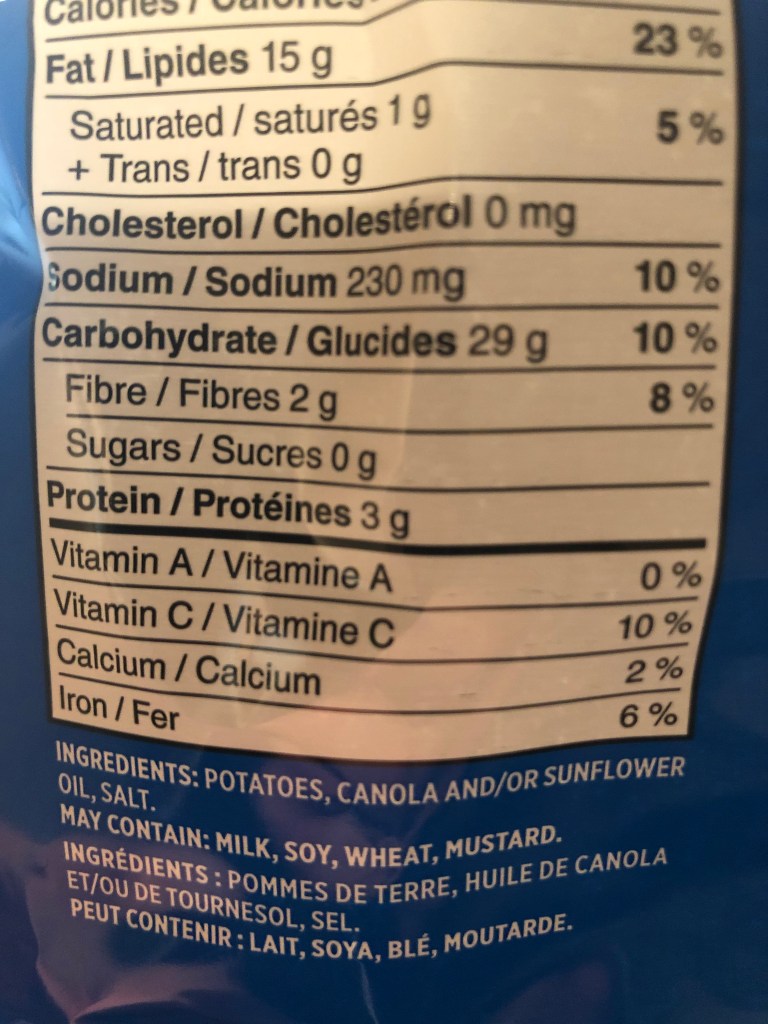
Meanwhile on the back, the total carbohydrate count is 29g
Once you look at the back of the bag, you see that the total carbohydrate count is 29g. If you subtract the 2g of fibre (fibre doesn’t affect blood glucose), that means that every portion of those chips you eat actually carries 27g worth of carbs.
Depending on your insulin sensitivity, that requires a significant amount of insulin. Especially since the average person tends to consume more than the “portion” amount listed on the back of any product. For example, based on my current pump settings, a 27g portion of carbohydrates requires 4.90 units of fast-acting insulin. It can add up quickly, especially if you don’t know to bolus for it.
If you have Diabetes, be sure to check the total carbohydrate count in order to know how to bolus appropriately. More than that, every person is different. Be sure to recognize how long certain foods take to release those carbs into your system. It could mean the difference between getting the right amount of insulin or bottoming out because the insulin outruns the carbs. ☯
I’m not a HUGE fan of modern technology, despite the fact I can admit to being an avid user. Although modern technology has brought us ahead in relation to medicine and research, the effects it’s had on modern society is almost palpable. And nauseating.
After enjoying supper with my family last night (I made Chicken Alfredo, it was quite delicious) I made a quick run to the grocery store. I needed milk and whipped cream for a chocolate pudding dessert I was making. Boy, to hear the recipes I prepare, you’d never think I have Type-1 Diabetes…
Anyway, I consider myself to be something I call a cluster-shopper. What this means is that rather than do a month’s worth of groceries in one sitting, I’ll go to the grocery store every few days instead, sometimes daily, in order to acquire the ingredients we need for our meals.
To make a long story short, going to the grocery store on a Friday evening turned out to be laborious. The grocery store was crowded, and filled with mindless automatons who were more concerned about looking around aimlessly than paying attention to their surroundings. Besides having people in front of me who were walking down the middle of the aisle at, as Ron White would say, “half the speed of smell” and preventing anyone from getting by them, I also had the pleasure of having multiple people cut out in front of me from a cross aisle, make eye contact with me and seeing my hustle, yet slow me to half the speed by coming to a crawl in front of me… FML!!!
It amazes me at how people are so communicative and quick when it comes to their smart phones and devices, yet they become mindless automatons simply going through the motions once they’re out in public. They don’t pay any mind to what’s happening around them, almost to the point where they cause strife in others around them. Their lives revolve around their social media accounts and smart devices, and they run on instinct once they return to the real world. It’s a real shame.
Folks, don’t forget that the real world still exists. You spend the majority of your day in it and there’s a lot to see, despite the fact it isn’t reflected into your eyes by the screen of a device. Take time to appreciate it and pay attention to your surroundings. You may be surprised at what you’ll see. ☯
No… No, it really couldn’t be! I mean yeah, it could be if you look at it from a perspective of, “Wow, I broke my leg! I guess it could be worse; I cold have broken my neck…” But really, how efficient and effective a mindset is that?
It’s no secret that people who say “it could be worse” are a serious pet peeve of mine. I’ve been hearing it all my life, especially in relation to my Diabetes. It’s unbelievable how often I’ve heard people throw comments at me. Here are some of the gems:
“It could be worse, you still have all your legs and toes…”
“It could be worse, you could be blind…”
“It could be worse, you could have heart or kidney failure…”
“It could be worse, you could have cancer…” (my personal favourite, and the word cancer is often interchanged with just about ANY other illness)
Why do people do this? For some people, it’s a defence mechanism. They simply don’t know what to tell you. If you mention an issue in your life and they believe that explaining a worse alternative will somehow make your current predicament better. Your car got totalled in a collision? “It could be worse, your house could have burned down…” As if losing your primary source of transportation suddenly isn’t terrible when compared to the imaginary scenario in which your house catches fire…
In our defence (“our” being the people with Diabetes who talk about it) we become so used to our condition that we often discuss things without realizing that a non-Diabetic may not consider it so normal. Like when I casually mention to someone I just had my bimonthly eye injections. Most times I get disgusted looks and dropped jaws. But it’s become so routine and normal to me, I usually think nothing of it.
But the reality is that even if something COULD be worse, it doesn’t take away from whatever bad or negative situation one may be facing at the moment. Everyone has a story, right? And not everyone may handle difficulty the same way, so it’s important to acknowledge a person’s situation for how they’re feeling it.
Although looking on the bright side is a fantastic perspective for life, trying to explain to someone why their situation could be worse is definitely not ideal. It certainly shouldn’t be said to someone suffering a medical condition, no matter how much worse a different condition may be. ☯
The other night I was broiling some lovely T-bone steaks in the oven… Yes, yes, I can hear all the meat aficionados screaming that a steak is better prepared on a grill. But the reality is that the winter makes such things a little less cozy than I would like. But I digress…
I took the pan out of the oven in order to check the steaks and I noticed that the wire rack the steaks were sitting on had slipped off the pan slightly. I used the tongues I was working with to steady the wire rack, but somehow managed to graze the edge of my middle finger along the side of the pan. I felt a searing pain and dropped the tongues. Clumsy? Probably. Painful? Without a doubt.
We already know that any injury can be made worse and/or aggravated by Type-1 Diabetes. But burns are a particular bastard, because they tend to cause other issues when they happen. Besides blistering and hurting, burns can cause reddening and peeling of the skin, as well as swelling, charring and cause the body to go into shock (depending not the severity of the burn)
According to WebMD, there are three common types of burns.
First-Degree Burns: These are the superficial ones. They can be identified by slight pain, dry skin and redness. These burns usually don’t go beyond the first layer of flesh and can be treated with skin care products like aloe vera;
Second-Degree Burns: These are worse than first-degree burns as they penetrate to a deeper layer of flesh. Second-degree burns will usually blister and can potentially require something a bit stronger, like an antibiotic ointment;
Third-Degree Burns: These are the worst, and will usually result in charred or whitened flesh. Third-degree burns won’t always be painful as they can sometimes be deep enough to burn away nerve-endings that transmit pain. These can often require skin grafts or surgery.
The big problem with burns is, left untreated, they can cause infection and even dehydration. And we all know how much fun THOSE are for someone with Diabetes. Even minor burns should be closely monitored and proper attention paid.
Ultimately, my burn was pretty minor, though it did blister, classifying it as a Second-Degree. But I was able to treat it and it’s already healed. It’s important to keep an eye on any injury and how well it heals when you have Diabetes. If you have any injury, burns or otherwise, that start to turn red and swollen, refuses to heal and shows signs of discolouration, it might be time to visit your family practitioner. ☯
Yesterday was a bit of a hazy day, with temperatures barely reaching the minus teens. Some light snow was falling and the sun was nowhere to be seen. I woke to my wife already on the couch with our newborn son, Alexander. He had been up, off and on during the night to feed.
I was all talk twelve hours earlier, and had bold plans to take the entire family out for the last day of Black Friday sales at Chapters bookstore and some other locations. But once we woke up, the story was much different.
Although my wife had no work today and my older son Nathan woke up when we did, we opted for a lazy morning. I made a solid “traditional” breakfast of eggs, hash brown potatoes and maple bacon (could I BE any more Canadian?) and we sat at the table for a quiet Sunday morning breakfast. Well, my wife and Alex did… Nathan ran off to his room like a butt-hurt teenager until he was hungry enough to scuttle out for his breakfast.
I cleaned up the kitchen after the breakfast I made and watched Batman Begins, which led to me sitting in my rocker for the morning. Once I finished the first movie, I moved on to The Terminal. My wife and I relaxed with coffee in the living room and neither of us did anything. You read that right. We did nothing.
Once the second movie was done, my son Nathan returned to his cartoons and everyone else enjoyed an afternoon nap. We never did make it out to the bookstore… Not particularly necessary in light of the thousands of books my wife and I own. But considering it was a cold, snowy day, it was hardly a wasted day.
Sometimes it feels nice to simply take a day to sit back and replenish your batteries. Apparently it became a family thing, which can also be nice. Although it’s of the utmost importance NOT to allow yourself to become complacent or lazy, there are measurable benefits to occasionally taking a day to do absolutely nothing. ☯
People often don’t take into consideration the very essence of one’s will. The human body is more than just a sophisticated machine, it’s an almost perfect machine, despite our many imperfect uses for it. For the most part, we depend on modern medicine and doctors to fix our problems and rarely take into account our body’s ability to mend and heal just about anything that life has to throw at us.
First, I should start by pointing out that I’m not taking anything away from the people who have suffered and even succumbed to the the effects of any illness. Despite the point I’m trying to make here, sometimes the body can only take so much. And I’ve seen a lot of that in my life.
For the past twenty years, I’ve been friends with a guy who is about ten years younger than I am. His father, who was also Type 1 Diabetic, was about ten years older than I am. A bit of a strange scenario, as it kind of puts me in range to have a reasonable friendship with either party.
The father spent his life living with nothing but positivity in his heart. He and his wife had only the one son, and he spent his life living the way he wanted to. However, he suffered from many complications normally associated with Type 1 Diabetes. He had heart problems, vision problems and suffered amputations on both of his legs.
On the negative side, he was a very sedentary man… Reasonably overweight, never exercised, ate like a trash can, smoked and drank heavily; none of which are good components for healthy Diabetes management.
Towards the end of his life, he had lost both feet, suffered severe failure to his eyes and cardiovascular systems and no longer had any measurable control over his Diabetes or his life. Sadly, he passed away in 2014. I don’t know what the exact cause of death was, but given all his complications it could have been anybody’s guess. Such is the Diabetic life…
The passing of my friend’s father was devastating, not only to him but for the fact that it’s usually an awakening to people with Type 1 that perhaps they need to take a look at themselves and examine what they’ve been doing to maintain their health. So, what makes me different from the many folks who seem to struggle and fight so hard against the ravages of this condition?
I was diagnosed with type 1 Diabetes in 1982, right around the time I started kindergarten. Although insulin and other therapies were in existence in the early 80’s, I was lacking in several key areas that could have changed the course of my life from the very beginning. I had just joined the Beavers (before anyone decides to be funny, the Beavers are a pre-cursor to the Scouts) and my school life was still raw and new.
My teachers did what was expected of them, they explained to the class that I was “special” and that if anyone saw me acting strangely or appearing to be ill, she should be told immediately. Great. Thanks, teach! You just set me apart from the pack and ensured I was a loner for the foreseeable future. Fantastic. I had to drop out of Beavers because I was still in a stage where I didn’t have control and proper management of my blood sugars and I was left vulnerable.
If I hadn’t taken my life in hand and started taking steps towards improving my health, I likely would be in same boat as my friend’s father. Certainly, I suffered from insulin resistance and a number of Diabetes comas. But at some point early on, I decided to make some drastic changes, even at a young age. I started to focus on fitness and health. I got into the martial arts. I studied and got on board with nutrition and eating better. I made a difference in my own life.
Through my own will, despite being told I wouldn’t live beyond my teens, I improved my health and have managed to reach my 40’s without any loss of neural function, clean cardiovascular system and strong blood glucose management. Am I so different or better than anyone else? Of course not, I’ve simply chosen not to lie down and let my condition take me. And that’s something any of us can do.
I repeat it in most of my posts, but the important things in life are eating well, exercising often and be willing to always learn something new. New treatments and therapies keep coming out and you have to stay on top of them. Most of us always say that we don’t expect to see a cure within our lifetime, but life is strange. One truly never knows. But how this all plays out is totally in your hands.
Do I acknowledge that my life has been shortened by a decade or more from Diabetes? Do I understand that this condition may debilitate me or render some of my organs useless? Sure, I do. But it doesn’t mean I have to go down easy. If my time comes because of Type 1 Diabetes, it will be because I fought the good fight until the very end.
I encourage you all to do the same. Whether you have Diabetes or not, the lethargy and sluggishness that life breeds doesn’t need to have a hold on you. Through your own strength of will, you can change the course of whatever may have a hold on you. ☯
Parenthood is a blessing (I can picture most parents making a squinty face as if to ask, “Is it though?”). It definitely is. On the one hand, you get to experience watching this tiny version of yourself grow and develop to become their own little person. They develop their own tastes and personalities and they also ensure our perpetual immortality through the continuation of our DNA. As I look down at my oldest son, who kindly spilled some mio-infused water on my carpet just now, I realize that they’re also little demons that are sent to punish me for all wrongs I’ve committed, known or otherwise. But once again, I digress…
But the purpose of today’s post is actual children’ inability to eat what’s in front of them. As I’m sure any parent knows, most kids have a hard time blindly accepting the food in front of them. A lot of different factors will play into why they won’t eat what’s provided, but it causes strife and difficulty for the parents who are trying to keep their kids nourished. Allow me to provide an example.
Yesterday was my oldest son Nathan’s fifth birthday. We had planned a fun supper idea involving stuffed crust pizza (his favourite) and we had purchased a rather large, colourful slab of white cake in which to enjoy afterwards. He had a number of gifts coming his way from my wife and I as well as a number of relatives.
Loads of fun, right? Not so much. It seems that while I was out at work, my son was offered a small portion of slow-cooker chicken and mashed potatoes for lunch. He took one look and refused to eat it. Although this isn’t totally unusual for Nathan, it’s still a source of great frustration for my wife and I, especially since he hadn’t even tried it before dismissing it.
My wife and I have a simple rule: you WILL try your food. I totally get that he may have tastes of his own, but we refuse to unnecessarily waste food in this house, so while we can promise that we won’t necessarily make that meal again if he doesn’t like it, we still insist that he eat some on the first occasion that it’s made. Sounds reasonable, doesn’t it? Not to Nathan.
Once he refused to eat his lunch, the usual penance was invoked: no other food would be provided until he ate what was in front of him. Although that might seem cruel a punishment for a five-year old, it ensures that our son will grow up learning the value of what’s provided, rather than the “flavour of the day” attitude that seems to exist in today’s society.
Here’s the hiccup in our plan: that penance means he wouldn’t get his stuffed-crust pizza OR any of his birthday cake… ON HIS BIRTHDAY! The threat of that didn’t seem to sway him at all, despite being repeated. The stubborn little mini-me was sticking to his guns and wouldn’t fold. I should point out that this was definitely a punishment to me as well. So, why the hell are kids like this?
The reality is that your child isn’t refusing or being picky because he’s trying to be an asshole. At least not in most cases. But there are a number of reasons why your child may be as picky as he/she is in relation to their food. For the most part, the texture and/or colour of certain foods may throw them off. We need to remember that young children view the world in a significantly different way than Mommy and Daddy do, and some things may look “yucky” despite being absolutely delicious (my slow-cooker chicken was delightful, by the way).
Jill Castle, a registered dietitian and childhood nutritionist, explains that between the ages of two to about six, children become picky eaters because their growth begins to slow for a period of time and so will their appetite. Castle goes on to explain that “food neophobia”, or fear of new food, can cause young children to be wary of trying new foods and vegetables, often based on texture, colour or appearance. In fact, forcing or demanding that your child eat may only reinforce this behaviour as young kids are usually not game to being coerced into ANYTHING (and my son is no exception).
Some children are also “Jag” eaters, where they eat a handful of typical and repetitive favourites without leaving room for anything new. Tuna and peanut butter (not together) are Nathan’s go to foods. Although they may not be eating a variety of foods we’d like to see them eating, they’re eating enough based on their hunger and requirements. They may also be distracted (I’m VERY guilty of this) where you allow your child the use of an electronic device or toys at the dinner table. This takes away from their focus on the food in front of them and may have a negative impact.
Realistically, there’s no easy answer as every child is different. All one can do is show the proper example and offer lots of food varieties and eventually your kid SHOULD get on board.
So, what happened with Nathan’s birthday, you ask? Of course the little booger got his damn pizza and cake! What am I, heartless???
Nathan with his birthday cake. Look at those icing balloons!!!
My wife and I agreed that Nathan’s birthday only comes once a year, and it was more important that he celebrate that, and the rest could come tomorrow. And I think this was a good call, as everyone had a great time with Nathan and shared his joy as he enjoyed his cake and played with the toys he got for his birthday.
Stick to a schedule, keep offering lots of options and eventually, your kid will outgrow the pickiness that drives all parents nuts! ☯
The past decade or two have unsurprisingly (given the state of the world) yielded some really strange social trends. Anyone with a modicum of common sense usually looks at these so-called “challenges” and wonders if it’s truly time to lie back and give up on the society.
If we look back as far as 2001, they came out with something called “The Cinnamon Challenge”. This ludicrous trend, which began pre-YouTube, involved the swallowing of a tablespoon of dry cinnamon powder, without the help of liquid. The big problem with this challenge isn’t just the difficulty, but the damage it could cause to your lungs through gagging, asthma attacks and choking. Not to mention that cinnamon contains an chemical similar to formaldehyde and is basically composed of ground up tree bark. So THAT’S what your possibly inhaling. It gained further steam for a while in 2006 when it finally hit YouTube and people started posting it.
Fast forward to more than a decade later, and they came out with something called “The Tide Pod Challenge”. Just to clarify, when I say “they”, I mean a generation of people who don’t seem to have anything better to do and don’t seem to understand the value in picking up a good book or getting a workout in. But I digress…
The Tide Pod Challenge simply involved putting one of the laundry detergent pods in your mouth and chewing on it. Yes, you read that right: LAUNDRY DETERGENT PODS!!! Friends would film you doing it, and possibly get some laughs as spit out soap bubbles and such. The problem, besides being stupid enough to put one in your mouth, is that some people would end up swallowing them, intentionally or accidentally. Considering these bad boys are made of laundry detergent, they’re caustic, toxic and can wreak havoc on your lungs and digestive system. And that’s just a start.
Sometime after Tide Pods were no longer the flavour of the week (see what I did there?), they came out with “The Condom Snorting Challenge”, which involved sticking a condom in your nostril while plugging the other one, inhaling it into your nasal cavities and reaching into your mouth to pull it out of your throat. Considering most people have difficulties using condoms the way they were intended, I can’t imagine why they think THIS is a good idea… The problem is that the condom can become trapped, block off breathing passages, be inhaled into the lungs and cause infections, sepsis and a score of other medical complications.
Really, internet? Most sources agree that the big problem behind all these “trends” is that they’re dare-based and today’s society thrives on how many likes, views and clicks one can get. Some people even make an income through their use of social media, so it’s not surprising that some of this happens. Although I can’t help but feel that this is Darwinism hard at work…
Now, on to my colourful title. Given that the month of November is almost done, I’l cover this one off. Many people have chosen to participate in a challenge called “No Nut November.” It’s pretty straight-forward: it’s simply going without ejaculating for the entire month of November. Although this seems like a pretty benign challenge and we can all agree that having some restraint is good, there are some dark aspects to this one as well.
First of all, there has been no scientific or medical evidence that shows that “going without” for a month has any measurable benefits for the body whatsoever. The opposite however, is that it can improve sleep quality, lower risk of prostate cancer and heart disease in men and can also boost the immune system. Fatherly.com has a good article that outlines all of this: https://www.fatherly.com/health-science/no-nut-november-is-bad-for-men/
But No Nut November can cause certain anxiety and stress issues, cause strife and difficulty in relationships and remember that preventing prostate cancer thing? You lose that benefit if you lose your happy ending…
I focused on this last social trend because it provided me with an entertaining title for today’s post, but the truth of the matter is that due to the popularity of online dares and challenges, we’ve likely not seen the last of this sort of thing.
Folks, pick up a book, go for a walk, spend time with friends or family… Any of those things will provide a much more fulfilling life and provide you with more benefit than getting a heavy number of views for possibly harming yourself online for the sake of some likes! I can’t change the world, but I can guarantee there may be a special school of the military sort waiting for either of my sons, should I ever hear they snorted a condom or ate a Tide Pod. ☯
I hear a lot of talk about the benefits of “natural” products over artificially made products. This is usually followed by some rant about how chemicals are bad for the body and such, and it often leads me to wonder: what exactly do people think a chemical is?
By simple definition, a chemical is simply the combining of two or more elements, either naturally or by artificial means. In fact, just about everything in existence is composed of chemicals. One of the best explanations I’ve found is in an article written by the Science Learning Hub, where they explain: “Matter is everything around you – whether it’s liquid, solid or gas. Atoms are like individual LEGO blocks. […] Matter can also be called a chemical. So if atoms are LEGO blocks, chemicals are the structures you can build with them.”
In fact, some of the most simple things we use in our daily lives are chemicals. One good is example is water. Believe it or not, water is a chemical. It’s called a “pure” chemical because it’s the same throughout its entire structure.
The above-mentioned article goes on to explain that the only difference between synthetic and natural chemicals is that the synthetic ones have been made by people through artificial means. But if we were to artificially create a chemical found in nature, there would be absolutely no difference between them. I’ve kept it pretty simple, but the article touches on a lot of other aspects and can be read here: https://www.sciencelearn.org.nz/resources/363-chemicals-everywhere
The bottom line is that we need chemicals in order to live. Especially since EVERYTHING IS MADE WITH THEM. Whether they choose to acknowledge it or not, even the people who claim that they’re “living naturally without the use of chemicals” are using chemicals. I don’t assume that they’re washing themselves and keeping themselves hydrated with rainbows and dreams!
Being natural or synthetic doesn’t make a chemical bad. In fact, there are some very dangerous and deadly chemicals that can be found in nature. Things like arsenic, urushiol (poison ivy) and snake venom are all chemicals found in nature that can harm or kill you.
In closing, this would be a good time to remind everyone that insulin is a chemical and that 415 million people world-wide would be dead without it. As with most things in life, there’s good and bad to everything. Chemicals are just one example. ☯
It never fails. You get up from a less-than-satisfying night’s sleep. Perhaps your blood sugar levels are low, or you have some unknown secondary illness, like a cold or a persistent cough. You stagger into the kitchen and you prepare yourself some food in order to bring back some vestiges of normalcy, when an interfering lump of 4-year old waddles in and sticks his nose into the food your making. The conversation usually goes like this:
KID: What are you doing, daddy?
PARENT: I’m making food, pal. Do you want some?
KID: (sniffs your food experimentally) No, I don’t like that stuff!
PARENT: Do you want anything else?
KID: No…
PARENT: You’re sure…?
KID: Yeah! (kid runs off)
You walk away with your plate, satisfied in the fact that you covered the bases and that you’re in the clear. You test your blood glucose and bolus with a dose of insulin specifically measured for the food on your plate. Your pump responds and starts pumping the life-sustaining medication into your subcutaneous tissue and you start enjoying your meal. Then, the 4-year old lump returns and eyeballs your plate. The second conversation usually goes like this:
KID: Mmmm, that looks good… (reaches for my plate)
PARENT: Hold it, buddy! That’s daddy’s food!
KID: But I want some…
PARENT: I asked you if you wanted some earlier, and you said no!
KID: But I want some now… (lip starts quivering and a meltdown is imminent)
What do you do? Considering children of this age are often picky eaters to start with, it’s a little difficult to refuse them when they actually WANT to eat! You can either buckle down and refuse, potentially forced to deal with the meltdown that will ensue. Or you can surrender your food and deal with the aftermath on your health, blood sugar levels and let’s be honest… your sanity.
It’s difficult to weigh the best option; especially when it affects your personal health. I’ll admit to surrendering my food since, in my state of perpetual exhaustion I prefer to scavenge for something else to replace the carbs I’ve given up than deal with prospect of trying to eat my food WHILE having a persistent child drooling over my shoulder. Maybe not the BEST way to approach it, but I’m a martial artist, not a child psychologist.
The challenge is when he takes only a portion of what I have, making it all the more difficult to balance and measure how much food of another type I require to replace the lost carbs. Or what I hate the most is to have him take some of my food and leave me to scramble for something else to eat before my blood sugars start lowering to that point of no return, only to discover the plate with almost the entire uneaten portion sitting on the table because he once again decided he didn’t like it. But I digress…
The food analogy (although the most frequent) is only one example. Children provide an issue for Diabetic parents on many fronts. I remember that when I started on my insulin pump, my son was barely more than a year old. As time went by, issues needed to be addressed in relation to recognizing daddy’s “ouchie” and staying away from my tubes and buttons. Not an easy task for a small child as the temptation is great when they see a small device to play with. What’s been even harder is trying to convince your child that, daddy isn’t eating candy because he WANTS to, he’s eating it because he HAS to and it isn’t sharing time.
I was rather lucky in the sense that I was diagnosed with Type 1 Diabetes at roughly the same age as my son is now. As strange as that may sound, it was lucky because I’ve never known any different and I was able to grow with my condition and learn to respect it without allowing it to control me.
Conversation and education is important for children. Although they may not be able to understand absolutely everything happening to you, explanations and reinforcement of the rules can mean the difference between maintaining yourself or having your infusion set accidentally ripped out. ☯