Have you ever heard the saying that you should never go to bed angry? Of course you have! Most people at some point in their adult lives have heard that saying. It used to be an important staple of relationship advice and previous generations stuck to it like glue. In fact, it’s even quoted in the Bible. Don’t believe me? Check out Ephesians 4:26 and tell me that Paul wasn’t talking about this exact thing.
Realistically, trying never to go to bed angry is an outdated and archaic way of looking at things. And it doesn’t just refer to marriage. It applies to most relationships, regardless of their nature and/or type. There are some sources that explain that going to bed angry can actually be helpful.
According to an article posted by Psychology Today, people tend to fight over nothing when they’re tired. They’ll even fight over issues that wouldn’t faze them if they were well-rested. The worst part is, resolving whatever the issue is winds up being more difficult due to the fatigue. The same can be said of trying to resolve a problem when you’re hungry.
Going to bed while you’re still angry is not only a good idea, it can lend some significant benefits. The fact is, you’ll likely be rested, refreshed and able to approach whatever got your hackles up with a renewed perspective. You may avoid saying something stupid because you were too tired. And as I said earlier, this applies to all relationships.
There are days when my 5-year old makes me angry as hell. Strange how kids can get under one’s skin sometimes, right? Rather than lose my temper and yell at him, I usually prefer to distance myself and let him go to bed. Once I’ve got a proper night’s sleep (or some close approximation) I can deal with the previous night’s issue with a better frame of mind.
The old school way of thinking isn’t always wrong; this just happens to be one of those times when it falls short of what’s necessary. So when tempers flare, don’t be afraid to take a step back. After all, “sleep on it” may be more beneficial than “never go to bed angry.” But what do I know? I’ve never fought with my wife before bed. ☯
Developing yourself and reaching a goal can be difficult. Especially when you don’t allow yourself to have a strong frame of mind or proper perspective. Having a partner when you work out can be extremely helpful, as I wrote about in a previous post It Takes Two, Baby…🎶. But although having someone there to spot you and motivate you can be quite the benefit, you need to allow yourself to have a correct frame of mind behind your workout.
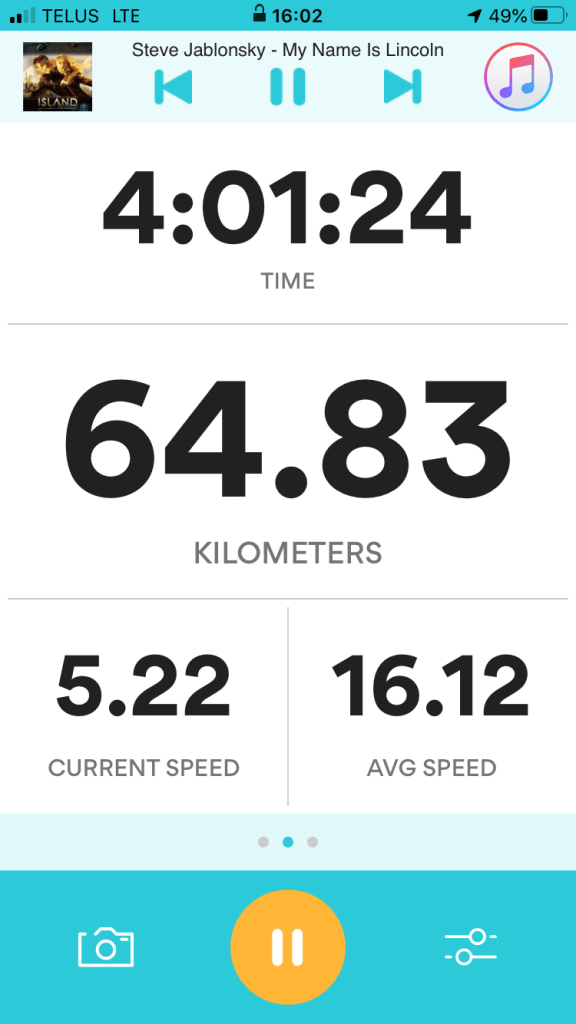
The distance I achieved yesterday
A friend of mine recently pointed out something important as it relates to fitness. Let’s say that you’re trying to lose some weight. You intend on climbing the nearby mountain with a partner, which is not only smart for safety reasons but can motivate you to push further in order to keep up. As you start climbing, you begin to feel tired. Your body is having difficulty continuing due to the excess weight that you’re trying to shed, and you feel compelled to stop.
Perhaps you tell your partner you need a rest. Or perhaps you tell them you can’t go on. Maybe you surrender to your body’s urge to have you sit down and give up. A terrible thing to allow, especially if you’ve set yourself some fitness goals that can be important for your health. For someone with Type-1 Diabetes, this can be a common occurrence, since fluctuating blood glucose levels can have the unfortunate side effect of making a person groggy and sluggish.
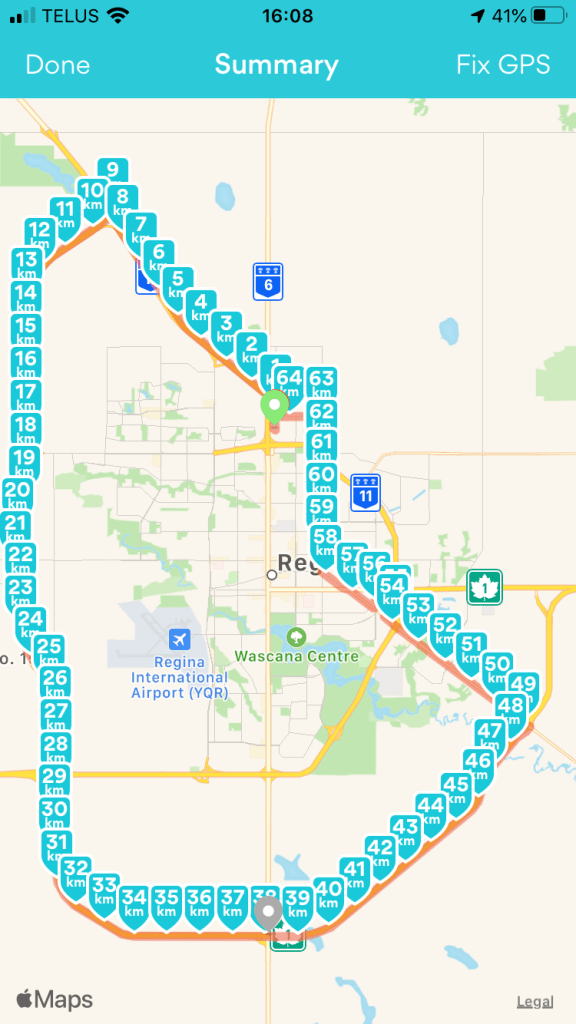
Yesterday’s route around the Regina Bypass
As I’ve often mentioned before, it’s important to ask yourself why? What is the reason behind your motivation? Your body should and will give out, long before you do. Why do you think people listen to music when they work out? It’s not simply for their love of it, although for some I would believe that’s included. It’s because music motivates us (and in some ways, distracts us from the physical exertion we’re going through).
This is why it’s so important to motivate yourself and stay positive. When I started cycling for fitness this year, I would get home after about a dozen kilometres and my legs would kill, I’d be exhausted and I would feel like total crap. But as you can see from the images above, the day before last saw me hit 65 kilometres. And yes, when I got home my legs killed, I was exhausted and dehydrated and needed food. But I can promise that a dozen kilometres now seem like a trivial amount, and I can do it quite easily in only about half an hour. This is something I wouldn’t have imagined when I started.
Sometimes it’s better to take things in small increments. If I’d hopped on my bike and tried to reach 60k on one of my first times out, I likely would have floored myself and became discouraged. But by staying consistent and building myself slowly, I’ve been able to keep building and developing how far I can go. The same can be said of martial arts or any fitness regimen that you may be attempting.
Let’s get back to our friend who’s attempting to climb the mountain. When exhaustion sets in and you feel like you can’t go any further, there’s no shame in taking a breather. But then, look ahead and spot a point further up the trail and tell yourself, “I can push at LEAST until that tree…” Then go for it. Once you reach that tree, maybe you’ll need another breather, maybe you won’t. But fix yourself another short goal and strive for it.
I think it was a Navy Seal that I had seen years ago, who described taking his training in steps, from day to day. At the beginning of the day, he would tell himself to simply get past breakfast. That’s it. Once this period had passed, he would focus simply on getting through the afternoon. Nothing more. With each piece of the day’s puzzle reached, he would be able to shift his focus and move on to the next, thereby guaranteeing he would make it through the day before hitting the rack. If he were to focus on completing the entire day, he would likely become discouraged and lack motivation. This is a concept that anyone can apply to their daily routines.
The idea is to allow yourself the time to grow. Have a positive and motivated perspective and you’ll go much further. If your thoughts are negative as soon as you begin, you’re sure to fail. how can you be motivated if you’re already defeating yourself? But if you focus on the positive, music, goals, health benefits, perhaps the scenery that surrounds you as you climb, you’re more likely to push farther and accomplish more.
Your own health and fitness is important; critical to your survival, really. And the proper mindset is what will help get you there. For someone with weight issues or Diabetes, staying fit and healthy can mean the difference between life and death. This is one of the reasons I push so hard. Life has too much to offer to lay down and die sooner than necessary.
And Diabetes or not, death will take me. Of this, there is no doubt. But I can promise two things: Death will lose ten pounds in sweat trying to make it happen and he’ll lose a mouth of teeth in the attempt. I intend to go down fighting. (Gee, that would make a great t-shirt) ☯
Washing one’s hands has become a popular topic of most conversations regarding personal hygiene in recent years, and it still surprises me how many people go without washing their hands frequently and especially after prepping food, using the washroom or contaminating one’s hands with something potentially painful, like hot sauce!
I’ll admit I’m usually guilty of this, at least a couple of times a month. I’ll prep a plate of nachos with cheese, varying ingredients and hot sauce and sit on the couch to watch a show or a movie with my wife. I’ll be snacking away, happy and content with the deliciousness of my nachos when, all of a sudden, my eye will itch. Absentmindedly, I’ll reach up and rub my eye. Within seconds and for minutes after, my eye is a fountain of tears and irritation as the hot sauce residue teaches me the importance of washing my hands before touching my face.
I wish I could say I’ve learned my lesson, but I unfortunately repeat this vaudeville routine on a regular basis. One of the main ingredients in most hot sauces is capsaicin, related to capsicum, which is the primary debilitating ingredient in pepper spray. And I rub that shit into my eyes on the reg… Are you sure y’all should be listening to ANYTHING I say? But I digress…
The reality is that your hands carry a shit-ton of germs. And yes, that pun IS intended, considering fecal bacteria is the most common thing on your hands, your phone, etc… Most people don’t wash their hands properly, and many that do fail to scrub up for as long as is necessary for proper hygiene. The big problem is that we use our hands for everything. We touch our faces, eyes, nose, mouth… often without even realizing it. And whatever nasty bugs we have on them will find a good home in any of those openings.
The next problem is that failing to properly wash one’s hands can lead to the propagation of those germs. By using our hands without properly washing them, we can potentially transfer germs and bacteria to food we prepare for our family or directly onto our children as we hug them and seek to protect them. And looking back on the funny story about putting hot sauce in my eye, there is another very unpopular condition that can be caused by dirty hands: pink eye!
Pink eye, or what’s known as infectious conjunctivitis, is usually caused by viruses but can also be caused by bacteria; such as the ones found on unwashed hands. I’ve been fortunate enough never to have pink eye, but it doesn’t sound like a spa treatment! And washing your hands regularly and frequently can go a long way towards helping to prevent it.
So, good hand washing practices are important, especially to help maintain proper health. Diabetics especially don’t need the added potential for germs and bacteria to cause infections and complications that could make us ill. The biggest challenge is trying to teach children. Trying to convince my 5-year old son why he has to go wash his hands before he eats, sleeps, touches the baby, etc is a battle unto itself…
Be sure to get your hands completely wet, scrub thoroughly with warm/hot water and soap for at least 20 seconds or more. Do this every time you’ve handled raw foods, did work outside, shook someone’s hands and especially after any and all bathroom use. And yes, you CAN overdo it. Washing your hands TOO much will scrub away oils needed to keep the skin healthy and cause dry, itchy skin. But you’d have to go a long way to reach that point. ☯
Yesterday, I wrote a post about the importance of meals and which of those meals is the most important (despite all of them being important). One of the points I made towards the end, is that it’s important to stop eating at east a couple of hours before you hit the sack, otherwise your body is busy digesting and processing foods instead of what it’s SUPPOSED to be doing during sleep.
As a follow up to that post, I thought it might be interesting to examine and discuss exactly what the body IS doing while we sleep. For the purposes of today’s post, I won’t get into all the “brain stuff” like REM sleep and sleep cycles. Rather, I’d like to focus on the physical aspects that take place within your body while you’re dreaming about that log cabin on the lake that you plan to retire to…
Let’s start with some of physiological effects… According to a list posted by WebMD, your body temperature will drop during sleep and your breathing will deepen and slow. Your heart rate will fluctuate, but non-REM sleep will lower your pulse and blood pressure, allowing the heart and blood vessels to recover. Deep sleep cycles are where the body takes advantage to repair muscle and other tissues, as well as release chemicals that strengthen your immune system. Ever wonder why you need “rest” and sleep when you’re sick? That would be why.
While you sleep, your brain sends out messages to keep you from acting out your dreams. Essentially, your brain paralyzes you while you sleep… (because THAT doesn’t sound horrible!) During sleep, growth hormones increase and stress hormones decrease. There’s also a whole mess of stuff that happens with other hormones as well.
Sleep not only allows your body the opportunity to heal and repair tissues, it also allows your energy to be restored to face the following day’s challenges. Not to mention that your brain processes and stores information and possibly creates long-term memories during sleep. Not to mention eliminating toxins and waste from the body, which is why (outside of drinking too much water before bed) most people dash to the washroom, first thing in the morning.
So just imagine that with everything the body takes care of during your sleep cycle, combined with the fact that your metabolism slows down, you pile a bunch of food on top of it all to be digested right before going to sleep. Eating right before bed can cause heartburn, indigestion and can have an effect on your weight, since the improperly digested calories will likely be stored as fat.
Sleep is super important, and there’s a whole frontier of mystery behind it, as scientists are still uncertain why we have specific sleep cycles, why we dream and what some of the brain activity involved in sleeping is meant for. But one thing is for certain; not getting an appropriate amount of proper sleep can be disruptive and harmful to the body’s natural function. So, hug your pillow tight! Even while you’re at rest, your body continues to work. ☯
Mornings suck… I mean, you’re entitled to your opinion if you believe this to be false, but I dislike waking up in the morning. Maybe it’s because I never get a genuine full-night’s rest from my sleep, for various reasons. But getting up in the morning leads to certain routines that most people adhere to. Things like brewing/consuming coffee and perhaps having breakfast.
Now, I’m not a nutritionist or a dietitian and I have no formal training in those areas. I function solely on the personal knowledge and study I’ve accumulated over decades due to being a Type-1 Diabetic. And I will allow myself a brief vulnerability and admit that I’m probably one of the worst people for failing to consume what is generally considered the most important meal of the day: breakfast!
I grew up in a household where breakfast was not only considered the most important meal of the day, but it was mandatory. I have memories of my mother almost physically dragging me to the breakfast table during those awkward teenage years when all you want to do is sleep. There was no way I would be permitted to leave the house without something in my stomach.
The main idea is that eating breakfast within an hour of waking up helps your body to get the sustenance and energy it requires to attack the challenges of the day. Your body’s metabolism is usually at its lowest upon waking, which is why you need the nutrients and energy from a well-balanced breakfast to kick things off. Skipping breakfast and/or the first meal of your day can have negative effects on your body.
According to a paragraph in an article by Science Direct, “[…] the failure to eat (a well-balanced) breakfast has been documented to have a deleterious impact on cognitive performance […]” The takeaway is that trying to start your day without food in your system will affect your overall cognitive functions and impede your overall performance.
WebMD seems to agree as a quote from their webpage states, “Skipping the morning’s meal can throw off your body’s rhythm of of fasting and eating. When you wake up, the blood sugar your body needs to make your muscles and brain work their best is usually low. Breakfast helps replenish it.” The article goes on to explain that skipping breakfast can lead to feeling drained and “zapped” of energy throughout the day, an effect I can attest to have suffered from on a number of occasions.
I’ll admit that I’m quite guilty of this. My first actions in the morning usually include grabbing the first available source of caffeine and flopping down into my desk chair and working on this blog… Thoughts of food don’t hit me until close to lunchtime, by which time I’ve become hungry enough that I overeat. This is an issue that I’ve gotten into a habit of stemming by eating a simple english muffin with my coffee.
What you eat for breakfast is often as important as whether or not you choose to consume breakfast. A balanced meal of proteins, grains and dairy will help ensure your body gets the necessary “kick” it requires to make it through the day. On the flip side, if you constantly consume a breakfast heavy in fats and processed sugars like popular name-brand cereals and bacon, you may start the day with a full stomach but you may also be doing damage in other ways. So, be smart about what you eat and when (something that WOULD require the advice of a nutritionist or dietitian)
So if breakfast is the most important meal of the day, is there a LEAST important meal? The short answer is no. All three meals, accompanied with light, healthy snacks in between, are all just as important in the grand scheme of your health. That being said, lunch can be a bit on the light side, with an accompanying snack during the middle of the afternoon. Dinner (or supper) may end up being a substantial meal as it’s statistically the one we have at home with the family and is prepared to be larger to accommodate everyone. But there’s no hard and fast rule to this.
The one important detail to remember is that no matter what meals you partake in and what time you enjoy them at, experts agree that you should stop eating a minimum of a couple of hours before bed so that your digestive system has time to process your food before you try and sleep. Once you go to sleep, your body is meant to fast as it works on rejuvenating itself for the day to come; something it can’t do if it spends half the night digesting your buffalo wings from your Netflix binge!
Eating your meals at proper intervals will also help with proper blood sugar control if you have Diabetes. Maintaining a proper routine and healthy diet is always the optimal choice in order to help prevent spikes or drops in blood sugar. So, there you have it! If you grew up through the 80’s like I did and constantly heard commercials on Saturday morning about starting your morning with a healthy breakfast, that rule is still a reality today.
For myself, I usually end up skipping breakfast in favour of sleeping in for that added twenty minutes and rushing off to work. But the reality is that most studies will show that getting up a touch earlier and having a proper breakfast may go farther towards ensuring you’re awake and alert than hitting the old snooze button. So take time to grab a meal before facing the world. It always looks better on a full stomach. ☯
I hate being interrupted. Honestly, it happens in all aspects of life; there’s simply no getting around that. With children, work and daily obligations, interruptions to ANY task I may be doing is a common occurrence. And I’ve honestly come to expect interruptions and even become concerned when I’m not interrupted. This usually means that my son is up to something… (he’s literally pestering me for food as I type this sentence)
A good example is the fact that between the first paragraph and this one, I’ve been away from my keyboard for about twenty minutes making waffles for my son and trying to figure out why my Roku stick won’t play his damnable shows…(Burn in hell, Peppa Pig!) But the good news is with something like a blog, I can stop typing to deal with whatever the interruption may be and return to it once I’ve gotten clear. But what about something like working out? Can you stop your workout and come back to it, later on?
Life isn’t a stopwatch. There’s no way to pause time and restart it once we’ve gotten past whatever may be in the way. There are a finite number of hours in the week, and focusing on one’s fitness amidst needy children, work, chores around the house and anything else that may come along can prove to be difficult. How effectively can your fitness plans be instituted into your daily life in these conditions?
According to a blog post on Strong Mommas, there are four valuable tips to dealing with interruptions to your fitness routine. You can click the link to get the full details from the post, but I’ll synopsize these tips here, based on how I deal with things. There are only three tips listed in my post because #2 and #3 in the linked post are basically the same:
Workout when you’ll be least interrupted. This can be a bit difficult, depending on your lifestyle and what job you have. The article describes the writer finally “sucking it up” and waking up at 5:30 in the morning to wake up. Screw that noise! I’m not a morning person to start with, so that’s the LAST option I would entertain. But it happens to be a period where the writer can guarantee she won’t be interrupted, so it works for her. Cycling workouts are best for me, as they happen to be outside the home. But even this gets interrupted, depending on what I have going on at home. If you have a period of the day where you may have some peace and quiet, this should be when you go for it. I agree on the writer’s last thought on this point, that working out during late evening when the kids go to bed can be rough, especially since you’ll likely be tired as well;
Pick up where you left off. If your workout gets interrupted and you find yourself freed up, there’s nothing wrong with coming right back to it. This sucks, since you’ve likely cooled down while taking care of whatever caused the interruption. If you can get back to it within 15 minutes, you should be good to go. Depending on how much your body has cooled down, you may have to warm up again before resuming your workout. This will depend greatly on how tight your muscles feel and is subjective to the person working out. If you’ve barely reached halfway through your set, just start the set from the beginning;
You may have to surrender and quit the workout. There’s a chance that depending on the workout and what the interruption is, you won’t get the chance to return to your workout. That pisses me off to no end and stubbornly, I often don’t include these instances in my logs. But as most fitness experts would tell you, doing anything is better than doing nothing.
If you’re anything like me, you should PLAN on being interrupted. Whether it’s a phone call, a child’s needs or anything else in the household, you can almost be guaranteed that your workout may be interrupted. I’ve found that what usually works for me is doing a shorter workout. Working out for only 30 minutes significantly increases the odds that you’ll get through your sweat before being stopped or interrupted. That being said, it also depends on what type of workout you’re indulging in.
The important thing to remember is to roll with the punches and not let it discourage you or stress you into NOT working out. You can exercise literally anywhere at anytime, so this is a pretty good flexibility when all things are considered. Look for opportunities and take advantage of whatever may be in front of you. For example, whenever I go for my eye injections in the city, I always walk from my hotel to the hospital, then back. It’s not an intense workout, by any means but it gives me the better part of over a kilometre of walking, which is better than nothing.
To be honest, I’m a creature of habit and routine, and I absolutely despise having said routines disrupted by anything. So I usually have to work pretty hard at not letting the anxiety levels rise to ridiculous levels. For example, while writing this post I was interrupted at least a half dozen times by the varying members of my family and their need of my assistance. Like I said, it’s GOING to happen, there’s no getting out of it. So plan accordingly, stick with it and keep pushing forward, no matter what the grind of daily life throws in your way! ☯
Although frequently misquoted, Bruce Lee continues to be a source of knowledge and inspiration to many people, martial artists or not. In my opinion, one of the best quotes he’s ever come up with is, “Do not pray for an easy life, pray for the strength to endure a difficult one.” The lesson there is pretty simple; life isn’t MEANT to be easy. Humans, as a species, would not have evolved if life was all comfort and ease.
Finding your inner peace in the midst of modern life isn’t easy. It’s made all the more difficult through recent developments that see most families isolated inside their homes together for extended periods of time. It probably SHOULDN’T be like that, but the reality is that everyone needs a bot of time alone, sometimes. Letting your head cool and finding time to be alone and to mediate can be challenging, even frustrating. This leads to an endless cycle of frustration feeds lack of peace, lack of peace increases frustration and so on and so forth…
I’m sure you’ve heard people say that life is what you make of it. And while this is true, you need to acknowledge that your life is YOUR life and that one often needs to adapt in order to find that inner peace that is so needed to make life work. That’s why there should always be a bit of time in every day that you take for yourself. It doesn’t have to be long or measured in hours, but every member of the household should be able to enjoy a bit of solitude in order to centre themselves.
For my 5-year old son, this means sprawling in his bed with his iPad and watching Paw Patrol or Hello Ninja on repeat until he decides to go outside and try to reenact what he sees on screen. For my wife, it involves doing digital puzzles. For me, it involves finding time/space to meditate or go out on a bike ride. The bike rides have won over the most in recent weeks, especially since I’m trying to build my tolerance for long distances.
Wayne Dyer once said, “Peace is the result of retraining your mind to process life as it is, rather than what you think it should be.” If you wait until life is exactly how you want it in order to find peace, you may be surprised at how empty and shorter your life will be. Accept what is and make a point to find your own peace within your daily life. You and the people in your environment will be all the better for it. ☯
One of the least discussed but most common issues with adult Diabetics, is complications in relations to sex. Realistically, whether you have Type-1 or Type-2, having Diabetes can cause some difficulties in relation to intimacy and sex, and it applies to both men and women.
It may be considered a bit taboo, and most people avoid talking about it. But solid communication is key in overcoming these complications. Trust me, I know all too well the stress and anxiety that comes with a first-time sexual encounter where I have to provide some rudimentary explanation about low blood sugar or why I may not be able to perform in that exact moment. It can make things hard (no pun intended!) and can be damaging to one’s self-esteem and self-image.
The first issue that applies to both genders, is blood circulation. Diabetes affects the nervous system and damages blood vessels. The unfortunate reality is that good blood circulation is necessary for a man to obtain and maintain an erection. Good blood circulation is also required in order for a woman’s vagina to swell, dilate and become lubricated. So you can just imagine that poor blood circulation and neurological damage can throw a damper in THAT department.
Another issue, which should be pretty obvious is one’s control of blood sugar. Nothing kills the mood faster than having your blood sugar drop. Because trust me, everything else drops with it! The best approach is to treat sex much like a workout. If you know sex is coming (which would be pretty presumptuous, but go with it), maybe carb up a bit so that you don’t suffer a low. Make sure to keep some fast-acting carbohydrates next to the bed (or wherever).
Last but not least, is the equipment. If you happen to wear an insulin pump, consider a lower, temporary basal rate for the next hour or suspend and remove your pump. Removing your pump for an hour is usually harmless, providing you don’t forget to reconnect. Seeing an electronic device tethered to the outside of your body can be a bit off-putting to someone who isn’t expecting it. But there again is where that ol’ communication aspect comes in.
I think we can all agree that Diabetes causes enough problems in one’s daily life without hampering one of life’s simple and natural pleasures. So plan ahead, communicate with your partner and be certain to test your blood sugar often. A healthy diet and exercise will also go a long way towards helping to prevent those particular difficulties. ☯
We have less than a month before the calendar-recognized beginning of summer. And I don’t know about y’all, but I definitely enjoy cracking a cold beer on a hot day! And that enjoyment has already started. I was tilling and seeding my back yard early last week, and when it was all said and done, my reward was to sit down with a cold brew and read a few chapters of a Lee Child book.
The truth is, beer has a notorious reputation and a love/hate relationship with many. Some of the world’s worst decisions and actions are a result of getting blitzed on beer. But like most things in life, the negative can be avoided simply by practicing some moderation. In fact, consuming beer in moderation (no more than one or two drinks a day) can lend a number of health benefits.
Much like wine, beer can help reduce the risk of heart disease. This is done by reducing inflammation and thinning the blood, thereby reducing the chance of developing a clot. It can also help to increase the “good cholesterol” and fight plaque in the arterial walls.
Beer is often considered to be bad for you but the reality is that beer contains a number of nutrients and minerals that can be beneficial. A Spanish study reported that people who worked out and rehydrated afterwards with beer were shown to be slightly better hydrated than those who drank only water. This is likely because beer contains many of the minerals required to maintain hydration and prevent hyponatremia.
Since beer increases insulin sensitivity, some studies have shown that moderately increasing your consumption of beer can reduce the risk of developing Type-2 Diabetes. That doesn’t mean getting lit every night and hoping you won’t develop Type-2! Moderation is the key, here.
Healthline.com has a good article that covers a number of the benefits and just to keep things on an equal playing field, they cover some of the downsides as well. Concerning someone with Diabetes, it’s important to remember that beer is loaded with carbs. This means you’ll have to take additional insulin to accommodate your drink. The average 355mL can of beer contains between 11 to 15 grams of carbohydrates. It starts to add up quickly if you have more than a couple.
Another issue is beer gut. Drinking beer in heavy amounts can lead to weight gain, especially from the calorie count. And of course, let’s not forget that drinking any alcoholic beverage in excess can lead to an addiction. But it’s nice to know that if someone comments about the cold beer you’re enjoying on a hot, summer afternoon on your afternoon off, you can brag about the benefits. ☯
Besides realizing the amazing accomplishments people can achieve despite having Type-1 Diabetes, my second favourite Diabetes aspect to write about are my pet peeves. And there are many of them. People have a lot of pre-conceived notions about Diabetes, what causes it and what the realities of dealing with it may be.
One of the worst pre-conceived notions I often hear about, is that Diabetes control only involves two things: exercise and insulin to lower blood sugar, and eating sugar to increase blood sugar. It’s actually much more complicated than that and the amount of attention that needs to be paid to all the “little” details would boggle your mind.
Let’s start by taking a look at the above image. This is a screen shot of my FreeStyle Libre from last week. Ignoring the painful fact that I only spent 46% time “in range” that day, you may notice that cute little spike in blood sugar levels during mid-day. This was right around the time that I was logging a 50-kilometre bike ride. So, what does this mean? Shouldn’t my blood sugar drop, if I’m performing strenuous exercise?
Not necessarily. In fact, strenuous exercise can often INCREASE your blood sugar, depending on the type of exercise and the accompanying rush you get. When under stress (me), in response to low blood sugars or when getting a rush of adrenaline, the body will release something called Glycogen, which is a secondary fuel source for the body.
So, what is Glycogen you ask? Or maybe you didn’t, but I’m going to tell you anyway. According to an article posted by Diabetes.co.uk, “In a healthy body, the pancreas will respond to higher levels of blood glucose, such as in response to eating, by releasing insulin which will lower blood glucose levels by prompting the liver and muscles to take up glucose from the blood and store it as Glycogen.”
Think of it as a spare battery for your body. In a normal human being, Glycogen will be released when the body needs extra glucose or energy, such as during strenuous exercise. The problem with someone with Type-1 Diabetes, is our pancreas doesn’t produce the insulin required to adjust for the high blood sugars that may result from a sudden release of Glycogen. Hence, the spike in my blood sugars.
Glycogen is actually pretty important towards keeping your muscles fuelled and helping you through physical exertion. In fact, low blood sugar after physical exertion will often happen because the body is trying to replenish its Glycogen stores by sapping the glucose in the blood. This is why exercising means adjustments to my basal rates, blousing in response to sudden spikes, staying properly hydrated and consuming fast-acting carbohydrates.
Nice, eh? A little more to it than just taking insulin or eating glucose. It’s just one more of those aspects related to my condition that requires monitoring and/or control. So the next time you see someone you know with Diabetes, wolfing down a donut or complaining of high blood sugars after an intense workout, you’ll know just a little bit more about the process. It’s a constant roller coaster of control… ☯