All Kneel Before The Mighty Caffeine…

Considering I haven’t properly gotten a decent dose of caffeine into my system yet, I may seem a little testy while writing this post. Sometimes I wonder how different life would be, had I not tried caffeine for the first time, way back when. I guess it wouldn’t have made much of a difference since I likely would have gotten around to it eventually. Caffeine is one of those staples of normal, adult life. But as with all things in life, there is some good and bad to caffeine. And we’re going to discuss some of it, here.

How does caffeine work and why do we use it to wake up in the mornings? In simple terms, caffeine works by stimulating certain parts of the brain that tell you you’re tired, as well as stimulating the central nervous system and blood pressure. people who consume heavy amounts of caffeine may need greater and greater amounts of caffeine to experience the same effects, It doesn’t ACTUALLY wake you up or make you less tired; it simply blocks the neuro-receptors telling you that you are.

Considering some of the effects of caffeine, namely the effects on the heart and blood pressure, it’s important to remember that these things can have an effect on blood sugars and Diabetes control, as well. And considering that caffeine can dehydrate you and acts as a diuretic, all of these factors need to be considered if you’re trying to maintain good Diabetic control.

So, how much caffeine is too much caffeine? This is an important question, despite the fact that many people tend to ignore it. If you visit Health Canada’s website (sorry, I don’t have the link for it), they recommend that a healthy person should limit their caffeine intake to no more than 400 mg of caffeine per day. The key aspect here is “healthy adult.” It could be less than that number for people who already have heart issues, blood pressure issues or may be pregnant.

All of this is also extremely suggestive, since different people will have different sensitivities to caffeine and how quickly they might metabolize it. And let’s consider that 400 milligrams of caffeine is what’s found in about three 8-ounce cups of regular coffee. I know some people who get through an entire pot of coffee every morning. When you get into the realm of energy drinks, such as I do, one usual, 473 mL can of energy drink will have about 160 mg of caffeine. This means that having two cans in one day has you touching the ceiling of your daily limit.

However, when one factors in the Taurine, Ginseng and Guarana included in the drink, which all act as stimulants, it makes an energy drink significantly stronger than your average cup of coffee. And since it’s summer time, one must also remember that an energy drink won’t slake your thirst if out in the sun. In fact, it may very well dehydrate you further.

At the end of the day, caffeine consumption is not a bad thing as long as one is able to enjoy it in moderation and bear some of these concerns in mind. Energy drinks aren’t any worse than drinking coffee. Just keep an eye on your caffeine levels and overall consumption. And for the love of the light, if you don’t drink energy drinks but you see someone who is, there’s no need to comment on it! Keep that shit to yourself! I think I need that coffee, now. Excuse me…☯️

Let’s Get Nuts…

Ahh, nuts… Is there ever to be a more perfect snack? Before everyone floods my comments section, let me be clear that I’m only half serious. Nuts are a great snack, an easy way to take the tinge off one’s hunger and can help on certain levels of health. Unfortunately, if you buy them in bulk they can be a pain in the ass due to the required shelling. If you buy them already shelled, they cost half a fortune.

As with all things in life, there’s good and bad to everything but nuts are pretty good, overall. I’ve recently taken a habit of keeping a few bags of varied nuts at the office and at home. They’re incredibly handy when hunger strikes and mealtime is a fair ways away, or you brought very little and feel you may need to supplement. Let’s examine a few reasons why you should include nuts in your diet, shall we?

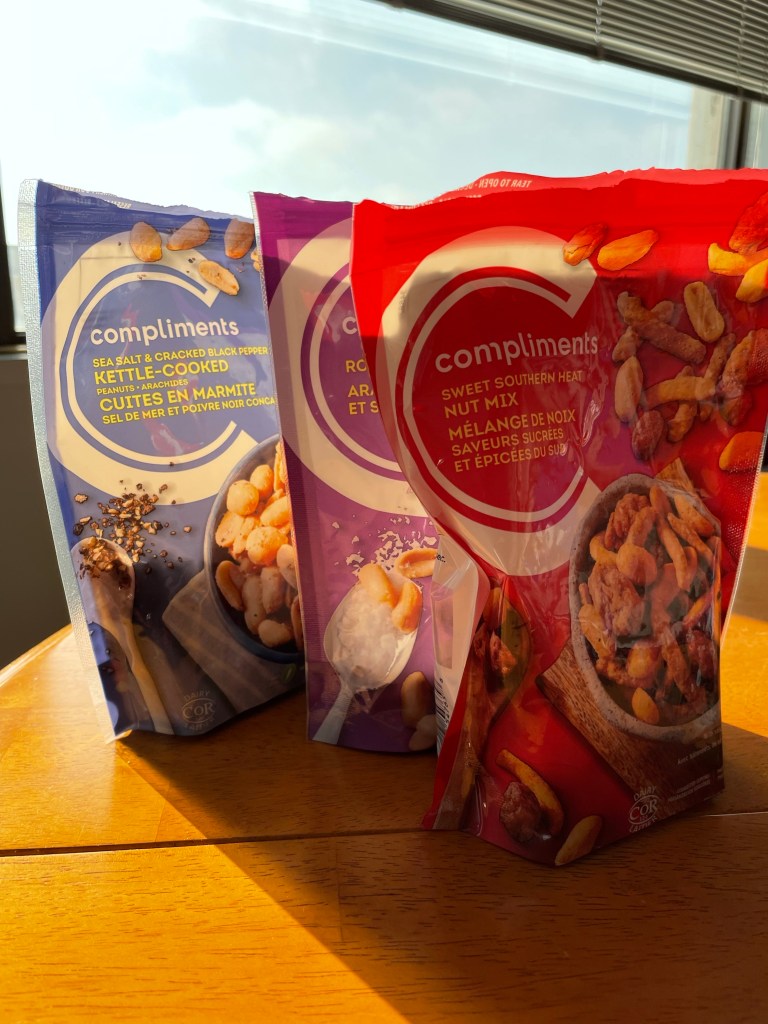
The nuts at my office (the non-living ones)

According to an article posted by HealthLine.com (I know, I haven’t quoted them in forever), there are a number of benefits to consuming nuts including but not limited to the inclusion of plenty of nutrients, fibre and antioxidants. The article suggest that the consumption of nuts can also help lower cholesterol and could potentially aid with weight loss.

This doesn’t mean you can sit and binge on an entire bag of salted peanuts at your leisure and expect to lose weight. One needs to bear in mind the increase in sodium intake. If possible, get your nuts salt-free. As with all things in life, a little bit doesn’t hurt. You just can’t overdo it and that previously-mentioned weight loss will only happen if one includes healthy lifestyle choices, such as proper diet and exercise. But I digress.

The big thing for me is the inclusion of fibre. Fibre is an important staple of a healthy diet because you need it for proper gut health, muscle repair and helps you to feel fuller for longer, reducing the portion of your meal and helping with weight loss. While the average adult should be consuming the higher end of 30 grams of fibre or more per day, a small serving of peanuts will give you a few grams of that total and help you along. Not bad, indeed.

The nice thing with nuts is there are tons of varieties and they can be used in many different ways. They can be used as butters (duh, peanut butter), tossed on top of your favourite salad or in your smoothie for a little added crunch or simply eaten by the handful. Just remember what I said… Although they’re better for you than eating a bag of chips or candy, moderation is still key. And if you enjoy some of the flavoured varieties, keep an eye on that sodium count. Now, let’s get nuts! ☯️

Better Days Are Not So Far Away…

Despite our efforts to avoid them, we all have bad days. Typically and for the most part, we suffer through them, deal with them and let them pass after a good night’s sleep. Remember I said that; it will apply later on in the post. But most people will actively do whatever they can to avoid bad days, despite the fact that they’re essentially unavoidable and a part of life.

Last week, I experience one of the worst “bad days” that I can recall in quite some time. What exactly happened to make it a bad day is not important (and I don’t need to come off like a snowflake for my woes) so much as how I dealt with it. Given everything I’ve been through in my life, I’ve prided myself on being able to maintain healthy tools to manage my emotions, more specifically anger. Please note that I said “manage” my anger and not control or suppress it.

Suppressing or bottling up one’s anger is a little like shaking a bottle of carbonated soda (something Nathan loves to do). Although the bottle will hold the soda, pressure will continue to build and gather until eventually the cap will pop and that pressure will explode outward, saturating everyone and everything near it. Anger is very much the same; if you don’t have a healthy outlet for it, it will eventually build up enough pressure to eventually burst and affect one’s entire environment.

Unless someone is close enough to me to have been told this fact, people believe I maintain my calm because I study the Buddha Dharma when in reality, I study to Buddha Dharma to help calm me. The difference is important because like any other living person, I feel and experience the entire spectrum of emotions and they affect me very much in the same way as anyone else. But it’s how I choose to deal with these negative emotions that’s important.

Just to be clear, anger, sadness and any other emotion labeled as “negative” still has a purpose, even if we dislike them and don’t assume so. Much like feeling fear let’s us known that we are potentially in danger, anger and disappointment tell us something about ourselves and the situation we’re facing that we may not have been aware of, otherwise. It doesn’t mean it isn’t normal to dislike being on those situations or that something shouldn’t be done about them. Cue the advice…

Meditation can be a fantastic way to help alleviate the effects of negative emotions. By entering oneself and allowing oneself to calm, breathe and focus on the lighter things, anger will often seem to lose its strength. This may not always be the case and may not work for everybody. But it’s definitely a good starting point. Finding the time and space to do this can be challenging, but never impossible.

Physical fitness is also an important aspect. Pushing yourself through a rigorous workout that can include martial arts or just hitting a good ol’ fashion punching bag can go a long way towards cooling the intense heat that your anger may have created within your soul. Even something that isn’t intense, like taking a walk, getting some fresh air and being alone with your own thoughts can be quite effective.

Sometimes there just isn’t anything that can be done and you have to just ride it out. This can be tough, especially if you’re already angry and you have to be in the same environment as loved ones and that anger become clear and obvious to them. An important step is not to bottle it up and isolate yourself. Letting those loved ones know WHY you’re angry is not only important towards making sure they know it isn’t directed at them but also pursues potential means of help as they could say or do something to provide relief from that anger.

Ultimately, sometimes all one can do is call it a day, hit the sack and get a solid night’s sleep in order to recharge one’s batteries and let one’s soul reset. This is what I did. Once I recognize I simply had no life left in me to deal with the day, I kissed my wife goodnight and let my head hit the pillow. In keeping with the mood I was in, a strong thunderstorm raged through most of the night. The next day was a new day with new challenges so I was grateful for having gotten the extra rest. Anger is a normal part of life. The idea isn’t to avoid it and the important thing is how you DEAL with it; and deal with it, you must. ☯️

What Binds Us…

Opening yourself up to others can be one of the most difficult things one can do. Especially in modern times, when people tend to try and get to know each other through virtual means before even meeting in person. When I was growing up, making a connection with someone meant actually meeting them face-to-face, introducing yourself and talking to them. Friends, associates and intimate relationships were forged this way.

These days, people meet dates online, join chat rooms and see each other for the first time through the digital frontier. Where spotting someone from across the room in a coffee shop and smiling at them would have been a first steps twenty years ago is basically considered creepy today, despite the fact that you genuinely never know who you’re meeting online until you see them in person, often with disappointment. In fact, there are entire shows about that very thing that you can watch.

Why am I bringing this up? Well, because as living creatures, there’s an energy that binds us all. That energy is called “connection,” and it’s something one can only truly accomplish by being physically present in the moment with another person. As one could no doubt agree, the problem with the online world is that you can be “connected” with thousands of people but still feel completely isolated and alone.

“Connection is the energy that exists between people when they feel seen, heard and valued; when they can give and receive without judgment; and when they derive sustenance and strength from the relationship.”

– Brene Brown

Being connection with someone else is more than physically being somewhere with them. There also has to be a trust, a comfort level, an ability to know that no matter what you say or do, that person won’t walk away from you or judge you. This isn’t an easy thing, especially in light of the modern world’s propensity to be overly sensitive and offended by everything. But a good baseline to know if you’ve made a solid connection with someone is to ask yourself if you would be comfortable doing something in front of them that you would usually only do alone. If the answer is yes, you can have confidence that some trust has been developed; at least to a certain degree.

Connections are important. Humans were never meant to be solitary, isolationist creatures. Even those who often claim they prefer to be alone still need others to one extent or another. And while that need is very real, making connections and building trust are integral parts of ensuring one’s wellbeing and health. Food for thought…☯️

“Roger” That…

Hey, I totally get it… It’s 2022 and everyone is tethered to their electronic conveniences on some way, shape or form… I’m no exception; I have my smart phone on me almost at all times and certainly never leave home without it. And there’s no denying that the advancement of technology has made Diabetes control far superior to what it was in 1982 when I was first diagnosed. But, do we take it too far? Are we too dependent? It all depends on who you ask…

As a father, I think the use of electronics has run rampant in society and it’s infiltrated my household. Getting my 7-year old through a full day without touching his device or his Nintendo Switch is a miracle akin to parting the Red Sea. Some of that is my bad, having introduced him to the colourful, moving pictures of an iPad when he was just an infant. And why not? It’s the way of the world, right? Unlike how it was when I was a kid, playing outside and occupying my mind solely on the strength of one’s imagination… Maybe I would have had more friends if I had been limited to social media as a kid. But I digress…

Having one’s nose buried in electronics has SO become the way of the world, it’s almost no longer considered a social taboo to have your smart device in front of your face when at a table with others. I’m reminded of a conference I recently attended, where the people at the table (there were about 8 of us) introduced ourselves and chatted for all of about a full minute. As I was looking around the room, I didn’t realize it right away but everyone at my table had retreated to their respective screens. It almost made me feel bad for leaving my phone in my pocket. Almost.

Canada recently suffered a telecommunications services disruption that rocked everyone’s respective world. If it weren’t for the inconvenience of no debit card use, I would have been mildly entertained by the state of people’s panic. I also would have been oblivious. It last a day, two at most, with all debit systems in the country inoperable for the time in question. Some areas were affected differently. For example, my mother claims that New Brunswick had no actual internet coverage during this time, which I think is hilarious since she doesn’t use the internet or even own a computer.

The effects were illuminating, from a societal standpoint. It was amazing to see how people were panicking and unable to function without the almighty invisible signal that governs their lives. I totally see the irony in the fact that I’m making light of this while drafting this post on a wireless device and if I were more committed to my imposed childhood school of faith, I might make comment about how people are hellbent on craving the comfort of an invisible force they can’t see, touch or feel but can’t live without. I think there was a book written about that once… Oh, the irony!

Don’t get me wrong; if I suddenly had absolutely no internet available to me, indefinitely, I’d likely piss and moan on a cosmic scale. What I get a kick out of is how society has become so utterly dependent on the need for our technology that we’re slowly forgetting what remains of our humanity. can’t watch your streaming service? Read a book, take a walk, sit outside in the sun. Play with your kids (considering they’re suffering the loss as well). I love me my games and daily challenges but there’s more to life than the digital frontier. Maybe it’s time some of us started remembering that. Food for thought… ☯️

Some Sleepy Facts For A Monday Morning…

It’s the start of the work week for most, and I’m sure we can agree that all of us would prefer to roll over, pull our blankets in closer and just keep sleeping until Monday goes away. Much like Garfield, most people aren’t fans of Mondays. ever wonder why Garfield hates Mondays so much? It’s not like he has a job to go to or any responsibilities. But I digress…

The topic of today’s post is about naps. I love naps. I often think back to my youth, when I would have had much more free time to grab a nap here and there but neglected to do so. It reminds me of my son, who outright refuses to nap and I keep telling him he’ll regret that choice when he gets older and no longer has the option. Our two-year old still gets put down for a nap and even when he fights it, ends up getting some sleep. Ah, the innocence!

I’ve written about naps in several previous posts and the reality is that naps are actually beneficial, as long as you don’t overdo them. Like everything else in life, there needs to be a balance. But if you nap in reasonable increments for short periods of time, they’ve been shown to lower the risk of heart disease, improve one’s memory, increase productivity and improve one’s mood. In Japan, nap periods during the workday are encouraged as they’ve already acknowledged that it increases the company’s overall productivity.

I once worked in a call centre (please don’t hold that against me) and they had a break lounge with dim lighting and soft, plush chairs for a staff to use their 15-minute breaks to grab a quick snooze. I was taken aback at the prospect that someone could actually nap for that short a period of time. But once I tried it a few times, I was surprised at how much good it did. Some experts I’ve read about have explained that sleep happens in four stages of a cycle, starting with the “falling asleep” stage, followed by the slowing and relaxing of the body, followed by slipping into deep sleep and finishing off the cycle with rapid-eye movement sleep, or what’s known as REM sleep.

So how long should one nap? This is a deeply debated aspect, since most professionals tend to agree that naps shouldn’t be TOO long or you risk falling into a deep sleep that will negatively affect the remainder of you or day and potentially prevent proper sleep at night. For the most part, I’ve always read that a 15 to 20-minute nap was enough to get you to the relaxing and slowing of the body stage, without allowing you to slip into deep sleep, which can be much more difficult to come out of.

The World Sleep Society claims that naps should be less than 45 minutes. This makes sense, since slipping into “deep sleep” can make waking up difficult and leave you feeling groggy and make it harder to push through the rest of your day. There’s nothing worse than feeling as though your nap made things worse or made you more tired. The whole point is to gain a bit of rejuvenation, right?

I read an article where Dr. Sara Mednick, a cognitive neuroscientist with the University of California, explained how taking an hour-long nap can be ideal since you start to slip into REM sleep. This is where all the beneficial aspects of sleep start to kick in; body regeneration, immune system repair and improved cognitive function. And coming out of REM sleep is actually way easier than coming out of a deep sleep. Apparently. I hate waking up in general. I’d live in the matrix, if it meant I could stay asleep. But once again I digress…

Napping through all four stages of a sleep cycle can do wonders and if t you have the time for it in your day, can increase your productivity and mood significantly. But even if you have time, anything more than an hour, hour and a half and you’re looking at possibly interfering with the sleep you try to get at night. So it’s important to find some balance. If you grab yourself a nap and still feel tired and/or exhausted, it could be a sign of something else so you shouldn’t be afraid to discuss it with your doctor or medical practitioner.

Now if you’ll excuse me, as much as I’d love to keep napping I have to get on with my Monday. perhaps the day will bring an opportunity for a snooze. We’ll see… ☯️

Fathers And Sons

A big part of my childhood involved going out and doing things with my father. Whether this meant running errands with him, doing activities outdoors or learning about computers, whenever I wasn’t at school or in karate, I was with my father. It made for an exciting and valued childhood. I’ve always said that when I had children, I would emulate this behaviour and do the same for my kids. I’m only now learning how difficult and “easier said than done” that this is to accomplish.

My hat’s off to my dad for making so much time and being there for as much as he was. As a kid, I couldn’t clearly grasp how my dad must have been fighting through fatigue from shift work to bring me swimming or how he likely preferred to sit on the couch relaxing on his day off, rather than spend the day peddling on a bike in the hot sun. But he did it all. It definitely makes me appreciate the effort he put in and makes me realize I could often put in more of an effort myself.

Excited anticipation upon arrival…

I had the opportunity to spend a wonderful day with my 7-year old son, Nathan. Our day involved a quiet morning for gaming and watching videos. Once we had lunch, we jumped into the car and headed to a movie theatre to watch Minions: The Rise of Gru. Nathan had recently mentioned liking minions and he’s watched some of the other Despicable Me movies, so I looked up the new one and found a 1:30 showing. We decided to head to the theatre early and partake of some of the games located in the lobby.

We played for almost 40 minutes, enjoying air hockey, shooting hoops and various first-person shooter games before grabbing typical movie snacks, which included popcorn, gummies and raspberry Coke Zero of all things, and finding our assigned seats in the theatre. The theatre was pretty quiet, with only one small group of four or five kids on the other side of the seating area. So we basically had the place to ourselves.

Seated and ready for a show!

Although the movie had its funny moments, the combination of arcade games and sugar made it difficult for Nathan to sit still for the hour and a half that it took for the movie to reach its conclusion. This is problematic, as Nathan becomes quite the handful. in this instances, he was climbing on the seats in front of him, shifting around and asking when it would be done. Even though we were enjoying the film, I could tell the wick on the stick of dynamite was slowly burning down and he would only stay in his seat for so long.

Once the movie was done, we took the opportunity to burn through our remaining game tokens and played some more games. Nathan was hellbent on burning through every token and appeared to enjoy THAT more than the movie itself. He particularly enjoyed the Jurassic Park shooter and spent most of his tokens there. It was fun, watching the joy in his eyes as he played and enjoyed himself in the arcade.

Gaming at its finest…

Admittedly, we were both hot and sweaty when we finally walked back out to the car. There was very little A/C in the gaming area and it was made all the worse by the fact that all the gaming machines were giving off their own respective heat. Although it was nearly 30 degrees outside, it felt cooler than it did inside. As you can see from the photos, Nathan and I were both wearing hooded sweatshirts but were quit to shed them once we left the building.

We travelled across the city and purchased a used life jacket for Nathan’s use while at a swimming pool. This immediately prompted Nathan to request a trip to the pool, which resulted in an argument over why we couldn’t go right away. We discussed potentially going swimming or hit the splash pad over the weekend, but he was insistent of a pool, which told me he only wanted to go because he just got a new life vest. But I digress.

Summertime homework

Once we got home and as we had previously agreed, Nathan got to work on some homework-style exercises that my wife has obtained for him in order to keep what’s he’s learned through the school year as fresh as possible. While he was doing his homework, I ordered pizza and wings for the whole family online. We received our food right around when he finished his exercises and everyone enjoyed a nice, take-out supper. Nathan and his brother particularly enjoyed the bread sticks.

It was a fantastic day and I would be lying if I said I didn’t enjoy myself. Life gets pretty busy and hectic and making time to do these kind of things can be difficult. But twenty years from now, Nathan will have the benefit of looking back and recognizing that we had this time together, much in the same way I have fond memories of the things I’ve done with my father. These are the important moments that make life matter. Sometimes we get so caught up in the rat race that we forget to take time to stop and smell the flowers. Food for thought… ☯️

On The Road To Recovery…

It’s been something of a rough week. This head cold has totally kicked my ass and made me feel like I was dying. Okay, okay, maybe I’m exaggerating just a bit, but I was on a downer there for a while. It started last Sunday night when I realized that my throat was feeling scratchy and my nose wouldn’t stop running. As I’ve often mentioned in the past, just about every little bug that floats by latches on to me, thanks to good ol’ Type-1 Diabetes.

I worked from home for a few days in order to recover. This is a definite advantage from previous jobs I’ve held, where my presence was actually required and things couldn’t be done virtually the way I do them now. I think it stands to reason that one can’t work from home as a police officer but even prior to that; working from home as a restaurant or pharmacy manager wasn’t a possibility, either. This usually meant going into work, even when I was feeling sick. This is a terrible thing, and not something anyone should have to endure.

I’m making it sound a bit more dramatic than it needs to be. After all, I had a small head cold, I wasn’t dying. But the sad reality is that not everyone has the benefit of continuing to work from home when ill, or the benefit of paid sick days. I think we can agree that everyone has bills, debts and responsibilities and not everyone can be absent from the job for several days to recover. And some employers are unfortunately cruel enough to worry only about their bottom line and may take action against an employee who does. I’ve been there.

Luckily, such is not the case for me now. I’m blessed to have an understanding employer who not only provides me with paid sick days but also has policies allowing remote work, so I was able to keep hammering through while sitting in my jammies and downing cold meds like they were tic tacs. Granted, it’s important to remember that pushing yourself is not always a good thing, either. It’s important to allow the body some genuine rest and even when you’re sitting at a desk, it isn’t comparable to lying down and staying warm and hydrated.

Allowing yourself some recovery time, even for common colds (which there’s no such thing, FYI) is an important step towards maintaining one’s health and wellbeing. It’s also extremely important as it relates to good Diabetes control and blood sugar management. I had a couple of readings this past week that will likely make my endocrinologist’s eyebrows raise but I worked it out. No matter what your work or life situation, just remember that you can’t work and pay the bills if you get worse and end up hospitalized.

Take the time to care for yourself first. Then you can hammer at the challenges of life afterwards. As I’ve often said and written, you need to take care of yourself before you can take care of anyone/anything else. That’s a hard lesson for any of us to embrace, especially when we’re committed to what we do and the responsibilities we have. But self-care ALWAYS has to come first. Food for thought…☯️

The Pebble In Your Shoe

The title refers to a much-referenced quote by Muhammed Ali. The full quote reads, “It’s isn’t the mountains ahead that wear you out. It’s the little pebble in your shoe.” It’s usually referenced to represent how the smaller challenges are what usually wear you out along your journey, as opposed to reaching the ultimate goal. That being said, it can also apply to one’s physical health. I recently wrote a post about things one can expect when living with someone who has Diabetes. if you missed it, you can read that post here.

Illness and pain are subjective to the person and it can be REALLY hard to compare oneself to another person. A paper cut can seem like a trivial pain to one individual, while another individual may do everything to avoid using that hand until the paper cut heals. One person may work through a common head cold, going to work and even attending fitness sessions while they recover. Another person will be completely on their ass and on the edge of debilitation from that same head cold. It’s all subjective and dependent on the person and their tolerance.

As much as I’d like to agree that one should just toughen up, hammer through and beat any illness before it beats you, there’s something to be said for taking the time to recover, even when it’s something minor. People tend to forget that the symptoms we feel are not only part of the overall illness but also part of the body’s defence mechanism. A good example is a fever. People tend to try and take medication to reduce or eliminate a fever. In truth, the fever is the body’s mechanism to kill whatever is making the body sick. That’s why it’s important not to ignore symptoms and to allow the body the time it needs to recover.

I’ll fully admit that I’m bad with pushing through. I recognized this last weekend when I started to feel a bit off but continued to do yard work, chores around the house and prepare meals. By the time Sunday rolled around, I started to seriously feel like shit. It was all in my head and I don’t mean that I was imagining it. My head felt heavy and foggy, my nose wouldn’t stop running, despite there being no airflow through it. I ended up sleeping downstairs and spent most of the night up, tossing and turning, taking nasal spray every couple of hours, which we all know is WONDERFUL for the body…

At time of posting, it’s begun to pass and I’ve returned to the office. The important thing to remember, is not to ignore illness when it hits. I don’t need to remind everyone that absolutely EVERYTHING affects Diabetes and as a result, even a small head cold can have nasty results. Take time to rest. This can be tough, depending on one’s adulting responsibilities. Not everyone has the sick days available to take a few days to recover from a cold, especially if they need to save them for more serious illness down the road. Given the way of the new world, maybe you can work from home. That’s what I did, for a couple of days.

The important thing to remember is that your health has to come first. Small colds and illnesses can seem menial but like the small pebble in one’s shoe, it can wear you down worse than the mountain you face. And because this is me and given the subject matter of today’s post, stay hydrated, test your blood often and if your body is weary, for the love of the light, SLEEP! Take rest when you need rest and can get rest. Trying to hard to push through can weaken one’s body further and lead to worse illness. Food for thought… ☯️

Supplementation, Part Trois…

This is my third time posting this material and no, I’m not being lazy. I consider the consumption of vitamins and minerals to be an important part of maintaining one’s health. It’s no surprise that modern nutrition is sorely lacking in most people and with every reposting of this material, I’m reminded of the importance of taking a steady multivitamin on a daily basis; a fact my doctors keep reminding me of, as well. So, bearing in mind that I’m not a doctor or nutritionist, here’s what I posted all the way back in June of 2019. Enjoy!

One of the key reasons behind the consumption of food is to obtain carbohydrates for energy. The human body requires energy to carry on normal functions and, well… stay alive! But what else do we get from the food we eat? A proper diet will also include a number of vitamins and minerals that we require to maintain proper health, growth and energy levels within the body. We’ve all heard about getting enough vitamins from a young age. I remember getting my Flintstones vitamin everyday as a kid.

But if you’re like most people, you’re likely wondering what these vitamins are for and what they do. My goal is to cover off the main ones here:

Vitamin A: This is an all-around vitamin that provides a number of functions including but not limited to the proper health of various bodily functions, tissues and helps to fight chronic disease and is known to be good for the eyes.

Vitamin B: This one is a bit complicated, as there is a large grouping of enzymes, vitamins and minerals that fall under the “B” category. In general, B-vitamins are used for energy production, immune function and absorbing iron. Some them include B2 (riboflavin), B3 (niacin), B9 (folate) and B12. There are a few more that I can’t recall, but B12 is considered amongst one of the most important of vitamins overall because it helps you turn food into energy.

Vitamin C: At some points, this one has been referred to as the sunshine vitamin. I’m thinking that’s mostly because people’s main source of Vitamin C is from citrus fruits. But this vitamin also helps with iron absorption, immune function and is a natural antioxidant that helps with the elimination of free radicals. Eating citrus fruits are also what sailors used to eat on long voyages to prevent scurvy.

Vitamin D: This vitamin helps with the strengthening of bones and teeth. Our bodies are designed to self-generate this vitamin naturally through exposure to sunlight, but obviously that needs to be done in small doses. Modern life has created an environment where more people spend their time indoors, away from the sun. So supplementation becomes important.

Vitamin E: A pretty straight forward vitamin, this one helps with proper blood circulation and clear skin.

Vitamin K: This vitamin is essential for blood-clotting. In order words, if you’re deficient in this vitamin, small cuts or injuries can cause excessive bleeding that can become dangerous.

Folic Acid: We hear people speak about this one as being necessary during pregnancy. And they would be correct! Folic Acid helps to prevent certain complications during childbirth but is important to everyone for proper cell renewal. This one is also known as Folate, or Vitamin B9 (as listed above).

Calcium: Most people should be familiar with this one. Teeth and bones, people! Teeth and bones! Good calcium levels are required to keep those body parts healthy.

Iron: This helps to build muscle tissue naturally and helps with proper health of the blood. As an interesting sidebar, it’s also what makes your blood red through the reflection of light!

Zinc: Immunity and Fertility. I’m a little unfamiliar with this one and haven’t had the opportunity to research it a great deal.

Chromium: This one is near and dear to my heart. Because it helps to control blood sugar levels. Chromium is what helps all the systems of your body to get the energy they need when they need it. Some traditional medicine practitioners will suggest Chromium supplements for Type 1 Diabetics who may have difficulty in maintaining proper levels.

Magnesium: This one helps your body to absorb all the other vitamins and minerals. It also acts as something of a relaxant to muscle tissue and play a role in proper muscle contraction.

Potassium: This mineral helps with the proper hydration of your body and helps to control blood pressure.

There are many others of course, but I’ve tried to cover off the main vitamins and minerals required for a proper diet. We get most of what we need by eating regularly and including a variety of healthy foods. A lot of people take a daily multi-vitamin, which is fine. But unless you are experiencing symptoms or unexplained illnesses, there shouldn’t be a need to actively try and take added amounts of anything. Your medical practitioner should be able to advise you if further supplementation is required. For example, patients who are recommended to take Folic Acid and Iron during pregnancy.

Obviously, all of this is extremely important; not only for proper health and fitness, which is important to me, but to help with Type 1 Diabetes as well. Taking a daily multivitamin can help to ensure that your body gets everything it needs, in combination with carbohydrates, lean proteins and fibre. My wife Laura originally gave me the idea for the post I wrote in 2019 when she asked about B-vitamins. Every time I re-post this material, I think of her. The credit for this post is all her! ☯️