The Unseen Demons

In my line of work, I’ve heard a lot about the unseen injuries that can be suffered from years of being exposed to violent and traumatic events. Law enforcement, first responders, rescuers and military often carry scars from their time of service that can’t be seen but are mostly felt. But one important aspect to consider is that it isn’t always the people in these specific lines of work that suffer from these unseen injuries.

One of the most common of these, is PTSD (Post Traumatic Stress Disorder). PTSD has been around for a very, very long time. It isn’t until recent times that deeper focus and understanding has started to come to the surface. In the times of World War I, the term “Shell Shock” was used before the term PTSD was coined. It was characterized by the reaction soldiers had to the constant exposure to violence and war time incidents. There has long been a stigma behind PTSD, where many believed it only affected those who “weren’t able to deal with it” or was a sign of weakness. For decades, there were those who also believed that it was a manufactured disorder and that the sufferer was not genuinely afflicted with an injury. Even today, there are some who question the legitimacy of PTSD.

In recent years, PTSD has been the subject of multiple studies, which have proven that there is a physical transformation that happens in the human brain as a result of repeated exposure to traumatic or terrifying events. These can include, but are not limited to car crashes, robberies, sexual assault and other various forms of accidents and/or crimes against a person. Although there is no known cure for PTSD at the moment, there are a number of therapies that, when used alone or in combination with one another, can alleviate the symptoms. In fact, The LifeLine Foundation even lists meditation as one of the treatment options. Imagine that…

Obviously, what works for one person doesn’t work for every person. people who suffer from PTSD can and will often suffer from different symptoms including but not limited to nightmares, flashbacks, sweating, trembling, increased irritability and constantly being “on edge”, as though was always felt as though they may be attacked at any given moment.

In previous years, many people would turn to the more “unconventional” types of self-treatment, such as alcohol, substance and drug abuse and unfortunately even suicide. It’s important to know that there are resources and people available to help you through it, if you are suffering from PTSD. The stigma is slowly being eliminated and it is starting to be recognized as the genuine article. Speaking from experience, I can tell you that PTSD is all too real…

More information and further resources on PTSD can be found on the following websites:

The LifeLine Foundation: http://thelifelinecanada.ca/resources/ptsd/?utm_source=google&utm_medium=cpc&utm_term=ptsd%20causes&utm_content=!acq!v3!42605611150_kwd-281317349__219978557412_g_c__&utm_campaign=Branded+-+Canada&gclid=EAIaIQobChMI6Y2c9oO_4QIVRLbACh01VQsbEAAYASAAEgKOWPD_BwE

The Mayo Clinic: https://www.mayoclinic.org/diseases-conditions/post-traumatic-stress-disorder/symptoms-causes/syc-20355967

Most first-responder organizations also offer a number of resources and people you can reach out to. It’s important to impact the message that thesis something you don’t have to deal with alone.

Breaking Bread, It’s What’s For Dinner…

Remember the good old days when people sat at a table together and had face to face conversations during a meal? I do. I call it “good old days”, but to those who don’t know otherwise, I guess they don’t see the difference.

Tonight, we had the opportunity to have dinner with another couple and their children. It was chaotic. There was noise. There was chatter. there were multiple children vying for attention at different times.

Know what else there was at this dinner? Jokes. Laughter. Conversation. Games. Two families enjoying an evening together in the traditional sense. Something you don’t see a great deal of nowadays.

I think that the dynamic we’ve developed as a people is such that it has become easier for us to communicate through our devices. Text messages and various forms of social media have become the new norm. When most groups sit at a table together, at least a number of them will have their faces buried in their smart phones. The newest generation haven’t even had the benefit of knowing any different. We see the same thing when we sit on the bus or at restaurants, even when it’s two or more people together.

Don’t get me wrong, I have a smart phone. I use it a lot. I mean, a LOT. And sometimes, it has been to the detriment of my family. Doing things like playing games, browsing social media and watching television have proven to be a bad example to my son especially, who thinks it’s perfectly normal to sit in front of the television during a meal as opposed to sitting together at the dining table.

As wonderful as the advancement of technology has been, and no matter how much easier it has made life, I think it’s important that we pass on those particular traditions to our children. In a busy world where technology reins, it’s important to keep a foot firmly grounded on our humanity. We shouldn’t forget that the spoken word and face to face contact should never be taken for granted.

So, take the time to enjoy those few valuable moments with your loved ones. Have a conversation. Ask how their proverbial day went and what they did. In the long run, it will be better for you than tweeting what your last meal was.

Lethargy and Apathy are NOT countries in Eastern Europe…

One of the many pitfalls of Diabetes is that is can often cause sluggishness and lack of energy. Many people tend to see this as laziness, but it is often attributed to out of control blood sugars and the physical tolls it takes on the human body.

Just to clarify, lethargy and apathy are pretty similar. the first means a lack of energy and enthusiasm; the latter means a lack of interest, enthusiasm or concern. Sometimes it’s easy to confuse the two.

People often wonder how to “push through” and get their workouts or exercise done, despite the lack of energy. This takes concentration and the willingness to push beyond what your body is telling you. Don’t get me wrong; it is important to take rest when it is required. Your body will eventually need to recharge and replenish itself. This is why most trainers and health professionals will tell you that you shouldn’t work out seven days a week. Eventually, you start doing more damage than good.

But as a matter of course, it is important to push yourself. When you get those days where you just don’t feel like getting off the couch, those are exactly the days where you should. Yesterday, I skipped a karate class. This is not a common practice for me, but some days one simply can’t find the motivation. Is that a bad thing? Not necessarily. But the throbbing pain in my upper back and right shoulder, coupled with my inability to keep my eyes open, told me that if I didn’t take a rest and allow these muscles to heal, I would likely injure or harm myself further.

So it becomes important to know the difference between required rest and lethargy. It is also important to recognize the difference between the ache of a rigorous workout and the pain of an injury. If you are ever uncertain as to which you are feeling, don’t hesitate to visit your family practitioner, chiropractor, massage therapist, whatever you need. Even if it turns out to be nothing, it’s always better to err on there side of caution. Your body will thank you.

Bone Alignment and Proper Form

When training in the martial arts, or any sport really, it becomes ultimately important to maintain proper form. Having improper bone alignment can lead to pulled muscles, injuries in the tendons and other serious sports-related injuries.

As it relates to the martial arts, the power behind a strike comes not only from one’s brute strength but a number of different factors that people often don’t think about. For example, a properly executed punch will draw some of its power from the ground. Don’t believe me?

A good example is if you’ve ever seen two people on the street breaking out into a fight. You’ll never see someone throw a punch from a normal standing position. They’ll usually blade or take a step back or something to allow themselves the opportunity to properly chamber the strike.

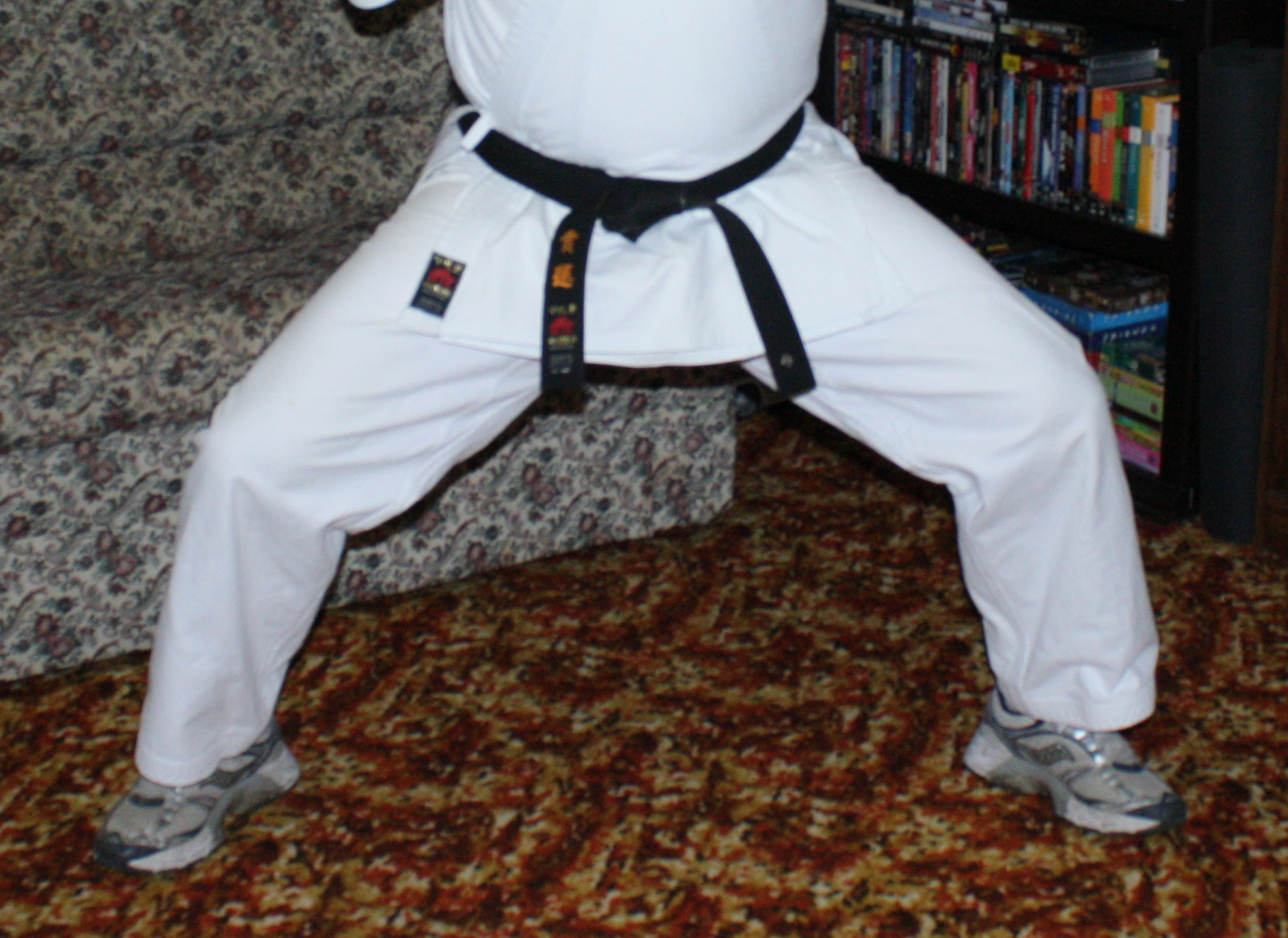
Another very important aspect to examine is your body’s natural pronation and supination. These refer to the natural alignment and rotation of your bones and joints. It becomes extremely important to acknowledge these and to try not to move against it. For example, when doing a “horse stance” movement in karate, one should keep the back straight and allow for the feet and knees to point slightly outward from the body. This is the natural movement of the body and the only way to effectively perform this movement.

The beginning of a good horse stance. I continue by getting lower into the seated position (no laughing at my orange carpet!)

Some styles try to point the feet directly forward or keep the knees pointed forward, but as you squat down in a horse stance, this movement becomes unnatural and taxing on the body.

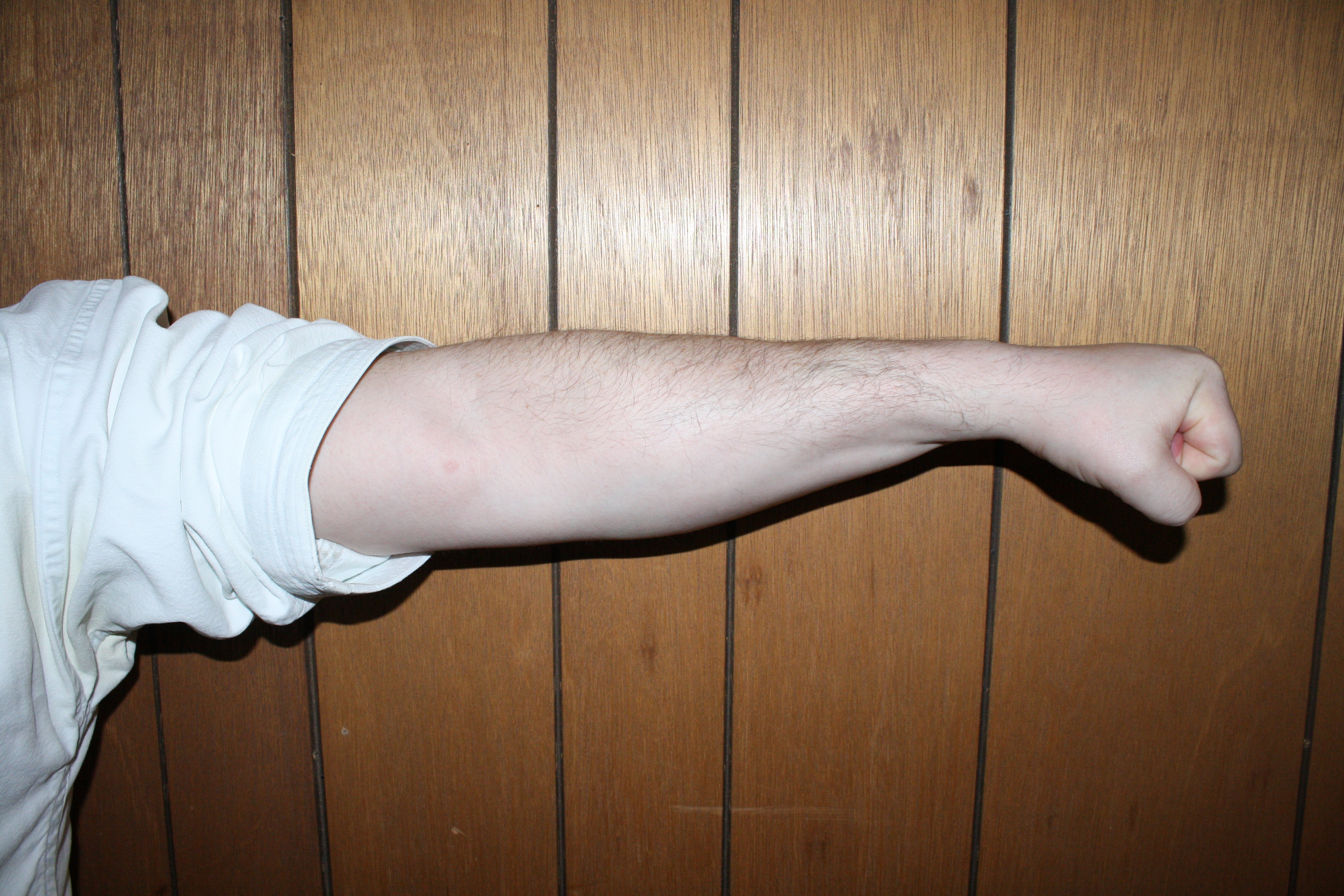
The same goes with any of the limbs or joints. When one throws a proper punch, it becomes important to strike, keeping the knuckles, wrist and elbow lined up perfectly. This not only guarantees a stronger punch, it also prevents injury.

This is one of the reasons why boxers, muay thai and MMA fighters generally have to wrap their hands. They have lots of striking power, but no precision or ability to align their joints. Without the additional wrapping, they would likely injure themselves after the first few strikes.

A punch, demonstrated with proper alignment of the knuckles, wrist and elbow

Now, don’t get me wrong… I sure as hell wouldn’t want to take a punch from any one of those types of athletes! They have tremendous power to their strikes. But in a situation of true self-defence, one needs to train the body to be ready to strike without the benefit of padding or wrapping.

Normally, your body will tell you if something is unnatural. But this doesn’t mean that the movement your body HAS gotten used to, is correct. Sometimes we need to be corrected and adjusted in order to promote that natural movement.

The Martial Arts Ladder

My Sensei used to say that martial arts was like a ladder; we all want to climb up the rungs and get higher. But once you’ve made it up a few levels, it’s important to look back and help up the ones below you. Once they progress, they could potentially make their way higher than you and they would, in turn, reach back and help lift you up to the higher level you have not yet achieved. This is the beauty and wonder of the martial arts…

Years ago, we used to have three regular classes a week. Now, just to be clear… this was back in New Brunswick and I’m talkin’ turn of the century/millenium when everyone was freaked out over Y2K but all I could think about was graduating my black belt in karate! I was training hard. But the world’s perspective on martial arts was changing. People didn’t want to shed blood, sweat and tears like they used to. The next generation was growing strong and people were more interested in the 3-year black belt that some particular schools and styles catered to as opposed to hard work and developing oneself.

When I achieved my green belt (this was the first adult belt in my system after four ranking stripes), it became my responsibility to show the new arrivals their first steps and katas. I had climbed up the first rungs, so now I had to look back and pull the new climbers up.

When I achieved my brown belt, it became my responsibility to teach the entire class and guide them during their basic exercises and aiding movements. I would guide new students through their first couple of forms and help with correction and checking on some body conditioning.

When I achieved my black belt, it dawned on me just how little I knew. I realized that a kick was just kick and a punch was just a punch (sound familiar?). Who was I, to try and guide these newcomers into their journey towards whatever it was they were trying to learn? But as I progressed, I came to understand that white belts also needed to understand how to kick and how to punch, and wouldn’t learn unless someone showed them.

I guess my point is that as a student learns, it becomes important to help the newer students to progress so that they can show the newest practitioners, and so on and so forth. You can’t be an efficient teacher without somehow helping the students to grow to to the point where they will teach others. Makes sense, doesn’t it?

Tonight, I had the benefit of having an experienced black belt teach me and show me a form in his particular martial art. It was humbling, because he could have spent his time practicing his own thing, but he spent time showing me the way instead. And isn’t that what’s important? No matter what level you reach, someone will need to carry on the way.

And this, dear friends, is the martial arts ladder. We grow, we learn, and we teach. So for every two steps you take, be sure to help someone else take one as well. Someday, that white belt may become a Sensei who teaches someone one new.

Lactic Acid, NOT An Ingredient In Your Milk…

We’ve all been there, right? Maybe you’re on a wicked jog, or participating in an intense spinning or Zumba class…. Maybe you’ve lost your mind and decided to drag your wife through a particularly sweating hypertrophy workout because it’s “something different”…

No? Just me? Alright then, think back to a time when you’ve been working out or exercising strenuously. Do you remember feeling that sudden burning feeling in your lungs? A noticeable lack of strength in your muscles and your body is essentially telling you to stop and rest? That, my friend, is a build-up of lactic acid in your muscle tissue.

Lactic Acid, or Lactate, is caused when you’re body is burning through more oxygen than it is carrying while exercising. Lactic Acid can be used by your body to produce energy without the use of oxygen, but it leaves some unpleasant side effects in its wake. The buildup of Lactic Acid is sometimes referred to Lactic Acidosis and the big problem is that your body will generally produce more Lactic Acid than you can quickly burn off and this is what causes you to feel symptoms like pain, cramping, nausea, weakness and exhaustion. One can sometimes fight one’s way through the effects of Lactic Acid buildup, but the result is more Lactic Acid. Rinse and repeat. Fun.

Once you hit that point, or what’s called the “Lactate Threshold”, it’s important to start your cool down. Your body’s exhaustion will likely tell your brain that it’s time to stop completely and maybe lie down for a nap, but this is not the proper thing to do. You need to cool down and allow your excess Lactic Acid to burn away.

There’s no real way to prevent Lactic Acidosis, other than to exercise regularly and increase the intensity gradually. I think WebMD said it best: “Don’t go from being a couch potato to trying to run a marathon […].” But if you build yourself up gradually, it will increase your threshold and make you capable of a lot more physical exertion before Lactic Acid builds up. The reality is that our ancestors sometimes had to face threats that didn’t allow them to build their intensity gradually, and this is why our bodies have this backup. But it is meant to be temporary. Unless your life is in jeopardy or the immediate situation mandates it, continuing to fight through Lactic Acidosis can be harmful (at the very least, it hurts like hell!).

But once you’ve hit that point, be sure to rest up and drink plenty of water as it helps to eliminate the excess acid. In some rare cases, medical conditions can cause Lactic Acidosis without intense exercise. Believe it or not, people who use Metformin for Type 2 Diabetes can experience Lactic Acidosis as a side effect of this medication. If you’re getting any of these symptoms as a result of a medical condition or medications, obviously you should speak with your doctor.

Otherwise, stretch properly, drink plenty of water and eat a balanced diet, chase all of that with a good night’s sleep and keep working out. I often hear people think that they believe Lactic Acidosis lasts for a couple of days after the workout; this is part of the recovery and not the actual Lactic Acid. Lactic Acidosis is an event that happens in the moment, and is usually gone soon after the workout ends.

The Next Generation Carries On…

Today’s blog post comes with a thick, heavy ounce of frustration as the power has been out at our home since about 6:30 this morning. We are currently sitting at a local fast-food eatery while my 4-year old indulges in a play structure and I stuff my visage with calorie-rich foods (only because we can’t make breakfast at home, of course!) But I digress…

One of the many benefits of being in martial arts for many decades is that I have been able to see many generations walk through the doors. Believe me when I say that students come in all shapes and sizes, walks of life and backgrounds. A good number of them have been children, and for a brief period in 2007, I actually had a “kids'” school of karate. It was there that I learned how hard some parents push their children. And this is coming from a karate instructor!

Martial arts has always been a passion for me, ever since I saw “Enter the Dragon” with Bruce Lee in 1982. This was further compounded by a ninja-based television series I used to watch called “The Master”, which started airing in the early 1980’s. I was never much of a team sport kind of kid, especially with all the difficulties that came from Diabetes at a young age. Needless to say, my parents didn’t have to encourage me to stay in karate. In fact, they didn’t even know I was practicing it for the first few years!

But to any casual observer watching a class, one thing is immediately obvious: some want to be there; some do not!

When I was teaching my students, one of the deepest lessons I tried to teach was honesty. I made a point of telling them that if they were unable to tell the truth, they would ultimately be unable to properly learn martial arts. This was driven home for me one day when I noticed a pre-teen student who was rather phoning it in during his workouts. This had been his general attitude for a number of weeks and I decided it was time to discuss it with him. I had the opportunity to sit him down after class and I asked him outright if he wanted to be in karate. I was somewhat taken aback when his immediate and unrehearsed response was a firm “no”. When I asked him why he was still coming to class when he didn’t want to be there, he explained that his parents were making him attend.

The following week before class started, I had the opportunity to speak with this young boy’s parents, who told me that they wanted their child to be involved in a sport to learn discipline and get in shape, and that he would remain in the class whether he wanted to or not!

Were they right? This is a fine line, folks. And if I’m being honest, as an instructor and a practitioner, I have to say that if you’re trying to teach your child a lesson by forcing them into something that isn’t a requirement to keep them alive and well, you’re teaching them the wrong lesson.

Here’s the thing: It’s important for kids to get into something. Although it is EXTREMELY important for kids to learnt to self-entertain, they also need to learn some of the basic socialization skills that are required to be carried into adulthood. Sports and leisure activities outside of school help teach this, but it also helps to instil a sense of commitment and accomplishment in a way that they won’t learn otherwise. But how far should we push this point if the kid really doesn’t want to keep doing it?

As part of the lessons about commitment and accomplishment, there are a number of factors to bear in mind. If the child has chosen the activity in question, and money has been provided to allow them to do so, then it becomes important for them to understand that they should stick with it and finish what they’ve started, especially since the family and household have sacrificed to make it so. There’s nothing wrong with them choosing something else once this commitment has been fulfilled. However, if the parent has chosen the activity and are actively forcing the child to stay with it, they may be doing more harm than good.

The other side of the coin is that if you decide to be a progressive parent and allow the child to quit, you may be teaching them that it’s okay to drop something once it becomes boring or played out. And in today’s world of electronically fuelled entertainment, that’s a slippery slope indeed.

Ultimately, I ended up “kicking” the young boy out. I had a talk with him and explained that if he genuinely didn’t want to stay with karate, he was damaging the class by only putting half the effort in. I told him he should talk with his parents and try to choose something that would suit him and make him happy. He was grateful. His parents were not. They didn’t understand that by having a child who didn’t put in the effort, he was damaging the energy and drive of the class, as younger students saw him basically phoning it in and thought this was okay.

And this is the unspoken side of this issue: kids who don’t want to be there will cause certain damage to the school and the goal it’s trying to reach with the children. I would recommend that if your child hasn’t chosen the intended sport or activity, maybe talk with them and see what they would like to do. This will insure a better chance of having them stick with it.

Last but not least, I should point out that every situation and child involved is different. What works for one parent and child may not work for the other. Although we want our kids learning important values such as commitment, dedication and seeing things through, we have to be careful to maintain the balance with respecting their rights and helping them reach THEIR goals.

Water, The True Nectar of Life

How much water do you drink in a day? Think you know the answer? I’ll bet you don’t… Most people don’t get enough hydration throughout the day, and this can lead to problems, especially if you exercise frequently or have Diabetes.

In the old days, we were always told that every person should consume eight 8-ounce glasses of water a day (that’s 1.89 litres for you metric folks). That’s not a lot! But this also doesn’t take into account water contained in foods and other beverages. It’s also no longer correct or relevant.

According to the Mayo Clinic (https://www.mayoclinic.org/healthy-lifestyle/nutrition-and-healthy-eating/in-depth/water/art-20044256) the human body is composed of approximately 60 percent water. Over the years, I’ve heard a lot of different numbers, including as much as 90 percent, but the majority of health professionals all land on 60 percent. But in general, the agreed guideline is to drink roughly one ounce of water for every pound you weigh. So if you weigh 200 pounds like I do (shut up, that’s my actual weight), then you would need to drink roughly 200 ounces a day, which evens out to almost 6 litres of water. That probably seems like quite a bit, but when you account for the water in your fruits, vegetables, food in general and other drinks such as coffee and juice, I can make do at my weight with roughly 3 to 4 litres of water throughout the day. Okay, I’ll be honest, drinking four litres of water in a day still seems excessive!

But this amount is reflected by the National Academies of Science, Engeneering and Medicine who determined that an adequate amount of water is about 3.7 litres for men and 2.7 litres for women. This takes into account fluids from other beverages and food as well. That’s pretty doable, if you sip consistently throughout the day.

The amount of water you need throughout the day will also depend on mass, age, fitness, hot weather, activity level and outlying medical conditions, such as Diabetes. One condition that Diabetics tend to get is what I like to call “The Devil’s Cycle”. When a Diabetic’s blood sugar rises too high, it has a bit of a diuretic effect and causes frequent urination. High blood sugar also causes increased thirst. So you drink more water, which leads to more urination, and so on and so forth. I call it “The Devil’s Cycle” because until the blood sugar comes down, you basically feel like hell.

Drinking water has an immeasurable number of health benefits, including but not limited to maintaining hydration, aiding in digestion and weight loss, energizing muscle tissue and keeping skin looking good. Regular water consumption aids in weight loss because dehydration is often mistaken for hunger, and people will eat when all they really need is to have some fluids. It also helps to alleviate headaches and is the only true cure fro a hangover. Water and time, people. Water and time.

There are a number of signs that indicate whether you are probably hydrated or not. Most prominently, if you’re not thirsty as all hell, it’s a pretty good sign you’re properly hydrated. I’m not going to start describing colour and odour of urine here, but if your conscientious enough to check, there are signs in your urine that will tell if you’re properly hydrated or not and these can verified through your family practitioner or on a reputable medical website.

Bottom line is that if you’re thirsty, drink some water! When you work out, drink some water! When trying to control your blood sugars, drink some water! See where I’m going with this? DRINK SOME WATER!!! Keeping a reusable, disposable water bottle with you around the house will help with this. My wife and I always have plastic, washable water bottles with us. Stay hydrated, folks!

The Unseen Enemy…

General Vegetius, of the Roman empire, once wrote “If you want peace, prepare for war”. (This comes from the book Epitoma Rei Militaris, and was written by General Vegetius) And I can think of no personal struggle that I’ve dealt with in my life that encompasses daily battles like Type 1 Diabetes!

This morning, I woke up in pain. My shoulders were a combination of numb and sharp, stinging pain. I sat up gingerly, as my head was spinning and my arms only seemed to have limited function. I thought maybe I had simply slept wrong and the circulation in my arms was impeded. It was just prior to 8 am. I reached for my phone and checked my blood sugar levels (I use Freestyle Libre Flash Glucose Monitoring System, which runs through my smartphone). Turns out, my blood glucose level was 2.5! Just to provide a frame of reference for my non-Diabetic readers, a normal blood glucose level is anywhere between 5.0 to 7.0.

So there it was! First thing in the morning and my battle has already begun. I stumbled out of bed, got to some fast-acting glucose and chased it with some caffeine. It took about ten to fifteen minutes before the spinning stopped and the headache began. The throbbing in my shoulders had passed, so it seems that I exchanged one level of pain for another. This is just a small slice of what I’ve dealt with since my diagnosis of Type 1 in 1982!

Low blood sugar, or Hypoglycemia as it is known in medical terms, is a marked and significant reduction in glucose in the blood stream. Glucose is required by the body, as a fuel source and to help transport oxygen to the brain. This is one of the reasons that people with low blood sugar will often seem dizzy or disoriented. Hypoglycemia in and of itself is not a disease, but merely a symptom of a related health condition, including but not limited to Diabetes.

In fact, several factors can cause non-Diabetics to experience a drop in blood sugar. Believe it or not (and some of my friends will curse my name for mentioning it), excessive alcohol consumption without eating can cause a drop in blood sugar. Your liver becomes so occupied with processing the alcohol that it neglects to release glycol into your system, which replaces glucose when you go too long without eating. But this is just one of the possibilities, including hormone deficiencies, Diabetes and certain medications or other medical conditions.

This is only one half of the brutal balance of high and low that Type 1 Diabetics have to deal with on a daily basis. The worst is when I actually do my homework, check out how many grams of carbs are contained in something I want to eat only to have my blood drop out on me despite the effort!

That’s why it is SO important to maintain a good exercise regiment, solid meal consumption and decent sleep patterns.

Regular exercise keeps the blood oxygenated and the systems functioning in time with one another. It helps with the propagation of hormones and enzymes throughout the body (insulin is a hormone, BTW) and helps to maintain your sleep habits.

Eating proper meals, at decent times, helps to keep your metabolism fired up and helps to maintain proper blood sugar levels. It also gives you the fuel required to exercise regularly. See how they kind of go hand in hand?

Getting between 7 to 9 hours of sleep every night allows your body’s systems to regenerate and refresh themselves, allowing for better blood sugar levels and overall better health.

All these factors go hand in hand with one another. Much like the proverbial yin yang, you can’t have one without the other. If any of my Diabetic readers are interesting in the glucose testing sensor I use, you can check it out on FreeStyle’s website at https://myfreestyle.ca/en/products/libre?gclid=EAIaIQobChMI3bSD-que4QIVVrjACh1HSQazEAAYASAAEgJssPD_BwE. Just be warned, this is a Canada-only website. If you are from outside Canada, you may have to access FreeStyle’s global webpage instead. ☯

Sleep, The Quiet Training Tool

Sleep can sometimes be elusive. We’ve all been there, right? You hit that certain hour of the evening, do your nightly routine and curl up comfortably on your bed of choice (mine happens to be a memory foam mattress I bought a few years ago at Jysk! It’s absolute heaven!). As you close your eyes, slow your breathing and attempt to slip into the land of nod, nothing happens. You lie there with your eyes open, staring at the ceiling, unable to fall asleep. Brutal. But here’s the bad news: whether you can achieve it or not, sleep is necessary!

According to Dr. Eric J. Olson from the Mayo Clinic, the average adult requires 7 to 9 hours of sleep every night. There are varying factors to how much sleep one requires, including the quality of sleep you get, sleep deprivation and change of sleep patterns due to things like aging and pregnancy. (https://www.mayoclinic.org/healthy-lifestyle/adult-health/expert-answers/how-many-hours-of-sleep-are-enough/faq-20057898)

If you’re sleep deprived, the amount of sleep you’ll need to get the following night will likely be increased. However, it is important to acknowledge that most health professionals agree that sleep is not a cumulative function. This means that you can’t get three hours of sleep the first night, followed by thirteen hours of sleep the second night, and expect to have the same results. So it is important (shift work notwithstanding) to set aside that required 7 to 9 hours every night. I’m sure we’ve all met that person who claims to be able to function after only a few hours of sleep, but their performance will be invariably affected even if they don’t realize it. WebMD has a good article that outlines some of the dangers and effects of sleep deprivation and “sleep debt”, which can be read at https://www.webmd.com/sleep-disorders/guide/sleep-requirements#1

Regular naps can be beneficial, if your lifestyle and schedule permit them (I’ve covered this in a previous blog) but they shouldn’t “replace” nor can be counted as, part of your night’s sleep. Neither should meditation! Despite how restful a proper meditation session can feel, it doesn’t replace the rejuvenative properties of a full night’s sleep.

Now, we get to the part about how sleep plays an important role in fitness and martial arts. Sleep and exercise go hand in hand. I’m sure that those of you who have ever had a wicked burn of a workout will acknowledge that once the day’s end hits, we crash like a pile of bricks for the night. This is because the physical exertion causes the body to need rest. Makes sense, right? The reality is that you actually tear and destroy muscle tissue during your workouts. (Trust me, ask you doctor next time you speak with them!) Your body’s muscle tissue and essential systems regenerate during your sleep cycle, which is why some professional and hardcore athletes require closer to ten hours of sleep every night. This regeneration causes your muscle tissue to heal and repair itself to be stronger than before. This is why a proper sleep regiment can allow you to be more energized and stronger in the long haul.

Bear in mind that napping, coffee and energy drinks don’t serve as adequate substitutes for proper sleep and will only help to alleviate the grogginess in the SHORT term. becoming dependant on these things can have negative effects in the LONG term. This coming from the guy who starts every morning with an energy drink… I can totally quit if I want to! Who am I kidding; my blood is 90% caffeine.

In all seriousness, the last aspect of sleep I’ll cover is Diabetes. As any of my Diabetic readers can attest to, EVERYTHING affects blood sugar levels. Our eating habits, fitness habits, work habits and sleep habits all play a role on how blood sugar levels are controlled and maintained. So as you can imagine, lack of sleep can certainly contribute to uncontrolled blood sugars.

So no matter what your lifestyle, fitness routines or work habits are, remember to set aside time for a good 8 hours of sleep! Your body will thank you.