Bundles Of Sleepless Joy

We’ve all been there, right? It’s Sunday morning and you have the day off. The house is cool and quiet and it’s an ungodly hour that you couldn’t imagine rising at, unless work demanded it. You’re curled up securely in your blanket and plan on getting another couple of hours of sleep…

Then it happens! You hear the unmistakable pitter-patter of tiny feet making their way toward you. Oh no… you think. Just relax, maybe he’s just going potty then he’ll go back to bed… Then within a moment you hear and feel the familiar nasal breathing of your toddler on your face. It’s even worse once they get tall enough to turn on lights on their own.

You foolishly think, “Maybe if I pretend I’m still asleep, he’ll leave me alone…” Then you hear a mild whisper: “Daddy?” The whisper increases in volume and intensity until you have no choice but to open your eyes. You try to reason with the little human by suggesting that he needs to be quiet because you’re still sleeping. This request is followed by a poking of the face or a manual lifting of the eyelids. When you get angry and tell him to stop, his response is simply, “What? That was quiet!”

That’s my child. He’s such a smart ass. I have NO idea where he gets it from. Let this short story be a warning to anyone who is foolish enough to listen to the grinding gears of their biological clock!

Apparently I make a great Pole Vault landing mat!

Children are most particular, because no two children are exactly the same. Hell, even identical twins will have some different habits. According to an article written in Today’s Parent, a 2007 study conducted in Switzerland found that some healthy, normal toddlers slept a total of 11.4 hours while others slept as much as 16.5 hours. That’s quite the difference.

There are some things that you can do to help balance all this out. The same article goes on to suggest that certain external factors can contribute to radical changes in sleep habits. Loss of a pacifier or bottle, a new sibling in the household or other noticeable changes in the regular flow of household life can contribute to altered sleep habits. And it can often cause levels of stress within your toddler, even if they aren’t necessarily negative changes.

There are a number of other suggestions; unfortunately they don’t apply to my son. He’s already off naps and he generally snacks before bedtime. One good suggestion is that if you notice your child is getting enough sleep but they still wake up at the crack of dawn doing their best rooster impression, moving bedtime to a slightly later time may be the answer.

All of this information is to illustrate that the important factor is to ensure a proper sleep routine. Routine, especially when it involves sleep, is exceptionally important for proper health. This is where your circadian rhythm comes in.

A circadian rhythm is an approximately 24-hour natural process that helps your body to regulate the sleep/wake cycle. This rhythm repeats itself every day and is the reason why it is so important to have a steady routine in regards to eating and sleeping.

Studies have shown that things like late-night television, excessive or late night eating as well as erratic bedtimes can disrupt your circadian rhythm and cause a score of complications.

I don’t think I need to explain that a steady and regular routine will help with effective blood sugar and fitness regulation. If one spends half the night up in a loud night club having alcoholic drinks, one can hardly be expected to do the 20 kilometre bike run they generally do every morning. And eating your meals at erratic times and intervals will cause issues such as overlapping insulin dosages and digestive problems.

If you happen to be a frustrated parent and want some suggestions on getting your toddler to sleep better, here’s that Today’s Parent article: https://www.todaysparent.com/toddler/toddler-sleep/waking-up-early/

With the obvious exception of shift work, in and as much as your life permits it, you should your absolute best to maintain a regular sleep schedule, allowing for the same bedtime every night and enough time to get between 7 to 9 hours of solid sleep. Following this standard will help you to wake feeling more refreshed and ready for day, will help reduce the amount of required caffeine and help maintain your circadian rhythm. ☯

A Dose A Day May Keep The Doctor Away…

You know, I don’t know anyone who doesn’t absolutely hate having to take daily medication or follow a medical regiment. As a Diabetic, I can certainly attest to the fact that I’m bound to follow a number of habits that would plunge my body into chaos if I neglected them.

The human body is a fantastic and well-built machine, capable of many wondrous things. But like any machine, it sometimes needs repair and assistance.

There are some things that the body can heal things on its own. But what happens when there is a repair that can’t happen by itself? This is where we sometimes need a bit of assistance.

The newest fad (or the oldest, depending on your perspective) is the attraction that modern society has towards “natural” or “Traditional” forms of medicine. If it’s natural it must be better, right? Not necessarily.

One of the things that most people seem to forget is that modern medicine is rooted in the traditional. Chemicals and modern medications are simply a combination and evolution of elements and compounds that obviously exist in nature. People have an inclination towards wanting to avoid taking medicine.

I’ve dealt with a number of people who have fallen into the dreaded cycle of avoiding medication on the basis that they “feel better” and don’t need them anymore. Rarely do they realize that they feel better BECAUSE they’ve been taking the medication.

Imagine if someone with Type 1 Diabetes did this? I’ve seen the consequences of forgetting even one dose of insulin. It isn’t pretty. And good luck healing a broken bone or most forms of cancer will acupuncture or herbs.

Both modern and traditional forms of treatment have their place in medicine. For example, if you are dealing with muscle pains and aches, acupuncture and massage therapy can be extremely useful. If you have stomach issues or headaches, herbology can be a useful treatment. But if you have something more serious, modern forms of medication and treatment become necessary.

Although there are books and websites that boast being able to treat and/or heal Diabetes through changes in lifestyle or diet, such a thing simply isn’t possible. Until a cure is found, I require insulin therapy in order to stay alive.

This is the case with a lot of medical treatments. Not only are they required, but most also require being taken at specific intervals otherwise they become ineffective.

We would all like to believe we can overcome anything. But even the most effective machine sometimes needs assistance in running smoothly. Be diligent in your care and the administration of your treatment. Your health and well-being depends on it. ☯

Big Boned Leads To Big Problems…

I’ve often written about some of the complications that people with Diabetes face on a daily basis. certainly, the list is long and the complications are many. Today I will address one of the more common and misunderstood issues surrounding Diabetes. Weight gain and obesity.

This is a very sensitive topic in modern society, so I’m going to start this post by being very clear: This is not a slight against people with genuine weight issues or intended to body shame in any way, shape or form. Although I am a firm believer that we should all love ourselves for who we are, obesity and heavy weight-gain are serious medical issues and carry many consequences.

According to numbers provided by Statistics Canada, approximately 61.3% of Canadian adults were considered under the category of “obese” as of 2015. This is almost a 25% increase from 2004. Without including the rest of world, this is a small example of how serious an issue it is.

An important misconception is that obesity causes Diabetes. Although there is some evidence linking obesity to Type 2 Diabetes, there is no confirmed evidence of the same being the case for Type 1.

Type 1 Diabetes is an auto-immune deficiency and is NOT caused by obesity. That being said, once a Type 1 Diabetic starts insulin therapy weight gain can occur, usually in the stomach area. This is because insulin helps your body to absorb glucose into the blood stream. And as Diabetes can make you extra hungry once you’re on insulin therapy, well… Glucose absorption + extra hunger = weight gain.

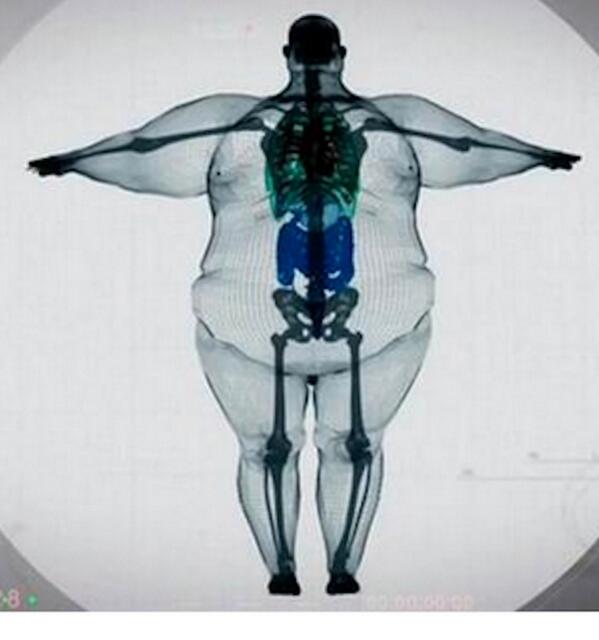
A photograph of an MRI scan that has circulated on the web for years, illustrating the fact that “big boned” is a misnomer!

There is a significant difference between being obese and being overweight. Obesity is generally defined as having a Body Mass Index (BMI) of 30 or higher. That being said, BMI is a fairly inaccurate way of measuring obesity. If you factor in my weight of 220 pounds coupled with a height of 5’7″, my BMI is sitting at 32.9, which is considered under the obese category. Anyone who has seen me in person knows that I’m a far cry from obese! Although it is a standardized form of measuring mass in the human body, it doesn’t take into account whether the weight is carried as fat or muscle. BMI is a subjective tool that has to be used in conjunction with all the other factors and assessed by your doctor.

According to a BMI calculator used on the Diabetes Canadawebsite, BMI also can’t be used for pregnant women, weight lifters, long distance runners, elderly or children. If you’re curious, the BMI calculator can be found here: https://www.diabetes.ca/managing-my-diabetes/tools—resources/body-mass-index-(bmi)-calculator

The purpose behind listing all of this is two-fold: to make people understand that being overweight is NOT what causes Type 1 Diabetes, as many television comedies or online jokes may make you believe, and that there are a number of complications that come with being overweight.

Weight gain and obesity have been linked to heart disease, stroke, gallbladder issues, some forms of cancer, osteoarthritis and gout as well as certain breathing issues and sleep apnea. The added weight one gains taxes and stresses most of the systems in the body and can lead to serious health complications. If you add that on top of having Diabetes, life becomes unnecessarily complicated. I mean, Diabetes makes it unnecessarily complicated anyway, but why make it worse?

All of these complications can be lessened and some may even be eliminated by losing some weight. The obvious steps involve a healthier diet and increased physical activity. Try to stick to foods that contain natural sugars as opposed to artificial additives and preservatives. Keep your workouts consistent, but throw in some variety of workouts to ensure you exercise all the areas of your body.

Remember, even though you should be happy with your body, health complications indicate that your body isn’t the way it should be. Consult your doctor and see what you can do to prevent these complications. ☯

Are You Down With The Thickness?

Time makes fools of us all. Not because we are fools, but because the ravages of time tend to catch us by surprise. Sometimes those ravages reveal changes we wouldn’t have expected.

It dawned on me a few days ago that we tend to photograph and document our accomplishments, but we rarely document and photograph the beginning. I have no photos of myself as a white belt.

I started karate in April of 1988. Despite my health, I was full of dreams and faith and I knew that my hard work would someday pay off. I could only speculate at how right I would become.

Three years ago, I was visiting a friend in the city whose parents were visiting. My friend’s mother made an off-the-cuff comment about how both of us had “thickened” and she would be curious to dig out a tape measure to see which one of us had gained the most weight over the decades.

Time and age catches up to us all. We don’t really have a choice; certain bodily functions tend to cause us to gain weight and our bodies to change. In fact, we tend to gain weight and lose about 8% of our muscle mass every deacde until we reach our 50’s as our metabolism slows. Fun, eh?

When I started karate in April of 1988, I weighed about 80 pounds, soaking wet. I was slight, I had very little muscle mass and my health wasn’t great.

My current stature, as of June of 2019

As of June of 2019, I weigh 220 pounds and have a significant amount of mass. This is a far cry from what started with in 1988. Sure, some of that is muscle. But some of it is a bit of the aging process.

Like I said before, we all get there. The important thing is to maintain your physical activity. This will help to maintain a healthy weight and proper physical stature as the years march on.

As I’ve gotten older, I’ve gained a lot of wisdom. If I had the physique I held in my 20’s mixed with my current physique, that would be a scary opponent to deal with. But given the current state of life, I’ll gladly accept the wisdom over the physical. ☯

Mind & Body, You Need Them Both!

The human body is an amazing combination of biological function, mixed with intelligence and self-awareness. I’ve often written about the importance of proper diet and exercise. But it’s also very important to pay attention to the mind.

First and foremost, I think it’s important to recognize the difference between the brain and the mind. The brain is the organ primarily responsible for the intellectual and nervous activity of the body. It controls the body’s systems in tandem with other, semi-independent systems within the body.

However, the mind is something slightly less tangible. The mind is defined as “the elements of a person that enables them to be aware of the world and their experiences, to think and to feel; the faculty of consciousness and thought.”

Who you are is more than just the 3-pound chunk of tissue inside your skull!

Who you are despite the state of your body is what is contained within the mind. I’ve had a saying I coined from my youth: “When you aren’t exercising the body, you must exercise the mind.” This is important because most people assume that as long as they exercise consistently, they’ve done what needs doing. I believe this to be false.

There are a number of things a person can do to help exercise the mind. Meditation is a great first step. Not only does it help lower blood pressure and help with overall cardiac and bodily health, but it can go a long way towards helping your mind as well. It can aid in maintain a good mental health and strengthen one’s focus and concentration.

Get more sleep, and be certain it’s GOOD sleep. Your brain works hard during the night while you sleep. In fact, some studies have shown that dreams are part of a thought consolidation that is necessary for proper mental health. This is where the belief that some folks have that you can “sleep on it” when dealing with life’s problems. If you don’t get a solid seven to nine hours of quality sleep at night, you may lose some of the benefits it can provide for your mind and mental health.

There are certain aspects of diet that can help as well, but I won’t get into those too deeply. That errs a bit deeper on the side of the physical brain health as opposed to the mind.

Stay healthy and happy. I don’t think I need to explain that thinking positive can go a long way towards strengthening who you are as a person. This isn’t always an easy task. Life is designed to challenge us (and it’s damn good at it).

Exercise your mind. There a lot of simple ways to do this. Read a book. Do a puzzle. Crosswords, sudoku, the choices are almost endless! It’s been proven that the more conversations you have with your child and the more books you read to them, the more intelligent they’ll grow to be. This concept applies to adults as well, despite having grown beyond childhood.

Continue learning. Most people let go of this as they reach adulthood, but a person’s IQ and intelligence never stops growing. Read the book you’ve been putting off, learn another language. All of these things can help improve your mind. Many people think that it becomes much more difficult to learn a second language once we reach adulthood, but there are actually no studies to prove this. One simply needs to put in the time.

Your mind is not only an important part of who you are, it IS who you are. So it makes sense to train and develop it the same way as you would train and develop your body. Mind & body must work together. ☯

You Put Your Left Foot In, You Put Your Left Foot Out… 🎵

People with Diabetes genuinely have a rough go at life. If it seems as though there aren’t any systems in the body unaffected by Diabetes, it’s because there really aren’t!

One of the more problematic areas where Diabetics have issues is with their feet. Because Diabetes has this nasty tendency of damaging nerve endings and restricting blood flow to extremities, folks with T1D are less likely to feel it when they injure their feet. This is what is referred to as Diabetic Neuropathy.

Because your feet are rather important for things like, you know, walking, running, standing and kicking (if you’re into the martial arts) there are many things you can do to promote proper foot health. Most of these apply to non-Diabetics as well.

Almost forty years of T1D and my feet and extremities are still in great health!

The reality is that Diabetes, regardless of the type, is the leading cause of neuropathic damage in the feet and accounts for almost 80% of all foot amputations that were not the result of a traumatic injury.

According to WebMD (obviously one of my favourite websites), your feet should be inspected daily. You want to check for scrapes, cuts, swelling and unexplained sores or ulcers.

Like everything else, keeping your blood glucose levels under control will go a long way to preventing the nerve damage that can lead to these issues. Exercise is also an important factor. Remaining sedentary for too long will increase your risk.

As much as it breaks my heart to say it, going barefoot is also a no-no. As much as I enjoy being barefooted, your feet need to be protected from debris and sharp objects, as injuries to the feet will take much longer for Diabetics, which can lead to infection and other complications. You should always wear some footwear while exercising to protect the feet and one should avoid wearing high heels or pointed toes (I guess I’ll throw mine out 😆).

Despite the light callouses due to karate, my feet are injury-free, warm to the touch and properly cared for (let’s pretend we don’t see the cuts on my shins!)

When you check your feet, they should be a normal flesh colour (comparable to the rest of your legs and body), only slightly pink and warm to the touch. You should keep your toe nails trimmed and clean and if you use lotion to help with dry skin, be certain not to apply between the toes.

If you do discover sores or ulcers on your feet, don’t try to pop them. Cover them with a bandage and wear comfortable shoes, allowing them to heal on their own. If ANY injury does not heal within a couple of days, consult your doctor or medical practitioner. There are a number of conditions or injuries on the feet that won’t go away on their own and one needs to recognize when it’s time to seek out medical help.

As usual, I like providing some of the sources where I get my information. In that respect, WebMD’s article can be read here: https://www.webmd/diabetes/caring-feet#1

As usual, even though it’s not a cure, exercise, diet and proper blood glucose levels will go a long way to prevent complications related to proper foot health. ☯

We Didn’t Start The Fire… But We’ll Sure Stoke The Flames!

I tend to be a strange creature in terms of the circles in which I travel. I tend to deal with a number of fitness and martial arts circles, all the while dealing with the Diabetic community. Sometimes the two conflict with each other. After all, there some aspects that are observed in the fitness world that Diabetics would have difficulties with.

One of those aspects involves the metabolism. To touch briefly on this, the metabolism is the chemical and biological process through which the body burns fat and processes its calories. This process is necessary for a person to stay alive, and it can be “somewhat” manipulated to help with weight loss and working out.

First of all, one common misconception is that if you want to lose weight, you should eat less. Your body needs to be fed. That HAS to happen, no matter what your goal. in order to lose weight, you need to consistently feed your body.

Don’t skip breakfast! I’m the worst for this. I usually wake up in the morning and reach for caffeine, typically on auto-pilot. But if you fuel your body right from the get-go, you’re setting the bar for how you’ll eat and metabolize throughout your day.

I’ve often heard it said that eating often throughout the day helps to keeps your metabolism fired up and will help to burn more calories. Although this CAN be true, there are some exceptions.

According to Dr. Edward Bitok with the Department of Nutrition & Dietetics at LLU School of Allied Health Professions, the preferred wait time between meal is between 3 to 5 hours. This is the amount of time required for the stomach’s contents got be emptied out into the small intestine.

It’s a bit of a balancing act, since waiting too long can cause issues such as low blood glucose, genuine hunger and other issues. But if you eat too soon, such as folks who eat every two hours, you may be eating more out of habit and cause weight gain through excess calories and such. Here’s the article if you wanna check it out: https://www.insider.com/how-often-should-i-be-eating-during-the-day-2018-5

The ideal proportion that should be on your plate. I’ll admit that I usually don’t have THAT many vegetables on my plate.

Many fitness and nutrition gurus will agrees that eating smaller, more frequent meals will help with weight loss and overall health. Waiting too long between meals will cause your body to go into a panicked “calorie storing” overdrive, since it doesn’t know when its next meal will come. Hence, one of the main reason for more frequent meals.

Here’s the fun fact: if you carb-count properly and check your blood sugars often, your choice of meal plan shouldn’t affect your Diabetes. I eat often throughout the day, although my main meals tend to revolve around lunch and/or dinner. Doing shift work can be problematic as well, since you don’t always get to decide when to eat.

Personally, I make it a point to listen to my body and eat when I’m hungry. What a concept, eh? But eating every few hours will help to ensure to stave off hunger, help to keep your metabolism fired up throughout the day and help to keep you energized for workouts and fitness routines.

Like everything else, what you do will be specific to you. What diet and meal planning one person uses may not be right for you. And if you are a Type 1 Diabetic, straying form the meal plan your nutritionist and/or dietician has set out for you may not be ideal. It may take a bit of experimenting in order to find your niche. ☯

A Mixed Bag Is Difficult To Keep Tidy…

A karate master my Sensei used to train with had a saying: “One Love, One Religion and Only one Style…” The first two are pretty self-explanatory but the third one refers to a martial arts style.

Training in more than one style of martial arts is difficult. Even if you happen to find a school that has similar styles and techniques, there will always be some inherent differences, however minor they may seem.

I’ve been doing it for about three years, at this point. As some of you may remember, I’ve been studying Okinawan Karate for over thirty years. Given that length of time, it’s safe to say that I’ve become entrenched in my techniques and how I execute them. The current school of karate I train with has some differences in their techniques as well as some stances that often seem strange and feel alien to me. But to them, it’s what they know and how it SHOULD be done.

Consolidating the two styles has been a challenge. Especially if I ever have any hope of continuing my martial arts education and obtaining my next Dan (next degree of black belt), I need to keep my techniques and forms from my home style crisp and proper. To stray from that risks making my techniques ineffective and cost me some progress.

So, which one is better? I hear a lot of head-butting comments within the martial arts community about how “my way is better” and “my technique is the proper way”… Even within my job, I’ve had a lot of debates with some people relating to what combat style and what techniques are more effective.

I think people should remember that there is not one style that is better than another. Every style of traditional martial arts has its own unique combination of factors that make it effective. And martial arts in general is very subjective to the student.

For example, Tae Kwon Do is a very effective form of Korean martial arts. But for the life of me, I would never be comfortable executing all those high-flying kicks and maneuvers. I’m simply not built for it. But the next person may take to it like a fish to water. For me, Okinawan Karate is ideal because it focuses on the use of hand strikes and grappling, allowing me to use my specific skill set in conjunction with karate techniques. But the Tae Kwon Do student may find my fighting method to be too restrictive. In a battle between the two, so long as the Tae Kwon Do student keeps me at a distance, he or she can deliver some devastating blows. But sure as the Sun rises every morning, if I get within grabbing distance, the advantage quickly becomes mine!

The point is that every style has its own benefits and disadvantages. It falls to the student to examine and try different styles until they find one that fits. That’s why there’s really no such thing as “mixed martial arts”. this is why I referred to “traditional” martial arts, earlier.

Be certain to find the style that is right for you. Then train hard within it until you achieve proficiency. Trying and/or training in a second style shouldn’t be attempted by anyone who hasn’t already reached a significant level or grade within their primary style. To do so will only serve to muddy the waters. ☯

Everyone Has A Type…

I write about Diabetes a great deal, mostly because I have been type 1 Diabetic since the age of 4, which means about 36 years at this point. Over almost four decades, I’ve accumulated a LOT of knowledge on Type 1 Diabetes, its symptoms and treatments and what you can do to make your life easier.

Something that has always blown my mind, is how little people actually know about Diabetes. Last year, just over 7% of Canadians were diagnosed with some form of Diabetes. So it isn’t like this is a passing thing.

When I was diagnosed in 1982, people believed that Type 1 Diabetes meant that your pancreas was totally dead and served no purpose. We’ve since learned that not only is this inaccurate, there are several types of Diabetes, and they differ from one another in the same way as candy bars differ from one another despite all having chocolate (See what I did there? A sugar pun…)

Here are the known types of Diabetes: Type 1 Diabetes, Type 2 Diabetes, Gestational Diabetes, Diabetes LADA, Diabetes MODY and Type 3 Diabetes. I’m gonna try and explain them all…

Type 1 Diabetes: This one is also known as “juvenile Diabetes” or insulin-dependent Diabetes. This type of Diabetes is based on the body’s own immune system attacking insulin production, which is what causes the issue. Because of this attack, the pancreas ends up producing very little or no insulin, and patients rely on insulin injections for the rest of their natural lives. There are a number of complications and issues attached to this type and it is the most well-known. But the pancreas still continues to function for other enzymes and hormones, despite this difficulty. This is also the type that I have.

Type 2 Diabetes: This one is popularly known as “adult onset Diabetes”, and the difference is that people with Type 2 experience insulin resistance or their bodies are affected in the way they metabolize glucose. What causes this type to differ from Type 1 is that obesity and lifestyle choices can CAUSE Type 2. This type of Diabetes can also be reversed, given weight loss, diet and proper treatment.

Gestational Diabetes: This one only occurs in pregnant women. It’s referred to as Diabetes because it affects the way your body uses sugar during the pregnancy. Any complications are cause for concern during a pregnancy, but Gestational Diabetes tends to clear up once delivery has occurred. That being said, it should be noted that women who have experienced Gestational Diabetes are susceptible to Type 2 Diabetes, later on.

Diabetes LADA: This is a weird one. Sometimes referred to as Type 1.5, LADA stands for Latent Autoimmune Diabetes in Adults, and holds many similarities to Type 1. The difference is that it usually occurs later in life, say after the age of 30, and can usually linger for years before insulin therapy is required. This one is often misdiagnosed as Type 2.

Diabetes MODY: This one is an unfortunate genetic gift. The acronym stands for Maturity-Onset Diabetes of the Young, and is usually considered a mutation brought on by factors such as obesity, or passed on by the patient’s progenitor. This one is subject to frequent misdiagnosis since it actually requires a DNA test to confirm.

Type 3 Diabetes: This one is linked to Alzheimer’s Disease. It involves the neutrons in the brain becoming resistant and unable to respond to insulin. This is necessary for memory and learning. There’s still a lot of research and learning required for this one, but it’s ongoing. It’s also a relatively new form of Diabetes, discovered sometime in about 2005.

There are a number of added sub-types, such as Double Diabetes, Steroid-induced Diabetes, Brittle Diabetes, Secondary Diabetes and Diabetes Insipidus. I won’t get into the details attached to these sub-types, but the United Kingdom’s Diabetes website has a great article thatbdescribes these at https://www.diabetes.co.uk/diabetes-types.html

Hopefully, this shows all my readers that there’s more to Diabetes than simply avoiding or not eating sugar. It is a complex condition that can affect a person on multiple levels. As usual, exercise regularly and maintain a proper diet, and don’t be afraid to ask your doctor about symptoms you may have that lead you to believe you may be suffering from one of the types listed above. ☯

Blood Pressure Isn’t Where You Want To Get High Score…

Diabetes is an extremely complicated condition, and it tends to affect all systems within the body. Recently, I’ve been trying to cover off the areas that seem to have the most impact. One of those areas happen to be high blood pressure.

Blood pressure is one of those enigmatic medical measurements that people generally don’t understand until their doctor tells them it’s too high. Speaking in general terms, a normal blood pressure for most people is about 120/80. This is the optimal range for people looking to maintain proper health, although your doctor will advise you what numbers are proper for your specific health and condition.

So what do those numbers mean? According to http://www.healthline.com, “the top number refers to the amount of pressure in your arteries during the contraction of your heart muscle. This is called systolic pressure. The bottom number refers to your blood pressure when your heart muscle is between beats. This is called diastolic pressure.”

Now that we have the medical jargon out of the way, how does this affect someone with Diabetes? There is a known and proven relationship between Type 1 Diabetes and high blood pressure. Having one automatically puts you at risk for the other.

Diabetes tends to cause damage to the arteries, which can lead to hardening and blood pressure issues. High blood pressure issues can lead to eye and kidney disease or aggravate an already existing condition. There are a number of other complications caused by high blood pressure that can be read on WebMD at https://www.webmd.com/diabetes/high-blood-pressure

There are a number of easy things you can do to help with blood pressure levels. Eating healthy and exercising are obvious steps. Maintaining your blood glucose levels and keeping your weight down can also help.

Your medical practitioner may also chose to put you on preventative blood pressure medication. Although I’m not a big fan of taking medication that isn’t needed in the immediate moment, this is one of those rare exceptions that prevention is best. I, myself, am on Ramipril, which is an ACE inhibitor that helps to treat high blood pressure.

Readers will likely notice that eating healthy, exercising and maintaining good blood glucose levels are the aspects I keep repeating over and over. But those three steps will certainly lead to an easier life when dealing with type 1 Diabetes. ☯