Dance Your Way Fit

You all know I enjoy writing about different fitness routines and how they came about. I especially enjoy trying these fitness routines, as it’s important to experience a healthy variety in order to keep yourself motivated. Sometimes, a good workout routine can be something completely unexpected and happen by accident. As long as you’re willing to keep an open mind, you might even find something you enjoy and would start doing regularly.

This is where Zumba comes into the picture. Zumba is a fitness program that combines dance and aerobics and was created in the late 1990’s when a Colombian fitness instructor forgot the music for the class he was teaching. He popped in some of the salsa music he had in his bag instead, and danced his way through the fitness class. It didn’t take long for the fitness craze to catch on and as of recent years, there are millions of videos, apps and classes all over the world.

I was first introduced to Zumba back on 2014. I owned an XBox 360 and had just purchased the Kinect adaptor, which is a sensor bar that allows you to play games using body movement as opposed to a controller. One of the games we got with the Kinect was called “Zumba Fitness.” Since we lived in a small town with effectively nothing to do at the time and I used to make my wife suffer through many of my workouts, she had me try the game out with her. Even if it was just a video game, it didn’t take me long to work up a sweat.

I love dance and I admire anyone who studies it for fitness or as a lifestyle. In fact, something that few people know about me is that I actually took professional dance lessons when I lived in Ottawa. Karate was definitely helpful in keeping my balance and remembering the structured routines required for some of the dances I was taught. Zumba is kind of up that alley, mixing dance with increase aerobic movements.

What I can appreciate about Zumba is its different approach to fitness and the fact that it keeps things interesting. It only took a few moments for me to be completely drenched in sweat when I tried Zumba, and I was taken aback by how challenging it was. The concept involves a set of specific core movements, but their combination and use can vary greatly with each class you participate in. You can do it in the privacy of your own home by purchasing DVD’s or enjoy the group dynamic by participating in classes. And classes have a crazy variety, as well. There are routines for all age groups, routines done in water or swimming pools, routines done WHILE performing HIIT or circuit exercises and even some programs to help with eating habits.

If you’re looking for something different to change up your routine, something that can get that heart rate up, burn calories and tone you up, Zumba may be for you. Listen to me, I sound like a damn infomercial! But in seriousness, variety is the spice of life so don’t be scared to try out different fitness routines. Hell, the creator of Zumba invented it by accident! So who knows what you might discover if you keep things varied? ☯
There Are No Cookie-Cutters In This Dojo…

I remember the first week that I opened my karate school’s kid’s class as a junior instructor. Boys, was I nervous! I’m not really sure why; I was qualified, well-trained and they were kids. I was in my late 20’s and there was nobody in the class older than 13 years old. But there was something particular about teaching the first class in “my” school. It only took a couple of weeks to find a groove and begin feeling comfortable with classes. And only a couple of months AFTER that for me to realize that teaching karate is not all it’s cracked up to be…

There’s a certain prestige that comes with being able to teach something to someone else, especially in the martial arts. After all, if you’re teaching someone else it probably means that you’ve learn said skill to a sufficient level that it allows you to pass on that knowledge to someone else. I had been a been a black belt for a few years at this point, and already accustomed to leading the class whenever Sensei would request it. But this would be my first foray into being the focus of attention if/when students or parents would be displeased about something.

Now, don’t get me wrong! I can deal with complaints with the best of ’em. After all, I’ve got years of management experience in retail, food service and public sectors so dealing with customer complaints is no problem. But karate is particular, because it’s personal. It’s not a job, it’s a part of my lifestyle that I not only study but thoroughly enjoy. And I’m not well-known for my ability to put up with other people’s bullshit. Enter: the league of disgruntled parents…

By the time the kid’s class had been up and running for six months, a few of my students had graduated a yellow stripe or two. My particular system has a LOT of yellow stripes for kids prior to testing for yellow belt, which is a good way to keep them focused and motivated. One of the disadvantages of opening a school from scratch, is that everybody starts off as a white belt and there’s no established belt hierarchy in place. This can be a good thing or a bad thing. It’s good in the sense that you don’t have to worry about branching off your teaching to accommodate the different ranks. It’s bad in the sense that the first people to promote usually set off alarm bells in others.

Sensei and I had agreed from the very beginning that as a junior instructor, I would teach the class while he tested for stripes. I would assist him with belt tests, but until I developed my teaching legs, he would deal with pulling out the students who were progressing and issue the stripes as required. That was an easy agreement. But as a few of the students climbed in rank, the ones who didn’t began to question why they didn’t. This concern was obviously passed on to their parents who apparently felt this meant their kids were being ignored. Can you guess what happened next?

I began receiving phone calls and having parents confront me in the dojo, questioning my audacity in promoting other students but not their kid, especially when everyone had started at the same level. These were some of the same parents that would often bring food or drinks into my dojo, take phone calls or carry on conversations at the back while I’d be trying to teach. I believe in picking one’s battles, but these are issues I had to discuss with them on previous occasions.

I tried explaining to these parents that every child is different and that every child learns in a different way and at a different pace (a lesson the public schools should no doubt adopt) and that stripes would NOT be issued if a particular student had not reach the required skill and knowledge level associated with it. This was like throwing gasoline on a campfire and caused further indignation from parents. Although we were still a few years before the true advent of the snowflake and parents who believe their kids can do no wrong, these parents were clearly adamant that the promoted students were no better skilled than their kids and that it wasn’t fair of me to promote some and not others.

I closed out the argument by explaining to the parents that karate was not a generic skill and that there were things the students could do on their own time in order to improve and help ensure promotion when the time came, but that it wasn’t fair to the students or my school, in fact, for me to issue a promotion someone hadn’t earned. This led to all sorts of threats about pulling their students out and enrolling them elsewhere, to contacting the parents of students who had promoted and a score of other idle threats to ludicrous to repeat.

Between these issues, which unbelievably never really went away, and the fact that I moved to Ottawa about six months later led me to close the doors of my kid’s school. That’s one of the benefits of not doing it for a living; you can close your doors without destructive repercussions. It was unfortunate for the kids more than anyone else, but it was also a sad mix of behaviour on the parents’ behalf, who should have been supporting the growth instead of trying to influence it. Some of the kids transitioned into the regular class and continued to train, so it wasn’t a total loss.

Folks, karate is not a cookie-cutter art. What this means is that if ten people started karate at the white belt rank today, you will see ten different people at ten different skill levels and likely ten different ranks. This is because each and every person is different and every person learns and absorbs information in a different way. if you’re studying the martial arts, it’s important to remember that even if someone progresses to a higher rank than you, it doesn’t mean they’re “better” than you, it simply means that you need to grow in your way. Every person’s martial arts journey is their own. ☯

An Attack Is Only As Good As The Result

I’m a bit of a weird contradiction when it comes to action movies. The guy in me absolutely loves the action, the plots and the effects. But the martial artist in me usually hates how a fight is actually portrayed on shows and movies. You know how it is… The protagonist and the antagonist square off, maybe circle each other for several minutes minutes exchanging sarcastic quips about who will kick whose ass… Then they spend the last twenty minutes of the movie locked in a heated exchange of strike after strike to each other’s head and body, most of which would have crippled a normal human being after the first or second strike.

Yes, a good action movie is fun and all. But the reality is that a fight will not only NEVER last as long as they’re portrayed, but if someone spin kicks you to the head, it’s pretty unlikely that you’ll just whip your head to the side, wipe the dribble o blood off your chin and keep fighting! The safe bet is that you’ll drop like a bag of sand, unconscious or stunned beyond the ability to continue. THAT’S reality. But actual full-contact fighting will also cause injuries to the person doing the striking.

I’ve written about this before, but let’s take a good old fashion punch to the head as our example. If you strike someone to the head with your fist, you’ll injure your hand. Notice that I didn’t say “might.” You WILL injure your hand in some way, shape or form. On the milder side of it, your knuckles will get inflamed and possibly swell. At worst, you may sprain your wrist, fracture some carpals or flat out break your hand. And that’s if you’re lucky. Most people have a hard head. A fist is comparatively smaller. Maybe go for an elbow strike instead. Yes, you’ll have to get in closer but you’ll also increase your chances of preventing injury.

That’s just one example, but this concept applies to just about any attack you use on another person. Unlike the movies, getting punched to the head will put you down. But you’ll also get hurt in the process. Unless your wrists are wrapped and you’re wearing padded gloves, the chances are slim that you’ll get multiples hits in without injury. Throwing a proper strike takes technique and precision, which can only be achieved through drills and practice. This is why we do form and work out in a dojo, so that muscle memory kicks in and your strike will be effective.

True self-defence isn’t about a long, drawn out battle or fancy techniques that look like they belong on the big screen. This is one of the reasons why there are so many videos circulating about people exposing “why martial arts don’t work.” It’s not that they don’t work; it’s that people have a skewed misconception about how martial arts would actually be used in a real fight. Self-defence is about protecting yourself and others, and being the one who walks away. ☯

It’s a HIIT…

It’s no secret that I love a little variety in my fitness routines. I’m pretty sure that I’ve tried it all… Cardio, Zumba, Tai Chi, Weightlifting, Cross-fit and many others… I’ve never been afraid of trying anything new and/or different when it comes to my fitness. After all, one could potentially discover a new fitness routine that’s loaded with fun, health and fitness benefits.

Enter: the HIIT workout. For those of you NOT in the know, HIIT stands for High-intensy Interval Training and features (as the name suggests) intense intervals of cardiovascular exercise mixed with short rest periods. These workouts usually let about half an hour, although some of them have been known to last a bit longer, depending on one’s endurance and fitness levels.

HIIT workouts can have a number of benefits, including fat burning, muscle gain and improved blood sugars. But I’m going to focus on 7 benefits of High-intensity interval training as discussed in an article posted by Heathline.com:

  1. You can burn calories quickly in a short period of time: This is one that’s come up in most of the articles I’ve read on the subject. And the general consensus is that you can burn more calories in less time during a HIIT workout than you would with something traditional like cycling or weight lifting;
  2. Your metabolic rate remains high for hours afterwards: an increased metabolism will lend a score of benefits that I won’t bother covering in this post, but a HIIT workout will do it for you. In fact, it will do it more effectively than other traditional workouts;
  3. The fat-burning benefits: Okay, I’ll be the first one to admit that fat-burning is not only one of the most sought-after benefits of any fitness regiment, I’ve often written about how no matter what “gimmick” workout you may doing, there is only one way to effectively burn fat: to burn more calories than you take in. However, a study named in the article I linked above showed a 17% reduction in visceral fat, or the disease-promoting fat surrounding your internal organs, when doing HIIT workouts;
  4. You could gain muscle: Alright, I won’t touch on this too much because the reality is that any consistent and intense workout regiment will help you gain muscle. This shouldn’t come as a surprise. And a “high-intensity” workout would be no different…;
  5. It could improve your oxygen consumption: In this regard, they’re referring to the fact that HIIT workouts will help your muscles to use oxygen more effectively, and will do so in half the time of a traditional workout;
  6. It can reduce heart rate and blood pressure: This has been shown to be prominent mostly in overweight and obese individuals, but it’s an important health benefit nonetheless;
  7. It can help reduce your blood sugar: Seriously?! Woohoo to that! being a Type-1 Diabetic, I’d rather have to consume carbs than burn them. Research has shown that HIIT workouts can not only be extremely beneficial to those with Type-2 Diabetes but can help to improve insulin-resistance.

The good thing about HIIT workouts is that it allows you to reap the benefits of most standard workouts in only half the time. Like any workout, you should consult your medical practitioner before starting ANY fitness regiment, and pay close attention to how a change in fitness routine affects your blood sugars. After all, variety may be the spice of life, but Diabetes will keep you seasoned with complications. ☯

The Next Milestone…

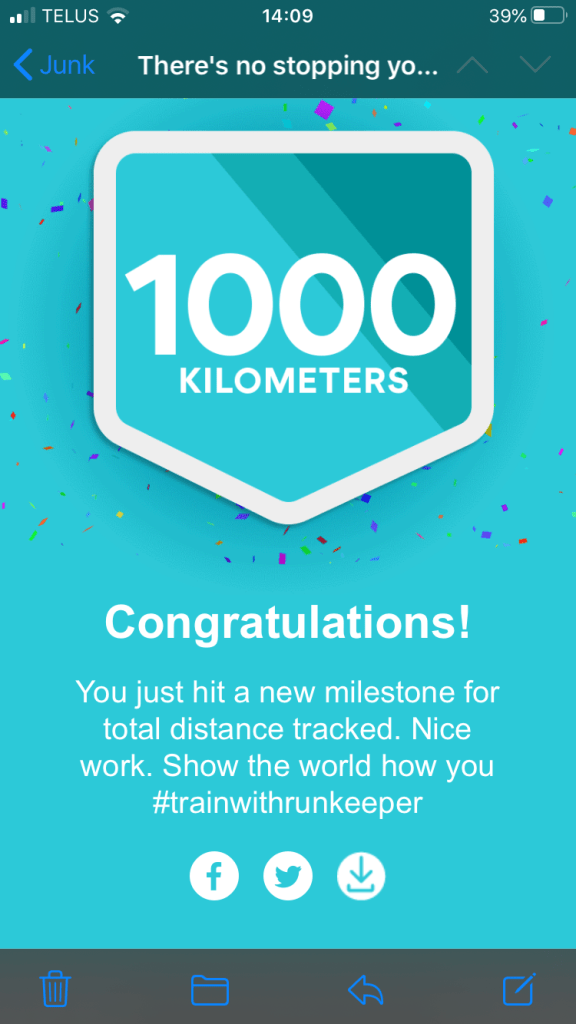
So after using yesterday’s post to bitch, whine and complain about Mother Nature’s unending use of the Prairie Provinces as her personal whipping ground with the non-stop wind, I got an e-mail from my RunKeeper app yesterday indicating that I’ve apparently hit 1000 kilometres this year!

I had some recent issues with my workouts not syncing up to my RunKeeper account, so even if I’ve been counting the number of workouts I’ve been doing per week, none of the statistical stuff has been uploading. I sent in a message to their support link and got a solution the same day. Once I cleared the syncing error and all the workouts synced, I got a batch of emails. One of them was the image you see above.

Considering I reached the 500k mark back in late May, I’m somewhat surprised that I got here this quickly. But either way, it feels nice to be up in the thousands. It will be interesting to see how many more kilometres I can rack up before the colder season kicks in and the snow hits the ground! ☯

Push Without Moving

There’s certainly no lack of different exercises and fitness routines out there. And I usually like to try them all. I’m not saying I stick with everything I try, but variety is the spice of life and what successfully works for one person may not be effective or successful for another. This is why it’s so important to keep an open mind and try different things. This is why the focus of today’s post is an exercise method used by one of the world’s most well-known martial artists: Bruce Lee.

Even if you’re not into martial arts, the safe bet is that you’ve at least HEARD of Bruce Lee, who can be recognized for his speed and martial arts prowess as well as his lean, muscular physique. Lee was a practitioner with very much the same mind set as my own, that the martial arts is a fluid and evolving thing and one needs to keep an open mind and try different things. One of his preferred methods of exercising, besides all the extra stuff he did, was isometric exercises.

In case you’re unfamiliar, isometric exercises are exercises that are performed by contracting muscle groups without moving the specified body part. And example of this would be to place your closed fist against a solid wall and pushing hard. The muscles on your arms will contract and flex without any full movement of the arms (unless your wall caves in, in which you’ve got bigger problems to worry about than fitness!)

Isometrics is an interesting concept, especially if you want to do some strength training but don’t have the room in your home for a weight gym and/or can’t afford a commercial fitness centre’s outrageous monthly fees. For myself, I especially like certain isometric exercises, because they allow me to get some rudimentary strength training in, considering my propensity for selling and/or eliminating all my belongings.

But like everything else in life, there are pros and cons to isometrics, and that’s what I’d like to cover today. I’ll start with the pros, since it’s always more fun to start with the positive:

  1. You can strength train with minimal space: Like I mentioned above, isometric exercises allow you to flex and contract your muscle groups without moving your body. You can do this with the majority of your body’s muscle groups, and you can easily find a batch by searching Google for “isometric exercises”;
  2. It strengthens your muscles rapidly: Isometrics essentially forces you to keep your muscles contracted for a longer period of time than a traditional weight exercise. This means that your muscle is providing a maximum effort for a longer period, which is what causes the muscle damage needed to increase strength. You may only have a second or two of “max effort” during a traditional exercise, but if you hold the pressure during the isometric equivalent for 8 to 12 seconds (which is what’s suggested on Bruce Lee’s workout website) you increase that max effort tenfold;
  3. Isometrics can be done while injured: Now, take this one with grain of salt… I often mention that I’m not a doctor, and I am NOT advocating that you work out while you are injured. But given the nature of this type of exercise, it can be performed without any movement, thereby ensuring you don’t aggravate the injury while continuing your strength training.

Now that I’ve covered off some of the pros, let’s look at some of the cons behind isometric training. I found most of this on the Mayo Clinic’s website, with some of my own thrown in as well.

  1. Isometric training provides limited strength range. Because your limb is sitting in only one position, it’s only strengthened in that one position. One would need to perform isometric exercises in various positions with the same limb in order to improve your strength throughout its full range;
  2. Isometric exercises ONLY improve strength. According to the Mayo Clinic article, “since isometric exercises are done in a static position, they won’t help improve speed or athletic performance.” This means that it’s extremely important to include other types of physical exertion in order to ensure you gain the full benefits of working out;
  3. Isometric exercises can raise your blood pressure. Isometric exercises can increase your blood pressure, and can cause a dramatic increase if you already have high blood pressure issues. So you either need to exercise at a lower level of intensity or check with your medical practitioner before getting too deeply into it. Of course, you should consult your doctor before starting ANY radical change in your workout routine.

There you have it; some good and some bad. A balance, if you will. As should be the case with all things in life. Isometrics looks pretty interesting, and I look forward to trying it out in conjunction with my other stuff. It’s particularly good for people who work at a desk over long hours. It’s super easy to tense, hold and release your abs, gluten, arms and legs while sitting at one’s desk.

The arms might be a bit problematic, especially if you have to, you know, consistently type and stuff… One of the best aspects about fitness is that there’s always something new to learn and try. Everyone is different, so it’s important to find something suited to your likes and needs. ☯

Blood, Sweat And Heat 🚲

Wednesday night, I did something stupid… If you know me, you may be thinking that this is nothing out of the ordinary and that I do stupid things all the time. If that’s what you’re thinking, shaddup! But you may be right. But the reason behind why this thing I did was so stupid isn’t because it was an inherently stupid act, but because the heat and humidity almost killed me in the process (not literally, but it felt like it!)

On Wednesday, my wife and I were prepping supper and I told her that I wanted to duck out to cycle a quick 10 kilometres before receiving a potential buyer for my car (yes, I’m selling my bachelor-mobile and I’m crying a bit. Something for a future post…) I told her that I needed to blow the cobwebs off as I haven’t done anything but forms and walking for the past two weeks.

This was mostly due to the flooding in our basement eliminating access to my karate area and punching pad and extreme heat making conditions unfavourable for long-distance cycling. I figured that a quick, 10-kilometre ride would only take me a little over thirty minutes anyway, so why not drop the hammer a bit. I think you know that I had to up the ante a bit. After all, this is me…

I told my wife that I intended to cycle my 10 kilometres in twenty minutes as opposed to my usual thirty. In reality, it takes me 3 minutes and 10 seconds for every kilometre when i’m cycling for distance, which means I reach 10 kilometres in about 32 to 33 minutes. I would have to shave 12 to 13 minutes off that time in order to achieve my boast (I mean my goal).

I put in my earbuds and hammered out of my parking lot like a bat out of hell… And promptly realized that the result of not doing any serious cardio in two weeks then pushing it in 32-degree weather was a stupid idea for a Type-1 Diabetic man of my age… And then I realized that this thought pissed me off and I should be ashamed of myself and pushed myself ridiculously.

And lo, I hammered through 10 kilometres of sweaty hell, my lungs on fire and my mind focused on trying to achieve that distance in 20 minutes. Every time the landscape sloped upwards, I felt as though my legs caught fire and spit the flames into my lungs. With every inspirational song on my phone, I pushed and peddled harder, despite the discomfort.

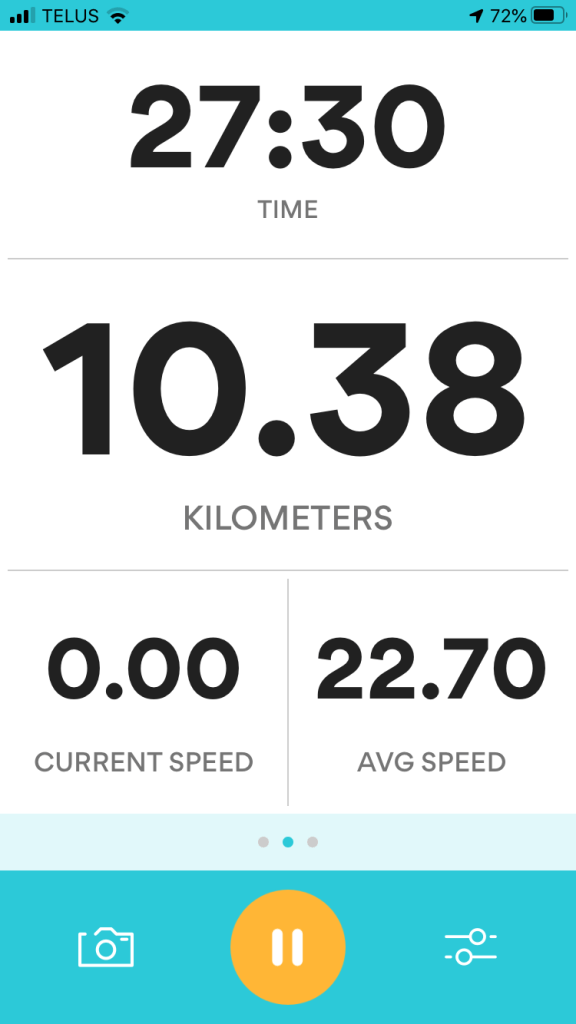
I managed to make my way home after hitting 10.38 kilometres in 27 minutes and 37 seconds. This meant an average of 2 minutes and 39 seconds per kilometre. A measurable reduction from 3 minutes and 10 seconds. However, I paid for it. I woke up the next morning with my legs killing me. I need to hammer out more of these explosive short rides. They have some benefit, despite the fact that I’m training for distance, not speed. But maybe I shouldn’t do it in high heat… ☯

Concentration Goes A Long Way

It stands to reason that over the decades, I’ve been asked about karate and the martial arts on a number of occasions. Many people have made a point of saying that they could never do what I do, as they don’t feel as though they have the physical abilities or the patience to do so. I usually try to explain that there is no specific physical pattern one must have to study the way, and I’ve trained with people who have had debilitating conditions and they’ve still gone on to become skilled martial artists.

Despite this fact, most people are of the opinion that the martial arts is a level of fitness that they could never achieve. The truth is, my body was essentially giving out on me when I started karate. But I stuck with it and thirty-one years later, I have a better constitution than most non-Diabetics of my age group who haven’t studied martial arts. But the biggest question during these conversations is usually what does it take? It often goes a little something like this:

“So you do karate, huh? I could never do that…”

“Why Not?”

“I don’t really think I’ve got what it takes to train in karate…”

“And what, exactly, do you think it takes?”

“I don’t know, I assume you need to be physically fit?”

“Nope.”

“Do you need to be strong?”

“Nope.”

“Well, if you don’t need those things, then what does it take to study karate?”

“Commitment and concentration. With those two things, which anyone can have, you can be successful in the martial arts.”

Now, this is a generalized conversation, of course. But it’s usually the gist of it. I’ve had some colleagues and students watch me when I use a punching bag or practice my forms and I’ve even had some ask me how I put so much power into my strikes. In recent years, this would be where I would insert a Mark Ruffalo joke about how “that’s my secret, I’m always angry.” But I usually like to use the analogy of a bullet versus a fist.

A bullet is a minuscule thing. It usually weighs in at about 40 grams or more depending on the size and caliber, and doesn’t really seem all that intimidating when it’s sitting on a table. If I were to pick up that bullet and flick it at you, it would bounce harmlessly off your chest and fall to the floor. For the most part, a bullet in and of itself is pretty harmless.

But take that same bullet, wrap a bunch of gunpowder behind it and ignite that powder and that same 40 grams of lead will be propelled at about 1,400 feet per second. At that speed, the bullet will penetrate flesh, bone and even some solid structures. The “minuscule” object that was harmlessly flicked at your chest in the previous paragraph is now capable of serious bodily harm. Doesn’t seem so harmless now, does it?

The same can be said of any technique you train with in the martial arts. When you train constantly and consistently, focusing on your form, technique and speed, the size of your bicep really doesn’t matter in terms of what physical power you exert. It all comes down to physics and Newton’s Second Law (F = ma). That formula basically means that an object’s Force (F) is equal to its mass (m) multiplied by its acceleration (a). It doesn’t take a math whiz to acknowledge that the greater the acceleration, even if the mass doesn’t change, the greater the overall Force.

This is why I usually tell people that their current physical state is never a reason NOT to try the martial arts. I know that when you see martial arts’ movies with actors like Jean-Claude Van Damme, you tend to assume that the musculature is a necessary aspect, but it really isn’t. In fact, if you check out any footage of Shaolin monks, they’re generally of average musculature. So the harder and faster you throw the punch, the better and more effective it will become. Same with your kicks and any other striking technique.

I’ve seen people with terminal cancer, heart issues, colostomy bags and even artificial limbs train in the martial arts and even go on to achieve a black belt. One good example of this would be Shoham Das, a young boy I wrote about some time ago in a post entitled Half A Heart, All Of The Will who literally had a piece of his heart missing but trained consistently and has gained black belt level.

The bottom line is that anyone can train and achieve the level they want. All it takes is the commitment and concentration required to keep going, even when it gets tough. This is what martial artists are referring to when they say “mind and body.” If you think you don’t have what it takes to do martial arts but you’ve always wanted to, you should give it a try. You might just surprise yourself. ☯

Slow And Steady Wins The Occasional Race

You know, they say that good things take time and that patience is a virtue. Yeah,… I’ve heard that on occasion. I’ll be the first to admit that I’m usually more of a proponent of hammering through at top speed. Going cycling for 60 kilometres? Nothing slower than 3 minutes per kilometre is acceptable. Practicing karate forms? Maximum strength and maximum speed! If I ain’t sweating, I ain’t happy!

But on occasion, going slowly can be a good thing. Whether you’re weightlifting, doing martial arts or learning a new fitness routine, there are a number of benefits that can be enjoyed if you just take your time and go slowly. According to an article I just read by Fitness Republic, lifting weights slowly can help you to prevent injury, help to maintain your form and people with minimal muscle mass or medical conditions can do it much easier than if they’d be expected to go at normal speed.

One of the key points is that it can also help you to build larger muscle mass. The thought behind this is “[…] lifting slowly forces your muscles to hold the weight longer. […] If you go faster, momentum will do a lot of the work for you, and your muscles will be active for a shorter amount of time.” In fact, the article goes on to explain that lifting slowly will also target your skeletal muscles, which are essential for everyday movement.

I’ve read a few articles where this is the focal point, and most of them agree that slow movements can be beneficial. I became curious about this after my latest MetaShred workout entitled Thermogenic Tempo Training. The workout had you do a set of six different exercises. During the first cycle, you’d lift slowly, hold and release. Then repeat. On the next cycle, you’d lift, hold and lower slowly over several seconds. The third set had me lifting and lowering slowly.

You wouldn’t think that doing exercise slowly would be challenging, but it was gruelling! I had sweat dripping off my forehead in no time. Now, I’ve begun incorporating this process with some of the more basic exercises I perform: squats, push-ups, etc… You ever try to do more than ten push-ups where it takes you several seconds to reach the floor and come back up? It’s painful as hell, and I’ve grown accustomed to doing dozens of push-ups at regular speed but I sure as hell can’t get past ten going slowly. At least not yet.

Without even realizing it, I’ve been training with slow movements all my life. From my very first day in the dojo, I’ve practiced forms and techniques slowly until I grew accustomed to them and could begin to perform them faster. And even to this day, I’ll perform katas slowly and methodically in order to ensure proper form and technique.

Hey, there’s nothing wrong with doing a fast-paced workout. But not every workout needs to be a spine crushing cross-fit style lightning round. Sometimes, as with many things in life, it’s better to slow it down and take your time. It doesn’t mean you aren’t still putting a maximum effort into it; it simply means you’re doing it a slightly slower pace. ☯

If You Don’t Like It, Then Split!

It should go without saying that if you train in the martial arts, you’re going to get hurt. It isn’t a knitting class, so you should expect that at some point in your martial arts career, you’ll take a hit. Even for people who have been training for decades, mistakes and accidents can happen. I’m reminded of last year, when one of the fellow black belts in my club cracked me in the nose with an elbow. It stunned me and my nose started bleeding, but I was lucky enough that he didn’t fracture or break it.

Whether by accident during drills or because you zigged when you should have zagged, getting hit is the LEAST of the injuries you could suffer while doing most traditional martial arts, such as karate. I’ve had pulled and torn muscles, damaged ligaments, bruising, hairline fractures and a score of other injuries too numerous for me to name or even remember after thirty-two years of Okinawan karate. But these injuries were sustained due to the necessary aspects of karate that I had to learn, and were mostly accidental.

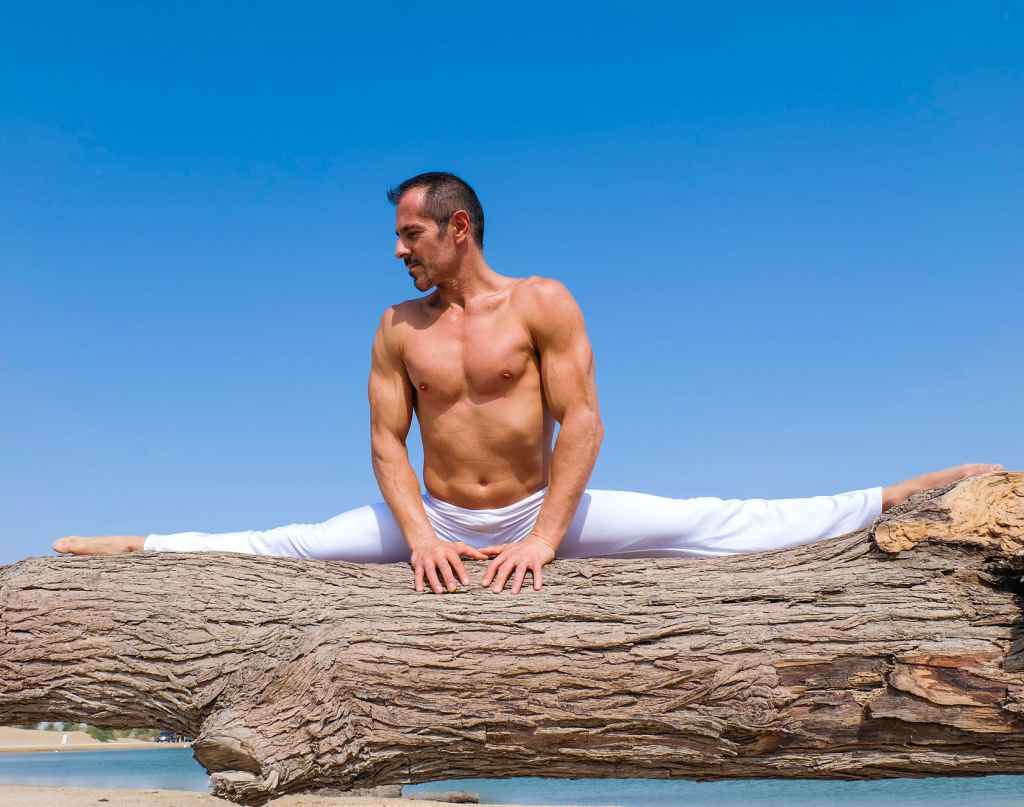
This is where we discuss what is, in my opinion, one of the most WORTHLESS movements taught in the martial arts: the splits. Surprisingly, there are a number of styles that teach and train with middle splits. Just to be clear, a middle split is the one illustrated above, where you open the legs and hips and lower yourself down to the floor and come to rest on your inner thighs. Although this type of split is generally used in things like gymnastics, it’s also considered a staple in certain martial arts styles that use high kicks, such as Tae Kwon Do.

Don’t get me wrong, Tae Kwon Do is an excellent system (for those it suits) and is absolutely challenging. But I’m a realist and I believe in always examining how effective any technique would be in a real-world application. It’s always fun to learn fancy and flashy techniques that look god in the dojo, but why learn self-defence if the technique you’re practicing can’t be used to, well… defend yourself?

This is where the splits start to give me problems. There is, honestly speaking, no practical application for a full split in the martial arts. Right about now, I can almost hear the chairs of every martial artist reading this, creaking in protest as they hold up their hands and say, “Now, hold on just one damn minute…” But bear with me for a moment as I explain my logic behind this assertion.

We’ve all seen the splits done, either on television or in movies. Some action heroes have even contributed to the wow factor behind doing the splits (I’m looking at you, Van Damme!) and it’s almost exclusively for practitioners who perform high-flying or fancy spinning kicks. And even though we can all agree that receiving someone’s heel to your face after they’ve spun it around once or twice would be an effective deterrent against your continued consciousness, these high kicks come with a batch of problems of their own.

A traditional martial artist will tell you that the smart money is on keeping your kicks no higher than the waist or lower abdomen. the reason for this is pretty simple. If you kick any higher than that, you’re shifting your centre of gravity and putting all of your weight on one foot. For anyone who’s ever been in a fight, I don’t need to explain why this is a bad idea. It opens up a plethora of vulnerable spots EVERYWHERE on your body and leaves you open to getting your ass kicked. High and spinning kicks may be great for breaking boards in the dojo, but they serves very little purpose in actual self-defence.

Next, there’s the issue behind how this split is accomplished. You’re asking something of your body that it wasn’t designed to do. Our bodies aren’t designed to split open at the hips the way is required for a middle split. I mean, you have just about all the different tissues involved in that one movement: muscle, tendons, ligaments… You name it. Not to mention the hip joints and surrounding bones. And most students want to progress as fast as possible and often find themselves taxing their body before it’s ready.

Although some medical sources advise that doing the splits is generally okay, any medical source I’ve read has indicated that the most important aspect is to ensure that you work at it slowly and progressively, accepting that it may take weeks and even months to accomplish a middle split. If you ever do at all. I can split to about half way down to the floor and that’s it. But then, I enjoy and appreciate my groin and don’t want to cause it any damage.

If you’re new to the martial arts and the curriculum requires a full split prior to promoting to a certain belt, be sure to take your time. Stretch properly and work at it slowly. If you’re training for the actual purpose of defending yourself, maybe accept that this style isn’t the one for you and look elsewhere. There are already likely to be numerous injuries in your future without causing the intentional ones. No need to hurt yourself intentionally. ☯