Can You Fight With No Hands?

When the average person hears the word “karate,” they picture kicking and punching. This stands to reason, since mainstream cinema has provided that portrayal for decades. But martial arts is so much more than just kicking and punching. There’s an entire way of life behind it; and knowing its proper application is just one piece of the puzzle.

“Before I Learned The Art, A Punch Was Just A Punch, And A Kick, Just A Kick. After I Learned The Art, A Punch Was No Longer A Punch, A Kick, No Longer A Kick. Now That I Understand The Art, A Punch Is Just A Punch, A Kick Is Just A Kick.”

– Bruce Lee

I’ve been doing Okinawan karate for over 32 years, and I’ve learned a great deal. I’m still learning. Despite that fact, my abilities within the art have limitations. Like anything else in life, there are aspects I’m quite good at and some that I’m NOT so good at. One of those aspects happens to be kicking. Kicking is a bit of a strange creature, in my opinion. Although stronger than punching and in some ways more effective, there are inherent risks involved.

My style of karate has taught me never to attempt a kick above the waistline. That may seem pretty restrictive, but why would you risk trying to put your foot that high when you have two very effective arms that can do the damage without compromising yourself. A real fight isn’t like what you see in the movies; opponents don’t spend forty minutes exchanging devastating blows to each other’s bodies and heads with only one winner declared once the penultimate strike is delivered.

In fact, any serious impact to the head will cause dizziness, nausea and disorientation. The recipient will likely be on their ass for a day or more before they’d be ready to do anything more than wipe their own backsides. That’s the difference between what you see in the movies and real life. The human body has backups and defences that prevent sustained battle when you get kicked in the head. But I digress…

A proper fight, even in the street, requires a combination of balance mixed with techniques and attacks that won’t compromise you. Your legs should be squared in such a way to maintain proper balance while allowing fluidity of movement. This is something that can really only be achieved after serious hours of intense training and development. You have multiple striking weapons on your body that allow you to effectively deliver attacks without compromising your balance and stance, including your fists, elbow, knees and forehead (a headbutt is a fantastic thing, but that’s for another post).

People see a lot of fancy, high-flying kicks in colourful styles like Tae Kwon Do. But these kicks are reasonably useless, unless you’re fighting someone who’s willing to sit there and take it. Let’s look at the illustration above. This is a free stock image of a kickboxing match. To the average spectator, this likely looks reasonably impressive. A nice high kick, poised to strike his opponent’s head.

Want to know what I see? I see an exposed groin. I see a lack of proper balance on the red guy’s part, due to the supporting foot being on its fuckin’ tippy-toes. And I see the guy in blue, ready to bob his head down and deliver a nice, devastating blow to the red guys’ groin. Obviously, this is a professional fight and a groin strike wouldn’t be permitted. But I deal with the real world, not organized fights with referees. The blue guy can take his sweet time striking anywhere on the red guy. Or better still, he can simply grab the leg and push back. This will throw the red guy completely to the floor. And as anyone who has watched an MMA match can attest, falling to the ground and having someone else come on top of you is usually the end of the match.

In Okinawan karate, we focus mainly on front kick to the abdomen, roundhouse and blade kick to the legs and knees. We let our hands do the work, if it involves the upper body. There’s just too much risk of injury, in any actual fight. And although I don’t advocate fighting, if you must fight, you must win. Anything else is simply not acceptable. ☯

It’s Okay To Skip A Step…

I hate cardio. This probably comes as a surprise, coming from someone who believes that if you aren’t dripping in sweat when you’re done, it wasn’t a workout. And the truth of it is, I do enjoy cycling. But that’s mostly because it allows me to get outside, reconnect with nature (to a degree) and keeps the cardio aspect buried in the background. The best of both worlds. But to say that I’m heading out for a run or doing cardio for the sake of doing cardio would be a stretch.

Cardiovascular endurance training is important for one’s health. According to an article posted by the Mayo Clinic, cardio exercises help to strengthen your heart and muscles, burn calories, help control your appetite, increases sleep, promotes joint movement and helps to manage Diabetes. Cardio can be a long-term or long-distance thing, like long-distance cycling or swimming 30 laps in a pool, or something incorporated into a weight or resistance workout, such as jumping rope.

Jumping rope is an easy, convenient way of including some light cardio into your workout routine. I’ve kept a jump rope in my gym bag for the past ten years, and I make use of it whenever I get the chance. Jumping rope can burn a wicked amount of calories; several hundred calories in a 15-minute period, in fact. It can help improve overall balance and coordination, not to mention that the heart benefits are the same as with traditional cardio. And although it can be taxing on the knees and leg joints, doing it properly is considered a lower-impact than something like running.

I like to incorporate it by using it with circuit or interval training with karate techniques. For example, I’ll do a minute of front kicks, followed by a minute of high-speed jump rope. Then a minute of the next kick and a minute of high-speed jump rope. So on and so forth. Sometimes I’ll simply use it as a warm-up or a cool down. A good quality jump rope is portable, convenient and low-cost. You can stuff it into any gym back or backpack and all you need is about a 25-foot square of space.

As much as I dislike cardio, it is a necessary aspect to proper health and fitness. And there’s no denying that it also helps with the blood sugar control and sleep quality required for someone with Type-1 Diabetes. If the last time you used a jump rope was during a spirited game of double dutch during your school years, you’ll want to start slow and ensure you do it on a stable surface. Avoid grass or carpet as it can snag the rope or catch against your footwear. ☯

Chishi! Gesundheit!

The martial arts can incorporate some pretty eclectic training techniques that can often appear strange or unusual to those who don’t use them. Often, certain techniques or training tools may remind us of the Karate Kid’s Mr. Miyagi, teaching Daniel karate by having him perform yard chores. Although I wouldn’t recommend trying to do karate against an opponent simply because you’ve been waxing your car or painting your fence all summer, there are some atypical things that traditional, Okinawan karate styles employ. Enter: the Chishi.

And no, despite my comedic title, it’s not the sound of someone sneezing. The Chishi is an Okinawan training tool used in Hojo Undo, which basically means “supplementary exercises.” It covers strength, stamina, muscle tone and posture by using a specific set of prescribed exercises and some rather arcane looking training tools. In fact, the makiwara, which I’ve written about in a few previous posts, is used in Hojo Undo for conditioning of the wrists and knuckles.

Example of a pair of Chishi

The basic construction of the Chichi consists of a lump of concrete attached to a wooden pole. That’s it. Pretty straightforward, right? There’s little more to it, especially if you’re making your own at home. You’ll need to get a few screws or solid nails through the end of the pole that sits in the concrete, to make for a stable setting. These weight clubs are used in Okinawan karate as a means of strengthening the fingers, wrists, hands and arms, as well as the shoulders. If you’d be looking to make your own at home, there are several really good DIY videos on YouTube that show you how.

If you’re like me and you’re a little on the cheap side, you may not want to buy a bag of cement simply to make a couple of these. After all, you can easily train in karate without them, since most modern dojos don’t use them. But if you’re looking to change up your training routine and get back to karate’s roots, a chishi can definitely be the way to go. You can easily recycle old materials (wooden pole, screw or nails) and go easy on the concrete.

The best I’ve found is a 10-pound bucket of “Quikrete” for about 20 dollars, which is a small bucket of quick-drying cement. And since you probably shouldn’t start with anything more than 5 pounds per chishi (since it’s a weighted lever effect, it will feel like more than 5 pounds when using it), this small pail can provide you with exactly what you need to start out. Or you can be a stubborn practitioner and do what I do… Use a fuckin’ sledgehammer!

The ending portion of a chishi exercise

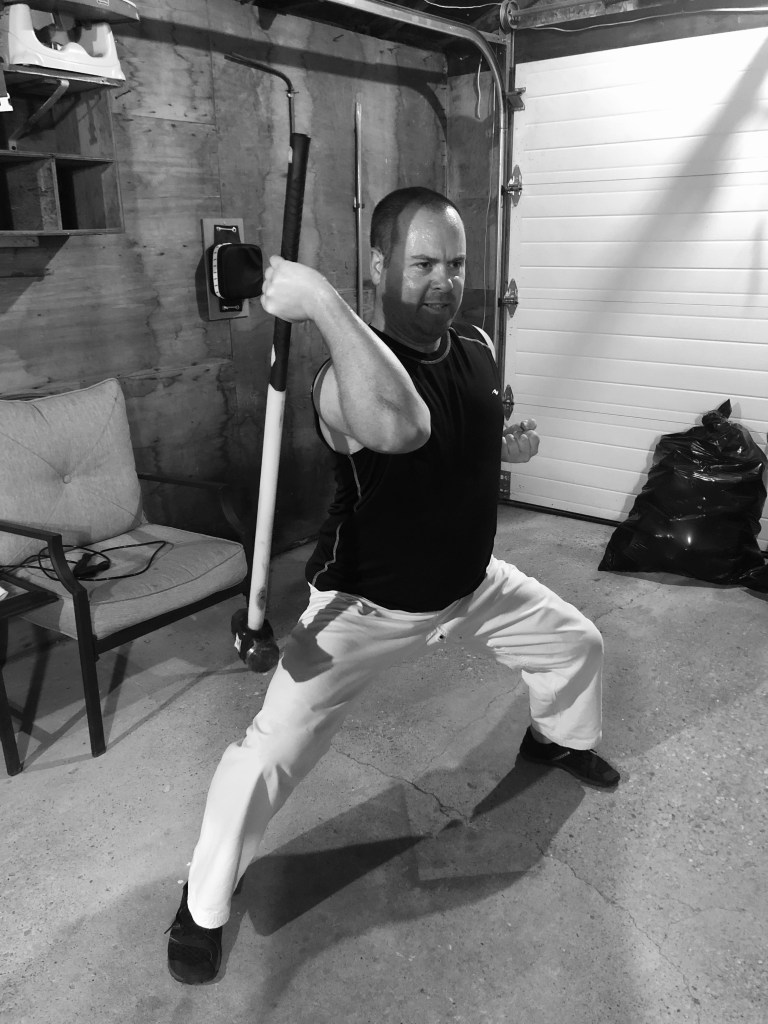
In the photo above, you see me using an 8-pound sledgehammer as a makeshift chishi. The handle of a traditional chishi would usually be shorter than the handle of a sledgehammer, so some adjustment usually needs to be made. But here, you can see me doing an exercise where I’m in a seated horse-stance position, and I’m thrusting the hammer out and bringing it back in towards my chest in repeated succession. The balance of the weight at the very top, combined with the movement of the arms, feels a bit strange at first.

In this next photo, I’m doing an exercise meant to strengthen the forearms and wrists. You can tell I’m getting fatigued at this point, since my horse-stance is starting to rise and the positioning of my right forearm and wrist isn’t where it’s supposed to be. But I can tell you that after repeated reps on each side, 8 pounds starts to feel like 80!

In this last photo, I demonstrate how a sledgehammer can also be used for some more traditional weight lifting exercises, with an added twist. The photo above is the starting position to a dozen squat thrusts, using the sledgehammer as a bar. I drop into a deep squat, followed by pushing the bar out in front of me as though I were doing a chest press, bring the hammer back to my chest and rise to my feet. Not only do I get the benefit of squats, performing a thrust with all the weight on one side and nothing on the other adds a certain amount of muscle confusion, which is great for working the core and some of the stabilizing muscles we often neglect.

This isn’t something that’s all too easy to purchase. For the most part, most practitioners make their own or use a substitute, like I do. Plus I get to feel a little like Chris Hemsworth, holding that hammer. But the best I’ve managed to find online are some shitty-looking units on Amazon or from the UK that range anywhere between $20 to 30$ (before shipping and all that good stuff). I’m certain there’s more out there, I just haven’t dug too deeply. Since that small, 10-pound pail of Quikrete I mentioned earlier costs about $20, you may consider it easier to simply order one online. To each their own.

There are all sorts of stabilizing and weightlifting exercises that you can do with a chishi. It allows you to incorporate whatever’s needed during your workout with a traditional feel, while remaining true to the roots of your art, presuming your art is Okinawan karate! But even if it isn’t, any practitioner can benefit from the exercise one can do with a chishi. Since you’re dealing with a heavy, concrete weight levered at the end of a stick, you just want to be mindful that you don’t bash your head in or drop it on any of your limbs. And as usual, consult your medical practitioner or at least an experienced Sensei before starting any new training regimen. ☯

Clothes Don’t Make The Karateka

I’m wearing a worn, black pair of gi pants and a Star Wars t-shirt. Far from formal dojo apparel. The sweat has rendered the grey t-shirt black and droplets coming off my forehead splash on the unfinished concrete floor. I just finished a set of shadow boxing and I’ve been using an 8-pound sledgehammer as a workout implement for the past fifteen minutes as my son watches in fascination from the corner. My muscles and joints are all screaming for me to stop, and my knuckles are throbbing from the use of my newly-installed makiwara post outside, but I’m only half way through my workout as the next hour will bring a minimum of three of each of my katas…

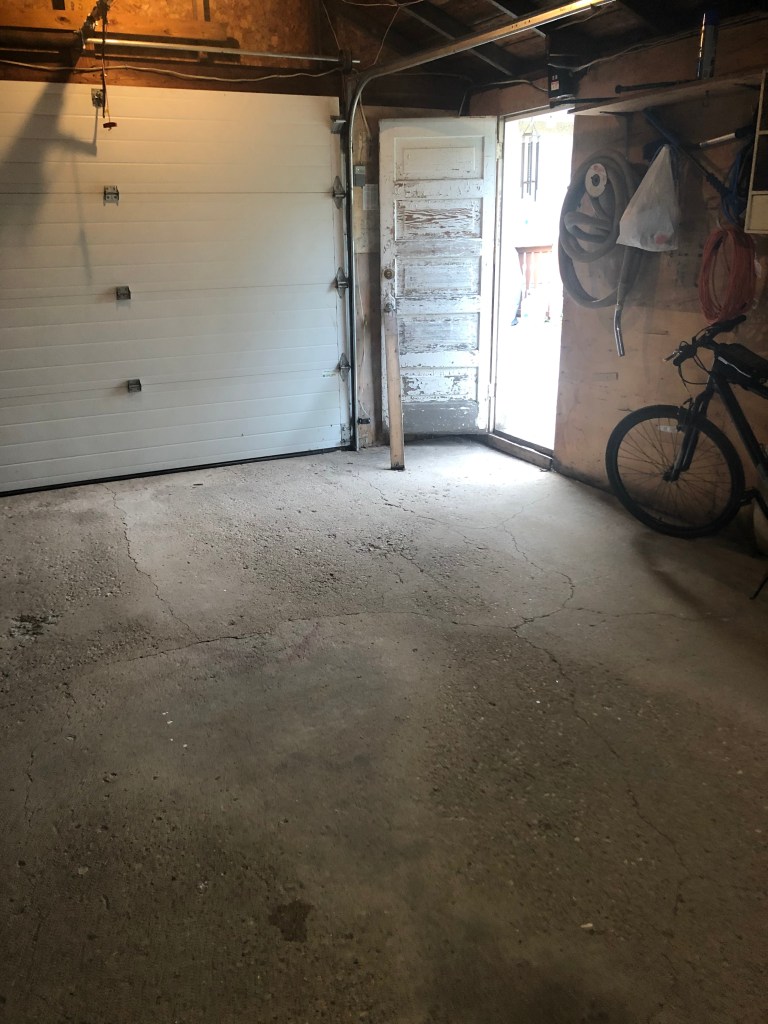
Clean, emptied out garage makes for a decent training area

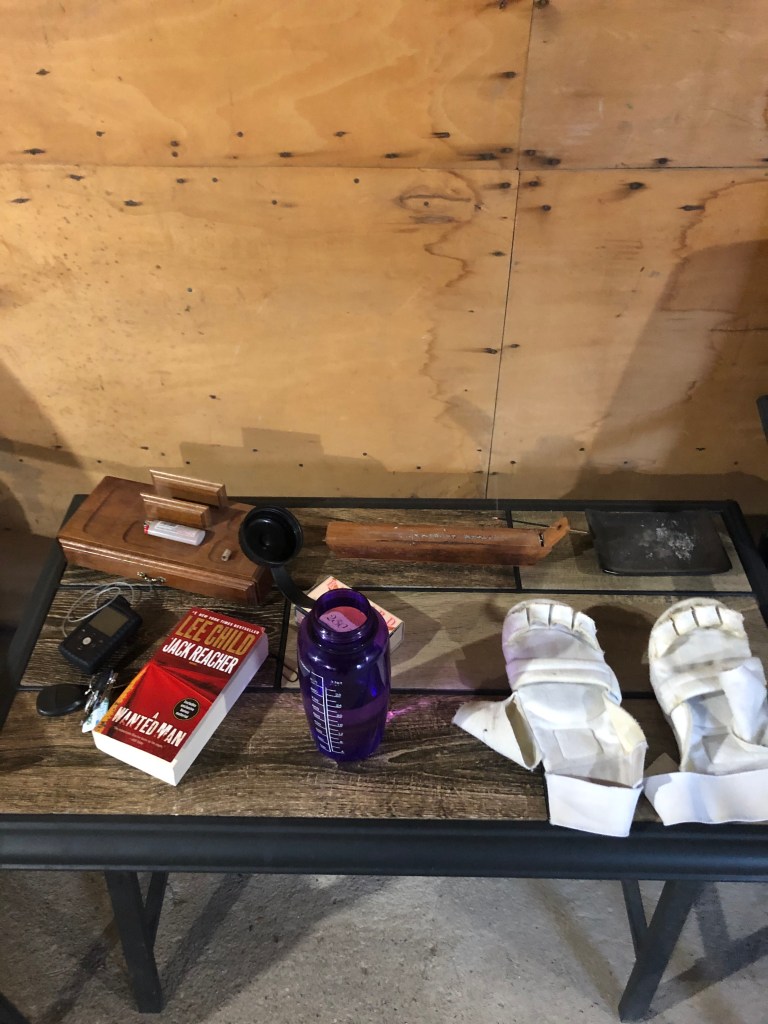
For the past couple of weeks, I’ve been using my garage as a makeshift dojo. The floor is bare, unfinished concrete and is pock-marked everywhere that something heavy or frequent traffic has damaged it. I fastened a padded punching square to the south wall and have a jumprope, an 8-pound sledgehammer and a small table to hold my water, phone and small training implements as may be required for any given session. I have a small incense burner to provide an ambiance to the environment, but with little to no ventilation inside the garage short of opening the large overhead door, I keep incense burning at a minimum.

When people hear about the martial arts, they have some pretty stereotypical images of a dojo in their heads. For the most part, people imagine a polished, hardwood floor, tatami mats in the corner, punching bags and kanji banners across every wall. Or at least, over whatever walls don’t contain photographs of the style’s masters or some the weaponry associated with the style. It’s clean and pretty and usually oozes a “karate movie” feel. But in fact, most traditional dojos (unless they’re the head of the school) never look like that.

The small table in my “dojo” holding everything I need and nothing that I don’t

When I travelled to Japan and Okinawa in 2001, one of the things that surprised me was the venue in which we spent most of our time training. Unlike the expected image of a karate school, or dojo as it is properly referred to as, we trained in a variety of different locations, including but not limited to the beach, on rocks, in school gyms, in garages and in back yards. One school we trained at the most was owned by my Sensei’s instructor and was located above his house. It contained some of the fancy elements, such as a hardwood floor and his training certifications, but little else.

There was nothing fancy. The entire ambiance was created by the efforts and energy put forward by the student body. And what energy there was! We didn’t have a single morning or evening where we weren’t drenched in sweat and felling pain along some or most of our body parts. But we learned a lot. I recently sent photos of my garage to one of my friends back home in New Brunswick and identified it as my “dojo.” His response was to laugh at the appearance. The sad part is, he’s trained in my style of karate, as well.

After only two weeks of use, my makiwara (just outside the garage door) has already shifted and has had to be adjusted. Not sure if that’s a good thing or a bad thing…

The point is, you don’t need a fancy or expensive location. You don’t need tons of equipment or have your training area look like something out of a bad 50’s samurai movie. In fact, if you study traditional karate, you can perform the majority of your (solitary) exercises within a 1-square metre space. That’s it! You can perform your katas, bunkai and kumites as well as a huge score of exercises too numerous to list out, including every push-up variation, squats, lunges and shadow boxing.

You reach certain limitations once you incorporate a partner or students, but let’s be honest: at that point, you may be using a local school gymnasium or go outdoors to a soccer field or something of the like. Some of the most traditional karate schools in Okinawa are tucked away behind a single, unmarked door in a back alley. Karate is a free-floating art, which can literally be practiced anywhere. ☯

A Shout Out To My Style

I just finished writing a post some days ago about different styles of karate and how I often regret that my own style, Uechi-Ryu, doesn’t get more attention when the original Okinawan styles are listed. In fact, if you look at most “family trees” of karate, Uechi-Ryu is rarely included, despite being Goju-Ryu’s sister-style and comparable to Shotokan and a few others.

That’s when I came across this YouTube video posted by Jesse Enkamp. Enkamp is a reasonably well-known practitioner of karate who has studied in Okinawa and in Sweden under the tutelage of his parents, who are karate instructors. As quoted from his website, Enkamp is “a best-selling author, entrepreneur, traveller, athlete, educator, carrot cake connoisseur and founder of Seishin International,” which is a fantastic line of martial arts apparel featuring karate gis.

He also has a YouTube Channel that I recently subscribed to, and he has some really great perspectives on karate and martial arts in general. We different on some of the perspectives, but as the old saying goes, “variety is the spice of life.” It’s unclear as to what style Enkamp actually Studies. This is because he claims he studies karate and not so much any specific style. I can’t say I entirely agree with his way of thinking, but he has pretty good reasoning behind this concept.

Regardless, he recently posted a YouTube video entitled, “The Best KARATE Style For Self-Defense,” where he talks about a traditional style of Okinawan karate that winds up being Uechi-Ryu. I had a pretty good idea that this was where he was headed (since the kanji symbols for Uechi-Ryu were in the title), but it was nice to have someone outside my system actually show some love for one of the best circular systems of Okinawan karate ever founded.

Enkamp’s YouTube entry on Uechi-Ryu

I don’t usually share or link YouTube videos as I consider someone’s video submissions to be theirs and theirs alone. But like I said, this one hit close to home and got me excited that someone was ACTUALLY talking about Uechi-ryu. This just goes to show a style is never really dead, so long as there are people willing to talk about it.

And Jesse, if you’re reading this, I hope you’ll like and follow my blog as I follow your YouTube channel. We karate practitioners need to stick together. ☯

Don’t Change Your Routine

I remember training for my black belt in karate, and doing my very best to prepare for it in a Rocky-style format. I used to get up at five in the morning and run five miles, followed by an hour of intensive shadow boxing and forms. Without getting into the specifics of the test, I knew that I would be facing the challenge of my life, and I wanted to do everything I could to ensure I would be successful.

The last class before the weekend of the test, I attended class and tried to blend into the background, which wasn’t easy considering I stood at the front as one of the senior students. I didn’t speak to anyone about the upcoming test I would be subjected to, over the weekend, as was the custom in our dojo. Test dates were kept private until the student walked into the next class with a new belt colour around their waist.

After that last class, Sensei and I took an hour together and discussed the test and what would be involved. We went over some of the material that I knew I had some mild difficulty with, and I made a point of explaining that I planned on having a light meal and getting to bed early, in order to get some extra rest. Sensei smacked me in the back of the head and spoke three very important words: Don’t. Change. Anything.

Essentially, Sensei explained that despite being faced with a very important and very physical test the following day, I should have the supper I’d usually have. I should follow it up by having the evening I would usually have and go to bed no earlier than I usually would. The idea was that altering my usual routine would cause a disruption in my rest as opposed to helping it, and potentially increase my test anxiety.

Change and variety are good. Of this, I have no doubt and there is no question. But when it comes to facing something out of the ordinary, it’s important to remember that we shouldn’t alter our routines. We need to trust our gut and follow our usual routine. trying to do anything out of the ordinary will only stress and tax your body further and increase one’s anxiety. Stick to what you know. It’ll serve you better in the long run. ☯

Strike The Proper Board

Quarantine and self-isolation have had a positive effect on the Canadian population, as many people have chosen to take some of the downtime to start new hobbies, clean out their homes or begin renovation projects that they may otherwise have never considered. It’s definitely a positive thing, and has kept lumber yards, home improvement places and retail locations in the black during this whole mess.

Although I’ve been dealing with small projects like growing a lawn in my back yard and selling my car, I haven’t really tackled anything that’s taken serious effort. But since the basement of my house is damaged and the whole thing will need renovating, I’ve found myself without a workout space. Oh sure, I’ve been able to continue doing things like cycling and I even did my Marine workout in the garage, last week. But I’m losing the striking pad I had mounted on the current basement wall. I needed a solution.

Some of the materials I started with

Since I didn’t consider it safe or in anyone’s best interest for me to attempt basement renovations on my own (I’m great with a sledgehammer, that’s the limit of my renovation capabilities), I decided to construct my own makiwara board for the back yard. I’ve mentioned this training tool in previous posts, but a makiwara is a padded board typically used to condition the knuckles and strengthen your punches. It’s thought to be Okinawan in origin and is mostly used in traditional styes of karate.

Polyester cord to wrap around the makiwara as a striking surface

Most properly-constructed makiwaras can run anywhere from one to several hundred dollars in cost, especially if you factor in the shipping and handling to have it brought to you from whatever distributor you purchased it from. But if the Okinawans can build theirs from scratch, I figured “so can I.” I had several 7-foot lengths of wooden board that was left over from our house’s previous owner. I started by trimming two of these boards to an appropriate and matching length.

The free lumber was definitely a solid start and is potentially the most expensive aspect of the project. I brought my son Nathan to Home Depot, where we purchased a half dozen 6-inch iron bolts with matching nuts and washers. I also purchased a 100-foot length of polyester cord, which would be wrapped at the top of the makiwara as the striking surface. Polyester is a water-resistant material, so it would be best-suited for an outdoor training tool.

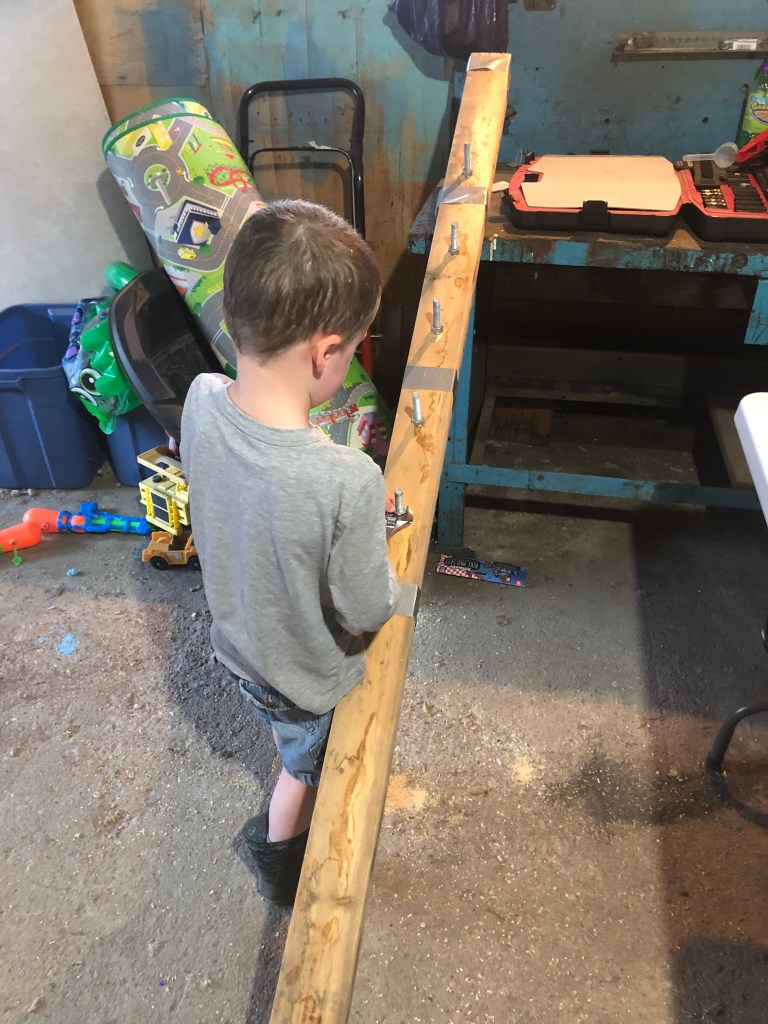
Nathan hard at work, screwing the bolts into place

Nathan and I duct-taped the two boards together so that they were flush, them I drilled 3/4-inch holes at five-inch intervals through both boards. I hammered the iron bolts through the holes and Nathan screwed the washers and nuts into place. Once all six bolts were firmly in place, we were able to remove the duct tape and move on to the striking surface.

The wrapping of the makiwara

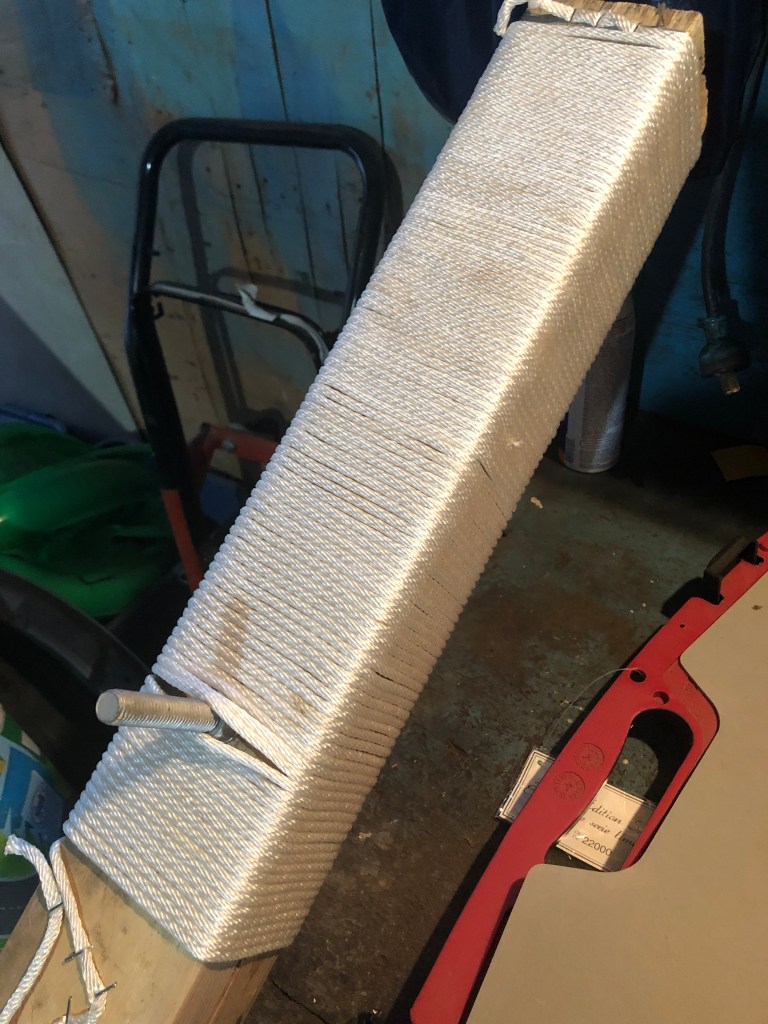
I left the top strip of duct tape and used a staple hammer to fasten the end of cord to the board, followed by twenty minutes of fastidious wrapping and tightening of one hundred feet of cord. With the exception of Nathan complaining he wasn’t allowed to do this part (and climbing over and under the project while I worked), it went reasonably well and I used the same staple hammer to fasten the other end once the cord was all wrapped.

The completed striking surface

The makiwara was now complete. The next step would require digging a two or three foot hole in the ground, placing the post and filling the remainder with some firm, affixing soil. That was over a week ago. The entire project took a little over an hour and Nathan and I were already tired. So we decided we’d put off the installation until we were able to get some rest and start digging when we were fresh.

Our long-weekend was cut short due to unforeseen circumstances. So on Sunday, Nathan and I took two shovels and a metal bucket and started digging. I didn’t take any photos of that part of the project, since Nathan and I were up to our elbows in dirt. The soil in Regina is a clay composite, which is what’s caused the damage to my basement. It sucks (royally) but it DOES have a benefit for this particular project. Nathan and I reached about twenty-eight inches, which was adequate for the makiwara.

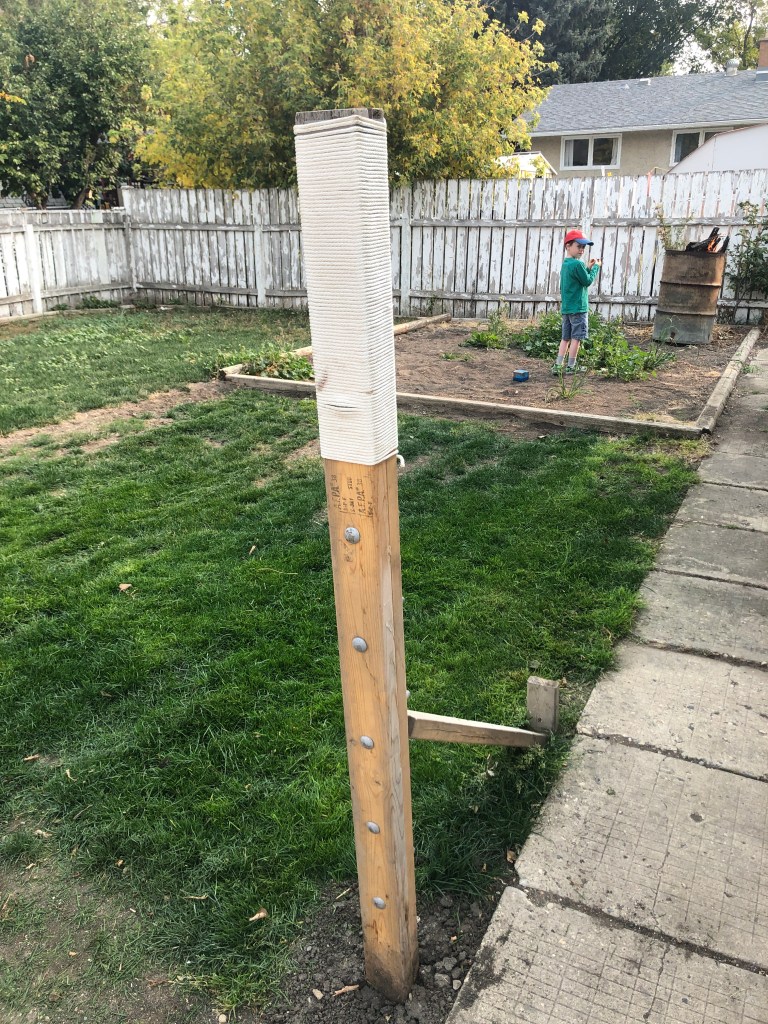
We lowered the post into the hole and packed the remaining space around the pole with the dug up soil. We packed it down after every few shovelfuls, and the clay soil held the post firmly in place. I followed it up with a short length of board to firm up the bracing, placed at an angle at the back. The end result came out quite well, and Nathan and I are quite proud of the job we did.

The finished product!

All said and done, a training tool that would have cost several hundreds of dollars wound up costing less than fifty dollars! Now I just have to find the motivation to get outside to use it. My neighbours have all seen the post and seem to understand the concept behind it, since I explained what it was for. But it may be interesting to see their reactions once I start striking it. There you have it! My do-it-yourself project. ☯

The Magic Mistakes

Fear of failure is a very real thing. Most people have it, whether they realize it or not. If you think carefully on your past, you’ll likely find one and/or many instances when you were afraid you wouldn’t succeed at something. Maybe it was a potential job opportunity or an important exam at school. Whatever. At some point, you would have been worried about the prospect of making a critical mistake or failing at something.

This phenomenon is very prominent in martial arts circles, especially given the strict discipline and structured requirements that come with traditional martial arts. I even remember myself, three decades ago, standing at the back of the class trying to move through my techniques without error and trying to avoid Sensei’s gaze. It didn’t matter if I was screwing it up, I was just afraid of doing it wrong. This effect wore off as the years melted away and I increased in skill.

People are afraid of making mistakes. For some folks, it’s about pride. Some people are too proud to admit that they can make a mistake. Others are afraid they may cause disappointment in others, parents, instructors or otherwise. Some are afraid of the windfall that comes from failure and facing the potential consequences. For myself, I was mostly afraid of people seeing me do it improperly.

Whether you’re a newcomer to martial arts or even if you’re experienced, or maybe you have some other endeavours that you’re tempted to try out, I’ll let you in on a little secret: mistakes are an important part of the lesson. The only way you’ll learn is by making mistakes and having them corrected. We all start from the same place; the beginning. And like anything else in life, you need to make the mistakes in order to learn the skills.

It’s like learning to ride a bike. You may fall off a couple of times, you may even get skinned knees. But the important thing is to climb back on and keep peddling. The same can be said of any skill, martial arts or otherwise you may be trying to learn. Don’t be afraid of making mistakes. Don’t be afraid of being corrected or asking for help. It’s the only way you’ll learn. And grow. ☯

I Gotta HAND It To You…🥋

The martial arts style I’ve trained in the most is karate. This is the one I’ve studied all my life, and its lessons have carried me far in life. Even to this day, I train consistently and have often joined my local karate schools so that I can enjoy the training dynamic that one can only find by working out within a dojo. But Karate Do (or Karate, as it’s known in the western world) translates as “way of the empty hand” because the art primarily uses empty-hand techniques. This means that a significant amount of conditioning needs to go into the hands.

When people work out, they tend to focus on the major muscle groups that show the best results, like biceps, triceps, chest and shoulders. There’s been a running joke for decades about how people tend to skip leg days, and with good reason. People like to focus on what shows, which is why many professional weightlifters look like they have chicken legs. All of this is a pretty broad generalization, but the truth of the matter is that one of the most overlooked aspects of working out happens to be grip strength.

Grip strength is exceptionally important in all martial arts, regardless of style. You can have ripped arms and legs but if you have no strength in your grip, your fighting skills will be greatly lacking. Think about it; if you study Judo or other grappling styles, you need your grip to, well… grapple! Having the grip strength to grab on to your opponent’s gi, clothing, flesh, whatever, in order to flip and/or throw them is critical. In normal striking arts, grip strength is critical for the proper execution of pressure points and grabbing/holding your opponent in order to execute techniques. Grip strength is even important for weapons styles, since it’s kind of important to have enough grip strength to hold your baton, staff or sword.

There are plenty of ways to increase your grip strength, including grip strengtheners you can buy at your local retail or fitness location, to rubber expander rings that you can squeeze and stretch. I used to keep one of the former at my desk at work and flex whichever hand was free as I’d work. Even those so-called “stress balls” can be handy, although the amount of resistance they provide is pretty limited.

Okinawan Gripping Jar, known as Nigiri Game

You can also use a more traditional training tool called Okinawan Gripping Jars. This involves clay jars that have a thick lip at the opening. The jar could be filled with water or sand and gripped at the lip and carried in order to strengthen the hands. Beginners would usually start by carrying them while empty and work their way up from there. If you happen NOT to live in Okinawa and have no skill with a potter’s wheel or a kiln, you can make your own “do it yourself” gripping jars by taking large, glass mason jars and filling them with stones or water. Once the lid is properly secured, the jar is narrow enough to grip at the top.

Hand strength in general is an important aspect of martial arts, and there are many ways to increase that strength. Knuckle push-ups are one of my favourite, as they toughen up the knuckles and strengthen the wrists. Installing a makiwara board in your backyard is also ideal, since it allows you to work on wrist strength and finger strength by working your knife hands, finger thrusts and punches.

Speaking of finger strength, did you know that your fingers are part of your hands? And you should strengthen THOSE as well? No? Well, step right on over for some education. There is supplemental strength training for the hands in the martial arts, known as jari bako. This involves filling a bowl or a bucket with sand, gravel or small stones. The exercise involves thrusting one’s fingers into the bowl or bucket, which results in the strengthening of the fingers and fingertips.

The receptacle would occasionally be filled with hot water as well, especially if you were a naughty student who acted out in class and required some additional motivation to behave. Not that I’m speaking from experience, of course. But the science behind this technique is that the trauma caused to the musculature causes an increase in finger strength, much like any other physical exercise.

As usual, extra care and starting slowly is required when working the hands and fingers as they contain small bones that can be easily injured. This is one of those times when I tend to disagree with the Okinawan masters of old, in that it isn’t necessary to traumatize and disfigure your knuckles or hands in order to increase your striking and grip strength.

My two foreknuckles on both hands are slightly increased in size but aren’t disfigured. That should be the extent of the damage. Anything more is unnecessary and may cause long term problems without necessarily increasing strength. If in doubt, seek instruction from someone experienced teacher or instructor who’s been there and done that! ☯

Life Isn’t A Spectator Sport

It can be pretty tough finding the motivation to get moving. Light knows, it takes me several minutes for the signal to go from my brain to getting a response from my body when it comes to waking up in the morning. And if I didn’t start my day with a pinch of caffeine, I believe that the world would be in genuine danger. Which is likely a problem, since being that dependent on coffee can’t be a good thing, but I’ll tackle that problem some other day.

My point is, it usually feels “easier” to sit still than to get going. This is a natural inclination, much like choosing to go through a tunnel as opposed to climbing over the hill. But all things in life require a balance, and sitting still can be as harmful on the body as pushing yourself too far. This is why frequent and even daily physical activity is an important part of daily life, whether you have Diabetes or not.

According to an article posted by the Mayo Clinic (one of my favourite websites), a person should aim to achieve 150 minutes of moderate exercise or at least 75 minutes of intense exercise, with about two workouts a week contributed to strength training. I like how the article describes mowing the lawn as a moderate aerobic exercise. I’ll definitely start adding those sessions to my training log.

But those are American sources and since I’m in Canada, it would be nice to lean on a source from my home turf. An exercise guideline chart posted by the Canadian Society for Exercise Physiology outlines pretty much the same basic requirement of at least 150 minutes of moderate to vigorous exercise per week in adults, with at least two days contributed to some sort of strength training. Although the “minimum” should include 10 to 20 minutes of physical activity or more, you should aim at hitting that 30-minute mark in order to reap the greater benefits.

So what happens if you don’t get enough exercise? The reality is that with everyone working from home and even before the pandemic, the average person finds themselves sitting far too much for far too long. This can have a number of nasty side effects on your heart, your weight, your back and even your mental health. But with all of us cooped up in our homes, many are tempted to flop down on the couch and binge-watch their favourite streaming services for days on end. This doesn’t just lead to the above-mentioned complications, but will also undo any physical conditioning you may have been doing prior to that.

Balance, people! Find the happy medium. If you’re doing work, especially in front of a computer screen, it’s important to get up out of your seat, stretch and move around. You should be doing this a minimum of at least once every hour. Although I wasn’t able to find a source for that interval, this is what has always been suggested to me. And if you have a boss that gives you hell because you’re getting up from your seat too often, check with your HR department on what your organization’s health policies allow you to do.

Since this is related to your health, your boss may be required to provide certain little benefits like a stand-up desk, floor padding or an ergonomic office chair in order to help alleviate any complications of sitting all day. And moving away from your computer screen to allow your eyes to adjust and focus on something else can also be very important. But I’m getting off topic, here. We’re talking about physical fitness…

From a Diabetes standpoint, maintaining your physical fitness will have a number of measurable benefits, including but not limited to better blood sugar control, improved insulin resistance and better blood circulation. Combine that with a reasonably healthy diet and most of the “pain in the ass” symptoms become manageable instead of lethal.

I can attest to that one myself, since insulin resistance was the main issue threatening my life when I was a child. Increased physical activity is what got me through. This would have been right around the time I joined the martial arts. Granted, even though this worked for me doesn’t necessarily mean it would work for everyone. But maintaining some level of physical fitness can lend nothing but benefits, if done properly.

When it comes to fitness, the sky’s the limit and I can almost guarantee that everyone can find SOMETHING that they enjoy doing that constitutes exercise. And at only 10 to 30 minutes per session, there’s little reason or excuse to claim you can’t find the time. I know a lot of people at work who would take walks over lunch, hit the gym and even meditate! Anything you can do to, as they say, get the blood flowing is a good idea and will help to eliminate or lessen unnecessary complications down the road. ☯