Why You Shouldn’t Force Kids Into Karate

Every parent wants what’s best for their kids, and that often involves putting them into sports, after-school activities and variety of different hobbies and groups. But what should you do if your child isn’t interested in the things you have them try? This video provides my perspective on why you should never force your children into karate, or the martial arts in general. ☯

My New YouTube Channel

Hey folks! I know I’m not in the habit of drafting two posts in a day and it’s a bit late in the game to be posting a second one, but I’ve decided to put my face on camera and started my own YouTube channel. I only have one video on there, which is scheduled to go live in about ten minutes. But I’m hoping to use the video aspect to discuss and demonstrate things that are a bit difficult to explain with words and photos. If y’all wouldn’t mind visiting the channel and clicking those little “like” and “follow” buttons, I can start pumping out videos in tandem with my blog posts. For any one interested, here’s the link to the YouTube channel.

Check out this first video, which I recoded tonight…

Hopefully, it doesn’t bore everyone any worse than my long-winded posts usually do. I look forward to sharing more in the future. If anyone has any thoughts on something I should be posting in video format as opposed to in written form, please let me know in the comments. ☯

Seeing It Through…

If you have uncontrolled Diabetes, having the motivation to see something through can be pretty difficult. I have unfortunate memories of my behaviour through my late teens and 20’s where my erratic blood sugars often caused mood swings and a deep apathy for life that went way beyond the point of being lazy. It was hard, because my lack of energy and motivation would usually result in me just wanting to “sit and relax,” or get some “rest.” This was usually code for simply not having any motivation. Honestly, I often wonder how I was able to make my way through the martial arts ranks.

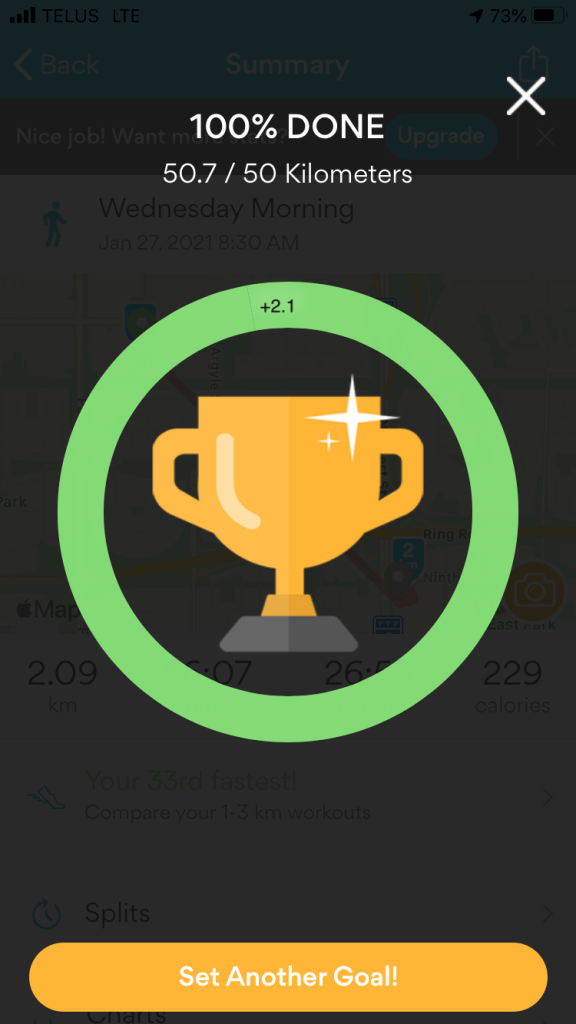
The lack of energy and motivation is what usually hit me hardest. I like to think that things are much better for me these days, and I use my motivation in ways that continue to grow my fitness and increase my control over Diabetes. And sometimes I like to try new things. You may have heard me mention that, once in a while. During the first week of January, I joined a fitness challenge through my RunKeeper app that involved logging 50 kilometres of distance within the calendar month. One would think that this shouldn’t BE an issue, since I usually log more than that in one cycling session. But it’s kind of difficult to cycle on snow, and walking roughly involves three times as much time as cycling.

I started by taking time to walk a few kilometres during the daylight hours. This was made all the more difficult by the fact that Nathan was remote schooling when I started this, and he couldn’t understand why I wouldn’t let him join. When he started going back to school in person, I would see him off on the bus then take my walk immediately after that. It would be a touch on the colder side, since the sun wouldn’t be up at this point. But I would usually manage to get three or four kilometres logged within an hour of walking, which was a good pace and started growing my monthly total to bring me closer to the 50 kilometres I needed.

Sometimes, it was actually nice to get out of the house and have a walk. On clear, sunny days I could listen to music or simply be alone with my thoughts while getting fresh air and some mild modicum of exercise. I started to see some of the advantage behind walking every day. On other days, it felt tedious and very much like an obligation. This is where I started to run into trouble, towards the end. With only 8 kilometres left to log, I lost motivation and started avoiding walks. It’s not like I was even actively trying to avoid it, I simply didn’t;t have the energy. Inclement weather and the recent snow storm with power outages certainly didn’t help.

Ultimately, I reached the minimum I needed. I believe I even went beyond the 50 kilometres I originally set out to log. Completing this 50 kilometres also enters my name in a draw for a potential prize of cross training sneakers that I would never afford on my own (or wouldn’t PAY for, normally) so there was some outside motivation involved, as well. But the experience was good and my wife and I have discussed making walks a family thing, now that the fitness challenge is done. This simply goes to show that you can start working on your fitness with something as easy as taking a walk. The motivation be sometimes need to be found first. But all it takes is getting off the couch and doing it. ☯

If You’re Going To Be Salty, May As Well Soak While You Do…

There are a number of things that I do to promote healing and recovery after workouts, including proper diet, proper sleep (when life and my body allow it), heat and/or cold as required, meditation and stretching. But one of the more relaxing things I enjoy doing is taking a hot bath with Epsom salts. Even if you’ve never used Epsom salts, you’ve no doubt walked past them numerous times at your local retailer’s or pharmacy. They come in either a sealed plastic bag or a pourable plastic tub.

If you’ve never used it, you may be asking what the hell Epsom salt is? Well, in simplest terms, it’s a white crystalline powder that composed primarily of magnesium and sulphate, hence the “salt” aspect. Apparently, the term “Epsom” is the place where it’s mined. But the idea is to pour a couple of cups of this stuff into a hot bath and it will dilute and break down into the individual magnesium and sulphate, which can then be absorbed into the body during your soak to reap the benefits of these two mineral salts for a variety of reasons.

Every article I’ve read and every source I’ve looked into claims that there’s no definitive evidence that there’s a benefit to soaking in an Epsom salt bath, but many people swear by it. I should know; I’m one of them. With our upstairs shower not functioning properly at the moment, the whole family is limited to baths. And I do find a soak with some Epsom salts to help with a faster recovery and better relaxation. You can get the salts as is, or you can get them scented with a variety of different things like lavender, mint and many more.

As with everything in life, there’s some good and some bad to using Epsom salts. Considering the profound lack of clear scientific evidence that proves it, most people would be inclined to believe there’s no point in using it and one would be just as well to simply soak in a hot bath. But it simply wouldn’t be me, if I didn’t present both pros and cons. So here are some of the benefits of using Epsom salts in your bath.

Soaking in a bath with it is supposed to help reduce inflammation, soreness and aches from working out as well as help with skin health. It’s also good for foot health, with many people using it to treat ingrown toenails. No need to tell you that this is an important concern for people with Diabetes. But overall, it can be used to relieve soreness and stiffness of varying types, as well as being used as a mild laxative if taken orally. Magnesium is also said to help produce melatonin, which can help you get a better night’s rest. Last but not least, it can help to reduce stress. Granted, a saltless bath can do that as well.

The down side is obviously the lack of definitive evidence on the supposed benefits. But in all honesty, a hot bath will help ease sore muscles and reduce stress anyway. And there’s very little downside or danger to using Epsom salts in every bath you take. That being said, if you take Epsom salts orally for whatever reason, there’s a plethora of different ways you can harm yourself with them. Just be sure to check with your medical professional if you’re going to attempt it. But taking a bath with it is safe enough. Most packages will have clear instructions on how much to add and such.

I genuinely enjoy baths with Epsom salts. It’s a great way to relax and unwind when the stressors of life are getting you down. And it can definitely help speed up recovery. But it’s one of those things that you basically have to try out for yourself in order to make an informed decision. All in, Epsom salts are pretty cheap. In fact, they’re less expensive than bubble bath and to be honest, there are more benefits. Give it a try, next time you need to relax. ☯

Read This Post While You Recover

One’s health and fitness depends on a number of different factors. Age, weight, body type, current level of fitness, medical conditions and how big of a wuss you are, all contribute to how much you can push yourself and how often you can work out. Okay, maybe that last one is a bit of a subjective opinion. But what you do and how often you do it will depend on these things and more. And at some point, no matter your level of fitness, you’ll need some time to recover.

Let’s start by examining the simple concept being effective fitness. When you work out, you tax and exert your muscles causing damage to them. Then, provided you consume an adequate diet of foods, your body will repair the muscle tissue, making it bigger and stronger than what it previously was in order to accommodate the exertion you previously put it through. This is what pop culture refers to as getting “gains.” It’s also how you’re able to push longer with more weight when you do strength training.

Although cardio is meant to provide something slightly different than strength training, most of the same factors are present. Otherwise, how can you grow, progress and run for longer distances (or walk, cycle and/or elliptical). But have you ever tried using a broken tool? You may still accomplish your goal, but it will likely be more difficult. And the end result may not be exactly what you were trying to achieve. This is why repairing a broken tool before reusing it (No, you’re a broken tool! I know you said it…) is important. Ans it’s also where getting proper rest and allowing your body to recover comes in.

An exact answer is a little difficult to gauge. After all, if you rarely work out then foolishly participate in a Marine Corps workout with your fitness-obsessed, psycho friend (wink, wink!) you’ll likely need recover immediately the next day and possibly even the day of. If you consistently work out and have a good fitness base, you may be fine with taking a day to recover every few days, or once to twice a week. But even your level of fitness is only one of the factors to be considered in terms of recovery.

Honestly, I’ve found so much contradictory information when I researched this post that I’m not even certain what sources to quote. Some have the opinion that you should take 24 to 48 hours to properly heal and recover after a workout. Other sites boast as much as 72 hours to recover for specific muscles groups, before performing a workout with them again. It’s a balance that depends on the intensity of the workout you do coupled with the bodily factors I mentioned earlier.

According to an article I found on BodyBuilding.com, a person should immediately recuperate for 2 to 4 hours following a workout, but as long as 72 hours afterwards. The article also explains that some of the issue lies in the fact that most people train to much and too often, as opposed to too hard. This ties in with my recent post about getting too much of a good thing. It’s important to listen to your body and recognize when you’re doing too much.

An article by MensHealth.com claims that muscle damage isn’t necessary for proper gains so long as you hit the gym regularly. They indicate that long recovery periods aren’t necessary for proper fitness, provided a bunch of factors are in place. But they don’t necessarily cover off recommended periods of recovery. It can be pretty difficult to know how long you should be resting after an intense workout.

One of the important things to remember is that recovery doesn’t mean being off your feet and doing nothing afterwards, either. You need to keep yourself moving in order to avoid seizing up. This might mean taking a light walk the day after, or doing some light stretches combined with soaking in an epsom salt bath. This will help ease and relax muscles as well as loosen stiff joints.

At the end of the day, be sure to listen to your body. Starting back before you’ve recovered will cause injury as opposed to normal muscle soreness associated with working out. If you wake up barely able to move, it stands to reason that you should probably take it easy and save the 10k run for a different day. But if you’ve rested for a day and you feel good and only slightly sore, you may be ready to kick back into gear. It will be entirely dependent on you. Last but not least, don’t forget that if you have Diabetes and injure yourself, healing and recovery will likely take longer.☯

Feelin’ The Burn When You’re A Weirdo…

Exercising means burning calories. If you aren’t aware of that by THIS point, I can’t help you. Light knows I’ve written about that very thing quite often during the previous 700 posts I’ve put up. And although intense exercise and movement is the best option for a calorie burn that contributes to one’s overall fitness and weight loss goals, It may come as a surprise to some people that there are a number of reasonably strange and everyday activities that help you to burn calories.

One good example of this is what happens within your body while you sleep. Most people refer to being “at rest” during the night, but there’s a plethora of internal activity that takes place while a person sleeps. Muscle and tissue repair, digestion, brain activity and whole bunch more… I would be curious as to what amount of calories are burned by the average person during an 8-hour sleep. This got me to thinking about some strange or “non-fitness” activities that can burn calories, as well.

The first and most prominent one in my mind is meditation. Although I wouldn’t necessarily refer to mediation as a workout in and of itself, a person does burn calories during meditation. Just to be clear, it’s important to understand that calories are burned for any and all movement that the body performs. How little or how much is the question. And it can be a different amount for different people, based on age, level of fitness and body chemistry. But for me specifically, I’m burning approximately 90 calories an hour during meditation. This means that the 10 minutes of restful meditation I perform at the end of my workouts will burn roughly 15 calories. Does that tip the scale on the mount of calories I just burned during the actual workout? No, but it exists nonetheless and it’s still a calorie usage.

For example, did you know that taking a hot bath for about an hour will burn about 140 calories? This is according to a study performed at Loughborough University and explained in a post by theconversation.com. This somewhat makes sense to me, since sitting in a hot tub of water increases one’s core temperature resulting in sweating and a bunch of other functions of the body. Where there’s movement, there’s calorie burn, remember? Even things like drinking multiple cups of green tea a day or cleaning your house can burn well over 100 calories over the course of a day.

According to an article posted by HealthLine.com, 6 unusual ways to burn calories include exposure to cold weather or drinking cold water. This makes sense as it forces your body to work in order to warm itself and this can only be done by burning fuel. But the article also describes things such as chewing gum, donating blood and even constant fidgeting. If that last one genuinely burns calories, how do I not have a freakin’ six-pack yet? I fidget like a maniac. I can barely EVER manage to sit still. last but not least, the article also describes laughing more often, which will also burn off extra calories.

There are plenty of articles and studies out there that describe all sorts of different activities that will accomplish an extra amount of caloric burn. Some of them are a bit on the surprising side, and it should be noted that many of them depend on a person’s body chemistry and overall metabolic rate, as well. Now if you’ll excuse me, I need to go fidget some more… ☯

Don’t Call Yourself Sensei…

The word Sensei is popularized in the Western world and sometimes used a little too often for comfort’s sake. Putting aside for a moment that the title of Sensei should never be self-given (except to explain to a new student that you ARE the Sensei), the word essentially translates as “the one came before,” indicating that it’s a person’ who’s been there and done that. In martial arts circles it mostly used as a title of respect used by the student body to the lead instructor, which is why I say it shouldn’t be self-given; it’s a word that your students should be using to address YOU, not to identify yourself. But as usual, I digress…

Teaching can be a difficult thing and is in fact, a very strange creature. Most people who DON’T teach, assume that all it involves is passing on knowledge that you know something about. Although that’s a part of it, teaching has a great deal to do with HOW you impart that knowledge, how receptive your students are to what you’re providing and the communication that takes place and control methods used in order to achieve that goal. Teaching is not for everybody; a fact that my wife and I have learned in great detail over the past month from trying to take ownership of Nathan’s “at home” learning.

From a martial arts standpoint, it isn’t enough to have the rank and experience to know what needs to be taught. This is especially true of kids’ classes, but it holds to all students. Having the dynamic methods to impart said knowledge to the students who wish to learn takes a number of different steps on behalf of the instructor, most of which I learned the hard way. I had my own dojo for a few years in Northern New Brunswick before moving out to the Prairies. And I learned a number of different things about how to properly impart the knowledge necessary for a student to learn karate…

Focus On The Foundation: While it may be impressive to start the first open class of your school by demonstrating a triple spin kick, couple with a backflip while holding a sword may be impressive (and redundant in a real fight), it won’t help your students to learn from the beginning. Most people who have been doing something for a number of years won’t relish going back to the beginning. Most of us want to keep moving forward. But that new student who is beginning on Day 1 needs to learn those basics that you mastered so many years ago. Not only is it NECESSARY to impart these foundational skills on new and even intermediate students, it can be a good revisitation for the instructor as it’s important to remember one’s foundation;
Explain The Rules: The dojo can be a confusing place, especially to a Westerner who’s never done martial arts before. They’ll need to be told and come to understand that they have to bow before entering the dojo, refer to the instructor as “Sensei” and how to properly line up. This needs to come BEFORE you start hammering them with all those knuckle push-ups as a punitive measure. This is one of those instances where ignorance CAN be an excuse, unless you permit it to continue;
Use Your Voice: If you’ve ever watch a show or movie centred around karate and the martial arts, you’ll notice that there’s often a lot of yelling going on, the instructor is walking the rows and correcting students’ movements, etc… This is important. Even if you know what you’re doing and you’ve told the class to mirror your movement, you can’t stand at the front like a mime trying to get out of the box. The class needs to feel your presence and receive correction. Maybe that student at the front needs a foot adjusted. Maybe the student at the back has to be reminded to focus instead of staring at the female student in front of him (true story). Be present. Be vocal;
Admit When You’re Wrong/Don’t Ask Anything You Won’t Do Yourself: With over thirty years of karate under my belt, there are still things I don’t know. It’s extremely important as an instructor that you be willing to admit if you don’t know something. Trying to circumvent the question or making something up not only makes you look ridiculous, but it can damage your credibility. Once that happens, good luck trying to teach the class. And if you intend on having the class drill through a couple of hundred kicks, you best be ready to do it as well. Nothing damages an instructor’s credibility like having the students sweating half to death while the instructor calmly and dryly walks around doing nothing. Don’t forget that even if you’re the instructor, you’re ALSO there to work out. You can’t do that from a still position. Never ask your students to do something you aren’t willing to do yourself;
Be Prepared And Have A Focus: As much as it shouldn’t be necessary, your students will need to be kept engaged and interested. If you walk into the dojo and perform the exact same warm-up and the exact same workout during every class, it won’t take long for people to start yawning in class (which is an incredible sign of disrespect, but shame on you if you’re the cause). Keep your warm-ups dynamic and different. Don’t be afraid to change it up, not only to keep it interesting but also because it will keep your muscle groups guessing and work more body parts. Every class should be thought out and planned before the class starts. Focusing on kicks? Next class, focus on punches or blocks. Doing break falls tonight? Maybe focus on pressure points or throws during the next class. It’s perfectly fine to have a class where you work lines of techniques for an hour, but that should be your EVERY class. Planning and preparation will ensure the you’re moving forward with the program and that your students will progress;
Acknowledge Ranks But Don’t Let Them Define Partnerships: It’s important to understand that the white belt that started last month won’t be able to perform some of the techniques and may not have the staying power that the green or brown belt may have. But there’s no reason why a beginner can’t be partnered up with an advanced belt for paired exercises. This is a common misconception in most dojos. Even my current dojo has a nasty habit of saying, “Try to pair up with someone of similar size and rank…” Although this isn’t done maliciously, the pairing of students at different ranks is important to the learning process. Honestly, the head instructor can’t give one-on-one focus to every student during every class. This is why it’s important for junior belts to interact and be involved with the senior and advanced belts. That way, they get the additional coaching they need and the advanced belt can also learn a lot from junior belts;
Push Yourself, No Matter What’s Going On: Life doesn’t care about your plan, and sometimes things may try to get n your way of teaching the class. One good excuse is getting sick. Now, I’m not referring to getting the chicken pox or something dangerous and contagious. But I’ll always remember the times when I’ve had a basic cold and still went to karate. It’s important for the instructor up front to be motivated and driven with the same level of enthusiasm, regardless of anything personal that may be happening or whether or not they are sick. Nothing sucks the energy out of a class like a sluggish instructor who isn’t pushing themselves.

This is not an exhaustive list, but I just took stock of how long this post has gotten, and I’m barely halfway there. Teaching can be a challenge. And since I’m going on about keeping one’s students interested, I’d also like to keep my readers interested so I’ll cut the list short before y’all fall asleep while reading it. Hopefully, it gives any prospective instructors a foundation on which to start teaching. And it should also provide a certain level of clarification for students who may be reading as well. Martial arts is meant to be a give and take. There must always be a balance. ☯

Too Much Of A Good Thing…

Can you ever have too much of a good thing? Yes. Yes you can. And depending on what that thing is, you can cause all sorts of damage to yourself, your health and your well-being. Don’t believe me? Choose your favourite take-out food and go eat it in buffet format… It won’t take long before you’ve overindulged and spend the next forty-eight hours regretting it for various reasons. And believe it or not, you can also have too much fitness, exercise and workouts. And even karate. There, I said it.

I think it was Epicurus who said, “No pleasure is bad in and of itself; only the consequences from overindulgences in those pleasures.” I think this applies to everything from favourite foods, sleeping and yes, even working out. I bring this up after recognizing that during the week of January 3rd, I performed 10 workouts. No, that’s not a typo! Granted, this is partially because I joined RunKeeper’s “Small Steps, Big Goals” Challenge that basically requires walking 50 kilometres and tracking them via the app, for the month of January. I’ve just been too excited (or stubborn?) at the recent purchase of my new kettlebells NOT to include a strength workout every day after my walk, as well.

What are the possible effects of working out too often or overexerting yourself? Well, according to a short article posted by HealthLine.com, most of the signs will be pretty recognizable. The first is pain, which I think makes sense. Working out causes damage to the muscle tissue, which then heals up stronger and bigger than before. This is how fitness growth is done. The next is fatigue. Not being tired, but fatigue. The difference is that being tired can be fixed almost immediately by resting. Fatigue can have a much deeper significance, including lack of energy, poor movements and lack of concentration.

You’ll also get sick more often. When you overexert yourself, your body will take longer to heal and recover, which means your body can’t fight other shit like, say colds and flus… Things like that. The last symptom the article included is difficulty breathing. If this happens, it can mean one of two things: either the exercise is too intense for the amount of oxygen you’re holding in, or you happen to be one of those poor idiots who holds their breath when doing something that requires effort! Not only should you be breathing properly throughout your workout, a decent exhale during the peak of a movement can be helpful to its proper execution. This is especially true in karate.

I’ll add a personal one that’s quite important, which is good nutrition. Most people seem to eat like trash. You need to include some lean proteins, healthy doses of vegetables (I have a rough time with that one) with at least one meal with a good dose of carbohydrates. That’s right, the Diabetic is suggesting carbohydrates. Don’t forget that carbs are your body’s fuel and you need to refill the tank after you’ve burned most of it. Although reduced-carb/reduced-calorie can help burn body fat, you can also overdo that aspect, which will lead to a whole different batch of complications.

You can avoid overexertion by acknowledging your particular circumstances. Age, medical conditions personal abilities are important and shouldn’t be ignored. Given that I have Type-1 Diabetes, testing my blood sugar levels every hour during fitness is an important aspect. You may be thinking, “Every hour? Am i supposed to be working out for longer than an hour?” Well realistically, the average karate class lasts between one and a half to two hours. My 70-kilometre bike runs last for almost four hours. It’s a bit tougher to stop during karate, since dojo etiquette usually prohibits leaving the floor without the instructor’s consent, but health comes first!

Another good way to avoid overexertion is by ensuring you’ve warmed up properly, you avoid sudden twisting and jerking movement that will hyperextend your muscles, tendons, ligaments and joints, get rest and food as appropriate and at appropriate times. And test, test, test… Different workouts will have different effects on your blood sugar levels, so it’s important to stay on top of that. Also, don’t forget to lighten the load when you need to. I’ve lost count of how many times in a gym that I’ve started doing reps only to drop to a lighter dumbbell for the next set because it was too much. There’s no shame in this. In fact, it’s a smart move and guarantees better growth and faster recovery.

The last, important point to avoid overexertion is learning how to do things properly. It may feel great to pound that punching bag for thirty straight minutes, but if your technique is wrong you can risk all sorts of injury and issues. Better to start slow and learn whatever it is you’re doing properly before increasing the intensity and amount. You’ll avoid all the nasty stuff and reap more of the benefits.

Get some rest! Did I workout in some way, shape or form every day during that week I mentioned earlier? Yes, I did. I also reached 10 workouts the following week, although some of these included the fitness challenge’s walks and some meditation (yes, meditating burns calories and can be considered a workout in some instances). One of the unexpected issues with working out almost constantly, is that your body will develop a muscle memory to constantly being taxed. This means that your system, as well as your blood sugar levels, will get used to constantly moving and exercising. The next time you have a light week where you may only work out once or twice will cause a reverse effect and mess with your blood sugars. Food for thought.

Fitness is important. Absolutely. But so is decent rest, good nutrition and proper form in all that you do. Work hard and focus on the benefits you’ll eventually gain. But keep a firm eye on what you’re doing and listen to what your body is telling you. It’s normal to feel pain during a workout, but there’s a big difference between aching or “feeling the burn” and being in genuine pain. Drink lots of water, take breaks and take care of yourself first. Your body is the engine that drives you, and every engine needs to cool down from time to time. ☯

Some Cold Facts About Fitness

The world keeps on turning, and the seasons don’t care that you planned on running or cycling before dumping a thick, cold blanket of white shit… I mean, snow all over the area you live in. Since humans have evolved to become sedentary creatures, we have to adapt to the ever-changing climates of whatever hemisphere we happen to reside in. In Saskatchewan, for example, we deal with basically half of the year with snow. If one waited for balmier weather to train outdoors, we’d be losing out on many months of potential fitness.

This is why it’s important not to let the snowy season get to you and not hesitate to enjoy the great outdoors despite the weather. This doesn’t mean that you should go jogging in -50 degree snowstorms, of course. And there are a number of things one needs to consider before heading outdoors. How will your workout be different? What effects might it have on your blood sugar? Why the hell do your lungs burn when they breathe in cold air? These and more, are all important questions that should be asked and answered before you head outside.

Let’s address that burning sensation in your chest when you hit the outdoors. According to RunnersWorld.com, “The burning sensation you feel when breathing in cold air is probably due to the combination of heat and water exchange that is occurring early in the inspiration of cold, dry air.” The article continues by explaining that the sensation will typically go away after a few breaths, but it’s an important consideration if you intend on performing any level of cardio exercise in winter conditions.

Further, basic biology tells us that cold with cause tissue to contract and narrow. In addition to drying out your breathing passages quicker than your body can keep up, this can make it a bit harder to breathe. Personally, I’ve never understood the attraction to cycling in the winter and I hate running at the best of times. But I’ve found myself running in colder conditions during training for belt test and things of that sort.

Next, let’s define two very important terms that people tend to use interchangeably: frostbite and hypothermia. Amazingly, people often confuse these two but they happen in very different circumstances and it’s also possible to have one without the other. I won’t go into incredibly deep details, but in the interest of understanding the difference, here is a simple definition to both.

Hypothermia is defined as a condition where the core temperature of your body dips below 35 degrees Celsius (95 degrees Fahrenheit). This is caused by prolonged exposure to cold weather where you start to lose body heat faster than your body can replace it. Once hypothermia sets in, a person will begin to shiver uncontrollably and feel confused. That confusion will worsen as one’s core temperature continues to drop. This is especially dangerous for someone with Diabetes as low blood sugar will increase one’s risk of hypothermia. Being under the influence of alcohol will also increase that risk. A person suffering from hypothermia (at least the mild version) can be treated by simply being taken out of the cold environment, removing wet clothing and slowly warming them with blankets and warm beverages.

Frostbite is defined as the freezing of bodily tissue or evaporation of the tissue’s moisture. The difference with this condition is that unless it’s extremely mild (a condition referred to as frosting) you’ll likely need to seek medical attention to help treat it. It can be noted by the fact that your skin will start to feel cold before going numb. Tissue will then go stiff and start to change colour from red to white before hardening. Milder forms of frostbite can be treated and may not leave permanent tissue damage. But severe frostbite can result in the death of tissues and nerve damage. Nice, eh? It’s usually caused by being exposed to cold weather for too long and can be a greater risk for folks with poor circulation (like Diabetics).

The last winter condition I’ll bring up, is sunlight. There’s this crazy, unspoken belief that when it’s cold outside, the sun doesn’t cause the same level of damage as on a hot, sandy beach. Although the latter would be more pleasant than running in the snow, sunlight is sunlight. If you’re outside on a clear, sunny day, UV rays are still striking your flesh with the same voracity as during the summer. Although there can be SOME variation due to conditions in the atmosphere during winter months, you still need to take steps to protect your bare skin. Using an adequate sunblock during the winter may sound weird, but you can still suffer sunburns and skin damage due to the sun.

Wouldn’t it suck to get a sunburn AND frostbite/hypothermia at the same time? Honestly, all of these can be prevented by simply taking appropriate preventative measures. Dress in layers, including a moisture-wicking garment, cotton overskirt and an appropriate coat in order to prevent hypothermia. Take breaks from the cold and don’t stay outside longer than is comfortable. Some people think that shivering and wanting to seek shelter puts them in the wimp category, but your body will tell you when you’ve had enough cold.

Don’t be afraid to put some sunblock on bare skin and even wear a good pair of sunglasses to prevent damage to your eyes from snow glare. The snow will magnify and reflect the sun’s rays and it can play hell with your eyes. Last but not least, and as usual, make certain to check your blood sugars regularly and keep some fluids and fast-acting carbohydrates on hand. Just in case. And even if you CAN do some limited martial arts training outside in the snow, all the same conditions as listed above will apply. ☯

It Ain’t All Smoothies and Sports Bras!

One of the things that the current pandemic has caused is a fine line where public fitness gyms are concerned. Some have remained open, with restrictions. Some have chosen to close their doors. I hold no judgement against either side of the coin, but I have to admit that there are pros and cons to the use of a public fitness gym. I’ve held memberships with some gyms; and unfortunate side effect of some of the places I’ve been posted over the years, since some of my work locations haven’t boasted gyms of their own.

I think that at SOME point in the past couple of years, I may have posted about the benefits of using a fitness gym… I honestly can’t remember because after almost 700 posts, they all kind of blend together. But needless to say, there are some definite benefits and advantages to using an actual fitness gym to get in shape as opposed to doing it at home, despite the fact that you CAN do so at home. And although I can’t seem to find the post where I posted the benefits, I decided it might be a good idea to post the down sides. Here are my five top down sides to training in a public fitness gym…

Membership Fees: Although it’s not only expected but required that one pays a monthly fee for the use of a public gym, sometimes those fees can seem a little off the rails. Depending on where you join, the monthly fees can lean a bit on the stupid side. Be sure to shop around and make sure that there’s a decent balance between available resources versus what you’re paying. If you live in a smaller community, you may not have much choice. But if you live in a larger centre, you have the benefit of being able to shop around and find the best value for your dollar;
Contracts: Don’t get me started! This pisses me off! Why do I need to sign a contract to join a gym? Will your building and equipment disappear if I quit your gym? No. So why do you require a fixed commitment, signed on paper from me just to allow me to lift weights for an hour, three or four times a week? What, am I renting the place from you? Can I sleep on the yoga mats at the end of the day? Give me a fuckin’ break…
Crowded Equipment: There’s nothing that quite gets me like a half dozen ‘roided up idiots surrounding the station I need for the day’s current workout. I’m the kind of guy that pre-plans his workouts before he starts, and having a group of douchebags standing at the leg press station, chatting away instead of getting their reps and moving on, ENRAGES ME TO NO END!!! Seriously though, it’s great if you can use your local gym to socialize with your friends, but I’m referring to the batch that are already huge and just hang out because they want to show off;
Other People’s Sweat: No matter how many signs they put up, no matter how many spray bottles are sitting all over the place, you’re bound to lay on a machine that was improperly washed by the previous user. Don’t even get me started on the gym showers and change facilities! I’ve always had the practice of sanitizing the machine BEFORE I hop on, but very few people maintain this practice, so Light knows what funk you may be exposing yourself to! That was a problem before COVID concerns became prominent…
Personal Perspective/Other People’s Judgment: This last one can be somewhat specific to the person, but not everyone feels comfortable stepping into a public place to try and get into shape. And I get that. What makes it worse is when you have some idiots making fun of people TRYING to make a positive change. I’ve seen some heavier set people hopping on a treadmill or elliptical with the intentions of trying to make a better future for themselves only to be discouraged by some nay-sayers who point and make fun of said people. We should grow up and be slightly more evolved at this point.

Honestly, I love using a fitness gym. It usually features multiples weight machines I would never dream of being able to afford on my own, coupled with sauna, shower and spa options that you just don’t get from working out at home. I don’t like paying for it, that’s probably the worst of the top five for me. But using a fitness gym, especially a personal trainer, can help get you on the right track for your fitness goals. ☯