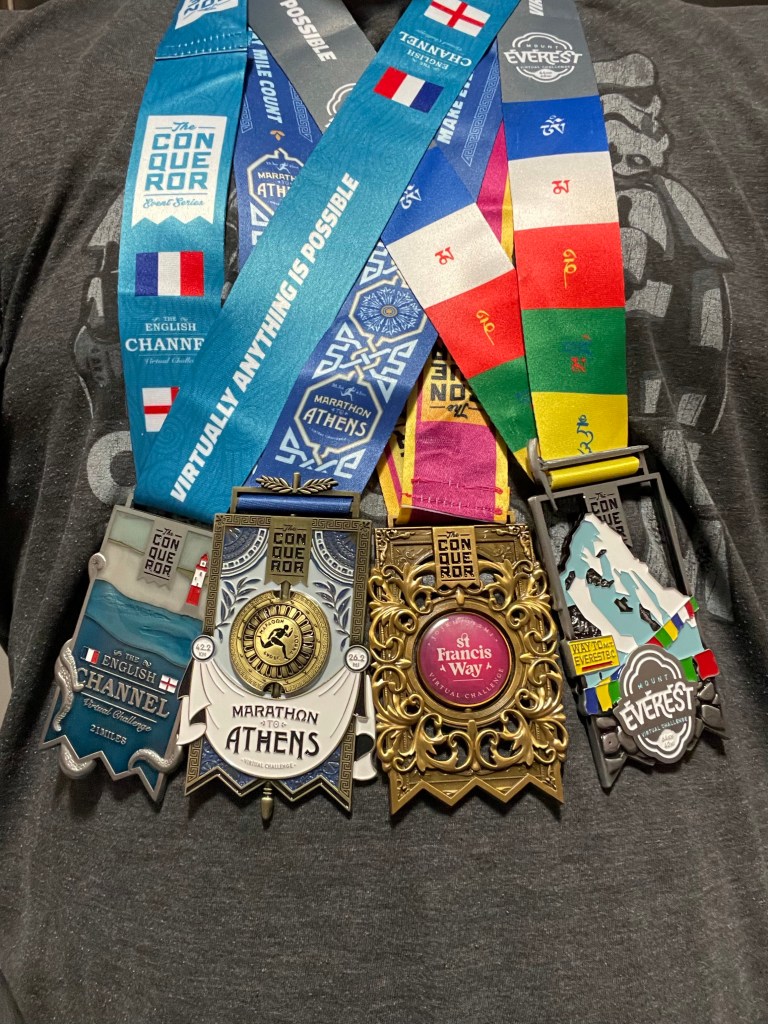
Sometime at the beginning of the summer, I wrote about trying an app called “The Conqueror Challenges.” The premise behind the use of this app is pretty simple. Once you have it installed and create an account, you can sign up for virtual marathons. These marathons (at least, that I’ve seen) have been as short as 26 kilometres all the way up to several thousand kilometres. You pay a nominal fee and you are able to choose a time limit (weekly amounts) to complete your challenge.
It’s a fun and interesting way to contribute to one’s overall fitness. The organization that runs the app plants a tree for every 20% of the challenge you complete. You get post cards and updates as you progress. For example, I completed the Mt. Everest virtual marathon, which involved travelling 64.2 kilometres. I gave myself a 3-week timeframe, but I was done within the first week. 64.2 kilometres racks up pretty fast on a bicycle.
At the end of your challenge, they ship you an actual medal depicting the challenge you were on. They’re pretty sweet, made of metal and usually have some special aspect to it specific to the challenge. For example, my “Marathon to Athens” medal has a slot with a Greek coin inside it. A reproduction, of course. But neat, nonetheless.
My swag, so far. #5 is in the mail and I’ve almost completed #6
The app syncs automatically with my Runkeeper app and will include any distance-related workout, such as running, walking or cycling. The St. Francis Way medal you see in the photo above was 502.8 kilometres. One of the best ways that this app keeps you motivated is that you pay money but lose the medal if you don’t complete the challenge in time. Nothing lights a fire under your ass like knowing you’ll actually lose money you’ve paid, if you get lazy and skip a few days of working out. Plus, you get to learn a great deal about all the different countries that are featured in these challenges.
I’m having a blast with these and they’re definitely conversation starters for those who see them. If you’re looking for a way to keep yourself on track, I highly recommend this. As long as you keep your goals realistic. I gave myself an 8-week timeframe for the 502.8-kilometre challenge. It would have been ridiculous to try and have it done in 2! But as long as you keep it realistic and consistent, you’re good to go.
Doing things in a virtual environment is the way of the new world. Why should marathons be any different. I’m always on the lookout for new ways to increase my fitness and new ways to exercise. This one has been loads of fun and it doesn’t hurt that I get a bit of bling to brag about, after the fact. ☯️
I want to live. Makes sense, right? Most people do. Most people have the opportunity. Not many people fight for that privilege. And I know what you’re thinking…. Why should someone have to fight for the privilege of living? Well, I don’t mean fighting for the privilege of staying alive because of oppression, war or famine. I mean fighting for the privilege to live against something that came to be, completely out of one’s control. If none of you have guessed that I’m talking about Diabetes at this point, let me clarify: I’m talking about Diabetes.
One of the best things about living in modern times, is that Diabetes is no longer an automatic death sentence. If you were diagnosed with Diabetes prior to the creation and distribution of insulin, that was pretty much it. I’ve written posts about how long a Type-1 can survive without insulin, even if they completely eliminate carbohydrates and continue to exercise. So I won’t get into that part, since that’s not what this post is about. Needless to say, insulin isn’t JUST about lowering blood sugar levels.
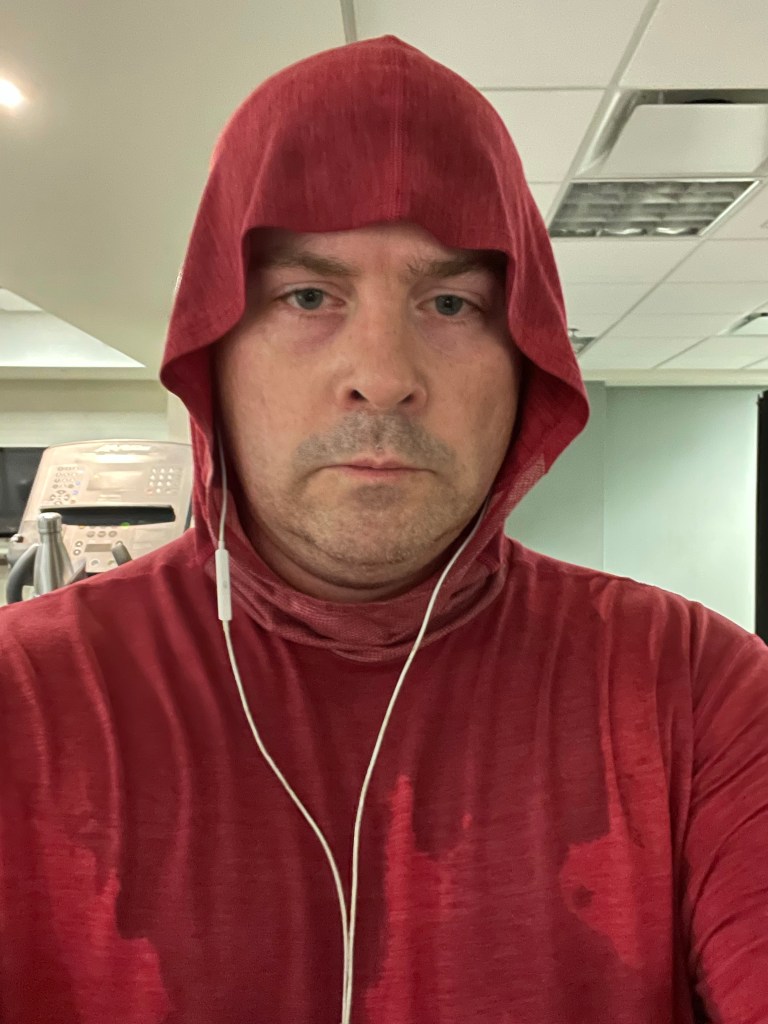
People have often asked me why I push so hard when I exercise, or why I do so much. I’ve had folks commenting on the fact that by the time I’ve completed a workout, I look like a wet cat who got stuck in the rain. Sometimes, it’s can be belittling or condescending; as though they’re suggesting that I shouldn’t be a sweaty mess in a public place where other folks can see. It’s almost akin to those who make fun of an overweight person in the gym for trying to get in shape. Granted, not EXACTLY the same, but the concept is the similar.
I learned from a very young age that Diabetes would show me no quarter. If I let up my guard, even for a day or two, it would find a way to swoop in and make my life difficult. Maybe this difficulty would come in the form of high or low blood sugars, which typically fuck with my entire day. Or maybe it would simply make me more susceptible to illness and make my day-to-day interactions all the more dangerous. Or perhaps it’ll take something simple like stubbing one’s toe and turn it into an automatic, infected toenail. Just because it can. Diabetes shows no mercy because it has no emotion.
Fitness is an important part of ANYONE’s lifestyle. It’s no secret that someone who doesn’t exercise regularly will face a host of health problems too numerous to list here. But staying fit and active is an important part of life and all the more so for someone with Diabetes. Again, from a young age I recognized this, especially in light of my doctors telling me I’d die due to Diabetes complications before I reached my teens (I’m now well into my forties, in case you were wondering).
I guess where I’m going with this is that there are a number of different reasons to work out and go to the gym. Some people want to get fit, some want to get muscular and some want to lose weight. hell, some people go to the gym simply to be social and see certain key people they may associate with. And that’s fine. At the end of the day, whatever your reasons for training consistently will never be bad. Anything will always be something more than nothing. My point is you’ll be able to easily discern who’s training to get fit and who’s training to save their lives.
That’s what I do. I train in order to save my life. I train because if I don’t, Diabetes complications will reach me all the sooner and take away something that I need in order to live. That’s why I’ll spend an entire hour on a cardio machine at a high level and end up soaked and breathing hard. That’s why I rarely take break days or rest days. Diabetes never takes a rest, so why should I? I push myself because I’m trying to stay ahead of a condition that will ultimately end my life, despite all the therapies, despite all the available resources and despite all my efforts.
And that’s the ultimate punchline of my existence. This is a race against time and a race against a condition that I will inevitably succumb to, despite my best efforts. But like trying to outrun an oncoming tornado, I have to try. I need to give it my all because I refuse to let it take me down. I have too much to live for. I owe it to myself and to those who matter in my life. I’m fighting against complications. I’m fighting against organ failure. I’m fighting against death. Besides, I’m well aware that there are those who push and train harder than me, anyway. But my efforts are mine and mine alone.
So, the next time you see me breathing hard at the gym, it doesn’t mean I’m “out of shape” or new to working out. When you see me walking away from a machine looking drenched like an alley cat left out in the rain, it isn’t because I couldn’t handle the exercise I was doing or I was doing too much. It’s because I’m fighting for my life. And if you don’t come out of that fight bloody and covered in sweat, you’re not really fighting. And you will lose. Ask yourself why YOU do it. No matter what your reason, you should never judge someone’s efforts or appearance when trying to better themselves. Whether it’s someone trying to get slimmer or fitter or someone who is simply trying to prolong his life long enough to see his children into adulthood. Food for thought… ☯️
I spend a lot of time online and with my nose buried in books, looking up the various knowledge and materials that I use in my posts. But I often overlook some pretty important and key dates that SHOULD hold a special place in my martial arts journey, One of those dates was yesterday. While doing some research for a post, I brought up Google’s home page and noticed Google’s banner was adorned with some martial arts imagery of a dojo, practitioners in white gis, and an image of Master Jigoro Kano in the centre.
It was a clever rendition and looked nice, but considering Google frequently changes their home page banner, I thought nothing further of it. That’s a shame, because yesterday’s post really should have focused on Master Kano’s 161st birthday, which is why Google had it up. It also dawned on me, a touch too late, that this is usually WHY Google will put something up; to recognize a special day. But I digress…
Master Jigoro Kano
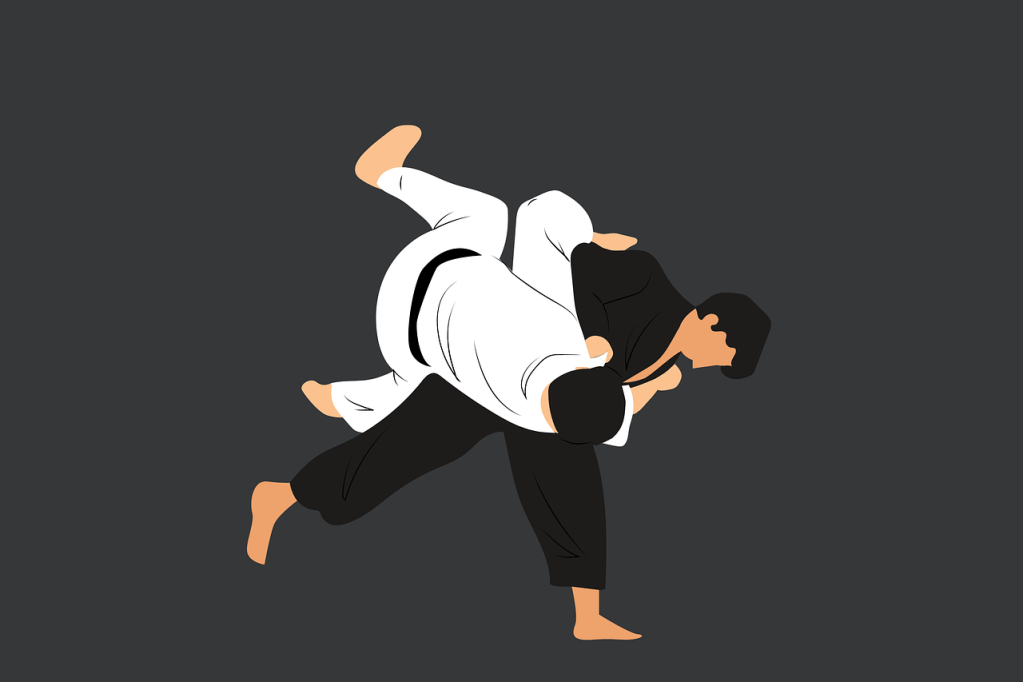
For those of you who don’t operate within martial arts circles, Master Kano was the founder of Judo. Even non-practitioners are usually familiar with that term. His efforts and teachings can be recognized and remembered as being the first Japanese martial arts to use the coloured belt system employed by most Japanese and Okinawan arts, as well as many others. He was a teacher by trade, which I have no doubt would help with teaching the martial arts, and contributed to Judo being taught in public schools.
Master Kano had originally studied Jujutsu while studying in university, long before it would make it’s way across the globe and everyone would only recognize “Brazilian Jujitsiu,” which is a combination of the two aforementioned arts. He eventually began to surpass his teachers and developed his own system, naming it Judo, which means “plainly” and “the way.” Master Kano also established the Kodokan, which is his Judo institute in Japan. I had the honour of visiting this facility in 2001. It was inspiring.
Although I consider myself a karate practitioner, Sensei also holds a black belt in Judo and incorporated a lot of Master kano’s teachings into our system. Through the decades, many of the holds, pressure points and throws taught in Judo were also taught to us. That’s why our school is called the New England Academy of Karate & Judo.
A happy, belated birthday to the late Master Kano. He may no longer be with us, but his legacy has obviously endured long after his passing and will continue on. In fact, judo was the first Japanese martial art to be included in the Olympics. It makes one wonder if he ever thought, all those decades ago, just how far his teachings would reach…☯️
Kids are amazing and they have no shortage of clever quips and imaginative ideas. Sometimes the amount of stuff my oldest son comes up with kinda scares me, especially when he starts talking about some of the “advanced” weaponry he builds with his legos and various other toys. If he ever gets a mountain fortress and a swivelling chair while petting a white cat, we may have a world domination problem on our hands. But getting them interested in the things you do can be the biggest challenge. For me, it’s been getting my children interested in martial arts.
My oldest son Nathan had some moments of interest where he would emulate some of the movements and techniques I would practice during a given workout. It was cute, considering he used to do this prior to being a toddler. I have a great video clip where he comes out of his room and sees me training, and immediately drops into a horse-stance and does a kiai. I used to show that video to EVERYONE, as I absolutely loved the precision and ferocity he did it with.
My oldest son, Nathan
This happened without my efforts to try and encourage him to do it. It gave me a slim hope that he would show some interest and perhaps prowess in karate and I would be able to start teaching him from a young age. I’ve seen the results of “forcing” children into karate, firsthand. The results are never positive. For this reason, I’ve always been an advocate of allowing children to make their own choice when it comes to sports and extracurriculars. That being said, Nathan has never shown an interest in learning beyond the occasional bout of floor grappling or “wrestling.”
When my second son, Alexander was born, he began to show some active interest almost immediately. As soon as he was able to walk without falling over, he would follow me around and do what I do. At only 2-year’s old, he currently practices punches, kicks and even lifts little 3-pound weights when I do resistance workouts. Although letting a small child use weights isn’t ideal, 3 pounds isn’t significant and it’s hilarious watching him do arm curls, trying to imitate me. Watching him on the punching bag is even better.
Beyond both of these scenarios of ultimate cuteness and adorability, one of the biggest issues is finding the time to do a proper workout when you have two small, rambunctious children clambering all over your legs. A good example was a few nights ago, when I was trying to do a short, weight workout in the living room. I’ve bring doing this push-up challenge called “Bring Sally Up,” lately (it’s been going well, BTW. Thanks for asking…) which requires the use of YouTube, since that’s where the video is. I prepped myself with a pair of shorts and a dry-fit hoodie with the hood up, which allows me to retain more heat and get a better sweat on.
The push-up challenge is about three and a half minutes long and at about the first minute mark, I raise my head just a touch to see a tiny, red-headed grin peeking into my hood. Hilarious, but obstructive. Then, as I was working through a set of dumbbell exercises, he was trying to emulate them with his 3-pounders. It would have been adorable if not for the fact that he was crowding my space and I had to keep moving or altering my sets in order to keep from cold-clocking him with a dumbbell.
I got the workout done, but it goes a long way towards showing how exercising with children involved can be complicated. The important thing is not only teaching children proper fitness safety as it pertains to proper stretching, not overdoing it and the dangers of the equipment you use, but trying to get it done for yourself in a safe, controlled manner. Kids don’t always get the potential dangers of exercise, especially with equipment. There’ll always be an excuse NOT to exercise but your children shouldn’t be one of them. ☯️
I have a great respect for teachers, a respect I wish I had when I was actually a student in school. I remember struggling to stay awake during class and considering a lot of the material boring and unimportant. As I grew into adulthood, I came to appreciate the importance of acquiring knowledge and how important those who were trying to pass it on were to me. As it pertains to karate, teaching is a very specific flavour that not everyone’s palette can appreciate. Myself included.
Having a good teacher is an integral part of a good martial arts journey. Too often, I hear about instructors who are either too violent with their students, refuse to provide certain levels of instruction or coaching or are simply more concerned with showing off their own skills than actually passing on their knowledge. These are all good signs that you’re in an ever-so-lovely “McDojo,” and you should exit, stage left if you ever find yourself in that kind of a teacher/student relationship.
I remember my first experiences with teaching karate. i was still a white belt, albeit a couple of stripes in, and I was tasked with teaching basic movements and the opening of our first forms to students who were starting classes for the first time. It was a fun experience, and it showed me some of the shortcomings and errors I was committing myself. Occasionally, I would been have a student who would recognize something and say, “Isn’t it supposed to be THIS way?” It was good, because it kept me humble and reminded me that there’s always learning to be done, even when it’s something you’ve learned already.
When I started to climb in rank and reached a senior belt level, I enjoyed taking the occasional class when Sensei wasn’t available and I continued to teach beginners and some higher belts as my own knowledge base increased. Teaching beginners was always a good thing, because it provided me with a refresher of my own materials and knowledge, which most martial artists tend to ignore as they climb the ranks. After all, it’s usually way more fun to practice that fancy, complicated kata instead of the basic one you learned as a white belt that essentially looks like you’re walking back and forth, right?
But the ability to teach and impart knowledge is a specific skill; one you don’t necessarily acquire simply by virtue of having “been there, done that.” the ability to impart knowledge is learned skill and a kept skill, but also one that has to be suited to one’s personality and overall abilities. This is a lesson I unfortunately had to learnt he hard way. And that lesson came in the form of teaching a kids’ class. When I graduated to black belt, Sensei approached me and asked if I would be willing to be the new Sensei for a kids’ class. he explained that he was getting increased pressure from some local parents to open one up again, but he simply no longer had the time or motivation to do so. He asked if I would do it, along with his silent assistance in the background.
I have to admit that I was happier than a pig in shit and very much looking forward to being an instructor. A head instructor of my own school, at that. So I got set up, sent out applications to the parents who wanted their kids to learn karate and started taking in students. During that first month, I had over thirty new kids in the class. That first class was reasonably decent, considering the children were reasonably quiet, compliant and following instruction. It helped that it was a new environment for most of them and as most children do, they were shy and withdrawn for those first few classes. then, all hell broke loose…
See, children have this thing they do where, once they get comfortable with an environment, they start getting cheeky and hyper. this is exactly what began happening in my dojo. With every passing class, it almost seemed as though I spent more time telling everyone to settle down and try to calm them to follow instruction than I was actually providing instruction. I also made the mistake of having some classes where i tried to introduce grappling by playing “king of the mat,” which resulted in the kids wanting to do nothing else.
After that first month, the total number of students dropped by half for a variety of normal reasons, including some who decided they didn’t like it, parents who thought tuition was too expensive (good luck finding another karate school that only charges $20/month) or children who had to be gently expulsed from the dojo due to refusal to follow instruction and such. It began to feel like a struggle and I quickly learned that teaching children was not my cup of tea. Within six months, I had approached Sensei and told him I would be stepping down and asked him who my replacement would be. There was none.
It was heartbreaking but I realized that teaching was beginning to take the joy out of karate for me. I didn’t want it to suddenly become something I no longer enjoyed, so despite having no replacement I made the difficult decision to close the doors of my dojo. Some of the slightly older children and the ones who showed proficiency were able to transition into the regular class and some of the parents were pretty miffed, but I closed my first dojo under a year of opening its doors.
Where am I going with this? Well, the lesson today is threefold. First, one needs to recognize that high rank does not make a teacher. It needs to be learned, inherent and wanted. Just because someone has reached the level of black belt (which isn’t the be all, end all BTW) it doesn’t automatically make them an adequate teacher. So the rank doesn’t necessarily come into it, to an extent.
The second point follows on the first, which is that you need to want it. If you start teaching others simply for the prestige of having them call you “Sensei,” then you’re doing it for the wrong reasons. Unlike classic Kung Fu movies where the aged master always retains a few key techniques for himself, true Senseis will teach their students everything they know in the hopes that the student will someday surpass the teacher.
Lastly, be clear on why you want to do it and know your niche. once again, teaching young children wasn’t my thing. I’m unfortunately too used to having structure and discipline in the people I teach to manage the chaos and lack of attention that accompanies most children. It takes a special level of patience. this is why I have the utmost respect for school teachers. When I think of the difficulties I often have trying to teach my 6-year old something important, I weep for the school staff that have to deal with him all week in tandem with a classroom full of his peers. I think they may be the true warriors… ☯️
I read a really good post recently about how “movies lie to you.” It covered a variety of things we see in the movies that generally wouldn’t be genuinely possible in real life. Things like drawing a long sword sheathed on your back, gunshots or explosions throwing people across the room or getting that zwing! Sound when drawing a sword from a leather sheath were some of my favourites. It was a pop up story on my Facebook feed, so I unfortunately don’t have a link to share, which sucks because it was a pretty good article. The one thing they brought up that caught my attention was actually something that I’ve written about before: kicks.
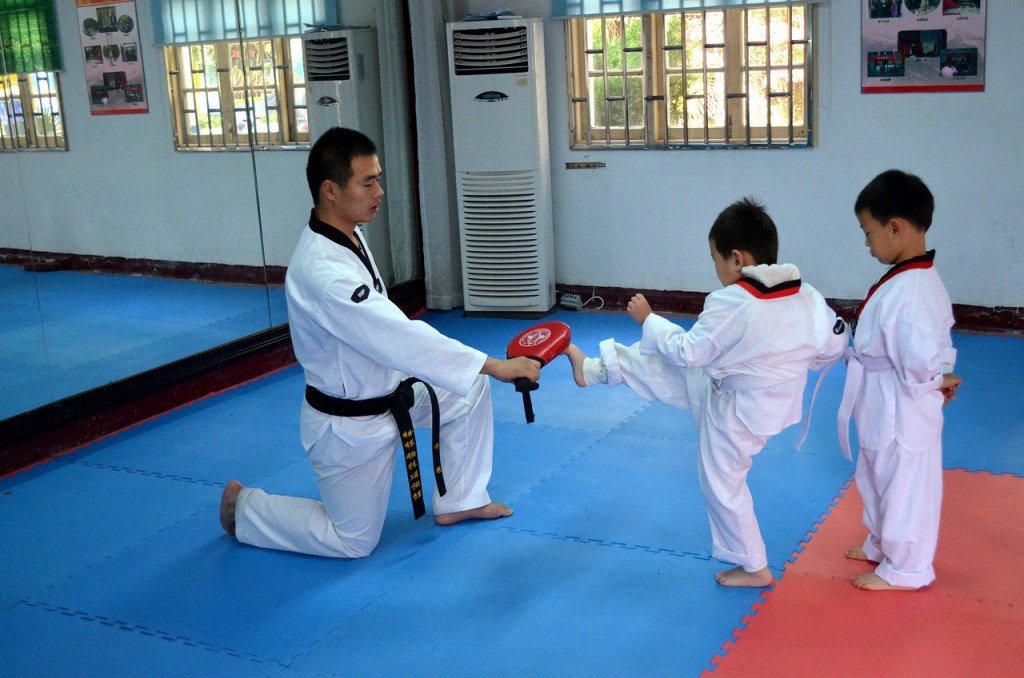
Do I study karate? Yes. Yes, I do. Do we practice kicks in karate? Oh, most certainly. But here’s the thing: high-flying or flowery kicks are all but useless in a real fight. Movies and television shows make a pretty good show of having martial artists duke it out with each other and there’s no shortage of kicks and it usually looks all cool and stuff. But all those high-flying kicks can leave you extremely vulnerable and standing on one foot is never a promising endeavour when you’re squaring off against an opponent.
I usually like to think, and I know some of my martial arts counterparts would agree, that any technique has its place. Some techniques are taught and practiced solely for the purpose of increasing flexibility and mobility and to develop that whole thing that if you want to kick to a certain extent, you should train further. But in actual real-world applications, it would never do to try and use a high kick against an opponent.
Not only do high kicks expose your groin and various other areas that one would rather not have struck, even a practitioner who’s trained and or acted certain kicks ad nauseam will find their balance precarious during an actual fight. One can easily make the argument that during training, you’re in a controlled environment where if you do nothing more than block, there are certain safeties in place that’s don’t exist in a real fight. When “fight or flight” kicks in, keeping your balance and composure can be challenging, despite muscle memory.
My style of karate basically includes front kicks, roundhouse kicks and blade kicks with an occasional sprinkling of back kicks. But with the exception of doing it to increase flexibility, all of our kicks are generally focused no higher than the belt line or floating ribs. I’m usually dependent on my hand strikes and blocks, since most real-world scenarios won’t involve a great deal of distance between you and your opponent. And honestly, if there IS that much distance, there would potentially be opportunity for you to simply reposition and walk away. Food for thought… ☯️
Without necessarily bragging (okay, maybe I’m bragging a little) I can usually manage about 50 push-ups before failure. That’s if I haven’t done anything prior to the push-ups, of course. About ten years ago, I could do far more. In karate, we made a point that our push-ups were always on our knuckles or fingertips. This was great for developing certain aspects of our art, including striking and pressure points. There’s no denying that push-ups are a fantastic exercise for building a bunch of different muscle groups.
Most people don’t realize that you can even change up HOW you do your push-ups for even more variety. This includes close-grip push-ups, wide-grip push-ups, single-arm and a bunch of other varieties that I usually don’t have the balls/muscle structure to try, Push-ups are about as classic an exercise as you can get. You can do them anywhere, require no equipment and they present a challenge, no matter what your fitness level. Needless to say, I’m a fan of them.
Some time ago, I found this video on YouTube of a guy demonstrating a push-up challenge called “Bring Sally Up.” The premise of the challenge is pretty simple. You play the song and every time they say “Bring Sally Up,” you push to the upper push-up position. When they say “Bring Sally Down,” you lower to the loaded push-up position and hold there until they say “Bring Sally Up” again. I decided to try this thing from a cold start, meaning I hadn’t done anything physical prior to starting it.
Theoretically, I should have been able to crush the 3:30 video without any issue, since it amounts to just over 30 push-ups (I didn’t take an exact count). But by 2:45, I was at muscle failure and dropped to the floor. My chest and arms were killing me and I was coated with sweat. It’s the pause at the bottom that does it. It’s absolutely brutal. During the version of the video I watched where the fitness trainer is providing some commentary, it’s mentioned that the more you perform this exercise, the stronger you become and the longer you can hold out. Like most fitness programs.
Anyway, if you’re looking to increase your push-up game and want to try something different, I highly recommend it. If you type “Bring Sally Up” into your search bar on YouTube, you’ll find multiple versions of the song; some where you see people doing it, some not. The version I like will be shared below this post. What I like is that there’s a timer display that counts up, showing you how far you’ve gotten. This is either good or bad, depending on whether you’re the kind of person who likes seeing time go by. There’s also a “beep” every thirty seconds, letting you know the progress you’re making in the event you aren’t watching the screen.
I like finding different ways to stay in shape. Exercise is (or rather SHOULD be) a daily part of life when you have Diabetes in order to ensure one’s continued health. Sometimes it can be integral to find ways to keep it interesting so that you don’t get bored. Boredom during fitness is one of the sure ways to ensure that you’ll skip days and eventually slip off the rails. So I gladly take any opportunity I can to try something new. Without butchering myself in the process, of course. Check out the video below and give it a try. Leave your results in my comments section, if you do. ☯️
We’re slowly starting to creep into that time of year when it takes the sun a bit longer to decide to grace us with its presence. Just a short month ago, I would leave to work just prior to 7 a.m. and the sun would already be blinding me on my transit down the road. However, if I take this morning as an example, I stepped outside and walked to the car and I felt the distinctive chill of the season seep through my layers and the sky was still dark. That first little while that this starts happening can be disconcerting and confusing, especially if you leave work late enough that the sun has already started to go down.
The view outside my office window
Depending on the environment you’re in throughout your day, this change in season can wreak havoc on your system. And no, I’m not just referring to the presence of pumpkin-spiced everything… I promise I’ll stop picking on those who enjoy those treats eventually; I just need to get a few shots in before the caffeine levels in my blood make me more reasonable. MOVING ON! My point is that some folks are fortunate enough to work in an environment where they can actively see the daylight. Some are not so fortunate and may work in a remote environment or an enclosed office where access to daylight isn’t always possible.
It should come as no surprise that the daylight plays an important role in a person’s health. First and most importantly, access to sunlight helps our bodies to naturally produce Vitamin D. Since I intended this post as an opinion piece and not necessarily an educational one where I’d have to cite sources and shit, I’ll keep it light. But the reality is that Vitamin D is necessary for all sorts of things like good bone health, stronger immune system and certainly not least or last, it helps with managing Diabetes. That last one is a touch important to me, as you might imagine.
Sunlight plays an integral role in the body’s function, including proper sleep patterns and managing your circadian rhythm. That’s your “internal clock,” which helps you to manage getting to sleep and waking up. So you end up feeling all sorts of fucked up, when you wake up for the day and it’s still looking pitch dark outside. Most people don’t have a regular work day where they wake up with the sun streaming through their window while soft violin music plays.
For all the reasons I’ve described above and much more, it’s important to take some preventative steps to ensure the colder weather doesn’t get you down into the dumps. Once you’re in the groove, these steps can become overall good daily habits. Here are a couple of things you can do to try and ensure you keep your energy levels on the up-and-up:
1. Starts Your Morning With Exercise. This is the best one, and something I wish I had more drive to maintain. I will FULLY admit that I’m terrible at doing anything, first thing in the morning, other than reaching for some caffeine. But doing exercise first thing in the morning gets you or blood flowing and oxygenated and will help you to hit the ground running far better than any cup of coffee you may grab. My wife is an absolute champion at this, usually starting her morning with a rigorous exercise routine she follows. During the pandemic winter, I used to walk my spin to the bus stop then walk anywhere from 5 to 10 kilometres. The result was the cold air woke me up and brutalized me before facing my day.
2. Drink Some Water. I’m a huge fan of caffeine for a variety of reasons. So I can’t honestly say with a straight face that I do this one, but there are studies that show that gulping down a glass of water first thing in the morning will jump start your system and help to wake you up. I have no idea if it works or not, since I guzzle caffeine minutes after waking. And don’t ask me what studies I’m talking about. I don’t have enough caffeine to remember where I read them…
3. Get Outside And Take A Walk. If you don’t work in an environment where you can see the sun, then go to where you can access it. Get some fresh air, take a walk and get some natural light on your body (and no, I’m not condoning stripping down and sunbathing while at work). Twice a day, I’ll take fifteen minutes to take a short walk outside, get some air and move around a bit. It makes all the difference and helps greatly with productivity. Most jobs entitle you to breaks throughout the day, so you should take advantage of them.
4. Control Your Blood Sugars. It’s obvious that you should be doing this anyway, but maintaining balanced blood sugars will help keep your overall energy levels up. Nothing saps your energy faster than having an extreme high or low, followed by balancing it out. I don’t know about the rest of you, but that usually leaves me feeling like all I want to do is sleep. Keeping your blood sugar levels balanced is not only a good idea for Diabetics in general, it can go a long way towards keeping you energized and moving throughout the day. Especially when in conjunction with everything else on this list.
There you have it. I’m no genius and none of this is reinventing the wheel, it’s simply common sense. But not everyone thinks about these things so maybe this will spark some ideas for the cold weather ahead. Especially here in Saskatchewan, the morning blahs tend to hit all that much harder once there’s snow on the ground and the weather reaches -50 degrees Celsius. That almost guarantees wanting to stay curled up in bed, despite whatever steps you may take. But life happens and facing the day is a necessity. May as well try to make it a energized and motivated as possible. ☯️
There’s no shortage of areas that have been affected by the pandemic, including work, schooling and social aspects. Some businesses have closed, some jobs have sent their staff to work from home and schooling was largely done online in the past year with graduating classes having virtual ceremonies or none at all. For me, the biggest effect was having the karate dojo close,
Although I recently wrote about how good it was to be back in the swing of things, we got word last week that we were once again closing amidst increased restrictions. This came after consulting with a martial arts association that the dojo is affiliated with, as they regulate what conditions we can train under and what’s permitted. Although we were scheduled to have class, last Tuesday, we got word on Monday that training in the dojo would be temporarily “paused” until it could be properly determined what we were safely permitted to do or not. A wise precaution. Or, is it…?
To some extent, I totally get it. Karate is a contact art, requiring practitioners to have some hands-on contact with each other while training in the dojo. Having someone literally in your face while training, without knowing their medical status, vaccination status or whether to not they may be a carrier can be a concern. And it certainly doesn’t conform to social distancing requirements. But one needs to recognize that to an extent, some conditions are more of a society-calming placebo than an effective means of stemming the virus’ propagation. That’s strictly an opinion, of course.
As it stands, we lost the entirety of last week without any word on what will become of classes for the foreseeable future. We were doing Zoom classes last year, which was a good alternative but it lacked a certain “oomph.” With this 4th wave hitting Saskatchewan, who knows what may come of all this. I don’t have a crystal ball. After 33 years of studying karate, I’m well-suited to continue training on my own, despite the fact the ambiance and joy of training with others definitely brings something to the table. If the world and society could just right itself, all of this would be significantly easier. I guess we’ll just have to wait it out. ☯️
I’ve noticed in the past week that the weather seems to be at single digits in the morning, prompting a lot of pain in my old joints and signalling that the warmer, summer months are gone for another year. With that comes the need to recognize that one’s fitness routine may be altered or NEED to be altered in order to accommodate the colder weather. We all know what’s coming next…. That wonderful white stuff that makes getting to work ion the morning an absolute nightmare.
But we aren’t going to talk about THAT, since we still have time before it starts hitting the ground. Hopefully. Today, we’re simply going to talk about colder weather as it pertains to fitness. For the most part, our brains tend to tell us that comfier and easier is better. This means that when we notice cold winds or a drop in temperature, we may be less inclined to step outside to do something physical. But there’s some inherently good and bad aspects to working out in the cold.
On the positive side, doing something physical outdoors will help with blood circulation, will wake you up better than a cup of coffee and will leave you feeling even cozier once you DO decide to hit the couch with a blanket and a warm cup of joe. Working out in colder temperatures can improve your mood and provide a somewhat different challenge than working out in the warmer weather.
For me, I’m slowly falling into the season where cycling for long distances is becoming less-favoured as a form of working out. Besides being cold, the colder wind whipping my face while cycling is a definitely no for me. I prefer to work up a sweat than try and defrost myself, so I look to different workouts, such as punching bag workouts or karate in my garage. I’m still outdoors, but without the Prairie winds taking advantage of my award-winning face. Kidding.
There are definitely some things to keep in mind, when stepping outside in cold weather. The first, is that you WANT to feel cold. Don’t believe me? The problem is that if you step outside feeling warm and comfortable, you need to understand that once you start exercising, your body heat will cause an increased amount of sweating, which is a recipe for disaster when you’re outside. Dress appropriately with a layer of moisture-wicking material first, and something insulating and breathable over that. This prevent the sweat from staying wet against your body.
When you sweat, your body inevitably loses heat through the evaporation of that sweat, which can leave you susceptible to being chilled. So, if you start off feeling cold but start working out, your body will take care of itself. The other side of the coin is to know what you’re personal and preferred limits are, and stick with them. Cold is cold, but only you will know what’s TOO cold for you. Is there a weather warning in effect? Maybe work out inside on that day.
Lastly, people tend to ignore a lot of the important steps when training outside, like applying sunblock to your exposed skin if it’s sunny and staying properly hydrated. The cold doesn’t protect you from UV rays and you’ll dehydrate just as easily in the cold. In some cases, easier. Not least of which is the fact that cold weather can have adverse effects on underlying health conditions, like asthma and Diabetes. Although subjective to the person, blood sugars will vary from prolonged exposure to the cold.
Keep an eye on yourself for warning signs of frostbite or hypothermia. Drink plenty of fluids and monitor your blood sugars frequently. And remember that if you FEEL it’s too cold, there’s no shame in moving your workout to the indoors. After all, winter is coming…. ☯️