Dojo Code Of Conduct


All the way back in December of 2019, I wrote a post outlining the proper guidelines a prospective student should follow when attending ANY martial arts school. Some of these are simply a matter of tradition, some of them are necessary to ensure that a dojo runs smoothly. Some, mostly all of them, are also a show of respect for the school you’ve chosen to attend. I think we can all agree that even if you’ve studied in a different style or have a different set of core beliefs, you should still show respect when inside someone else’s dojo. ESPECIALLY if your goal is to have it become your dojo, as well. Of course, if your core beliefs don’t align with the school you’re visiting, you likely shouldn’t be joining. But that’s a concept for a different post.

In recent months, I’ve returned to the dojo environment after a significant hiatus. My absence from any martial arts school was equal parts circumstance and COVID-19. But I’ve had the opportunity to observe some students, visitors and outsiders in the dojo I currently train with. Taking into consideration some of the things I’ve observed, I thought it would be ideal to once again share some of the basic principles of conduct within the dojo. This is never an exhaustive list and is often subjective to what’s been seen in the dojo but it’s all good stuff. Here we go:

  1. Bow when entering or exiting the dojo: This seems like a bit of a tiny detail, but it is an important one. It provides a show of respect; respect towards the instructors, respect towards the ones who trained before you, and respect towards the school. It also evokes a sense of discipline. Even though you may not realize it now, that tiny detail begins to lay the foundational discipline that should become the cornerstone of your training;
  2. Ensure your Gi, or karate uniform, is clean and pressed: This one is important not only for protocol and etiquette, but for hygiene reasons as well. And you would be surprised how many people overlook it. There’s nothing worse than someone who assumes that their last workout wasn’t intense enough to warrant laundering their uniform. Make sure it’s clean. Not only does that ensure a more “pleasant” environment for yourself and the other students, it shows proper respect for the uniform you wear on your journey. Keep an eye on the condition of your uniform. If it’s become yellowed and stained, regardless of washing, it’s time to replace it. If there are tears and/or holes, have them repaired (unless they’re unsightly even once fixed). You shouldn’t have to iron your gi but if you do, for the love of ALL that’s good and holy, don’t iron a crease down the center of your pants. Your going to karate class, not a business meeting;
  3. Stand straight and pay attention: When not executing a movement in the immediate moment, it is imperative that you stand straight and tall, heels together and thumbs tucked into the front of your belt. Keep your gaze towards the front and pay close attention to what the head instructor is saying. Try to avoid looking around and fidgeting. A big part of discipline is being able to focus long enough to build an attention span beyond that of a goldfish and if you fidget and spend your time, you may miss an integral piece of information you needed for what you’re working on;
  4. Acknowledge every instruction given: Different styles will have different ways of doing this. Some will choose a shallow bow when the head instructor provides instruction, some will answer in the affirmative by saying Hai (Japanese for “yes”) or something of the like… The method of acknowledgment will depend on the style and school you’re in. But once it’s clear that the instructor has completed providing instruction, this small acknowledgment is not only a sign of respect but provide the instructor with some cursory way of knowing that you’ve understood what’s been said;
  5. No food or drink within the dojo: You would think this one would be common sense, but a martial arts school is no place for you to sip your mocha-choca latte while your kid trains. Since the average martial arts class only lasts about an hour and a half to two hours, you can manage this easily without having food and drink within the confines of a training environment. In recent years, I’ve noticed that it’s become a bit more of a common thing for the practitioners to carry water bottles into the dojo and take water breaks throughout training. I’m pretty divided on this, considering Sensei always use to tell us to use the washroom and grab our drink BEFORE class started, because once you bowed in, you were in until you bowed out. But from a health perspective, I understand better than most that proper hydration is important. That being said, my current classes are only an hour in length and the average person should be able to make it through that short period without necessarily sucking back on a bottle;
  6. Get out of the way: If you become injured or over-tired, bow, step back and sit in seiza (on your knees) at the rear of the class. Stay out of the way and remove yourself from the flow of the class until your fatigue passes or your injury allows you to continue. Of course, if your injury is severe or serious enough to think you need to remove yourself, you likely shouldn’t continue as you could aggravate the injury further. The point is, there’s nothing to be served by standing in the way while others continue and you shouldn’t expect that everyone will stop and wait. After all, this is their time, too;
  7. Don’t show up late: This one is and always has been, a personal pet peeve of mine. Some instructors will say that if you show up late, it’s better to get “some of the workout” in rather than none at all. Although that is a great concept, showing up late can be disruptive to a class and shows great disrespect to your class and instructors. We all have busy lives. It falls to you to plan ahead and schedule things so that you may attend class. Whether or not showing up late is appropriate will be up to your head instructor, but true respect dictates that if you aren’t fifteen minutes early for class, you’re already late. A good example is a recent evening where I had to fight off a bout of low blood sugar and didn’t make it to class. I’m sure that if I really pushed it fought my way down there, I would have been able to make it only a short period after start of class. But such disrespect for the flow of a dojo’s operations shouldn’t be encouraged;
  8. Don’t waste your instructor’s time: Although you’ve likely paid a fee for your presence, the instructor(s) within the school are there to impart their knowledge and skills to you and others. If you aren’t going to put in your full effort, then you’re wasting your instructors time. Effectively, you’re also wasting your time AND the fee you paid. You’re also affecting the other student’s ability to learn properly. Karate isn’t something you can walk into a few 1-hour classes and expect to progress. You need to put in some supplementary time training outside the dojo, on your own. This is the only way you’ll truly progress and make any headway. Otherwise, you may as well join a knitting circle;
  9. Respect and train based on your partner: You will sometimes be paired with someone of lower or higher rank than yourself. If you’re paired with someone of lower rank, you become the example of what is to be taught. If you inflict injury upon your partner, you may discourage them from further learning and you will have gained nothing yourself. If training with someone of higher rank, respect should be given and you should take every advantage to learn from this person as they are in the same position you would be if training with a lower ranked belt. Granted, time has proven that there is just as much you can learn from a lower rank. It depends on how positive your perspective may be…

I’ve seen everything from kids running around, coffee, students fidgeting and looking around… In a school I no longer train with, there was even one guy who showed up forty minutes late for class with a bag of cheeseburgers and ate while the rest of us did calisthenics! Besides the fact that the smell of burgers was killing me, a karate dojo is definitely NOT the place to eating, much less junk food. Even though some of these points could be viewed simply as one’s person’s opinion, it stands to reason that tradition and respect are things that should never be ignored in the dojo.

Folks, no matter what sport or art you study, there will always be guidelines to follow. The martial arts simply have more, and that’s part of the charm. Although the above guidelines are only basic, they apply to any martial arts school you attend. Your specific dojo may have more, and this is one of those moments where it’s important to take the initiative and ask. After all, respect is a primary aspect of karate and all martial arts. Food for thought… ☯
It’s Never Too Late, Until It Is…

“It’s never too late…” How often have you heard that saying throughout the course of your life? It’s a well-known utterance, usually accompanying someone who is doing something said to be beyond the social or physiological limits of their current state. I’ve often read inspirational stories of people in their 70’s getting their PhD’s or parent and child graduating from the same college at the same time, together. Imagine how awkward THOSE frat parties would be? But to some, age is just a number and time seems infinite. I recently read a story about how Willie Nelson earned his fifth degree black belt at the age of 81. You can read that article here.

The big problem with this concept, and trust me when I say that I’m not TRYING to be negative, is that eventually it DOES become too late. Exceptional accomplishments much later in life are the exception, not the rule. This doesn’t make them impossible, simply improbable. And doing so is extremely subjective. Perhaps one person’s specific factors won’t allow for the same level of accomplishment as another. This is true of any point in life, not just the latter part. But eventually, the rigours and responsibilities of life start to accumulate one can find themselves at the mercy of responsibility instead of enjoying the freedom of their own potential. What’s possible becomes a fevered dream, to be dwelt upon during fleeting moments drowned in a cloud of reminiscent drunkenness.

I know that some of this likely sounds negative as hell and once again, it’s totally not meant to be. But since I’m throwing out sayings and utterances, another important one to keep in mind would be, “life is short.” And it is. None of us have any idea when life will take a turn towards that dark tunnel with the light at the end of it, so we should take full advantage. If you spend your life saying that it’s never too late, eventually, time will run out and it WILL be. Although one can always try their best to shoot for the stars, it’s important not to wait on the things that matter to you. Want to train for your black belt? Today is the day you should get started. Want to get on a diet and start losing weight? Don’t wait, get at it. Tomorrow is one more day that you haven’t done what you need to do. “It’s never too late?” Sure, until it is…

Never forget that life should be a pleasant experience. But that takes effort. Happiness should be the first and last thing on every person’s mind in a day but we cause our own suffering, and feeling a sense of loss over the “what if’s” only contribute to that suffering. Despite the pleasantness, life also wasn’t meant to be easy. And one shouldn’t mistake an easy life with happiness. One is not synonymous with the other. One can easily find happiness while still navigating the difficulties of life. What one should never do, is put off the things they want to accomplish. Because eventually, inevitably, the time will come when it WILL be too late. Food for thought… ☯️

Like A Hamster On A Wheel…

One of the big things I enjoy doing for fitness is cardio. There’s something pleasant about pushing oneself to go farther and faster, all while burning calories and fat. Given that my knees are pretty shot from three decades of fight training, I usually opt for cycling because it allows maximum distance while still getting a good burn without all the impact on my knees. This is why I opt for the elliptical during the winter. But despite having the centre of gravity equivalent to a rock, I can run. I usually choose not to, but I can.

During the late autumn and winter months, I’ve taken advantage of using the gym located in my office building. I’ve posted videos of what that location has to offer and it’s served me well. But in recent weeks, I’ve come to find out that circumstances may take this location away and I’ve once again found myself in a position where cardio will take a back seat. I mean, let’s be honest… I have free weights at home. I have a punching bag at home. And I now have a dojo at my disposal. This means that cardio is very literally the only reason I would use the gym location in question.

I’ve gotten rather lazy in recent weeks, missing some classes and negating the aforementioned cardio. There are a number of reasons behind this, including but not limited to the increased work load that has kept me from taking time to run at work. And I kind of enjoy spending some time at home, you know? With this in mind, I started looking for something I could do at home. A traditional elliptical machine or stationary bike would be too heavy and cumbersome to get downstairs, not to mention it would cost a fortune.

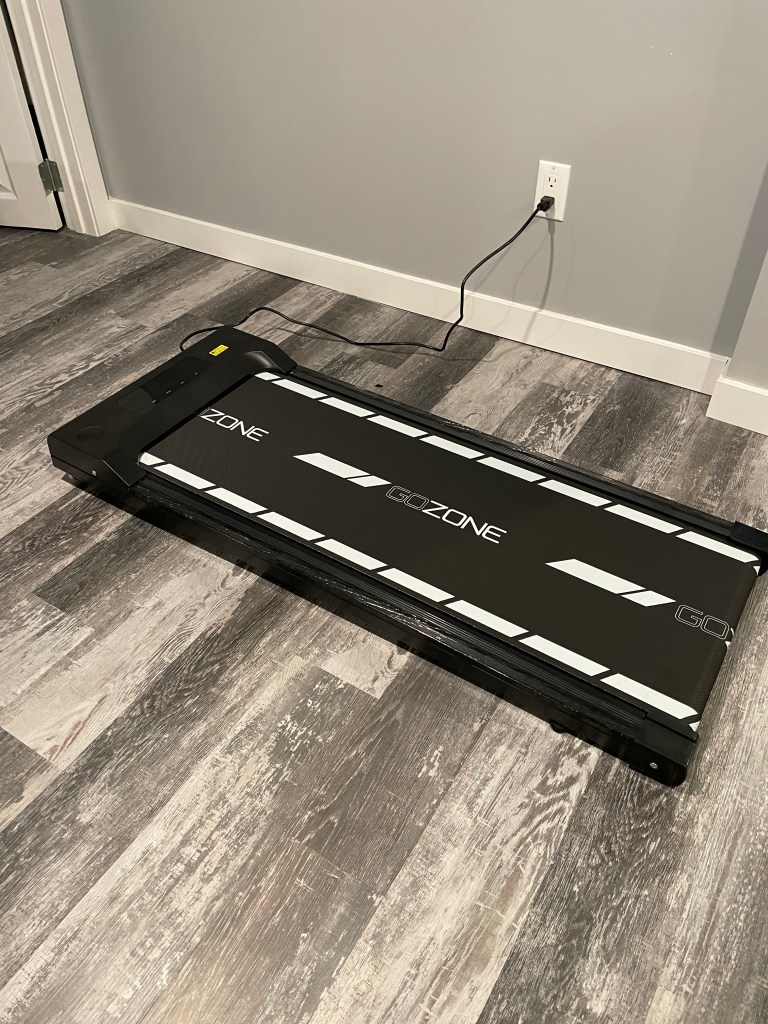
My GoZone “Walking” treadmill…

Enter: the GoZone Walking Treadmill. I purchased it from a local retail outlet and I usually don’t make it a point to endorse any particular distributor, but it doesn’t take a genius to guess what location I’m talking about, given the brand name. Pricing in at about $250, it’s currently on special for about $160. It supports a maximum weight of 265 pounds but only weighs 40 pounds, itself. it doesn’t boast a handlebar with a bunch of fancy buttons and displays but it definitely serves the purpose for an at-home workout area.

Digital display

I started by plugging it in to a nearby wall socket and set upon my laptop for music/streaming. It comes with a small, handheld remote, which controls speed and time. The digital display alternates between elapsed time, speed (in mph), distance (in miles) and energy burned. There’s a memory key on the remote that allows you to set maximum distance or time, and a rounded button for speed adjustment. Maxing out at 6 mph (approximately 10 kph), it allows for a reasonable jog. It wouldn’t be fitting for someone looking to train at hard running but definitely serves its purpose for some at-home cardio.

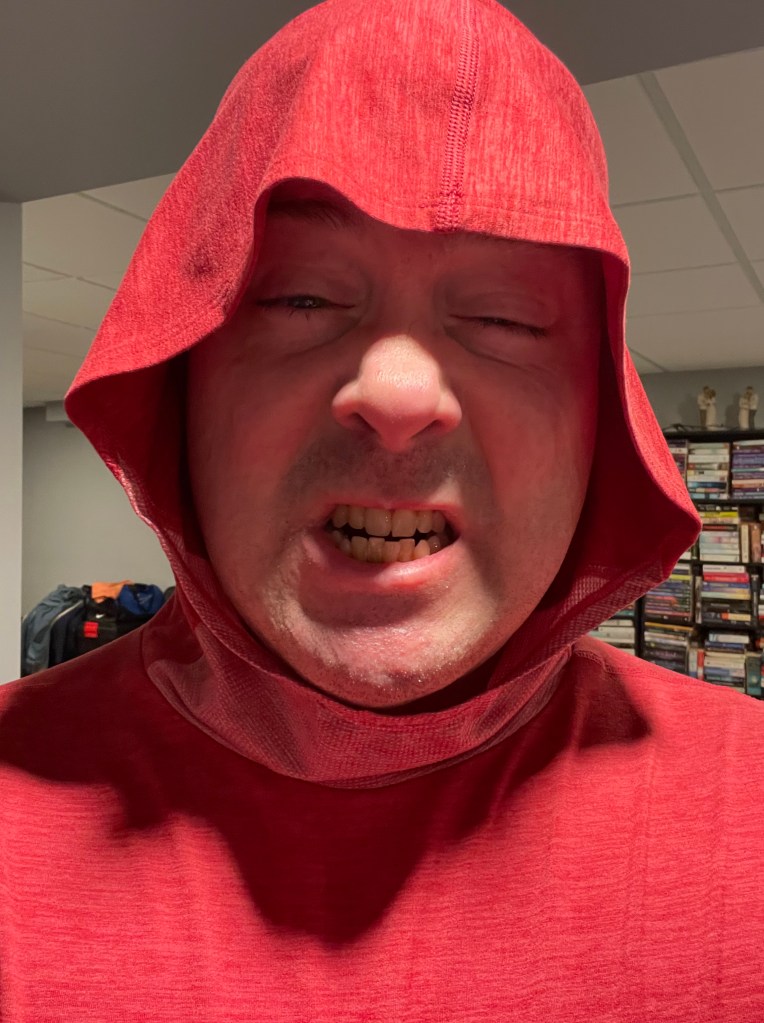
I’m not keen on the fact that it looks as though I have boobs…

I hadn’t run or performed any significant cardio in months, so I decided to test the treadmill out by running a simple mile (1.6 kilometres). I had Disney+ playing on the laptop and I was watching “According to Jim.” The mile crept up quickly and I could feel the shin splints building as I neared the end. It was a good burn, albeit brief, and once I stopped, my core temperature decided to catch up and I was sheathed in sweat. my blood sugars also dropped, making me grateful for training at home. Nathan also hopped on and trotted for almost half a mile.

Being old and out of breath is no joke…

Honestly, I was a bit concerned that the track would start to falter with me running on it. But it held up pretty well. I don’t know how long this thing will continue to work as smoothly as it does but it will make an excellent addition to my fitness routine. Given the low, reasonable cost, light-weight design and portability for storage and reasonable speed, the GoZone “Walking” treadmill is definitely recommended. I keep putting “walking” in quotations because I’ll only ever use it for jogging. ☯️

Self-Care First…

If you’re anything like me, you work pretty hard towards taking care of others. Whether you’ve found your calling by pursuing a career that allows you to help others or you do volunteer work or perhaps simply take that extra amount of time in your daily routine to throw on a load of laundry, do extra dishes or extra cleaning around the house, helping and taking care of others is an important part of one’s life. If there’s anything that life has taught me, it’s that everybody needs somebody and helping to care for them takes many forms and is important.

That is to say, it’s ALMOST as important as taking care of yourself. Great strides have been made in the past couple of decades towards acknowledging one’s mental health as an integral part of a successful, healthy life. Of course, some have been wise enough to acknowledge that, long before it started being well-known. The important thing to remember is that you’re no good to anyone else unless you manage to take care of yourself first. I’ve previously written about the need to take time to do things for oneself, whether that means reading a book or taking a drive on your own.

Your mental health depends on it, which is why it’s so important. Throughout my life, I’ve experienced toxic relationships where I’ve been hindered or prevented from taking proper care of myself. Not only does this make life far harder than it needs to be but the toll it takes on a person is substantial. All that being said, there are three things you should never have to explain or justify. And those three things play an important role in your well-being. In fact, they represent some of the basic needs that all people have. Here they are:

The Need To Sleep

Sleep is an integral part of a person’s health. Without proper sleep, a person can expect difficulty concentrating, blood pressure issues, cardiac issues and a whole score of health-related issues that no one wants to deal with. When you feel tired or sleepy, there’s no reason you should have to explain the need to sleep. There’s nothing worse than being tired and wanting to lie down, only to have someone require an explanation or accuse you of being lazy.

According to Maslow’s Hierarchy of needs, sleep counts as a physiological need, which is the bottom and first layer of needs. At its most basic, everyone sleeps. And the reality is that if one doesn’t sleep, one will eventually succumb and die. Work and familial obligations notwithstanding, you shouldn’t have to explain if you need to lie down and grab a quick snooze.

The Need To Eat

Another bottom level and basic physiological need, eating is subjective to the person. The rules of survival are pretty simple; if you’re hungry, you should eat. Now, bear in mind that hunger can be attributed to more than simply the need for food. Dehydration can cause feelings of hunger, so it’s important to maintain proper hydration levels by sipping water throughout the day. Emotional issues can also cause a person to compulsively eat, which isn’t directly associated to hunger but can cause a person to eat outside the regular boundaries of one’s three meals.

But if you find yourself hungry for the the old fashion reason, that being that you need food in your system, this isn’t something that you should need to explain or justify. In past relationships, I’ve actually had partners who have commented on my eating habits and have accused me of “eating too much” or gaining unnecessary weight through excessive eating. Although I’m not exactly the skinniest dude on the block, I also know that my weight is consistent with my age, size and activity level.

The Need To Recuperate From Illness

This one is near and dear to my heart, especially since I was diagnosed with Type-1 Diabetes when I was 4 years old. Throughout my childhood and into my teens, I would often have friends and later girlfriends, comment on my mood, health and energy levels as Diabetes took its pound of flesh from me. Even into adulthood, I’ve had difficulties when trying to explain or justify needing some down time to myself when overcoming a cold, flu or something Diabetes-related.

I remember one time, I was dating a local woman in on of the towns I was posted in. We went out to an even this one evening when nausea and stomach pain seized me. I told her I would be going home to rest and I could tell she was clearly upset by my early departure. She even made a passive-aggressive comment to others about how we had to leave because I was “not feeling well.” It wasn’t until she came in to check on me the following day and saw the state I was in, did she realize that I was genuinely sick and wasn’t making excuses.

The experience left a sour taste in my mouth and helped me realize that one should never have to explain or justify needing time to medically recuperate. And taking care of one’s health is the second level on Maslow’s Hierarchy as part of one’s Safety Needs, one step above basic physiological needs. I don’t think I need to explain why it’s so important to maintain one’s health and well-being.

This post is effectively an opinion piece. Perhaps there are other needs you feel would be more important and that you dislike having to explain or justify. If so, feel free to share them in the comments section. At the end of the day, the lesson here is that you have to take care of yourself before you can take care of others. Otherwise, the whole house of cards will falter. And as I said earlier, you can’t help others or take care of them before first taking care of yourself. ☯️

Ignorance Isn’t Always Bliss…

As I get older, one of the big things I notice is the increased amount of pain and discomfort. It isn’t a constant, debilitating pain, of course. But it’s usually just enough that it sits on the present fringes of my consciousness, a steady companion as I make my way towards the latter portion of my life. For example, just twenty years I could get a night’s sleep, whether good or bad, step out of bed and hit the ground running. Now, it takes several minutes for my body to acknowledge and accept that I’ve woken up, everything cracks and settles as I sit up and then my knees and joints scream at me as I get them moving. Such is life.

One of the important aspects about any pain and discomfort that we feel, is recognizing the need to seek medical attention. We’re often ignorant of this, whether due to the inconvenience of trying to get in to see a medical practitioner, which is not an easy in modern days, or the stubbornness of believing that pain is temporary. It often is, but we allow ourselves the indulgence of a far longer wait than we should, in some instances. This can lead to complications that one can ill afford, especially if you’re dealing with Type-1 Diabetes on top of things.

From a martial arts’ standpoint, many injuries will be suffered during training. Bruises, scrapes, blisters, pulled muscles, torn muscles and even broken bones are al injuries that I’ve either suffered or seen during my many decades of training. Most things can be healed with a bit of rest and time, specifically things like bruises and pulled muscles. But even those can lead to complications if left unchecked. If bruising begins to inexplicably spread or change to unusual shades of colour than what your bruises typically look like, there may be something more serious happening beneath the surface.

Pulled and damaged muscles actually take much longer than people assume. If left to heal properly, it can take several weeks for muscle tissue to return to its former state. If it’s been several months and the pain still persists or has worsened, that’s a sign that ice packs or warm baths won’t help any further. Medical examination may be required. Trying to return to your normal activities without allowing your muscles t properly heal will aggravate an existing injury and potentially cause others. Broken bones are a problem all their own. Besides the broken bone, certain breaks can cause a kink of nerves, restricted blood flow and circulatory issues.

It goes without saying (despite the fact I’m saying) that broken bones shouldn’t be ignored and require medical treatment. The old belief that you won’t be able to move a limb or use the part of the body if your bone is broken is myth. You’ll still be able to walk on a broken leg as movement is done through your muscles. That doesn’t mean it won’t hurt like hell and cause al kinds of damage, though. I’ve been lucky enough to get through my life with only mild fractures. I’ve only had to be casted once and have otherwise never needed to be laid up.

Numbness and loss of feeling is also an important concern. If you have pain somewhere in your body and start to notice numbness or loss of sensation in the extremities, this could suggest that whatever your injury may be is causing lack of circulation or kinking a nerve. None of that is a good sign and should prompt you to get the injury checked as soon as possible. trying to “tough it out” can lead to nerve damage and loss of extremities if blood flow is hindered.

Having Diabetes adds a whole different flavour to injuries and I recognize that I’ve mostly been speaking about internal injuries that show show a great deal of much on the surface. But cuts and open wounds are especially difficult, since people with Diabetes will have difficulty healing in a timely fashion by virtue of neurological and circulatory issues. Not only will injuries take longer to heal, but T1D’s are prone to infection, which will make matters all the worse. This is why it’s so important to maintain good blood sugars and seek medial assistance if injuries appear red and angry, ooze any kind of fluid and it appears as though they aren’t healing properly. ☯️

Hot Or Cold, The Debate Rages On…

Water. Fluid of life. Our bodies are primarily composed of it, we need to drink copious amounts of it on a daily basis to stay alive and maintain our internal bodily functions. In fact, the average adult needs to drink anywhere from 3 to 5 litres of water a day in order to meet that requirement. This is dependent on size, weight and even gender. And I should clarify that we also take in a certain amount of water through food, as well. So it ain’t all about chugging it down from a glass. Wait, whiskey has water, right? Moving on…

When I was younger, I was always discouraged from drinking icy cold water. There were a number of reasons behind this, including the contraction of tissues that could make it harder to digest food properly, shocking one’s kidney and causing bodily cramps. Most of the time, this was encouraged by Sensei, who explained it was preferable to sip water at room temperature; a practice I maintained for years afterwards, thinking that he had a point. Although how you choose to take in your H2O and like most things in life, there’s a good and a bad side to everything. And the temperature of your water is no exception.

I decided it might be time to examine exactly what is so bad about drinking cold water. Is it genuinely bad at all? Turns out a lot of people wonder that very thing. I’ve read a number of different articles and papers on the subject and they’re al pretty consistent in terms of current findings. My preferred one is posted by Healthline.com, which may be bias on my part since it’s one of my favourite websites. But the article addresses some of the pros and cons of drinking cold water.

One of the points the article mentions that appeals to be is how practitioners of Chinese Medicine have a belief that drinking cold water with a hot meal creates an imbalance. On the flip side, consuming hot water is said to improve breathing, which is likely one of the reasons why people are encouraged to eat chicken noodle soup or hot tea when trying to recover from a cold or flu. All that being said, the article suggests that drinking cold water can cause increased congestion and migraines in people who suffer from them.

Cold water can be beneficial during fitness routines. Not only will the cold water help keep your core temperature cooler as you exercise but it may also help you burn more calories since your body will fight harder to warm that same core temperature up. That’s assuming you can actually get your hands on cold water. My current gym doesn’t even have a water fountain available and if I bring cold water, it’s warmed up by the time I get to the gym, workout and finally take a drink, it’s pretty much reached room temperature.

I can easily agree that the consumption of cold water on a hot summer day may SOUND like a good idea in the moment, but it could potentially increase the mucus in your throat and the difference in temperature between your core and your water can cause cramps, pains and shock the body in uncomfortable ways. I’ve also gotten a mild version of brain freeze on days I’ve come back from cycling and chugged water from a refrigerated water bottle. So while the jury may be out, it’s up to the individual person to decide how good or bad the consumption of chilled water could be.

One way or another, any water you get into your system is good. There isn’t enough evidence either way to suggest total overall benefits or loss of drinking cold or hot water. My older brother, the Light rest his soul, used to enjoy a cup of hot water at supper. Without tea in it or anything. He used to say it helped him digest his food. Maybe there was something to that. As long as you’re getting enough water to stay hydrated and healthy, that’s what’s important. And for my Dia-buddies currently reading, proper hydration can help with proper blood sugar control. ☯️

Some Winter Supplementation…

Most of this material was part of a post I wrote in June of 2019. It was one of my favourite posts and one of the most researched. This is one of those posts where I should point out that I’m not a medical practitioner, dietitian or health professional. So, consult your physician or medical practitioner before starting any supplementation. That being said, this is my third time posting this material in the past three years, and for good reason. I haven’t met a doctor yet who hasn’t recommended using a daily multivitamin to supplement my meals. And since any given doctor has no way of knowing which vitamin I’ll purchase and it isn’t a prescribed item, the conspiracy theorists can’t even spit out their usual bullshit about “big pharma” trying to coerce us into buying them. It’s one of the few things where one needs to acknowledge that it can be helpful. And since the winter weather causes everyone to catch every little bug that comes about, I thought it would be a good idea to remind people of the importance of vitamins and minerals in the everyday diet.

One of the key reasons behind the consumption of food is to obtain carbohydrates for energy. The human body requires energy to carry on normal functions and, well… stay alive! But what else do we get from the food we eat? A proper diet will also include a number of vitamins and minerals that we require to maintain proper health, growth and energy levels within the body. We’ve all heard about getting enough vitamins from a young age. I remember getting my Flintstones vitamin everyday as a kid.

But if you’re like most people, you’re likely wondering what these vitamins are for and what they do. My goal is to cover off the main ones here:

Vitamin A: This is an all-around vitamin that provides a number of functions including but not limited to the proper health of various bodily functions, tissues and helps to fight chronic disease and is known to be good for the eyes.

Vitamin B: This one is a bit complicated, as there is a large grouping of enzymes, vitamins and minerals that fall under the “B” category. In general, B-vitamins are used for energy production, immune function and absorbing iron. Some them include B2 (riboflavin), B3 (niacin), B9 (folate) and B12. There are a few more that I can’t recall, but B12 is considered amongst one of the most important of vitamins overall because it helps you turn food into energy.

Vitamin C: At some points, this one has been referred to as the sunshine vitamin. I’m thinking that’s mostly because people’s main source of Vitamin C is from citrus fruits. But this vitamin also helps with iron absorption, immune function and is a natural antioxidant that helps with the elimination of free radicals. Eating citrus fruits are also what sailors used to eat on long voyages to prevent scurvy.

Vitamin D: This vitamin helps with the strengthening of bones and teeth. Our bodies are designed to self-generate this vitamin naturally through exposure to sunlight, but obviously that needs to be done in small doses. Modern life has created an environment where more people spend their time indoors, away from the sun. So supplementation becomes important.

Vitamin E: A pretty straight forward vitamin, this one helps with proper blood circulation and clear skin.

Vitamin K: This vitamin is essential for blood-clotting. In order words, if you’re deficient in this vitamin, small cuts or injuries can cause excessive bleeding that can become dangerous.

Folic Acid: We hear people speak about this one as being necessary during pregnancy. And they would be correct! Folic Acid helps to prevent certain complications during childbirth but is important to everyone for proper cell renewal. This one is also known as Folate, or Vitamin B9 (as listed above).

Calcium: Most people should be familiar with this one. Teeth and bones, people! Teeth and bones! Good calcium levels are required to keep those body parts healthy.

Iron: This helps to build muscle tissue naturally and helps with proper health of the blood. As an interesting sidebar, it’s also what makes your blood red through the reflection of light!

Zinc: Immunity and Fertility. I’m a little unfamiliar with this one and haven’t had the opportunity to research it a great deal.

Chromium: This one is near and dear to my heart. Because it helps to control blood sugar levels. Chromium is what helps all the systems of your body to get the energy they need when they need it. Some traditional medicine practitioners will suggest Chromium supplements for Type 1 Diabetics who may have difficulty in maintaining proper levels.

Magnesium: This one helps your body to absorb all the other vitamins and minerals. It also acts as something of a relaxant to muscle tissue and play a role in proper muscle contraction.

Potassium: This mineral helps with the proper hydration of your body and helps to control blood pressure.

There are many others of course, but I’ve tried to cover off the main vitamins and minerals required for a proper diet. We get most of what we need by eating regularly and including a variety of healthy foods. A lot of people take a daily multi-vitamin, which is fine. But unless you are experiencing symptoms or unexplained illnesses, there shouldn’t be a need to actively try and take added amounts of anything. Your medical practitioner should be able to advise you if further supplementation is required. For example, patients who are recommended to take Folic Acid and Iron during pregnancy.

Obviously, all of this is extremely important; not only for proper health and fitness, which is important to me, but to help with Type 1 Diabetes as well. Taking a daily multivitamin can help to ensure that your body gets everything it needs, in combination with carbohydrates, lean proteins and fibre. My wife Laura originally gave me the idea for this post in 2019 when she asked about B-vitamins. So, I should once again extend a shout out to her for keeping me inspired and constantly feeding me ideas. ☯

A Little Something To Help The Journey…

As I’ve written in previous posts, I recently started practicing Shotokan karate. I was lucky enough to find a school in Regina and it’s quite traditional and shares many of the same values I was raised on, from a karate perspective. I officially registered with their school this month, making it the first time in over a decade that I’ve been a registered student in any dojo. I missed the majority of classes last week due to other obligations, a problem I didn’t have in my teens and 20’s, and I’ll be missing today by virtue of it being my eye injection appointment.

But it’s been fun and exciting. I’ve already learned some new forms and ways of doing techniques I’ve been using for decades. Learning something new is always a good thing and for me, the stagnation that’s come from training by myself for the past ten years has made me realize I have a long road ahead of me if I expect to regain some of the lost skill I used to have. Recent classes have shown that I lack muscle tone, flexibility and skill in certain areas where I used to shine. Ali used to say that it isn’t the mountains ahead that wear you out, it’s the little pebble in your shoe. Well, I have a lot of little pebbles…

One of the biggest things about karate is that it isn’t a “one and done” where you go to your scheduled classes every week then call it a day. A practitioner needs to focus on lessons outside the class, practicing what they’ve learned and honing it on their own, using class time as a means of obtaining correction and guidance to keep growing further. Otherwise, a 10-year journey will easily turn into a 20-year one. That’s why it’s important to have some tools to help you along your training. For most modern, western dojos, students won’t have access to their instructors outside of class hours. Depending on the style you’re studying, you can be lucky enough to find videos on YouTube that will demonstrate your techniques and katas so that you can practice them and obtain correction. In my day, we had do something different; we used books.

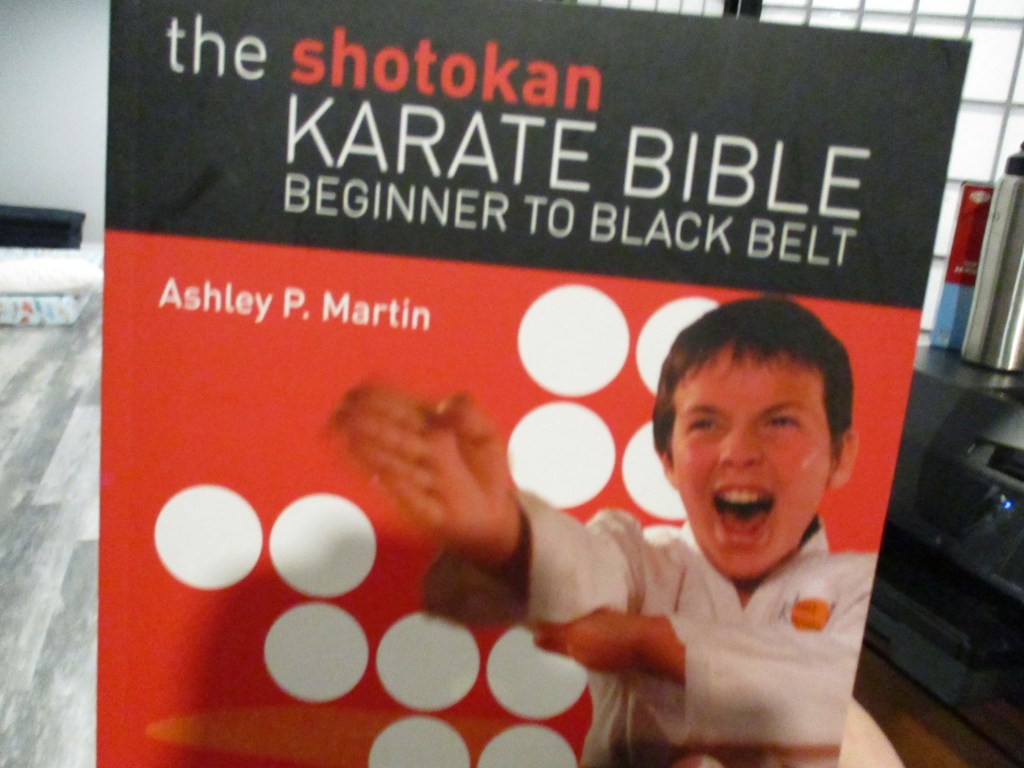
The first book on Shotokan karate I purchased years ago…

I can hear Mr. Miyagi’s voice in my head from the original Karate Kid movie, when he walks into Daniel Larusso’s apartment to fix the sink. “Learn karate from book?” The heavy accent and curiosity made the question seem as though he couldn’t believe what he was seeing. And with good reason. Book are a fantastic way to supplement one’s training and can contain material that’s valuable to a student’s progression in karate. But it’s important to note that a supplement is all that it is, and that nothing substitutes being in class learning from your counterparts and instructors. But I digress…

The book pictured above is one that I purchased almost five years ago. I was out at a book store and even though I am primarily a Uechi-Ryu practitioner, I was drawn by the book and chose to buy it. In all honesty, I never understood why and with all the material I read in the course of a year, combined with work, my kids and writing, I never gave it more than a cursory glance. Fast forward to this year, where bI’ve coincidentally joined a school of Shotokan. Most people are divided on the concept of all things happening for a reason but there’s something to be said for the fact I purchased a book on a different style of karate, years before I would consider joining one of their schools.

In an effort to try and get a leg up (karate pun fully intended) in my new learnings, I cracked this bad boy open and started using it to learn my first form. Learning from a book can be difficult if you’ve never seen the form done in person, since even if the illustrations are clear you could potentially err in such aspects as what direction to turn and how to place your footing. That’s one of the reasons that I suggest that being in-class and learning first is important, even if you’re practicing at home.

My most recent purchase…

Since I’d been training with Shotokan for a couple of weeks, I decided to get pro-active and look into whether they had some sort of primer of book that would relate directly to the founder of the style. This is where I came across the book pictured above. Some years ago, I came across the book entitled “Uechi Ryu Karate,” by George Mattson. Although written by an American, this book contained all the materials of my style from start to finish and all the illustrations included Master Uechi himself. It’s been an incredible aid in maintaining my katas and techniques, especially since I don’t have Sensei here to correct me.

“Karate-Do Kyohan” is similar in its content in that as far as I can tell, it contains all the pertinent material for Shotokan that covers all levels of training. I was pretty pleased to have found a second-hand edition of the book that someone was wiling to part with. The amount of material is immense and the illustrations clear in such a way that I will be able to get ahead of the curve on learning this new-to-me style of karate.Considering some of the differences in how they stand and their approaches to certain techniques, it will also help me to acclimate to this new environment as I learn one of the more popular styles of karate.

Karate is a life-long commitment. Unless you’ve completely given up on yourself it never goes away, even if you haven’t been in the dojo in years. And with that commitment comes the requirement to work hard and practice OUTSIDE THE DOJO. If all you do is attend class two or three times a week, do your hour then head home… Sure, you may get some fitness and some cardio in. As long as you pay attention and participate, you’ll even learn a thing or two. But if you want to become proficient, you have train outside of class. Take a couple of evenings to contribute an hour to your training. It’ll make all the difference and will help with your proficiency and overall karate journey. ☯️

One Foot In Front Of The Other…

People aren’t usually thinking about their feet. Other than having one’s partner or one’s children tell them that their feet smell bad, we don’t give them much thought, other than to ensure their properly covered when going outdoors or giving them a cursory wash while showering or bathing. But for a Type-1 Diabetic, the care and attention of one’s feet is critically important; all the more so when one is a martial artist.

Over the course of my life, I’ve trained on a variety of different surface including but not limited to, polished hardwood, concrete, tile, sand and rocks. And let me tell you that not all surfaces are created equal. What even funnier, is that your feet will tend to callous in a very specific way that accommodates the surface you’re training on, so that training on a different floor that’s still made of wood will affect your feet.

So why do Diabetics have such a difficult time with their feet? The short answer is that Diabetes causes a bunch of secondary conditions that relate to the limbs, including arterial disease and neuropathy. This will decrease circulation and make one more susceptible to sores and infections. Left unchecked, it can lead to serious complications that often result in amputation. This is why you hear of so many people with Diabetes losing a foot.

Besides being one’s main method of moving around, the feet are what support us. We use them to walk, run, maintain balance and, oh yeah… KICK! Pretty much every martial art I’ve come across uses kicks in some given way, shape or form, so maintaining the health of my legs and feet is definitely important to me in several ways. But there’s no denying that training in karate normally involves training bare-footed, which can present its own set of challenges, depending on the floor’s cleanliness and soundness.

There’s plenty you can do from the Diabetes standpoint to ensure the proper health of your feet. This includes the usual laundry list of things I mention in almost every second post, like consistently working out, monitoring your blood sugars and blood pressure and eating a healthy diet. Reducing your stress can be a big one too, since increased stress will affect al the other things I just mentioned as well as cause other issues.

The reason Diabetic feet are prone to easier injury and infection is mainly because the decreased blood flow and neuropathy will cause a loss of sensation. This means that if you get a cut, bruise or sore on your foot, you’ll be less likely to feel it and you’ll keep walking on it, ignoring it and putting pressure on it, which can cause certain injuries to aggravate. And THAT’s exactly what you want to prevent.

We discussed what can be done from the medical side. What about the practical side? First and foremost, wash your feet daily. That should probably be obvious. But also CHECK your feet. Visually look at the soles, between the toes, at your heels… Watch for injuries, cuts, scrapes and sores to ensure an injury doesn’t go unnoticed and gets infected. Perform self-checks on your feet to ensure you still feel light sensations, pressures and different temperatures.

One good thing to remember is something that seems minor or menial to the average person can pose some serious risk to someone with Diabetes. If you DO have any injuries on your feet, make sure you aren’t picking at them or removing scabs. Keep your toenails trimmed and avoid going barefoot unless absolutely necessary (like during karate class). ☯️

Not Just The Boy Scout Motto…

Even if you’ve never been in the Boy Scouts, you’ve no doubt heard of their motto, “Be Prepared” in television or movies at some given point. I myself, was a Beaver Scout in the early 80’s, until I was diagnosed with Type-1 Diabetes and my world was turned on its head. But before I turn this post into a pity party, let’s focus on the motto, which is the aim of today’s post. Being prepared in life is important. Since we live in a relatively comfortable environment where most resources and amenities are available to us (at least here in Canada), people have a tendency to overlook good preparedness.

Now, I could be very generalized and discuss how one should be properly prepared in ALL aspects of their lives, including the care of their home, family, health and property. But what I’m going to focus on today is specifically as it relates to one’s fitness, especially in conjunction with Diabetes. It’s no secret that having Diabetes presents a plethora of challenges, especially when you’re working out. This means you need to be prepared for the inevitable issues you may face when training.

First of all, we need to agree that it’s somewhat easier to function with high blood sugar than it is with low blood sugar. There’s a certain where where either one is an issue but if you’re doing something fitness-related, you’ll find you can at least push through and won’t pass out if your blood sugars are high. The same can’t be said if your blood sugars are low. For that reason, it’s important to ALWAYS bring some fast-acting carbohydrates with you. For me, jellybeans work best. I know that some people will use a variety of juices, gummy candies and even straight sugar and water. You’ll want to find what works for you and be sure to keep it on hand. You want to avoid certain foods like chocolate, which is basically just a block of fat that will take forever to bring your levels up.

Next and equally important, is water. If you haven’t noticed from the thousand+ posts I’ve put up (yes, I am now in the thousands), hydration plays an integral role in fitness and overall health. Proper hydration is also helpful in maintaining balanced blood sugars. Most sources will say that we should all be keeping a reusable bottle with us and consistently siping from it, throughout the day. My wife is far better at this than I am. When it comes to fitness, you want to strike that proper balance and try to avoid dehydration AND drinking too much water.

You probably read that last sentence and asked, “Can you really ever drink TOO much water, Shawn?” Why, yes! Yes, you can! Consuming too much water in the wrong conditions will cause something called hyponatremia. This condition can be caused by an increase in diuretics, severe or excess sweating or consuming too much water. The result is your body’s concentration of electrolytes, namely sodium, gets too low. Back in the summer of 2020, I experienced this condition firsthand. I woke up on a day off and chugged an energy drink, which I unfortunately seem to do every morning. Then, I performed the longest bike ride I had taken (at that point) where I peddled from Regina to Balgonie.

It’s a 56-kilometre trek, back and forth, which is far from the farthest I’ve managed to achieve since then. But it was summertime, with temperatures in the mid-30’s and dry Prairie air… My phone shut down halfway due to being too hot, I was sweating like a hog and chugging back water ever five minutes. To my credit, I had brought plenty of water and fast-acting carbs, but little else. This meant that I kept pumping the water in to slate my thirst but I was losing electrolytes through my sweat. Like, a lot!

By the time I got home, every joint was killing me, I had a headache, nausea and difficulty focusing. It took several minutes of trying to look up the symptoms and my wife helping out to discover that I needed to take in some sodium. I slugged back a couple of bottles of Gatorade and ate some salt & vinegar chips and laid on my bed with the A/C going at full strength. Once my body slowly started to regulate, I got groggy and fell asleep for a while. It was probably the most uncomfortable and painful experience outside of a tangible injury or Diabetes.

Since then, I maintain a practice of mixing electrolytes with water as I cycle, which has served me well on my 70 and 80-kilometre treks. But it was an important lesson to recognize that getting to the end of a significant workout can require more than just sheer will. Easy things to carry with you, whether at the dojo or while out doing cardio, are little things like a portable battery pack to charge your phone in the event of an emergency and bandages or a small travel first aid kit. You may never NEED any of those things but it’s always better to have it and not need it.

Being prepared is an important aspect of anything one does in life. It can mean the difference between potential facing a dangerous or hazardous situation or being temporarily inconvenienced. it all depends on how prepared you want to be. For most people with Type-1 Diabetes, being prepared and constantly dragging along a small bag with carbs, testing equipment and food can mean the difference between good health or a hospital trip. Why not take the few minutes required to ensure that you always have what you need for any workout or outing you go on. ☯️