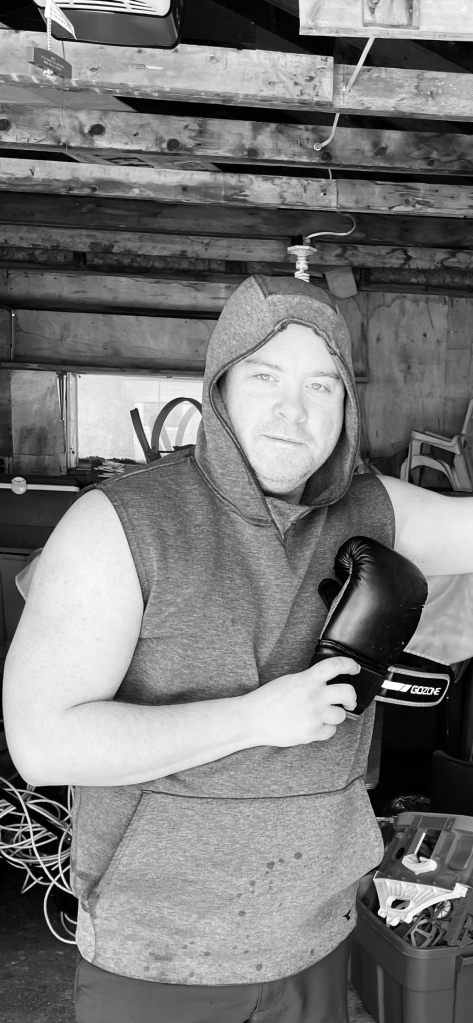
With the warmer weather becoming more of the norm than the exception, my mind has been turning to all the fun, outdoor activities that I usually enjoy doing in order to supplement my martial arts training. Some of those activities include long-distance cycling and using the punching bag in my garage. Last Sunday, the weather reached 7 degrees Celsius in Regina. As such, I decided to spend some time outdoors. Nathan spent the afternoon with a neighbour boy his own age. Alexander and my wife decided to come outside and enjoy some of the warm weather and fresh air.
They also came outside to watch me break a sweat as I chose to have my first punching bag workout of the season. I’ve been waiting on pins and needles to get outside to use my bag and getting some kilometres on the bike. It was a good burn; I only pounded the bag for about 30 minutes but that was all I needed to get my heart rate up and break a solid sweat. By the time I was done, I was sore and tired but I felt good. It was a bit like shaking the cobwebs off and coming up for air. I love training in a dojo but it’s important to do some stuff on the side in order to maintain one’s cardio and weight management.
I didn’t get out on the bike like I had intended, given that I had no grease for my chain and my can of WD-40 was empty. I would have enjoyed throwing a few clicks under my belt as well, but I’m more than happy to save that for another day. In the meantime, I had a “training partner” who decided to pick up the gloves and take a shot. As you can see from the video below, he’s a bit rusty as well. But the effort was still there. Check it out…
He definitely shows potential and always wants to punch or kick something. Wonder who he gets THAT from? I’m definitely happy with the better weather and the opportunity to start training outdoors again. I can’t wait to get out on the bike. There’s nothing quite like having fresh air in your lungs, music in your ears and a heavy sweat as you peddle your way to better health. ☯️
isolation can be a difficult concept to adapt to, and even some of the most diehard advocates for being alone can admit that life is always a bit better with some other people involved. Speaking strictly for myself, I’m not exactly “Mr. social” but I do enjoy the pleasure and benefits of a few good and valued friends. Considering my background and personality, if you’re still around and I speak to you regularly, I can say that you’re definitely doing something right.
But today’s post isn’t about me. It’s about having a partner as a means of getting things done. For the most part, when we set goals for ourselves, we usually do so through the lens of someone who intends on completing said goals on their own. But in reality, there’s a lot to be said for having a partner there to help you through, keep you motivated AND keep you accountable.
One good example is using a bench press. If you’ve seen any show that features a gym, you’ll usually see a scene where someone is using a bench press and has someone standing behind them to spot them. While this is done to prevent muscle failure from causing the steel bar to come crashing down on one’s trachea, it also helps to have that spotter cheering you on and pushing you. One has a greater tendency of lifting harder when one knows others are watching.
This is mostly because as people, we don’t like to feel failure or embarrassment in front of others. Although you shouldn’t necessarily care what others think of you, this reflex can be extremely handy in reaching any goal you set for yourself. This includes fitness, dieting or even learning a new skill. Knowing that a chosen partner will ask you if you completed the day’s workout or not makes you more likely to complete it for fear of having to admit otherwise, over the embarrassment of saying that you didn’t.
Having partners within one’s own household can be especially helpful, if said partners are willing to participate and join in on whatever goal you’re trying. On the other hand, if your goal is to stick to a particular diet and the people in your house are munching away on junk food while you’re wolfing down kale and tofu, it may be far more difficult to resist temptations and reach your goals.
In some instances, a partner will be a foregone conclusion. For example, if you join a karate class, you’ll often be partnered up with other people in order to train. Take it from me when I say that even though you CAN train by yourself in karate once you reach a certain experience level, it tends to suck. Big time. Most fitness and health goals will be not only easier but more fun when done with someone else.
The important thing to remember is to find a partner who has similar motivations and end goals as you do. Choosing a friend who usually quits things or has a different mindset can be frustrating, especially if they end up quitting shortly after starting. And a negative attitude will have the opposite effect of choosing a committed, dedicated partner. Food for thought… ☯️
I chose today’s post title based on something my father once told me when I was a child. He was repairing or installing some damned thing in the apartment we were icing in, when he asked me to fetch him a certain screwdriver. Always quick to help (and since my dad had a a booming voice that brings out one’s pucker factor) I immediately ran to his toolbox in our storage closet and it took me all of five full minutes to dig through the absolute plethora of tools and gadgets, most of which I’d never seen him use, before I found the screw driver and brought it to him.
When he got it, I asked him why he had all these tools if he never had need of any of them and he said, “When I see a tool that I MIGHT use, I make a point of picking it up. After all, it’s better to have it and not need it than the opposite and an empty toolbox is basically useless. Those words stuck with me and although completely unrelated, I realized during a period of contemplation that it also applies to the martial arts.
This certainly isn’t rocket science and in fact, I’ve written about this before. Martial arts, like many things in life is a very subjective thing and needs to be chosen with care. I walked in to several dojos before finally landing on karate and specifically, Uechi Ryu karate. And as much as I’d like to claim the crown for practicing the BEST style of karate around, I know that even though it was suited for me, that isn’t the case for everyone.
As a student, it can difficult to recognize the shortcomings of one’s style. During one’s formative years, one usually toes the line and follows instructions; step here, stand this way and strike like are usually what’s on a student’s mind as opposed to asking why, which can actually be one of the most important questions in karate. It doesn’t help that some instructors aren’t necessarily amenable to being questioned during training. I was lucky enough that Sensei welcomed his students’ questions. I often just didn’t know to ask.
The thing is, although it may be important to commit yourself to one style, it can also be extremely difficult to identify what that style’s shortcomings may be, if you never venture outside of it. A happy medium of exposure to other training and fighting methods, other styles and schools, can be useful in ensuring that your toolbox will be a full as possible.
Now, it’s important to recognize the difference between dabbling and exposing yourself to other styles and actively training in multiple styles at once. The former will allow you to identify some of the shortcomings you may have in your style while the latter will dilute and confuse your overall training and prevent you from mastering any one style. But identifying one’s weaknesses and shortcomings can be extremely important, especially if/when one ever faces a real-life situation.
Let me frame it with an example that most people will understand, since everyone is obsessed with hockey for some unknown reason… Imagine a professional hockey player who has the very best slap shot and can outshoot the puck on any other player. Now, imagine how ridiculous it would be if, despite being such a proficient puck handler, that same player can’t skate to save their life. They would need to recognize that gap and take steps to bridge it. The same is true for karate.
I’ve recently come to recognize that my style has a significant gap in that most of my techniques are close in and small circle. This means that if I have an opponent who is out of my reach, I won’t attack. This is how I’ve always been taught. But in a real world scenario, closing the gap between yourself and an opponent can be extremely important. This is where my new dojo comes in. there, I’m learning to extend my stances and learn different means of performing certain key techniques, which will ultimately make me a better overall martial artists.
Don’t be afraid to branch out and explore. Even if you’ve found a style that works for you, it can be useful to examine what other methods of training may have to offer. If you’re primarily a grappling style, maybe look into something with some striking. If you only employ hand techniques, look into something that focuses on kicks or pressure points. A little variety can good. After all, an empty toolbox is useless… Food for thought… ☯️
One of the more frustrating things when practicing the martial arts is being held back. And this happened a lot to me as I was growing and learning. It happens far more than the average person would be inclined to believe and often for good reason. one might be inclined to ask themselves WHY this would happen… Why would a sensei or sifu hold back one of their students? That seems counterintuitive to teaching someone…
In some respects, an instructor may hold back a student for a variety of reasons including health issues, danger of injury, the student’s progress staling or stalling and in some cases, where a student hasn’t mastered the material they already have in hand so the instructor doesn’t want to pile more on until they’ve learned properly. Hell, I remember Sensei once held back someone’s progression because he found out that the student had been bullying other kids at school and didn’t want to teach him further until he could counsel them against such things.
A committed student will often be a fiery tempest of dedication, training outside the dojo environment, pushing themselves and ultimately having a constant and non-stop thirst for more learning. This can be a positive thing. But it’s important to remember that there is a balance to all things. A fiery dedication must be balanced by gentleness and calm. A big part of effective self-defence is being able to respond to one’s opponents as opposed to hammering towards them.
Take the time to study what’s coming at you. It can be frustrating to practice a technique that you feel you may not be getting right but it’s just as important to detach from yourself and become responsive to your opponent instead. once you gain calm and fluidity, you would be surprised how easily you can develop your techniques without all the frustration and discouragement. Let’s not kid ourselves; there WILL be discouragement. You’re not truly committed and dedicated if you don’t occasionally feel that discouragement. As long as you keep pushing at it. ☯️
Some of my posts in recent weeks have been pretty negative and morose, considering some personal matters that have been happening in my life. That’s why I felt that when there was something positive I could write about (including my post about the Batman from last Tuesday) I should make a point of seeing it happen. This is where my story about last weekend comes in…
My wife and I are typically homebodies, preferring to stay at home and watch a streaming service or game on our devices than venture out into the outside world. Most of this is by virtue of the colder weather keeping us indoors as neither of us is a fan of the cold. But the recent milder weather and temperatures reaching into the positive has seen us walk outside into the sunshine more than usual.
Last Friday was a bit of a crap shoot, considering you may have read about what happened to my son Nathan in yesterday’s post. I left work on Friday morning and brought him to the doctor’s office for an eye infection. By the time I got home and actually sat in front of my computer, my work day was almost done. My evening saw me playing with my kids and sitting to watch some television with my wife. Not a bad way to spend the evening and pretty typical of what we do.
That’s when my wife suggested we go to the movies. This was pretty exciting for me, because I had been wanting to see the Batman. We chose a 4 pm viewing, since it was a 3-hour movie and we didn’t want to get home at a ridiculously late hour. We spent the morning cleaning the house as a family with all the windows open, allowing the cool air to circulate through the house. Once the house was all clean, I pre-ordered a pizza for the boys and the babysitter, which would arrived around 4:30 pm while we were gone.
We made our way to the theatre and enjoyed some Chucky Cheese style games, including shooting hoops and playing air hockey. Turns out my wife is a little hellcat at air hockey and kicked my ass twice. We watched the movie, which I reviewed in a previous post. So I won’t get into it. After the movie, we went to an eatery that specializes in poutines and ordered a couple of large bad boys, which we brought home to consume in front of the television.
The boys in bed and our poutines in front of us, we ate until we were ready to fall into a carb-induced Conan and went to bed. It was a fantastic night and loads of fun. So much fun that we decided that we would bring the boys to the theatre to use our remaining game tokens the following day. We had a good handful but I brought an extra 10-dollar bill in order to ensure everyone got to try some of the games.
On Sunday morning, I checked for the theatres hours of operation, which were erroneously shown as being 11:30 am. We left the house and ran a couple of errands before making our way to the theatre and parking about ten minutes before the time they were SUPPOSED to open. It was only then that we found out that they don’t open until noon. Thanks a bunch, fuckers! You know how easy it is to get a screaming toddler back into his car seat when he’s finally been released? Not easy at all…
We took a drive and came back at noon and everyone had a blast. Some mild issues with losing tokens in one of the air hockey tables was quickly rectified by a staff member who compensated us with some extra tokens. Nathan and Alex had a blast. You know a toddler has had some fun when he breaks down crying at the prospect of leaving. We got home and enjoyed some family nap time before having supper. Then, since it was Sunday night and our week was about to begin anew, it was baths and showers all around before getting the boys to bed.
My wife and I capped off our night by watching Bill & Ted’s Excellent Adventure of all things. Definitely a fantastic weekend and loads of fun was had. I know that with everything going on in the world right now, it can sometimes be hard to remember that happiness still exists. But our household definitely recognized that fact, this weekend. I don’t have any photos or documentation of our excursions. Wanna know why? Because I was too damned busy having fun to take photos. Now if only this mild weather could hold and keep melting the snow, I might be able to get my bike out… ☯️
If you practice martial arts, you’re gonna get hurt! Read that first sentence again; it’s important. Martial arts isn’t designed to be gentle, although there are some gentle aspects to it. But the reality is that if you join something like karate, you need to expect that you will, at some point, get struck, bruised, experience pain, pulled muscles, potential black eyes and even bleed. After all, this is a striking art, not cross-stitch (which can still make you bleed, FYI).
The reason I bring this up is because as time goes by, people as a whole seem to have grown in their “sensitivities” and that has often translated to the dojo environment. It surprises me, blows me away, actually how so many people join a martial art then are caught off guard or are surprised when they get hurt in some way, shape or form. I can’t necessarily speak for other styles and types but karate is a striking art and you should clearly expect that a strike may connect at some point while training.
When training in karate, we develop an eye distance to help us gauge the depth of a strike and whether or not it will impact with the surface. We usually train for striking in three ways:
1. A strike that doesn’t stop when it reaches the target. This one is usually done on a mat or a cushion as to not intentionally injure a partner. The idea is to develop one’s power and accuracy and acknowledging that stopping at the surface of a target may inadvertently cause one to pull back, reducing the strike’s effectiveness; 2. A strike that touches but doesn’t cause harm. This helps to develop accuracy and control and helps a partner to acknowledge and realize when contact has been made and whether their block was effective or not. 3. Stopping on a dime, regardless of strike power. Sensei would call this “eye distance,” and it refers to being able to execute a strike at full strength but stopping right at the surface of the target without striking it. This also plays into control and accuracy and is important when learning techniques in a controlled environment.
I’m getting pretty technical and for the purposes of this post, perhaps I needn’t be. But if you read that short list again, you’ll notice that the consistent terms in all three categories are control and accuracy. One could easily argue that in a real fight scenario, all accuracy and control goes out the window. One is basically just trying to survive. While this MIGHT be true, the control and accuracy we train for in the dojo helps to develop the muscle memory that we would carry into the street, if such an unfortunate incident ever occurred.
The important thing to remember is to respect your fellow students. Regardless of belt or rank, regardless of skill level, having respect for your partner/opponent and recognizing that accidents happen and never trying to o intentionally harm them will ensure a richer learning environment for all concerned. That being said, it’s important to recognize that even the most skilled and senior of students can slip and make mistakes. If you get struck, remember that this is a striking art and all part of the overall martial arts journey.
And if you strike someone while training, apologize sincerely and carry on with the exercise (unless your partner is unable to continue). Being humble shows greater strength than puffing out one’s chest and saying something like “you should’ve blocked!” Yes, maybe I should have. But mutual respect is how we all climb the martial arts ladder. Remember this, the next time you’re icing an injury or nursing a pulled muscle. It’s all part of the journey. You want injury-free? Go join a chess club. ☯️
I’ve trained with more martial artists over the decades than I could ever possibly hope to count… Different schools, different styles and different personalities notwithstanding, not everyone views what they’re doing the same way. For example, I’ve often noticed that children and teenagers will often be quite proud of being in karate and may occasionally even brag about their skills and prowess.
But it’s important to remember that there’s a big difference between pride and ego. Ego is one’s sense of self-importance or self-esteem. It can be an important part of a person’s overall existence but becomes a problem if it inflates beyond certain healthy levels. It’s possible for one to have an inflated ego where they genuinely believe they’re better than everybody else or have greater skills than everyone else.
Honestly, there’s no room for that shit in traditional karate. I’m well aware that some school shave students like this; I’ve even TAUGHT students like this but it usually never ends well. I was reminded of this recently when I was training at. The Shotokan dojo. I’ve always been very confident in my skills, even in recent years. But I was quickly reminded that time and age are rarely kind and there will always be others who may be more skilled. Squaring off against another student who happens to be half my age and weight but skilled to the same degree was all I needed as a sobering reminder.
Another fantastic aspect that reminded me of this, is when one of the instructors came to me after class ended last week and asked me to teach him one of my Uechi Ryu katas. I was more than happy to oblige and he patiently worked through the beginnings of Sanchin, which is ironically the first and last karate that we learn. We got to discussing how, if one is willing to set aside their egos and learn, rank meant nothing and there was always something more to be gained. Especially when experienced practitioners from different styles are willing to share with one another.
It brought me to believe that I made a good choice in choosing this school as the next leg of my martial arts journey. But it also reminded me of all the times that I’ve dealt with someone who bragged they were the best and had a better style, only to get flattened when they faced me. And maybe a few times when people practicing something I thought less of, flattened ME in much the same way. There’s no room for ego.
The important detail is to go in with an open mind. Check your ego at the door and be willing to listen, learn and absorb. This is truly the only way to be successful in one’s martial arts training. As the old story goes, it’s hard to add to a cup which is already full. If you walk into a dojo with a bunch of pre-conceived notions or opinions, regardless of your rank or skill level, you’ll fail before you even begin. And THAT would be a loss to everyone concerned. Food for thought… ☯️
I know that it seems as though I’m often posting about negative shit but trust me when I say, it’s about the journey and the pitfalls we face, not the negative aspect. That being said, it can be easy to fill an entire book with the negative aspects of Diabetes, considering the side effects and secondary issues it causes within the human body. One of them happens to be that wounds are much more difficult to heal for someone with type-1 Diabetes. This if for a variety of reasons including but not limited to, poor blood circulation and nerve damage.
One of the nastiest and most annoying wounds that one can get, is when a toe splits open. Believe it or not, this can happen a great deal when doing karate by virtue of some of the stepping, stomping and movement performed repetitively on a hard floor over hours of class time. I recently discovered this when I noticed last Thursday night after class that my right foot stung every time I took a step. When I got my phone out to snap a pic of what was happening underneath (I’m sure as hell not flexible enough anymore to bring my foot up to my face) I found a fine cut, right the seam where the toe meets the foot.
Calloused but clean…
These types of wounds are worse than paper cuts, because they continue to constantly move and flex with every step one takes. This means that it’s all the more difficult for these kinds of cuts to heal in a timely manner because the wound can’t sit long enough for it to close up quickly (or as quickly as a Diabetic foot will permit). And of course, all the usual Diabetes-related issues will apply; poor circulation in the extremities and neurological damage will contribute to the overall length of time it takes to heal.
That being said, there are things you can do to ensure this type of wound DOES heal up, whether it takes a bit longer or not. Keeping your feet warm and dry are the first lines of defence. Moist feet will breed bacteria (yes, I used the word “moist,” get over it), which is the last thing you want when you have an open wound in an enclosed area like the bottom of a toe. Although most and covered wounds may be more likely to let regeneration happen faster in most wounds, you need to consider the totality of where the injury is, coupled with the fact that the cut I’m showing you in the photo above won’t scab. No one likes scabs, but they do serve an important role in the healing process.
Since a cut like this won’t easily accommodate a band-aid or bandages, keeping the wound site clean can be problematic, especially if you’re stubborn and will keep going to class and training with bare feet. As much as it pains me to recommend it, taking the next class or two off, to allow the cut to heal is preferable to walking and training on a floor where several parties are all bare-footed as well. Luckily, I discovered this cut on Thursday night and no longer have class until Monday night, so I should be able to let it heal.
When you’ve showered/bathed, be sure to dry the area properly and don’t be afraid to let your feet air out well before slipping on socks. If you wear slippers, remember that those bastards contain everything your feet come into contact with. So if you’ve got a pair of old faithfuls that you’ve been wearing for years and you slip them on your freshly-showered feet, you’re mashing light-knows-what into your wound that’s been collected inside them bastards when your feet maybe weren’t as clean as you’d like to think. Moving on…
Antibiotic creams or gels CAN be helpful, although the jury is out on whether they genuinely provide faster healing or not. The consensus I’ve found is that they can help to reduce the risk of infection in simple cuts and wounds but may not do a great deal for the length of time it takes to heal. The other thing to consider is if you smear antibiotic cream into the crook of your toe, as with the cut in the picture above, you’re likely going to rub it all off as soon as you start walking, barefooted or not.
This is the part where I explain that proper diet and exercise and strict management of your blood sugars level will all help with the proper healing of cuts and wounds on your feet. As with any injury, you should seek medical attention if you start to notice that it’s becoming red and angry, turning strange colours, spreading or oozing pus or fluid. Or if it’s been an extended period of time without healing. That’s kind of important, as well.
Limb amputation is the last point I’ll touch on in this post, as morbid as it may be. It’s a harsh reality that’s people will Diabetes often need to face, especially in cases where their condition is poorly controlled and monitored. When a wound in the extremities becomes aggravated or infected, there’s a greater chance that it can lead to amputation, which is why it’s so important to take good care of your feet. You only get one set, so you need to pay attention. Check your feet for wounds and sores you may not feel or be aware you have. Keep that circulation going and keep your blood sugars controlled. ☯️
Nobody likes feeling pain and if you do, you likely run in circles that won’t have you reading a Buddhist blog. But I’m not here to judge. GENERALLY, people don’t like to feel pain and it’s no secret that there are many sources of pain outside of accidental or intentional. I’ve recently written posts about injuries and how they can be aggravated by Diabetes as well as how one shouldn’t ignore injuries or pain if they persist for long periods of time.
One of the body parts that can relate to ALL of those aspects are one’s joints. I don’t know about you but as the years have dragged on, I’ve started to notice an increased amount of joint paint. Not consistent and certainly not debilitating but just enough that it draws my notice.
Now, just to be clear because sometimes I’m not, a joint as it relates to the body is where two bones meet. Joints allow the free movement of the body, which we would be unable to do otherwise. These meetings of bones are held together by ligaments, which are strong elastic bands of tissue and movement is achieved by tendons, which are also a connective tissue that connect to the muscles that create movement.
All caught up? Good. People tend to take their joints and the respective movement they provide for granted and assume that muscles are solely responsible for proper movement. But there are many moving pieces to the process (pun fully intended). The last piece of the puzzle is cartilage. This is another type of connective tissue that serves a number of different functions throughout the body. One of the most important among these functions is coating the bones in a joint to cushion them against friction and impact.
Over time and extensive use, such as one might see from decades of martial arts training, the cartilage in one’s joints can become worn. This wear and tear can eventually cause loss of motion in the joint and pain as the bare surfaces of the bones start to rub together. This grinding of bones is called osteoarthritis, or the “wear-and-tear” disease.
It’s not always as bad as bare bones rubbing against each other. Even mild conditions can have you feeling aches and pains in the joints, especially when moving. It’s important to pay attention to these aches and pains as they can be treated in various ways but it’s obviously easier to do so before it becomes worse. Any joint pain you feel that’s sharp or acute can mean something more serious, like a torn ligament or tendon, muscle damage of bone fractures. None of those should be left untreated and you should have them checked by your medical practitioner.
Why am I writing about this? Well, the reality is that when one studies a contact art like karate, one’s joints take a terrific beating, figuratively and literally. I know that after the many decades of training hard, my joints certainly aren’t what they used to be and I would be lying if I said my knees don’t swell up like balloons on rainy days. The important thing is to keep stretching, warming up the body and ensuring that you don’t ignore consistent, chronic pain when it becomes known. Your body will thank you. ☯️
Yesterday, I wrote a post about dojo code of conduct and the etiquette that should be observed, regardless of what school you’re in or visiting. It’s a post I’ve written a few times over the past few years, because the concept never changes for me and merits being revisited. Plus, it’s always a good idea to provide information to potential new readers who may not have the time or motivation to read through almost 1,100 of my posts. yes, I may be bragging just a wee bit. I may be full of myself but honestly, who else would I be full of? But I digress…
When I covered a point related to not wasting your instructor’s time, I explained the concept that one shouldn’t JUST be training in the dojo. Although I kept it short (short by MY standards, of course), I think the concept merits further examination. When it comes to something like karate, it’s important to remember that it takes a greater commitment than attending a few classes a week. Although you MAY progress by doing this, the speed and level of your progress would be greatly improved by taking the time to train by yourself, outside the dojo.
When I joined karate, we had three, two-hour classes scheduled every week on Monday, Wednesday and Friday. It was a good spread and I almost always consistently attended all three classes. Over the years, I began to notice a trend where most students would only attend two out of three classes each week, with Friday being the most popular class to miss by virtue of the weekend arriving. For me, Friday was an easier night to train since I didn’t have the burden of homework to concern me before bed. But these absences eventually led to Sensei cancelling out the Friday classes, much to my dismay. I was lucky enough that one of Sensei’s black belts had opened a school of her own nearby and one of her classes happened to be on a Friday.
One of my many quirks (others call them quirks, I call it commitment) that made me somewhat unpopular among my friends, especially when I started dating, was the fact that I would attend class NO MATTER WHAT. This would often be a pain to others, especially during the warmer seasons when we’d be out swimming or sitting around a fire. “Oh, you can miss one class… We’re chillin’ here…” Chill away, lazy folks! Imma go build on my foundation. It sounds like I’m bragging and maybe on some level I am. The point is that I understood, even at a young age that I wouldn’t get to where I wanted to be or have the level of health I wanted to achieve by skipping out on class every time something fun presented itself.
The other problem is that I’d constantly be referencing karate or practicing outside the dojo. Again, others called it a problem; I called it commitment. If we hung out at the beach, I’d soon find myself doing forms on the sand. If we were on a road trip, I’d be using a hand grip strengthener to work my fingers and my grip. That used to drive my friends crazy, especially since I was usually the one driving. If homework was light and it WASN’T a karate night, I was still putting in a couple of hours in my bedroom or I’d go jogging or speed cycling. Anything and everything I could do to improve and increase my overall health and karate development.
It wasn’t always easy. In some ways, a lot of ways, I missed out on a lot of experiences that are considered a right of passage to some. I didn’t go to my prom. I never partied or drank alcohol as a teenager. I never travelled or participated in extra-curricular activities. I just never had the time. I always doing karate. It took me a little over ten years to achieve my black belt, even with that level of intensity and commitment. Of course, there were a number of differences between Sensei’s dojo and many of the ones you see now. Asking to be tested was not permitted; it was up to Sensei to deem when you’d be ready and to test accordingly. And a decade is pretty average in terms of obtaining a black belt in a traditional form of martial arts.
The lesson here is that there really isn’t a bad reason for joining karate, unless your reason is to beat the shit out of someone. So ultimately, if you attend your few classes every week, get a solid sweat in and learn anything, you’ll have still accomplished something. And anything is always something more than nothing. But if you truly want to learn the art, progress and grow into a proficient martial artist, it’ll take more than that. Time is one of the world’s most precious commodities. It the only one we can’t artificially produce or created more of. Giving of your own time is the greatest commitment you can make towards your martial arts journey. And it will eventually yield the best rewards. ☯️