CGM Is A No-Go…

Well, damn! Just shy of three weeks after starting on Continuous Glucose Monitoring with my new insulin pump, I’ve discontinued its use and I have no idea if I’ll be able to get back on it. I’ve already described some of the problems I started out with, using CGM in a post from last week entitled Step By Step, Day By Day… but the past week has been even worse. In twenty days, I burned through a seventy-day supply of CGM sensors. How did I get here?

The first instance is described in the linked post, so I won’t get into THAT one, but even that one gets me to my second sensor on the second day, which should only have happened after seven days. Luckily, the second sensor lasted the full week. I was elated and happy, and just a little bit impressed at how the pump would instantly stop and start delivering insulin based on my blood sugar levels. It wasn’t responding quite as quickly as I would have hoped, given some of there highs and lows I had, but I guess the idea is to get levels to taper off as opposed to just suddenly dropping a high.

But anyway, the third sensor I placed barely lasted twenty-four hours. Two workouts and some hot showers later and the adhesive dried out and the sensor slipped. After about a week and a half I was already on my fourth sensor, which should have lasted me a month! No small wonder that I’ve grown frustrated and have taken a break from CGM.

It seems as though all these little problems, lack of adhesive, faulty sensors, bad sites full of scar tissue, etc… are a repeat occurrence for me. Consistent physical activity, especially long bike rides in the sunny, Saskatchewan heat, doesn’t bode well for CGM. I’ve even tried wrapping band-aids around the adhesive site in an effort to try and keep the site intact, to no avail.

The night before last was the straw that broke the camel’s back. I noticed that the adhesive was starting to lift on the current sensor, which still had six days left before requiring replacement. In an effort to keep from having issues, I added additional bandages to keep the damn thing in place. Next thing I know, my pump gives me a message indicating that the sensor was “updating” and not to calibrate. It was also nice enough to tell me that this process could take up to three hours. Lovely…

When it finally allowed me to test my blood sugar and calibrate, it didn’t accept the reading and told me to wait 15 minutes and test again. I did just that. Instead of accepting the calibration, it once again told me that it was “updating” and not to test. I checked my instructional guides and didn’t find any reference to this. In my frustration, I sit tight and wait for this so-called update.

The pump finally tells me that the sensor is not functioning and to replace it. I blow air through pursed lips and install a brand new sensor. I get the typical message advising me that the warm-up may take up to two hours. It’s almost ten o’clock in the evening and my wife heads off to bed, wishing me good luck in getting my CGM working.

After the two hours, I provided two calibrations before having the damned thing tell me that the sensor isn’t working and to replace it. I’ll admit that I totally lost my shit and tore all of it out. I turned off the CGM option on my pump and installed a leftover FreeStyle Libre on my tricep. I made it to bed shortly after 1 o’clock in the morning with firm thoughts of telling CGM to go fuck itself. But I digress…

It just goes to show that issues with Diabetes aren’t limited to the body. The technology that’s meant to make our lives easier can very much be a problem as well. I have fourteen days on the current FreeStyle sensor, so I’m taking a break. Perhaps once I’ve had a break, I’ll return o it and try with a renewed sense of purpose. For now, it appears that my Diabetic journey towards becoming part machine has ground to a halt. ☯

Lazy People Need Not Apply!

Laziness is insidious… Once it gets its greasy claws into a person, it can be pretty difficult to shake ’em off. There are ALL sorts of explanations for laziness, including psychological issues ranging from lack of self-esteem or fear of success, all the way to physical deficiencies that include lack of certain key vitamins like B vitamins, Vitamin D or certain mineral salts.

In the case of someone with Type-1 Diabetes, laziness takes on a whole new meaning. For some, it’s an unintentional result of how they deal with their condition. Fluctuating blood sugars, stress from treatment or lack of rest (since we never tend to sleep all that well) can contribute to feeling sluggish and lethargic. These feelings can often be contributed as laziness by the unaware, and it’s a label I faced often throughout my school years.

Years ago, way before the advent of frequent daily testing, carb counting and my trusty insulin pump, I would often suffer high blood glucose levels during the school day. Especially since lack of education made it so that I never assumed there was a problem with “sugar free” foods, despite their high carbohydrate count. I would often find myself sprawled on my desk, snoring softly as a teacher would walk over and crack a metre stick on my desk. Sometimes it wouldn’t even wake me. I wonder how much more I could have accomplished if I had better control of my levels, back then.

But every now and again, I would encounter someone who is genuinely lazy, for no medical reason, and simply chooses not to bother with their own care. I encountered such a woman over a decade ago. I was dating a woman whose mother had Type-1 Diabetes. She suffered from a leg discrepancy and was only in her early 50’s. We were at her home for a family meal the one night, when someone came in with a 2-litre bottle of soda. She immediately requested a large glass of the soda, to which I “helpfully” pointed out how much sugar it contained and asked when the last time she had tested her blood.

She laughed at me. In fact, the entire family joined in her laughter, as though the concept of testing her blood sugar was anathema in her household. I watched in horror as this woman quickly gulped down almost 50 grams of carbohydrates as though it was water, followed by a full meal. Whether she was using long-acting insulin injections or not was a mystery, but she certainly didn’t inject herself BEFORE the meal. If I consumed that many carbs without an insulin adjustment, my blood glucose levels would skyrocket dangerously (and I’m currently only in my 40’s).

Sadly, the woman in this story passed away just a couple of short years ago. I’ve wondered how much longer she could have lived, with better health and better quality of life, had she simply taken her self-care in hand and worked to keep control of her Diabetes. And this is the important takeaway: having Diabetes means you can’t afford to be lazy. There are too many fine details we need to pay attention to, including maintaining supplies, knowing what foods we’re eating and keeping a tight control of blood sugars and other complications.

I’ll admit that I’ve been guilty of waking up in the middle of the night to a pump with only a few units left and rolled over, content to change out my set once I woke up. Despite my best efforts, laziness hits me occasionally as well. But considering that someone with type-1 Diabetes already has a shortened life expectancy, it’s important to test blood sugars often, work out frequently and do your best to maintain your health. You not only owe it to yourself, but to your family. ☯

Step By Step, Day By Day…

I tend to harp on Diabetes a lot and complain about the many complications that accompany the disorder. And rightfully so, considering how many issues Diabetes can cause in one’s daily life. Just one day can be a chaotic turmoil of problems that can affect other areas of your life. Enter: last Saturday night…

I started Continuous Glucose Monitoring about a week and a half ago, in anticipation of turning on the Auto Mode on my new insulin pump. Auto mode is pretty sweet as it takes a lot of the guess work out of trying to keep blood sugars in range. Working in tandem with the CGM, auto mode tracks your blood sugars every five minutes and makes adjustments on that basis. If it sees that your blood sugars are starting to climb, it’ll increase your basal rate. If it’s starting to drop, it’ll reduce your basal rate or suspend your pump until you even out.

The reviews have been quite positive, considering this particular Medtronic pump has been in use in the United States for the past couple of years. The benefit has been that Canada has gotten to take advantage of their findings without suffering all the trial and error up here. The only active involvement on the user’s part, is the occasional finger prick throughout the day to calibrate the CGM and telling the pump how much carbohydrate they’re eating.

I feel it’s about as close to having an artificial pancreas as one can get, although I have no doubt that the next twenty years could yield some even better technologies. But Auto Mode does require a number of things. For one thing, you need to have a certain amount of sensor data accumulated before activating it. As previously mentioned, you also need to check your blood sugars through a traditional finger prick at least two to four times a day to calibrate the sensor, which is a pain in the ass.

Anyway, I’ve explained all the bell and whistles associated with my new pump before (Presenting, New Medtronic 670G), so you can click on the link for more info. But as with any new technology, there will ALWAYS be trial and error. And that’s what happened to me last Saturday. Let’s examine the timeline, shall we?

Monday, June 22nd: I attend the local MEDEC Centre for CGM and Auto Mode Training. MEDEC means Metabolic & Diabetes Education Centre. This is where I obtained all of my pump training and is also the office my Endocrinologist works out of. Once the training was completed, I was walked through the process of installing CGM and did so in the office, prior to my departure;

Tuesday, June 23rd: Less than 24 hours after first installing CGM, I removed it. Issues late in the previous evening caused a sensor error that couldn’t be corrected. It requested a second calibration and subsequently requested that I install a new sensor. My pump trainer was contacted and we discussed everything from possible scar tissue to simply having bad enough luck to have installed a faulty sensor. He also recommends installing a new one. My fears at letting a machine control my well-being are renewed and I stubbornly refuse to install a second CGM. Not today, SkyNet…

Wednesday, June 24th: After a full day of negotiating with myself, I decide to install a new sensor. I also did it while accompanied by my wife, since she would be the one who would need to apply the adhesives in the event I choose the back of my arm as a sensor site. I cycled a 60k with one of my friends the previous day, which I felt justified my not installing a new sensor right away. I’m pretty good at convincing myself…

Thursday, July 2nd: I’ve worn a sensor for a full week at this point and the pump is now requesting that I replace it. I marvel at the perks I’ve enjoyed during the week, including the pump suspending itself if I hit lows and spending much more time “in range” than I’m accustomed to. I feel somewhat better physically, but I’m absolutely exhausted, either by the hot weather mixed with thunder storms or because my body is finally staring to relax. Or maybe it’s the fact I’ve effectively cut out energy drinks (I say, as I compulsively scratch my forearms and rock back and forth);

Friday, July 3rd: This day taught me an important lesson. I started the morning by doing some intensive yard work in the sun. I followed it up by doing a MetaShred Workout and 30 minutes on the punching pad a little while later. Two workouts, two showers and extended time in the hot Sun taught me that sensor adhesives have a distinct limitation on how well they can stick to a grown man’s belly. In my hubris, I didn’t make a nice, smooth seal of adhesive all the way around the sensor. The result was water getting under the adhesive and drying/evaporating, which ultimately dried out the adhesive and caused the sensor to lift. It lost its footing in my flesh and popped out. One day into a new sensor and I’m forced to replace it because I rushed through the installation. Lesson learned…

Saturday, July 4th: When installing the new sensor last night, I took extra care in applying all the adhesive pads. I basically treated it something akin to putting a new diaper on my newborn, Alex. If I don’t ensure the edges are covered and the bands stick properly, he’ll introduce me to a new level of hell by spewing a volcanic jet of baby waste out the sides. So I essentially treated my sensor with the same amount of attention. And they say that you can’t learn anything from diaper changing! But it’s during the evening and overnight that the proverbial full diaper hit the fan…

  • 4:00 pm: My wife bakes a banana bread. My wife’s banana bread is my kryptonite! If I could sit with the pan in front of me and eat the entire thing, I would. Hence, the reason she cut the recipe down to a third of the sugar. A fact I was made aware of AFTER I bolused for my usual two pieces of bread;
  • 4:50 pm: My pump alarm goes off and suspends due to a low. I mention it to my wife and become aware of the lessened sugar content. I’m frustrated at the low but tickled pink that the pump is doing its job and I get to keep eating, so I cut myself two more pieces of banana bread. This was a mistake I would pay for later…;
  • 8:00 pm: The low and the accompanying correction I dealt with is followed up by my usual feeling of fatigue. My wife is also quite tired and we agree to go to sleep early after getting both kids to bed. I think to myself that I may ACTUALLY get a solid 8 hours’ sleep for a change. Then, I realize that my blood glucose is skyrocketing and a correction is necessary. It takes over an hour to finally fall asleep;
  • 3:10 am: I am awoken by a beeping I can’t identify. In my sleep-induced haze, I check my phone before realizing it’s coming from my pump. It tells me that it’s lost sensor signal and to move the pump closer to the sensor. I swear and mumble softly as to not awake my wife, since both items are tethered to my stomach. How much closer do they need to be??? But I had apparently rolled onto the sensor, which caused a problem. I decide to ignore it and allow the problem to correct itself. I go back to sleep;
  • 3:30 am: Damn it all to hell! I just manage to fall asleep and the pump starts blaring at me that it needs a calibration. Apparently, my timing was off and I should have tested right before bed. I decide to be lazy and press the pump’s “snooze” option;
  • 4:30 am: The pump once again tells me to get up and calibrate via finger prick. I give my pump the proverbial middle finger and hit the snooze button again…;
  • 5:30 am: GET UP AND CALIBRATE YOUR DAMN PUMP, SHAWN!!!! Fuck you, pump! You’re not the boss of me! I’ll do as I damn well please… (as I get up, walk downstairs to my office and test my blood sugar) I curl back up into my blankets, give my pump a last cursory glance to ensure no issues. Blood sugar is normalizing and I feel my eyelids getting heavy. I go back to sleep;
  • 6:30 am (roughly): Baby Alex starts crying as he realizes that its morning and he considers it a firm injustice that we have the temerity to leave him in his crib. My eyes pop open with the cartoon sound of smashing glass and I fight off the urge to start weeping. My wife, who is the ultimate champion of our household, musters from her slumber and rescues the baby from the torture chamber that is his crib;
  • 8:30 am: I awake to the dulcet sounds of Joe Satriani’s Always With Me, Always With You for only the second time in many months, since I usually awake before my alarm goes off. I step away from the bed with an accumulated two or three hours’ of sleep. My wife made coffee. She rules.

Lovely, eh? The life of a Type-1 Diabetic is sprinkled with these lovely days of difficulty and lack of rest. I’m confident that once I get used to it and the Auto Mode is in full swing, I’ll feel better about it and things will get easier. When I first started the pump, I had all sorts of difficulties and there were days I was ready to chuck it out the window. But I couldn’t imagine life without an insulin pump, now. As long as my patience holds out and I stick with it, Auto Mode may just be the ticket to getting my Hemoglobin A1C’s below 7.0, for the first time in over a decade. Here’s hoping… ☯

Hot In The City, Hot In The City, Tonight! 🎶

Summer is upon us, and I couldn’t be more exhausted. Or miserable! This time last week, we reached temperatures in the low and mid-30’s (Celsius) and I’ve been hiding out in the cool recesses of my basement ever since. I know, I know… I should stop complaining as winter temperatures in Saskatchewan can often hit -50 degrees Celsius and then there’s the shovelling. But I don’t function well in the heat, and would opt for an Alaskan cruise or deep-cave exploration as opposed to laying on a hot beach.

Diabetes doesn’t like heat, either. In fact, according to an article posted by the CDC, people with either Type-1 or Type-2 feel and experience heat a lot more than the average person. Why? Quite simply, nerve damage caused by Diabetes can affect the sweat glands, making it more difficult for Diabetics to cool themselves as efficiently. We also tend to dehydrate much easier, since when the heat starts to dehydrate us our blood sugars rise, we urinate more and lose more fluids… Wash, rinse and repeat.

The other issue is that heat simply slows down the will to move and you tend to want to lay in the shade and do nothing. This is one of the reasons why people in South America tend to go “siesta” in the afternoons, when the sun is at its peak and temperatures are highest. Maybe they have the right idea. Besides dehydration and other typical complications, high heat will also affect how your body processes your insulin doses, so more frequent blood glucose testing (if you aren’t using CGM) may be required to ensure you don’t hit too many highs and lows.

Your equipment carries an entirely different batch of issues. Insulin is the biggest problem, as it requires an ideal temperature range to be effective. Having insulin in direct sunlight or extreme heat will not only damage its effectiveness, but it may cause the medicinal ingredients to evaporate and turn your insulin into nothing more than very expensive water! But your equipment is no different, including insulin pumps, glucometers and even test strips will be adversely affected by the heat. So it’s important to keep these things packed in a cool receptacle when travelling outdoors for any period of time.

Yes, the summer season is nice to get out and get fresh air and enjoy the outdoors. But the heat can sure throw a monkey wrench into the daily life of someone with Diabetes. Especially since kids find themselves out of school and your routine may be royally shot to hell. But as long as your drinking plenty of fluids (non-alcoholic), using sunscreen and have a cool, air-conditioned environment to take breaks in, you shouldn’t have too many problems. Stay cool! ☯

It’s What’s Inside That Counts…

No, this isn’t a post about inner beauty and about how everyone is beautiful! I’ll save THAT conversation for another day, as I do have some definitive thoughts on it. But if you’ve had Diabetes for the amount of time I have, you’ve been through some shit. And you’ve put up with some shit. Diabetes is shit… That’s the takeaway! But in all seriousness, the topic of today’s post are physical scars, which are mostly inside. And having Diabetes or using the associated therapies can leave a number of different scars.

Let’s begin with the digits, shall we? The fingertips… Part of effectively treating Diabetes is the frequent testing of one’s blood sugar levels. Although I was limited to testing only once a day when I was first diagnosed, as a result of financial constraints and my parents being unfortunate enough not to know better, the ideal situation is to test at LEAST five times a day or more. This would include when waking, before every meal and before hitting the sack at the end of the day.

As I got older and took control of my treatment, I started to test my blood sugar more and more in order to avoid many of the complications I had as a child. The result of this is that my fingertips lost sensitivity and accumulated hard, shell-like scarring. This type of scarring is true scarring, same as you’d get from an injury or a wound. It happens due to the accumulation of a fibrous protein called collagen, and is the body’s way of helping to heal the wound. Although the scar tissue may soften over time, it never truly goes away. Even if I have feeling in my fingertips nowadays, you can still see the scar tissue if you look closely (especially since I still do finger pokes.)

The more problematic scarring (because let’s be honest: as long as the needle pokes through the tissue and draws blood, fingertip scarring is no kind of a big deal), is Lypohypertrophy. You can check that term out on Google or Wikipedia if you wish, but the gist of it is a visible lump under the skin near your insulin injection sites. Besides being painful, it can also affect how your insulin is absorbed and the length of its effectiveness. I’m just going to refer to them as “Lumps” for the rest of this post…

People forget that insulin is a growth hormone and because of that fact, the Lumps you find at your injection sites are often an accumulation and/or growth of fat tissue. This is generally caused by using the same injection site repeatedly, but does go away over time. Depending on the severity of the Lumps, it can take several days, weeks, even years in some cases for them to completely heal and disappear. But they generally do, over time.

Here are a few ways to avoid developing Lypohypertrophy:

  1. Rotate your injection sites: This is something you should be doing anyway, but you want to avoid using the same spot over and over without allowing it some time to heal. In fact, my pump trainer was telling me about a Type-1 who only uses one side of his abdomen per month, allowing for a full calendar month for the other side to “heal” and for Lumps to disappear. I don’t go to THAT extreme, but I do switch sides with every new infusion set;
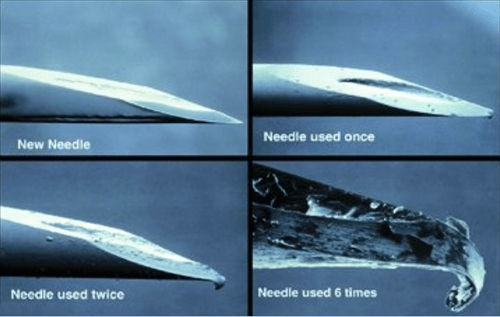
  2. Use a fresh needle: I used to be EXTREMELY guilty of this one. Either from laziness or trying to be cost-saving, re-using the same needle over and over can be terrible for you flesh (see illustration below). Even after one use, the point of a needle begins to warp and change shape, requiring more pressure to breach your flesh and causing more damage on the way in. This can lead to actual scarring as opposed to just Lumps. It will also increase the chances of inflammation and infection;
  3. Leave some space: If you are injecting on the same side and are close to the previous injection site, make sure you leave at least an inch of space between your current site and the new one. Like I said, insulin is a growth hormone. If you inject too close to the previous site, absorption and effectiveness can still be an issue;
  4. Give yourself time to heal: Alright, this one may be riding on the coattails of #1, but it’s important. Like anything else, injection sites need time to heal and get better. No matter what you may read online (this blog included), your body is unique and your healing time will be yours alone. So make sure you’re giving it the time it needs before poking into your preferred injection area.
Microscopic view of a needle tip after repeated use

Obviously, if things seem kind of wonky with a previous injection site, such as discolouration, throbbing or pain or the tissue is hot to the touch, you should seek medical attention as it could be an indication of a worse injury or even infection. I’ve just complicated matters for myself, since CGM requires a second injection site and is supposed to last for seven days. So I get to yo-yo two different injection sites with different change times and try to prevent reusing those sites too frequently.

At the end of the day (or week), those Lumps will disappear as long as you stay true to fresh needles and fresh injection sites. You may develop Lypohypertrophy on occasion even IF you do all these things, so don’t be surprised if you get the occasional Lump. Just be sure to take care of them properly and you’re good to go! ☯

Another Piece To The Puzzle

I started CGM last week. For those of you who may be unfamiliar, CGM stands for Continuous Glucose Monitoring, and it’s a device that measures my blood glucose levels every five minutes and communicates them with my insulin pump. In some ways, it’s the same as my FreeStyle Libre, with the exception that my FreeStyle doesn’t communicate with my pump.

Although having a device that instantly tells my pump whether it needs to suspend basal delivery because of a low and maintain a better percentage of “time in range,” it stands to reason that a more complicated device will theoretically have more issues. And I have found this to be true with CGM. The FreeStyle Libre has been good to me overall, providing little in the ways of problems and interfacing with my phone for a quick, easy means of checking my blood sugars.

When I started the insulin pump in early 2015, I was resistant to CGM. Hell, I was resistant to the pump itself, but the medical professionals through my work kept “encouraging” it, and since they were footing the bill I figured, why not? And no, that isn’t a brag about the fact my pump was covered by my medical insurance. I’m well aware that most people don’t have that benefit, so I’m grateful rather than bragging.

But given the potential violence of my work, I felt that it wouldn’t be ideal to have a device hanging off my gut, around the clock. I also didn’t want to feel tethered to a machine, having grown up watching my brother hooked to machines all his life. I conceded to try the pump, but I refused the CGM as it would be a second module attached to the body and I felt as though one was enough. I mean, come on! Life with Diabetes is difficult enough without turning myself into a cyborg, am I right?

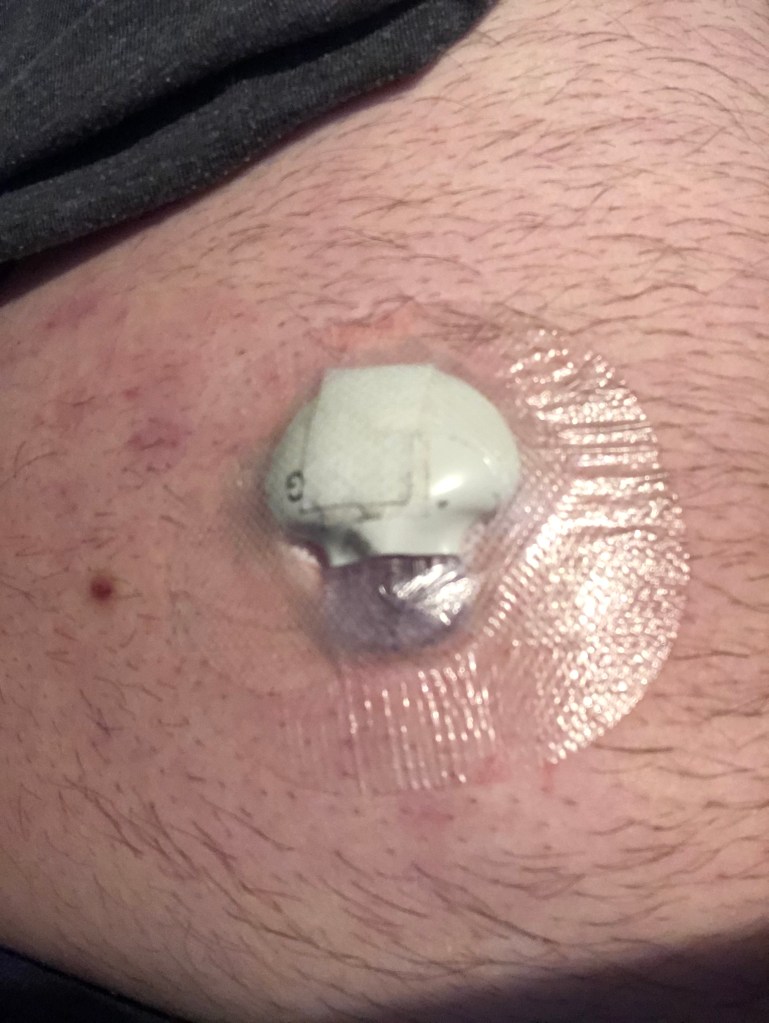
Hello, CGM! Welcome to the party! (Pointing out my freckle is not necessary, thank you!)

My endocrinologist did it right; sneaking the FreeStyle Libre into my life, calling it the “poor man’s CGM” (although it’s far from being cheap, by any means) and allowing me to get comfortable with the prospect of a second device on my person. I have been using FreeStyle for about two years now, and with the advent of my new pump that I started mid-March (Presenting, The Medtronic 670G), I decided to stop being such a stubborn princess and try the CGM that my pump is designed for. (Don’t get any ideas, I’m the only one allowed to call me a princess… And maybe my wife…)

So, here are the problems… Because this is me, and of course there are problems… The first glucose sensor I installed at my pump training failed within hours. Either from a faulty sensor or from scar tissue (which I’ll be covering the day after tomorrow) we don’t know. But it was a pain in the ass, nonetheless. Installing the sensor is tedious, involving more steps than refilling the insulin pump AND using enough adhesive to make Red Green‘s duct tape jealous. (If you don’t know who that is, click on the link and I apologize for aging myself so severely)

This happened last Monday. I was frustrated and I already felt as though the CGM would cause more problems than it was worth, so I shut the option off on my pump. I’m also a bit old school and it takes me a while to put the fate of my well-being in a machine I’m unfamiliar with (Not today, SkyNet!). On Tuesday, I went cycling with a friend and felt it wasn’t a great day to re-install, so I went without it. On Wednesday, I realized that I was actively avoiding it, so I installed a new sensor and started the whole thing up.

I also needed to demo the installation for my wife, who will be the one helping me install it on my tricep, should I decided to use that as a potential site (cue the naughty nurse jokes, here.) Here’s the thing: it’s been helpful. I’m eating an entire murder of crows admitting this, but having the ability to simply glance at my pump screen and see my trends and know what I may be currently sitting at has been nice. Also, my pump is set to automatically suspend my basal rates if I hit 4.0 mmol/L, making it a whole lot safer for me at night. Now, I just need to see how the device will hold up to extreme exercise or cycling, and how I’ll handle a punch to the gut when I return to karate, for the jury to fully have a verdict.

I guess my point behind all of this, besides pointing out how stubborn I am, is that although we don’t have a cure for Diabetes yet, technology has carried us lightyears beyond where we were in the early 80’s when I was diagnosed. When I think about the brick of a glucometer I used to carry around, only testing my blood once a day, “eat no sugar” being my only mantra and the fact that I was excused from most if not all sports due to the fact that “Diabetes makes it dangerous to play sports…” Pffft… what bullshit! If I only knew then what I know now. But I digress…

My point is that we’re getting there. Different technologies are at least making Diabetes manageable in ways it never could be, before. Will we have a cure someday? Like a significant percentage of the Canadian population, I sincerely hope so. I just don’t know if it’ll be within my lifetime. In the meantime, I’m well on my way to becoming a cyborg. ☯

Gear Up For The Ride 🚲

I was recently asked what I bring with me on my bike rides, especially since I have Diabetes and my distances are starting to get longer and farther. I’m no professional athlete and I’m obviously not crossing the entire country (or the Province) but I certainly have some details to consider. Especially if I want to keep from, you know… dehydrating or passing out from low blood sugar.

So with that in mind, here’s a list of the items I carry with me, either on my person or on the bike itself, when I head out on my peddling adventures;

My two-wheeled cadillac
  1. A Bike: D-uh, right? But obviously you need to get yourself a bike that suits your needs. This bad boy is the Diadora Orbita 18-speed. It retails at about $300 (give or take a few bucks) and is a mountain bike. I point out that last detail because there are a few different types of bicycles including road bikes, comfort bikes and hybrids. The important thing is to ensure that the frame and wheel size are appropriate for your height and that you know what you’ll primarily be using the bike for. If you purchase your bike from a decent retail location, they’ll have specific sales people who deal with bicycles and should be able to help you with that. Depending on what you’re using it for, it doesn’t have to cost you a fortune. I would even recommend looking into getting a decent second-hand bicycle. But if you do, be sure to test it out before purchasing it;

2. A Water Bottle: It stands to reason that you need to stay hydrated during your travels. When getting your bike, you want to make certain that if it doesn’t already have a water bottle holder that it at least has the mountings for you to install your own. This is what I did. As you can see from above, there’s a second space to install a second water bottle holder across from the first one (the silver bolt in the lower right corner).

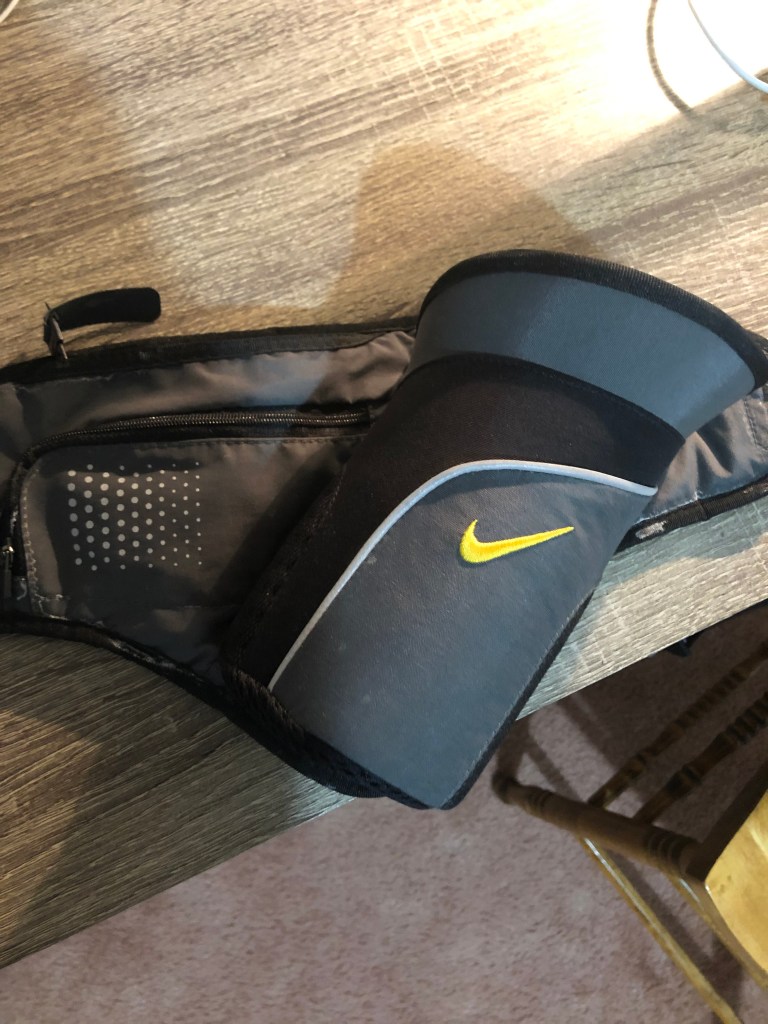
3. Second Water Bottle Holder: Although not a second bottle holder, I use this Nike Bottle Belt that’s actually intended for runners. But it works quite well while cycling as well. Between the two, it allows me to carry about a litre of water. I usually carry one bottle of water and one bottle of sugar-free electrolytes in order to ensure I stay hydrated and don’t succumb to hyponatremia while cycling. Eventually, I plan on getting a second bottle holder on the frame AND use the one pictured above.

4. Rear Accessory Pouch: There are a number of different frame-mounted bags and pouches you can get for your bike. The one pictured above is a small Diadora pouch I purchased at a local retailer that mounts under the seat. I use it to hold house keys, my first aid kit and anything that I would need to stop in order to use, such as nasal spray or painkillers. And speaking of First Aid kits…

5. First Aid Kit: Most people don’t consider this aspect, but if you’re out and about on a bike and are planning on travelling for a significant amount of distance, you need to consider the possibility that you may become injured. I purchased the kit as seen above from the “travel section” at a local retailer. At only $4, it contains a pair of vinyl examination gloves and basic bandages as well as some towelettes. This kit fits nicely in rear pouch of my bike and at such a low cost, it’s easy to replace if you end up using any of it. It’s a pretty basic kit, but honestly if you have an injury that you can’t cover with a bandage or band-aid, you should probably be calling for help;

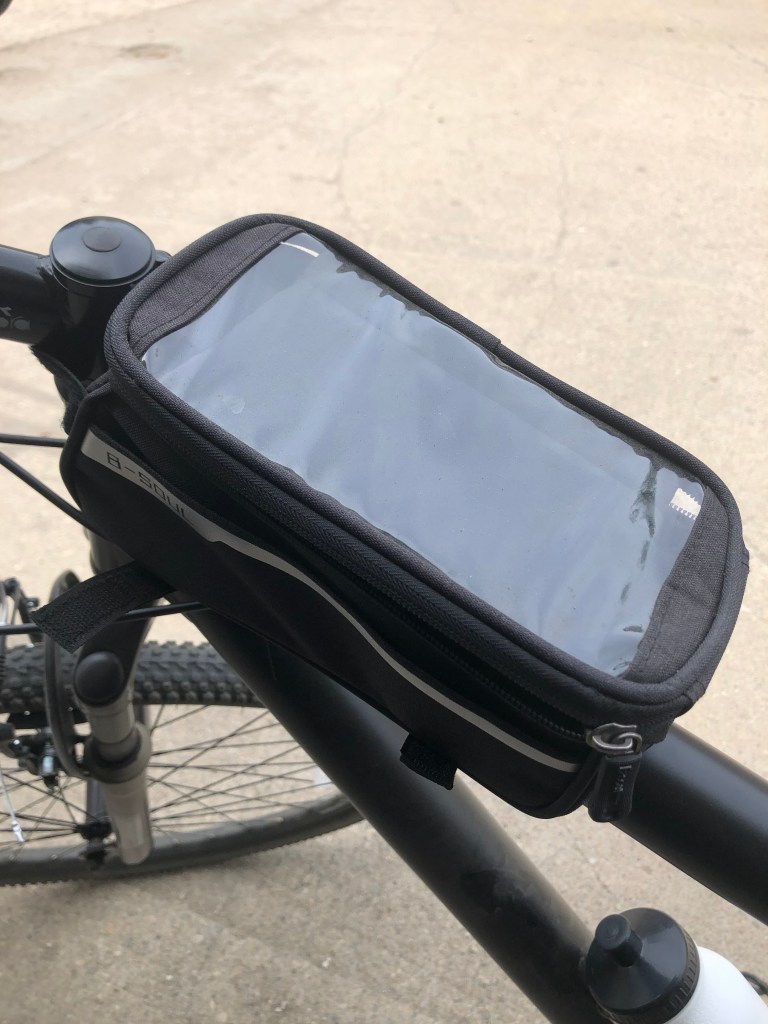
6. Main Storage Pouch: Alright, here we go. This pouch contains the essentials. I usually bring a small travel bottle of sunblock, gum, lip balm, my wallet and a small Tupperware container of jellybeans. The lip balm is important in order to keep winds and elements from drying and cracking your lips. Your wallet is an important aspect in the event you require medical attention or you happen to be approached by law enforcement (depending on where you’re cycling). The jellybeans are the best form of fast-acting glucose that works well for me. After about ten jellybeans, even some of my worst lows correct themselves quickly. This is also the place where I’ll jam a few dried meat sticks, some cereal bars and even some ibuprofen in the event I need it. The front panel is clear vinyl, allowing me to store my cell phone and see its display as I ride. This is handy as it allows me to use my GPS tracking app and monitor my mileage and what music I’m listening to.

Outside of what you may store on your bicycle, you want to make certain that you’re dressed in comfortable fitness gear. I wear a thin Under Armour long-sleeved jacket, which protects me from wind and other elements and also provides me with pockets for a few small items. I use fingerless gloves so that my hands are also protected from the elements but my fingertips are bare, allowing me to access the touch-screen on my phone.

You also want to make certain to wear an approved helmet and properly-fitted footwear. You’d be surprised how much of a difference it makes if you’re wearing sneakers that fit and are well broken in. Sunglasses are also a must, if not for UV protection, to protect your eyes from the wind and debris as you ride. As I continue to increase my distances, I plan on adding a rear bike rack with saddle bags. In the event that I start travelling for hundreds of kilometres, I’ll start including a single-person tent and a bedroll as well as changes of clothing and additional food and supplies.

I don’t want to get ahead of myself, of course. But the important thing to remember is that planning ahead is the important aspect. You want to make sure that you carry the essential items that you’ll require for the length and duration of your trip. Glucose, hydration and means of communication in the event of an emergency are always a must. ☯

The Right Frame Of Mind

Developing yourself and reaching a goal can be difficult. Especially when you don’t allow yourself to have a strong frame of mind or proper perspective. Having a partner when you work out can be extremely helpful, as I wrote about in a previous post It Takes Two, Baby…🎶. But although having someone there to spot you and motivate you can be quite the benefit, you need to allow yourself to have a correct frame of mind behind your workout.

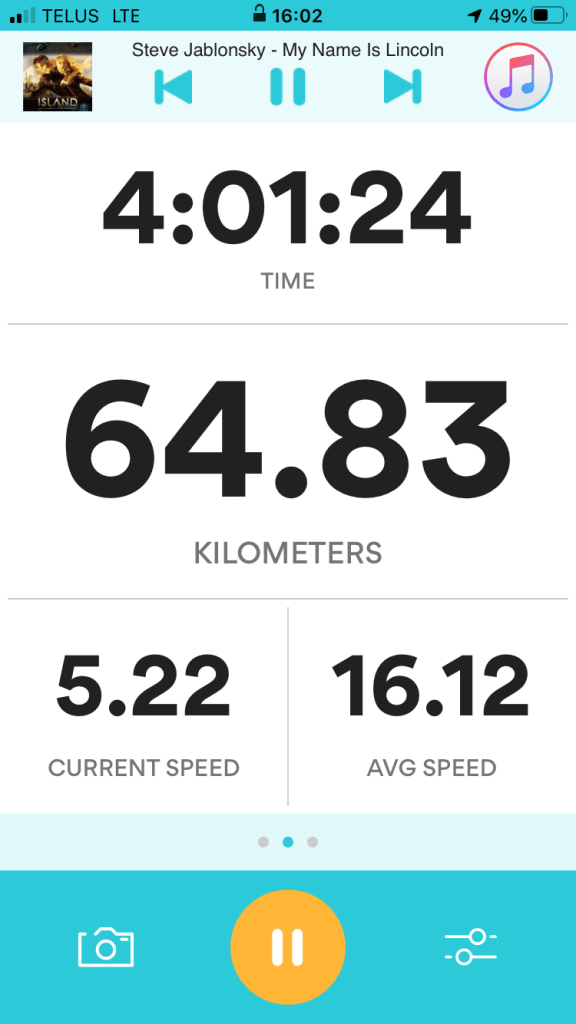
The distance I achieved yesterday

A friend of mine recently pointed out something important as it relates to fitness. Let’s say that you’re trying to lose some weight. You intend on climbing the nearby mountain with a partner, which is not only smart for safety reasons but can motivate you to push further in order to keep up. As you start climbing, you begin to feel tired. Your body is having difficulty continuing due to the excess weight that you’re trying to shed, and you feel compelled to stop.

Perhaps you tell your partner you need a rest. Or perhaps you tell them you can’t go on. Maybe you surrender to your body’s urge to have you sit down and give up. A terrible thing to allow, especially if you’ve set yourself some fitness goals that can be important for your health. For someone with Type-1 Diabetes, this can be a common occurrence, since fluctuating blood glucose levels can have the unfortunate side effect of making a person groggy and sluggish.

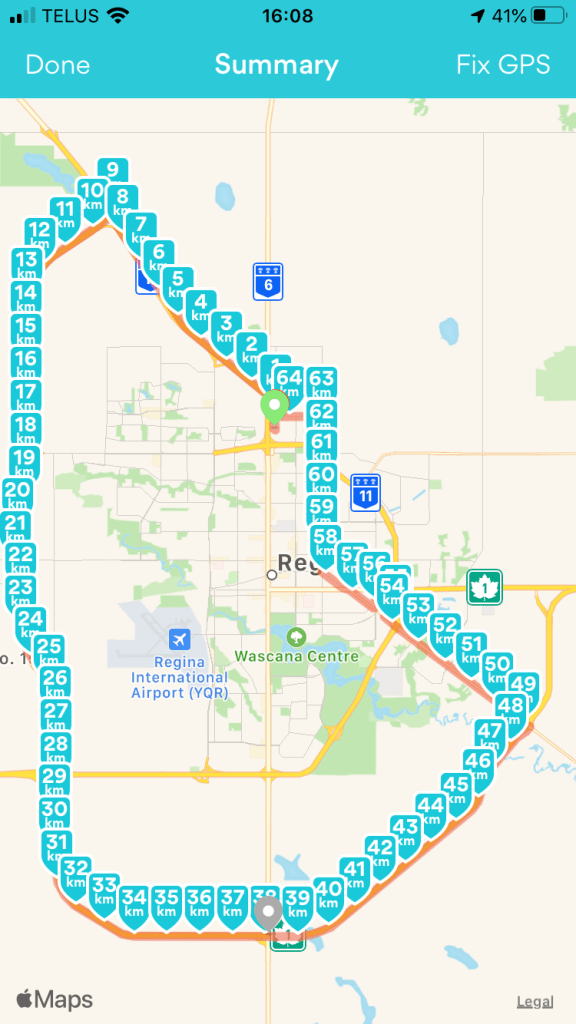
Yesterday’s route around the Regina Bypass

As I’ve often mentioned before, it’s important to ask yourself why? What is the reason behind your motivation? Your body should and will give out, long before you do. Why do you think people listen to music when they work out? It’s not simply for their love of it, although for some I would believe that’s included. It’s because music motivates us (and in some ways, distracts us from the physical exertion we’re going through).

This is why it’s so important to motivate yourself and stay positive. When I started cycling for fitness this year, I would get home after about a dozen kilometres and my legs would kill, I’d be exhausted and I would feel like total crap. But as you can see from the images above, the day before last saw me hit 65 kilometres. And yes, when I got home my legs killed, I was exhausted and dehydrated and needed food. But I can promise that a dozen kilometres now seem like a trivial amount, and I can do it quite easily in only about half an hour. This is something I wouldn’t have imagined when I started.

Sometimes it’s better to take things in small increments. If I’d hopped on my bike and tried to reach 60k on one of my first times out, I likely would have floored myself and became discouraged. But by staying consistent and building myself slowly, I’ve been able to keep building and developing how far I can go. The same can be said of martial arts or any fitness regimen that you may be attempting.

Let’s get back to our friend who’s attempting to climb the mountain. When exhaustion sets in and you feel like you can’t go any further, there’s no shame in taking a breather. But then, look ahead and spot a point further up the trail and tell yourself, “I can push at LEAST until that tree…” Then go for it. Once you reach that tree, maybe you’ll need another breather, maybe you won’t. But fix yourself another short goal and strive for it.

I think it was a Navy Seal that I had seen years ago, who described taking his training in steps, from day to day. At the beginning of the day, he would tell himself to simply get past breakfast. That’s it. Once this period had passed, he would focus simply on getting through the afternoon. Nothing more. With each piece of the day’s puzzle reached, he would be able to shift his focus and move on to the next, thereby guaranteeing he would make it through the day before hitting the rack. If he were to focus on completing the entire day, he would likely become discouraged and lack motivation. This is a concept that anyone can apply to their daily routines.

The idea is to allow yourself the time to grow. Have a positive and motivated perspective and you’ll go much further. If your thoughts are negative as soon as you begin, you’re sure to fail. how can you be motivated if you’re already defeating yourself? But if you focus on the positive, music, goals, health benefits, perhaps the scenery that surrounds you as you climb, you’re more likely to push farther and accomplish more.

Your own health and fitness is important; critical to your survival, really. And the proper mindset is what will help get you there. For someone with weight issues or Diabetes, staying fit and healthy can mean the difference between life and death. This is one of the reasons I push so hard. Life has too much to offer to lay down and die sooner than necessary.

And Diabetes or not, death will take me. Of this, there is no doubt. But I can promise two things: Death will lose ten pounds in sweat trying to make it happen and he’ll lose a mouth of teeth in the attempt. I intend to go down fighting. (Gee, that would make a great t-shirt) ☯

A Gentle Hand In Hygiene…

Washing one’s hands has become a popular topic of most conversations regarding personal hygiene in recent years, and it still surprises me how many people go without washing their hands frequently and especially after prepping food, using the washroom or contaminating one’s hands with something potentially painful, like hot sauce!

I’ll admit I’m usually guilty of this, at least a couple of times a month. I’ll prep a plate of nachos with cheese, varying ingredients and hot sauce and sit on the couch to watch a show or a movie with my wife. I’ll be snacking away, happy and content with the deliciousness of my nachos when, all of a sudden, my eye will itch. Absentmindedly, I’ll reach up and rub my eye. Within seconds and for minutes after, my eye is a fountain of tears and irritation as the hot sauce residue teaches me the importance of washing my hands before touching my face.

I wish I could say I’ve learned my lesson, but I unfortunately repeat this vaudeville routine on a regular basis. One of the main ingredients in most hot sauces is capsaicin, related to capsicum, which is the primary debilitating ingredient in pepper spray. And I rub that shit into my eyes on the reg… Are you sure y’all should be listening to ANYTHING I say? But I digress…

The reality is that your hands carry a shit-ton of germs. And yes, that pun IS intended, considering fecal bacteria is the most common thing on your hands, your phone, etc… Most people don’t wash their hands properly, and many that do fail to scrub up for as long as is necessary for proper hygiene. The big problem is that we use our hands for everything. We touch our faces, eyes, nose, mouth… often without even realizing it. And whatever nasty bugs we have on them will find a good home in any of those openings.

The next problem is that failing to properly wash one’s hands can lead to the propagation of those germs. By using our hands without properly washing them, we can potentially transfer germs and bacteria to food we prepare for our family or directly onto our children as we hug them and seek to protect them. And looking back on the funny story about putting hot sauce in my eye, there is another very unpopular condition that can be caused by dirty hands: pink eye!

Pink eye, or what’s known as infectious conjunctivitis, is usually caused by viruses but can also be caused by bacteria; such as the ones found on unwashed hands. I’ve been fortunate enough never to have pink eye, but it doesn’t sound like a spa treatment! And washing your hands regularly and frequently can go a long way towards helping to prevent it.

So, good hand washing practices are important, especially to help maintain proper health. Diabetics especially don’t need the added potential for germs and bacteria to cause infections and complications that could make us ill. The biggest challenge is trying to teach children. Trying to convince my 5-year old son why he has to go wash his hands before he eats, sleeps, touches the baby, etc is a battle unto itself…

Be sure to get your hands completely wet, scrub thoroughly with warm/hot water and soap for at least 20 seconds or more. Do this every time you’ve handled raw foods, did work outside, shook someone’s hands and especially after any and all bathroom use. And yes, you CAN overdo it. Washing your hands TOO much will scrub away oils needed to keep the skin healthy and cause dry, itchy skin. But you’d have to go a long way to reach that point. ☯

Make A Meal Of Some Information…

Mornings suck… I mean, you’re entitled to your opinion if you believe this to be false, but I dislike waking up in the morning. Maybe it’s because I never get a genuine full-night’s rest from my sleep, for various reasons. But getting up in the morning leads to certain routines that most people adhere to. Things like brewing/consuming coffee and perhaps having breakfast.

Now, I’m not a nutritionist or a dietitian and I have no formal training in those areas. I function solely on the personal knowledge and study I’ve accumulated over decades due to being a Type-1 Diabetic. And I will allow myself a brief vulnerability and admit that I’m probably one of the worst people for failing to consume what is generally considered the most important meal of the day: breakfast!

I grew up in a household where breakfast was not only considered the most important meal of the day, but it was mandatory. I have memories of my mother almost physically dragging me to the breakfast table during those awkward teenage years when all you want to do is sleep. There was no way I would be permitted to leave the house without something in my stomach.

The main idea is that eating breakfast within an hour of waking up helps your body to get the sustenance and energy it requires to attack the challenges of the day. Your body’s metabolism is usually at its lowest upon waking, which is why you need the nutrients and energy from a well-balanced breakfast to kick things off. Skipping breakfast and/or the first meal of your day can have negative effects on your body.

According to a paragraph in an article by Science Direct, “[…] the failure to eat (a well-balanced) breakfast has been documented to have a deleterious impact on cognitive performance […]” The takeaway is that trying to start your day without food in your system will affect your overall cognitive functions and impede your overall performance.

WebMD seems to agree as a quote from their webpage states, “Skipping the morning’s meal can throw off your body’s rhythm of of fasting and eating. When you wake up, the blood sugar your body needs to make your muscles and brain work their best is usually low. Breakfast helps replenish it.” The article goes on to explain that skipping breakfast can lead to feeling drained and “zapped” of energy throughout the day, an effect I can attest to have suffered from on a number of occasions.

I’ll admit that I’m quite guilty of this. My first actions in the morning usually include grabbing the first available source of caffeine and flopping down into my desk chair and working on this blog… Thoughts of food don’t hit me until close to lunchtime, by which time I’ve become hungry enough that I overeat. This is an issue that I’ve gotten into a habit of stemming by eating a simple english muffin with my coffee.

What you eat for breakfast is often as important as whether or not you choose to consume breakfast. A balanced meal of proteins, grains and dairy will help ensure your body gets the necessary “kick” it requires to make it through the day. On the flip side, if you constantly consume a breakfast heavy in fats and processed sugars like popular name-brand cereals and bacon, you may start the day with a full stomach but you may also be doing damage in other ways. So, be smart about what you eat and when (something that WOULD require the advice of a nutritionist or dietitian)

So if breakfast is the most important meal of the day, is there a LEAST important meal? The short answer is no. All three meals, accompanied with light, healthy snacks in between, are all just as important in the grand scheme of your health. That being said, lunch can be a bit on the light side, with an accompanying snack during the middle of the afternoon. Dinner (or supper) may end up being a substantial meal as it’s statistically the one we have at home with the family and is prepared to be larger to accommodate everyone. But there’s no hard and fast rule to this.

The one important detail to remember is that no matter what meals you partake in and what time you enjoy them at, experts agree that you should stop eating a minimum of a couple of hours before bed so that your digestive system has time to process your food before you try and sleep. Once you go to sleep, your body is meant to fast as it works on rejuvenating itself for the day to come; something it can’t do if it spends half the night digesting your buffalo wings from your Netflix binge!

Eating your meals at proper intervals will also help with proper blood sugar control if you have Diabetes. Maintaining a proper routine and healthy diet is always the optimal choice in order to help prevent spikes or drops in blood sugar. So, there you have it! If you grew up through the 80’s like I did and constantly heard commercials on Saturday morning about starting your morning with a healthy breakfast, that rule is still a reality today.

For myself, I usually end up skipping breakfast in favour of sleeping in for that added twenty minutes and rushing off to work. But the reality is that most studies will show that getting up a touch earlier and having a proper breakfast may go farther towards ensuring you’re awake and alert than hitting the old snooze button. So take time to grab a meal before facing the world. It always looks better on a full stomach. ☯