“Grin” Through It…

The pandemic has certainly put a number of things on the back burner, with most amenities and some necessities having closed for a number of months and most of us finding ourselves dealing without. One of those basics necessities happens to be the dentist. I had the opportunity to visit a local dentist’s office and treat myself to a good old fashioned cleaning. I brought Nathan with me so that he could get a look at the process and what’s involved with proper oral health, since during his last trip to the dentist, he turned into wolverine and fought off the staff.

Some of this is quoted from my previous post on oral hygiene because, well… concrete information doesn’t change! So if you’re a committed reader of my blog, you may recognize some of the information.

Oral hygiene and dental health are extremely important. Perhaps more so than most people understand. While growing up, I remember that the standard was simply that you needed to brush regularly and floss in order to keep from losing your teeth. Since then, studies and medical advancements have proven just how serious the problems can become if you don’t pay proper attention to your mouth.

Let’s think about our mouths for a moment: it’s the entry point for your food and the air you breath. This means that you have a lot of stuff from the outside world that enters your body through your mouth. Like most surfaces on your body, your mouth is full of bacteria. Some of that bacteria is good, but the bad bacteria is what can lead to tooth decay, bacterial infections and gum disease. Bacterial infections can be pretty serious, especially for Type 1 Diabetics. Our weakened immune systems make us more susceptible to infection and makes them worse. Just to make you grit your teeth harder, (see what I did there?) the gum disease caused by improper oral health can make it harder to control your blood sugar levels.

Even if you don’t have Diabetes, poor oral health can leave you susceptible to cardiovascular complications, pregnancy complication and pneumonia. So, what can you do to hep prevent those oral health issues? Brushing your teeth is an obvious first step. Despite what some of us were taught as children, brushing three times a day (or after every meal, whichever is greater) is not necessary. According to the Mayo Clinic, brushing twice a day is what the current recommendation indicates. This means brushing once in the morning and once before bed. Despite this, most dentists still stick to “old faithful” and tell folks to brush three times a day. It’s not a bad thing.

Although some dentists have indicated that even once can be acceptable, you tend to run into some problems with that, including potential bad breath throughout the day and unsightly food stuck in your teeth if you’re out in public. If you only brush once a day, best to do it first thing in the morning to eliminate morning breath. But brushing after any meal you eat is ideal, since the break down of food by the bacteria in your mouth will potentially cause issues. Be sure to floss. Most people overlook flossing or it bothers them. But flossing is required to eliminate the bits of food that can’t be removed by a toothbrush. Leaving that food between your teeth against the gum line can lead to an increase in bacteria. Use an antibacterial mouthwash. Don’t forget that mouthwash is supposed to complement your dental routine and isn’t meant as a substitution for brushing.

Click on these links to articles posted by Colgate and WebMD that explain some of what I’ve written and can provide further insight. Some other small changes can also help with improved oral health, such as avoiding staining drinks such as red wine or smoking tobacco products. And don’t forget to replace your toothbrush every few months. That s&*t gets gross!

So it may not have been a post about blood sugars or exercise, but proper oral hygiene can help prevent Diabetic complications and other issues that be aggravated by Diabetes. Why take chances when the prevention is so simple? Nathan was pretty impressed with the fact that I nearly fell asleep during my cleaning and it proved to be no issue for me. He’s looking forward to a check-up of his own in order to cash in from the Tooth Fairy. Now that dental offices have re-opened, I highly recommend everyone get in for a check-up. ☯

What’s A Name Worth?

Yesterday, I wrote a post about the potential addictive nature of sugar. I won’t get into that aspect again, since y’all can simply go read yesterday’s post if you haven’t already. But after having that post go live, I had some folks as for examples of the different names that companies use for sugar in their ingredients. As I wrote in my post Fruit Juice Is Bad For You from two weeks ago, foods that are advertised as “No Sugar Added” or “Natural” won’t necessarily be sugar-free.

In that spirit, I thought I would share a list of different names that companies use in their ingredient lists to replace the word “sugar.” This is not a comprehensive list, simply the ones I’ve seen or are aware of. Here we go… (takes a deep breath)

Dextrose, Fructose, Glucose, Lactose, Maltose, Sucrose, pretty much any word with “ose” at the end… Cane juice or Cane sugar, Corn Syrup, Maltol, pretty much anything followed by the word “syrup”, Caramel, Cane juice, Honey, Molasses… (exhales and tries to catch his breath).

Those were just the ones that I know about. I found an article posted by VirtaHealth.com that lists 56 different names for sugar. You can give it a gander and see for yourself. Some of them sound like perfectly normal foodstuffs and you wouldn’t assume that they refer to sugar. And since the ingredient list usually runs from highest to lowest amount, the closer to the beginning of the ingredient list that the word is found, the higher the content. Something to keep in mind when trying to reduce your sugar consumption. ☯

That White Powder Is NOT Cocaine, But It May As Well Be…

Sugar. Ahh, my old nemesis… Since I was diagnosed as a Type-1 Diabetic at the chaotic age of 4-years old, I never really got to experience that sweet side of life throughout my childhood. In fact, on the few, rare occasions where my blood dropped and the only recourse was to enjoy a regular Dr. Pepper or have a good old fashion candy bar, it would usually make my week. I made it past my teen years before having anything sweeter than fruit became possible. Since carb-counting wasn’t a thing in my household, the total and complete elimination of sugar in my diet was one of the key ways that my parents dealt with my condition.

It’s no secret that sugar has a measurable and real effect on the body, whether you have Diabetes or not. This has been proven time and again, and there have been studies that I’ve read that show that sugar has been shown to have an addictive effect as well as many others, on the body.

According to an article posted by WebMD, the average person consumes 17 teaspoons of sugar a day, which is significantly more than the recommended 12 teaspoons. Granted, that’s an American statistic but I’m sure it still applies to the majority of the Western world. And since the population seems to be hell-bent on consuming copious amounts of sugar, let’s examine some of the effects it has on the body.

According to that same article, eating sugar causes a release of dopamine, which is the “feel-good” hormone. Because of this, you’ll be likely to want more and more sugar in order to continue riding the dopamine train. This will cause the “sugar high” that my son seems to love using as a weapon of mass destruction, followed by a sugar crash, which can adversely affect your mood and make you feel down. This, in result, will cause you to seek out more sugar to counter the crash. Wash, rinse and repeat.

In addition, sugar consumption has been linked to dental issues, joint pain, skin issues, liver and heart disease. And it’s no secret that excess sugar consumption has been linked to weight-gain. And if I have to explain the issue with eating excess amounts of sugar if you have any type of Diabetes, then you probably need to go back and read some of my previous posts. Which you should be doing anyway. Go ahead, I’ll wait…

There have been some studies that have shown that sugar can be as addictive as cocaine (hence, today’s title). I tried my damnedest to find the studies I read, but I couldn’t track down the one that referred to it. But there’s no denying that some people enjoy the dopamine release and the short burst of energy that sugar can bring, and have difficulty staying away when it isn’t present. This is why you’re likely to grab a donut on your afternoon break as opposed to carrot sticks.

Can sugar have an addictive component? Yes. Granted, it often depends on who you talk to. The idea is not to try and completely eliminate sugar from your diet (whether you have Diabetes or not), but to consume in moderation in the same way as you would do with everything else. It can also be difficult to truly know how much sugar you’re consuming since it can be labelled as so many different things that you may not even know that you’re eating sugar! Modern Diabetic therapy has made it possible for people to eat in the same way as everyone else, provided they test their blood sugars regularly and adjust their insulin levels. ☯

The Need For Speed

Low blood glucose is probably my biggest pet-peeve in terms of Diabetic symptoms. I’ve been fortunate enough that with the exception of a bit of Diabetic Macular Edema, I haven’t had to deal with the more extreme Diabetic side effects. But given that I’m a fitness enthusiast with just a hint of crazy, low blood sugar is definitely one of my most-visited Diabetic symptoms.

So, how does one best treat a low? The standard answer is the rule of 15/15. Provide 15 grams of fast-acting glucose and wait 15 minutes. If your blood sugar is still low, then repeat. This isn’t always feasible, since you may be in the middle of a 60-kilometre bike ride with no place to rest or take shelter, and you need to boost your blood glucose NOW! So what’s the best answer for getting some fast-acting glucose into your system?

For myself, I like to use regular jellybeans. The ones usually put out by Dare or Ganong. They usually sit at about 2 grams of carbs per jellybean, so wolfing down about a dozen usually does the trick. I find they work the fastest and the best for me in particular, especially in the middle of the night. Grabbing two handfuls puts me at just over a dozen jellybeans, which allows me to safely go back to sleep.

Every body is different, and every Diabetic will be just as different. What this means for you is that you may need to experiment and try a few different sources of fast-acting carbohydrate to figure out what works best for you. Maybe jujubes will be preferable over jellybeans, or maybe it’s apple sauce, like one of my fellow bloggers prefers.

What you want to try and avoid, is any source of glucose that is high in fat, like chocolate. Although chocolate will have the desired effect, it’ll simply take a whole lot longer since the body will need to break down the fat before getting to the glucose. And since chocolate is essentially a brick of sugary fat, your blood may continue to drop while your body is trying to process the fat before giving you what you need.

Glucose tablets can be ideal, although they don’t seem to work well for me. I usually have to eat the entire package before I feel or see any noticeable difference. And that’s the thing: what works for you depends on your metabolism, how low your blood sugar may be and how quickly you need it to rise. If you’re lounging at home, binging Netflix, chocolate may be a perfectly acceptable option for you. It’s pretty subjective.

At the end of the day, monitoring your blood sugars through a CGM or by testing via finger-prick multiple times throughout the day is an absolute must to ensure you maintain good blood glucose levels. But if you’re suffering a low and need to get yourself up there a bit faster, be sure to chose a fat-free option that can be easily and quickly consumed. ☯

Full Disclosure Does Not Mean Full Exposure

Most people are not prone to revealing their medical conditions to people. And I can’t say I don’t understand where they’re coming from. Some people are fearful of how others will act and react around them once they know. Others feel that perhaps they’ll be treated differently at work and potentially get passed up for promotions and special duties if certain medical conditions are known.

In Canada, the Labour Code and the Charter of Rights prohibits such discriminatory behaviour on the grounds of a medical condition, but if you were to strap your boss’ appendages to a polygraph and ask if that was the reason, you might be surprised. And in some cases, most cases I would think, this stems from ignorance about conditions such as Diabetes. So in a way, employers may think they’re protecting you as well as their business by ensuring they don’t put you in a position where you could bring harm to yourself.

Truth be told, I’ve always been of the opinion that full disclosure on what’s going on with me is the best policy. This simplifies matters, especially in cases where I need to request time off for something like my eye injections. In addition to that, I’ve been in a position on more than one occasion in my youth, where I’ve suffered Diabetic issues and the people around me didn’t know what was going on. Not a pleasant situation to be in.

So this begs two question: How much should you tell your employer/friends/family? And what should these folks do in a situation where you are having a Diabetic episode? The answer to the first one may be my opinion. The answer to the second is common sense and SHOULD be observed, regardless of what environment you work in.

First, let’s make something clear: you are under no obligation to share your medical information with an employer. The Labour Code and the Charter of Rights and Freedoms are reasonably clear on that. But you can click on the links to research that on your own. But should you choose to disclose your Diabetes to an employer, it can be a life-saving choice, as we all need some help every once in a while. I’ve been in situations where although I’m conscious and able to speak, I was sure grateful to have someone get my glucose to help me out. This can be an important consideration and you should bear it in mind before deciding that you don’t want to bring up your Diabetes.

The next point, and I’ve been asked this more times than I can count, is what to do if you find someone suffering from Diabetic symptoms (extreme high or low blood sugar). This is what would be referred to as hypoglycaemia and hyperglycaemia. Both are pretty terrible and carry their own set of complications, and there are differing opinions on what you should do if you come across someone you believe is suffering from either.

What I usually try to explain to people is that they’ll always be faced with one of two scenarios. Either I’m conscious, in which case I’ll get them to help me get what I need, or I’m unconscious. If a suspected, Diabetic patient is unconscious, I don’t care what literature you’ve read that says otherwise, DON’T TRY TO GIVE THEM ANYTHING!!! If you can’t ascertain if their blood is too high or too low, trying to treat them blindly can cause more damage.

For a while, there was a school of thought that said to give a Diabetic some glucose as you would either treat a low or if they were running high, first responders could treat it when they got on scene. Are you kidding me? If they’re in rough shape from high blood sugars, the amount of damage you can do to them by giving them additional glucose would be catastrophic.

If you’re familiar with Diabetes and the equipment we use, you could potentially test their blood. Most glucometers are reasonably fool-proof these days. Just stick the test strip into the slot and the meter will tell you what to do anyway. In this way, you can ascertain if they’re running too high or too low, and this can be of great help to first responders and you’ll know if providing glucose would be a good idea or not. But if you blindly give glucose, you could cause issues like DKA (Diabetic Ketoacidosis), organ failure, nerve damage and even heart attacks and strokes. Not a chance I’d want anyone taking with MY life if they were there.

If you were on the ball enough to call 911, first responders will be there in due course to deal with matters. The best option is to keep the person safe and clear of any danger and make sure to pass on whatever symptoms you may have documented to first responders so they can best do their job. And if you work/live with someone who has Diabetes, ask some questions. Most of us will gladly answer them as we not only prefer to clear up any confusion, most of us understand that it could be of great help to us in an emergency.

And if you HAVE Diabetes, consider letting your employer know. You may not HAVE to, but doing so could potentially save your life. And let’s be honest; there’s no shame in having Diabetes. Contrary to how it’s sometimes portrayed in the media, having Type-1 Diabetes is not your fault and it’s nothing to be embarrassed about. A little food for thought on your Wednesday morning. ☯

It’s a HIIT…

It’s no secret that I love a little variety in my fitness routines. I’m pretty sure that I’ve tried it all… Cardio, Zumba, Tai Chi, Weightlifting, Cross-fit and many others… I’ve never been afraid of trying anything new and/or different when it comes to my fitness. After all, one could potentially discover a new fitness routine that’s loaded with fun, health and fitness benefits.

Enter: the HIIT workout. For those of you NOT in the know, HIIT stands for High-intensy Interval Training and features (as the name suggests) intense intervals of cardiovascular exercise mixed with short rest periods. These workouts usually let about half an hour, although some of them have been known to last a bit longer, depending on one’s endurance and fitness levels.

HIIT workouts can have a number of benefits, including fat burning, muscle gain and improved blood sugars. But I’m going to focus on 7 benefits of High-intensity interval training as discussed in an article posted by Heathline.com:

  1. You can burn calories quickly in a short period of time: This is one that’s come up in most of the articles I’ve read on the subject. And the general consensus is that you can burn more calories in less time during a HIIT workout than you would with something traditional like cycling or weight lifting;
  2. Your metabolic rate remains high for hours afterwards: an increased metabolism will lend a score of benefits that I won’t bother covering in this post, but a HIIT workout will do it for you. In fact, it will do it more effectively than other traditional workouts;
  3. The fat-burning benefits: Okay, I’ll be the first one to admit that fat-burning is not only one of the most sought-after benefits of any fitness regiment, I’ve often written about how no matter what “gimmick” workout you may doing, there is only one way to effectively burn fat: to burn more calories than you take in. However, a study named in the article I linked above showed a 17% reduction in visceral fat, or the disease-promoting fat surrounding your internal organs, when doing HIIT workouts;
  4. You could gain muscle: Alright, I won’t touch on this too much because the reality is that any consistent and intense workout regiment will help you gain muscle. This shouldn’t come as a surprise. And a “high-intensity” workout would be no different…;
  5. It could improve your oxygen consumption: In this regard, they’re referring to the fact that HIIT workouts will help your muscles to use oxygen more effectively, and will do so in half the time of a traditional workout;
  6. It can reduce heart rate and blood pressure: This has been shown to be prominent mostly in overweight and obese individuals, but it’s an important health benefit nonetheless;
  7. It can help reduce your blood sugar: Seriously?! Woohoo to that! being a Type-1 Diabetic, I’d rather have to consume carbs than burn them. Research has shown that HIIT workouts can not only be extremely beneficial to those with Type-2 Diabetes but can help to improve insulin-resistance.

The good thing about HIIT workouts is that it allows you to reap the benefits of most standard workouts in only half the time. Like any workout, you should consult your medical practitioner before starting ANY fitness regiment, and pay close attention to how a change in fitness routine affects your blood sugars. After all, variety may be the spice of life, but Diabetes will keep you seasoned with complications. ☯

The Next Milestone…

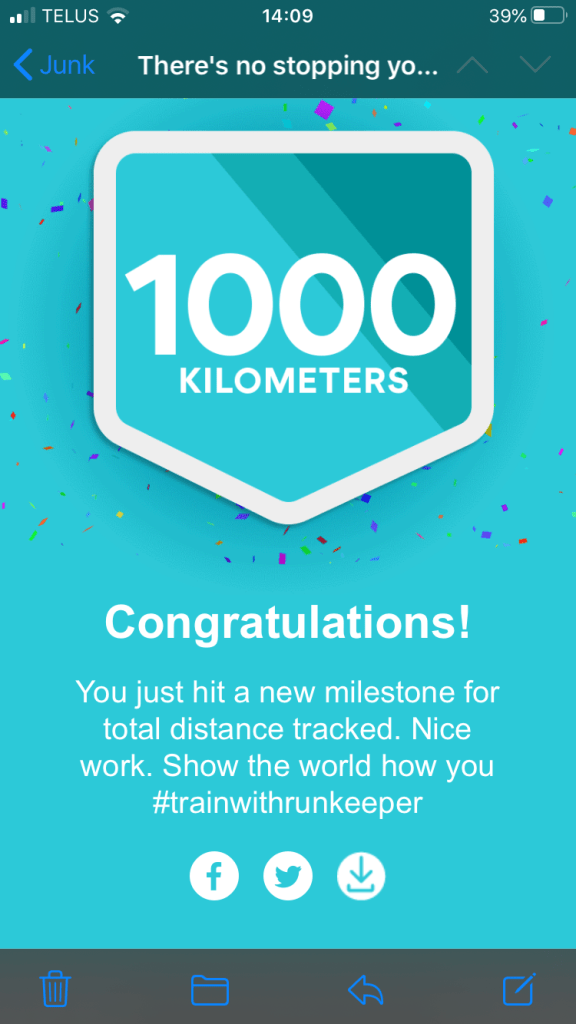
So after using yesterday’s post to bitch, whine and complain about Mother Nature’s unending use of the Prairie Provinces as her personal whipping ground with the non-stop wind, I got an e-mail from my RunKeeper app yesterday indicating that I’ve apparently hit 1000 kilometres this year!

I had some recent issues with my workouts not syncing up to my RunKeeper account, so even if I’ve been counting the number of workouts I’ve been doing per week, none of the statistical stuff has been uploading. I sent in a message to their support link and got a solution the same day. Once I cleared the syncing error and all the workouts synced, I got a batch of emails. One of them was the image you see above.

Considering I reached the 500k mark back in late May, I’m somewhat surprised that I got here this quickly. But either way, it feels nice to be up in the thousands. It will be interesting to see how many more kilometres I can rack up before the colder season kicks in and the snow hits the ground! ☯

Fruit Juice Is Bad For You!

Wait, what??? How can juice be bad for you? It’s natural, made of fruit and contains all sorts of vitamins and stuff, which last time I checked, was SUPPOSED to be good for you. Right? Well, maybe those particular aspects are good for a person in general. But for someone with Diabetes, fruit juices can be less than ideal because of all the sugar they contain. And despite the fact that I titled this post in relation to juice, this applies to a number of different foods, sometimes without the consumer even realizing it.

I was recently caught by surprise when my mother decided to send me a couple of packages of “No Sugar Added” sugar wafers (yes, I still get care packages from my mommy, they’re mostly for my kids!) First and foremost, the fact that they’re called “sugar wafers” should have set off some alarm bells in my mother’s head. But bless her big heart, she’s still stuck in the 1980’s mindset where words like “sugar-free” actually mean, well… sugar-free!

When examining the wafers’ nutritional facts on the back of the package, I realized that three of these wafers, which is what they consider a “serving size” contained about 24 grams of carbohydrates. Somewhat significant when you have to take bolusing insulin into consideration. Since that’s about the same amount of carbs contained in most store-bought cream cookies, I found myself asking where the benefit was.

Out of curiosity, I purchased a couple of regular packages of sugar wafers from my local grocery store. These were run-of-the-mill and had no indications of being reduced sugar or “no sugar added.” To ensure I didn’t hit a fluke, I bought more than one package, in different flavours. To my surprise, the regular sugar wafers showed a portion size of 4 wafers at 22 grams of carbs. Yes, you read that right and it isn’t a typo.

According to new math, the “no sugar added” alternative sits at 8 grams of carbs per wafer, with the regular ones sitting at about 5.5 grams per wafer. I was somewhat taken aback to realize that the “no sugar added” wafers had a higher carb count than regular ones. The problem is that if they eliminate sugar from their recipe, most companies will need to find an alternative to replace the lost sweetness. And that alternative can sometimes add to the overall carb count.

Another issue I once ran into was something I thought was carb-free when it really wasn’t. I bet that most people who measure and monitor their carbohydrate intake would be of the opinion that vegetables are carb-free, right? I would certainly think so. Have all the carrots, broccoli and brussel sprouts that you can handle, my friend. Those will certainly be carb-free. But did you know that many vegetables are pretty carb-loaded?

Just one cup of corn kernels contains 36 grams of carbohydrates! I learned this the hard way when I decided to have a “carb-free” meal of vegetable soup, only to have a blood sugar spike soon after. There was corn in the soup. Frickin’ corn!!! I also recently purchased a bag of lentils to try out in some recipes, since they’re packed with protein AND the recipes were sitting on my Endocrinologist’s coffee table.

But the bag of green lentils I purchased show that only half a cup of lentils contain 35 grams of carbohydrate! That’s a pretty significant jump, just to sass up my burger patties or add a little something to my soup. And there are a number of foods that fall under this category that one would tend to assume would be low or carb-free. This is why it’s so important to check the nutritional information on everything you eat and keep a close eye out.

I tried explaining the issue to my mother when she asked me how I had enjoyed the wafers. Her response was, “That’s impossible. The package clearly says No Sugar Added!” My mother still lives with a mindset that all Diabetes means is “don’t eat sugar and take insulin,” and everything will be peachy. The concepts of carb counting and anything other than sugar causing an issue doesn’t compute. But it’s certainly something to keep an eye on, especially if you want to maintain reasonable blood sugar levels. ☯

Blood, Sweat And Heat 🚲

Wednesday night, I did something stupid… If you know me, you may be thinking that this is nothing out of the ordinary and that I do stupid things all the time. If that’s what you’re thinking, shaddup! But you may be right. But the reason behind why this thing I did was so stupid isn’t because it was an inherently stupid act, but because the heat and humidity almost killed me in the process (not literally, but it felt like it!)

On Wednesday, my wife and I were prepping supper and I told her that I wanted to duck out to cycle a quick 10 kilometres before receiving a potential buyer for my car (yes, I’m selling my bachelor-mobile and I’m crying a bit. Something for a future post…) I told her that I needed to blow the cobwebs off as I haven’t done anything but forms and walking for the past two weeks.

This was mostly due to the flooding in our basement eliminating access to my karate area and punching pad and extreme heat making conditions unfavourable for long-distance cycling. I figured that a quick, 10-kilometre ride would only take me a little over thirty minutes anyway, so why not drop the hammer a bit. I think you know that I had to up the ante a bit. After all, this is me…

I told my wife that I intended to cycle my 10 kilometres in twenty minutes as opposed to my usual thirty. In reality, it takes me 3 minutes and 10 seconds for every kilometre when i’m cycling for distance, which means I reach 10 kilometres in about 32 to 33 minutes. I would have to shave 12 to 13 minutes off that time in order to achieve my boast (I mean my goal).

I put in my earbuds and hammered out of my parking lot like a bat out of hell… And promptly realized that the result of not doing any serious cardio in two weeks then pushing it in 32-degree weather was a stupid idea for a Type-1 Diabetic man of my age… And then I realized that this thought pissed me off and I should be ashamed of myself and pushed myself ridiculously.

And lo, I hammered through 10 kilometres of sweaty hell, my lungs on fire and my mind focused on trying to achieve that distance in 20 minutes. Every time the landscape sloped upwards, I felt as though my legs caught fire and spit the flames into my lungs. With every inspirational song on my phone, I pushed and peddled harder, despite the discomfort.

I managed to make my way home after hitting 10.38 kilometres in 27 minutes and 37 seconds. This meant an average of 2 minutes and 39 seconds per kilometre. A measurable reduction from 3 minutes and 10 seconds. However, I paid for it. I woke up the next morning with my legs killing me. I need to hammer out more of these explosive short rides. They have some benefit, despite the fact that I’m training for distance, not speed. But maybe I shouldn’t do it in high heat… ☯

Slow And Steady Wins The Occasional Race

You know, they say that good things take time and that patience is a virtue. Yeah,… I’ve heard that on occasion. I’ll be the first to admit that I’m usually more of a proponent of hammering through at top speed. Going cycling for 60 kilometres? Nothing slower than 3 minutes per kilometre is acceptable. Practicing karate forms? Maximum strength and maximum speed! If I ain’t sweating, I ain’t happy!

But on occasion, going slowly can be a good thing. Whether you’re weightlifting, doing martial arts or learning a new fitness routine, there are a number of benefits that can be enjoyed if you just take your time and go slowly. According to an article I just read by Fitness Republic, lifting weights slowly can help you to prevent injury, help to maintain your form and people with minimal muscle mass or medical conditions can do it much easier than if they’d be expected to go at normal speed.

One of the key points is that it can also help you to build larger muscle mass. The thought behind this is “[…] lifting slowly forces your muscles to hold the weight longer. […] If you go faster, momentum will do a lot of the work for you, and your muscles will be active for a shorter amount of time.” In fact, the article goes on to explain that lifting slowly will also target your skeletal muscles, which are essential for everyday movement.

I’ve read a few articles where this is the focal point, and most of them agree that slow movements can be beneficial. I became curious about this after my latest MetaShred workout entitled Thermogenic Tempo Training. The workout had you do a set of six different exercises. During the first cycle, you’d lift slowly, hold and release. Then repeat. On the next cycle, you’d lift, hold and lower slowly over several seconds. The third set had me lifting and lowering slowly.

You wouldn’t think that doing exercise slowly would be challenging, but it was gruelling! I had sweat dripping off my forehead in no time. Now, I’ve begun incorporating this process with some of the more basic exercises I perform: squats, push-ups, etc… You ever try to do more than ten push-ups where it takes you several seconds to reach the floor and come back up? It’s painful as hell, and I’ve grown accustomed to doing dozens of push-ups at regular speed but I sure as hell can’t get past ten going slowly. At least not yet.

Without even realizing it, I’ve been training with slow movements all my life. From my very first day in the dojo, I’ve practiced forms and techniques slowly until I grew accustomed to them and could begin to perform them faster. And even to this day, I’ll perform katas slowly and methodically in order to ensure proper form and technique.

Hey, there’s nothing wrong with doing a fast-paced workout. But not every workout needs to be a spine crushing cross-fit style lightning round. Sometimes, as with many things in life, it’s better to slow it down and take your time. It doesn’t mean you aren’t still putting a maximum effort into it; it simply means you’re doing it a slightly slower pace. ☯