For The Longest Time…🎶

My eye injections came and went yesterday, as they do every 8 weeks. I’ve written about this before… I receive injections of a prescription medication called Lucentis. In case you’re just now joining the show, Lucentis is used to treat a condition known as Diabetic Macular Edema, which involves the accumulation of fluid in the tissues of the eye. Lucentis dries up the fluid, reducing the swelling it causes and overall improving my vision. The condition is basically permanent, and requires scheduled in-hospital injections every two months or so. All caught up? Good! Moving on…

As I recently posted, I sold my car. There were a number of reasons behind this move, but it was for the best. As such, our home is now down to only one vehicle. This shouldn’t be a problem in theory, since I grew up in a household with only one vehicle and I turned out fine (as my jaw twitches imperceptibly). But the timing of this eye injection appointment came at the worst possible time. My son Nathan started his first full week of 1st Grade yesterday.

My wife and I had concerns that if something happened, such as a bathroom-related accident or heaven forbid, he coughs at school, she would have to go get him. Something not so easily accomplished if I have the vehicle up in Saskatoon while she’s stuck down here, juggling a cranky infant and trying to find a way to pick up our five-year old. Boring and routine as my eye injection appointments had become, I decided to branch out and go on a little adventure. I took the bus…

The time, at the city bus stop

It turns out that Regina does have a bus line that runs from here to Saskatoon and back. Since my appointment was at 3 pm, I could catch a bus from Regina to Saskatoon at 7:30 am, arrive around 10:30 am, walk to the hospital, get my injections and catch a return bus at 6 pm. Sounds reasonable in theory, right? Since the bus terminal is a little over 5 kilometres away, it would take a little over an hour to walk there. And waking the entire family just to drop me off and come back home is a definite no! Especially since once you wake an infant, you’re pretty much screwed.

I checked the city bus schedule, and the bus that ran downtown passes in front of my house at 5:40 every morning. When I woke up at 5 am, the temperature was only 4 degrees Celsius and there was a chill in the air. So I dressed with a thermal shirt and my wool fleece shell, wool hat and gloves. I packed a t-shirt and a light Under Armour jacket for the later afternoon. I was quite glad I did, since I made plans to hop on the city bus during this frigid time.

An empty bus in the early hours of the morning

The bus was running a few minutes late, which in retrospect I wish I could say was reasonable and I understood. But my chattering teeth demanded justice, and since there was no one ON the bus, I couldn’t quite understand why the delay. But there’s no telling what the route may have been like, up the road. So I left it alone, paid my fare and sat down.

I was immediately greeted by the conductor’s voice over an intercom asking me to put on a face mask. Of course… Good ol’ COVID-19… I didn’t see the point, since the driver is wrapped in what is effectively a plastic bubble and I was alone on the bus. But fatigue and lack of caffeine rendered me silent and I slipped on a mask. I overestimated the time I would require, since this was my first time getting to Saskatoon this way. I arrived in the downtown area at 6 am, an hour and a half before the departure of the Saskatoon bus.

I’m Batman!

I walked along 11th Avenue in Downtown Regina feeling like that one lonely hospital patient who wakes up during the apocalypse. The streets were empty and quiet, except a couple of city buses, and there was even a token grocery bag floating by on a light morning breeze. Since I was far too early and uncertain what to do with myself, I decided to fix one problem and stopped in at a Tim Hortons, which conveniently opened at 6 am. It was a downtown location without a drive-thru and isn’t open 24 hours like most locations.

I sat down with my coffee and a Wheel of Time book and let the hot cup of caffeine breathe some life into me. About half an hour later, I was asked to vacate my seat as the location had a “no more than 30 minutes” policy in relation to their lobby. I was a little miffed, but it didn’t surprise me. It’s become the way of the world for most businesses. I half-heartedly objected, but I packed up and shuffled on. I made it to my intercity bus stop at 6:40 am. Now, we wait…

Mmm, coffee…

There was one other gentleman (besides the bus driver) waiting at the stop, and upon seeing my coffee cup, asked if I would watch his bags while he walked to Tim’s to grab one of his own. I was a little taken aback by how trusting he was to allow a stranger to watch his bags, until I realized he probably assumed I had nowhere to go since I would be taking the same bus as him.

The bus ride itself was uneventful and I took advantage of the fact that I could still see clearly to do some reading. We arrived on 2nd Avenue in Saskatoon at about 10:30. My appointment was about a 15-minute walk away and was scheduled for 2:55 pm, so I had some time to kill. This is where I discovered something important about Saskatoon: their downtown core has nothing! Oh sure, there are office buildings and businesses, a couple of convenience stores… But I was looking for a place to hunker down for a while and get out of the chill. The nearest place I found was a restaurant that only opened in half an hour.

My chariot awaits

I made my way down to Midtown Plaza, which is a two-story shopping centre I knew would have a food court and hot coffee. I got there fine, despite some douche-canoe’s attempt to grab my backpack (a story for another day) and enjoyed my second cup of coffee of the day and did a bit of reading. I got bored pretty quick and after a couple of laps of the stores in the centre, I walked over to the hospital. I figured I could sit on the bench outside the main entrance and relax until my appointment.

By 12:30, I was starting to get cold and decided to try and get inside. The hospitals are pretty controlled at the moment and for the most part, you can’t even get inside unless you have an appointment. My name was on a list but they obviously didn’t have an appointment time as they told me to go right in. I got to the Eye Care Centre and checked in, since I didn’t assume they’d let some random person lounge in their waiting room.

The first thing the employee at the admitting desk said was that I was booked in for 2:55 pm and that I was too early. I played it off as though it was a mistake and said, “2:55? Not 12:55? That’s my bad, I must have read the appointment slip wrong. Should I just sit and wait then, or do I need to leave and come back?” Since I had arrived on a bus and had nowhere to go, she agreed to let me sit in the waiting room and she would “put a note on my file,” which resulted in my getting in early and being seen by the doctor almost right away.

I should have felt guilty at being passed so far ahead of schedule, but considering the times when I WAS on time and still had to wait an hour beyond my appointment, I took the win and left the hospital just shortly after 1 pm. Now I had a different problem. I needed somewhere to go for the next FIVE HOURS!!! My bus was only scheduled to leave at 6 pm.

I spent the afternoon randomly walking around the city and looking at different shops and things. I walked by the river and I even did a few more laps of the mall. Considering my vision was impaired and I couldn’t read, I was pretty limited so I ended up sitting on a bench at 2nd and 23rd Street and settled in for a long wait for the bus that would take me home. At one point, some city worker (or at least I assumed he was, since he had an orange vest on) tried to tell me to move along since that particular corner had signage stating that loitering was not permitted. I explained why I was there and was basically left alone afterwards.

At 5:30 pm, I walked to the actual bus stop and was checked in for the trip. At 6 pm, which was supposed to be our departure time, we were advised the bus was running at least 15 minutes late. Of course, it is! When the bus finally arrived, loading and check-in for everyone had us leave a half hour later than our scheduled departure. At this point, my head and my eyes were killing me and I was too tired to care. As long as somebody drove the damn bus and got me home.

When I got back to Regina, I stepped off the bus and started walking to wards the only city bus route that ran up to my street. As I walked, I checked the online bus schedule and realized that the next bus would leave the stop I was heading towards at 9:15 pm. It was 9:13… I was over a block away, but I ran. I had to reach that bus, otherwise I would be stuck waiting an hour for the next one. The downtown mall was closed and so was the Tim Hortons I had used that morning. If I missed the bus, the best I could hope for would be a local pub, which wouldn’t be the worst thing but I ultimately just wanted to get home.

My saving grace is that there were four buses lined up to use the stop, and the one I needed was last in line. I had never been so happy about a delay in my life. In actually, a delay had CAUSED the panicked rush. If the intercity bus hadn’t left Saskatoon 30 minutes late, I would have made it to the stop in plenty of time. But the bottom line is I made it, got on the bus and sat quietly, all the way home. I walked into the house and took all of ten minutes to unpack a couple of essentials before unceremoniously crashing on my bed.

Over the course of the day, I walked about 15 kilometres in total. I got cold, then I got too warm. I was found with too much time on my hands and I was at the mercy of someone else’s driving. And as those of you who know me are aware, if it goes faster than I can walk, I just as soon be the one driving. I had a person attempt to steal my backpack, watched some “colourful” people shouting and acting erratically in the street, and experienced the pulse of the neighbouring city.

Do I regret taking the bus instead of the family vehicle? Let’s consider the pros and cons… On the pro side, the cost of my transit was less than half of what I would have paid for my usual hotel room. Once you factor in meals and fuel for the vehicle, I saved a few hundred dollars. Although not an earth-shattering amount, that makes a savings of just shy of $2,000 after a full year. Not too shabby. I also didn’t have to drive and could focus on scenery and reading for a change.

The cons? I had a lot of downtime on my hands with nowhere to go and nothing to do. That’s partially my fault as I overestimated my timings since it was my first time travelling this way. But COVID-19 also take the majority of the blame, since I really had nowhere I could go to simply grab a coffee and chill. In pre-Corona days, I would have sat with a coffee and read for a couple of hours.

I’ll definitely need to fine-tune my timings and work something out, as I don’t plan on spending HOURS outdoors during the winter months. Will this be my new normal? Probably. But the savings involved can’t be ignored, neither can the biggest pro of them all; the fact I was able to sleep in my own bed that night. ☯


An Itchy Throat Can Be Trouble…

If you’re anything like me, having Type-1 Diabetes has the lovely effect of having me catch just about every little sniffle, bug and/or flu that may come floating my way. With an immune system that doesn’t seem to know enough NOT to attack the insulin-producing cells of my body, it stands to reason that whoever is manning the immunity train in my body is drunk at the wheel. This is one of the reasons why the upcoming season is one of two of the most difficult seasons for me to get through…

The autumn season has always been the most difficult for me, despite the fact it’s one of my favourites. The temperature turns colder and inclement weather becomes the norm. These weather phenomenons have the effect of making you sick more often. Unlike the common misconception, it’s not the cold itself that causes you to become sick but rather the fact that cold viruses travel better and spread faster when temperatures are cooler. Not COLD, but cooler. There’s a bunch of extra fun stuff, like colder temperatures making your sinuses less likely to block a virus and your immune system being less effective in the cold. But I’m not a doctor and I digress… Moving on!

Normally, none of this is a problem and I suffer through the colder seasons the same way as the rest of the world does… By cranking the heat and bitching about it. Some colds and illnesses have required me to take the occasional sick day, although this has been pretty rare. But the advent of COVID-19 has changed a great many things, and having a cold is no longer a simple thing.

Don’t think it makes a difference? Step onto public transit, like a bus or a train, and cough. Take a quick look around and take stock of how many people are giving you a look akin to thinking you carry the bubonic plague. The past year has fostered the belief that a cough means COVID-19, and I’ve seen people avoid, walk away and even become aggressive against others who may have had nothing but a dry throat or the common cold. This is a concern for me, as I’m the one in my family who faces the front lines to do groceries and run errands so that my family is the LEAST exposed.

There are a number of things that you can do to mitigate these issues, including washing your hands frequently, coughing and/or sneezing into your elbow and avoiding places where people gather in large numbers. You’re probably thinking, “But Shawn, aren’t those things we’re supposed to be doing anyway?” Ah, very good, Grasshopper! These are things that you should have been doing, even in pre-Corona times. Considering my immune system and the fact I have year-round sinus issues, my throat often gets dry and sends me into the occasional hacking fit, which has always been fine.

Now, it’s a guaranteed way to clear the crowd in front of me, since most people associate coughing to COVID-19 and not the fact that I’m simply an idiot who can’t seem to breathe and swallow his own saliva at the same time. So, let’s discuss the newer steps that should be taken. In addition to all of the above, staying home when you’re sick is also expected/required, depending on your area’s laws and policies. The next is the wearing of a face mask. And we’re gonna talk about THAT one…

Depending on what source you lean on, the effectiveness of face masks have been disputed since the beginning. Some people fall on the side of wearing them and others feel they’re useless and make no difference. Considering that hospitals and first responders have been using them for decades, you’d think the message would already be clear. But people aren’t always so great at getting the message. Some areas are starting to require the wearing of a mask as soon as you step out of your home, which in some respects may be a little over the top. I certainly don’t want to start wearing a face mask when I’m cycling, for example.

But even here in Regina, many businesses, including large-scale retail chains, have made the wearing of a face mask mandatory in order to enter their locations. Since people LOVE to be unique, many people have opted for wrapping their face with bandanas or wearing custom, homemade masks as opposed to purchasing masks at their retail locations or medical outlets. Although this is fine, not all masks are created equal, and there are significant problems with wearing a mask that falls short of what’s required.

According to an online article posted by ScienceDaily, any facial coverings that you wear “need a minimum of two layers, and preferably three, to prevent the dispersal of viral droplets from the nose and mouth that are associated with the spread of COVID-19 […]” This means that if you wrap a repurposed layer of an old t-shirt around your face, you’re not preventing much. Some studies have shown that although two layers of thick cotton or other recommended materials obviously prevented the spread of droplets from a cough or sneeze much more effectively than a single layer, three is the optimal choice.

Wearing a single layer can actually makes things worse, as the single cotton layer will cause what’s called “aerosolization” of droplets and make them easier to spread. So if you’re being a jack ass and simply wrapping a single-layer bandana over your face so that you can get into your local Walmart, you’re definitely defeating the purpose. It doesn’t help that most people are aware that the wearing of a mask doesn’t necessarily protect them from the spread of COVID-19 but is intended to prevent THEM from spreading their own germs.

This gives them a sense of entitlement where they feel they don’t need the mask, since it doesn’t help them anyway. This concept is right up there with people who don’t believe in vaccination. It’s about society as a whole and not necessarily just for you. It’s become a sad state of affairs when you see people yelling and arguing with retail employees because they refuse to wear a mask. Medical workers and first responders have to wear that stuff for eight to twelve hours, sometimes more. Wearing a face mask for twenty minutes while you get your favourite brand of cheese puffs and your tube of Preparation-H should be the least of your problems, snowflake!

We’re a long way from the end of this pandemic. So it’s important that everyone does their part in order to help get us past it. Even I’ve jumped on the face mask bandwagon, with my custom Batman mask! The best recommendation I can personally make, is to wash your reusable masks frequently. Most people don’t realize that you’re exhaling into that thing for long periods of time and your breath is expelling bacteria into the material. Failing to wash your masks frequently can result in causing other health problems.

There are worse things in the world than the proper wearing of a facemark when you go shopping or run errands. And it’s important to know the symptoms and recognize them, in yourself and in others. For example, sneezing and sniffles are NOT symptoms of COVID-19, despite the reaction people have when someone sneezes in public. Although some would argue it’s for good reason, we’ve developed a paranoia against any and all symptoms, which doesn’t bode well for my weakened immune system throughout the colder months. It’s gonna be a long winter…☯

Life Isn’t A Spectator Sport

It can be pretty tough finding the motivation to get moving. Light knows, it takes me several minutes for the signal to go from my brain to getting a response from my body when it comes to waking up in the morning. And if I didn’t start my day with a pinch of caffeine, I believe that the world would be in genuine danger. Which is likely a problem, since being that dependent on coffee can’t be a good thing, but I’ll tackle that problem some other day.

My point is, it usually feels “easier” to sit still than to get going. This is a natural inclination, much like choosing to go through a tunnel as opposed to climbing over the hill. But all things in life require a balance, and sitting still can be as harmful on the body as pushing yourself too far. This is why frequent and even daily physical activity is an important part of daily life, whether you have Diabetes or not.

According to an article posted by the Mayo Clinic (one of my favourite websites), a person should aim to achieve 150 minutes of moderate exercise or at least 75 minutes of intense exercise, with about two workouts a week contributed to strength training. I like how the article describes mowing the lawn as a moderate aerobic exercise. I’ll definitely start adding those sessions to my training log.

But those are American sources and since I’m in Canada, it would be nice to lean on a source from my home turf. An exercise guideline chart posted by the Canadian Society for Exercise Physiology outlines pretty much the same basic requirement of at least 150 minutes of moderate to vigorous exercise per week in adults, with at least two days contributed to some sort of strength training. Although the “minimum” should include 10 to 20 minutes of physical activity or more, you should aim at hitting that 30-minute mark in order to reap the greater benefits.

So what happens if you don’t get enough exercise? The reality is that with everyone working from home and even before the pandemic, the average person finds themselves sitting far too much for far too long. This can have a number of nasty side effects on your heart, your weight, your back and even your mental health. But with all of us cooped up in our homes, many are tempted to flop down on the couch and binge-watch their favourite streaming services for days on end. This doesn’t just lead to the above-mentioned complications, but will also undo any physical conditioning you may have been doing prior to that.

Balance, people! Find the happy medium. If you’re doing work, especially in front of a computer screen, it’s important to get up out of your seat, stretch and move around. You should be doing this a minimum of at least once every hour. Although I wasn’t able to find a source for that interval, this is what has always been suggested to me. And if you have a boss that gives you hell because you’re getting up from your seat too often, check with your HR department on what your organization’s health policies allow you to do.

Since this is related to your health, your boss may be required to provide certain little benefits like a stand-up desk, floor padding or an ergonomic office chair in order to help alleviate any complications of sitting all day. And moving away from your computer screen to allow your eyes to adjust and focus on something else can also be very important. But I’m getting off topic, here. We’re talking about physical fitness…

From a Diabetes standpoint, maintaining your physical fitness will have a number of measurable benefits, including but not limited to better blood sugar control, improved insulin resistance and better blood circulation. Combine that with a reasonably healthy diet and most of the “pain in the ass” symptoms become manageable instead of lethal.

I can attest to that one myself, since insulin resistance was the main issue threatening my life when I was a child. Increased physical activity is what got me through. This would have been right around the time I joined the martial arts. Granted, even though this worked for me doesn’t necessarily mean it would work for everyone. But maintaining some level of physical fitness can lend nothing but benefits, if done properly.

When it comes to fitness, the sky’s the limit and I can almost guarantee that everyone can find SOMETHING that they enjoy doing that constitutes exercise. And at only 10 to 30 minutes per session, there’s little reason or excuse to claim you can’t find the time. I know a lot of people at work who would take walks over lunch, hit the gym and even meditate! Anything you can do to, as they say, get the blood flowing is a good idea and will help to eliminate or lessen unnecessary complications down the road. ☯

Feel The Heat 🔥

It’s no secret that I’m not a big fan of extreme heat. The closest I can get to actually “enjoying” higher temperatures is if I’m in a hot tub and have an air-conditioned environment to retreat to, when I get out. So I’ve been in a “do nothing” state for the past while since the city I live in has been the subject of a heat wave that’s shown temperatures in the high 30’s. It’s made it difficult to breathe outside, and the heat has been more than my air conditioning unit has been able to keep up with.

The extreme heat broke about four days ago, and I’ve been spending my nights sleeping on the spare bed in my basement. It seems to be the only place that’s cool enough for me to actually get any sleep. Makes me a touch jealous of the friends I have who have basement apartments (you know who you are!). But the heat plays all sorts of hell on the life of someone with Diabetes.

I wrote a post on that very subject about two months ago, but with the extreme heat of summer in full swing it doesn’t hurt to provide some mild reminders. I reviewed an article posted by the Centres For Disease Control and Prevention that lists the following reasons why Diabetics are affected by the heat much worse than others:

  1. Nerve damage makes it more difficult for our bodies to cool, which can lead to heat exhaustion and stroke;
  2. Diabetics are prone to dehydration for a variety of reasons, including greater loss of fluids and frequent urination due to high blood sugars. Extreme heat will aggravate these symptoms and cause further dehydration, causing further blood sugar issues. Wash, rinse and repeat;
  3. Your body’s ability to use insulin will be affected by the heat, which means that you may need to alter your dosages and sensitivities based on this.

Obviously, the important preventative measures include sipping plenty of water consistently throughout the day and check your blood sugar often (unless you’re wearing a CGM, in which case just keep a close eye on it). Try not to work out in the extreme heat, at least not outside. And follow all the usual summertime protocol: wear a hat, apply sunblock and wear loose-fitting clothing in light colours. Whatever you can do to help beat the heat.

Last but not least, it stands to reason that high temperatures will affect most of your Diabetic equipment. This is especially true since most Diabetic equipment is powered by batteries, and they don’t do so well in the heat. High temperatures will cause batteries to work harder and can lead to leaks, failures but not least of all, dying quicker. Something to keep in mind, if you aren’t in the habit of carrying spare batteries. And if you use an insulin pump or carry around extra vials, bear in mind that insulin begins to break down when exposed to higher temperatures. This basically means that your insulin will turn into very expensive water, after a while.

Having Diabetes doesn’t mean you can’t enjoy the summer. It simply means you need to pay closer attention to your health and well-being. And let’s agree that this would be the case for most people anyway. Stay hydrated and test your blood sugars frequently. And get some shade when you can. Now if you’ll excuse me, I need to go book an Alaskan cruise to get out of this heat… ☯

Hope For The Best, Prepare For The Worst

I had a recent appointment where I shared a laugh with the person receiving me at the fact I was carrying a backpack to said appointment. The irony is that the location wasn’t all that far from my home and the appointment would likely only take about an hour but as a responsible person who has Diabetes, it’s up to me to have everything I need in order to ensure I don’t run into issues.

For the most part, unless I know that the outing/errand I’m running will literally only take five minutes (for example, going to my 7-11 convenience store on the corner) I bring a bag with me. This bag contains AT LEAST the following: nasal spray, hand gel, blood sugar meter, cereal bars and jelly beans, a book, my iPhone’s earbuds and business cards for my blog. Yes, I have business cards for my blog. It’s much easier than trying to give someone the website address…

If I travel to any great distance, for example flying back to New Brunswick, my carry-on bag will contain all the above-noted items as well as reusable insulin pens that simply require me to step into a pharmacy and purchase insulin over-the-counter should my pump fail or I run out of pump supplies. I started taking that last precaution after an issue I ran into last September when I returned home for some job interviews.

Usually, I’ll calculate my equipment needs for all my absent days, plus three. This means that I should have enough supplies to last me three days longer than my intended trip. That way, should there be flight delays, equipment issues or problems along the way, I’m all set. But last September, I flew to Fredericton, New Brunswick for a full week on a job competition. This meant I would need at least three pump change-ups with a fourth set to accommodate any failure or delays, and about 600 to 800 units of insulin for those seven days. Sounds reasonable, right?

During the second or third day that I was in Fredericton, I received an email from one of the other agencies in New Brunswick I had applied with and they required that I attend in person for an interview the following Tuesday. This meant that my seven-day trip would be extended to twelve days or more to accommodate the interview. I discussed what I should do with my wife and it was agreed that I should stay. All of a sudden, I scrambled to change my flights and cancel my hotels as I would simply stay with my family for the added days in between.

I still had plenty of Humalog (short-acting insulin), so I went to a local pharmacy and purchased disposable syringes as well as a bottle of Lantus (long-acting insulin) in anticipation of my pump running out and no longer having access to an automated basal rate. In the end , I was able to stretch out my pump sets to accommodate the additional time and I made it home to Saskatchewan under the wire. But it makes me wonder: what if I were isolated someplace where I didn’t have the option of buying added supplies?

In my late teens and early 20’s, I went on a number of nature treks where a friend and I would canoe or kayak down the Restigouche River. We’d get a ride west to where we would “ship off” and time on the river would usually see us locked away from civilization for at least three days. I was pretty cheeky in my late teens, early 20’s and not always cognizant of the danger I may have been putting myself in. I always brought plenty of insulin and test supplies, but I’d be lying if I said I had plenty of fast-acting carbs to shore me up if I dropped. I had SOME, but probably not enough for a multi-day excursion that required me to paddle a canoe for hours on end.

So this begs the question: how does one deal with a situation where one has run out of supplies with no ability to obtain replacements? What if my insulin spoiled in the summer heat while I was out on the river? What if I dropped my pen and smashed the only remaining vial I had? These are possibilities that I would have to deal with. I’ve always been pretty careful have luckily never had to deal with such situations, but being two days or more away from civilization would throw a serious damper on the trip.

I wrote a post last April entitled Don’t Fear The Reaper, Kick His Ass Instead, which covered off some of the issues that one could face and how long a Type-1 Diabetic could live without insulin. You can click the link to give it a read, it’s pretty bleak. The reality is the average Type-1 Diabetic has a life expectancy without insulin of about 7 to 10 days at most. Nice, eh? And that’s under some pretty particular conditions. Having an adequate supply of water to stave off dehydration is a great start, since most adults can only survive three or four days without. And bearing in mind my scenario involves being on a fresh-water river, I’d likely be okay in that regard (barring bacterial contamination from drinking river water).

I had linked an article posted on Healthline.com that explained that without insulin, your body can’t use glucose as fuel and begins to break down fatty tissue as a replacement, which causes those fats to turn into acids called ketones.  These ketones build up in the bloodstream and eventually get expelled through one’s urine. However, when these ketones accumulate in the bloodstream, your body chemistry begins to change and the blood starts to become acidic. This causes a condition called Diabetic Ketoacidosis.

Any of the even moderately serious side-effects of Diabetes could kill you, including dehydration or hunger, but if you manage to make your way through all of that, DKA is what would do you in. What to do if you’re in a life-or-death scenario where you don’t have access to a hospital or extra supplies? There isn’t really a happy answer. The reality is that you’ll likely expire, unless you’re some sort of super-human Diabetic who can stave off all those symptoms for a longer period of time.

Situations are much easier to deal with nowadays with the common use of cell phones. Back when I used to travel the river, cell phones weren’t a commonality yet. At least in the modern age, you could potentially call for help so long as you can find a cell phone signal. But even cell phones can fail, get dropped in the river, lack a signal, etc…

IS there a perfect solution to any of it? Unfortunately not. Diabetes makes for an imperfect life. But you can ensure that you take every precaution and make certain that you pack/bring/include everything you need with multiple extras. Having Diabetes absolutely doesn’t mean you can’t do any particular thing. You simply need to be prepared and take the precautions necessary to prevent finding yourself in a bad situation. Hope for the best, but be prepared for the worst. ☯

The CGM Do-Over…

For the most part, I’m a firm believer that most people and things deserve a second chance, even when things didn’t work out the first time around. Unless we’re talking about someone who has done something truly horrendous that’s damaged my life, of course. But today, we aren’t talking about anything quite so dramatic. I’ve been taking a second crack at CGM, or Continuous Glucose Monitoring.

For anyone who doesn’t remember, I wrote a post about five weeks ago entitled, CGM Is A No-Go where I described the various issues I had been dealing with in regards to the sensor set-up involved with CGM. Although I had decided it would be in my best interest to step away from CGM, a quick video chat with my Medtronic Representative was all it took for me to give it another go. Plus, Medtronic replaced the box of sensors that I had burned through at no cost.

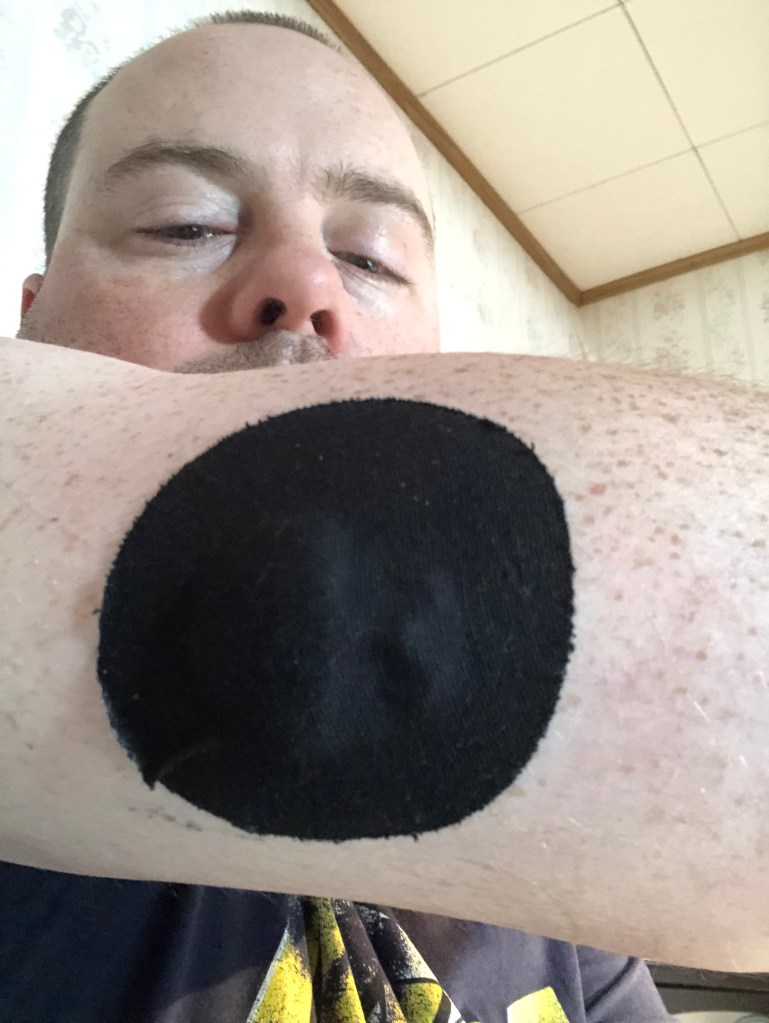
My Guardian Sensor, tucked safely underneath my adhesive patch (yes, I know I look exhausted)

When a company is good enough to go above and beyond in that way (box of 5 sensors is $399.00 in Canada), I owe it to at least TRY and make the damn thing work. So I’ve been hammering through. The photo above is the fifth sensor I’ve been on since that last post, and it’s been going reasonably well. I had one sensor give out after five days instead of seven, but that’s an error margin I can live with.

One of the main recommendations that my rep provided was that if I was used to having my Freestyle Libre on the tricep and it was working for me, I should do the same with my CGM. And to be honest, it’s been WAY better. Because of the steps required to properly install the sensor and transmitter, I can’t get it all done one-handed. So I enlist the help of my wife to get everything set up and in place.

The large, black adhesive you see covering everything is an after-market adhesive called Patchabetes that my rep recommended. I ordered mine through Amazon, but you can click the link to go right to their site to have a look at the various products they carry. I ordered a pack of 20 patches for about $25 Canadian, which means they’re costing me about $1.25/week to use. That’s definitely a cost I can live with. I shell out more money on that in caffeine every DAY!

One of the big problems I was having with the adhesives that come with the sensor is that after a rigorous workout followed by a hot shower, the adhesive would dry out and start to lift. I was shoring it up with band-aids and pretty soon I looked as though I was a badly-designed mummy out of a B-movie. On top of that, the sensor tube would usually end up slipping out of my arm and I’d have to replace it within days as opposed to after a full week. I’m fortunate enough that my medical insurance covers my sensors, but it still feels horrible to be burning through expensive supplies that quickly.

Since switching over to Patchabetes, I can work out, shower and spend all afternoon in the hot sun and it still stays firmly in place. The size of the adhesive and the fact that it’s one piece, ensures that the area is waterproof and I’ve had no issues since starting back on the whole thing. And let’s be honest: it’s kind of nice to have an updated blood sugar reading every five minutes. It’s been making the overall daily control a little bit easier.

Technology can be wonderful and can be very helpful in making the life of a Diabetic much easier. As with most things in life, there’s a steep learning curve involved, especially when it involves your overall health and well-being. So the lesson here is that sometimes you have to push through and give things a second chance, once you’ve had the opportunity to learn the proper way. Even in a fast-paced world, not everything can happen quickly. Now I just need to get over my cowardice and activate the AutoMode again… ☯

Change Isn’t Always Good

This is one of those posts where I need to reiterate at the outset that I am not a doctor or medical practitioner and have absolutely no formal medical training. What I DO have, is 38 years of combined experience, private study and use of therapy for all things related to Type-1 Diabetes. In fact, if one were so inclined, one could easily believe that enough years have been spent and enough private study has been done to equivalate the knowledge of a doctor, if not the skill. But I’m not that vain… (wink, wink). Totally kidding, let’s move on…

Now that the disclaimer portion of our day has been completed, let’s move on to the actual subject of today’s post: pancreas transplantation. A pancreas transplant is one of those things that everyone with Diabetes has at least wondered about, at some point in their lives. It would make sense, right? If you have a faulty heart or kidney, you can try and have THOSE transplanted, provided you’re lucky enough to find a donor that matches you and all goes well. All sorts of other organs have been transplanted, including livers, lungs and even eyes! So what’s the problem with pancreas transplantation, and why isn’t it more of a thing?

To answer that, we need to start by doing the same thing I’ve done a dozen times since starting this blog page. We need to properly define the two mainstream types of Diabetes. Although there are a number of various types and sub-types, for the purposes of this post I will limit these definitions to Type-1 and Type-2.

In simplified terms, Type-1 Diabetes occurs when your body’s own immune system seems hell-bent on destroying your body’s insulin-producing cells, namely the ones in your pancreas. Once these cells are destroyed, your pancreas effectively stops producing insulin. In a normal body, insulin is a hormone that allows glucose to enter the bloodstream. If the amount of glucose gets too low, your body reduces or limits the amount of insulin it produces and the vice versa. Still with me? Good, moving on…

Type-2 Diabetes is a bit different on the sense that one’s body is either resistant to insulin and its effects, or one’s pancreas creates little to no insulin. This used to be referred to as an “adult-onset” Diabetes, much like Type-1 used to be referred to as “Juvenile Diabetes,” but some children have been shown to be diagnosed with Type-2 in recent decades, due a number of different factors I won’t bother getting into. Despite different treatment and dietary regiments, there is no cure for either type. No matter what you’ve read.

Now that we’re all caught up, let’s discuss the reasons behind why a pancreas transplant may not be the thing for you. First and foremost, like any organ transplant, you need a donor. Unlike liver transplantation where a portion of healthy liver can be taken from a living donor, there’s no way to replicate this with the pancreas. So simply put, you need an organ from a deceased person. There are a number of difficulties behind obtaining such an organ, including but not limited to making your way up a donor list, having the donor be a match for you and trying to determine if a transplant is right for you based on your specific set of Diabetes-related symptoms and complications.

So pancreas transplantation CAN be done, it just simply isn’t the norm. It also isn’t permanent. And apparently we live in opposite world because the worse your Diabetes may be and the harsher your complications, the better odds that you’d qualify for a transplant. This is because they usually look at the fact that your Diabetes can’t be treated with traditional therapy methods. So THAT’S weird, but Type-2 is more likely to be a fit for a transplant, since its cause is mostly the lack or reduced production of insulin in the pancreas, so replacing it would typically fix that.

So let’s say that the stars align, you pass all the tests and get a donor organ and are approved to go through with the transplant. You’ll need to undergo a rigorous regimen of anti-rejection medications. A lot of things will remain the same for you, including all the medications and constant medical check-ups to ensure your proper recovery and the acceptance of your new organ. The next issue is that the very same immune system that attacked the first pancreas will begin to attack the new one. Shortly, you’d be faced with the very same issue that caused your Diabetes in the first place.

This means that part of your new medication regimen will require immunosuppressants in order to limit your immune system so that it won’t attack the new organ. Limiting one’s immune system will lead to a greater risk of infection and you may need a whack of antiviral and antibacterial drugs. Then, one needs to consider all the complications related to the surgery and the after-care involved in any surgery, the side effects of the anti-rejection medications and the drugs you’ll need to take for the rest of your life, as well as the potential for rejection after all that pain and suffering. Are we still on the transplant gravy train or are we running scared yet?

I’m making it sound pretty horrific, but the reality is that a pancreas transplant CAN work for some individuals. It simply isn’t the standard therapy to deal with it. And even if a successful transplant will eliminate the immediate need for insulin therapy, it doesn’t actually CURE Diabetes. And if the transplant fails or one rejects the organ, one can simply go back on insulin therapy. No harm, no foul. Minus major surgery, that is.

The Mayo Clinic actually has a good article that outlines the specific procedure and the complications associated with a transplant, so give it a read. There is no cure for Diabetes. As much as I’d like to add the word “yet” to the end of that statement, I believe much as most Diabetics do, that a cure won’t be forthcoming in our lifetime. But therapies have come a long way, and if I compare being on an insulin pump, using CGM and the effectiveness of my insulin compared to 1982 when I had to guess my manual injections, carb counting wasn’t a thing and I carried a glucometer that was effectively the size of a brick, I’d say we’re pretty spoiled. ☯

Diabetes Scrabble…

We are the product of our environment. Part of your environment is the job you do. It’s inevitable. My chosen career usually has me seeing the world through those lenses, and Diabetes is very much the same. I’ve had Type-1 Diabetes for so long that I have a nasty habit of throwing out Diabetes-related terms that the average person may not understand. After several years of hearing them, my family is still left reeling by some of the terminology.

With that in mind, here are some of the most commonly-used terms I tend to throw around. These were taken from a previous article I posted last november:

  1. Basal Rate:  This refers to the constant supply of some given medication that is delivered over time. For someone with Diabetes, one’s basal rate refers to the dosage of insulin, which is slowly delivered throughout the day, usually by way of an insulin pump;
  2. Bolus:  Unlike one’s basal rate, a bolus refers to a singular dosage of insulin that is delivered within a fixed period of time, either by manual injection or by way of an insulin pump. For example, before eating a meal, one would “bolus” a specific dose of insulin in response to the amount of carbohydrates in the meal;
  3. Blood Glucose:  This one should be pretty straightforward, but I’ve been surprised at how many people honestly don’t understand what is meant by blood glucose.  This term simply refers to the sugar carried through the blood stream in order to supply the body with energy. Having either too much, or too little sugar in the blood stream is one of the main issues with Diabetes;
  4. Carbohydrates:  Considering all the “nutritional gurus” and fad diets on today’s market, this one comes as a surprise as far as people not understanding what carbs really are. Carbohydrates are the body’s main source of fuel, and includes sugars, starches and fibres. This is why it’s so important for someone with Diabetes to properly calculate their carb intake; because all these components (except fibre) will affect blood sugar;
  5. Fasting:  Although not unique to Diabetes, fasting is often required prior to certain blood collection or medical examinations. It basically means that one abstains from ingesting any food or drink for a prescribed period of time;
  6. Hemoglobin A1C:  Although more complicated than what I’ll explain, A1C refers to the average of one’s blood sugars over a 3-month period. This is a test frequently used to see if a person’s blood sugars are staying within acceptable range. This test has become less of a favoured method, since one’s A1C can be manipulated through extreme highs and lows. Methods of measuring a person’s “time in range”, such as continuous glucose monitoring have become more of an accurate method;
  7. Hyperglycemia:  High blood sugar. That is all;
  8. Hypoglycemia: Low blood sugar. Bam!
  9. Insulin:  This is a hormone produced by the pancreas, which regulates the level of glucose in the blood stream. In someone with Type-1 Diabetes, this hormone is no longer produced, which causes the need for a synthetically created insulin to be injected;
  10. Interstitial Tissue:  This is the tissue that connects your outer flesh with the really bloody stuff underneath. This tissue is important for someone with Diabetes because it is where blood glucose levels are measured using a continuous glucose monitoring system;
  11. Ketoacidosis:  This is one of the more common complications of Diabetes. As I understand it, ketoacidosis happens when there isn’t enough insulin in the system to help the sugar enter the cells. Without sugar as fuel, the body begins using fat stores for energy. This causes certain acids to start spilling into the system, which can be spilled out through one’s urine. It’s very dangerous and usually requires medical attention if your blood glucose level won’t come down or your ketones are unusually high;
  12. Subcutaneous Tissue:  This refers to the layer of fat and connective tissue beneath the skin and is generally where injected insulin NEEDS to end up once injected from one’s pump or syringe.

There are probably some other terms that Diabetics use that confuse people, but these are the only ones I can think of. If you have any words or terms that you’re wondering about, drop them in my comments section and I’ll provide an explanation for those who may not know. ☯

The Pot Calling The Kettle Black

I’m usually really good at telling the people in my inner circle, “Don’t forget this” and “Remember to do that” when it comes to their medical requirements and/or Diabetic needs. A strong attention to detail is always something I’ve prided myself on, personally and professionally. But if there’s one thing that this pandemic has taught me, is that I have the potential to slip and get a little too comfortable in my routine. I learned exactly to what depth I had slipped into that comfort zone yesterday morning…

As is the case on most Monday mornings, my wife had the day off and since the pandemic has limited the number and type of excursions we can undertake, I usually use this time for a long-distance bicycle ride. Since my 70k from two weeks ago was such an unmitigated disaster, I thought that yesterday would be the perfect opportunity to make another attempt. I discussed it with my wife and she agreed that maybe it would be better to attempt an in-city 70k as opposed to the open highway.

This would at least prevent some of the issues I had faced on my last excursion. Alright, this made sense. After all, I had achieved my 70k (as far as distance goes) but my phone had died, I ran out of food and struggled with the Prairie wind so badly that I added more than an hour onto my total time. Not exactly the ideal situation. Despite the great workout, I got home feeling frustrated and disappointed that I had no documented proof to show of my achievement.

So yesterday morning was supposed to be different, and I hit the sack on Sunday night, confident that Monday would provide me with a screenshot of my Runkeeper app showing 70k or greater. I set an alarm for the early hours of the morning and let my head hit the pillow. Ironically, it turned out to be a night where Diabetes didn’t intervene in any way and I actually slept for a solid number of hours. But as I’ve often said in the past, life doesn’t care about our plan. And we usually can’t predict when a wrench will be dropped into our gears.

I awoke with the morning sun and as is often my custom (unless the baby wakes me first) I woke up before my alarm went off. The sun had been up for a while, and I went downstairs to my home office to prepare my gear. Nathan had fallen asleep on the spare bed in the office, so I made every attempt to be quiet as I prepared. The first item on my list: change up my pump’s infusion set. I went to bed with about 35 units left, and I already knew I’d have to change up my set before heading out on the bicycle.

I grab a reservoir and infusion set and realized I couldn’t find my bottle of Humalog. I searched everywhere and just couldn’t find a bottle of insulin anywhere. I still had enough insulin to last me the morning (as long as I didn’t consume carbs) and the pharmacy only opened at 9am. Well, there goes my plan to ride… I can’t remember the last time I ran out of insulin. As in, I can’t remember because it’s been YEARS! I’m usually on top of my supplies, especially since they keep me alive. I now found myself despondent and killing time until my pharmacy opened.

By the time I made my way to the pharmacy and dealt with some unnecessary and unexpected delays on their part, I was most of the way through the morning and the Prairie summer heat was already in full swing. As I’ve learned the hard way over recent weeks, this isn’t the ideal environment in which to cycle for long kilometres. I opted for some light yard work instead, mowing the back lawn and getting a bit of fresh air.

Despite my usual attention to detail, this proved to show me that I’m just as human as the rest. I’m at least grateful that I live in an area where getting a prescription the same day as I need it is pretty easy. But it has also proven that I apparently need to start paying closer attention as I crawl forward in my age, as I already seem to be letting details slip. ☯

“Grin” Through It…

The pandemic has certainly put a number of things on the back burner, with most amenities and some necessities having closed for a number of months and most of us finding ourselves dealing without. One of those basics necessities happens to be the dentist. I had the opportunity to visit a local dentist’s office and treat myself to a good old fashioned cleaning. I brought Nathan with me so that he could get a look at the process and what’s involved with proper oral health, since during his last trip to the dentist, he turned into wolverine and fought off the staff.

Some of this is quoted from my previous post on oral hygiene because, well… concrete information doesn’t change! So if you’re a committed reader of my blog, you may recognize some of the information.

Oral hygiene and dental health are extremely important. Perhaps more so than most people understand. While growing up, I remember that the standard was simply that you needed to brush regularly and floss in order to keep from losing your teeth. Since then, studies and medical advancements have proven just how serious the problems can become if you don’t pay proper attention to your mouth.

Let’s think about our mouths for a moment: it’s the entry point for your food and the air you breath. This means that you have a lot of stuff from the outside world that enters your body through your mouth. Like most surfaces on your body, your mouth is full of bacteria. Some of that bacteria is good, but the bad bacteria is what can lead to tooth decay, bacterial infections and gum disease. Bacterial infections can be pretty serious, especially for Type 1 Diabetics. Our weakened immune systems make us more susceptible to infection and makes them worse. Just to make you grit your teeth harder, (see what I did there?) the gum disease caused by improper oral health can make it harder to control your blood sugar levels.

Even if you don’t have Diabetes, poor oral health can leave you susceptible to cardiovascular complications, pregnancy complication and pneumonia. So, what can you do to hep prevent those oral health issues? Brushing your teeth is an obvious first step. Despite what some of us were taught as children, brushing three times a day (or after every meal, whichever is greater) is not necessary. According to the Mayo Clinic, brushing twice a day is what the current recommendation indicates. This means brushing once in the morning and once before bed. Despite this, most dentists still stick to “old faithful” and tell folks to brush three times a day. It’s not a bad thing.

Although some dentists have indicated that even once can be acceptable, you tend to run into some problems with that, including potential bad breath throughout the day and unsightly food stuck in your teeth if you’re out in public. If you only brush once a day, best to do it first thing in the morning to eliminate morning breath. But brushing after any meal you eat is ideal, since the break down of food by the bacteria in your mouth will potentially cause issues. Be sure to floss. Most people overlook flossing or it bothers them. But flossing is required to eliminate the bits of food that can’t be removed by a toothbrush. Leaving that food between your teeth against the gum line can lead to an increase in bacteria. Use an antibacterial mouthwash. Don’t forget that mouthwash is supposed to complement your dental routine and isn’t meant as a substitution for brushing.

Click on these links to articles posted by Colgate and WebMD that explain some of what I’ve written and can provide further insight. Some other small changes can also help with improved oral health, such as avoiding staining drinks such as red wine or smoking tobacco products. And don’t forget to replace your toothbrush every few months. That s&*t gets gross!

So it may not have been a post about blood sugars or exercise, but proper oral hygiene can help prevent Diabetic complications and other issues that be aggravated by Diabetes. Why take chances when the prevention is so simple? Nathan was pretty impressed with the fact that I nearly fell asleep during my cleaning and it proved to be no issue for me. He’s looking forward to a check-up of his own in order to cash in from the Tooth Fairy. Now that dental offices have re-opened, I highly recommend everyone get in for a check-up. ☯