There Are No Shortcuts To A Thin Waistline

One of the biggest challenges I’ve faced in recent years is the thickening of my mid-section. Although I’ve never really been a big fan of a traditional six-pack (traditional Okinawan karate’s custom believes the hara, or the source of life, is in the midsection), I’m also not a big fan of having a hanging gut. Most people tend to forget that insulin is a hormone and can cause weight gain depending on its use. And given that I’ve reached my 40’s, my metabolism is no longer what it used to be.

Most of the time, and as I’ve written before, fad diets and gimmicks are usually useless. There is generally only one true, effective way to lose weight and burn fat and that’s to burn more calories than you consume. The prospect of reducing your food consumption or filling up on foods that are low in calories, such as lean meats and vegetables, are obvious ways to accomplish that goal when combined with rigorous exercise performed several times a week.

That fact doesn’t prevent some people from trying their best with things that they believe will help them along on their weight-loss journey. I’m saddened to admit that even I gave it the old college try, back in 2015. Despite how hard and how often I was working out, I decided to jump on the bandwagon and look into a supplement that I was told was “guaranteed” to help trim stomach fat. I’m talking about Conjugated Linoleic Acid, or CLA.

CLA is a fatty acid that can be found naturally in a number of foods, but it is not an “essential” fatty acid. This means that you don’t necessarily need it in order to be healthy. We consume CLA through these natural sources, but many people use an artificial CLA supplement in order to help shed some weight. For the most part, the jury is out and although it shows SOME potential towards shedding weight, it’s negligible.

According to an article posted by Healthline.ca, there have been numerous studies performed in relation to CLA and weight loss. The results usually showed only a minimal loss of fat compared to those who were given a placebo. The article talks about a matter of half a pound per month. For those who are a bit weaker in math, this means that consistent use of CLA supplements over a full year would see you lose no more than about six pounds.

The article actually offers a sadder total, estimating that long-term use of CLA over the course of six to twelve months only reduced body fat by 2.93 pounds. That’s pretty pathetic, when compared to the cost of paying for the supplements, coupled with some of the negative side effects that one will likely develop from its use. You can click on Healthline’s link above to read about some of those, but wouldn’t it be easier to simply exercise more?

I was living proof of these studies when I used CLA supplements for the better part of a year. My muscle mass increased with all the exercising I was doing but in terms of body fat, there were no results. Plus, I had dished out a bunch of money on buying the supplements when I could have been using that added money on lean meats. I love lean meats. And fish… Damn, I’m getting hungry now…

Just to give you a bit of an idea behind the financial toll this attempt took on me, I would purchase a 60-capsule bottle at about $25. I won’t make myself civilly actionable by naming the retail chain I purchased the capsules from, but the dosage is 3 to 5 capsules a day. So at the lowest dosage, I would need another bottle roughly every three weeks. This means that over the course of a year, I paid $450 for those supplements. At the highest dosage, I would need to replace the bottle every two weeks, meaning I would have paid $650 over the course of a year. Thank the light I only stuck to the lowest dose…

There are no easy shortcuts to weight loss. No magic pill or secret formula you can consume will make the fat magically melt off your gut. This is one of those things in life where you need to put the time and the work in. Despite the fact I should have known better, I had to learn it the hard way. And sometimes it needs to be that way, but I’m hoping that my post will help some understand.

Eat well, rest well and exercise well and you can be assured that weight loss will happen in its own time. And remember that every person and every person’s metabolism is different, and what works for one person may not work for you. Hopefully you won’t waste a bunch of money figuring that out. But if you are thinking of trying out a new supplement, be sure to consult your medical practitioner and do your research. ☯

I’m In An Awkward Position

Anyone who reads my posts on the regular knows that I tend to bitch about Diabetes complications a lot. And with good reason; Type-1 Diabetes affects just about every system and every organ in the body, to one extent or another. Sleep is no different, with fluctuating blood sugars causing insomnia, nightmares or restless leg syndrome. There’s plenty that can go wrong during a Diabetic night’s sleep, including being woken from a drop in blood sugar. Believe me when I say that I’m grateful that I DO wake up. But for the most part, I haven’t had a full, uninterrupted eight hours of sleep in a very long time.

The focus of today’s post isn’t exactly a symptom, per se. But rather an unfortunate side effect of the current Diabetes therapy I use. I’m referring to trying to get a full night’s sleep while wearing an insulin pump and/or CGM. It stands to reason that as I sleep, I need to carefully consider how I position myself in order to avoid kinking my cannula (say THAT three times fast) or applying consistent pressure to the CGM sensor, which may cause it to fail.

There are all sorts of websites that provide some interesting (if not altogether accurate) explanations regarding different sleep positions, what they mean and apparently describe your personality. I’m not a big believer of that last one, but to each their own. My point is that for the longest time, I’ve slept on my stomach. I have no other explanation for this other than it’s always felt the most comfortable. But over the past year or so, I’ve slowly adjusted myself to remain on my back while sleeping, due in part to the pump set sitting on my abdomen and the CGM sensor embedded in my tricep.

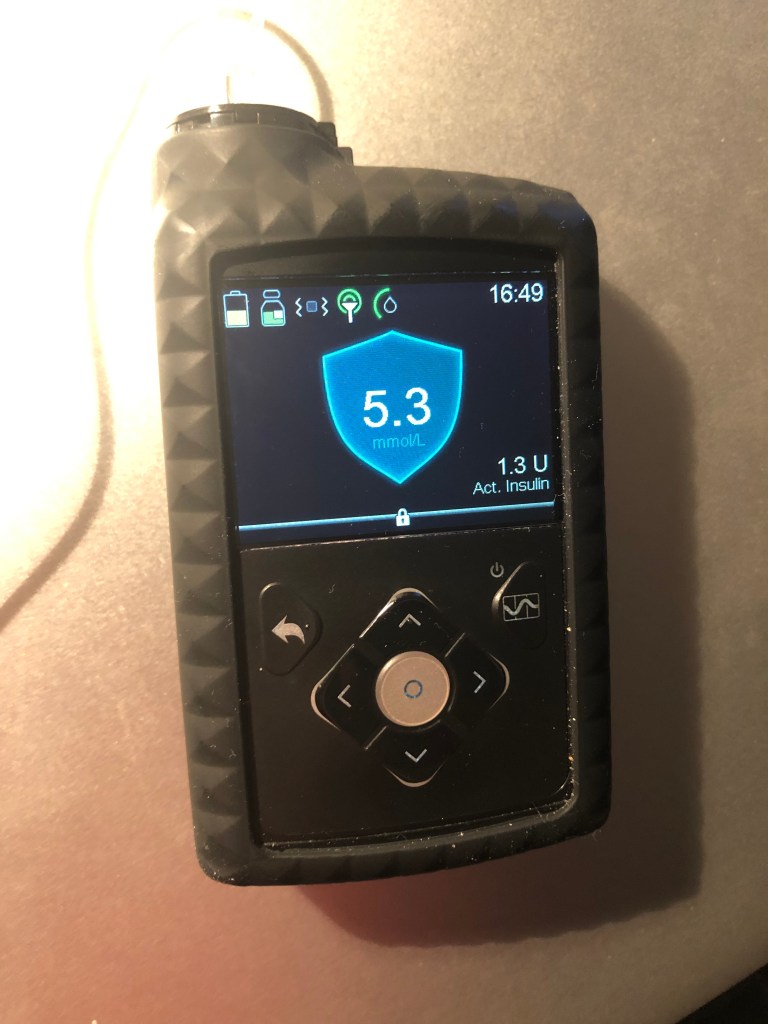
There have been a number of times where I’ve rolled over during the night, since the average person can’t necessarily control their movements while asleep. This has caused a score of issues including but not limited to, my pump slipping out of my pocket, my infusion set being pulled out and even my pump slipping off the bed and yanking at the injection site. Wanna talk about rude awakening? That’ll do it for ya! I’ve rectified this with a silicone sleeve, which makes the pump less slippery and less prone to slipping out of my pyjama pockets. There are also neoprene belts you can purchase, if you don’t mind paying a fortune.

CGM sensors are a different bastard, since any sustained pressure against their injection site will cause them to fail. This means that if I roll to my side and my tricep is pushed against my mattress, it prevents the sensor from reading the interstitial fluid in a way that’s required for consistent CGM readings. And since the Medtronic 670G absolutely LOVES chirping at me in the middle of the night, it only takes a few minutes before the pump wakes me with an alarm to tell me that something’s wrong. Two times out of three, if I’ve kinked or blocked the sensor in this way, it won’t right itself and I find myself disposing of a sensor long before I was due for a change.

I’m likely making it sound worse than it actually is. In reality, the sensors aren’t AS delicate as the previous paragraph makes them out to be. But it’s a very real concern. The biggest concern, which has happened before, is having the pump’s infusion set pulled out of my injection site. The problem with this one is that it can take a long time before my CGM acknowledges that my blood sugars are starting to rise. And even as they do, the Auto Mode will start pumping out more insulin to compensate, which will do nothing but soak into the bedsheets.

After a long enough period of time, an alarm will start beeping on the pump to warn me that my intervention is required since the insulin isn’t working. But by then, my blood sugar level can have potentially gotten high enough to require multiple boluses, monitoring for hours and plenty of fluid intake. Something everyone LOVES to spend the overnight hours doing. Luckily, this has only happened to me a few times, and the sting from the adhesive being pulled usually wakes me anyway.

When we talk about Diabetes complications, most people associate the term with vision problems, organ failures, amputations or Ketoacidosis. But we often forget that the technology we use, although helpful in many respects, can be a hindrance in others. This is what’s led me to sleep like a poorly posed Egyptian mummy. If you’re on pump therapy, try and train yourself to sleep in a position that will prevent issues with your equipment. Store your pump in a protective silicone sleeve in case it tumbles out of bed or consider using pyjamas that have zippered pockets. It makes the sleep process more complicated, but it’s a small price to pay for decent blood sugar control. Now if you’ll excuse me, I need a nap… ☯

Excuse Me, Have You Seen My Dojo?

Most people have been adversely affected by COVID-19 over the past six to eight months. Either their finances or their jobs have been affected, people unable to pay their mortgages or rental fees, not to mention the poor souls who have contracted the virus and those who have unfortunately succumbed to it. Some areas of Canada have been doing fine, with the virus practically non-existent. Other areas haven’t been so lucky (like Ontario and Quebec).

But some of the smaller things can have a big impact on a person’s day-to-day life as well. For myself, one of the biggest losses I’ve suffered throughout the pandemic is the closing of the karate school I frequent. Although fortunate and grateful that my job, finances and home have not been affected and that no one in my family has contracted COVID-19, Tuesdays and Thursdays bring about a reminder that not only do I no longer have a dojo to train in, but the world is a long way from returning to normal.

Riding on the coat tails of yesterday’s post, the colder weather has had a profound effect on my level of motivation. Every joint in my body has started to ache every morning, thanks to 32 years of intensive training that’s caused wear and tear on almost everything. My feet are cold due to lack of circulation, thanks to Type-1 Diabetes. My sleep has always been horrible, but it’s all the worse now, with the fact that the sun doesn’t rise for almost an hour AFTER my alarm goes off.

All in all, the cold weather and pandemic have had a profound effect on my level of fitness and motivation. It’s already starting to be too cold for extended bicycle rides, even if I could sneak in a short one here and there in the afternoons. And with the renovation of our basement starting in a couple of weeks, we’ve started to move most of our belongings from the basement to the garage, thereby taking away my little “at home dojo” that I recently wrote about. I’ve also started to indulge in morning naps when my 1-year old takes his (my 5-year old is gone to school), which is a terrible habit to get into as my body has come to expect it. It’s gonna suck when I go back to regular work!

Can I train at home? Absolutely. DO I train at home? Most certainly. But there’s a lot to be said for training in the dojo environment. Not only to you get to feed off everyone’s else energy and motivation, thereby increasing your own, there’s a camaraderie that one gets to enjoy that can’t be found elsewhere. Unlike working out in a gym or by yourself, social interaction within the dojo is basically a requirement. Although not impossible, it’s quite difficult to train for an entire class without interacting with at least a few of your classmates.

The selfish side of me is disgruntled at the fact my dojo has remained closed throughout all of this. Considering the dojo runs on the school schedule and schools have let in, and the few students we have ensures a better chance at social distancing and lower percentage of contracting the virus than most classroom settings currently have, in some ways it makes little sense. The sensible side of me understands that a karate school is a far cry from being a “necessary service,” and that it would be an unnecessary risk to allow classes to resume.

There are some sources that have expressed that the world may factually never completely return to normal and that social distancing practices will become the new standard. If this is so, perhaps the dojo will never reopen. That would truly be heart-breaking, as it could mean the severe decline of modern martial arts and the possibilities that some arts may be lost. Only time will tell. In the meantime, I need to find my own motivation and continue to forge ahead, feeling that small twinge of loss every week when Tuesdays and Thursdays roll around. ☯

Cold Thoughts

If there’s one thing that’s usually consistent, it’s the changing of the seasons. Maybe not consistent in the fact that it always starts happening on the exact same date every year, but one could bet good money that autumn will follow summer and winter will follow autumn. So on and so forth. Although most people I know aren’t exactly huge fans of the cold, the seasons bring about the same process where most people complain about the heat in the summer and complain about the cold in the winter.

Personally, I’m a fan of autumn. Not only is the weather cooler so that I’m not sweating bullets when I’m outside, I’m not forced to shovel the copious amounts of snow that drift into my vehicle due to Saskatchewan winds. The autumn also brings a lot of beauty with the changing of the leaves and it almost feels like there’s a change in the atmosphere. Because there is. Even though we’re not in the swing of winter yet and there’s no snow on the ground (at least here in Saskatchewan), the weather has already started to drop and this has some measurable effects on the body and one’s mood.

First thing’s first: let’s dispel the old rumour that the cold weather causes a person’s blood to thicken. Not only is that total bullshit, your blood actually has a better chance of thickening in the hot weather, due to the dehydrating of fluids in the blood. But the colder weather does seem to bring a yearning for curling up and binge-watching a show with various pumpkin spice-flavoured snacks, compulsive napping and most importantly, lack of motivation.

That last one is rather important, especially if you have Type-1 Diabetes. Motivation is a key element in maintaining one’s eating habits, sleeping habits and fitness habits; all of which are affected by colder weather. One of the main conditions that help to make things worse is the fact that the days get shorter and darkness hangs around for longer. This causes change in our moods, appetite and sleep cycles, which brings us to the next problem: Seasonal Affective Disorder.

Yes, cold weather can bring on an actual disorder and it can play hell on your system. According to an article posted by the Mayo Clinic, Seasonal Affective Disorder, or SAD, can cause lower levels in energy, lack of motivation or mood, difficulties concentrating and loss of interest in activities you once enjoyed. There are a lot more symptoms, and I’d invite you to click the Mayo Clinic’s link to see them all.

The problem with SAD, especially during the colder seasons (the article does show that there’s a summer version as well) is that it can lead to nasty things like overeating, weight gain, lack of energy and flat out, good old fashioned laziness. As previously mentioned, all of these things are absolutely horrible for people in general, but even more so if you have Diabetes.

Although most health professionals will tell you that you can eat whatever you want so long as you take the appropriate level of insulin for it, that doesn’t protect you form the weight gain you may experience from doing so. If your sleep is affected, your blood sugar levels will be affected. If you have a lack of energy and motivation, the lack of exercise will also adversely affect your blood sugar levels and your overall health.

It can get tough to focus on routine and the status quo, when cold weather kicks in and all a person wants to do is curl up under a warm blanket and binge-watch Star Trek reruns for hours on end. No? Just me? Alrighty, then… But it’s important to maintain proper diet, sleep and exercise, Diabetic or not, in order to maintain one’s health and well-being. Especially since the winter season has the highest percentage of depression of the rest of the year. With the colder weather approaching, self-care and keeping a routine is most important. ☯

Auto-Mode 2: Electric Boogaloo

Advancing to pump therapy and including Continuous Glucose Monitoring has been something of a rough journey for me over the past five years. All things being equal, the concept of Auto-Mode is a little bit scary. If your blood sugars start to rise, your pump will start trickling some extra insulin into your system. If you begin to drop, it will taper off your basal delivery (or suspend it, depending on how low you’re going). It demands a certain level of trust in an inanimate object that most humans won’t necessarily have. Myself included.

Artificial devices are the new way to go, since transplanting an actual pancreas is more complicated than it sounds, comes with its own batch of complications and has a pretty low success rate. Therefore, finding some other way to replicate or imitate the functions of a pancreas is the next logical step. Something akin to obtaining a prosthetic limb after an amputation. My new Medtronic pump, when including CGM and on Auto-mode, is about as close to what they refer to as a “closed-loop system” as you can get. The hardware and software basically work towards controlling your highs and lows on its own.

Sounds a bit like Skynet is taking over to me, but whatevs. Given my age and the fact I’m not getting any younger or stronger means I need to be open to new therapies and methods of controlling my Diabetes. The decision was ultimately taken away from me around mid-July, when constant issues with Auto-mode and multiple faulty sensor issues caused me to scrap the whole thing and simply use my new pump manually. I got some further coaching and guidance and have now been on CGM for well over two months, with minimal problems and/or difficulties.

That’s why, after being contacted by Medtronic to ask me “how Auto-mode is going,” I thought I should take another crack at it. With a fresh vial of insulin, fresh sensor set and a bit of patience, I activated Auto-mode and have been on it for about the past two weeks. Given that the pump has had two months to accumulate data for the purposes of Auto-Mode, I would have been pretty pissed off if it didn’t take. But I have to say, its been going much smoother and my blood sugar levels have been fantastic.

I’m still a bit leery and I’ve been waiting for the other shoe to drop because, well… this is me, we’re talking about. But besides my pump clip breaking last week (don’t even get me started on that one), I’ve had no issues except one infusion set failure, which was mostly due to scar tissue. Auto-mode certainly includes more alerts than I’m used to on manual mode, but I’m getting used to them. Skynet seems to be working just fine.

I guess it’s still better than having an internal artificial organ that I can’t see, or have any direct control over. And as long as it continues to do its job, I guess I’ll have one less aspect of Diabetes to bitch about. As with all new technologies, all it takes is a little patience and some getting used to. ☯

Bad Habits Make For Bad Results

As human beings, we’re creatures of habit. And to be honest, most of those habits are terrible for us. Smoking, drinking, gambling, addiction to electronics or social media… It’s all horrible and it all has terrible short and long-term effects on a person’s health. I can promise you without any doubt, that any of the people whose life was brought to a sooner end as a result of any of these bad habits wish they had never gotten into them in the first place.

Don’t get me wrong; in the past twenty years, I’ve effectively indulged in everything I’ve listed above at one time or another. Even now, I admit to being guilty if enjoying the occasional cigar or having a bottle of wine while watching Lord of the Rings and contemplating life. I don’t really do the whole gambling thing, unless you count my weekly lottery ticket (don’t get me started on THAT one). And since I’m currently writing this blog on a laptop, the use of electronics speaks for itself.

My grandfather lived to be 96 years old, after surviving active service in World War II and enjoying his drink just a little bit more than the average person. Actually, if I’d fought on active front lines during World War II, I’d likely enjoy my drink a LOT more than I do. But I digress… My point is, some people have the ability to manage their vices without it being detrimental to their lives. And as I’ve often said, all things in moderation. But here’s the part that sucks: all of it is worse for someone with Type-1 Diabetes.

Although I can totally admit that gambling is more of a detriment on one’s life in general, it’s mostly the consumption of alcohol and smoking that has some measurable effects on the system of anyone living with Diabetes. And yes, this applies to both Type-1 and Type-2, as well as any of the unpleasant in between versions of Diabetes that I’ve written about before.

As far as alcohol is concerned, a Diabetic first needs to be knowledgeable on the amount of carbohydrates contained in their drink of choice. The average can of beer usually contains about 11 grams of carbs. That likely doesn’t seem like a lot, but if you sit to an evening with your pals during your favourite UFC pay-per-view and down a six pack on your own, you’re looking at 66 grams of carbs you need to bolus for! And that’s without taking into consideration the fact that by your sixth beer, you’re likely starting to forget you should bolus.

Wines and spirits are just a little bit better, with wine coming in at about 4 grams of carbs per glass and most pure spirits having no carbohydrates at all. One of the secondary concerns is that we tend to snack on some rather nasty snack foods when we drink, which can also lead to bad blood sugar control. Don’t get me started on the fact that increased alcohol consumption can lead to higher blood pressure, sleep and weight issues, all of which can adversely affect Diabetes.

Next, let’s look at smoking. Because I enjoy bumming everyone out. It’s no secret that smoking will lead to a host of health complications, not least of which includes high blood pressure and cancer. But according to an article posted by the Junior Diabetes Research Foundation, an important study was conducted from 1983 to 1993, which was named the Diabetes Control and Complications Trial. It found that increased levels of smoking led to higher HbA1C results, increased chances of retinopathy and kidney issues. The only good news is that the Diabetes-realted complications disappear almost immediately, if you quit smoking.

The bottom line is that poorly-controlled Diabetes will cause increased blood pressure on its own. Why make it worse by introducing something that will aggravate that condition? This doesn’t mean you can’t enjoy a beer with your friends. It simply means to consider moderation, monitor your blog glucose levels closely and don’t allow yourself to get into a situation where you start neglecting your insulin and/or blood sugar levels. ☯

Trial And Error

I’ve had Type-1 Diabetes for almost four decades now, and during those decades I’ve seen it all, heard it all and almost tried it all. With the exception of some of the more complex procedures, such as pancreas and/or islet cell transplants, I’ve been on every kind of therapy and have tried several different diets. Some have even been rather “new age” and eclectic. I’ve also dealt with a number of conditions, such as Diabetic Macular Degeneration, Diabetic Retinopathy and Diabetic Ketoacidosis.

One of the bigger issues that many if not most people fail to recognize is that not every therapy works for every person. In fact, many therapies simply won’t work for different people. For example, there have been types of insulin that simply have little or no effect on me the way my current insulin does. And for the most part, these issues have been discovered by accident, or through a change in my prescriptions or therapies.

This is one of the reasons why, as a child and a teenager, I hated going to doctor’s appointments or even changing practitioners. Every doctor or medical practitioner I’ve had, has changed my prescriptions, altered my therapies or has tried to put their own personal spin on my condition. It can make life difficult; especially when any change can upset the balance of one’s daily routines.

On the face of it, we usually have very little choice but to accept it when a doctor says, “we’re going to try this and see how it works for you.” As a child, I would usually just sit there and nod. I’d let my parents take the prescription or document the change in requirements and then I’d ride the change. More often than not, I’d find myself getting ill or suffering major complications and I’ve been in several comas, between the ages of 6 and 10.

This has led to a certain level of paranoia when trying new things, in relation to my health. But the reality is that there is no REAL way of making progress in the available therapies without some trial and error. If I hadn’t tried certain diets and prescriptions, I wouldn’t have found what’s worked for me and what hasn’t and I may well have not survived beyond my teen years, which is what my doctors at the time offered me as a life expectancy.

It’s pretty similar to trying out a specific type of diet. Let’s take something reasonably well-known, like the Paleo or Keto diet. Some people try these fad diets and lose a reasonable amount of weight and it works well for them. Others will try those same diets with no measurable results. Or worse, they’ll gain weight. The same can be said for certain Diabetic therapies. What works for one person with Diabetes may not necessarily work for someone else.

It reminds me of when I started on pump therapy. I avoided insulin pumps like the plague. Given my chosen profession and the nature of how insulin pumps operated, I honestly didn’t think it was for me. Until I tried it. After a significant amount of trial and error, pump therapy wound up being the best decision I could have made. Even recently, adding Continuous Glucose Monitoring to the mix has proven to be an exceptionally good decision.

My point is that you may have to throw caution to the wind and try a few things in order to smooth out your therapy. Diabetes is a well-known condition, albeit not always understood. But every human being is different and every person’s system is different, so one particular therapy may produce different results for different people. Makes sense, right? Don’t be afraid to branch out and try different things in order to keep yourself healthy. As long as you take ownership of those attempts and take care, you can almost be guaranteed to find something that will work for you. ☯

Be Mindful Of How You Dish Out…

People love to eat. And that stands to reason! There are so many cultural foods, restaurants and options available, as compared to even 20 years ago when the best you could hope for was a local fast-food joint and perhaps one fine-dining restaurant in your home town. And for the most part, you wouldn’t set foot in that fine-dining establishment unless it was a special occasion. But these days, you can order just about any type of food online, in person or through delivery. Eating what you want (so long as you can afford it) has never been easier. And that’s a problem…

Over the past century, there has been a measurable increase in how much the average person eats during a meal. This has led to a heavy increase in obesity, heart and circulatory issues as well as contributing to Type-2 Diabetes. In fact, according to a 2012 article posted by The Globe And Mail, “most Canadians underestimate what constitutes one serving of meat, grains and fruit and vegetables under Canada’s Food Guide.” And that’s a pretty accurate statement, when you consider that the t-bone you just seared on your barbecue this summer was without a doubt higher than your recommended daily intake of meat.

For those who don’t live in the Great White North, Canada’s Food Guide was created in 1942 in order to help ensure Canadians were eating in the proper proportions and maintaining their proper health. It also took wartime rationing into consideration, but the Guide is still accurate and actively used. It essentially describes that the average plate of food should be comprised of 50% vegetables, 25% grains and fruits and 25% protein. Although that’s just the gist, it’s also the basis for how we should be measuring out our plates on a daily basis.

There are a lot of reasons why we tend to underestimate portions and eat more. Some of it is perception. Plates and implements are larger than they were in, say, the 1950’s. Some of it is a monetary issue; we expect more for less, as in we expect our plates to be loaded when we go to a restaurant or eatery even though portion sizes would dictate that we should eat far less. Just think about the last time you went a restaurant and ordered a plate of pasta. In Canada, if you pay $25 for a plate of pasta, you would damn well expect that the plate will be piled high with pasta, sauce and plenty of meatballs. And where the hell is my garlic bread???

Meanwhile, the actual recommended portion of pasta for a single meal is no bigger than a tennis ball. And that’s just one general example, but because of rising meal costs in most restaurants, we expect more bang for our buck. For food products in general, most Canadians tend to measure portions on the fly, meaning if you eat cereal you’re likely to fill your bowl and grab some milk as opposed to reading the label to see what the actual portion size is. In many cases, the nutritional information label will list a portion size that’s much smaller than what you’ve been consuming in one sitting.

There’s a lot you can do to fix this problem. I found an article on Australia’s Huffington Post that provides “8 doable tips” to help with portion control. Rather than list them all in detail, I’ll let you click the link and give the article a read. It’s quite good, but the tips include simple things like drinking water prior to eating a meal, properly measuring out carbs and proteins, using the same plates and bowls consistently for frame of reference and eating slowly. There are more tips in the article.

For those who have Diabetes, portion control is critical because we need to count all the carbs we ingest and calculate the amount on insulin we need to take to counter them. Most Diabetics would be prone to saying, “But Shawn, it doesn’t matter how many carbs we eat, so long as we take the required insulin for it…” First of all, you may be right. But secondly, it’s not just about the carb versus insulin consideration. It’s the fact that overinflated portions can lead to unnecessary eating, weight gain and health issues.

You don’t need to keep eating until you’re stuffed. I know I’m guilty of this one myself. If we make a pizza and I earmark half of it for myself, I’m usually inclined to eat the entire half in one sitting. The nutritional label usually reads 1/3 of the pizza as a single portion, meaning I’ll often wolf down three portions in one meal. And I wonder why I can’t slim down my middle!

Children are lucky in that they still have the instinct to stop eating once they’ve had enough. In fact, that’s why most parents find themselves barking at their kids to finish off their plates. They’ve just gotten full and no longer WANT to eat. But by the time they reach adolescence, that instinct disappears and overeating rears its ugly head, leading to a score of health issues.

As I always say, it’s important to consume any and all things in moderation. But what’s even more important is portion control. You don’t want to skip meals or starve yourself as you’ll be more likely to gorge yourself on unhealthy snack along the way. But as you eat, you should try cutting down your portion sizes. Combined with consulting your health and/or medical practitioner and regular exercise, it’s a sure recipe for success. ☯

It’s Okay To Skip A Step…

I hate cardio. This probably comes as a surprise, coming from someone who believes that if you aren’t dripping in sweat when you’re done, it wasn’t a workout. And the truth of it is, I do enjoy cycling. But that’s mostly because it allows me to get outside, reconnect with nature (to a degree) and keeps the cardio aspect buried in the background. The best of both worlds. But to say that I’m heading out for a run or doing cardio for the sake of doing cardio would be a stretch.

Cardiovascular endurance training is important for one’s health. According to an article posted by the Mayo Clinic, cardio exercises help to strengthen your heart and muscles, burn calories, help control your appetite, increases sleep, promotes joint movement and helps to manage Diabetes. Cardio can be a long-term or long-distance thing, like long-distance cycling or swimming 30 laps in a pool, or something incorporated into a weight or resistance workout, such as jumping rope.

Jumping rope is an easy, convenient way of including some light cardio into your workout routine. I’ve kept a jump rope in my gym bag for the past ten years, and I make use of it whenever I get the chance. Jumping rope can burn a wicked amount of calories; several hundred calories in a 15-minute period, in fact. It can help improve overall balance and coordination, not to mention that the heart benefits are the same as with traditional cardio. And although it can be taxing on the knees and leg joints, doing it properly is considered a lower-impact than something like running.

I like to incorporate it by using it with circuit or interval training with karate techniques. For example, I’ll do a minute of front kicks, followed by a minute of high-speed jump rope. Then a minute of the next kick and a minute of high-speed jump rope. So on and so forth. Sometimes I’ll simply use it as a warm-up or a cool down. A good quality jump rope is portable, convenient and low-cost. You can stuff it into any gym back or backpack and all you need is about a 25-foot square of space.

As much as I dislike cardio, it is a necessary aspect to proper health and fitness. And there’s no denying that it also helps with the blood sugar control and sleep quality required for someone with Type-1 Diabetes. If the last time you used a jump rope was during a spirited game of double dutch during your school years, you’ll want to start slow and ensure you do it on a stable surface. Avoid grass or carpet as it can snag the rope or catch against your footwear. ☯

Growing Sometimes Means Getting Smaller

I have clear memories of all the stuff I had to go through when I was first diagnosed with Type-1 Diabetes. Since my older brother had a wide variety of illnesses, junk food and sugary snacks were never really a staple in my household anyway, but I remember that certain things took a dramatic change nonetheless. I was no longer allowed to drink juice whenever I wanted. I was subjected to frequent daily shots for insulin and finger pokes for blood glucose testing. It was a traumatic time for a 4-year old who hadn’t even had the opportunity to grab life by the horns.

The irony is that all the traumatic stuff is the only reason I’m still alive, even if some of it was misguided, wrong and in some ways caused more harm than good. Back in good ol’ 1982, carbohydrate counting wasn’t a thing at my hospital. Maybe if I had lived in a larger centre, there would have been better Diabetes education available. But in my hometown, there was a singular mantra when it came to the control of Diabetes: Don’t eat sugar! That was it. In tandem with a morning injection of short-term insulin and an evening injection of basal insulin, my blood was tested once a day before bed and I was good to go.

Yes, you read that right! My blood was only tested once a day. Quite a far cry from the dozen times I finger poke myself these days, or the Sensor Glucose readings I get from my pump every five minutes. Not to mention that my first glucometer was roughly the size and shape of a brick. (There’s an illustration of that glucometer in my previous post: When Diabetics Get High… (but not the way you think) But Diabetes therapy has come a long way from it’s beginning, when a person diagnosed with Type-1 Diabetes usually considered it a death sentence.

A photo of the first insulin pump

Pump therapy, along with carb-counting and exercise, have made the life of a Type-1 Diabetic easier by scores from what it previously was! As illustrated above, the first insulin pump was basically the size of a large backpack and included metal parts and was cumbersome and impractical. It looks like something Tony Stark developed in a cave. Would I use something like this today? Obviously not, but back in 1963 when Dr. Arnold Kadish designed it, it would prove to be the launching pad for an insulin therapy device that would be widely accepted.

Smaller insulin pump. Source: Wikipedia

Smaller versions were developed by others roughly a decade later and they started being developed with wearability and accessibility in mind. But it wouldn’t be until the early 2000’s that insulin pump therapy would catch on as a common thing. One of the main obstacles is the overall cost. Although I don’t remember the exact retail price of my most recent insulin pump, I do know that it ran to the tune of about $8,500. If I didn’t have benefits through my work, I wouldn’t be on pump therapy.

That’s without taking into consideration that a box of infusion sets runs at about $200/month, reservoirs are about $50/month and the CGM sensors are about $400/month, making for a lovely total of almost $1,000/month when you factor in the insulin and test strips and anything else I may not have mentioned. Is it any wonder why people without solid medical insurance can’t take proper care of themselves? But I digress…

My point is that Diabetes therapy follows the very same trends as modern electronics and technology. When computers started becoming a thing, the average computer took up an entire room that had to be temperature controlled. Imagine trying to play Candy Crush on one of those bastards? The concept of a “personal computer” didn’t take hold until the 1970’s and even then they were boxy, clunky, difficult to move around and were pretty limited in what they could do. Today, the average smart phone has more computing power than what astronauts originally used to land on the moon.

The same can be said for insulin pumps. What started out as a huge, boxy, metallic backpack has now become a small, inconspicuous 3-ounce plastic box. Smaller than most cell phones. And technology is just getting better and better. There are different aspects being developed, including an artificial pancreas going through clinical trials, which could be promising for the future of improved Diabetes control. Who knows, maybe we’ll reach a technology that will allow for the wearing of a simple “insulin patch,” like a nicotine patch, and forego injections and needles altogether! We’ll get there, eventually. But getting there is the obvious problem and as the old saying goes, the waiting is the hardest part. ☯