The NERVE Of That Needle…

The human body has a pretty bad ass nervous system, and that system is responsible for more than most people think. Your nervous system is not only responsible for the sending and receiving of information between your body and your brain, it’s also responsible for generating how your body reacts to the information it receives; either from the brain or from outside stimuli. Your nerves are also what your children seem to think is appropriate to climb onto during a Sunday morning when they believe it’s appropriate to both wake up at 7 o’clock in the morning as opposed to letting their parents sleep in! But I digress…

One of the common side effects of Diabetes is Diabetic Neuropathy. This is the damage that can happen to your nervous system due to frequently high blood sugars and bad blood sugar control. This happens because as the tiny blood vessels supplying blood to your nerves are damaged, you begin to get that numb feeling in your extremities. This often starts with the feet and legs, although it can be present elsewhere. About half of people with Type-1 Diabetes will experience some level of neuropathy if they’ve had Diabetes for 10 years or more and lack proper control.

There are ways to deal with this, of course. Maintaining proper blood sugar levels to prevent the aforementioned blood vessel damage is key. Maintaining good blood circulation is also incredibly important. That’s why I often harp on and on about the importance of good fitness. It’s not all about being buff, which is a problem I don’t have, anyway. Being physically active not only helps in controlling blood sugars and processing your body’s fuel, it also goes a long way towards promoting proper blood circulation.

I often like to say that one’s body is an engine. Most modern engines have a computer controlling everything, which would be your brain. And since there needs to be some sort of interface between the engine and the computer, this is where your nervous system comes in. So what happens when you introduce something foreign into that interface? As a someone with Diabetes, I’ve been a living pincushion for 38 years. Wow, 38 years… Times sure flies when you’re dealing with Diabetic bullshit.

But seriously, I’ve had to deal with thousands upon thousands of injections during my life, including finger pricks, insulin injections, IV injections and in recent years, intravitreal injections for my eyes. So what happens if you stick one of those needles into a nerve? I can almost promise that if you’ve had Diabetes for any length of time, you’ve had this issue. Maybe you didn’t realize it at the time. Or maybe you’re dead inside and didn’t feel it. That’s not a joke; I mean that if you have neurological damage and the associated nerve is injured due to damaged blood vessels… Come on… I’m not ALWAYS sarcastic.

But being on insulin pump therapy in recent years has introduced a different problem I haven’t had to face during all those years. I now have plastic cannulas inserted into my body for days at a time. For the insulin pump aspect, it isn’t a big deal; the infusion set is changed every three days. But for the CGM, or Continuous Glucose Monitor, it can be more problematic as this sits in place for a full seven days (approximately) unless there’s an issue or a failure. So, what happens if one of those is injected into a nerve?

The first thing you’ll notice is pain. I mean, needles hurt by their very nature. But inserting one into a nerve will hurt more than usual. This can be difficult for someone with Diabetes to discern, since numbness in the extremities may make the increased pain difficult to notice. But you MAY notice continued or constant stinging at and around the injection site for as long as the cannula is in place. You may also notice a mild twitching of the muscle grouping around the nerve, which is an after effect of the nerve’s reaction.

The pain and damage is normally temporary and will go away either once the nerve heals itself or you’ve removed the object causing the issue. But since this is Diabetes and nothing is ever easy, it’s important to be aware that permanent damage CAN be caused. Of course, I’m referring to tiny, sensory nerves that are generally close to the surface of the skin. So they tend to heal up quickly, but if they’ve been cut or puncture in any serious way, it can take several weeks to heal. Increased exercise will release endorphins, which are the body’s natural painkillers and provide increased blood flow. That will also help the nerve to heal faster.

As with anything in life that gets on your nerves, you have to deal with it and make it stop. If you experience burning pain or twitching muscles that doesn’t seem to be subsiding, it may be worth it to remove the cannula or sensor and start over. If you pay for your supplies “out-of-pocket,” this may not seem like the optimal choice if a sensor is supposed to last 7 days. But it may be preferable over causing permanent damage or dealing with the pain for a week. ☯

“Seiza” The Opportunity For Meditation Facts…

A couple of weeks ago I was chatting with a fellow blogger who asked me an interesting question in relation to how I meditate. We had been discussing the ability and opportunity to meditate in the midst of being at home with family, pretty much around the clock. This discussion led to a question about what posture I use and how I deal with comfort issues and positioning during meditation. Since I effectively never do anything the easy way, the answer is not as simple as one specific pose or position.

The kneeling position, known in martial arts circles as “Seiza”

For the most part, I sit in a kneeling position during meditation. That doesn’t mean that this is always the OPTIMAL position, and I do tend to use a few different ones. But the position you see illustrated above is one that’s also associated with karate and some formal Japanese settings, so I’ve had most of my life to get used to it. Named “Seiza,” this position requires the person to kneel on the floor, placing their calves beneath their thighs and pointing the toes out behind them. The big toe on the right foot overlaps the left one, and the butt rests on the heels of the feet.

There’s a bunch of pomp and ceremony that goes into how to sit down and get up when using this posture, as well as when it’s appropriate and/or required to use it. But this post ain’t about all that. This is a posture that Sensei would often have us close out in, as it allows for a few moments of deep breathing and contemplation at the end of a workout. It also makes it significantly easier to bow respectfully when karate class closes. This posture is also used at the current karate school I train with, both at the beginning and the end of class.

From a meditation standpoint, I like this posture because it effectively forces me to sit up straight. I can breathe fully and unlike the lotus position, which I’ll cover off next, this posture doesn’t allow much room for me to slouch or slump. The downside is that sitting on one’s legs for more than about 20 or 30 minutes can lead to a condition called “paresthesia,” which is where some of the nerves and the blood flow in the legs become compromised resulting in the “pins and needles” sensation when a limb falls asleep. It’s never a good thing to block circulation, and since a Type-1 Diabetic’s circulation isn’t all that great to begin with, this can be a concern if you plan on meditating for a long period of time.

The next important posture is the lotus position. This is the classic and most recognizable posture in meditation. In fact, any time you see a statue of Buddha, he’s likely seated in the lotus position. This involves sitting with your butt on the floor with the left foot resting on top of the right thigh and the right foot resting on top of the left thigh in a cross-legged position. The hands are generally resting on top of the thighs, usually with the index and thumb of each hand joined together. This pose is not only used in meditation but is also used in forms of yoga, and is thought to promote the proper channeling of the body’s energy.

This can be a more comfortable posture to assume if you plan on meditating for a half hour or longer, as it won’t necessarily constrict blood circulation the way Seiza does. The problem I find with this posture is that unless I’m propped against a wall, I tend to let my shoulders slump or I start slouching at the upper back, which can become uncomfortable and damaging to the spine over long periods of time. Lotus has many variations to it and I usually favour the “half lotus,” which involves only setting one of the feet on top of the opposing knee with the other one simply being on the floor. This prevents the usual possible circulatory issues.

If you have Diabetes (or any other circulatory issues) there are a few things you can do to help facilitate meditation, regardless of what pose you use. You can get a meditation pillow. These are great as they keep your butt about four to six inches up off the ground, putting less stress on the knees, hips and various joints associated with meditative postures. The Japanese have special little folding stools that allow for the appearance of the kneeling position while taking the stress off of joints and allowing proper circulation.

Last but not least, you can try traditional postures, such as sitting in a chair. This is fine and I’d be lying if I said that I’ve NEVER done it. It just feels weird to me. Probably because I’ve spent my entire life using formal postures. Sitting in a chair just feels like it takes something away from the experience. You can also try lying flat, either on the floor, a yoga mat or on your bed. The only problem with this is if you lie on your bed and start breathing deeply with your eyes closed, you face the risk of falling asleep. Although I’m a big fan of naps and falling asleep isn’t necessarily a bad thing, it also usually isn’t my goal when I meditate. So I try to avoid this posture unless I’m having difficulty sleeping and I’m intentionally trying to meditate my way to dreamland.

Obviously, there are different types of meditation and postures that go along with them. Depending on what your goal is with meditation, you can’t really go wrong. The important thing is to find a posture that’s comfortable and suits YOU. It should accommodate your body and allow you to relax so that breathing, energy and blood flow are facilitated and you can focus on the mindfulness required for proper meditation. As I’ve often written, every person is different so it should be no surprise that each person’s needs and preference may be different from a meditative standpoint. ☯

I’m Cranky Enough To Write This Post…

Diabetes causes a host of problematic side effects within the body. Each nastier than the next. And as if it weren’t enough that Diabetes messes with your physiology, it also causes a host of problems with your mood. That’s right, Diabetes can have you acting like an ogre with a thorn in your foot in no time. This mostly happens when your blood sugar levels are uncontrolled, but there can be other reasons as well.

Outside of the issue of blood sugar control, Diabetes can cause changes in mood for a variety of reasons. Some of the most important reasons involve the stress and anxiety associated with having Diabetes. Let’s be real: even if you keep a tight control of your condition, it’s still going to potentially cause debilitating side effects including loss of vision, organ failure and possibly shorten your life expectancy by a number of years. Having all of that on one’s mind while trying to eat properly and manage blood sugar levels isn’t as easy as it sounds and can often have emotional impacts that affect the people around you, as well.

I certainly remember that during my teens, when one’s body is going through significant change and hormones are already running rampant, I was a bit of a nightmare to deal with. My blood sugars lacked the control I have now, and mood fluctuations were the norm. My parents often attributed this to simply being a moody teenager and I’d be lying if I said that didn’t have SOMETHING to do with it. But some of it also had much to do with the effects of extreme highs and lows.

I remember on one occasion, when I was in the basement of the girl I was dating along with several other friends. It had been a pretty lazy day and I hadn’t done much, physically. The evening started out fine, but within the span of an hour I started to feel resentful of the people around me and cranky at how noisy everyone was being. I sat in a lounger and started watching a show on the television by myself. My then girlfriend approached me to ask what was going on and I remember snapping at her and telling her to leave me alone because I was trying to watch tv. She had done nothing to deserve this reaction and the situation certainly didn’t call for it.

I probably seemed like a real bastard, and I was. I remember the event in question but more importantly, I remember being unable to regulate my reaction to others. It’s a little like being a mean drunk; they always regret it the next morning and are often apologetic, despite the damage already being done. I know that throughout my younger years, I damaged and even lost many relationships as a result of those mood swings. Some occasions where I treated my parents like absolute shit also come to mind. Can I blame it solely on Diabetes? Perhaps in some cases, but much like the apologetic alcoholic, one eventually needs to take ownership and do something more than simply apologize.

As explained in a post on HealthLine.com, “Feeling a range of highs and lows is not uncommon if you have Diabetes. Your blood sugar impacts how you feel and can contribute to mood swings. Poor management of blood glucose can lead to negative foods and contribute to a lower quality of life.” Accurate. The article goes on to provide some of the mood-based effects that low or high blood sugars can cause. Irritability is listed for lows and anger is listed for highs, but I’ve seen those easily happen for either end of the blood sugar scale.

The truth is, blood sugar extremes will actually inhibit your brain’s ability to manage those emotions and feelings of aggression and/or anger. In some cases (depending on the person) those feelings can become dangerous as they can lead to self-harm or harm to others. This can be difficult and dangerous for immediate family as there’s really only so much one can do to navigate those rough waters and you can’t force a person to take control of their condition; it’s ultimately up to them to manage their blood sugar levels properly.

Next on the list is alcohol. Aah, alcohol… the cause of, and solution to, all of life’s problems! I’m not serious, that’s a Homer Simpson quote. But on the serious side, let’s call alcohol what it is: a depressant. A rather effective and powerful one. In my experience, when people consume alcohol, they ultimately fall under two categories: calm and chill or emotional. And to be clear, I’m not referring to having the occasional glass of wine while writing a blog post (cough, cough) or grabbing a beer with friends. I mean getting plastered drunk.

If you’re the calm and chill type, that’s all well and good. I fall under that category. On the few occasions where I can say I’ve actually consumed enough to be drunk, I usually prefer to stay in one spot, either watching a movie, reading a book or being annoyingly chatty as my French side rears it ugly head. Once I start chatting on, there’s no stopping me. But being an emotional drunk can mean a lot of things. You can be all about the love; the huggy, loving type who has nothing but good feelings for everyone around you. You can be the weepy type who suddenly pours out all their grief or the angry type who suddenly vents all their rage.

Although there’s nothing wrong with having a good cry on occasion, venting out all your emotions, especially when on the influence of alcohol, can be damaging to you, your family and friends. Now, add blood sugar control into that equation and you’ve got a serious nightmare. As I’ve written on previous occasions, alcohol can have serious effects on one’s blood sugar levels. Most alcoholic drinks will contain some levels of carbohydrates, which can lead to highs if they aren’t compensated for. On the other hand, consumption of alcohol can keep your liver quite busy, resulting in extreme lows due to the lack of glycogen release in the system. It quite honestly differs depending on the person, their specific body chemistry and blood sugar control.

Since Diabetes can affect one’s mood and alcohol can affect one’s mood, it can be pretty easy to see how combining the two without adequate moderation and blood sugar control can be an issue. The same can be said of recreational and/or prescription drugs, smoking and bad diet. It can all play a role in what kind of asshole you turn into when your blood sugar levels are wonky. That’s why moderation and proper blood sugar checking and control are critically important. Except the recreational drugs. Stay away from that shit altogether. Jus’ saying’…

If you’re a family member or loved one, it can be important to bear all of this in mind if your T1D happens to be a cranky bitch on a given day. If you ARE a T1D, test your blood sugar frequently and bear this in mind if you’re actually feeling moody. Should you be blaming all your moodiness on Diabetes. Not really, but it can be a consideration. And for the love of all that’s good and Holy, don’t even ACCUSE someone of being cranky because of their Diabetes, whether it’s the cause or not. Ever try to tell an angry spouse to calm down or blamed their mood on a “monthly visitor?” How’d THAT work out for you?

This falls under that same category. Although communication is important and bad Diabetes control should be addressed, especially if it’s causing problems, the last thing you want to do with someone who has aggression that can’t be biologically controlled is be accusatory. “You seem in a bad mood… Is your blood sugar high or something?” Not only will that only serve to further aggravate the situation, it can be a slap in the face to someone who is genuinely feeling their emotions for a reason outside of their condition.

This is where I usually close up by explaining to test your blood sugars often, do everything in moderation and to include diet, exercise and meditation in your daily routine. Honestly, Diabetes control doesn’t have to be HARD, although it can often be COMPLICATED. As if dealing with the physical aspects of Diabetes wasn’t enough, there’s also the psychological and mental health component to bear in mind. if any of this rings true for any of you, take the time to question your doctor or medical practitioner and seek help if feelings of aggression or depression begin to affect your life, despite blood sugar levels. It can be indicative of a bigger problem. And there’s never any shame in asking for help. ☯

Changing The Infusion Set On My Minimed 670G

If you’re new to the insulin pump scene or even a current user, some of the steps required to change up your infusion set can seem a little intimidating. Especially if you read all the instructions and steps as laid out in your instruction manuals or watch the training videos. But once you’ve done it a couple of times, it becomes second nature and can even be done on muscle memory.

In the following video from my YouTube channel, I demonstrate how quickly I can change up an infusion set, even during the middle of the night and when my blood sugar was sitting at 3.9 mmol/L. This process can be different, depending on what make and model of insulin pump you use, but the steps are effectively the same. ☯

You’ve Lost That Vegan Feelin’…🎶

I’ve often said that I have absolutely nothing against people who choose different diets and/or lifestyles, so long as it isn’t harming anyone (those people included) and isn’t being shoved down my throat like some unwanted rhetoric. Unfortunately, most people who choose such diets or lifestyle choices are prone to wanting others to jump on the bandwagon; either through a sense of not wanting to be alone or because they seek validation for their choices. Whichever reason they may have, it’s almost a safe guarantee that if one of your friends or family members has made the decision to consume a vegetarian or vegan diet, you’re gonna hear about it! And today, I’m gonna be one of ’em! Buckle up…

In recent weeks, I’ve slowly groomed myself to reduce the amount of calories I consume in a day. No, I don’t starve myself! I can certainly promise you that I’m not going hungry and the pool floatie I seem to be carrying around my mid-section would sustain me for weeks without food, anyway. But I digress… I recently wrote that as part of an unofficial “New Year’s resolution,” I would be trying to maintain a certain level of calorie-deficit in my daily diet in an effort to coax my body towards tapping into its rather substantial fat stores. I’ve also been aware for some time that I tend to consume far more calories in the course of a day than I generally require.

It’s been going rather well, with no lingering hunger and no visible effects that I can report. I’m still exercising regularly, but one significant side effect is that I’ve noticed better, more balanced blood sugar levels overall. This is due in part to the fact that for about two meals a day, I’m only consuming a negligible amount of carbohydrates for my insulin pump to deal with. In fact, when you factor in meals such as a tuna steak with brussel sprouts, I occasionally don’t have to bolus at all! This means that I can maintain blood sugar levels that are in range for longer periods of time than my usual diet.

That’s been nice and all, but as a 210-pound man, I frequently crave certain foods that would be better off left in the grocery store. One of those guilty pleasures (besides cheeseburgers) is buffalo chicken. I absolutely love the stuff, despite the fact that the after-effects very much dislike me. I’ve had buffalo chicken in almost all of its form, including buying plain chicken strips and/or nuggets and simply making my own buffalo sauce at home using hot sauce. After all, buffalo sauce is only hot sauce mixed with butter. (I’m drooling through the chest pain here, folks!)

Recently while doing groceries, I decided that in the spirit of eating better and trying to reduce the number of calories I consume, that I would purchase and try a package of vegan chicken strips. They boasted as being “hot buffalo” so I thought to myself, “Hey, I’ll try anything once…” I’ve had friends serve me vegetarian meals over the years, and I can freely admit that they’ve been delicious. It’s isn’t all tofu and quinoa. Given that the vegan strips were on special, it was a perfect time to try them out. I baked ’em. I ate ’em. I went out and bought more…

They were quite delicious, and I did indeed purchase more while they were still on special. But as with al things in life, there should be a balance. And there is in fact, some good news and some bad news. For obvious reasons, I won’t be naming brands or locations and before I dip into information from everywhere else, here are the facts I collected during my own consumption of these vegan chicken bites. The first problem is that they’re comparatively more expensive than traditional chicken strips and/or nuggets. Even while on special, factoring in the portion size shows the vegan option to be more expensive.

This is a problem, especially if you’re as cheap as I am! And as the old saying goes, “as long as a burger costs $1.37 and a salad costs $6.95 at my favourite restaurant…” Right? Am I the only fiscally responsible one here??? Maybe? But the biggest aspect is looking into what you actually get from these vegan bites as opposed to chicken-based bites. In order to make this comparison, I matched up the vegan chicken bites against their popular, fast-food chain counterparts in order to see how they stacked up against one another.

First, let’s look at the chicken version. For a popular chain’s pack of just 4 chicken “nuggets” or bites (approximately 58 grams), you’re looking at about 170 calories, 10 grams of fat and 10 grams of carbohydrates. Not too bad, right? 10 grams of carbs for a meal is manageable. Throw some greens into that equation and it’s a pretty low-cost meal, especially since it would only represent ROUGHLY 10% of my daily caloric intake. Not a bad start to the show, if my second meal is just as low, followed by a “all bets are off” meal of about 500 calories.

Now for the vegan option. This is based on the brand I tried, either buffalo or plain so that my wife could partake (she isn’t a fan of buffalo). For a 51 gram serving, which is about two strips, you’re looking at 90 calories and about 4 grams of fat. So there’s a reasonable reduction in those respects, but it’s a negligible difference of 8 grams of carbohydrates for this serving. Considering the fact that this serving is a bit smaller than the chicken alternative, you’re basically getting the same level of bang for your bolus. But it’s still ideal for a bit of a reduced-calorie serving.

Here’s the real kicker: some of these vegan alternatives are often made to look, smell and taste like the meat they try to replace. And there’s a fair bit they do to accomplish this. Meat replacement options can often contain high levels of sodium, fillers and preservatives to not only give them a signature look, but to make them palatable. And you’ll have less nutrients and vitamins than their meat-based counterparts.

To be clear, a vegan diet isn’t inherently bad for you; but these specific frozen meat replacements aren’t GREAT for you. That’s the point I’m trying to make. In fact, an article posted online by Men’s Health names frozen meat alternatives, tofu deli meats, frozen vegan meals and veggie chips as food alternatives that are inherently bad for you. In defence of vegans, those foods aren’t the greatest for you in their original iterations, either. It’s all about watching the sodium and calorie levels and reading your nutritional labels properly.

My verdict on all of this is that your local grocery store may be selling vegan options that are boasted to be “healthier,” but this just isn’t so. Eating these vegan strips/bites on the odd occasion when they come on special won’t harm you any more than going out for fast-food once a week. As with all things in life, it’s about moderation. But from a Diabetes standpoint, you can burn through just as much insulin eating these vegan options as their genuine counterparts. Sorry, folks. Be wary.

If anyone has their own stories or information on this topic they’d like to share, feel free to post them in the comments. Please, keep it kind. I’ll mention that I wrote this post in the interest of sharing the information and my experience, not to pick a fight with anyone whose lifestyle is based on a vegan or vegetarian diet. I’m still reeling from the unfortunate blogger who thought she had to attack me personally for writing a post about the differences between meat and vegetarian diets. Seriously. Grow up and quit arguing, people. As the theme song goes, “The world don’t move to the beat of just one drum…” Can’t we all just get along? ☯

My New YouTube Channel

Hey folks! I know I’m not in the habit of drafting two posts in a day and it’s a bit late in the game to be posting a second one, but I’ve decided to put my face on camera and started my own YouTube channel. I only have one video on there, which is scheduled to go live in about ten minutes. But I’m hoping to use the video aspect to discuss and demonstrate things that are a bit difficult to explain with words and photos. If y’all wouldn’t mind visiting the channel and clicking those little “like” and “follow” buttons, I can start pumping out videos in tandem with my blog posts. For any one interested, here’s the link to the YouTube channel.

Check out this first video, which I recoded tonight…

Hopefully, it doesn’t bore everyone any worse than my long-winded posts usually do. I look forward to sharing more in the future. If anyone has any thoughts on something I should be posting in video format as opposed to in written form, please let me know in the comments. ☯

The Unexpected Prejudice

When we think about the word “prejudice,” we mostly think about race, culture, ethnic background or religion. To name a few. But in reality, the term “prejudice” refers to preconceived notions or opinions about someone else, based on something that is KNOWN about the person. This opinion or notions, however, are never based on fact or actual knowledge. Having someone be prejudice against you for any reason can be hurtful, harmful and cause damage to a person’s self-esteem and even prevent certain advancements on life.

I bring this up because believe it or not, I’ve spent a good portion of my life having folks be prejudice against me, because of my Diabetes. Hard to believe? I know. It SHOULD be hard to believe because it isn’t something that should occur. But believe me when I say that it has happened to me far too many times to recount, for a variety of different reasons. I started being “pigeonholed” at a very young age; essentially being dropped into a category that defined me according to my condition as opposed to who I was as a person or what contributions or goals I could achieve.

This started extremely early; as far back as when I was first diagnosed. I was part of a younger group of Scouts, called Beavers (let’s keep the NSFW jokes to a minimum, shall we?). I joined this group when I was 4 years old, and believe me when I say that I was pretty excited about it. Then I was diagnosed with Type-1 Diabetes. A group “camping” event, which entailed staying in the community hall with sleeping bags over a weekend, was denied me on the basis that I had Diabetes. My parents objected to this and tried to do everything possible to allow me to attend. At the end of the argument, my mother even volunteered to attend and stay the weekend as well, in order to deal with the Diabetes aspect of the issue. I was still refused.

I know what you’re going to say; as an adult I understand what the Scouts’ view of the situation might have been. There are risks and liabilities and issues that Scouts Canada simply wouldn’t have wanted to take responsibility for. I get it. But I probably would have been far more understanding at the time, had they made an effort to understand what was going on rather than simply say, “Sorry, we can’t accommodate him.” Effectively, my time as a Scout was over before it began. It shouldn’t have been a big deal. But given my age, it set the tone for all the things that would follow through my life.

My diagnosis came while I was attending kindergarten. This was the big one, because it set the tone for the next decade, in terms of who befriended me and what groups I could have been part of. I still remember the embarrassing “speech” the teacher gave about how I was a “special kind of sick,” and that the children had to treat me gently and tell her immediately if I was found to be acting strangely or seemed too sleepy. ARE YOU FUCKIN’ KIDDING ME???? Setting aside the fact that I’m already weirder than a pillowcase full of angry ferrets, this basically told a bunch of 4 and 5 year olds that there was something strange and different about me. The effect was that most of the kids avoided me unless they were forced to join me for a group lesson during class.

All throughout my formative years in school, I was denied certain group activities, sports and/or teams on the basis of my Diabetes. Some years, I was automatically excused from gym classes and given a basic passing mark for sitting on the side while the rest of my class would play ball, run and exercise, leaving me to rot as opposed to growing my physical capabilities. One would be inclined to think that teachers and adults would be more enlightened and ask certain questions about my condition before simply writing me off. After all, this was well before the snowflake generation of getting offended at everything, so my parents and I would have gladly answered any questions got assuage any concerns.

But instead, it was easier for all of them to live within their (incorrect) preconceived notions and cats me aside, refusing to take responsibility or take a chance on the possibility that something could happen to me while I was in their care. And I get that. Now. Back then, it was a constant feeling of being rejected and segregated. No wonder my health waned and I took a downward turn when I was nearing 10 years old. I was never allowed the opportunity to participate in sports and be a part of the group. If this happened now, there’d be an uproar! People would mount protests, parents’ groups would petition the school board, people would lose their jobs… Anarchy! But I just took it in stride.

I’d like to say that when I finally joined karate that things turned around. And yes, they turned around from a health standpoint, but even karate was a problem. Because my parents refused to let me join, thinking I’d get hurt or that my blood sugars wouldn’t allow me to survive a 2-hour class. As I’ve mentioned in previous posts, I had to join in secret, using my merger allowance to pay what tuition I could. Sensei was really good about never asking questions and trained me no differently than anybody else. That’s when I started to accumulate some mass, gained strength, speed and reflexes and discovered that I could have potentially have had a different path if I could have started to gain these benefits at a younger age as opposed to having everyone simply sit me on the side to watch. After all, life isn’t a spectator sport.

It’s extremely important that you never assume something about someone else’s condition. For my specific example, I may have had a rough start during my childhood. But once I took control of my health and fitness, I took huge strides and have suffered almost none of the usual complications associated with Diabetes. And what’s more is I’ve trained in the martial arts for over three decades, still have all my toes and appendages and have fathered two children. Many said I’d never accomplish any of that. Shame on them. ☯

Seeing It Through…

If you have uncontrolled Diabetes, having the motivation to see something through can be pretty difficult. I have unfortunate memories of my behaviour through my late teens and 20’s where my erratic blood sugars often caused mood swings and a deep apathy for life that went way beyond the point of being lazy. It was hard, because my lack of energy and motivation would usually result in me just wanting to “sit and relax,” or get some “rest.” This was usually code for simply not having any motivation. Honestly, I often wonder how I was able to make my way through the martial arts ranks.

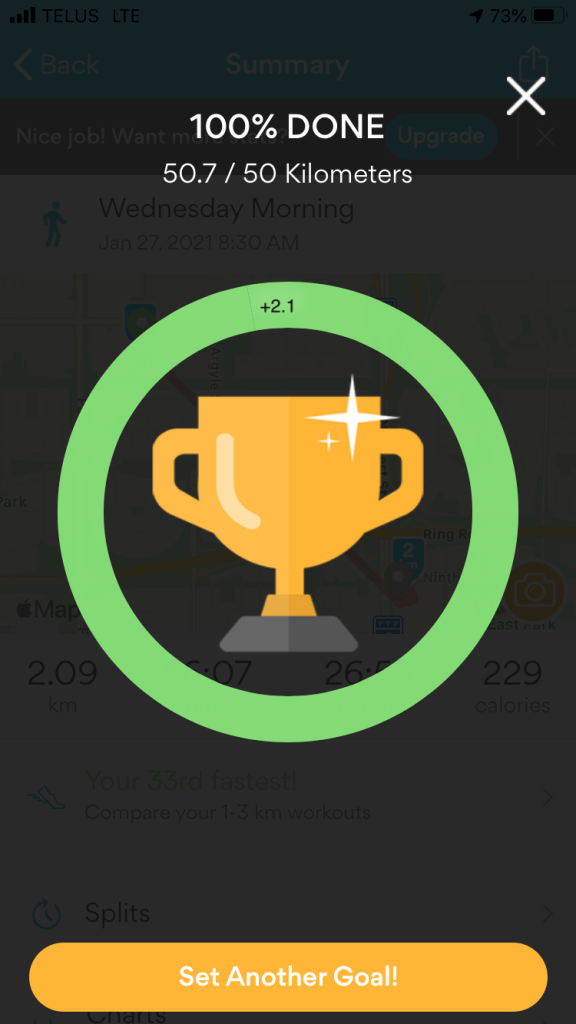
The lack of energy and motivation is what usually hit me hardest. I like to think that things are much better for me these days, and I use my motivation in ways that continue to grow my fitness and increase my control over Diabetes. And sometimes I like to try new things. You may have heard me mention that, once in a while. During the first week of January, I joined a fitness challenge through my RunKeeper app that involved logging 50 kilometres of distance within the calendar month. One would think that this shouldn’t BE an issue, since I usually log more than that in one cycling session. But it’s kind of difficult to cycle on snow, and walking roughly involves three times as much time as cycling.

I started by taking time to walk a few kilometres during the daylight hours. This was made all the more difficult by the fact that Nathan was remote schooling when I started this, and he couldn’t understand why I wouldn’t let him join. When he started going back to school in person, I would see him off on the bus then take my walk immediately after that. It would be a touch on the colder side, since the sun wouldn’t be up at this point. But I would usually manage to get three or four kilometres logged within an hour of walking, which was a good pace and started growing my monthly total to bring me closer to the 50 kilometres I needed.

Sometimes, it was actually nice to get out of the house and have a walk. On clear, sunny days I could listen to music or simply be alone with my thoughts while getting fresh air and some mild modicum of exercise. I started to see some of the advantage behind walking every day. On other days, it felt tedious and very much like an obligation. This is where I started to run into trouble, towards the end. With only 8 kilometres left to log, I lost motivation and started avoiding walks. It’s not like I was even actively trying to avoid it, I simply didn’t;t have the energy. Inclement weather and the recent snow storm with power outages certainly didn’t help.

Ultimately, I reached the minimum I needed. I believe I even went beyond the 50 kilometres I originally set out to log. Completing this 50 kilometres also enters my name in a draw for a potential prize of cross training sneakers that I would never afford on my own (or wouldn’t PAY for, normally) so there was some outside motivation involved, as well. But the experience was good and my wife and I have discussed making walks a family thing, now that the fitness challenge is done. This simply goes to show that you can start working on your fitness with something as easy as taking a walk. The motivation be sometimes need to be found first. But all it takes is getting off the couch and doing it. ☯

If You’re Going To Be Salty, May As Well Soak While You Do…

There are a number of things that I do to promote healing and recovery after workouts, including proper diet, proper sleep (when life and my body allow it), heat and/or cold as required, meditation and stretching. But one of the more relaxing things I enjoy doing is taking a hot bath with Epsom salts. Even if you’ve never used Epsom salts, you’ve no doubt walked past them numerous times at your local retailer’s or pharmacy. They come in either a sealed plastic bag or a pourable plastic tub.

If you’ve never used it, you may be asking what the hell Epsom salt is? Well, in simplest terms, it’s a white crystalline powder that composed primarily of magnesium and sulphate, hence the “salt” aspect. Apparently, the term “Epsom” is the place where it’s mined. But the idea is to pour a couple of cups of this stuff into a hot bath and it will dilute and break down into the individual magnesium and sulphate, which can then be absorbed into the body during your soak to reap the benefits of these two mineral salts for a variety of reasons.

Every article I’ve read and every source I’ve looked into claims that there’s no definitive evidence that there’s a benefit to soaking in an Epsom salt bath, but many people swear by it. I should know; I’m one of them. With our upstairs shower not functioning properly at the moment, the whole family is limited to baths. And I do find a soak with some Epsom salts to help with a faster recovery and better relaxation. You can get the salts as is, or you can get them scented with a variety of different things like lavender, mint and many more.

As with everything in life, there’s some good and some bad to using Epsom salts. Considering the profound lack of clear scientific evidence that proves it, most people would be inclined to believe there’s no point in using it and one would be just as well to simply soak in a hot bath. But it simply wouldn’t be me, if I didn’t present both pros and cons. So here are some of the benefits of using Epsom salts in your bath.

Soaking in a bath with it is supposed to help reduce inflammation, soreness and aches from working out as well as help with skin health. It’s also good for foot health, with many people using it to treat ingrown toenails. No need to tell you that this is an important concern for people with Diabetes. But overall, it can be used to relieve soreness and stiffness of varying types, as well as being used as a mild laxative if taken orally. Magnesium is also said to help produce melatonin, which can help you get a better night’s rest. Last but not least, it can help to reduce stress. Granted, a saltless bath can do that as well.

The down side is obviously the lack of definitive evidence on the supposed benefits. But in all honesty, a hot bath will help ease sore muscles and reduce stress anyway. And there’s very little downside or danger to using Epsom salts in every bath you take. That being said, if you take Epsom salts orally for whatever reason, there’s a plethora of different ways you can harm yourself with them. Just be sure to check with your medical professional if you’re going to attempt it. But taking a bath with it is safe enough. Most packages will have clear instructions on how much to add and such.

I genuinely enjoy baths with Epsom salts. It’s a great way to relax and unwind when the stressors of life are getting you down. And it can definitely help speed up recovery. But it’s one of those things that you basically have to try out for yourself in order to make an informed decision. All in, Epsom salts are pretty cheap. In fact, they’re less expensive than bubble bath and to be honest, there are more benefits. Give it a try, next time you need to relax. ☯

Read This Post While You Recover

One’s health and fitness depends on a number of different factors. Age, weight, body type, current level of fitness, medical conditions and how big of a wuss you are, all contribute to how much you can push yourself and how often you can work out. Okay, maybe that last one is a bit of a subjective opinion. But what you do and how often you do it will depend on these things and more. And at some point, no matter your level of fitness, you’ll need some time to recover.

Let’s start by examining the simple concept being effective fitness. When you work out, you tax and exert your muscles causing damage to them. Then, provided you consume an adequate diet of foods, your body will repair the muscle tissue, making it bigger and stronger than what it previously was in order to accommodate the exertion you previously put it through. This is what pop culture refers to as getting “gains.” It’s also how you’re able to push longer with more weight when you do strength training.

Although cardio is meant to provide something slightly different than strength training, most of the same factors are present. Otherwise, how can you grow, progress and run for longer distances (or walk, cycle and/or elliptical). But have you ever tried using a broken tool? You may still accomplish your goal, but it will likely be more difficult. And the end result may not be exactly what you were trying to achieve. This is why repairing a broken tool before reusing it (No, you’re a broken tool! I know you said it…) is important. Ans it’s also where getting proper rest and allowing your body to recover comes in.

An exact answer is a little difficult to gauge. After all, if you rarely work out then foolishly participate in a Marine Corps workout with your fitness-obsessed, psycho friend (wink, wink!) you’ll likely need recover immediately the next day and possibly even the day of. If you consistently work out and have a good fitness base, you may be fine with taking a day to recover every few days, or once to twice a week. But even your level of fitness is only one of the factors to be considered in terms of recovery.

Honestly, I’ve found so much contradictory information when I researched this post that I’m not even certain what sources to quote. Some have the opinion that you should take 24 to 48 hours to properly heal and recover after a workout. Other sites boast as much as 72 hours to recover for specific muscles groups, before performing a workout with them again. It’s a balance that depends on the intensity of the workout you do coupled with the bodily factors I mentioned earlier.

According to an article I found on BodyBuilding.com, a person should immediately recuperate for 2 to 4 hours following a workout, but as long as 72 hours afterwards. The article also explains that some of the issue lies in the fact that most people train to much and too often, as opposed to too hard. This ties in with my recent post about getting too much of a good thing. It’s important to listen to your body and recognize when you’re doing too much.

An article by MensHealth.com claims that muscle damage isn’t necessary for proper gains so long as you hit the gym regularly. They indicate that long recovery periods aren’t necessary for proper fitness, provided a bunch of factors are in place. But they don’t necessarily cover off recommended periods of recovery. It can be pretty difficult to know how long you should be resting after an intense workout.

One of the important things to remember is that recovery doesn’t mean being off your feet and doing nothing afterwards, either. You need to keep yourself moving in order to avoid seizing up. This might mean taking a light walk the day after, or doing some light stretches combined with soaking in an epsom salt bath. This will help ease and relax muscles as well as loosen stiff joints.

At the end of the day, be sure to listen to your body. Starting back before you’ve recovered will cause injury as opposed to normal muscle soreness associated with working out. If you wake up barely able to move, it stands to reason that you should probably take it easy and save the 10k run for a different day. But if you’ve rested for a day and you feel good and only slightly sore, you may be ready to kick back into gear. It will be entirely dependent on you. Last but not least, don’t forget that if you have Diabetes and injure yourself, healing and recovery will likely take longer.☯