When The Way Is Right…☸️

I don’t deny that one could say I became a Buddhist almost by accident. I hadn’t even HEARD of Buddhism when I started martial arts in the late 80’s, yet here I am. Decades later, constant study and trying to follow the right path. A good portion of my story is a prime example of cause and effect. As I progressed in the martial arts, I was introduced to concepts such as Budo, Bushido’s code and my first introductions to Buddhism.

Despite the accidental introductions (or not so accidental, if one believes that all things happen for a reason) there have been a number of measurable benefits to my years of Buddhist study and martial arts. I originally got into martial arts for the purposes of improving my health, and it has turned out to provide more benefit than that scrawny kid ever could have imagined when he set out on the journey…

There’s no denying that the martial arts has provided me with a number of significant advantages.  The physical requirements and exercise has helped to improve my insulin sensitivity and fight off insulin resistance.  The intense training has provided me with better blood circulation, which as most of you likely know, is VERY important to someone with Diabetes.  Measurable improvements in body mass and appetite followed, allowing me to survive well past the window of expectation that most of my doctors had for me in the late 80’s, early 90’s.

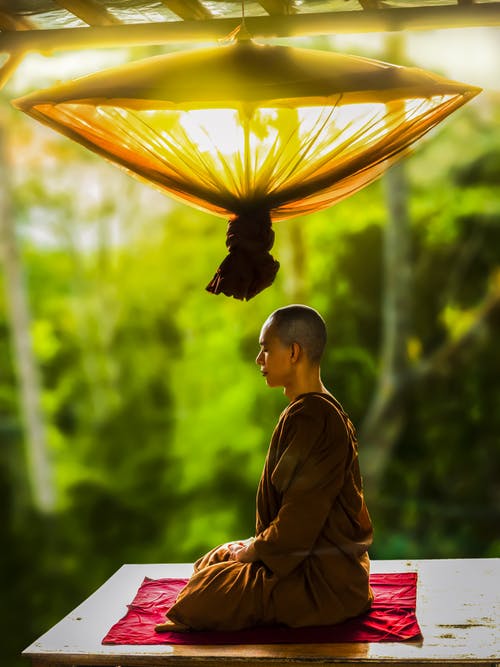
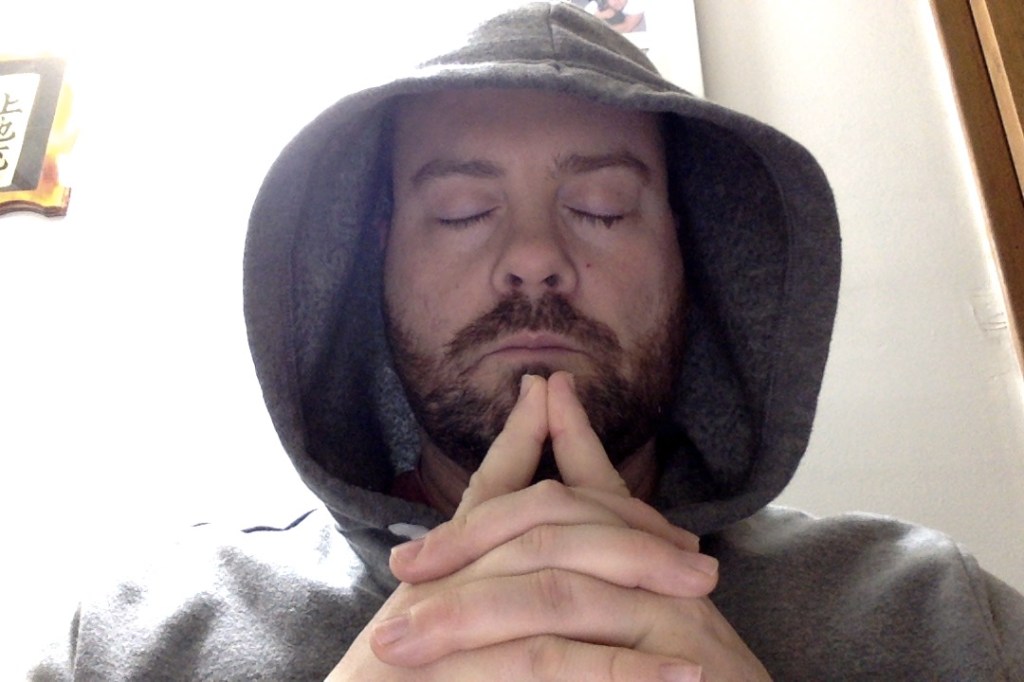
  When I started studying Buddhism, some of the most important aspects that I began to work on were mindfulness, meditation and control of my inner thoughts and emotions.  This is not to say that I don’t display emotions (my wife can attest to that), but my practice has allowed me to control how I externalize my reactions and emotions.  Over the years, this has allowed me to deal with problems and face issues in my personal and professional life in an almost detached manner that allows for logic to step in and for the emotion to come out at a later time.

Something I need to point out is that most people automatically associate Buddhism with meditation, but the truth is that you can reap the benefits of meditation on its own.  Not only from a Diabetes standpoint but for people in general, meditation can do a world of good.  This is becoming a well-known fact, and plenty of people are getting on board.  Meditation is offered/taught in some places of work, schools and a variety of classes where different varieties of meditation are taught.

And yes, there are different types of meditation.  Some of the most popular ones are transcendental meditation, focused meditation, mantra meditation and relaxation meditation are but a few, and it all depends on what you’re trying to accomplish with the meditation that you do.  Just like there are a variety of types of yoga and types of martial arts. 

But some of the benefits of meditation can include lowering one’s blood pressure, controlling pain within the body, improving one’s sleep, helps one to focus and increase self-awareness and helps with stress and anxiety.  All of these things can be helpful with the control of blood sugars and overall Diabetic health.  You can find introductory classes on guided meditation in most major cities, and there are plenty of books on the subject as well.  Be sure to keep an open mind, and if it doesn’t feel right to you, don’t be afraid to  seek out different classes as every instructor or teacher may have a different method of imparting the knowledge.

I may have fallen into some of what I do by accident or coincidence, but I’ll never look back.  One of the beautiful aspects of meditation is that you can basically do it anywhere.  All you need is a comfortable place to sit/lie down, whatever your preference may be.  ☯

Even If All Things Happen For A Reason…

There is a significant balance in life that one needs to acknowledge. For the most part, do well and you’ll live well. If you do wrong, you can expect to eventually crash and burn. This is a pretty basic rule to life that most people adhere to. Hmm… I think that has something to do with that whole karma thing. I’ve long been a firm believer that all things happen for a reason. That reason may not always be clear to some, but I’ve had enough instances in my own life where I’ve been able to trace the cause and effect of those instances to know it to be true.

The important thing to remember is that even though all things may HAPPEN for a reason, it doesn’t mean that it necessarily happens on its own.

“If It’s Meant To Be, It’ll Happen…”

– Lazy, Delusional Fools

I’ve heard the above statement often, from a lot of different people. “If it’s meant to be, it’ll happen…” Mmm, no! Nope! Nada! No, it won’t. Most of the time, this is said by people who are afraid or unwilling to go out and make things happen for themselves. And that’s exactly what NEEDS to be done. You gotta go out and make things happen.

This is an important life lesson, and one that many people in today’s altered society don’t seem to comprehend. There seems to be an almost undeniable belief in today’s society that good things can and will happen for you if you simply sit back and wait Coupled with this is an aggravating sense of entitlement that the most recent generations seem to have developed, where they feel that they should have something coming to them despite barely ever having lifted a finger.

Life doesn’t care about your plan. Light knows, I’ve said that often enough. But life is also like a book. And every book has a start and an end. It’s the chapters in between that are up to you to fill. How full and complete those chapters may be is up to you. Although all things happen for a reason, there’s nothing stopping you from going out and making those reasons happen for yourself. In fact, life can/will be exponentially better if you do. ☯

To Chi Or Not To Chi…

Does Chi exist? What is Chi? Chi can go by a number of different names: Chi, Ki or Qi, this energy is said to be the animating force behind all living things. In karate, we learn that our energy comes from the hara, or the belly area. This would be why ritual suicide in medieval japan was done by slicing open the belly as opposed to other “conventional” means.

But… Does it exist? This is the question that has been debated, especially in the Western world, for a very long time. Depending on what culture and/or background you may be referring to, Chi is what gives you the energy to keep going. We all have Chi and each person has the same amount throughout all of our lives. The use of that energy is simply allocated to different aspects as we get older. This would be one of the reasons why my 5-year old seems as though he has an endless pool of daddy-crushing energy while I wake up most mornings wondering if my body will actually get me out of bed.

It’s not magic or wild fantasy… I’ve seen some “scientists” speak about how Chi does not exist, there’s no evidence of it and there’s no way to prove its existence. Hmm. Perhaps they’re right, but some of the concepts behind Chi are also rooted in modern science. For example, the Law of Conservation of Energy teaches us that energy never ceases to exist; it is merely transformed or transferred. The amount of energy within a contained system remains constant.

So, ask yourself an important question: What are you? Are you simply the sum of your physical body? Nothing but a mass of tissue, water and bone? If so, what about the essence that makes you, well… you? The person you are, the sentience, the awareness, your personality and the living being that has put in years of existence in this life… What happens to that after you die? Is it simply a light switch that flicks off, or do you believe that your energy will be transformed or transferred?

Thinking about some of these questions can be scary. After all, no one likes to conceive of their own death. But as my uncle always says, “We only do TWO things in life; pay taxes and die!” The joke is many people get away from paying taxes. But death comes for us all. And the question of what comes after can yield anxious results.

I am totally on board with the fact that Chi isn’t some “magic” energy that can be harnessed. When you see people claiming to be able to push over opponents from behind a wall and shatter stone with the power of their Chi and other wild things, I can understand why people would be reluctant to believe or understand Chi. But just because a few charlatans have demonstrated fraudulently aspects, doesn’t mean it doesn’t exist.

That certain “something,” the unspoken quality that makes you sentient and self-aware, can’t be denied. It makes no difference whether or not you believe in gravity; it’ll still keep you firmly rooted to the ground. The same can be said about the energy that makes you who you are. Whether you choose to believe in its existence or not, won’t change the fact that you are still here. ☯

Nothing Is Free

I think it was Ted Hughes who said, “Nothing is free. Everything has to be paid for.” In fact, I’ve been hearing some iteration of that saying all my life. My family and close influences have always told me that nothing in life is free. And in many ways, they’re quite right. All life is a balance, and usually that balance is maintained by taking from column “A” and dropping into column “B”.

This is why I’ve always been fascinated by the term “free time.” To be clear, this is the term used to define the period of time where one is not required to work, or has the time to spare to engage in leisure activities. In recents weeks, people have been finding themselves with loads of “free” time and have often found themselves at a loss as to how to fill it.

Despite the current state of things, your time is certainly not free. Whenever you surrender your time for one thing, it usually comes at the cost of another. Consider this: It’s Sunday afternoon. You’ve followed whatever routine and habits your household adheres to and perhaps you’ve enjoyed Sunday brunch or some pre-planned meal.

Now comes the decision as to what you’ll do with your afternoon. Will you do some household chores? If you’re a homeowner, that list is never complete. Perhaps you could have a workout. Maybe you need to assess your taxes, complete paperwork needed for work on Monday, play with your kids or call you mother. The chances are that whatever choice you make will take away from everything else. If you choose to assess your taxes or focus on paperwork for your job, you’ll be ignoring your kids and sitting on your rump as opposed to getting some exercise.

“Nothing Of Value Is Free. Even The Breath Of Life Is Purchased At Birth Only Through Gasping Effort And Pain.”

– Robert Heinlein, author of Stranger in a Strange Land

At the end of the day, it all comes down to proper time management. Being able to decide how to accomplish things through the course of your day in conjunction with keeping deadlines is invaluable, whether it’s for your home or your work. Believe it or not, there is no such thing as multitasking.

Don’t believe me? Think about it… No matter how many tasks you think you’re doing simultaneously, you’re only ever actively doing one thing at a time. Even when you have two things on the go, one of them is usually progressing on its own while you’re attending to the other.

My job uses a colourful term referred to as “task sequencing.” This follows on the coattails of what I mentioned above, where you aren’t so much doing two things at once but doing one thing after another respectively, based on their importance. I may be getting on a bit of a rant here, and being a bit too specific and/or technical. My only point is that even in the midst of all this “free” time, one should be mindful of how their time is put to use.

If you do find yourself with some of this so-called free time, be sure to use it constructively. After all, idle hands lead to idle minds. It may be the perfect time to get to that book you’ve been dying to read or try and learn that second language. Online learning and courses are become all the rage, especially as a semi-permanent after-effect of a self-isolated world. Either way, when one is not exercising the body, one should be exercising the mind. So be sure to fill your time constructively. Not only will it pass the time, you will be all the better for it. ☯

I Apologize For This Post…

I’m sorry. That doesn’t seem difficult to say, does it? Yet, most people are reluctant, even hesitant, to say they’re sorry and apologize, even when the situation warrants it. And why is that? As reasonable, rational people, should apologizing be so difficult? For most people, it certainly is.

I found myself thinking about this recently, when I had a small confrontation with my 5-year old son. I had woken and got my first caffeine of the morning with the intention of sitting and enjoying it before having to deal with matters of the day. My son was playing nicely on the floor with his baby brother, Alex. When I came down to the floor to check on the baby, Nathan and I got into a playful wrestling match. Once it was done, I started to stand, but he was holding firmly to my leg.

When I finally convinced him to let go, I stood and took the first step towards my morning coffee. He grabbed my leg once again, shifting my balance and forcing me to bring my foot down hard to stabilize myself. I very nearly stepped on the baby’s leg. I was not impressed. I sternly told him never to grab someone’s leg when they were walking as he could have tripped me and harmed the baby.

He took direct offence to this, and started pouting. Without getting into unnecessary details, the interaction ended with Nathan being sent to his room for talking back and being the basic little brat he occasionally enjoys being (I blame his damned cartoons!) I instructed him not to move from there until he was ready to apologize and be good.

It took well over an hour before he finally emerged from his room and presented me with a scribbled piece of construction paper. The scribbling apparently was a written apology, which he delivered verbally as well. (Doesn’t it tug your heart strings?) I freed him from his imprisonment and as an afterthought, I apologized as well…

Did I do anything wrong? Did I need to apologize? Maybe not. But I got angry with my child. I raised my voice and I doled out punishment. And I was sorry for both of those things. So I voiced as much. We exchanged a hug and he carried on with his day. I’ll admit that I felt better for apologizing.

So, if it makes one feel better, why does it seem so hard to do? According to an article posted by PsychologyToday, people who fall under the category of “non-apologists” will avoid or refuse apologizing, even in the most required of circumstances. The reasons for this may include trying to separate actions from character, feeling shame from having to apologize, fear of further conflict and assuming full responsibility for the situation.

But even if you’re not a non-apologist, saying that you’re sorry, even when you may be responsible, can be difficult for most people. For some, apologizing can be difficult because it makes them feel vulnerable or humiliated. For others, it can be a matter of self-image as apologizing for something can make a person feel inadequate or lacking in something, since apologizing can often be interpreted as assuming fault or responsibility. Even if that’s not necessarily the case.

Saying that your sorry can be the easiest thing that is so hard to do. But there’s no denying that there would likely be less suffering in the world if we could all swallow our pride and simply say “I’m sorry” when it is asked of us. Whether wrong or not, sometimes it can mean all the difference. Maybe even to yourself. ☯

Good Vs. Evil

Are you a good person? I’ve asked this before in a previous post, where if you were to ask the average person on the street whether they believed they were good or not, the safe odds are usually that they believe that they are. As I’ve said before, most people don’t go through life trying to be inherently bad.

But what about evil? The word is thrown around a lot, usually by people who have had some wrong inflicted on them by someone else, but can a person genuinely and truly be evil? The Oxford Dictionary defines evil as “profoundly immoral and wicked”, with other sources citing the term “evil” with colourful adjectives such as “wicked”, “disastrous”, “harmful” and “injurious”. My favourite is the term “imputed bad conduct”. The point is that all of it is meant to refer to people.

First and foremost, I wouldn’t be the researcher and eternal student of life that I am if I didn’t take a moment to try and put a defined explanation on evil from someone else’s perspective than my own. According to an article posted by the Stanford Encyclopedia of Philosophy, “Evil in the broad sense has been divided into two categories: natural evil and moral evil. Natural evils are bad states of affairs which do not result from the intentions or negligence of moral agents. Hurricanes and toothaches are examples of natural evils. By contrast, moral evils do result from the intentions or negligence of moral agents. Murder and lying are examples of moral evils.”

I like this explanation, because it shows that bad things can often happen without the necessarily bad intentions of people, or of people BEING bad. The article was actually quite an interesting read and goes into deeper detail. Here it is, if you want to give it a read: https://plato.stanford.edu/entries/concept-evil/

If you were to search your thoughts for a moment, I’m sure that we could all conjure up the name of a person or persons that we consider to be evil. Dictators, murderers, terrorists, that lady who lets her poodle crap on my lawn every morning… Plenty of examples would fit the bill. But is it possible that BEING evil isn’t actually a thing?

I’ve spent most of my life studying and believing that the universe as a whole contains a balance. Newton’s Third Law is a good example of this, “For every action there is an equal and opposite reaction.” Although this is primarily meant to refer to motion and physics, I believe it very much applies to every thing in general. Because Newton’s Third Law sounds suspiciously a lot like some aspects of karma.

The universe always tries to find a balance; light and dark, hot and cold, black and white, matter and anti-matter… Depending on your school of thought, there are plenty of other examples you can find. But I provide these examples because for the most part, one is an absence of the other. For example, darkness isn’t a thing. It’s simply the absence of light. Cold isn’t a thing, it’s simply the absence of heat and so on and so forth.

So with that line of thinking in mind, is it possible that evil is not a thing but simply the absence of good? This would have some pretty deep implications as the concept applies to people, as it would mean that a person simply lacks the goodness necessary to fit the standard as opposed to necessarily being evil themselves.

I don’t think that this moral definition will ever be changed, as it is the nature of people to consider anyone who does something intentionally bad to be categorized as evil. But sometimes we need to consider the perspective. I can almost promise you that for the most part, both sides of a violent conflict likely believes themselves to be right and the other side is evil. As Winston Churchill said, “History is written by the victors.”

Is Free Will An Illusion?

Once and a while, I start to dwell on things and ask questions of myself as they apply to life. One of these questions is the title of today’s post: Is free will an illusion? I think that most people would agree that for the most part, people in the western world live as free people with all the choices and entitlements associated with our lifestyles.

But how much of it is real? And how much of it is simply a comforting dream that we allow ourselves to have in order to cope with the prison of our own reality? Not to sound totally morose, but sometimes one needs to question things. This appears to be the mood I’m in today.

As usual, I’ll start by defining what it is I’m referring to. Free will is defined as “the power of acting without the constraint of necessity or fate; the ability to act at one’s own discretion.” This is according to the Oxford Dictionary, which also provide the action of doing something voluntarily.

So, how much of our free will is real and how much is the illusion. I like thinking that I walk through life doing whatever the hell I want, but I may be incorrect in some respects. Allow me to explain…

For the most part, we get to decide and choose what we will do with our lives. As long as we work hard and study (or so we’re told) we can choose an avenue of post-secondary study and embark on a career that will make us happy and fulfilled. If one is lucky enough to become successful in that endeavour, then we usually slip into the expected and often wanted aspects of societal norm; a home, a spouse, children and vacations…

But what if you happen to lack the financial means to make that post-secondary study happen? You can be as good at schooling as you want to be but if you can’t afford college or university, some of your chosen professions will be off limits to you. Or the other side of the equation would be if you don’t have the best grades in school, some post-secondary opportunities will be off limits, regardless of your financial means.

But is this truly free will? I use schooling as an example, but there are many others. For example, if you decided you wanted to drop everything and spend your life travelling the world as a nomad, could you? Or would there be societal, governmental and familial obligations that would prevent you and potentially ruin you if you tried?

Let’s say that you get everything you wanted: complete your chosen studies, obtain the job of your dreams and everything falls into place. Is everything one in your life now dictated by your free will or is some of it still imposed by outside factors? Things such as work schedules and paying taxes are required of people and are usually outside the purview of our free will.

The importance behind free will isn’t so much in getting to do what you want, so much as it relates to the ability to make a choice. Choice is the true aspect of free will that every person has. In truth, even doing nothing is still making a choice. And even in the face of constraints or restrictions, making a choice will always be the true free will. Food for thought… ☯

Shake It Off 🤝

There are hundreds, if not thousands of different cultures and religious beliefs around the world. Each and every one of these have their own set of traditions and habits that they follow, based on their scriptures and/or cultural and societal habits. But in a lot of cases, some of these traditions can conflict with those of other cultures and religions.

Although this should be fine, and everyone should simply adopt a modus operandi of live and let live, it continues to surprise and fascinate me how some people appear offended or even insulted, when someone does something different than what they do. Although this would make sense if you did something heinous like blowing your nose with a holy scripture or something, I’m talking about the little things…

Flashback to an incident that happened last year when I visited my parents in New Brunswick. My mother happens to be French Catholic and as such, I have the habit of attending a church service with her whenever I visit. I am appreciative of all people’s faith, so it’s always a pleasure to be able to share in the experience with my mother.

One of the Catholic church’s traditions during a typical service is to turn and wish peace and well-being upon your neighbours in a practice referred to as “Passing the Peace.” This is usually done by shaking peoples’ hands while saying “Peace be with you.” From my understanding, it’s a practice that’s observed by a number of Christian sects and churches.

This is an interesting topic, considering the advent of social distancing and most people trying to avoid physical contact with others. For the most part, and considering the nature of my job, I don’t avoid shaking hands as a rule but I do tend to restrict physical contact with total strangers to an extent. My mother is very much the same, and has long discontinued the practice of shaking hands and simply says “Peace be with you” and moving on.

For most people, there’s nothing wrong with this. But some people always seem to see the negative in a situation. During this particular service, my mother and I were seated behind some people who took some… liberties with their time within the church. The woman took her shoes off and appeared to be picking at her feet throughout most of the service.

I’m not here to judge. I wasn’t THERE to judge. Especially in a church whose holy Bible reads, “Judge not lest ye be judged.” But perhaps shaking your hands after you’ve been picking the light knows what from the crevices in your feet is NOT in my best interest. So when the time came for Passing the Peace, I respectfully bowed to the woman while saying “Peace be with you.” The look of utter shock and judgement on that woman’s face caught me completely by surprise.

Now to my mother’s credit, she makes a point of telling people that she doesn’t shake hands. Pretty clear cut. But in my case, I don’t know if it was my refusal to stick out my hand, the woman’s embarrassment because she HAD stuck out her hand or the bow, but I had somehow rubbed her the wrong way. To the point where she felt it necessary to approach me after the service to say that it was customary to follow the church’s customs when visiting.

Here’s the joke: I grew up in the Catholic church. Up until my teens, when I started making my own way, I followed my mother to church every week. So I knew her point of view was skewed and incorrect. Could I have corrected her? Sure. Could I have explained my religious views? Probably. Was it easier to leave her in her ignorance and walk away? It was, and you bet your keister I did!

Unless your traditions and beliefs bring harm to yourself and other people, we should all be able to share a respect for each other’s faith. They may all be different, but they should all be meant to evoke acceptance and understanding. Otherwise, what is faith for? The appropriate response from this woman would have been to ask questions and perhaps learn about our respective differences in faith. Given the way the world has evolved, haven’t we reached a point where said acceptance and understanding rule the day? Food for thought… ☯

Pebble In The Pond

“Just As Ripples Spread Out When A Single Pebble Is Dropped In The Water, The Actions Of Individuals Can Have Far Reaching Effects.”

– Dalai Lama

One of the most important aspects of our existence is karma. Lots of folks refer to karma, usually in an angry context. “Karma will bite you in the ass” or “Karma will get you” are popular ones. People rarely concern themselves with their own karma or how to influence their own lives through their own actions. And I think it says something about modern society when we’re more concerned about someone else’s negative actions rather than our own.

Karma is the totality of everything you do in life, and the resulting energy that ultimately decides the outcome of your life and potentially future lives (if you subscribe to such beliefs). In layman’s terms, what goes around, comes around. So if you do bad, you get bad. If you do good, you may get good. Clear enough?

Another way to look at it is causality. Cause and effect. This is a phenomenon that describes that an action or event will result in the production of a new action or event, usually believed to have been at least partly caused by the original action or event. This means that every action has a result. So if you do something wrong or bad within the scope of your own existence, you’ll likely cause a negative result.

I find that a lot of people tend to do things on a whim, good or bad. And they’ll move on with their lives and forget about the things they’ve done, regardless of the result it may have had on someone else. This is a big part of the issues I’ve been dealing with in recent years. One person’s negative actions have caused immeasurable damage and chaos within my own life. But despite the fact they may have moved on and forgotten about the problems they’ve caused, eventually karma will catch up with them and everyone at some point needs to pay the piper.

As described in a movie I once watched about Bruce Lee’s life, you drop a pebble in a pond, you get ripples… Soon, the ripples cross the whole pond. I believe that the message was that your influence can be far reaching. However, it can also mean that any action on your behalf, good or bad, will affect other people. So make sure you make them positive. You never whose life you may damage. Or improve. ☯

Social Distancing ≠ Social Dissolving

One of my biggest fears when faced with the current state of the world is the after-effects that will continue to linger within our society. For the longest time, we’ve been a society that tends to ignore the world around us. Unless we happen to be online, where most people suddenly become activists, politicians and armchair warriors who always seem to know better. But I digress…

There are many cultures around the world who have ALWAYS practiced social distancing, so the recent pandemic hasn’t create anything new. However, for the folks who haven’t done it before, social distancing may have effects that will take years to recover from. If you’re an outgoing person who enjoys being among the masses, suddenly being locked away in your home can have detrimental physical and emotional effects.

I’m sure you’ve all seen some of the memes and jokes online about social distancing; like the group of dads having beer in the street in a large circle, standing six feet apart. Social distancing has been blatantly difficult for some people to accept and maintain, despite its necessity in helping stem the current spread of COVID-19.

In fact, according to an online article posted by USA Today, large-scale social distancing is required in order to prevent the virus from running rampant and overwhelming the healthcare systems in respective countries, leading to large numbers of fatalities in the coming year. The article goes on to explain that we are nowhere near to ending social distancing and that we NEED to maintain it, in order to stem the propagation and bring an end to the pandemic. (https://www.usatoday.com/story/opinion/2020/03/26/coronavirus-pandemic-growing-too-fast-stop-social-distancing-column/5083173002/)

Despite this requirement, the need for everyone to come together has never been greater. Isolation, whether with family or alone, can involve a number of problems that we may not recognize before they become serious. Depression, hopelessness and the use of drugs and alcohol can become very real aspects to cope with the current state of self-isolation. It’s important to remember that there are a lot of ways, especially in today’s modern world of technology, to stay in touch and communicate with people, thereby maintaining social contact and preventing the dissolving of society.

This is one of the rare occasions where social media can be an asset. Although still a nasty source of false news, misinformation and a destructive means of sharing private information, social media’s ability to help people stay in contact despite long distances can’t be denied. I know that a number of my family members make use of Facebook and other means of online communication in order to stay in touch with friends and loved ones.

A handy tool that many people seem to forget about these days, is the telephone. What with texting and social media, most folks seem to forget that the plastic brick in their hands is actually intended as a means of verbal communication that was invented over 140 years ago!!! Despite the fact tat we live on opposite ends of the country, my mother and I speak by phone every few days, even if only to stay in touch (cue the mama’s boy jokes, here).

My point is that we need to ensure that we don’t begin to accept social distancing as the norm and begin to shy away from in-person contact with each other. It may be necessary in the here and now, but when the smoke clears and the pandemic is over, we will need to rebuild social bridges and allow ourselves the benefit of each other’s company. The worst thing that could come out of all this, is to survive it all just to become xenophobic against society for fear of what else may happen. After all, there will be a lot of work to do once every steps back out into the sunlight; and we’ll need each other more than we probably understand. ☯