The home of Buddhism, Martial Arts, Diabetes and health…
Author: Shawn
I am a practitioner of the martial arts and student of the Buddhist faith. I have been a Type 1 Diabetic since I was 4 years old and have been fighting the uphill battle it includes ever since. I enjoy fitness and health and looking for new ways to improve both, as well as examining the many questions of life. Although I have no formal medical training, I have amassed a wealth of knowledge regarding health, Diabetes, martial arts as well as Buddhism and philosophy. My goal is to share this information with the world, and perhaps provide some sarcastic humour along the way. Welcome!
You all know I enjoy writing about different fitness routines and how they came about. I especially enjoy trying these fitness routines, as it’s important to experience a healthy variety in order to keep yourself motivated. Sometimes, a good workout routine can be something completely unexpected and happen by accident. As long as you’re willing to keep an open mind, you might even find something you enjoy and would start doing regularly.
This is where Zumba comes into the picture. Zumba is a fitness program that combines dance and aerobics and was created in the late 1990’s when a Colombian fitness instructor forgot the music for the class he was teaching. He popped in some of the salsa music he had in his bag instead, and danced his way through the fitness class. It didn’t take long for the fitness craze to catch on and as of recent years, there are millions of videos, apps and classes all over the world.
I was first introduced to Zumba back on 2014. I owned an XBox 360 and had just purchased the Kinect adaptor, which is a sensor bar that allows you to play games using body movement as opposed to a controller. One of the games we got with the Kinect was called “Zumba Fitness.” Since we lived in a small town with effectively nothing to do at the time and I used to make my wife suffer through many of my workouts, she had me try the game out with her. Even if it was just a video game, it didn’t take me long to work up a sweat.
I love dance and I admire anyone who studies it for fitness or as a lifestyle. In fact, something that few people know about me is that I actually took professional dance lessons when I lived in Ottawa. Karate was definitely helpful in keeping my balance and remembering the structured routines required for some of the dances I was taught. Zumba is kind of up that alley, mixing dance with increase aerobic movements.
What I can appreciate about Zumba is its different approach to fitness and the fact that it keeps things interesting. It only took a few moments for me to be completely drenched in sweat when I tried Zumba, and I was taken aback by how challenging it was. The concept involves a set of specific core movements, but their combination and use can vary greatly with each class you participate in. You can do it in the privacy of your own home by purchasing DVD’s or enjoy the group dynamic by participating in classes. And classes have a crazy variety, as well. There are routines for all age groups, routines done in water or swimming pools, routines done WHILE performing HIIT or circuit exercises and even some programs to help with eating habits.
If you’re looking for something different to change up your routine, something that can get that heart rate up, burn calories and tone you up, Zumba may be for you. Listen to me, I sound like a damn infomercial! But in seriousness, variety is the spice of life so don’t be scared to try out different fitness routines. Hell, the creator of Zumba invented it by accident! So who knows what you might discover if you keep things varied? ☯
I remember the first week that I opened my karate school’s kid’s class as a junior instructor. Boys, was I nervous! I’m not really sure why; I was qualified, well-trained and they were kids. I was in my late 20’s and there was nobody in the class older than 13 years old. But there was something particular about teaching the first class in “my” school. It only took a couple of weeks to find a groove and begin feeling comfortable with classes. And only a couple of months AFTER that for me to realize that teaching karate is not all it’s cracked up to be…
There’s a certain prestige that comes with being able to teach something to someone else, especially in the martial arts. After all, if you’re teaching someone else it probably means that you’ve learn said skill to a sufficient level that it allows you to pass on that knowledge to someone else. I had been a been a black belt for a few years at this point, and already accustomed to leading the class whenever Sensei would request it. But this would be my first foray into being the focus of attention if/when students or parents would be displeased about something.
Now, don’t get me wrong! I can deal with complaints with the best of ’em. After all, I’ve got years of management experience in retail, food service and public sectors so dealing with customer complaints is no problem. But karate is particular, because it’s personal. It’s not a job, it’s a part of my lifestyle that I not only study but thoroughly enjoy. And I’m not well-known for my ability to put up with other people’s bullshit. Enter: the league of disgruntled parents…
By the time the kid’s class had been up and running for six months, a few of my students had graduated a yellow stripe or two. My particular system has a LOT of yellow stripes for kids prior to testing for yellow belt, which is a good way to keep them focused and motivated. One of the disadvantages of opening a school from scratch, is that everybody starts off as a white belt and there’s no established belt hierarchy in place. This can be a good thing or a bad thing. It’s good in the sense that you don’t have to worry about branching off your teaching to accommodate the different ranks. It’s bad in the sense that the first people to promote usually set off alarm bells in others.
Sensei and I had agreed from the very beginning that as a junior instructor, I would teach the class while he tested for stripes. I would assist him with belt tests, but until I developed my teaching legs, he would deal with pulling out the students who were progressing and issue the stripes as required. That was an easy agreement. But as a few of the students climbed in rank, the ones who didn’t began to question why they didn’t. This concern was obviously passed on to their parents who apparently felt this meant their kids were being ignored. Can you guess what happened next?
I began receiving phone calls and having parents confront me in the dojo, questioning my audacity in promoting other students but not their kid, especially when everyone had started at the same level. These were some of the same parents that would often bring food or drinks into my dojo, take phone calls or carry on conversations at the back while I’d be trying to teach. I believe in picking one’s battles, but these are issues I had to discuss with them on previous occasions.
I tried explaining to these parents that every child is different and that every child learns in a different way and at a different pace (a lesson the public schools should no doubt adopt) and that stripes would NOT be issued if a particular student had not reach the required skill and knowledge level associated with it. This was like throwing gasoline on a campfire and caused further indignation from parents. Although we were still a few years before the true advent of the snowflake and parents who believe their kids can do no wrong, these parents were clearly adamant that the promoted students were no better skilled than their kids and that it wasn’t fair of me to promote some and not others.
I closed out the argument by explaining to the parents that karate was not a generic skill and that there were things the students could do on their own time in order to improve and help ensure promotion when the time came, but that it wasn’t fair to the students or my school, in fact, for me to issue a promotion someone hadn’t earned. This led to all sorts of threats about pulling their students out and enrolling them elsewhere, to contacting the parents of students who had promoted and a score of other idle threats to ludicrous to repeat.
Between these issues, which unbelievably never really went away, and the fact that I moved to Ottawa about six months later led me to close the doors of my kid’s school. That’s one of the benefits of not doing it for a living; you can close your doors without destructive repercussions. It was unfortunate for the kids more than anyone else, but it was also a sad mix of behaviour on the parents’ behalf, who should have been supporting the growth instead of trying to influence it. Some of the kids transitioned into the regular class and continued to train, so it wasn’t a total loss.
Folks, karate is not a cookie-cutter art. What this means is that if ten people started karate at the white belt rank today, you will see ten different people at ten different skill levels and likely ten different ranks. This is because each and every person is different and every person learns and absorbs information in a different way. if you’re studying the martial arts, it’s important to remember that even if someone progresses to a higher rank than you, it doesn’t mean they’re “better” than you, it simply means that you need to grow in your way. Every person’s martial arts journey is their own. ☯
I had a recent appointment where I shared a laugh with the person receiving me at the fact I was carrying a backpack to said appointment. The irony is that the location wasn’t all that far from my home and the appointment would likely only take about an hour but as a responsible person who has Diabetes, it’s up to me to have everything I need in order to ensure I don’t run into issues.
For the most part, unless I know that the outing/errand I’m running will literally only take five minutes (for example, going to my 7-11 convenience store on the corner) I bring a bag with me. This bag contains AT LEAST the following: nasal spray, hand gel, blood sugar meter, cereal bars and jelly beans, a book, my iPhone’s earbuds and business cards for my blog. Yes, I have business cards for my blog. It’s much easier than trying to give someone the website address…
If I travel to any great distance, for example flying back to New Brunswick, my carry-on bag will contain all the above-noted items as well as reusable insulin pens that simply require me to step into a pharmacy and purchase insulin over-the-counter should my pump fail or I run out of pump supplies. I started taking that last precaution after an issue I ran into last September when I returned home for some job interviews.
Usually, I’ll calculate my equipment needs for all my absent days, plus three. This means that I should have enough supplies to last me three days longer than my intended trip. That way, should there be flight delays, equipment issues or problems along the way, I’m all set. But last September, I flew to Fredericton, New Brunswick for a full week on a job competition. This meant I would need at least three pump change-ups with a fourth set to accommodate any failure or delays, and about 600 to 800 units of insulin for those seven days. Sounds reasonable, right?
During the second or third day that I was in Fredericton, I received an email from one of the other agencies in New Brunswick I had applied with and they required that I attend in person for an interview the following Tuesday. This meant that my seven-day trip would be extended to twelve days or more to accommodate the interview. I discussed what I should do with my wife and it was agreed that I should stay. All of a sudden, I scrambled to change my flights and cancel my hotels as I would simply stay with my family for the added days in between.
I still had plenty of Humalog (short-acting insulin), so I went to a local pharmacy and purchased disposable syringes as well as a bottle of Lantus (long-acting insulin) in anticipation of my pump running out and no longer having access to an automated basal rate. In the end , I was able to stretch out my pump sets to accommodate the additional time and I made it home to Saskatchewan under the wire. But it makes me wonder: what if I were isolated someplace where I didn’t have the option of buying added supplies?
In my late teens and early 20’s, I went on a number of nature treks where a friend and I would canoe or kayak down the Restigouche River. We’d get a ride west to where we would “ship off” and time on the river would usually see us locked away from civilization for at least three days. I was pretty cheeky in my late teens, early 20’s and not always cognizant of the danger I may have been putting myself in. I always brought plenty of insulin and test supplies, but I’d be lying if I said I had plenty of fast-acting carbs to shore me up if I dropped. I had SOME, but probably not enough for a multi-day excursion that required me to paddle a canoe for hours on end.
So this begs the question: how does one deal with a situation where one has run out of supplies with no ability to obtain replacements? What if my insulin spoiled in the summer heat while I was out on the river? What if I dropped my pen and smashed the only remaining vial I had? These are possibilities that I would have to deal with. I’ve always been pretty careful have luckily never had to deal with such situations, but being two days or more away from civilization would throw a serious damper on the trip.
I wrote a post last April entitled Don’t Fear The Reaper, Kick His Ass Instead, which covered off some of the issues that one could face and how long a Type-1 Diabetic could live without insulin. You can click the link to give it a read, it’s pretty bleak. The reality is the average Type-1 Diabetic has a life expectancy without insulin of about 7 to 10 days at most. Nice, eh? And that’s under some pretty particular conditions. Having an adequate supply of water to stave off dehydration is a great start, since most adults can only survive three or four days without. And bearing in mind my scenario involves being on a fresh-water river, I’d likely be okay in that regard (barring bacterial contamination from drinking river water).
I had linked an article posted on Healthline.com that explained thatwithout insulin, your body can’t use glucose as fuel and begins to break down fatty tissue as a replacement, which causes those fats to turn into acids called ketones. These ketones build up in the bloodstream and eventually get expelled through one’s urine. However, when these ketones accumulate in the bloodstream, your body chemistry begins to change and the blood starts to become acidic. This causes a condition called Diabetic Ketoacidosis.
Any of the even moderately serious side-effects of Diabetes could kill you, including dehydration or hunger, but if you manage to make your way through all of that, DKA is what would do you in. What to do if you’re in a life-or-death scenario where you don’t have access to a hospital or extra supplies? There isn’t really a happy answer. The reality is that you’ll likely expire, unless you’re some sort of super-human Diabetic who can stave off all those symptoms for a longer period of time.
Situations are much easier to deal with nowadays with the common use of cell phones. Back when I used to travel the river, cell phones weren’t a commonality yet. At least in the modern age, you could potentially call for help so long as you can find a cell phone signal. But even cell phones can fail, get dropped in the river, lack a signal, etc…
IS there a perfect solution to any of it? Unfortunately not. Diabetes makes for an imperfect life. But you can ensure that you take every precaution and make certain that you pack/bring/include everything you need with multiple extras. Having Diabetes absolutely doesn’t mean you can’t do any particular thing. You simply need to be prepared and take the precautions necessary to prevent finding yourself in a bad situation. Hope for the best, but be prepared for the worst. ☯
For the most part, I’m a firm believer that most people and things deserve a second chance, even when things didn’t work out the first time around. Unless we’re talking about someone who has done something truly horrendous that’s damaged my life, of course. But today, we aren’t talking about anything quite so dramatic. I’ve been taking a second crack at CGM, or Continuous Glucose Monitoring.
For anyone who doesn’t remember, I wrote a post about five weeks ago entitled, CGM Is A No-Go where I described the various issues I had been dealing with in regards to the sensor set-up involved with CGM. Although I had decided it would be in my best interest to step away from CGM, a quick video chat with my Medtronic Representative was all it took for me to give it another go. Plus, Medtronic replaced the box of sensors that I had burned through at no cost.
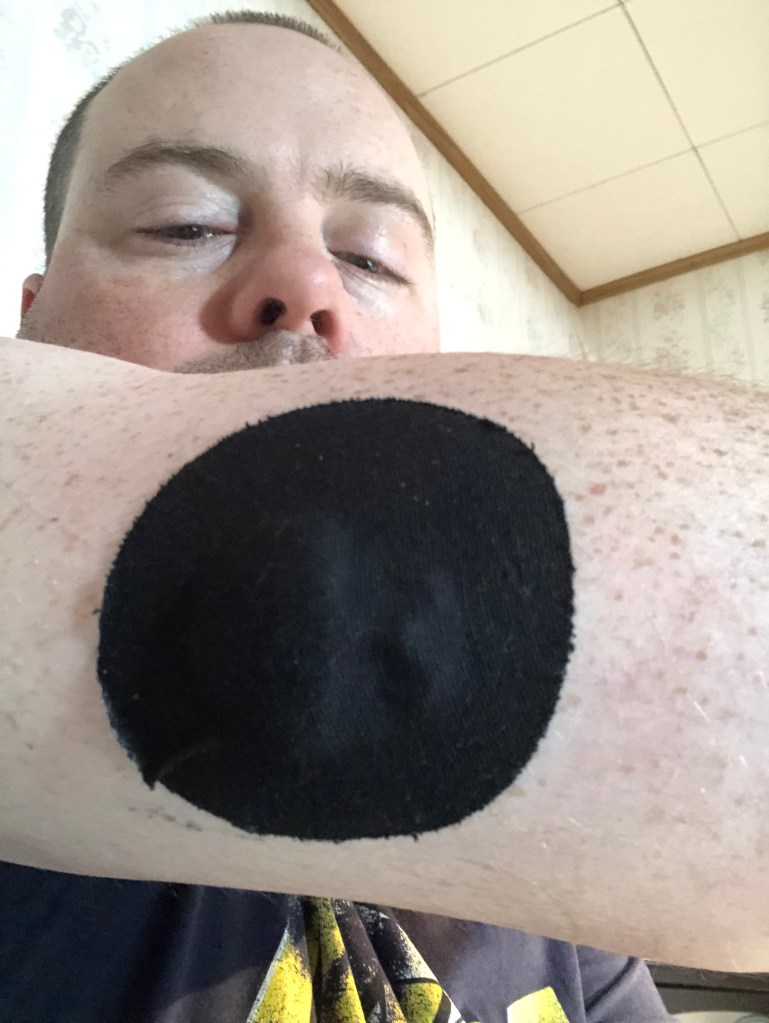
My Guardian Sensor, tucked safely underneath my adhesive patch (yes, I know I look exhausted)
When a company is good enough to go above and beyond in that way (box of 5 sensors is $399.00 in Canada), I owe it to at least TRY and make the damn thing work. So I’ve been hammering through. The photo above is the fifth sensor I’ve been on since that last post, and it’s been going reasonably well. I had one sensor give out after five days instead of seven, but that’s an error margin I can live with.
One of the main recommendations that my rep provided was that if I was used to having my Freestyle Libre on the tricep and it was working for me, I should do the same with my CGM. And to be honest, it’s been WAY better. Because of the steps required to properly install the sensor and transmitter, I can’t get it all done one-handed. So I enlist the help of my wife to get everything set up and in place.
The large, black adhesive you see covering everything is an after-market adhesive called Patchabetes that my rep recommended. I ordered mine through Amazon, but you can click the link to go right to their site to have a look at the various products they carry. I ordered a pack of 20 patches for about $25 Canadian, which means they’re costing me about $1.25/week to use. That’s definitely a cost I can live with. I shell out more money on that in caffeine every DAY!
One of the big problems I was having with the adhesives that come with the sensor is that after a rigorous workout followed by a hot shower, the adhesive would dry out and start to lift. I was shoring it up with band-aids and pretty soon I looked as though I was a badly-designed mummy out of a B-movie. On top of that, the sensor tube would usually end up slipping out of my arm and I’d have to replace it within days as opposed to after a full week. I’m fortunate enough that my medical insurance covers my sensors, but it still feels horrible to be burning through expensive supplies that quickly.
Since switching over to Patchabetes, I can work out, shower and spend all afternoon in the hot sun and it still stays firmly in place. The size of the adhesive and the fact that it’s one piece, ensures that the area is waterproof and I’ve had no issues since starting back on the whole thing. And let’s be honest: it’s kind of nice to have an updated blood sugar reading every five minutes. It’s been making the overall daily control a little bit easier.
Technology can be wonderful and can be very helpful in making the life of a Diabetic much easier. As with most things in life, there’s a steep learning curve involved, especially when it involves your overall health and well-being. So the lesson here is that sometimes you have to push through and give things a second chance, once you’ve had the opportunity to learn the proper way. Even in a fast-paced world, not everything can happen quickly. Now I just need to get over my cowardice and activate the AutoMode again… ☯
This is one of those posts where I need to reiterate at the outset that I am not a doctor or medical practitioner and have absolutely no formal medical training. What I DO have, is 38 years of combined experience, private study and use of therapy for all things related to Type-1 Diabetes. In fact, if one were so inclined, one could easily believe that enough years have been spent and enough private study has been done to equivalate the knowledge of a doctor, if not the skill. But I’m not that vain… (wink, wink). Totally kidding, let’s move on…
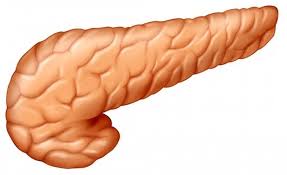
Now that the disclaimer portion of our day has been completed, let’s move on to the actual subject of today’s post: pancreas transplantation. A pancreas transplant is one of those things that everyone with Diabetes has at least wondered about, at some point in their lives. It would make sense, right? If you have a faulty heart or kidney, you can try and have THOSE transplanted, provided you’re lucky enough to find a donor that matches you and all goes well. All sorts of other organs have been transplanted, including livers, lungs and even eyes! So what’s the problem with pancreas transplantation, and why isn’t it more of a thing?
To answer that, we need to start by doing the same thing I’ve done a dozen times since starting this blog page. We need to properly define the two mainstream types of Diabetes. Although there are a number of various types and sub-types, for the purposes of this post I will limit these definitions to Type-1 and Type-2.
In simplified terms, Type-1 Diabetes occurs when your body’s own immune system seems hell-bent on destroying your body’s insulin-producing cells, namely the ones in your pancreas. Once these cells are destroyed, your pancreas effectively stops producing insulin. In a normal body, insulin is a hormone that allows glucose to enter the bloodstream. If the amount of glucose gets too low, your body reduces or limits the amount of insulin it produces and the vice versa. Still with me? Good, moving on…
Type-2 Diabetes is a bit different on the sense that one’s body is either resistant to insulin and its effects, or one’s pancreas creates little to no insulin. This used to be referred to as an “adult-onset” Diabetes, much like Type-1 used to be referred to as “Juvenile Diabetes,” but some children have been shown to be diagnosed with Type-2 in recent decades, due a number of different factors I won’t bother getting into. Despite different treatment and dietary regiments, there is no cure for either type. No matter what you’ve read.
Now that we’re all caught up, let’s discuss the reasons behind why a pancreas transplant may not be the thing for you. First and foremost, like any organ transplant, you need a donor. Unlike liver transplantation where a portion of healthy liver can be taken from a living donor, there’s no way to replicate this with the pancreas. So simply put, you need an organ from a deceased person. There are a number of difficulties behind obtaining such an organ, including but not limited to making your way up a donor list, having the donor be a match for you and trying to determine if a transplant is right for you based on your specific set of Diabetes-related symptoms and complications.
So pancreas transplantation CAN be done, it just simply isn’t the norm. It also isn’t permanent. And apparently we live in opposite world because the worse your Diabetes may be and the harsher your complications, the better odds that you’d qualify for a transplant. This is because they usually look at the fact that your Diabetes can’t be treated with traditional therapy methods. So THAT’S weird, but Type-2 is more likely to be a fit for a transplant, since its cause is mostly the lack or reduced production of insulin in the pancreas, so replacing it would typically fix that.
So let’s say that the stars align, you pass all the tests and get a donor organ and are approved to go through with the transplant. You’ll need to undergo a rigorous regimen of anti-rejection medications. A lot of things will remain the same for you, including all the medications and constant medical check-ups to ensure your proper recovery and the acceptance of your new organ. The next issue is that the very same immune system that attacked the first pancreas will begin to attack the new one. Shortly, you’d be faced with the very same issue that caused your Diabetes in the first place.
This means that part of your new medication regimen will require immunosuppressants in order to limit your immune system so that it won’t attack the new organ. Limiting one’s immune system will lead to a greater risk of infection and you may need a whack of antiviral and antibacterial drugs. Then, one needs to consider all the complications related to the surgery and the after-care involved in any surgery, the side effects of the anti-rejection medications and the drugs you’ll need to take for the rest of your life, as well as the potential for rejection after all that pain and suffering. Are we still on the transplant gravy train or are we running scared yet?
I’m making it sound pretty horrific, but the reality is that a pancreas transplant CAN work for some individuals. It simply isn’t the standard therapy to deal with it. And even if a successful transplant will eliminate the immediate need for insulin therapy, it doesn’t actually CURE Diabetes. And if the transplant fails or one rejects the organ, one can simply go back on insulin therapy. No harm, no foul. Minus major surgery, that is.
The Mayo Clinic actually has a good article that outlines the specific procedure and the complications associated with a transplant, so give it a read. There is no cure for Diabetes. As much as I’d like to add the word “yet” to the end of that statement, I believe much as most Diabetics do, that a cure won’t be forthcoming in our lifetime. But therapies have come a long way, and if I compare being on an insulin pump, using CGM and the effectiveness of my insulin compared to 1982 when I had to guess my manual injections, carb counting wasn’t a thing and I carried a glucometer that was effectively the size of a brick, I’d say we’re pretty spoiled. ☯
I’m a bit of a weird contradiction when it comes to action movies. The guy in me absolutely loves the action, the plots and the effects. But the martial artist in me usually hates how a fight is actually portrayed on shows and movies. You know how it is… The protagonist and the antagonist square off, maybe circle each other for several minutes minutes exchanging sarcastic quips about who will kick whose ass… Then they spend the last twenty minutes of the movie locked in a heated exchange of strike after strike to each other’s head and body, most of which would have crippled a normal human being after the first or second strike.
Yes, a good action movie is fun and all. But the reality is that a fight will not only NEVER last as long as they’re portrayed, but if someone spin kicks you to the head, it’s pretty unlikely that you’ll just whip your head to the side, wipe the dribble o blood off your chin and keep fighting! The safe bet is that you’ll drop like a bag of sand, unconscious or stunned beyond the ability to continue. THAT’S reality. But actual full-contact fighting will also cause injuries to the person doing the striking.
I’ve written about this before, but let’s take a good old fashion punch to the head as our example. If you strike someone to the head with your fist, you’ll injure your hand. Notice that I didn’t say “might.” You WILL injure your hand in some way, shape or form. On the milder side of it, your knuckles will get inflamed and possibly swell. At worst, you may sprain your wrist, fracture some carpals or flat out break your hand. And that’s if you’re lucky. Most people have a hard head. A fist is comparatively smaller. Maybe go for an elbow strike instead. Yes, you’ll have to get in closer but you’ll also increase your chances of preventing injury.
That’s just one example, but this concept applies to just about any attack you use on another person. Unlike the movies, getting punched to the head will put you down. But you’ll also get hurt in the process. Unless your wrists are wrapped and you’re wearing padded gloves, the chances are slim that you’ll get multiples hits in without injury. Throwing a proper strike takes technique and precision, which can only be achieved through drills and practice. This is why we do form and work out in a dojo, so that muscle memory kicks in and your strike will be effective.
True self-defence isn’t about a long, drawn out battle or fancy techniques that look like they belong on the big screen. This is one of the reasons why there are so many videos circulating about people exposing “why martial arts don’t work.” It’s not that they don’t work; it’s that people have a skewed misconception about how martial arts would actually be used in a real fight. Self-defence is about protecting yourself and others, and being the one who walks away. ☯
We are the product of our environment. Part of your environment is the job you do. It’s inevitable. My chosen career usually has me seeing the world through those lenses, and Diabetes is very much the same. I’ve had Type-1 Diabetes for so long that I have a nasty habit of throwing out Diabetes-related terms that the average person may not understand. After several years of hearing them, my family is still left reeling by some of the terminology.
With that in mind, here are some of the most commonly-used terms I tend to throw around. These were taken from a previous article I posted last november:
Basal Rate: This refers to the constant supply of some given medication that is delivered over time. For someone with Diabetes, one’s basal rate refers to the dosage of insulin, which is slowly delivered throughout the day, usually by way of an insulin pump;
Bolus: Unlike one’s basal rate, a bolus refers to a singular dosage of insulin that is delivered within a fixed period of time, either by manual injection or by way of an insulin pump. For example, before eating a meal, one would “bolus” a specific dose of insulin in response to the amount of carbohydrates in the meal;
Blood Glucose: This one should be pretty straightforward, but I’ve been surprised at how many people honestly don’t understand what is meant by blood glucose. This term simply refers to the sugar carried through the blood stream in order to supply the body with energy. Having either too much, or too little sugar in the blood stream is one of the main issues with Diabetes;
Carbohydrates: Considering all the “nutritional gurus” and fad diets on today’s market, this one comes as a surprise as far as people not understanding what carbs really are. Carbohydrates are the body’s main source of fuel, and includes sugars, starches and fibres. This is why it’s so important for someone with Diabetes to properly calculate their carb intake; because all these components (except fibre) will affect blood sugar;
Fasting: Although not unique to Diabetes, fasting is often required prior to certain blood collection or medical examinations. It basically means that one abstains from ingesting any food or drink for a prescribed period of time;
Hemoglobin A1C: Although more complicated than what I’ll explain, A1C refers to the average of one’s blood sugars over a 3-month period. This is a test frequently used to see if a person’s blood sugars are staying within acceptable range. This test has become less of a favoured method, since one’s A1C can be manipulated through extreme highs and lows. Methods of measuring a person’s “time in range”, such as continuous glucose monitoring have become more of an accurate method;
Hyperglycemia: High blood sugar. That is all;
Hypoglycemia: Low blood sugar. Bam!
Insulin: This is a hormone produced by the pancreas, which regulates the level of glucose in the blood stream. In someone with Type-1 Diabetes, this hormone is no longer produced, which causes the need for a synthetically created insulin to be injected;
Interstitial Tissue: This is the tissue that connects your outer flesh with the really bloody stuff underneath. This tissue is important for someone with Diabetes because it is where blood glucose levels are measured using a continuous glucose monitoring system;
Ketoacidosis: This is one of the more common complications of Diabetes. As I understand it, ketoacidosis happens when there isn’t enough insulin in the system to help the sugar enter the cells. Without sugar as fuel, the body begins using fat stores for energy. This causes certain acids to start spilling into the system, which can be spilled out through one’s urine. It’s very dangerous and usually requires medical attention if your blood glucose level won’t come down or your ketones are unusually high;
Subcutaneous Tissue: This refers to the layer of fat and connective tissue beneath the skin and is generally where injected insulin NEEDS to end up once injected from one’s pump or syringe.
There are probably some other terms that Diabetics use that confuse people, but these are the only ones I can think of. If you have any words or terms that you’re wondering about, drop them in my comments section and I’ll provide an explanation for those who may not know. ☯
Life certainly throws out a more-than-fair amount of challenges into one’s daily life. Even when you think you can fight your way through one obstacle, another one pops up to either take the first one’s place or make matters even worse. It certainly seems that way, over the past two years.
If anyone is keeping score, issues in my professional life have caused me difficulties and sent me home long before COVID-19 took hold. Despite this radical change of life and the reckless endangerment of my dream job by others, I kept on pushing and fighting. Then, job interview after job interview came and went. Most left me feeling pretty good and certain that I wold turn a corner. But I’ve been consistently passed up over and over.
Then at the beginning of the year, the world fell into chaos (more so than it usually is) and the pandemic struck. I’m sure that at this point, I don’t need to explain the problems and issues that having the world self-isolate and essentially lock itself down has caused. Even six months later, the world is still licking its wounds and trying to recover.
Then, we attempted to sell our home. We came to this decision as a result of my current job situation and the fact that we’re trying to eliminate debt. Despite many people who came to view our home, structural issues with our foundation caused most people to pass. We have come to the decision that we need to repair our foundation, which requires the demolishing of our finished basement. This sucks, because it also meant we had to take our house off the market as we can’t really show the house while we’re in mid-construction/renovating.
It almost feels as though everything is coming up bullshit and sometimes it certainly feels as though it would be easier to simply give up and let go. And no, I’m not being fatalistic or trying to send out red flags; I simply mean that the Buddhist side of me feels that life shouldn’t be such a struggle, that I shouldn’t have to force so hard in order for life to be good. The martial artist in me believes that I need to keep fighting and win, no matter what the struggle. If it comes down to me or them, it won’t be me! More often than not, the martial artist wins over the Buddhist. Such is life.
“Success Is Stumbling From Failure To Failure With No Loss Of Enthusiasm.”
– Winston S. Churchill
As a general rule, most people are afraid of failure. They see it as a weakness and they believe that it’s an embarrassment or shameful to fail at something. But the irony is that I can promise beyond any reasonable doubt that every living person has failed at something. It’s inevitable. You show me someone who claims they’ve never failed at something in life, I’ll show you a liar.
But failure is an important part of life. You see, life believes in showing you what you’re doing wrong. It sucks, can be painful and can even be disruptive to one’s life. But it sure shows you what path you should be taking. Failure isn’t a failure, it’s a learning tool. It helps you to grow and become the person you’re meant to be. I’ve been defeated and failed at a number of things in my life. But I keep on fighting. Because what’s the point of the lesson if you do nothing with it?
Don’t be afraid of failing at something. As long as you keep pushing, fighting and moving forward, you’ll eventually clear the storm and come out on top. And should you happen to fall and fail, the important part is to rise, dust yourself off and find a new and different path to pursue. ☯
Since a lot of people are stuck at home until the world returns to normal, many have chosen to undertake some DIY projects within the home. I, myself, have decided that the patch of bare dirt in our backyard deserved to get some love and I started working the soil. Much to my surprise, the past few summers of weeding and spraying made the soil pretty easy to till and plant some grass seed.
I managed to make myself proud as a full half of our backyard now contains a full, lush green lawn that requires mowing twice as often as the front yard. The other half contains a quarter space where we plan on planting our own vegetables and a quarter space that I had left for Nathan to dig with. I have since seeded the digging quarter as Nathan has given up his mining ambitions in favour of his razor scooter. but I digress…
Our back yard has a circle of grey bricks that had apparently been arranged to ring a tree that had been in the backyard. When we moved in, the tree was cut down at its base and nothing remained but a slim stump. So I decided to till the soil within the ring and plant some flower seeds. I felt that the back yard could use a little color. Within a few weeks, the entire ring grew some greenage that was over half my height! I was tickled pink (not literally) and like an unaware idiot, kept watering daily and trying to get everything to grow as much as possible.
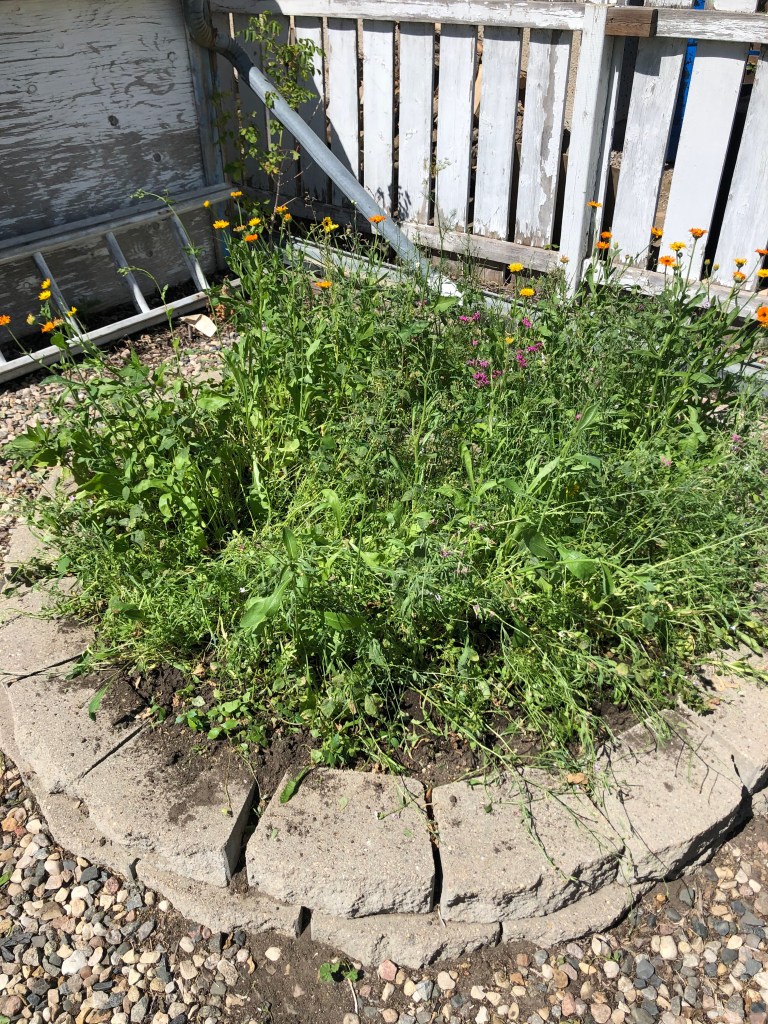
The decimated centre area, once my wife and I removed all the weeds
Turns out that the tall, green stalks I was watering and so proud of, were invasive weeds that were preventing the actual flowers from fully blooming. I have to admit that I had no clue and I thought the thick stalks were a species of flower that would bloom fully. Once we found out, my wife and I took an afternoon to remove as much of the weed as we could in an effort to let the flowers take hold.
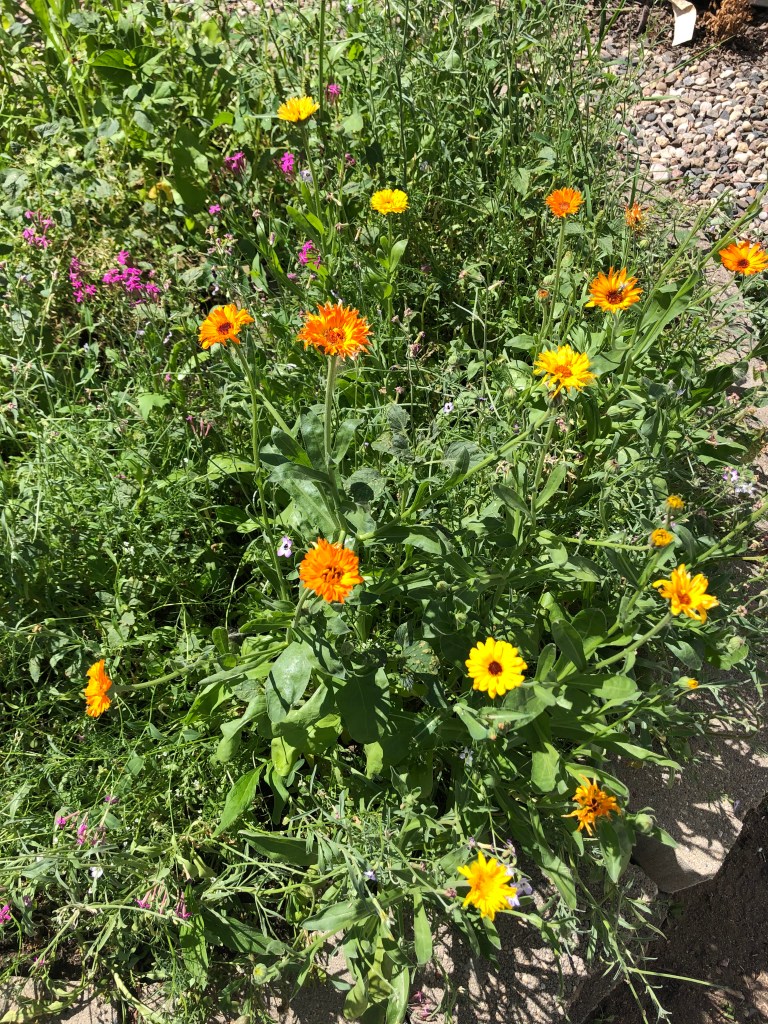
The flowers that come in when they’re permitted to bloom
Flowers are starting to take over and some are already in full bloom. But as usual, it got me to thinking about perspective. Until I was told the tall stalks were weeds, I was happily and cluelessly watering the weeds like they were worth their weight in gold. Once I knew they were weeds, I got angry and became hell-bent on removing them from my garden. But I would have been oblivious, otherwise.
And this is something that applies to life, as a general rule. Something that may be unpleasant to one person could easily be a benefit to another. Sometimes, things may seem like they don’t belong but even things that are not preferred can be important to someone else. Dandelions are considered weeds, but it sure doesn’t stop my son from loving the yellow ones and blowing the fluff off the white ones. It’s all about one’s perspective. ☯
I’m usually really good at telling the people in my inner circle, “Don’t forget this” and “Remember to do that” when it comes to their medical requirements and/or Diabetic needs. A strong attention to detail is always something I’ve prided myself on, personally and professionally. But if there’s one thing that this pandemic has taught me, is that I have the potential to slip and get a little too comfortable in my routine. I learned exactly to what depth I had slipped into that comfort zone yesterday morning…
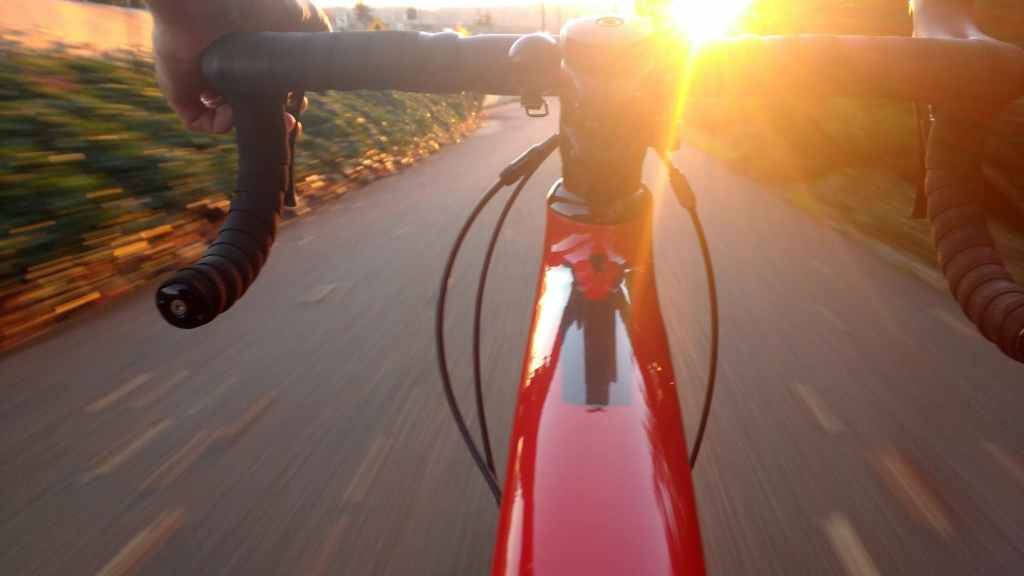
As is the case on most Monday mornings, my wife had the day off and since the pandemic has limited the number and type of excursions we can undertake, I usually use this time for a long-distance bicycle ride. Since my 70k from two weeks ago was such an unmitigated disaster, I thought that yesterday would be the perfect opportunity to make another attempt. I discussed it with my wife and she agreed that maybe it would be better to attempt an in-city 70k as opposed to the open highway.
This would at least prevent some of the issues I had faced on my last excursion. Alright, this made sense. After all, I had achieved my 70k (as far as distance goes) but my phone had died, I ran out of food and struggled with the Prairie wind so badly that I added more than an hour onto my total time. Not exactly the ideal situation. Despite the great workout, I got home feeling frustrated and disappointed that I had no documented proof to show of my achievement.
So yesterday morning was supposed to be different, and I hit the sack on Sunday night, confident that Monday would provide me with a screenshot of my Runkeeper app showing 70k or greater. I set an alarm for the early hours of the morning and let my head hit the pillow. Ironically, it turned out to be a night where Diabetes didn’t intervene in any way and I actually slept for a solid number of hours. But as I’ve often said in the past, life doesn’t care about our plan. And we usually can’t predict when a wrench will be dropped into our gears.
I awoke with the morning sun and as is often my custom (unless the baby wakes me first) I woke up before my alarm went off. The sun had been up for a while, and I went downstairs to my home office to prepare my gear. Nathan had fallen asleep on the spare bed in the office, so I made every attempt to be quiet as I prepared. The first item on my list: change up my pump’s infusion set. I went to bed with about 35 units left, and I already knew I’d have to change up my set before heading out on the bicycle.
I grab a reservoir and infusion set and realized I couldn’t find my bottle of Humalog. I searched everywhere and just couldn’t find a bottle of insulin anywhere. I still had enough insulin to last me the morning (as long as I didn’t consume carbs) and the pharmacy only opened at 9am. Well, there goes my plan to ride… I can’t remember the last time I ran out of insulin. As in, I can’t remember because it’s been YEARS! I’m usually on top of my supplies, especially since they keep me alive. I now found myself despondent and killing time until my pharmacy opened.
By the time I made my way to the pharmacy and dealt with some unnecessary and unexpected delays on their part, I was most of the way through the morning and the Prairie summer heat was already in full swing. As I’ve learned the hard way over recent weeks, this isn’t the ideal environment in which to cycle for long kilometres. I opted for some light yard work instead, mowing the back lawn and getting a bit of fresh air.
Despite my usual attention to detail, this proved to show me that I’m just as human as the rest. I’m at least grateful that I live in an area where getting a prescription the same day as I need it is pretty easy. But it has also proven that I apparently need to start paying closer attention as I crawl forward in my age, as I already seem to be letting details slip. ☯


 The Blogging Buddhist